

How to Calculate a Sales Budget That Actually Works
A RevOps lead we know spent three weeks building a sales budget in a spreadsheet, got it approved, then watched it fall apart by February because nobody accounted for two new hires ramping at half-productivity for five months. The budget looked great on paper. The pipeline didn't care. Sales budget calculation doesn't have to end this way - here's how to build one that survives contact with reality.
What Is a Sales Budget?
A sales budget determines your total expected revenue for a given period. It's not an expense plan - it focuses on money coming in, not going out. The core formula is dead simple:
Expected Units x Selling Price = Budgeted Revenue
If you sell 500 units at $200 each, your budgeted revenue is $100,000. Most teams structure this quarterly with an annual rollup, though monthly breakdowns give you better control.
Sales Budget vs. Sales Forecast
These get confused constantly. They're related but different.
| Sales Budget | Sales Forecast | |
|---|---|---|
| Purpose | Revenue target | Revenue prediction |
| Timeframe | Annual / quarterly | Monthly / weekly |
| Owner | Finance + sales leadership | Sales ops + reps |
| Update cadence | Quarterly reforecast | Weekly or biweekly |
| Relationship | Set first | Created after the budget |
The budget is where you want to be. The forecast is where you think you'll actually land. Forecasts get built after the budget and break targets into shorter, more granular periods that account for seasonality and pipeline reality.
Choose Your Budgeting Method
Three ways to build a sales budget. Each has a clear tradeoff.
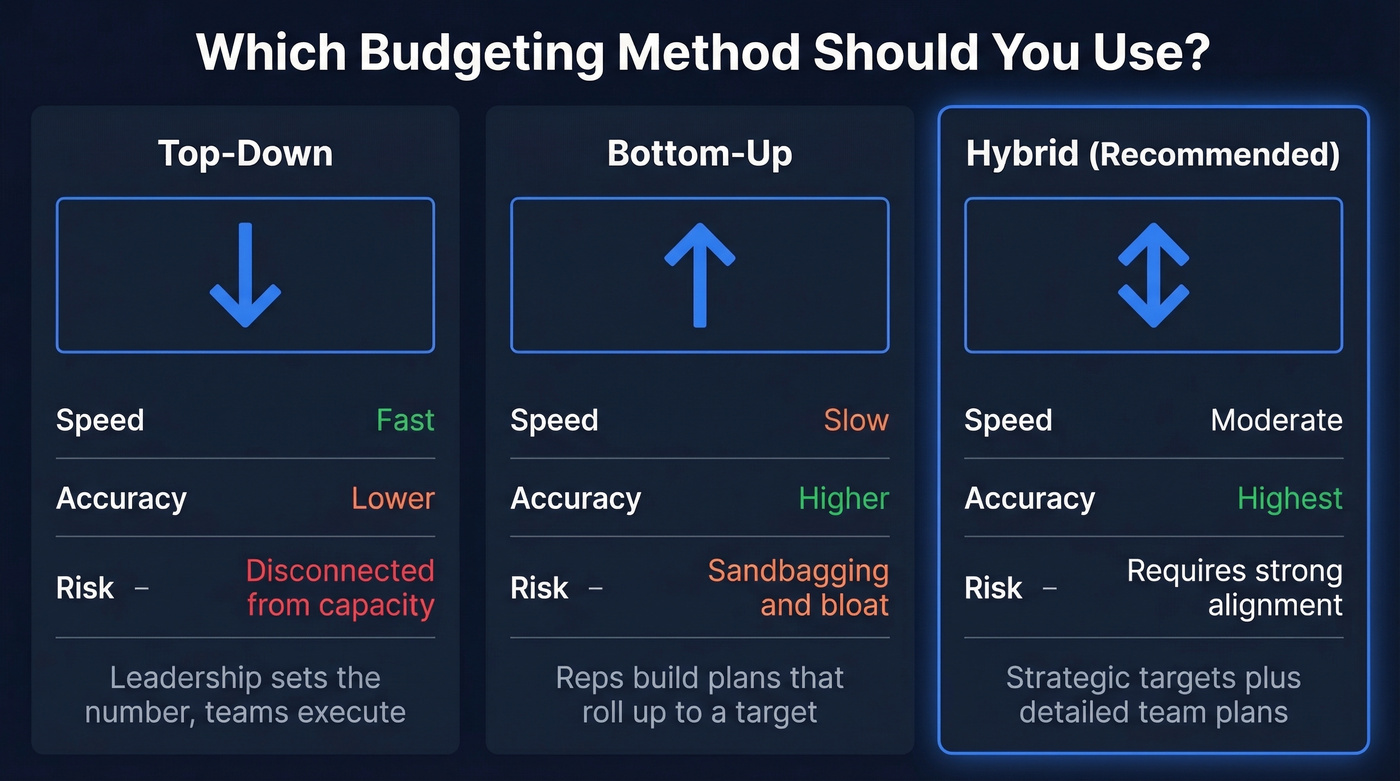
| Method | Speed | Accuracy | Risk |
|---|---|---|---|
| Top-down | Fast | Lower | Disconnection from capacity |
| Bottom-up | Slow | Higher | Sandbagging and bloat |
| Hybrid | Moderate | Highest | Requires strong alignment |
Top-down means leadership sets revenue targets that cascade to departments. It's fast and keeps everyone aligned to strategic goals, but it can miss operational reality entirely. If the board says "grow 40%" and your team can't physically generate enough pipeline, you've got a budget that breeds burnout and nothing else.
Bottom-up starts with individual reps and territories building detailed plans that roll up to a company number. It's more accurate and gets buy-in, but it's slower and teams tend to pad their estimates.
Hybrid is what most scaling companies should use. Leadership sets strategic targets - revenue goals, hiring velocity, market expansion - while teams build the detailed plans underneath. You get strategic alignment without the disconnect. We've watched too many top-down budgets implode by Q2 because nobody asked the reps whether the number was physically achievable.
How to Calculate a Sales Budget (Step-by-Step)
Set Your Revenue Target
Start with unit-based targets, not percentage growth. "Grow 30%" sounds concrete but tells you nothing about how. Define targets using a tiered framework instead:
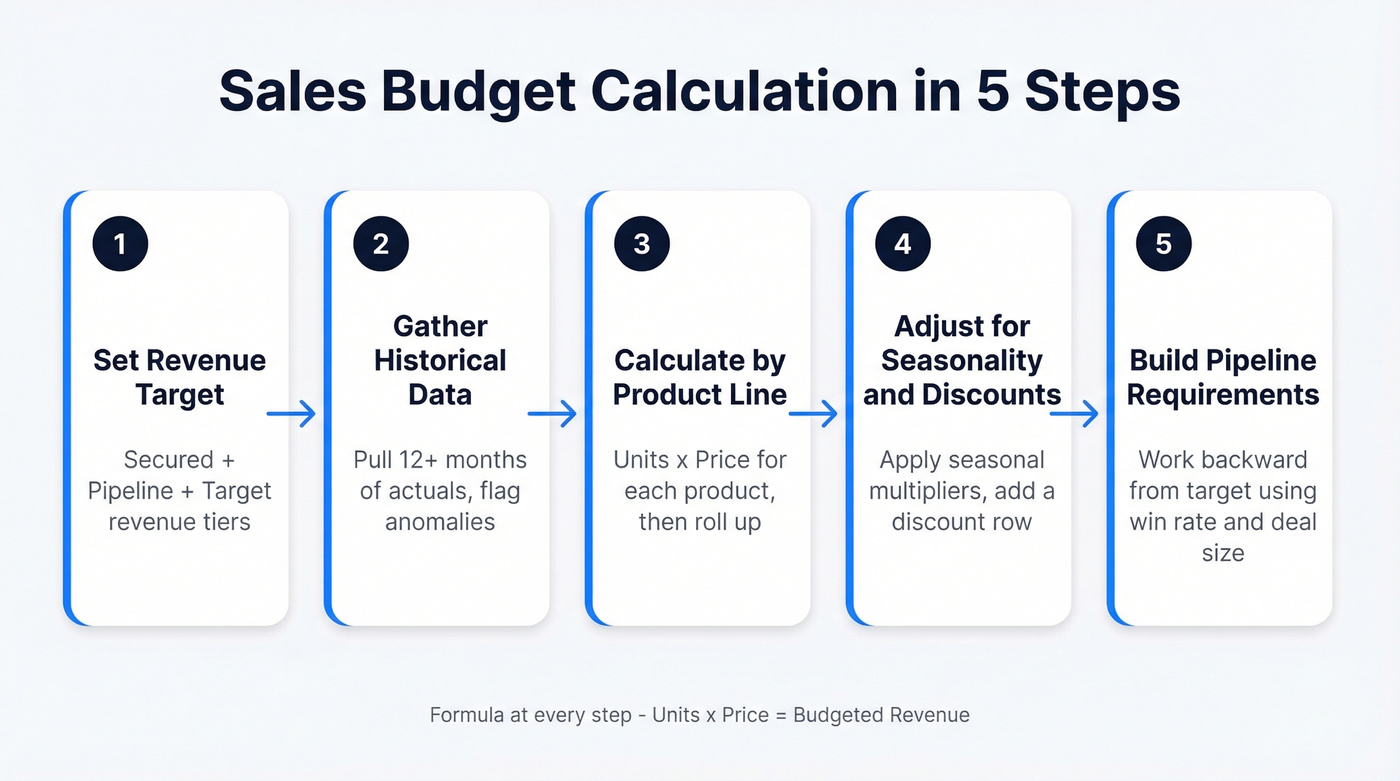
- Secured - contracted and renewal revenue already in hand
- Pipeline - weighted by stage probability
- Target - new business you still need to generate
This forces you to separate what's real from what's aspirational.
Gather Historical Data
Pull at least 12 months of actuals. You're looking for baseline run rates, seasonal patterns, and anomaly months you need to exclude. One sales rep on r/salestechniques shared their territory averaging ~$35K/month with a single anomaly month at $68K - exactly the kind of spike you need to flag before it inflates your baseline. For newer territories without deep history, use the shortest reliable period you have and weight recent months more heavily.
Calculate Revenue by Product Line
For each product, the formula stays the same: Units x Price. In a spreadsheet, that's =C5*C6 where C5 is projected units and C6 is unit price.
Roll everything up with =SUM(C7:H7) across months or quarters. If you need to model cash timing, split revenue into cash and credit collection - a common assumption is 40% cash / 60% credit, with formulas like =C7*0.40 and =C7*0.60.
Adjust for Seasonality and Discounts
No budget survives without seasonal adjustments. If Q4 historically runs 15% above average, multiply your quarterly baseline by 1.15.
Build a discount row too. If you typically discount 5-8% in competitive deals, bake that into the budget rather than pretending every deal closes at list price. In our experience, the teams that skip the discount row are the same ones scrambling to explain a revenue miss in Q3.
Estimate Costs and Allocations
Personnel and compensation typically eat 60-70% of a sales budget. That's base salaries, commissions, bonuses, and benefits. The rest splits across tools, travel, enablement, and contingency.
Two numbers that trip up most budgets: new AEs average 5.3 months to reach full productivity, and you should carry a 5-10% contingency buffer for unplanned expenses. If you're hiring three reps in Q1, don't budget them at full quota until Q3.
Build Pipeline Requirements
Work backward from your revenue target. If you need $2M in new business, your average deal is $50K, and your win rate is 25%, you need 160 opportunities.
That math assumes your reps can actually reach those prospects. If your contact data bounces at 25%, you're starting at 75% of planned pipeline before anyone picks up a phone. Tools like Prospeo verify emails in real time with 98% accuracy on a 7-day refresh cycle, so you're not budgeting pipeline around stale records that bounce on first touch.

Your sales budget is only as good as the pipeline feeding it. If 25% of your emails bounce, you need 33% more prospects just to hit plan. Prospeo delivers 98% email accuracy on a 7-day refresh cycle - so the pipeline numbers in your budget actually hold up through Q4.
Stop padding your budget for bad data. Start with contacts that connect.
Worked Examples
Single-Product Business
A company selling one product at $150/unit with a quarterly baseline of 1,000 units:
| Quarter | Base Units | Seasonal Adj. | Adj. Units | Revenue |
|---|---|---|---|---|
| Q1 | 1,000 | -10% | 900 | $135,000 |
| Q2 | 1,000 | - | 1,000 | $150,000 |
| Q3 | 1,000 | - | 1,000 | $150,000 |
| Q4 | 1,000 | +15% | 1,150 | $172,500 |
| Annual | 4,050 | $607,500 |
The seasonal adjustments swing annual revenue by $7,500 compared to a flat projection. That's real money to miss.
Multi-Product, Multi-Quarter
This is where most guides stop. Here's a company selling three products with different seasonal patterns:
| Product A ($150) | Product B ($300) | Product C ($75) | Total | |
|---|---|---|---|---|
| Q1 | 900 x $150 = $135K | 200 x $300 = $60K | 2,000 x $75 = $150K | $345K |
| Q2 | 1,000 x $150 = $150K | 250 x $300 = $75K | 1,800 x $75 = $135K | $360K |
| Q3 | 1,000 x $150 = $150K | 220 x $300 = $66K | 2,200 x $75 = $165K | $381K |
| Q4 | 1,150 x $150 = $172.5K | 300 x $300 = $90K | 2,500 x $75 = $187.5K | $450K |
| Annual (pre-discount) | $1,536K | |||
| Discount (-5%) | -$76.8K | |||
| Annual (net) | $1,459.2K |
Product C drives volume but Product B drives margin. Your budget needs to reflect both dynamics, and the 5% discount row keeps you honest about what actually hits the bank.
Here's the thing: if your multi-product budget doesn't have a discount row, you don't have a budget - you have a fantasy. We've seen teams miss annual targets by 6-8% purely because they modeled every deal at list price. Nobody closes every deal at list.
SaaS Company (ARR-Based)
SaaS budgets work differently because revenue is recurring. The component formula:
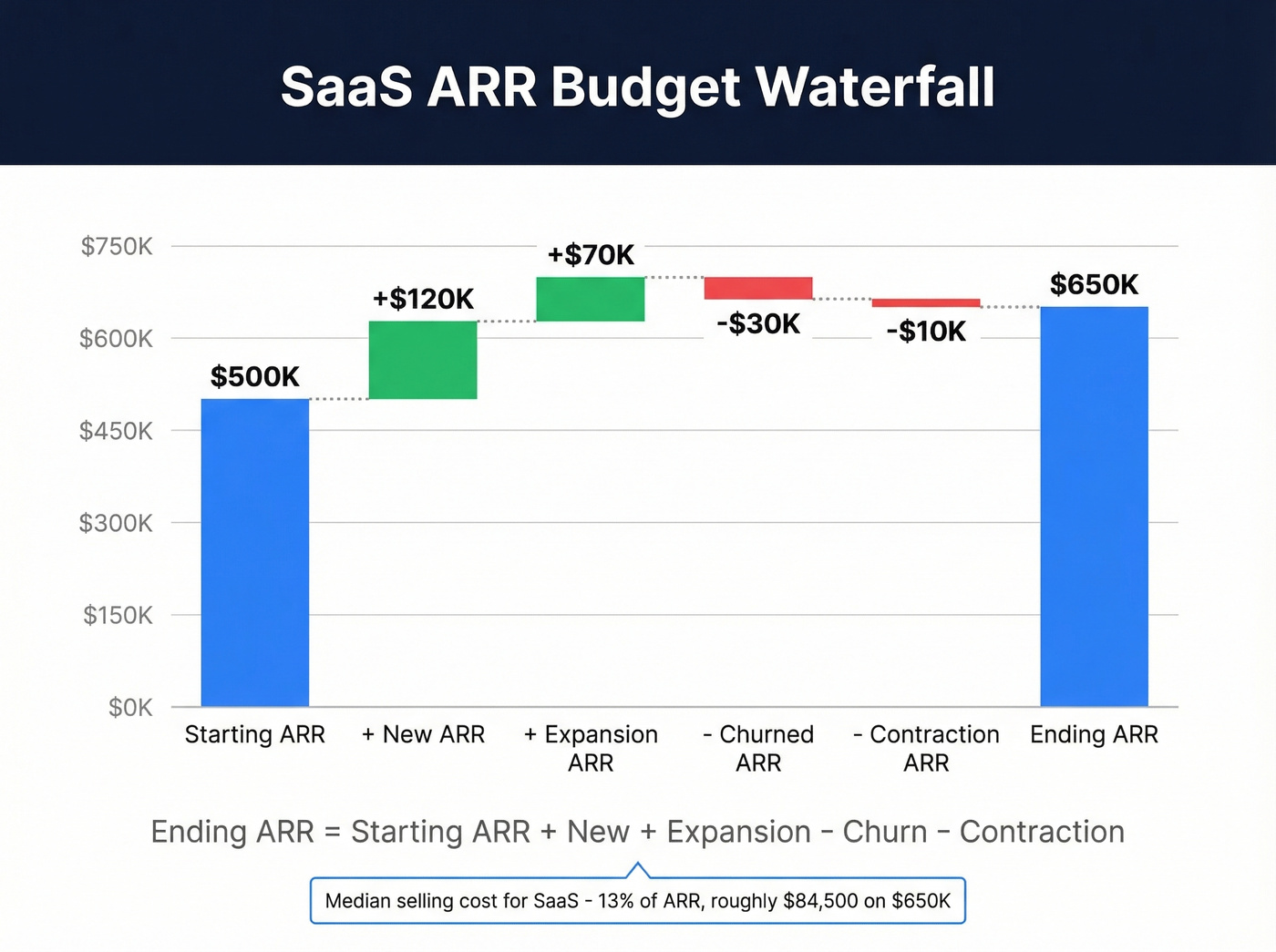
ARR = New ARR + Renewal ARR + Expansion ARR - Churned ARR - Contraction ARR
Normalization matters: a $150K three-year contract contributes $50K ARR, not $150K. Here's a worked example:
| Component | Amount |
|---|---|
| Starting ARR | $500,000 |
| + New ARR | $120,000 |
| + Expansion ARR | $70,000 |
| - Churned ARR | $30,000 |
| - Contraction ARR | $10,000 |
| Ending ARR | $650,000 |
For cost benchmarking, SaaS Capital's 2026 survey of 1,000+ private B2B SaaS companies found median selling costs at 13% of ARR. On $650K ARR, that's ~$84,500 for your sales budget.
Sales Budget Benchmarks for 2026
Here's where your numbers should land, depending on your business model:
| Industry | Selling Costs (% of Revenue) |
|---|---|
| SaaS | 13% of ARR (median) |
| Manufacturing | ~5-8% |
| Professional Services | ~15-20% |
| Retail | ~8-12% |
For SaaS companies in the $3M-$5M ARR range, the median breakdown runs roughly 15% selling, 7% marketing, 7% CS/support, 20% R&D, and 15% G&A. Bootstrapped companies spend a median of 95% of ARR total, while equity-backed companies spend 107% - meaning VC-funded SaaS companies are, on average, spending more than they earn. That's by design, but know where you sit on that spectrum before you set your numbers.
Budget Mistakes That Kill Accuracy
No scenario planning. Build three versions: pessimistic, realistic, optimistic. A single-number budget is a wish.
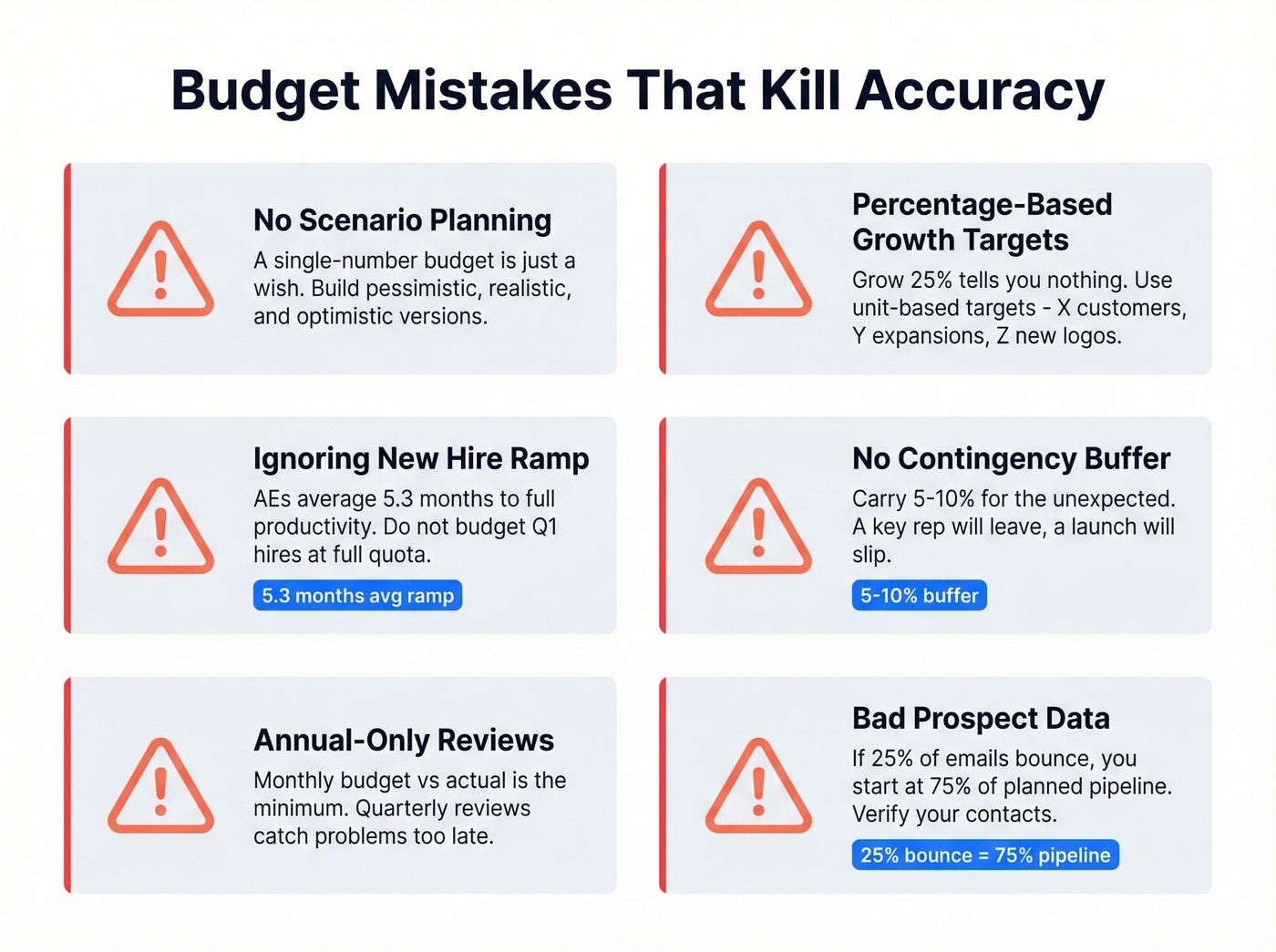
Percentage-based growth targets. "Grow 25%" tells you nothing. Use unit-based targets - acquire X customers, expand Y accounts, close Z new logos.
Ignoring new hire ramp time. AEs average 5.3 months to full productivity. Budget Q1 hires at full quota and you'll miss by a mile.
No contingency buffer. Carry 5-10%. A key rep will leave, a product launch will slip. Budget for it.
Annual-only reviews. Monthly budget-vs-actual reviews are the minimum. Quarterly is too slow - by the time you catch a problem, it's already compounded for three months.
Optimistic-only projections. Skip this if you want to keep your credibility with finance. If your budget only works in the best-case scenario, it doesn't work.
Bad prospect data undermining pipeline math. Your budget assumes X opportunities, which assumes your reps can reach prospects. When contact data bounces at 25%, you're starting at 75% of planned pipeline. This is the kind of invisible leak that makes a perfectly good budget look broken by Q2.
You just calculated pipeline requirements: 160 opportunities to hit $2M. Now make sure every rep can actually reach those prospects. Prospeo gives you 300M+ verified profiles at ~$0.01/email - 90% cheaper than ZoomInfo - so your cost-per-lead line item shrinks while your connect rates climb.
Cut your data spend by 90% and hit the number you just budgeted.
How to Track and Adjust
A budget isn't a document you file and forget. Structure your tracking sheet with two columns per month - budgeted and actual - with an automatic Over/Under variance column. Then follow this cadence:
Monthly: Compare budget-to-actual revenue by product line and territory. Flag any line that's off by more than 10%.
Quarterly: Deep review of assumptions. Are win rates holding? Is average deal size shifting? Are new hires ramping on schedule?
Trigger rule: Two consecutive months of >10% variance in either direction means an immediate reforecast. Don't wait for the quarterly review. We've seen teams lose entire quarters by waiting for the "official" review cycle while variance compounded month over month - by the time they acted, the gap was too wide to close.
Track three leading indicators that predict whether your budget will hold: pipeline coverage ratio, win rate trend (declining win rates signal a problem before revenue does), and average deal size shift. Shrinking deals mean you need more volume to hit the same number, and that realization at month eight is too late.
FAQ
What percentage of revenue should a sales budget be?
SaaS median selling costs run 13% of ARR per SaaS Capital's survey of 1,000+ companies. Manufacturing falls at 5-8%, professional services 15-20%. Personnel alone consumes 60-70% of whatever you allocate.
How often should you update a sales budget?
Review monthly against actuals and deep-reforecast quarterly. If you miss by more than 10% for two consecutive months, reforecast immediately - static annual budgets are how companies end up 30% off by December.
What's the difference between a sales budget and an expense budget?
A sales budget projects revenue (units x price). An expense budget projects costs (salaries, tools, commissions). A complete sales plan includes both - most guides cover only the revenue side, which leaves half the picture missing.
How does data quality affect budget accuracy?
Your budget assumes a pipeline, which assumes reps can reach prospects. When contact data bounces at 25%, pipeline projections collapse. Weekly-refreshed, verified contact data keeps pipeline math intact - and it's worth auditing your current bounce rates before you finalize any budget number.