

7 Sales Coaching Examples With Scripts You Can Use Monday
A sales manager on r/sales described his coaching routine like this: "I'm managing 8 reps, realistically coaching 2 or 3 of them a week. The rest get me listening to a call recording at 1.5x speed and dropping surface-level feedback in Slack." He wasn't lazy. He was drowning. And his 1:1s kept drifting into pipeline reviews because those felt more urgent than actual skill development.
Most articles listing sales coaching examples give you 10, 20, even 30 tips - none of which show what coaching actually sounds like. That's like writing a guitar guide without a single chord. What follows are seven real scenarios with scripts, actual words you can say in your next 1:1. Fewer platitudes, more dialogue you can steal.
If you only take two things from this article:
- The discovery call scorecard (Section 6) - print it, score one call before every 1:1
- The one-behavior-per-month rule - pick one skill gap per rep, coach only that until it sticks
Why Coaching Drives Revenue
When coaching skills exceed expectations, 94.8% of reps hit quota. When coaching needs improvement, that drops to 84.5%. A roughly 10-point gap tied directly to the manager's ability to develop people.
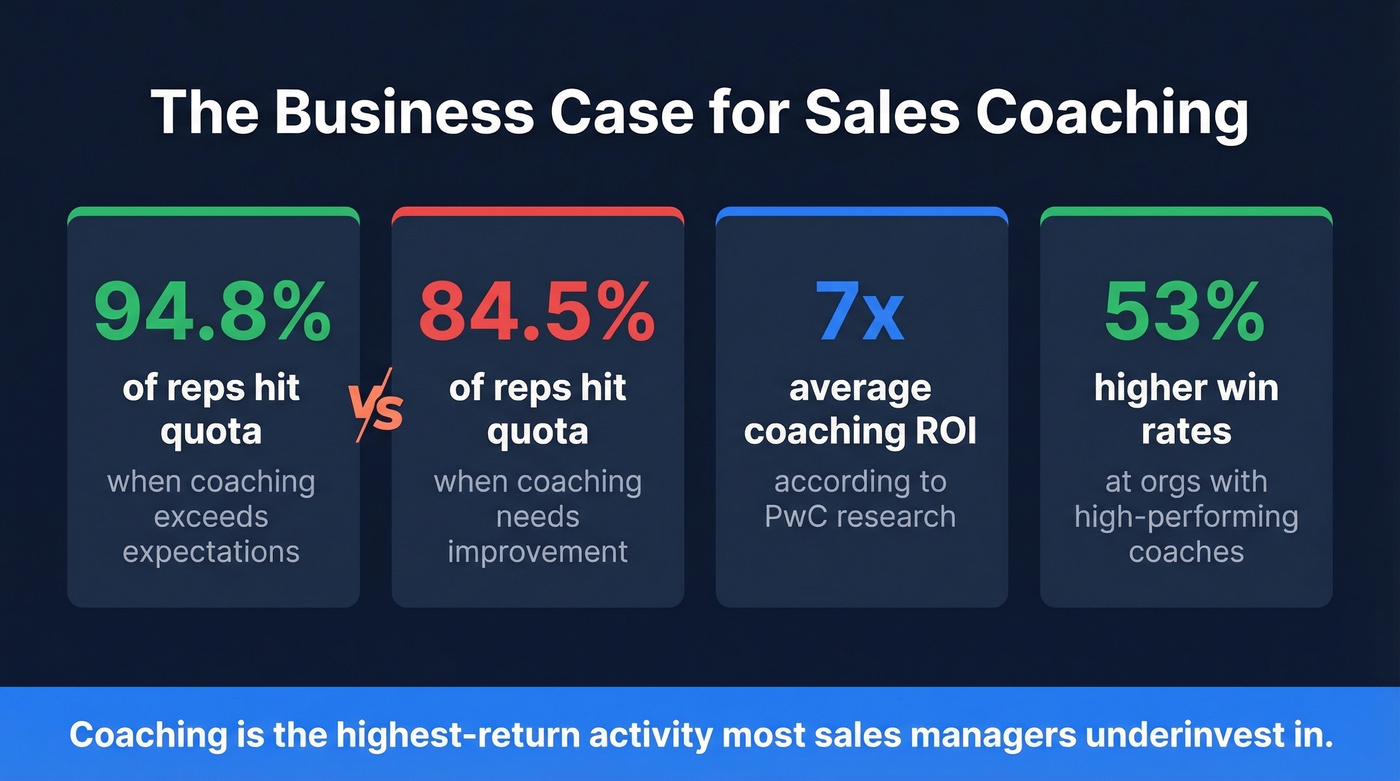
The money case is just as clear. PwC pegs the average coaching ROI at 7x. Seller turnover runs around 35%, and replacing a single rep costs 0.5x-2x their base salary. Organizations with high-performing coaches see 53% higher win rates. PCD Inc., an AV integrator, hit their 100-room sales target months ahead of schedule after a 26-week structured coaching program. If you want to help reps sell better, coaching is the highest-return activity most managers underinvest in.
Who to Coach First
Gartner found that managers spend less than 10% of their time actively coaching. Reps spend only about 29% of their time actually selling. When time is that scarce on both sides, you need a triage system - not equal distribution.
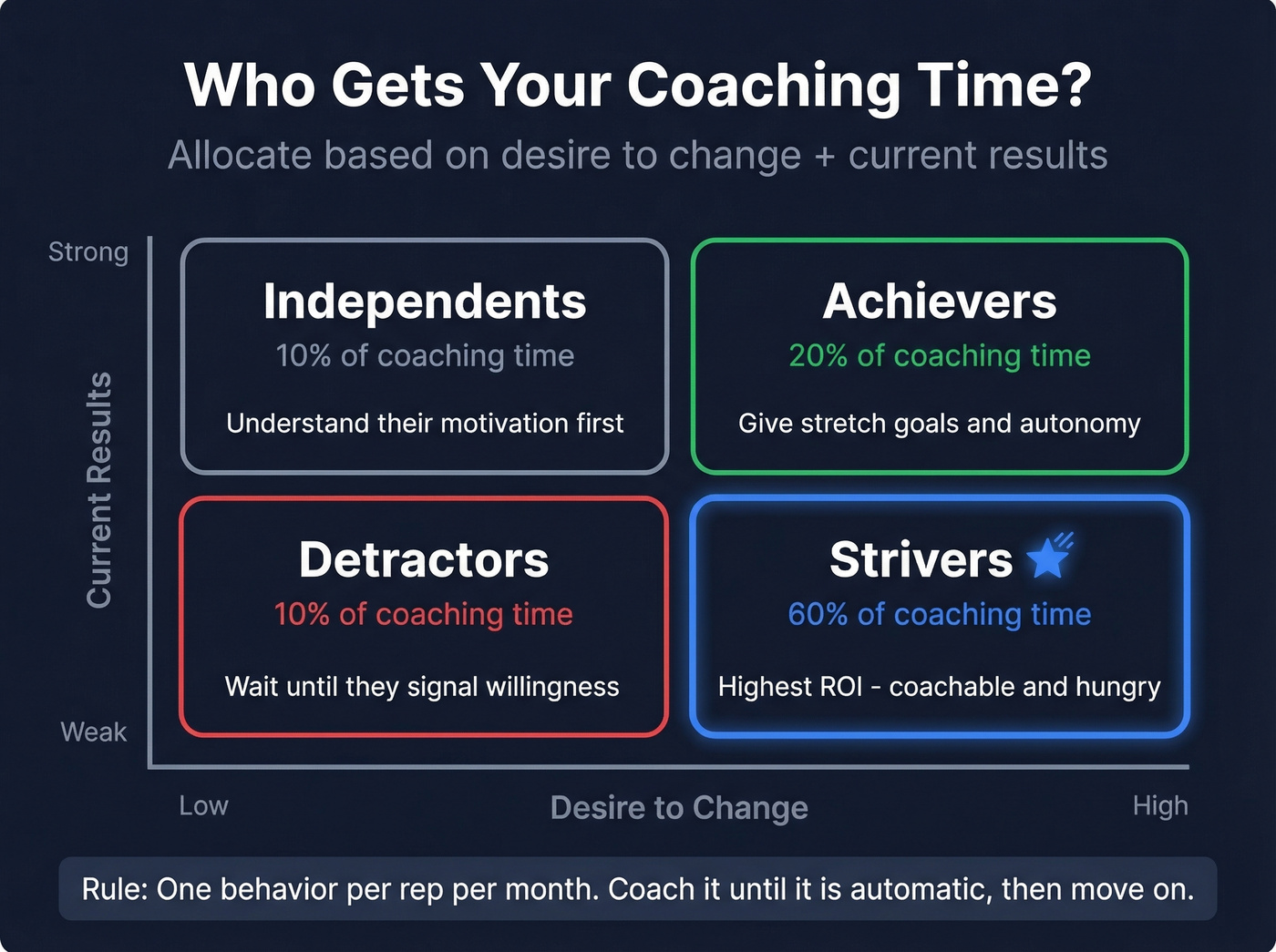
| High Desire to Change | Low Desire to Change | |
|---|---|---|
| Strong Results | Achievers | Independents |
| Weak Results | Strivers | Detractors |
Strivers deserve 60% of your coaching time. They want to improve and they're coachable, so your investment compounds fastest here. Achievers get stretch goals. Independents need you to understand their motivation before you push. Detractors get almost none until they signal they want to change.
The principle underneath: one behavior per rep per month. Not twelve things to fix. One. Coach it until it's automatic, then move on.

Great coaching closes the skill gap. Bad data closes the pipeline. Even your best-coached reps can't convert if they're calling wrong numbers and bouncing emails. Prospeo delivers 98% email accuracy and 125M+ verified mobiles - so the behaviors you drill in 1:1s actually reach real buyers.
Stop coaching reps to sell into a void. Give them verified contacts.
7 Coaching Scenarios With Dialogue
1. Call Review Coaching
Scenario: You scored a discovery call recording against your rubric. The rep nailed rapport but barely uncovered key results.
Manager: "I scored your call with Dataline. You opened strong - the prospect was engaged within 90 seconds. On 'key results,' I gave it a 2 out of 5. You asked what they're trying to solve, but you didn't dig into what success looks like in numbers. What happened there?"
Rep: "I felt like I was already running long and didn't want to push."
Manager: "Here's the tradeoff - a 40-minute discovery call that uncovers budget authority and success metrics converts to a second meeting at 2x the rate of a 25-minute surface-level call. Next call, ask one question: 'What does success look like in 6 months, in numbers?' Just that one."
2. Discovery Coaching (GROW Framework)
Scenario: Your rep's second-meeting conversion rate is 18%. Team average is 34%.
Manager: "Your conversion to second meetings is half the team average. What's your read on why?" (Goal: close the gap to 34%)
Rep: "I think I'm covering pain points, but maybe I'm not connecting them to outcomes." (Reality)
Manager: "What could you do differently in the first 15 minutes to make a second meeting feel worth their time?" (Options)
Rep: "I could ask more about their current process and where it breaks down - get them talking about the cost of doing nothing."
Manager: "Good. Will you commit to asking 'What happens if you don't fix this?' in your next three discovery calls and tracking how it changes the conversation?" (Will)
This is the GROW model in action - Goal, Reality, Options, Will. It works because the rep arrives at the answer themselves. You're not lecturing. You're pulling.
3. Role-Play Coaching
Scenario: Your rep's cold-call connect-to-conversation rate is low. Prospects hang up within 10 seconds.
Manager: "I'm a VP of Marketing mid-email when you call. Go."
Rep: "Hi, this is Sarah from Acme. I'm calling because we help marketing teams--"
Manager: "Stop. You started pitching. The prospect's brain is already looking for the exit. Try this: 'Hey, this is a cold call - can I get 30 seconds to see if this is worth your time?' You're owning the interruption. It disarms them. Again."
They run it three more times. By the fourth attempt, the delivery is natural and the transition into the value hook is smooth. We've watched reps go from a 4% connect-to-conversation rate to 12% in two weeks just from drilling this opener. Role-play is one of the simplest coaching ideas that consistently moves the needle, and the consensus on r/sales backs this up - reps who role-play weekly outperform those who don't.
4. Pipeline Review Coaching
Scenario: Your rep has 12 deals stuck at the proposal stage for 14+ days.
The temptation is to go deal-by-deal asking "what's happening with Acme?" That's an audit, not coaching. Here's what actually works:
- Ask the pattern question: "What has to be true for a deal to move from proposal to verbal commit?"
- Force the count: "How many of these 12 have confirmed the economic buyer has actually reviewed the proposal?" The answer is almost always fewer than half.
- Assign the behavior: "For every deal at proposal, your job this week is to confirm the economic buyer has the document and a next step scheduled. Not chase - confirm."
5. Objection Handling Coaching (PAUSE)
Scenario: Your rep folds every time a prospect says "this is too expensive."
Manager: "On the Meridian call, when they said 'this is more than we budgeted,' what did you do?"
Rep: "I offered to discount."
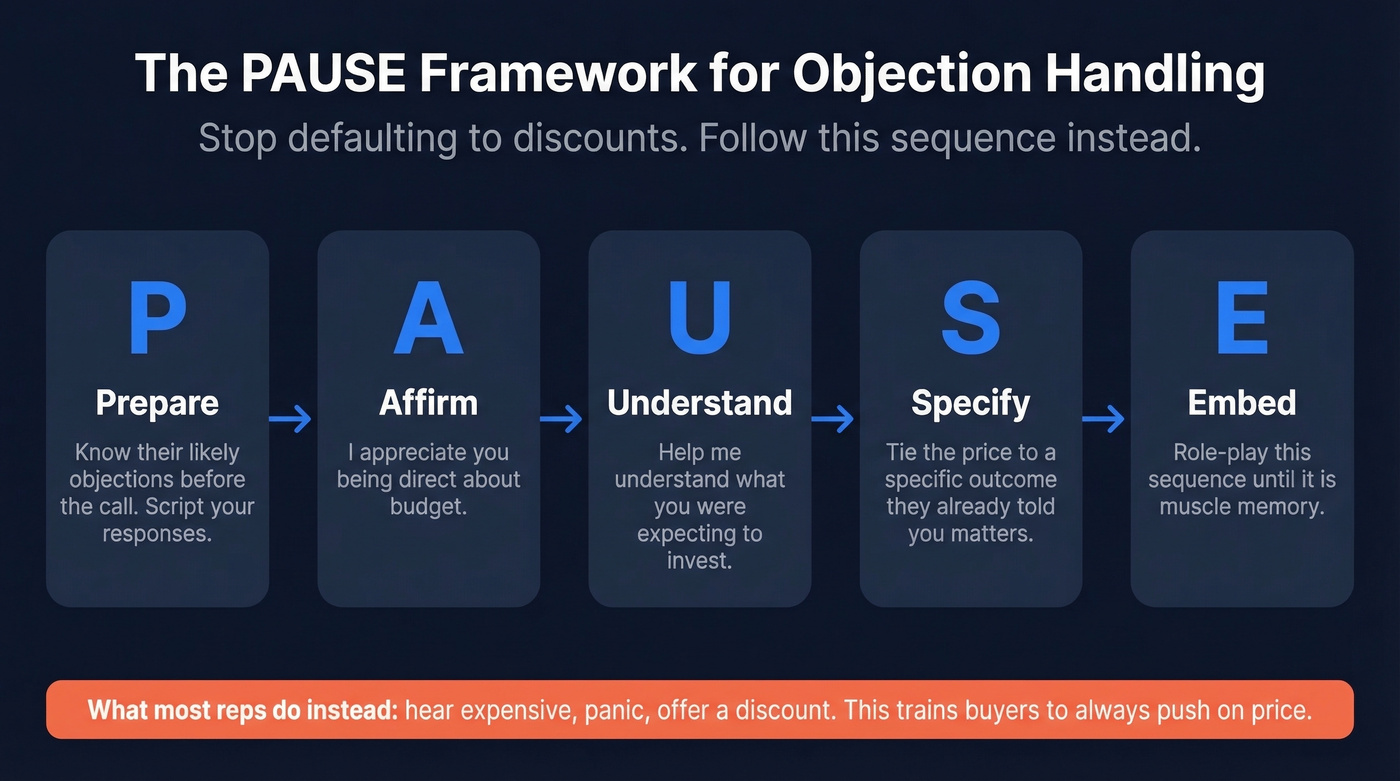
Manager: "Let's try a framework called PAUSE:
- Prepare - before the call, know their likely objections and your responses
- Affirm - 'I appreciate you being direct about budget'
- Understand - 'Help me understand what you were expecting to invest'
- Specify - tie the price to a specific outcome they already told you matters
- Embed - practice this sequence until it's muscle memory
Let's role-play the Understand step right now. I'll say 'this is too expensive' and you respond without offering a discount."
This is where most reps break. They hear "expensive" and panic. The PAUSE framework gives them a physical sequence to follow so they don't default to discounting, which trains the buyer to always push on price.
6. Prospecting Coaching
Scenario: Your rep is making 80 calls a day but their connect rate is under 8% - well below the 15% team benchmark.
Manager: "You're putting in the work. 80 dials is solid. But if only 6 connect, we need to look at the data, not the effort. How confident are you that the numbers you're dialing are current?"
Rep: "I pull them from our database, but a lot go straight to voicemail or are disconnected."
Manager: "That's a data quality problem, not a skills problem. Let's get your list verified through Prospeo this week - 98% email accuracy and 125M+ verified mobile numbers mean your coached skills aren't wasted on dead lines. We'll measure connect rates again next Friday."
Here's the thing: you can coach a rep's opener, tone, and objection handling to perfection, but none of it matters if 40% of their dials hit disconnected numbers. We've seen teams double their connect rates just by cleaning up their contact data before touching anything else.
7. Win/Loss Debrief Coaching
Your rep lost a deal they'd forecasted at 80% confidence. Instead of a post-mortem that assigns blame, run a rapid debrief with three questions:
- "What did the buyer tell you versus what we assumed?" Forces the rep to separate signal from wishful thinking.
- "Was your champion able to make this decision alone?" Almost always, the answer is no. There's a CFO, a procurement team, or a board member the rep never reached.
- "What's the one question that would have changed this outcome?" In our experience, it's usually: "Who else needs to see this before you can move forward?"
One question. That's the coaching takeaway. Not a 12-point action plan.
A Discovery Call Scorecard You Can Copy
Scoring one call before every 1:1 takes about 8 minutes and transforms the entire conversation. Score each dimension 1-5 after reviewing the recording, then circle one as the coaching focus for that session.
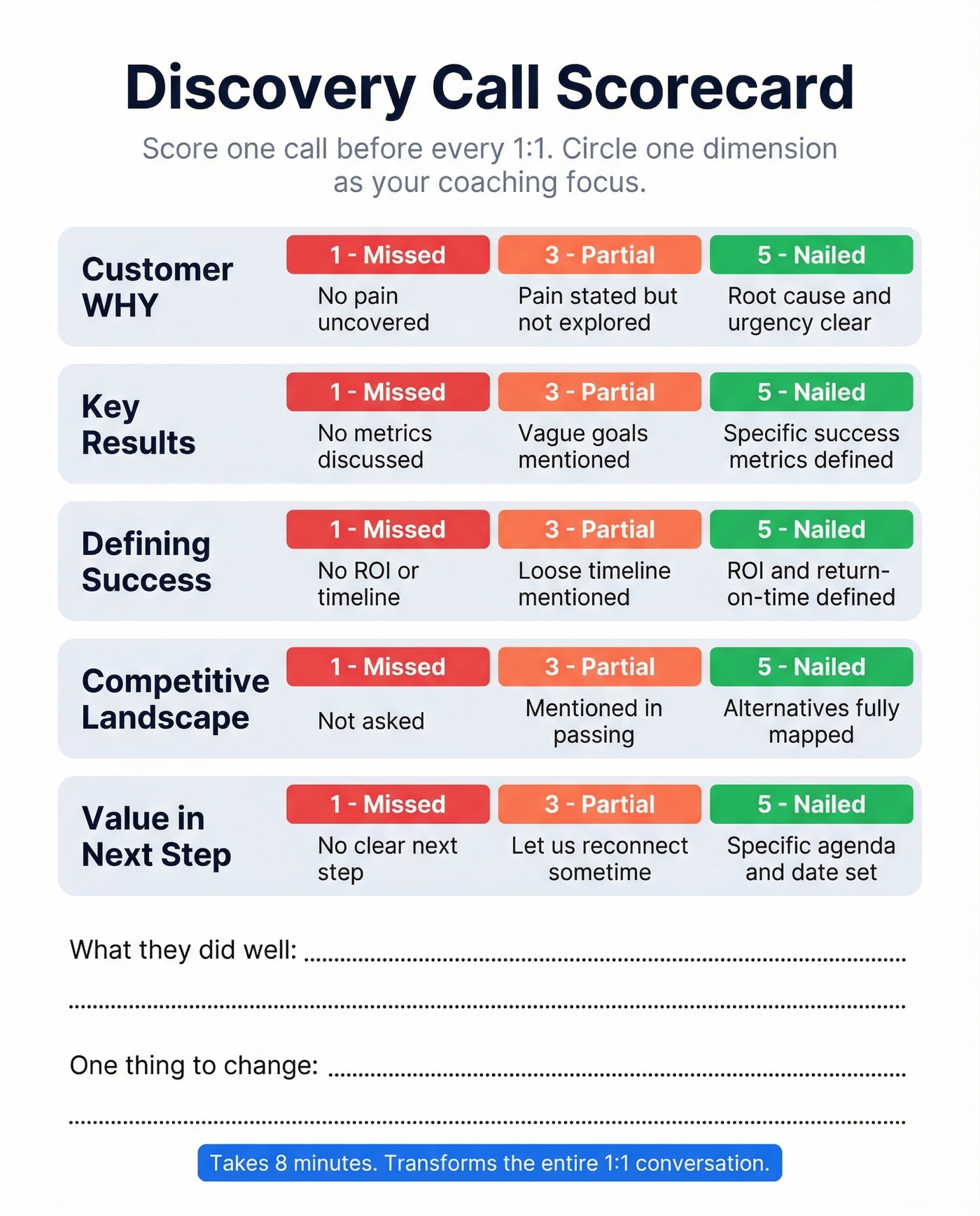
| Dimension | 1 (Missed) | 3 (Partial) | 5 (Nailed) |
|---|---|---|---|
| Customer WHY | No pain uncovered | Pain stated, not explored | Root cause + urgency clear |
| Key Results | No metrics discussed | Vague goals mentioned | Specific success metrics |
| Defining Success | No ROI/timeline | Loose timeline | ROI + return-on-time defined |
| Competitive Landscape | Not asked | Mentioned in passing | Alternatives mapped |
| Value in Next Step | No clear next step | "Let's reconnect" | Specific agenda + date |
What they did well: _______________ One thing to change: _______________
Let's be honest - most managers skip call scoring because it feels like extra work. It is. But it's the difference between walking into a 1:1 with "I think your calls could be better" and "On the Dataline call, you scored a 2 on Key Results because you didn't ask about success metrics." One of those changes behavior. The other doesn't.
How to Measure Coaching Impact
The chain you're measuring: coaching intervention -> behavior change -> pipeline impact -> revenue.
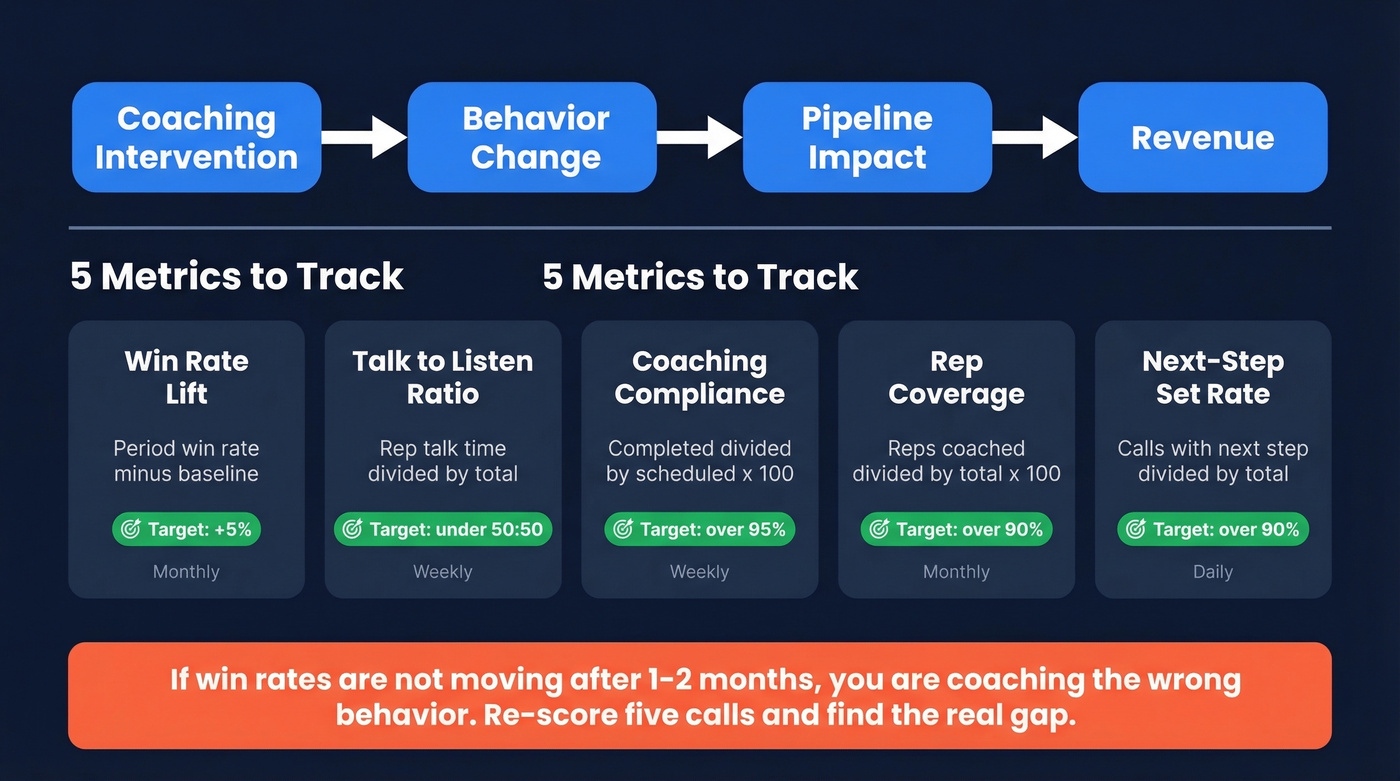
| Metric | Formula | Cadence | Target |
|---|---|---|---|
| Win Rate Lift | Period win rate - baseline | Monthly | +5% |
| Talk:Listen Ratio | Rep talk time / total | Weekly | <50:50 |
| Coaching Compliance | Completed / scheduled x 100 | Weekly | >95% |
| Rep Coverage | Reps coached / total x 100 | Monthly | >90% |
| Next-Step Set Rate | Calls with next step / total | Daily | >90% |
If win rates aren't moving after 1-2 months of consistent coaching, you're coaching the wrong behavior. Go back to the scorecard, re-score five recent calls, and find the real gap.
Three Mistakes That Kill Coaching
Pipeline reviews disguised as coaching. If your 1:1s are just deal updates, you're auditing - not developing. Pipeline reviews belong in a separate meeting. Full stop.
Coaching 12 things at once. The one-behavior rule exists because humans can't change everything simultaneously. Pick the behavior with the highest revenue impact, coach it for a month, then move on. We've seen managers try to fix discovery, objection handling, and closing technique in a single 1:1. The rep walks out overwhelmed and changes nothing.
Only coaching underperformers. Strivers and Achievers respond to coaching the fastest. Skip this trap: if you're only sitting down with struggling reps, you're missing the highest-ROI time on your calendar. AI conversation intelligence tools can help you spot patterns at scale, but they augment human coaching - they don't replace the 1:1 where a rep actually changes a behavior.
For teams where the average deal runs under $15K, you probably don't need a $30K-$50K coaching platform. You need a manager who scores one call a week and runs these scripts. The method above is free. The triage matrix solves the time problem. Start there.
You just read about reps spending only 29% of their time selling. Bad contact data makes that number worse - reps waste hours chasing dead emails and disconnected numbers. Prospeo's 7-day data refresh and 30% mobile pickup rate mean your coached reps spend time in conversations, not bouncing.
Reclaim your reps' selling time with data that actually connects.
FAQ
How often should you coach each sales rep?
Weekly 1:1s of 30 minutes, each focused on one pre-scored call or one specific behavior. Managing 10+ reps? Supplement with biweekly group call reviews where the team scores a recording together.
What's the difference between sales coaching and sales training?
Training teaches new skills in a group setting. Coaching applies those skills to real deals through targeted questions and practice. Without follow-up coaching, 87% of new skills are lost within 30 days.
How do you coach a remote sales team?
Use call recordings instead of live ride-alongs. Score one call with the scorecard above before every 1:1 so you arrive with specific, behavior-level feedback - not generic impressions from memory. Every sales coaching example in this article works just as well over Zoom as in person.
What tools help scale sales coaching?
Conversation intelligence platforms like Gong or Chorus surface coachable moments automatically. For prospecting coaching specifically, clean data matters most - if reps are practicing skills on disconnected numbers, no amount of coaching fixes the outcome. Pair any tool with the one-behavior-per-month rule to avoid coaching overload.