

How to Run Pipeline Reviews That Actually Move Deals
It's Thursday at 3 PM. Your sales manager pulls up a Salesforce dashboard, asks each rep to "walk through their deals," and 45 minutes later everyone leaves with zero action items and a vague sense of wasted time. Sound familiar? 56% of sales organizations rate their pipeline management as poor or neutral - and the ones who get it right see a 15% revenue lift. As one sales manager on r/sales put it, pipeline reviews are "just busywork so leadership doesn't have to read CRM updates."
The gap between high-performing teams and everyone else isn't talent or tooling. It's how they run their reviews.
What You Need (Quick Version)
- Stop reviewing every deal. Pick 2-3 - late-stage, stalled, newly added - and go deep.
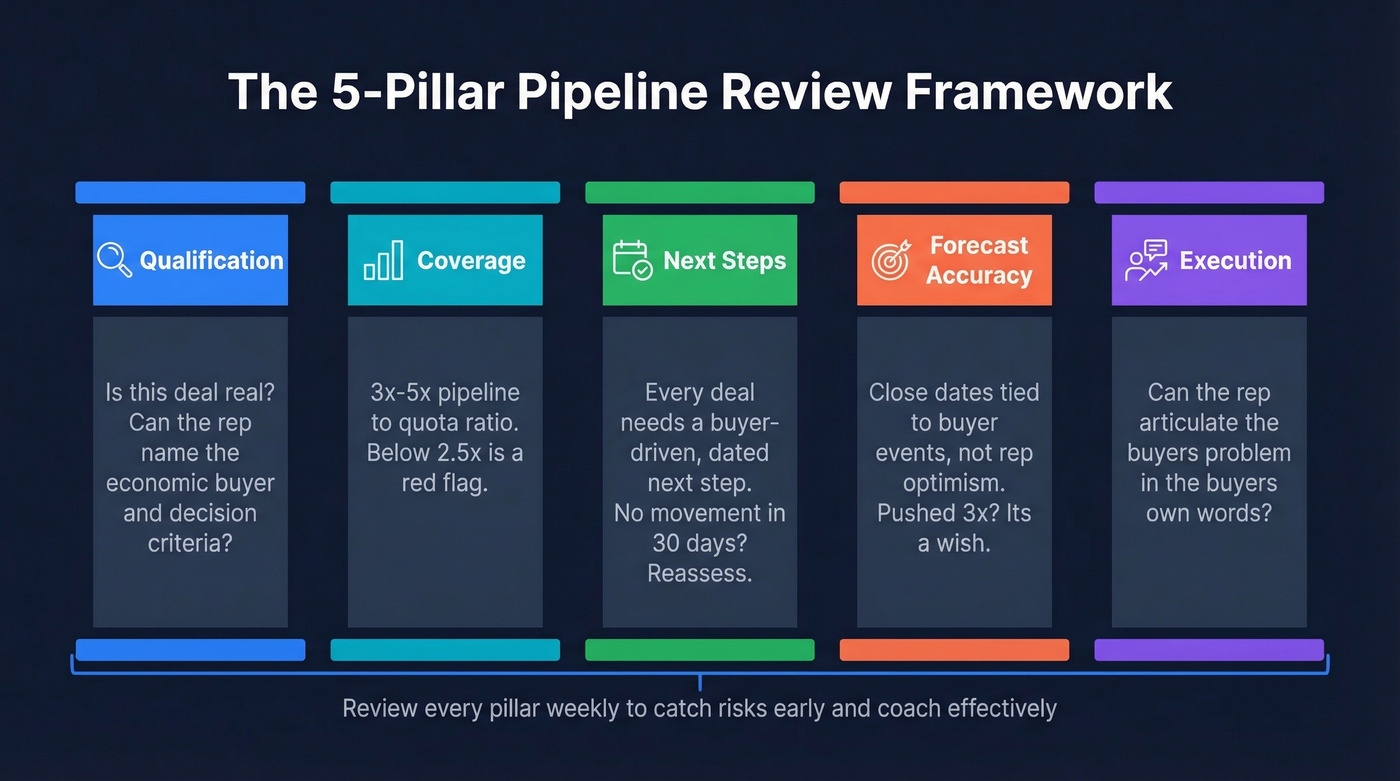
- Use the 5-pillar framework: Qualification, Coverage, Next Steps, Forecast Accuracy, Execution.
- Fix your data first. Review sessions built on stale CRM records are fiction. If your contacts changed jobs three months ago, you're reviewing ghosts.
What a Sales Pipeline Review Actually Is
A pipeline review is a sales execution meeting. Its job is to assess deal health, identify risks, and make sure your pipeline supports revenue targets. That's it.
It's not a status check. It's not a forecasting meeting. It's not an open-ended session where reps narrate their week. Reps come prepared with data, managers come prepared with coaching themes, and the output is action items - not updates.
Most orgs blur four distinct meeting types into one. Here's how to separate them:
| Meeting Type | Purpose | Cadence |
|---|---|---|
| Pipeline Review | Deal health + execution | Weekly |
| Forecast Call | Commit/best-case for leadership | Weekly or biweekly |
| Deal Review | Deep dive on one deal | As needed |
| QBR | Quarterly performance + strategy | Quarterly |
If your "pipeline review" is really a forecast call where reps defend their commit numbers, you're running the wrong meeting. The questions, the energy, and the outcomes are completely different.
Mistakes That Kill Deals
No agenda. Reps show up cold, managers wing it, the meeting drifts. Publish a 3-section agenda - data review, deal deep-dives, action items - 24 hours before.
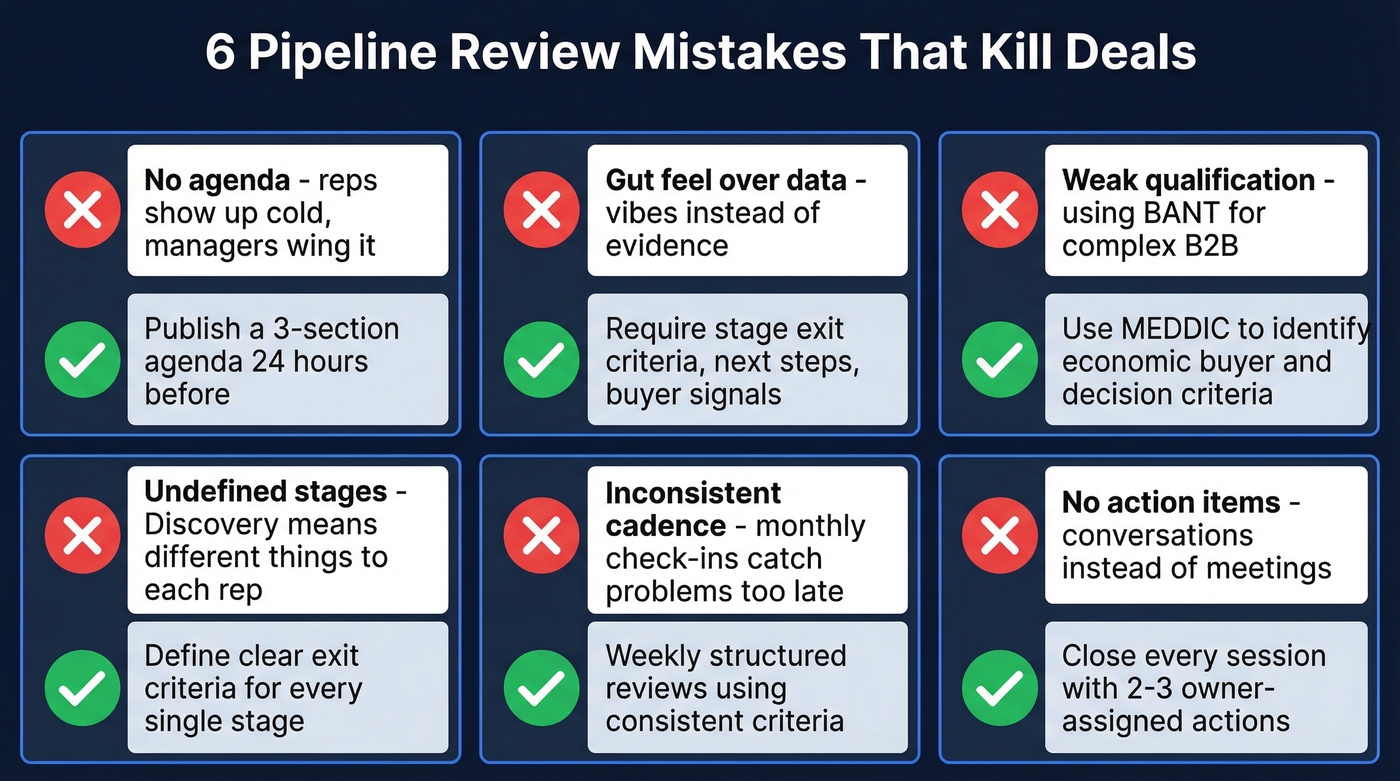
Gut feel over data. "I think this one's going to close" isn't analysis. Require reps to reference stage exit criteria, next steps, and buyer signals. Not vibes.
Weak qualification frameworks. BANT can work for simpler, transactional sales. For complex B2B with multiple stakeholders and longer cycles, MEDDIC is usually the better lens because it forces reps to identify the economic buyer, the decision criteria, and the paper process before a deal gets to Stage 3.
Undefined stages. If "Discovery" and "Qualification" mean different things to different reps, your pipeline data is noise. Define clear exit criteria for every stage. A deal doesn't advance until those criteria are met.
Inconsistent cadence. Gartner's research shows high-performing orgs conduct weekly health reviews using structured criteria; average teams do monthly subjective checks. Weekly wins. Biweekly is acceptable for smaller teams. Monthly is too late to catch a stalling deal.
No action items. A review that ends without documented next steps is a conversation, not a meeting. Close every session with 2-3 specific, owner-assigned actions and a follow-up date.
Interrogation culture. Here's the thing: the "CRM police" anti-pattern - where managers grill reps on data entry instead of coaching on deal strategy - kills candor and morale. I've watched managers spend entire reviews asking "Is the close date updated?" instead of "Why would this buyer act now?" That's a reporting meeting, not a coaching session.
The 5-Pillar Framework
Qualification
Every deal in your pipeline should answer one question: is this real? Use MEDDIC to pressure-test. Can the rep name the economic buyer? Articulate the decision criteria? Describe the paper process? If the answer to any of those is "I'm not sure yet" on a Stage 3+ deal, that deal needs work or removal. (If you want a deeper qualification playbook, see MEDDIC sales qualification.)
Pipeline Coverage
The rule of thumb: you need enough pipeline to hit your number. A healthy coverage ratio is often 3x-5x, and for stable mid-market SaaS in 2026, 3x is a common benchmark. Early-stage companies or teams with lower win rates should target 4x-5x. If you're at 2x, it doesn't matter how good your close rate is - you simply don't have enough at-bats.
Coverage ratios are meaningless if your data is stale. Prospeo refreshes contact data every 7 days - compared to the 6-week industry average - so your pipeline reflects reality, not last quarter's org chart. (More on keeping records current: data enrichment services.)
Next Steps
Every deal needs a buyer-driven, dated next step. Not "follow up next week." Something like "CFO reviews proposal with legal on Tuesday; we have a 30-minute call Thursday at 2 PM to address redlines." If a deal hasn't advanced in 30 days and has no clear next step, reassess or remove it. Stale deals inflate your pipeline and distort your coverage ratios.
Forecast Accuracy
Challenge slipping close dates. If a deal has been pushed three times, the close date is a wish, not a forecast. Ask reps to tie their expected close date to a specific buyer event - a board meeting, a contract renewal, a budget cycle. Dates anchored to buyer milestones are forecasts. Dates anchored to rep optimism are fiction. (If you need tooling, compare sales forecasting solutions.)
Sales Execution
Can the rep articulate the buyer's problem in the buyer's own words? Does the strategy align to the buyer's priorities, not just your product's strengths? This pillar is where coaching happens. It's the difference between a manager who reviews deals and a manager who develops sellers.

You just read that stale data makes pipeline reviews fiction. Prospeo refreshes 300M+ profiles every 7 days - not the 6-week industry average. 98% email accuracy means your coverage ratios reflect real buyers, not outdated org charts.
Stop reviewing ghosts. Start reviewing pipeline you can actually close.
Metrics and Benchmarks
Some teams simplify pipeline health to four dimensions: Volume, Value, Velocity, and Coverage. Your metrics should cover all four. Here's the formula that ties them to a single number:
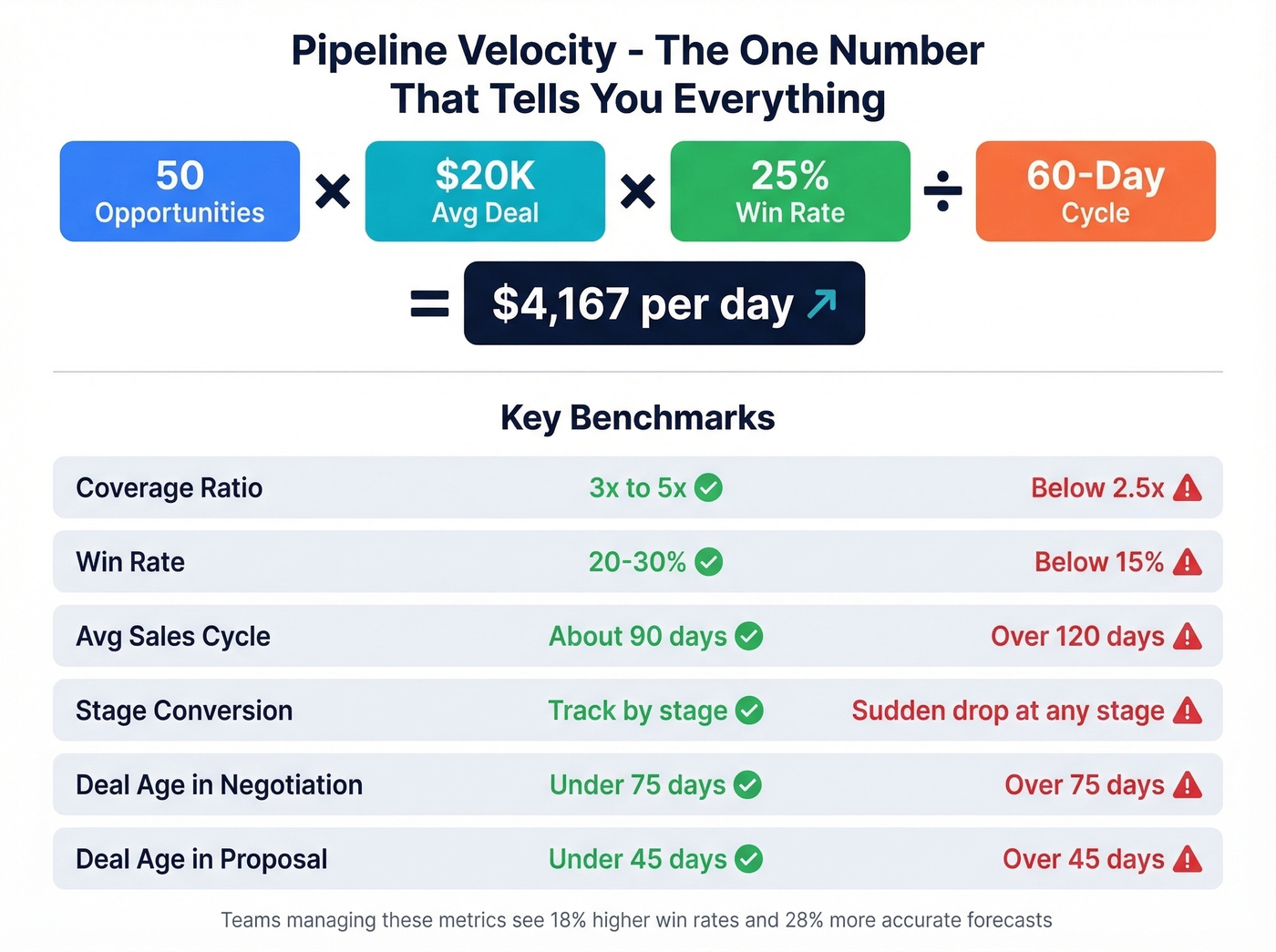
Pipeline Velocity = (Number of Opportunities x Average Deal Value x Win Rate) / Sales Cycle Length (days)
Worked example: 50 opportunities x $20,000 average deal x 25% win rate / 60-day cycle = $4,167 per day in pipeline velocity. Track this weekly. If it's declining, something in the numerator is shrinking or the denominator is growing - and your review should diagnose which. (For a broader set of leading indicators, see pipeline health.)
| Metric | Benchmark | Red Flag |
|---|---|---|
| Coverage Ratio | 3x (stable), 4x-5x (early-stage) | Below 2.5x |
| Win Rate | 20-30% (mid-market B2B) | Below 15% |
| Avg Sales Cycle | ~90 days (mid-market SaaS) | > 120 days |
| Stage Conversion | Track by stage to find bottlenecks | Sudden drop at any stage |
| Deal Age in Negotiation | < 75 days | > 75 days |
| Deal Age in Proposal | < 45 days | > 45 days |
Sales cycles have stretched roughly 21% since 2020, which makes tracking stage conversion rates even more important. If deals are dying at the same stage consistently, you have a qualification or enablement problem - not a closing problem. (Common root causes: sales pipeline challenges.)
Teams actively managing these metrics achieve 18% higher win rates and 28% more accurate forecasts. That's not marginal. It's the difference between hitting plan and missing by a mile.
Questions That Actually Work
Stop Asking These
"Is the close date updated?" The close date should tie to a verified buyer event. If you have to ask, your stage definitions are broken.
"Did you email them back?" Activity should be visible in your CRM. This is a tooling problem, not a pipeline problem.
"What's the probability of this closing?" Humans are terrible at estimating probability. Replace with observable buyer behaviors.
"Do we have a champion?" Yes/no invites lazy answers. A champion isn't a checkbox.
Start Asking These
Validation
"Why would they buy now rather than do nothing?" This is the single most important question in any deal review. If the rep can't answer it, the deal isn't qualified.
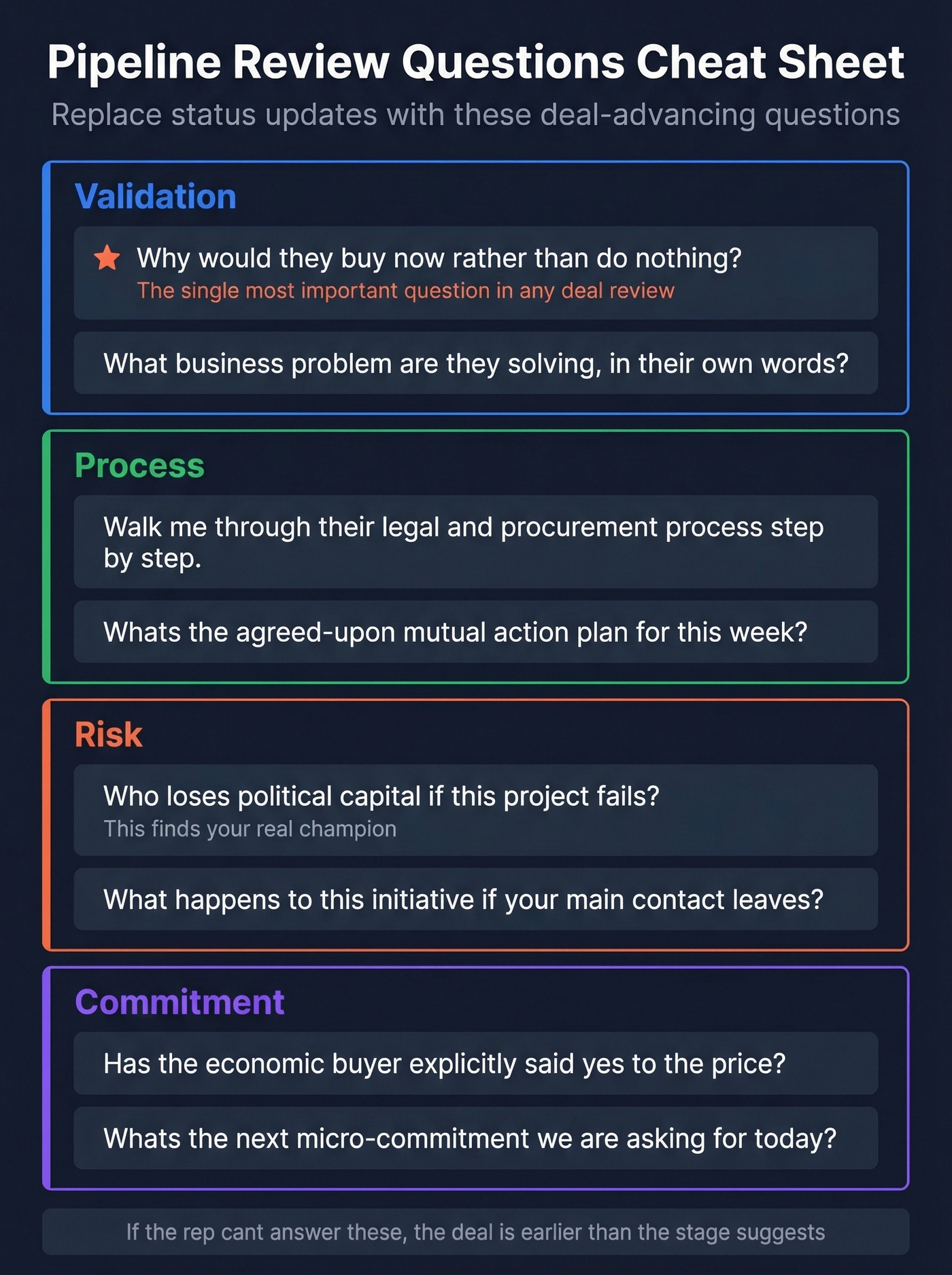
"What business problem are they solving, in their own words?" Not your words. Not your marketing's words. The buyer's words.
Process
"Walk me through their legal and procurement process step-by-step." If the rep doesn't know, the deal is earlier than the stage suggests.
"What's the agreed-upon mutual action plan for this week?" Not your plan - a mutual plan with buyer-side commitments.
Risk
"Who loses political capital if this project fails?" This identifies the real champion - the person with skin in the game.
"What happens to this initiative if your main contact leaves?" If the answer is "it dies," you're single-threaded and exposed.
Commitment
"Has the economic buyer explicitly said 'yes' to the price?" Not "they seemed comfortable." Explicitly said yes.
"What's the next micro-commitment we're asking for today?" Every interaction should advance the deal by one concrete step.
How to Run a 30-Minute Review
You don't need an hour. You need 30 focused minutes and pre-work.
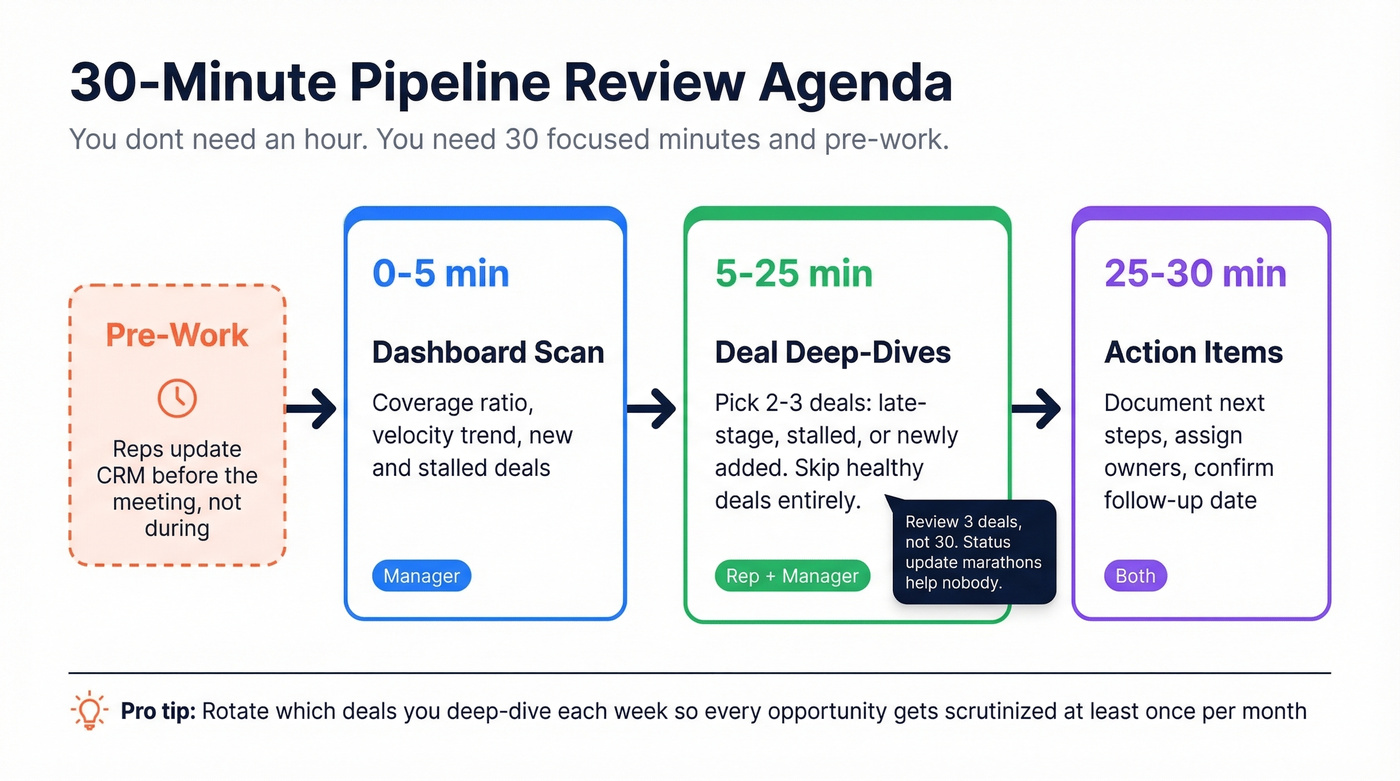
Pre-work requirement: Reps update CRM before the meeting, not during. If a rep is editing deal stages while you're talking, you've already lost.
| Time | Activity | Owner |
|---|---|---|
| 0-5 min | Review pipeline dashboard: coverage ratio, velocity trend, new/stalled deals | Manager |
| 5-25 min | Deep-dive on 2-3 deals (late-stage, stalled, newly added) | Rep + Manager |
| 25-30 min | Document action items, assign owners, confirm next review | Both |
Review three deals, not thirty. Skip healthy deals entirely - they don't need your attention. Spend your time on deals that are stuck, at risk, or freshly added and need validation. We've seen teams try the "review every deal" approach, and it always degrades into a status update marathon where nothing gets coached.
One tip that high-performing managers swear by: rotate which deals you deep-dive each week so every opportunity gets scrutinized at least once per month, even if it looks healthy on the surface.
Let's be honest about something: if your average deal size is under $10K and your sales cycle is under 30 days, you probably don't need a formal weekly session at all. A 15-minute standup with a shared dashboard will do more than a structured meeting that feels like overhead. Pipeline reviews earn their keep on complex, multi-stakeholder deals - not on high-velocity transactional sales. Skip the formality if that's your world.
Keep Your Pipeline Data Clean
Imagine this: you spend 20 minutes discussing a $45,000 deal. The strategy is solid. The next steps are clear. Then someone checks the contact record and discovers the VP who championed the deal left the company two months ago. The deal is dead. You just wasted everyone's time reviewing a ghost.
This happens constantly. One Reddit thread from a manager overseeing 150 reps described their pipeline as inflated by roughly 60% due to data hygiene issues - wrong values, outdated contacts, stale close dates. No framework fixes bad data.
Before your next review session, run your active deals through Prospeo's CRM enrichment. 83% of leads come back with updated contact data across 50+ data points. With a 7-day refresh cycle and 98% email accuracy, your pipeline reflects reality instead of wishful thinking - and your reps walk into meetings with clean, current data instead of guessing whether their champion still works there. (If you’re building a broader stack, start with contact management software.)

Pipeline velocity depends on reaching real decision-makers. Prospeo delivers 143M+ verified emails at 98% accuracy and 125M+ direct dials with a 30% pickup rate - so every deal in your review has a live contact behind it.
Every deal needs a real buyer. Make sure yours actually has one.
FAQ
How often should you run pipeline reviews?
Weekly for teams with more than $500K in quarterly quota; biweekly for smaller teams. Weekly cadence catches stalling deals before they die - monthly cadence finds the body.
Who should attend a pipeline review meeting?
Sales manager plus individual rep in a 1:1 format. Team sessions work for alignment and knowledge sharing, but 1:1s deliver deeper coaching because reps are more candid without an audience. For larger orgs, a collaborative format where reps share deal strategies with peers builds collective intelligence while keeping sessions focused.
How is a pipeline review different from a forecast call?
Pipeline reviews focus on deal health and execution - moving deals forward through coaching and strategy. Forecast calls focus on commit and best-case numbers for leadership reporting. One is coaching; the other is accounting.
How do you fix stale data before a review?
Run your active contacts through a CRM enrichment tool with a fast refresh cycle. Prospeo returns updated data on 83% of records across 50+ fields with a 7-day refresh, so you're reviewing real deals - not outdated org charts.