

Sales Enablement Teams: How to Build One That Actually Delivers
87% of sales enablement teams are expected to serve seven or more critical roles. Only 39% have enough headcount to dedicate someone to each one. If your enablement function feels like it's drowning, you're not failing - you're under-resourced.
The fix isn't working harder. It's building the right team, in the right order, with the right structure.
The Short Version
- Quota-carrying experience first. Not a trainer. Not a content marketer. Someone who's carried a bag and knows what reps actually need.
- The 1:30-1:50 ratio tells you when to scale. One enablement manager per 30-50 reps is the benchmark.
- Start centralized, go hybrid after 150+ reps. Decentralized enablement creates chaos without a strong foundation.
- Fix data quality before investing in enablement platforms. All the training content in the world won't help reps prospecting with 60% accurate contact data.
What Enablement Teams Actually Do
Sales enablement isn't sales ops, and it isn't sales training - though it gets confused with both constantly. Ops owns process, tools, and data infrastructure. Training is a one-time event. Enablement is the ongoing system that makes reps more effective at every stage of the deal cycle.
The scope covers onboarding, content creation and management, ongoing coaching, and performance analytics. Buyers spend roughly 20% of their total buying cycle with sales reps, and that window keeps shrinking. Enablement's job is making sure reps maximize every minute of that 20% - showing up prepared, with the right content, saying the right things.
Core Roles and Who to Hire First
Your First Enablement Hire
Your first hire should be a generalist who's carried a quota. Not a former L&D specialist, not a content strategist - someone who's sat in a rep's chair and understands the daily friction. This person owns onboarding, builds the initial content library, and runs the first coaching programs.
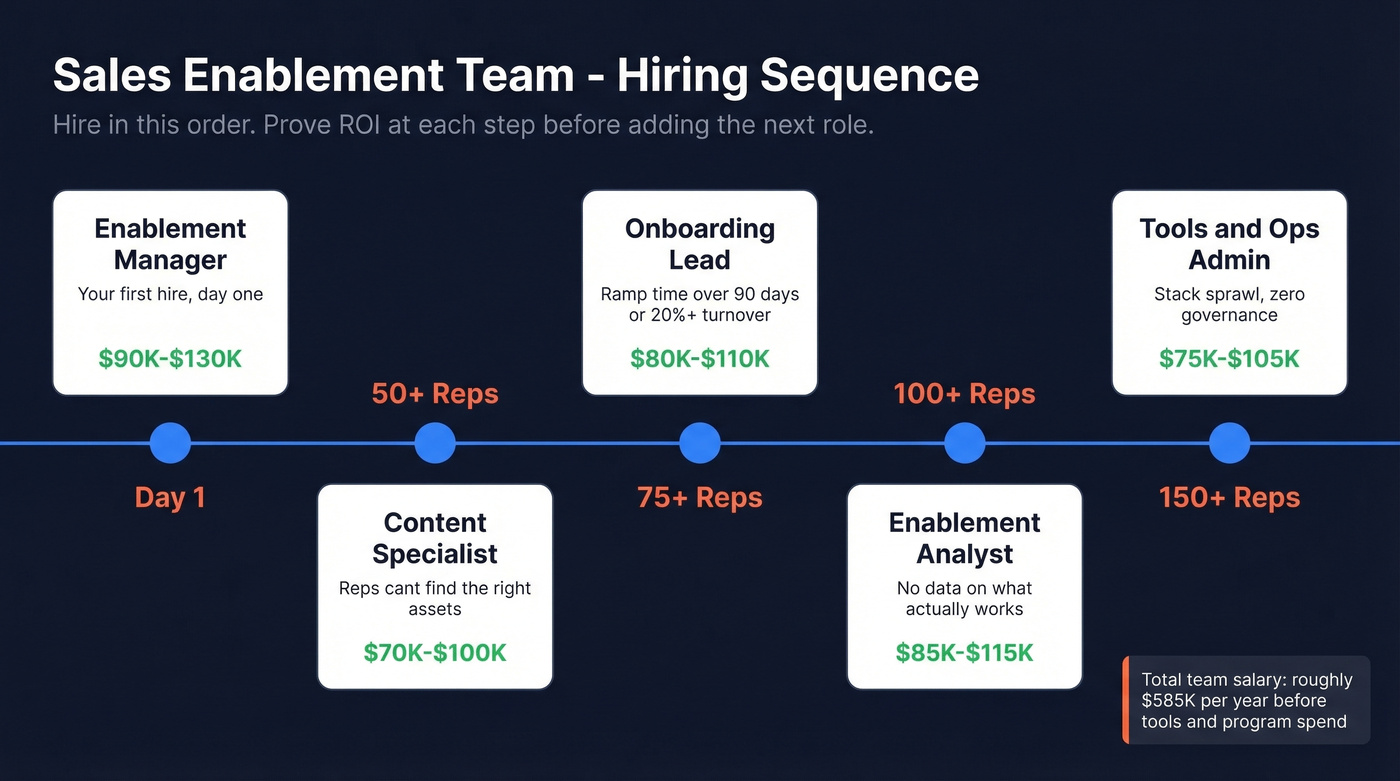
Don't hire a dedicated content creator, a tools administrator, or an analytics specialist yet. Those come later. Your first hire needs to be comfortable doing all three at a basic level while figuring out what actually improves rep performance for your specific team.
Scaling to 3-5 People
Once you've proven the function works, here's the hiring sequence that makes sense for most organizations:
| Role | When to Add | Trigger Signal | Est. Salary Range |
|---|---|---|---|
| Enablement Manager | Day 1 | Function created | $90K-$130K |
| Content Specialist | 50+ reps | Reps can't find assets | $70K-$100K |
| Onboarding Lead | 75+ reps or 20%+ turnover | Ramp time >90 days | $80K-$110K |
| Enablement Analyst | 100+ reps | No data on what works | $85K-$115K |
| Tools/Ops Admin | 150+ reps | Stack sprawl, no governance | $75K-$105K |
A modest enablement team runs roughly $585K per year in salary alone - before program spend, tools, or external content. That's real budget, which is exactly why you need to hire in the right order and prove ROI at each step.
The Hiring Filter That Matters Most
Among top-performing enablement organizations, 95% of enablement hires had at least one year of quota-carrying experience. That's not a nice-to-have. It's the single strongest predictor of whether an enablement hire will earn credibility with the sales floor.
Reps can smell someone who's never had to close a deal, and they'll tune out fast.
The most common failure mode isn't effort - it's lack of executive sponsorship. Without a C-level champion, enablement gets treated as a cost center no matter how talented the team is.
Organizational Structures That Work
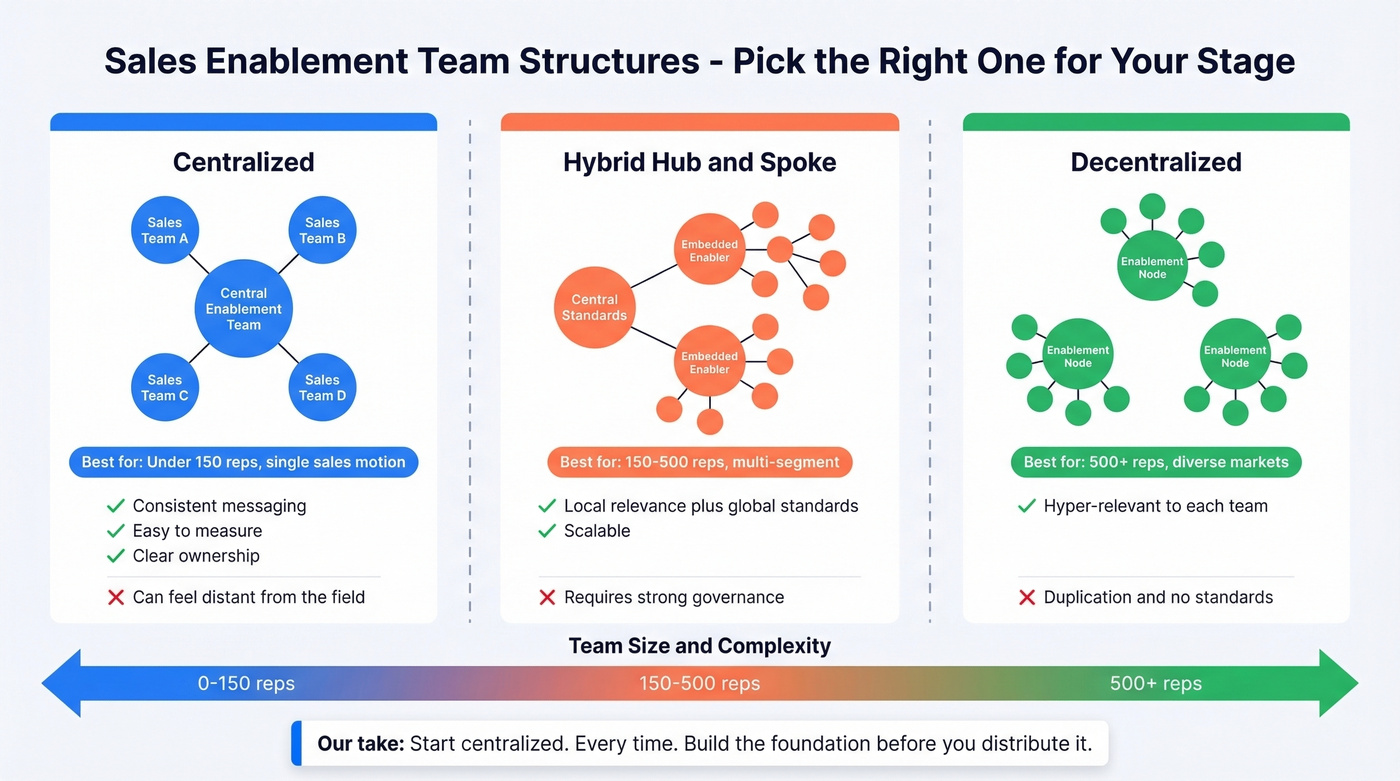
Three structural models exist, and picking the wrong one creates more problems than having no structure at all.
| Model | Best For | Pros | Cons |
|---|---|---|---|
| Centralized | Smaller teams, single motion | Consistent, measurable | Can feel distant from field |
| Hybrid hub-and-spoke | Multi-segment orgs | Local + global standards | Requires strong governance |
| Decentralized | Large orgs with diverse regions | Hyper-relevant to each team | Duplication, no standards |
When should you switch? Move from centralized to hybrid after crossing 150 reps and having embedded enablers who can maintain the standards you've built. Move from hybrid to decentralized only when you have 500+ reps across genuinely different markets or geographies - and even then, keep a central team setting standards.
Here's our prescriptive take: start centralized. Every time. Sales complexity, GTM scope, geography, and maturity of adjacent functions like RevOps and PMM all factor in, but a centralized model gives you clarity of ownership, consistency in messaging, and the ability to actually measure what's working.

You said it yourself: fix data quality before investing in enablement platforms. Reps prospecting with 60% accurate contact data waste every dollar you spend on training and content. Prospeo delivers 98% verified email accuracy with a 7-day refresh cycle - so your enablement investment actually converts to pipeline.
Stop enabling reps to fail on bad data. Start with Prospeo.
Who Owns Enablement - and Where It Should Report
This question generates more internal politics than almost any other org design decision. Here's where enablement functions actually sit today, per the Sales Enablement Landscape Report:
| Reports To | % of Teams | Best When... |
|---|---|---|
| RevOps | 39.4% | Cross-functional alignment |
| Sales | 25.4% | OKR alignment with quota |
| C-suite | 16.6% | Exec sponsor + budget |
| Marketing | 5.2% | Content-heavy model |
| PMM | 3.5% | Product-led GTM motion |
| HR/L&D | 2.6% | Compliance-heavy industries |
RevOps is the most common home, and for good reason - it gives enablement a cross-functional mandate without being buried under a single department's priorities. If your CRO is the executive champion and wants tight alignment to quota, reporting into Sales works too.
The worst option? HR. Enablement under HR almost always gets treated as a training function, not a revenue function. Who owns enablement matters less than whether that owner has executive sponsorship and a clear mandate tied to revenue outcomes.
When to Scale - The 1:30 Rule
The 1:30-1:50 ratio is your north star. One enablement manager per 30-50 reps. When you're consistently above 1:50, you're leaving impact on the table.
Headcount ratio isn't the only trigger, though. Watch for these signals: entering new market segments that need different messaging, expanding into new geographies with different buyer expectations, or broadening scope to include CS and partner enablement. Worth stealing from 360Learning's playbook - their enablement hiring process includes a case study gate where candidates present a real enablement scenario before advancing. It filters for practitioners over theorists, and we've seen similar approaches work well in our own hiring conversations with enablement leaders.
The Measurement Problem
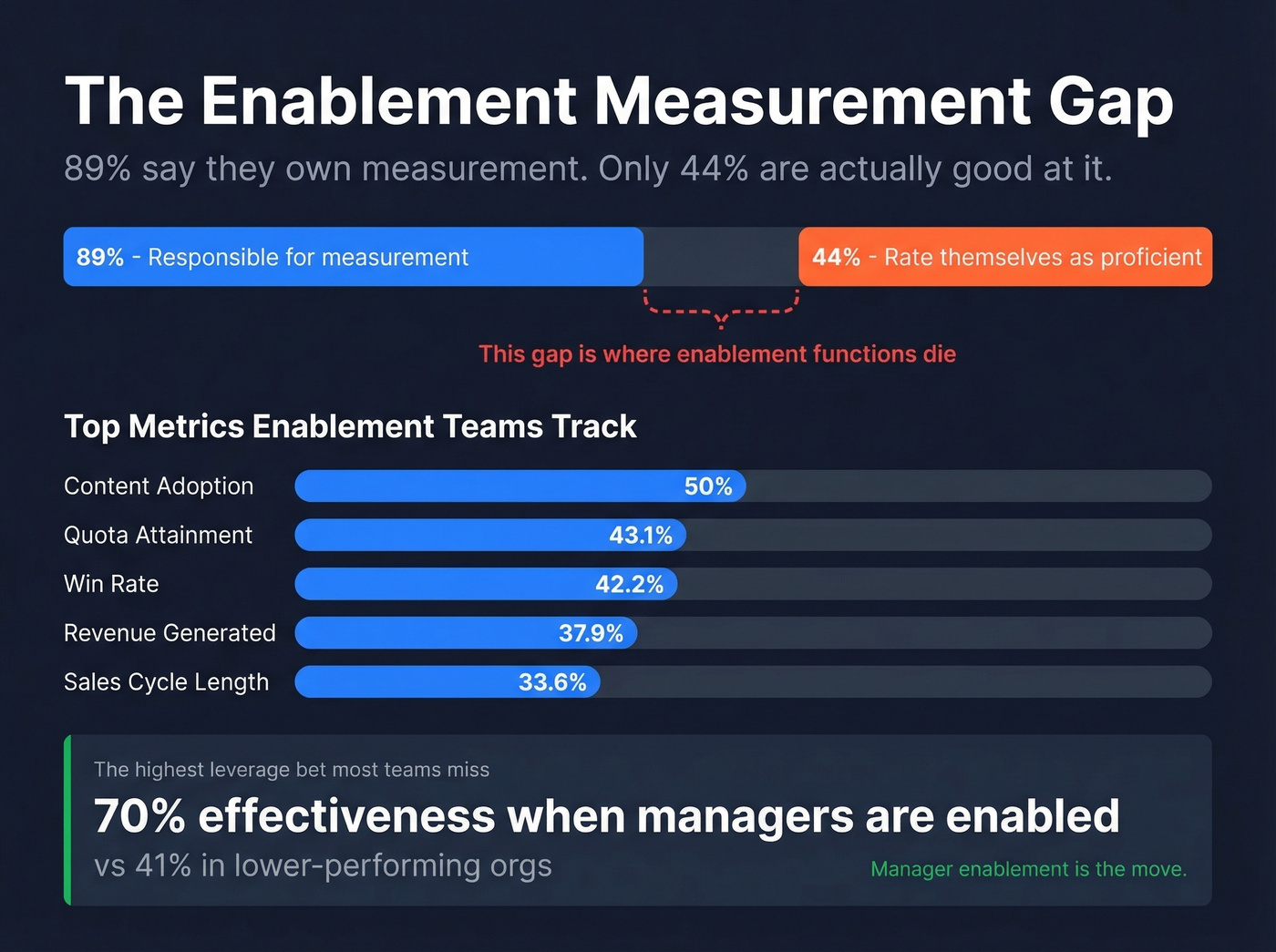
Let's be honest about this one: 89% of enablement teams say they're responsible for measurement and analytics. Only 44% rate themselves as proficient at it. That gap is where enablement functions die - not from lack of effort, but from inability to prove their impact.
The best framework treats enablement like a product team. Reps are your internal customers. Programs are your products. You ship, measure adoption, iterate, and kill what doesn't work. The Sales Enablement Collective advocates this approach, and it works because it forces measurement discipline from day one.
The top metrics enablement teams report on: content adoption (50%), quota attainment (43.1%), win rate (42.2%), revenue generated (37.9%), and sales cycle length (33.6%).
One stat that should change how you invest: teams where managers are enabled effectively see 70% effectiveness ratings, compared to 41% in lower-performing orgs. Manager enablement is the highest-leverage bet most teams aren't making.
Enablement Tech Stack in 2026
The Consolidation Wave
The enablement tool market is consolidating fast. Seismic and Highspot announced a merger in February 2026. Showpad completed its merger with Bigtincan in October 2025. Gong is expanding beyond conversation intelligence into broader revenue enablement, and AI coaching tools are reshaping how teams deliver real-time guidance at scale - think automated call scoring, predictive content surfacing, and rep-specific coaching nudges.
For buyers, this means fewer standalone options and more pressure to pick a platform that'll survive the next round of M&A. Don't sign a three-year contract with a tool that could get absorbed and sunset.
What to Buy First
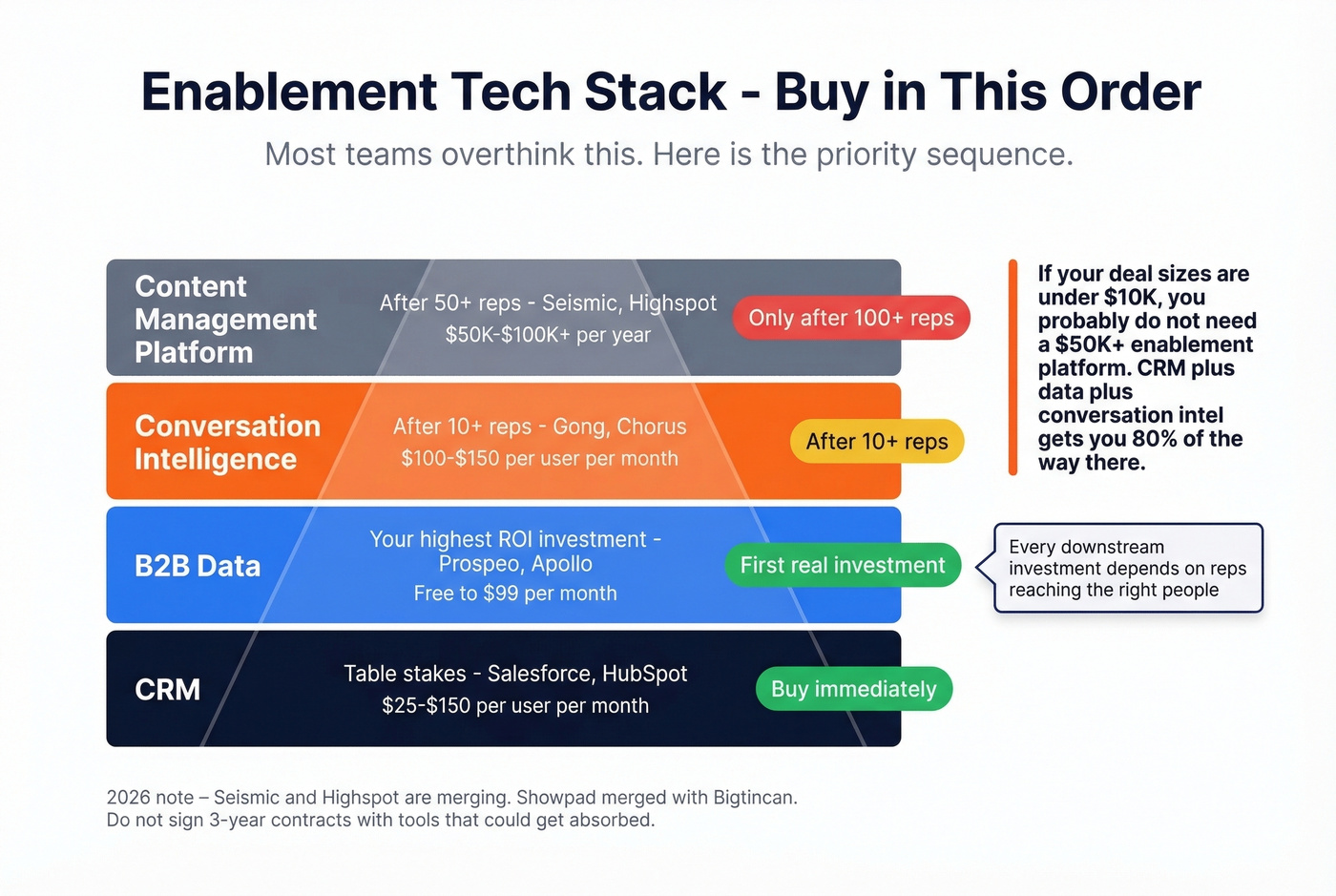
Most teams overthink their tech stack. Priority order:
| Category | Priority | Examples | Cost Range |
|---|---|---|---|
| CRM | Table stakes | Salesforce, HubSpot | $25-$150/user/mo |
| B2B Data | First real investment | Prospeo, Apollo | Free-$99/mo |
| Conversation Intel | After 10+ reps | Gong, Chorus | ~$100-$150/user/mo |
| Content Management | After 50+ reps | Seismic, Highspot | $50K-$100K+/yr |
Your CRM is assumed. After that, the single highest-ROI investment is clean prospect data - because every other enablement investment downstream depends on reps actually reaching the right people. We've seen this pattern repeatedly: teams pour money into training and content platforms while their reps are burning sequences on bounced emails from stale databases.
Here's the thing - if your deal sizes are sub-$10K, you probably don't need a $50K+ enablement platform. A CRM, a solid data layer, and a conversation intelligence tool will get you 80% of the way there. Save the enterprise platform spend for when you've crossed 100 reps and have the governance to actually use it.
Skip the Enterprise Pricing
Enterprise enablement platforms run $50K-$100K+ per year. For teams under 100 reps, that's hard to justify when self-serve alternatives exist.
GreyScout cut rep ramp time from 8-10 weeks to 4 weeks after switching their data layer - proof that clean prospect data on day one is the fastest onboarding shortcut most enablement teams overlook.

A $585K enablement team budget means nothing if reps can't reach the right buyers. Prospeo gives your team 300M+ verified profiles, 125M+ direct dials with a 30% pickup rate, and 30+ filters to build targeted lists - at $0.01 per email. That's the foundation your enablement programs need to actually move quota.
Equip your reps with contacts that connect, not bounce.
Sales Enablement vs. Revenue Enablement
The shift from "sales enablement" to "revenue enablement" isn't just a title change - it reflects a real expansion in scope. Revenue enablement spans Sales, Marketing, CS, and RevOps across the full customer journey. An HBR Analytic Services study found that 90% of organizations recognize the value of cross-functional collaboration, but only 37% say they do it well.
When should you make the shift? Only after your enablement team is already hitting its sales-focused KPIs and your CS or partner teams are actively asking for the same kind of support. Don't expand scope before you've proven the model works for sales first. The 70% of organizations using AI for enablement that report increased productivity suggests the transition is becoming more feasible with leaner teams - AI handles the repetitive coaching and content surfacing that used to require dedicated headcount for each function.
Skip the "revenue enablement" rebrand if your sales enablement team hasn't yet nailed onboarding, content adoption, and basic performance measurement. Expanding scope prematurely is how good enablement functions collapse under their own ambition.
FAQ
What's the ideal size for a sales enablement team?
One enablement manager per 30-50 reps is the standard benchmark. Most companies start with one or two people and scale to five as they cross 100+ reps. Budget roughly $585K+ per year in base salary alone.
Should enablement report to sales or RevOps?
RevOps (39.4% of teams) delivers the strongest cross-functional alignment. Sales (25.4%) works when your CRO wants tight quota accountability. Avoid HR - it turns enablement into a training function, not a revenue driver.
How much does an enablement team cost?
A five-person team runs approximately $585K in base salary. Fully loaded with benefits, tools, and program spend, expect $750K-$900K annually for a mid-market organization.
What's the difference between sales enablement and sales ops?
Enablement focuses on rep effectiveness - training, content, coaching. Ops focuses on process, tools, and data infrastructure. They're complementary functions but own distinct outcomes tied to different KPIs.