

=== CURRENT ARTICLE (slug: sales-enablement-vs-sales-training) ===
Sales Enablement vs Sales Training: Where Should You Invest?
You ran a $50K sales kickoff in January. By March, reps were back to their old habits - same objection fumbles, same stale decks, same pipeline gaps. That's not a training failure. It's a systems failure, and it's exactly why the sales enablement vs sales training debate matters more than ever. According to Highspot's 2025 State of Sales Enablement report, 55% of organizations still can't effectively drive their go-to-market initiatives despite spending more on both than ever before.
The Short Answer
Sales training teaches reps how to sell - skills, methodology, product knowledge. Sales enablement gives them the tools, content, and data to execute what they learned. Training is an event. Enablement is an operating system.
You need both, but where your next dollar goes depends on your biggest bottleneck.
What Is Sales Training?
Sales training is structured skill development: workshops, certifications, role-plays, methodology rollouts like SPIN Selling or Challenger. It's time-bound, usually owned by L&D, and measured by completion rates and assessment scores.
The U.S. spent [$102.8 billion on training in 2025] - up 4.9% year over year - at an average of $874 per learner. That's serious money. But here's the catch: reps forget 70% of what they learn within a week if it isn't reinforced. Every hour in a classroom is an hour not on the phone, and that tradeoff only pays off when the knowledge actually sticks. Without a reinforcement mechanism, you're essentially renting skills instead of building them.
What Is Sales Enablement?
Sales enablement is the ongoing infrastructure that makes reps effective: content management, sales intelligence, playbooks, coaching tools, and the data layer underneath all of it. It's continuous, not episodic, and typically owned by RevOps or a dedicated enablement function.
The global enablement platform market hit $6.58 billion in 2025 and is projected to reach $35.68 billion by 2035 - an 18.42% CAGR. On r/sales, practitioners describe good enablement as a sign that an org "has their stuff together." But enablement that becomes docs and trainings reps don't use is broken enablement. The bar is adoption, not output.
Key Differences at a Glance
| Dimension | Sales Training | Sales Enablement |
|---|---|---|
| Scope | Skill development | Tools, content, data, process |
| Duration | Event-based (days/weeks) | Ongoing / continuous |
| Ownership | L&D / HR | RevOps / Enablement |
| Measurement | Completion, assessments | Win rates, deal velocity, content usage |
| Buyer alignment | Indirect (skill transfer) | Direct (content + data) |
| Scalability | Instructor-dependent | Platform-driven |
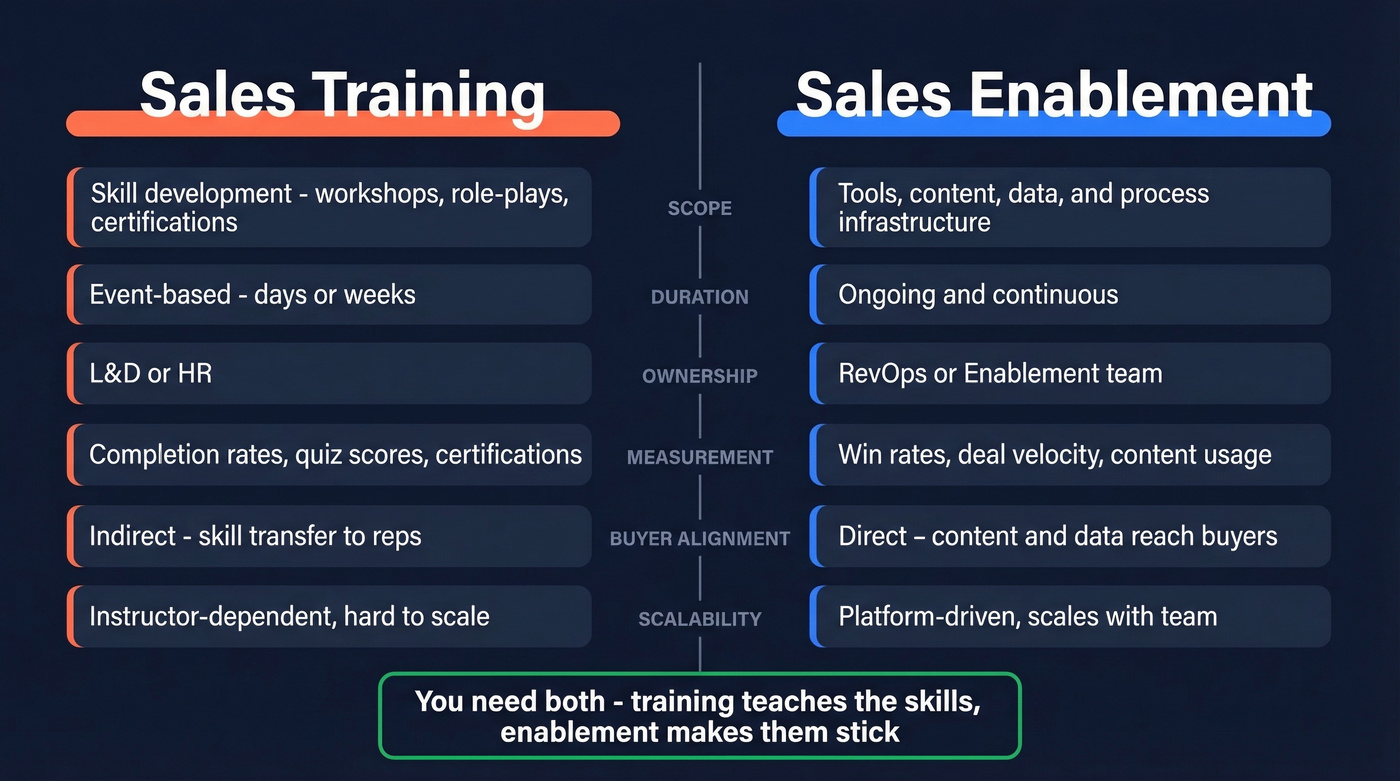
The most important row is measurement. Training teams report completion rates and quiz scores. Enablement teams report win rates and pipeline metrics like deal velocity and content usage. That gap in how each discipline proves its value is the single biggest source of organizational tension between them.

You just read that reps forget 70% of training within a week. But even the training that sticks falls flat when reps dial dead numbers and bounce emails. Prospeo delivers 98% email accuracy and 125M+ verified mobiles on a 7-day refresh - so your enablement investment actually converts to pipeline.
Stop blaming your enablement platform when the data underneath it is broken.
When to Invest in Each
The decision isn't binary - it depends on where your team is right now and what's actually blocking revenue.
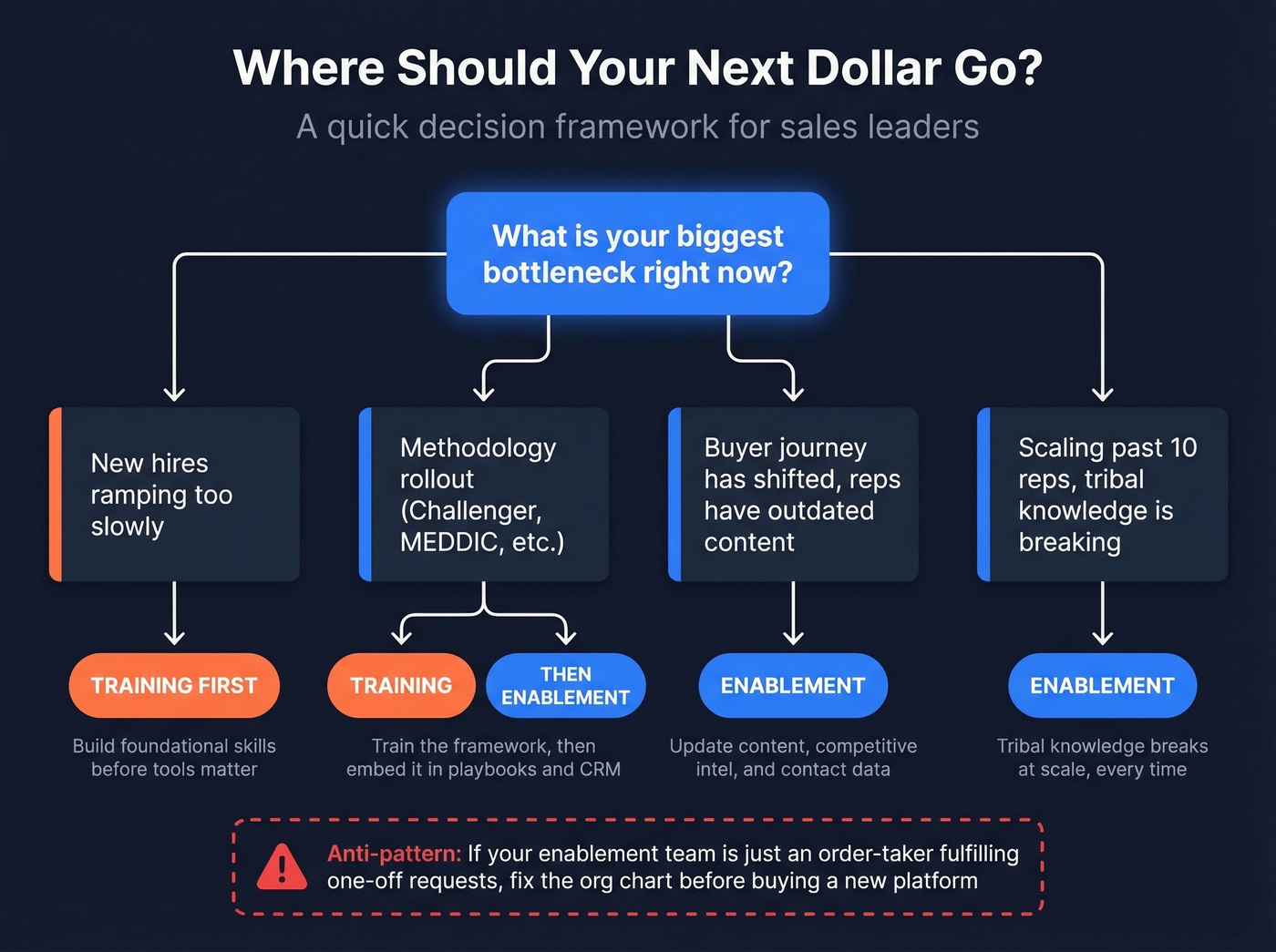
New hire onboarding calls for training first. Reps need foundational skills before tools matter. A methodology rollout needs training to introduce the framework, then enablement to embed it into playbooks and CRM workflows so it doesn't evaporate by Q2.
When the buyer journey shifts - and it's shifting constantly in 2026 - that's an enablement problem. Reps need updated content, competitive intel, and better data to match how buyers actually buy. And once you're scaling past 10 reps, enablement infrastructure becomes non-negotiable. Tribal knowledge breaks at scale. Every time.
One anti-pattern we see constantly: enablement becomes an order-taker function, reacting to ad-hoc requests instead of driving strategy. If your enablement team spends most of its time fulfilling one-off content requests from individual reps, that's a broken operating model - skip the new platform purchase and fix the org chart first.
How to Measure ROI
Training metrics center on completion rates, certification scores, and new hire ramp time. Enablement metrics focus on win rates, deal velocity, content usage, and pipeline sourced or influenced.
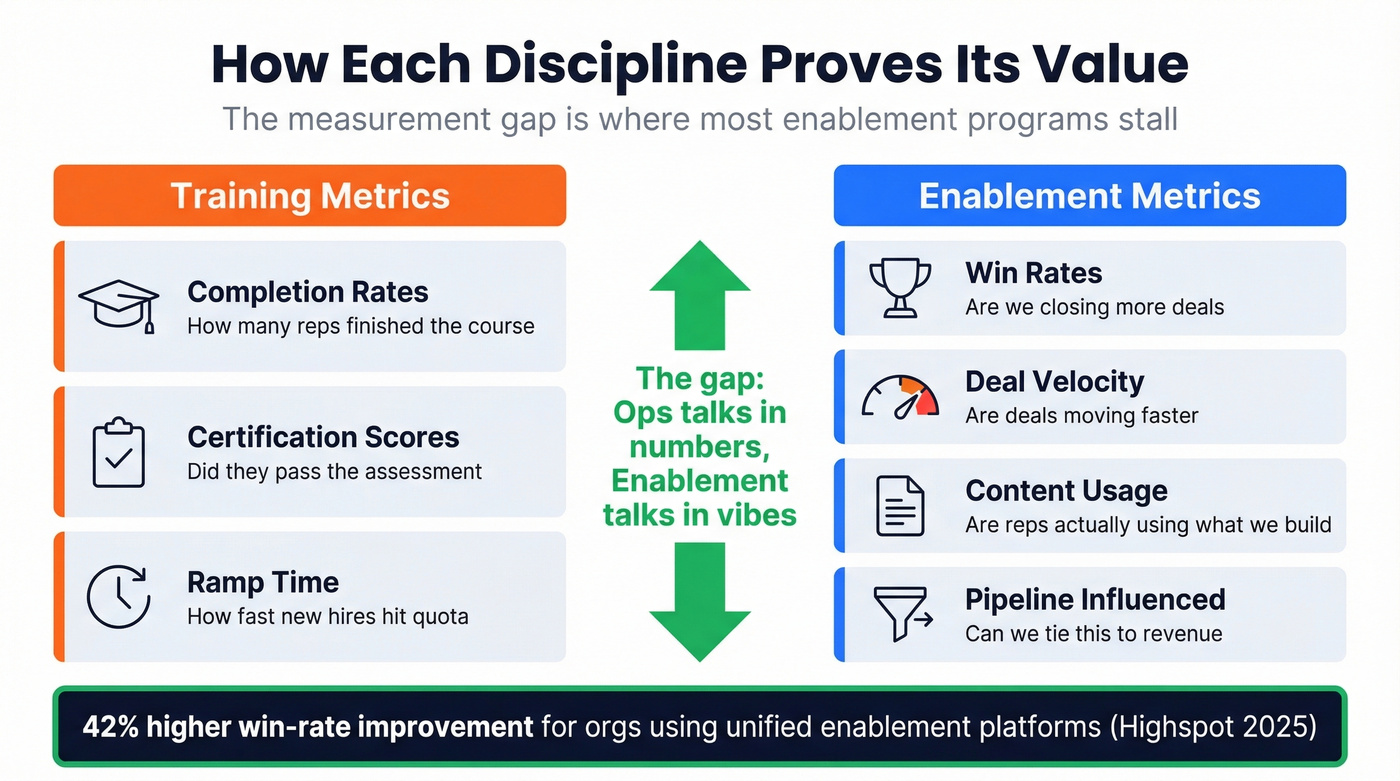
Here's the thing. As one Reddit practitioner put it: "Ops talks in numbers. Enablement talks in vibes." In our experience, this measurement gap is where most enablement programs stall. If enablement can't tie its work to revenue, leadership treats it as a nice-to-have - and it's the first budget cut when the board starts asking questions.
Organizations using a unified enablement platform are 42% more likely to improve win rates. The measurement problem isn't unsolvable. It just requires the right infrastructure and a team willing to instrument their content and workflows properly.
The Enablement Stack in 2026
Enablement platforms are consolidating fast. Seismic and Highspot announced a definitive merger in February 2026. Showpad completed its merger with Bigtincan in October 2025. Gong expanded into full revenue enablement in early 2026. Point solutions are collapsing into platforms, and orgs are running two fewer tools on average compared to last year. Enterprise enablement platforms typically run $20K-$150K+/year depending on team size and feature depth.

None of these tools work when reps are calling stale numbers and bouncing emails. We've watched teams blame their enablement platform when the real failure was the contact data underneath it. That's where Prospeo fits - 98% email accuracy on a 7-day refresh cycle, with a free tier to test before committing. Your enablement stack is only as good as the data feeding it.
Let's be honest: most teams don't need a $100K enablement platform. They need a CRM their reps actually use, a content library that isn't a graveyard, and contact data that doesn't bounce. Start there.
Making Training and Enablement Work Together
The real power is the reinforcement loop. Training introduces a methodology. Enablement embeds it into tools and playbooks. Managers reinforce through coaching. Data from enablement platforms identifies skill gaps so training can iterate. It's a cycle, not a choice.
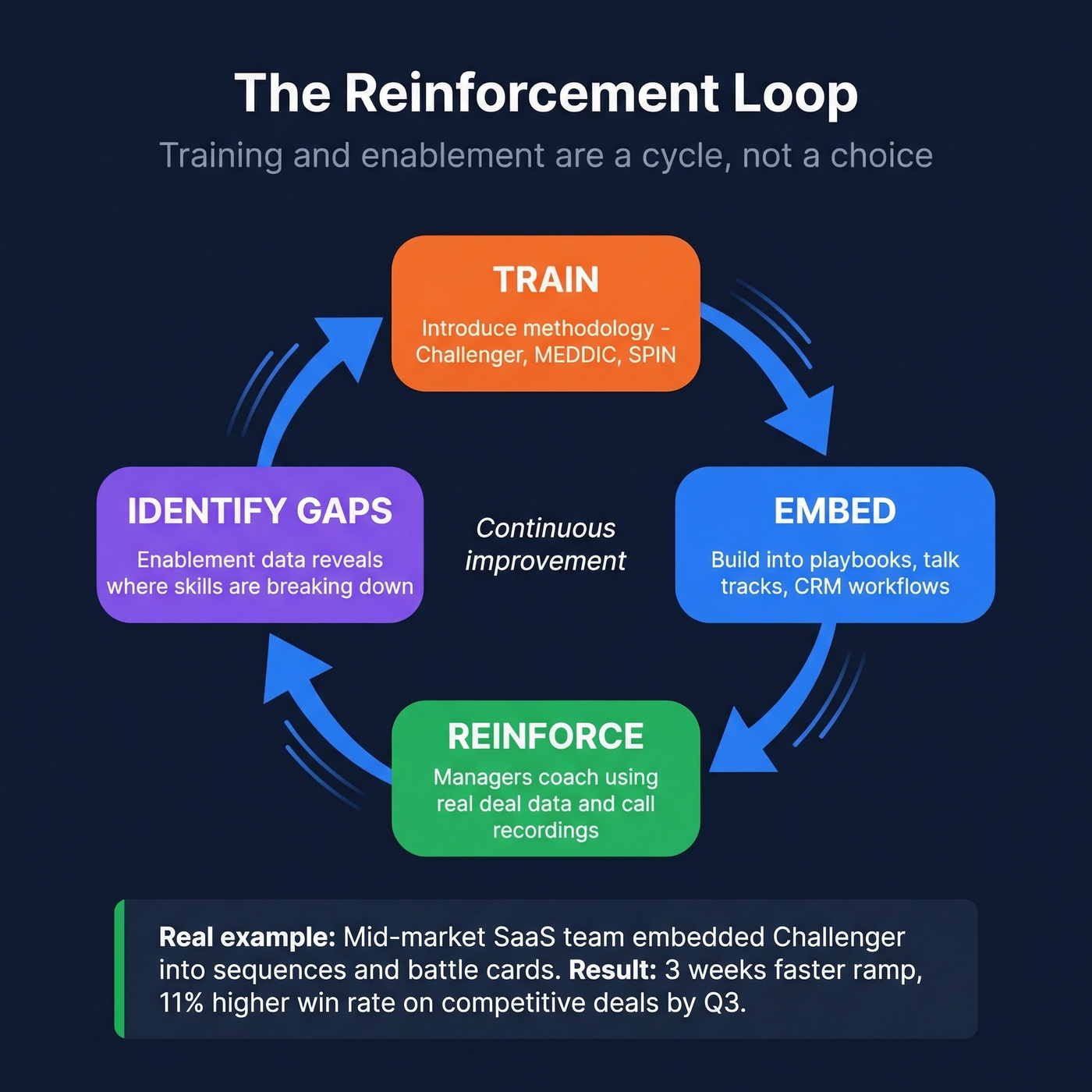
We worked with a mid-market SaaS team last year that ran Challenger training in Q1, then built Challenger-aligned talk tracks directly into their sales engagement sequences and battle cards. Reps weren't just taught the methodology - they couldn't avoid using it because it was baked into every workflow. Ramp time dropped by three weeks and win rates on competitive deals climbed 11% by Q3.
Stop debating sales enablement vs sales training as an either-or. The real question is whether your team has the data, tools, and skills to book the next meeting. Everything else is organizational politics.
The enablement stack only works when the data layer is solid. Teams using Prospeo replace stale contact databases with 300M+ profiles verified every 7 days - not the 6-week industry average. At $0.01 per email, it costs less than one hour of wasted rep time on bad numbers.
Give your reps data worth enabling - start with 75 free emails.
FAQ
Is sales enablement the same as sales operations?
No. Sales ops manages CRM administration, forecasting, territory planning, and compensation. Enablement focuses on content, training reinforcement, and the tools that help reps sell. They overlap on data and process, but carry different mandates.
How do you measure sales enablement ROI?
Track win rates, average deal velocity, and content engagement before and after enablement rollouts. Organizations using unified enablement platforms see 42% higher win-rate improvement. If your enablement team can't tie its work to pipeline or revenue metrics, it's flying blind.
Can a small team handle both training and enablement?
Yes. Under 50 reps, one person often owns both. Start with structured onboarding and a maintained content library. Add enablement infrastructure - verified contact data, playbooks, deal rooms - as you scale past tribal knowledge.
What tools do you need for a basic enablement stack?
At minimum: a CRM reps actually use, a content system that isn't a shared Google Drive, and verified contact data. Platforms like Seismic or Highspot add content management and analytics at scale, but clean data is the foundation - everything else sits on top of it.