

The Sales Engagement Market Is Consolidating - Here's What That Means
62% of organizations run some form of engagement platform. Yet the category itself is being dismantled and rebuilt under a new name. The sales engagement market hits $9.2B in 2026, growing at a 16.4% CAGR - but the standalone SEP as we've known it is disappearing into something bigger.
What Is Sales Engagement?
Gartner defines sales engagement applications as tools combining multichannel outreach, workflow execution, and AI-driven automation into a single interface while syncing activity data back to your CRM. That means sequencing, call logging, email tracking, and analytics in one place. If you've ever asked "do I need a separate engagement platform," the answer increasingly depends on whether your CRM already covers these capabilities natively.
Here's the critical nuance: Gartner now explicitly labels this category as "Sales Engagement Applications (Transitioning to Revenue Action Orchestration)." That parenthetical isn't decoration. It signals the standalone SEP category has an expiration date.
Market Size and Growth
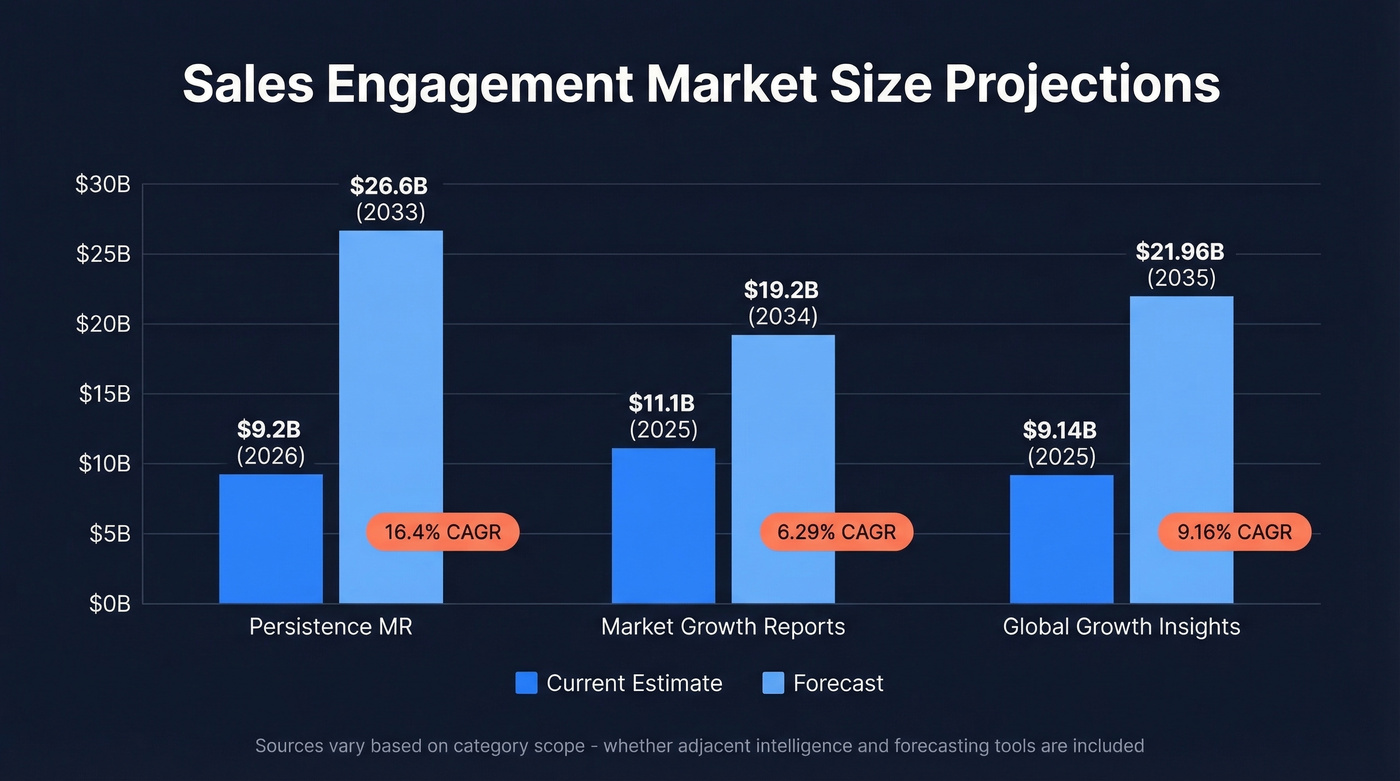
Sizing this market depends on who you ask.
| Source | Size (2025-26) | Forecast | CAGR |
|---|---|---|---|
| Persistence MR | $9.2B (2026) | $26.6B (2033) | 16.4% |
| Market Growth Reports | $11.1B (2025) | $19.2B (2034) | 6.29% |
| Global Growth Insights | $9.14B (2025) | $21.96B (2035) | 9.16% |
The discrepancy comes down to scope - whether you include adjacent intelligence and forecasting tools or stick to pure engagement. Persistence's numbers are the most widely cited and align with what we see in practice.
North America holds 38% of the platform market. APAC is the fastest-growing region at 17.2% CAGR. Cloud deployment accounts for 58% of implementations, and SMBs are the fastest-growing buyer segment at 18.5% CAGR, making the small-team segment one of the most competitive battlegrounds right now. Tools like Apollo have made enterprise-grade sequencing accessible at $49/month, which has completely reset buyer expectations around pricing.
Roughly 62% of organizations now rely on some form of engagement platform. Adoption isn't the question anymore. ROI is: early adopters report 25% productivity gains, 15% revenue growth, and 20% faster rep ramp times.
The Evolution - and Expiration Date
The standalone "sales engagement platform" as a category is being absorbed. What started as basic email sequencing grew into multichannel inside sales software, then layered on analytics and AI - and now the category is merging with revenue intelligence entirely.
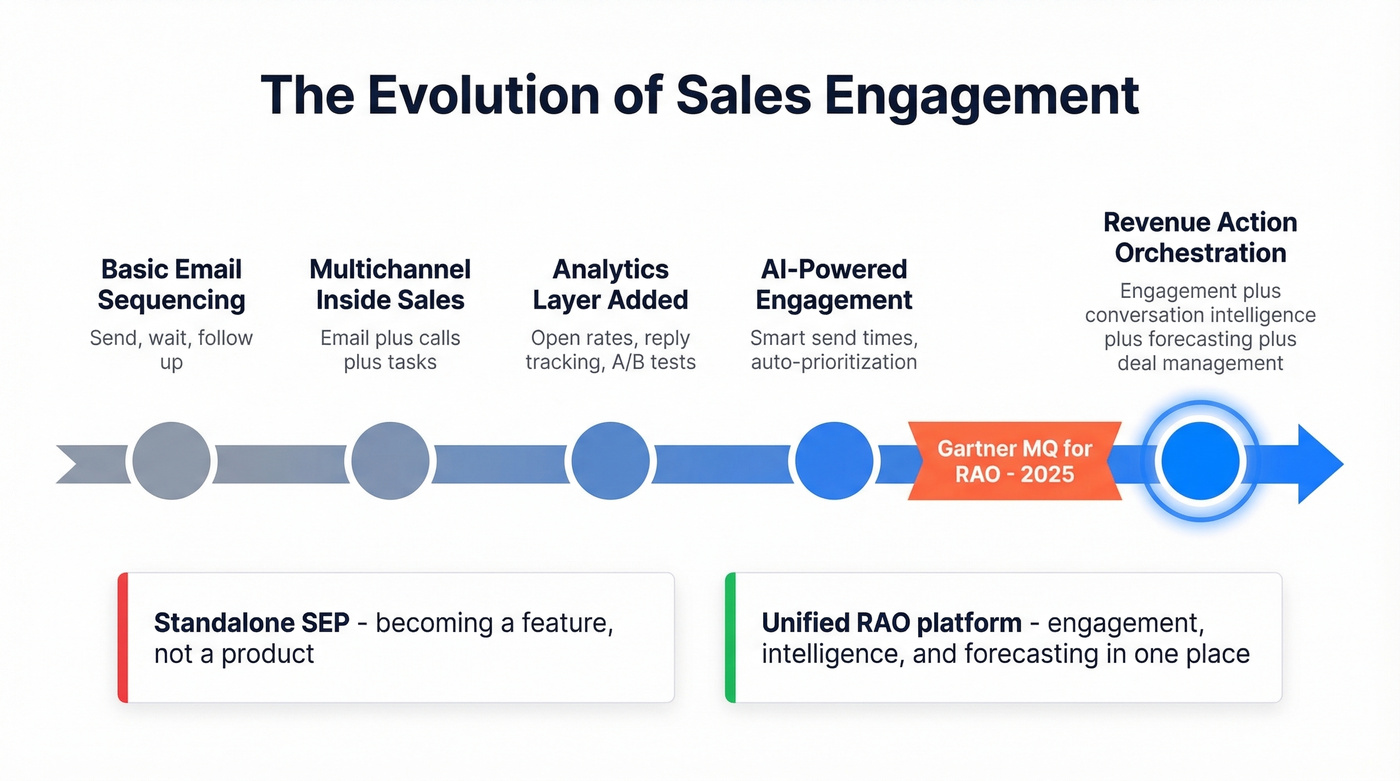
Gartner published its first-ever Magic Quadrant for Revenue Action Orchestration in 2025, evaluating 12 vendors. Gong and Clari landed as Leaders. Salesloft came in as a Visionary. Forrester isn't far behind - they coined "Revenue Orchestration Platform" in 2024. Different label, same thesis: engagement, conversation intelligence, and forecasting belong in a unified platform, not three separate tools.
Let's be honest about the cost of ignoring this. Fragmented sales systems cost organizations 20-30% of potential revenue. That's not a rounding error. It's the cost of bolting together six point solutions that don't talk to each other. We've watched teams consolidate from 8-12 point solutions down to 4-6 integrated platforms, and the biggest barriers are exactly what you'd expect: 37% cite integration complexity, 33% struggle with data sync issues.
The standalone SEP that only does sequencing and call logging? It's becoming a feature, not a product.

Fragmented sales stacks cost 20-30% of revenue. The fix isn't another platform - it's better data underneath. Prospeo feeds your engagement tools with 98% accurate emails from 300M+ profiles, refreshed every 7 days instead of the 6-week industry average.
Stop sequencing into the void. Start with data that connects.
The Consolidation Wave
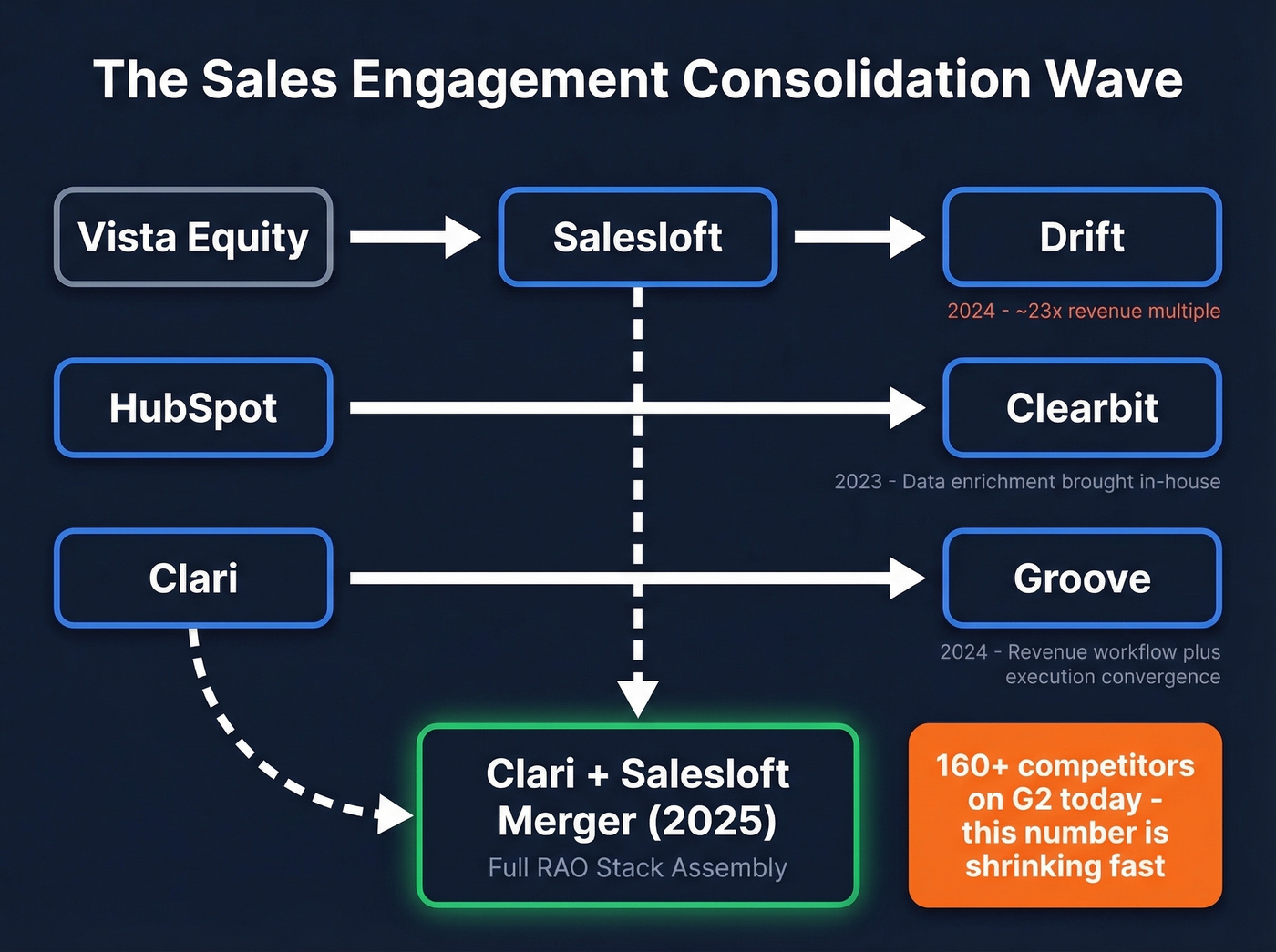
The M&A activity tells the story better than any analyst report.
| Year | Acquirer | Target | Why It Matters |
|---|---|---|---|
| 2024 | Vista Equity | Salesloft | ~23x revenue multiple |
| 2024 | Salesloft (Vista) | Drift | Conversational AI bolt-on |
| 2023 | HubSpot | Clearbit | Data enrichment in-house |
| 2024 | Clari | Groove | Revenue workflow + execution convergence |
| 2025 | Clari + Salesloft | Merger | Full RAO stack assembly |
There are over 160 competitors in the engagement space on G2 alone. That number is going to shrink fast. The Clari-Salesloft merger is the clearest signal: a revenue intelligence company combining with an engagement company to build a unified RAO platform covering everything from prospecting to closed-won.
AI agents are accelerating the timeline. By end of 2026, 40% of enterprise applications will feature AI agents, up from less than 5% in 2025. Basic sequencing - the core of automated outreach - is exactly the kind of workflow AI agents replace first. Both Outreach and Salesloft shipped agent-based features in 2025, and we expect every major vendor to follow suit within the next 12 months.
Key Players and Pricing
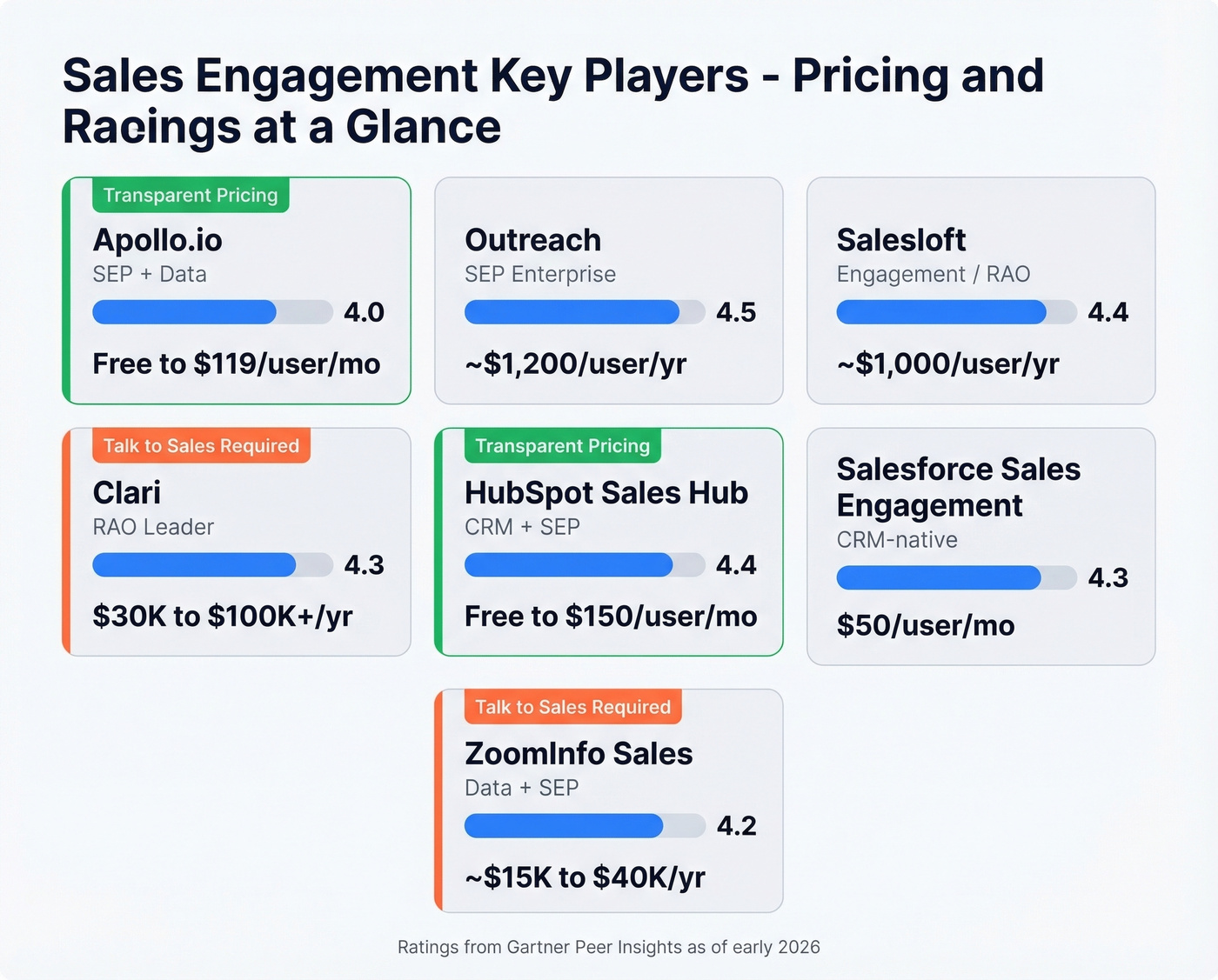
Apollo is eating the mid-market because it publishes its prices and ships a 270M+ contact database alongside its engagement tools. That combination sounds trivial, but in a category where most vendors hide behind "talk to sales," transparency is a genuine competitive advantage.
| Vendor | Category | Gartner PI Rating (Reviews) | Pricing |
|---|---|---|---|
| Apollo.io | SEP + Data | 4.0 (6) | Free-$119/user/mo |
| Clari | RAO Leader | 4.3 (310) | $30K-$100K+/yr |
| Salesloft | Engagement / RAO | 4.4 (284) | ~$1K/user/yr |
| Outreach | SEP Enterprise | 4.5 (185) | ~$1.2K/user/yr |
| HubSpot Sales Hub | CRM + SEP | 4.4 (97) | Free-$150/user/mo |
| Salesforce Sales Engagement | CRM-native | 4.3 (48) | $50/user/mo |
| ZoomInfo Sales | Data + SEP | 4.2 (106) | ~$15-40K/yr |
HubSpot's free CRM tier combined with Sales Hub sequences makes it the default entry point for teams that want outreach automation without a separate tool. The free tier with 1,200 credits/month lets teams start without procurement approval, and paid plans scale from $49 to $119/user/month. Compare that to Gong's platform fee model, where first-year costs land in the mid-five to low-six figures. Implementation timelines matter too: enterprise deployments typically run 6-12 months, while self-serve tools like Apollo and HubSpot go live in days.
Adoption is also spreading beyond traditional sales teams. Recruitment firms use sequencing tools to nurture candidate pipelines, agencies run white-label outreach at scale, and even real estate brokerages are emerging as niches as these industries digitize their prospecting.

The Data Problem Nobody Talks About
Most engagement failures aren't platform failures. They're data failures.
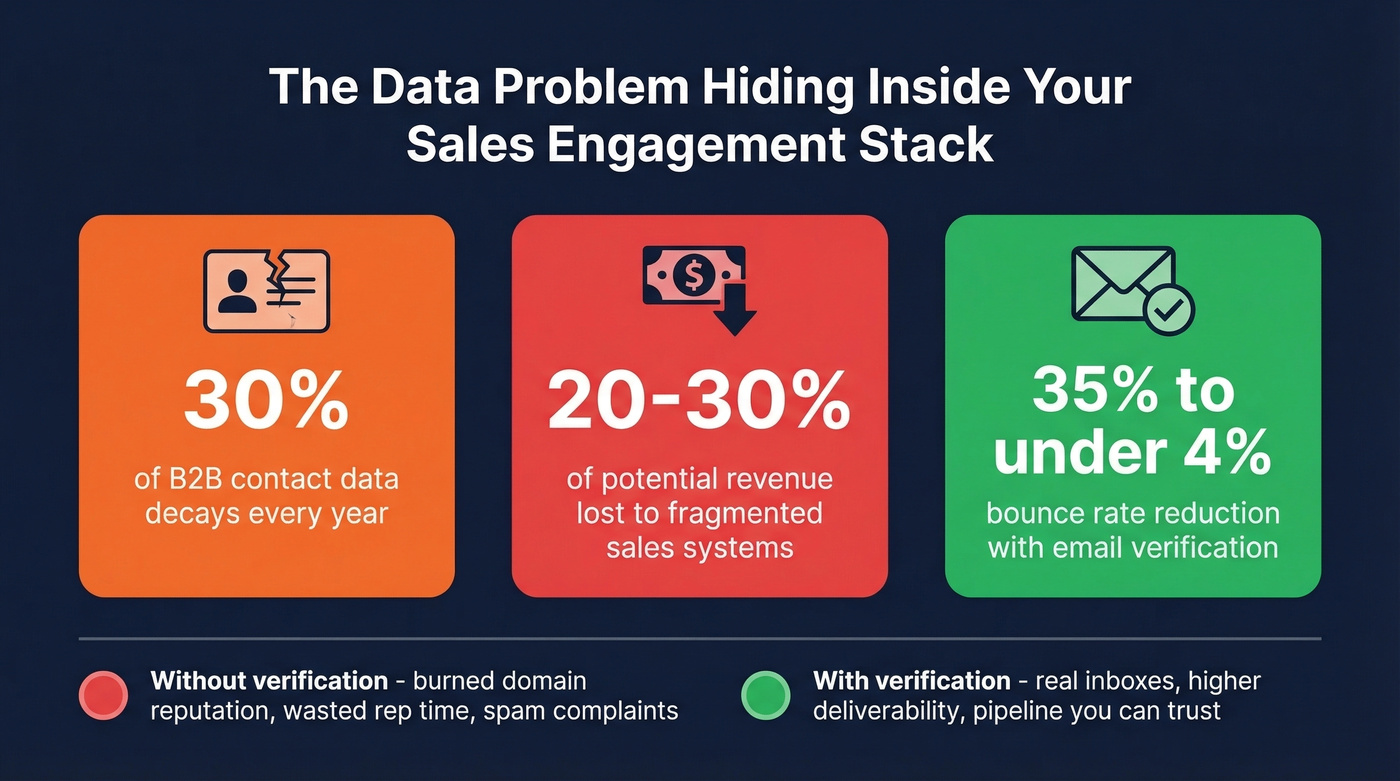
B2B contact data decays at roughly 30% per year. People change jobs, companies rebrand, phone numbers rotate. Your engagement platform doesn't verify any of this - it just sends whatever you load into it. Bad emails burn your domain reputation. Dead phone numbers waste rep time. Data quality is the single biggest predictor of campaign performance, yet it rarely appears on any buyer's evaluation checklist.
Look, the consensus on r/sales frames the space as "incredibly saturated" and worries that AI-scaled outreach is producing more spam. They're right - if the underlying data is garbage. The buyer experience suffers when prospects receive irrelevant messages at dead addresses, and it erodes trust across the entire channel.
This is where a verification layer like Prospeo fits. It's not an engagement platform - it's the data accuracy layer underneath one. With 300M+ professional profiles, 98% email accuracy, and a 7-day refresh cycle built on proprietary infrastructure, it catches the decay before your sequences do. One customer, Meritt, cut bounce rates from 35% to under 4% and tripled their pipeline from $100K to $300K/week by adding verification before loading contacts into their engagement tool.
B2B contact data decays 30% per year, but most engagement platforms never verify a single email. Prospeo's 5-step verification and 7-day refresh cycle keep your sequences hitting real inboxes - at $0.01 per email, not $1.
Your SEP doesn't fix bad data. Prospeo does.
What to Watch Through 2026
More M&A. Expect 2-3 major acquisitions as RAO vendors fill capability gaps. The 160+ competitor field will consolidate hard, and scalability will determine which mid-market vendors survive versus get absorbed.
AI agents replace basic sequencing. If your SEP's core value is "send email, wait, follow up," that workflow gets automated away first. We're watching automation move from rule-based sequences to autonomous agents that adapt messaging in real time.
Pricing transparency wins. Apollo proved that publishing prices drives adoption. More vendors will follow or lose mid-market deals to those who do. Skip any vendor that won't give you a ballpark without a demo call - it's 2026, not 2018.
Data quality becomes the differentiator. As platforms converge on similar features, the teams with cleaner contact data will outperform regardless of which tool they pick. If your average deal size is under $10K, you probably don't need a $50K platform. You need accurate data and a simple sequencer. Improving results starts with fixing your data, not upgrading your platform.
Mobile capabilities expand. Mobile app features are becoming table stakes as reps work from the field. Expect every major vendor to ship full-featured mobile experiences by late 2026.
The sales engagement market isn't dying - it's being absorbed into something larger. The winners will be teams that pick the right consolidation bet and pair it with data they can actually trust.
FAQ
How big is the sales engagement market in 2026?
Approximately $9.2B in 2026, projected to reach $26.6B by 2033 at a 16.4% CAGR. Estimates range from $9.14B to $11.1B depending on scope. North America holds 38% share; APAC grows fastest at 17.2% CAGR.
What's the difference between a sales engagement platform and revenue action orchestration?
SEPs handle multichannel outreach sequences - emails, calls, task management. Revenue Action Orchestration combines engagement with conversation intelligence, forecasting, and deal management in one platform. Gartner formalized the RAO category in 2025, and the standalone SEP is being absorbed into it.
Which sales engagement platform has the most users?
Apollo.io leads G2 with 9,235 reviews at 4.7/5, indicating the strongest adoption momentum. Its free tier and transparent pricing drive grassroots adoption. Gong follows with 6,407 reviews, Salesloft with 4,237, and Outreach with 3,511.
How do I improve engagement results without switching platforms?
Start with your contact data. Most failures stem from bad emails and dead phone numbers, not platform limitations. Verify your prospect list before loading it - teams routinely cut bounce rates from 30%+ to under 5% with a verification tool that refreshes data weekly. That single step often matters more than any feature upgrade.