

Sales Facilitation: The Complete Guide for B2B Teams
You ran a flawless demo. The champion loved it. Two weeks later, they went dark - not because they chose a competitor, but because they couldn't get their own team aligned. The deal didn't die in your pipeline. It died in their conference room.
This is the problem sales facilitation solves. As one enterprise SaaS seller put it on r/sales, the job isn't closing - it's "facilitating meetings with them and their team, creating a platform for them to buy." That framing changes everything about how you run a deal.
Facilitation is a methodology, not a personality trait. It means guiding buyers through their internal change management process - stakeholder alignment, risk assessment, consensus - instead of pitching harder. Below you'll get the framework, a head-to-head comparison with Challenger, SPIN, and Consultative Selling, and the actual questions to ask on your next call.
What It Actually Means
A sales process is your pipeline stages: discovery, demo, proposal, close. A sales methodology is how you execute within those stages. Facilitation is a methodology, and adopting one leads to 15% higher win rates and a 21% increase in quota attainment, per a Korn Ferry stat cited by Monday.com.
It's also distinct from enablement and training. Enablement is an operational function - content, tools, playbooks. Training is a time-bound program to build skills. Facilitation is what happens on the call, in real time, with the buyer.
The formal origin traces to Sharon Drew Morgen's Buying Facilitation methodology. Her core insight: selling and change management are two distinct skill sets. Buyers don't self-identify as "buyers" until they've handled internal alignment, risk assessment, and stakeholder buy-in. Only about 5% of prospects have already completed that internal work when you reach them. The other 95% need help navigating a structured change process before they're ready to select a vendor.
The 13-Step Buying Decision Path
Morgen's framework maps the internal journey a buyer goes through - much of which happens before vendor selection conversations even start. Here's the path, condensed into five phases:
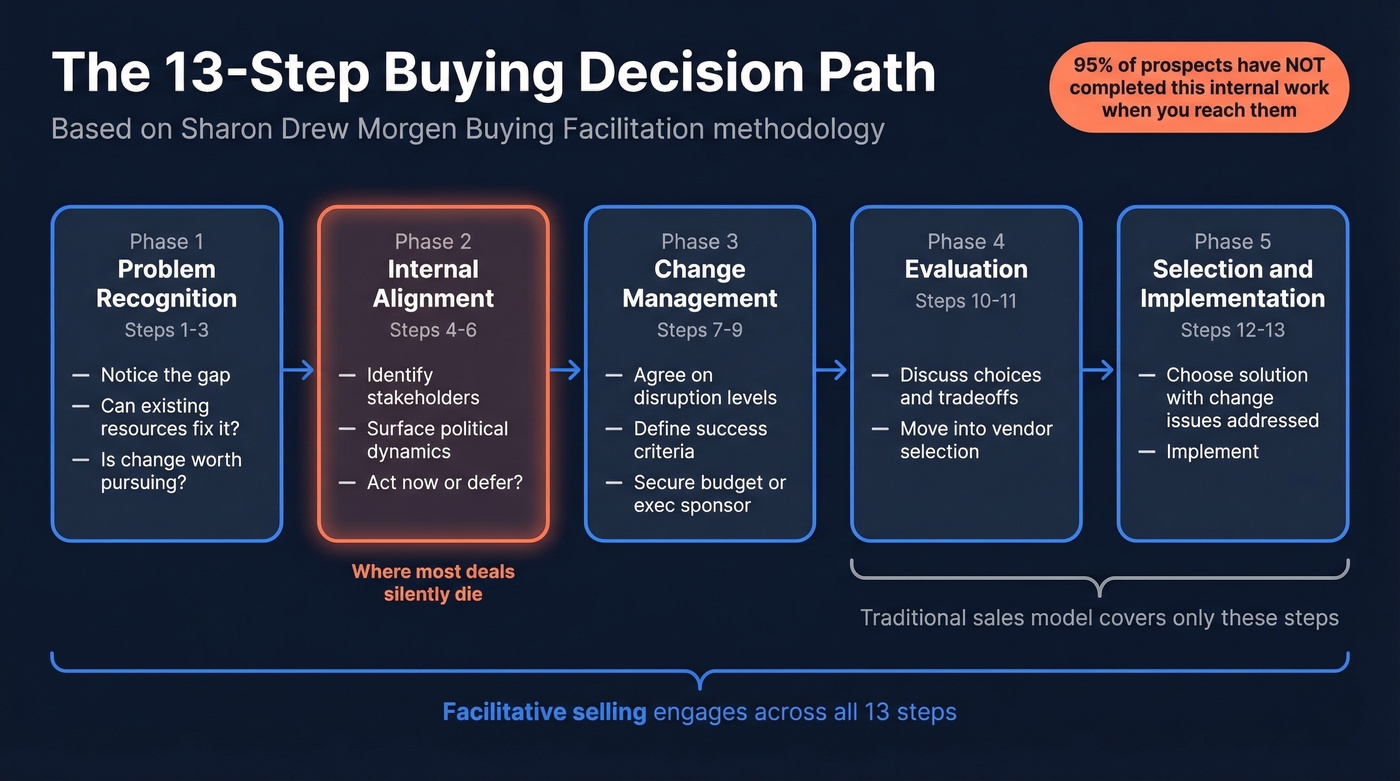
- Problem recognition (Steps 1-3). The buyer notices a gap, assesses whether existing resources can fix it, and determines if the issue warrants organizational change.
- Internal alignment (Steps 4-6). Stakeholders are identified, political dynamics surface, and the team debates whether to act now or defer. This is where most deals silently die.
- Change management (Steps 7-9). The buying committee agrees on acceptable disruption levels, defines success criteria, and gets budget or executive sponsorship.
- Evaluation (Steps 10-11). The buyer discusses choices, weighs tradeoffs, and moves into vendor selection.
- Selection and implementation (Steps 12-13). New solution chosen with change issues incorporated, then implemented.
The traditional sales model handles steps 10-13. A facilitative approach engages across all of them. That's the difference between closing a deal and wondering why your champion ghosted you after a great demo.
Why This Matters in 2026
The buying environment has shifted in ways that make facilitation necessary, not optional.
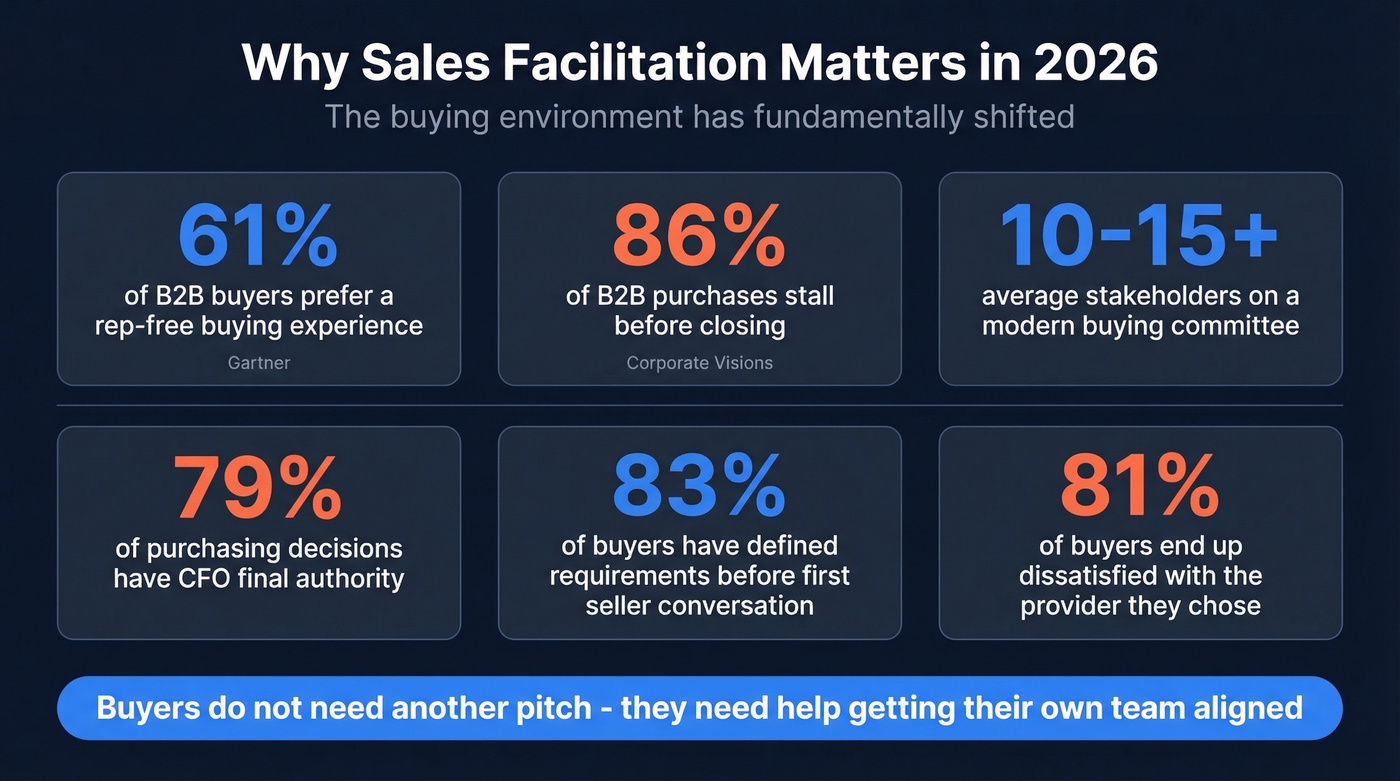
61% of B2B buyers now prefer a rep-free buying experience, and 73% actively avoid suppliers who send irrelevant outreach. Meanwhile, 69% of B2B buyers report inconsistencies between website information and what sellers tell them. Buyers don't want another pitch. They want someone who helps them navigate the mess happening inside their own organization - and who provides consistent, trustworthy intelligence while doing it.
That mess is real. 86% of B2B purchases stall, and 81% of buyers end up dissatisfied with the provider they chose. Modern buying committees average 10-15+ stakeholders, with CFOs wielding final authority in 79% of purchasing decisions. That's not a sales problem. It's a consensus problem.
Here's the thing: sales cycles are actually compressing. Average cycle length dropped from 11.3 months to 10.1 months over the past year, with first contact moving 6-7 weeks earlier in the journey. Buyers are engaging sellers sooner, but 83% have mostly defined their requirements before that first conversation. They don't need you to educate them on the problem. They need you to help them get their own house in order so the deal can actually close.
Facilitation vs. Challenger, SPIN, and Consultative Selling
If you're selling into buying committees of 5+, facilitation is the methodology. Everything else is a partial solution.
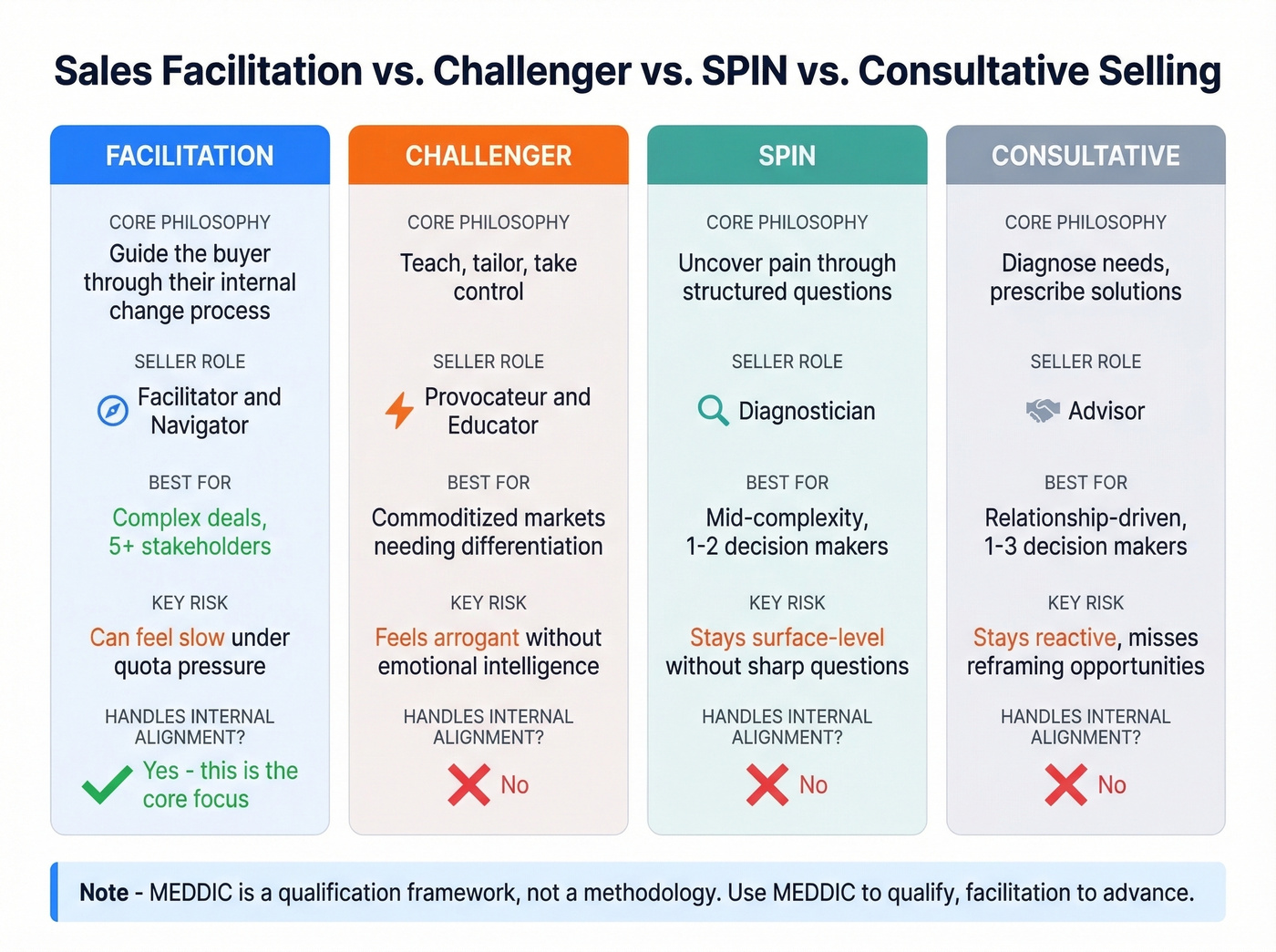
| Dimension | Facilitation | Challenger | SPIN | Consultative |
|---|---|---|---|---|
| Core philosophy | Guide the buyer's internal change process | Teach, tailor, take control | Uncover pain through structured questions | Diagnose needs, prescribe solutions |
| Seller role | Facilitator / navigator | Provocateur / educator | Diagnostician | Advisor |
| Best for | Complex deals, 5+ stakeholders | Commoditized markets needing differentiation | Mid-complexity, 1-2 decision-makers | Relationship-driven, 1-3 decision-makers |
| Key risk | Slow under quota pressure | Feels arrogant without EQ | Surface-level without sharp Qs | Stays reactive, misses reframing |
Challenger works when you need to reframe how a buyer thinks about a problem. SPIN works when you're diagnosing pain with a single decision-maker. Consultative selling builds trust in relationship-heavy industries. But none of these address the real killer of enterprise deals: internal misalignment among stakeholders who all have different priorities, timelines, and risk tolerances. That's where facilitation lives.
One clarification we get asked about a lot: MEDDIC is a qualification framework, not a methodology. It tells you whether a deal is real. Facilitation tells you how to make it real. They're complementary - use MEDDIC to qualify, facilitation to advance.
The pushback you'll hear on any sales floor: "Facilitation sounds passive." It isn't. It's the hardest skill in enterprise sales because you're managing a process you don't control. In our experience, the deals that stall longest are the ones where the seller never asked about internal alignment - they just kept demoing features to the one person who already said yes.

You can't facilitate a buying committee you can't reach. Prospeo gives you verified emails and direct dials for every stakeholder - 300M+ profiles, 98% email accuracy, 125M+ mobile numbers. Map the full committee, then facilitate the deal.
Reach all 10-15 stakeholders, not just your champion.
Practical Facilitation Questions
The traditional sales model enters at step 10 and covers evaluation through close. A facilitative seller engages across all 13 steps, starting with the buyer's internal change process. Here are the questions that get you there.
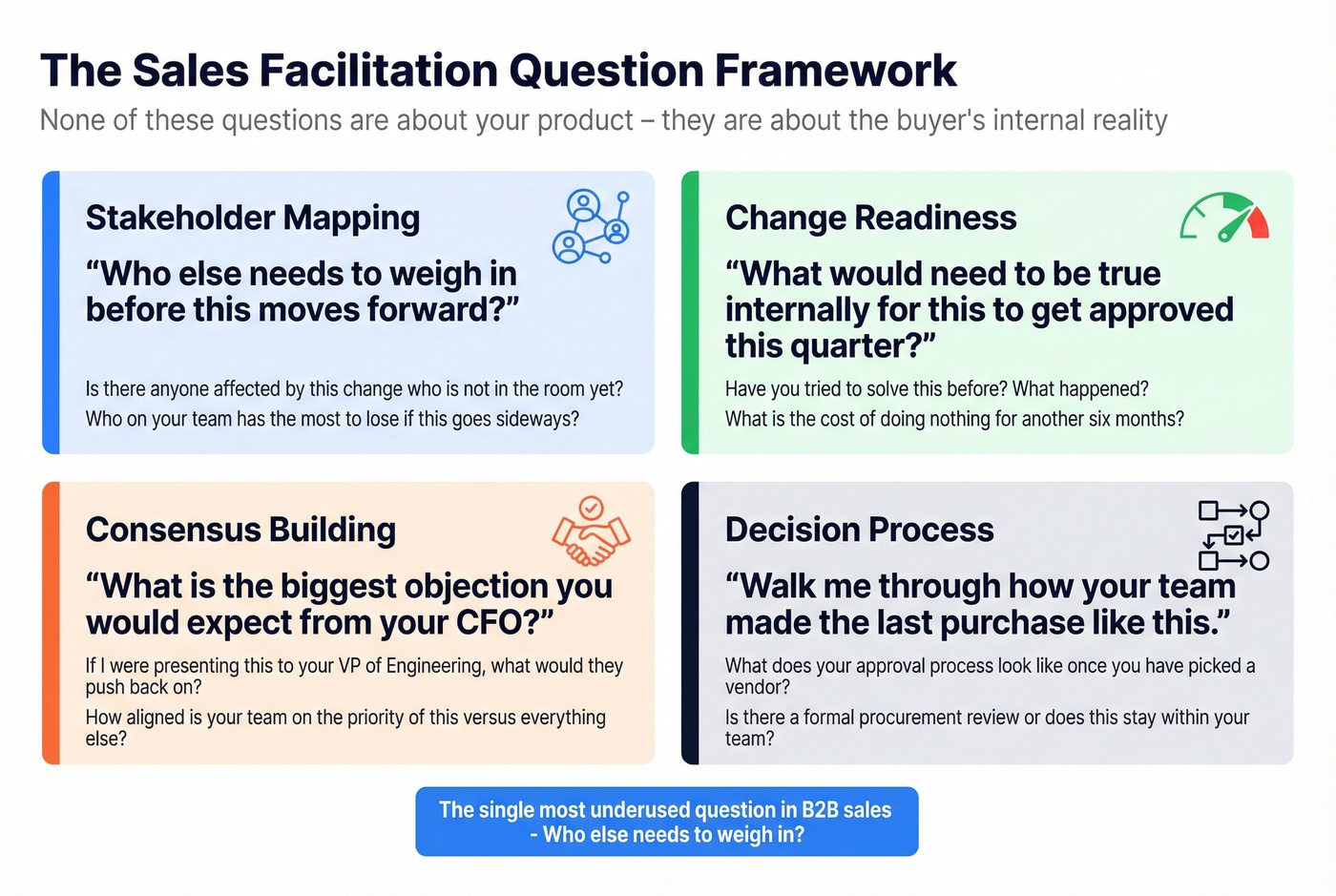
Stakeholder Mapping
- "Who else needs to weigh in before this moves forward?"
- "Is there anyone who'd be affected by this change who isn't in the room yet?"
- "Who on your team has the most to lose if this project goes sideways?"
Change Readiness
- "What would need to be true internally for this to get approved this quarter?"
- "Have you tried to solve this before? What happened?"
- "What's the cost of doing nothing for another six months?"
Consensus Building
- "What's the biggest objection you'd expect from your CFO?"
- "If I were presenting this to your VP of Engineering, what would they push back on?"
- "How aligned is your team on the priority of this project versus everything else on the roadmap?"
Decision Process
- "Walk me through how your team made the last purchase like this."
- "What does your approval process look like once you've picked a vendor?"
- "Is there a formal procurement review, or does this stay within your team?"
None of these questions are about your product. They're about the buyer's internal reality. You're not qualifying the deal - you're creating the conditions under which the deal can happen.
Let's make this concrete. Imagine a company redesigning their website. The marketing director wants a new CMS. But IT needs to approve the security architecture, finance needs to sign off on the annual license, and the CEO's executive assistant is the one who actually updates the site daily. Four stakeholders, four different concerns, zero alignment. A traditional seller demos the CMS to the marketing director and waits. A facilitative seller maps all four stakeholders, surfaces the security objection before IT raises it, and helps the marketing director build an internal business case that addresses finance's concerns. Same product, completely different outcome.
Reaching the Buying Committee
Facilitation requires reaching the right stakeholders with relevant context - not blasting generic outreach to whoever downloaded a whitepaper. When 73% of B2B buyers actively avoid irrelevant outreach, your first touch has to demonstrate that you understand their buying committee, not just their company.
Buying committee mapping means verified contacts for the CFO, VP-level decision-makers, and end users who'll influence the decision. Bad data - wrong titles, bounced emails, outdated direct dials - undermines the entire approach before it begins. We've found that Prospeo's 30+ search filters make it straightforward to find the CFO, the VP of Engineering, and the end-user champion in the same search, with 98% email accuracy and a 7-day data refresh cycle so you're working with current org charts rather than stale records.
Building the Skills
75% of reps who receive consistent coaching hit their quotas, and teams with structured coaching see 16.7% higher revenue growth. But 70% of training is forgotten within a week without reinforcement. So skip the two-day workshop and focus on what sticks.
Three methods that actually work. First, role-play facilitative discovery calls where the "buyer" introduces curveballs - a new stakeholder, a shifted timeline, a competing priority. Second, shadow experienced reps who run multi-stakeholder deals and debrief specifically on how they navigated consensus. Third, take every stalled deal and run a post-mortem through a facilitation lens: where did the internal change process break down?
We've seen teams uncover 2-3 additional stakeholders per deal just by adding one question to every discovery call: "Who else needs to weigh in?" It sounds basic. It's the single most underused question in B2B sales.
The SessionLab State of Facilitation report found that facilitation sessions are trending shorter - from half-day workshops to 90-minute sprints. The same applies to sales calls. You don't need an hour. You need 30 focused minutes where you're guiding the buyer's internal process, not presenting slides.
Deals die in conference rooms because sellers only know one contact. Prospeo's 30+ filters - including department headcount, job changes, and buyer intent - let you identify and reach every stakeholder before misalignment kills the deal. At $0.01 per email, building a full committee map costs less than a coffee.
Stop facilitating blind. Know every stakeholder before the call.
FAQ
What's the difference between sales facilitation and enablement?
Sales facilitation is a real-time methodology - how sellers guide buyers through internal consensus and change management on the call. Enablement is an operational function providing content, tools, and training before the call. They're complementary, not interchangeable. Think of enablement as the prep work and facilitation as the execution.
Does facilitative selling work for transactional sales?
Not really. Facilitation shines in complex B2B deals with 5+ stakeholders and buying cycles exceeding 30 days. For single-decision-maker transactions that close in one meeting with a credit card, a straightforward consultative or solution-selling approach is faster and more appropriate. Skip this if your average deal closes in under a week.
How do I start implementing this on my team?
Add "Who else needs to weigh in?" to every discovery call this week - most teams uncover 2-3 hidden stakeholders per deal immediately. Then run post-mortems on your last three stalled deals to identify where internal alignment broke down. Build stakeholder maps for your top 10 open opportunities and verify contact information across the full buying committee. The pattern becomes clear fast: deals stall because of the buyer's internal process, not your product.