

Sales Funneling: Stages, Benchmarks, and How to Fix a Leaky Funnel
Your VP of Sales just asked why pipeline is down 20% this quarter. Your CRM shows plenty of leads at the top. The problem isn't volume - it's mid-funnel conversion, and you can't diagnose it without stage-by-stage benchmarks.
Most sales funneling guides define stages without telling you what good actually looks like. This one has the numbers.
What Is Sales Funneling?
Sales funneling is the active, ongoing process of moving prospects from first awareness through to a closed deal. It's the gerund form for a reason - this isn't a static diagram on a whiteboard. It's the daily work of qualifying, nurturing, and converting buyers through defined stages.
The distinction matters. The sales funnel is a model. The funneling process is what your team actually does: running sequences, booking demos, handling objections, following up. The model is useless without the motion.
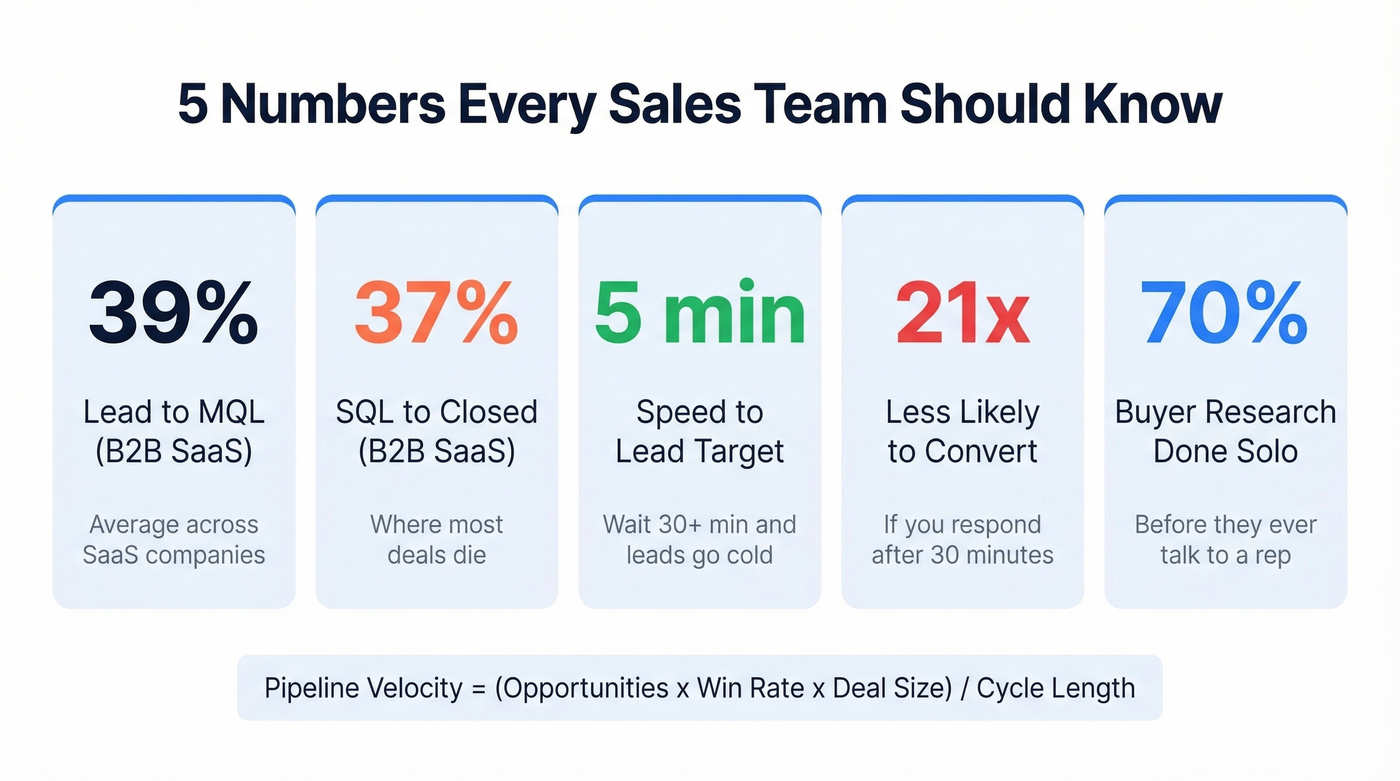
Buyers now complete roughly 70% of their research independently before they ever talk to a rep. By the time someone fills out your demo form, they've already read your case studies, checked your G2 reviews, and compared your pricing page to two competitors. Your funnel needs to account for a buyer who's already halfway through it before you know they exist. That means the top of your funnel isn't really "awareness" in the traditional sense - it's more like "awareness that you exist as a shortlisted option." Every stage needs to add value beyond what the buyer already found on their own. Generic nurture emails and "just checking in" follow-ups don't cut it when the buyer already knows your feature set.
The Quick Version
- Sales funneling = the ongoing process of moving prospects through Awareness, Interest, Decision, and Action. It's a verb, not a noun.
- Know your stage-by-stage numbers. The average B2B SaaS funnel converts 39% of leads to MQLs but only 37% of SQLs to closed deals. If you don't know yours, you can't fix them.
- Pipeline velocity is the single metric that captures funnel health: (Opportunities x Win Rate x Deal Size) / Cycle Length. Track it monthly.
- Speed-to-lead is the most underrated lever. Respond in under 5 minutes to maximize conversion. Wait 30+ minutes and a lead is 21x less likely to become a sale.
- Your funnel is only as good as the data entering it. Verified contacts prevent the silent killer of bounced emails and tanked sender reputation.
Sales Funnel Stages Explained
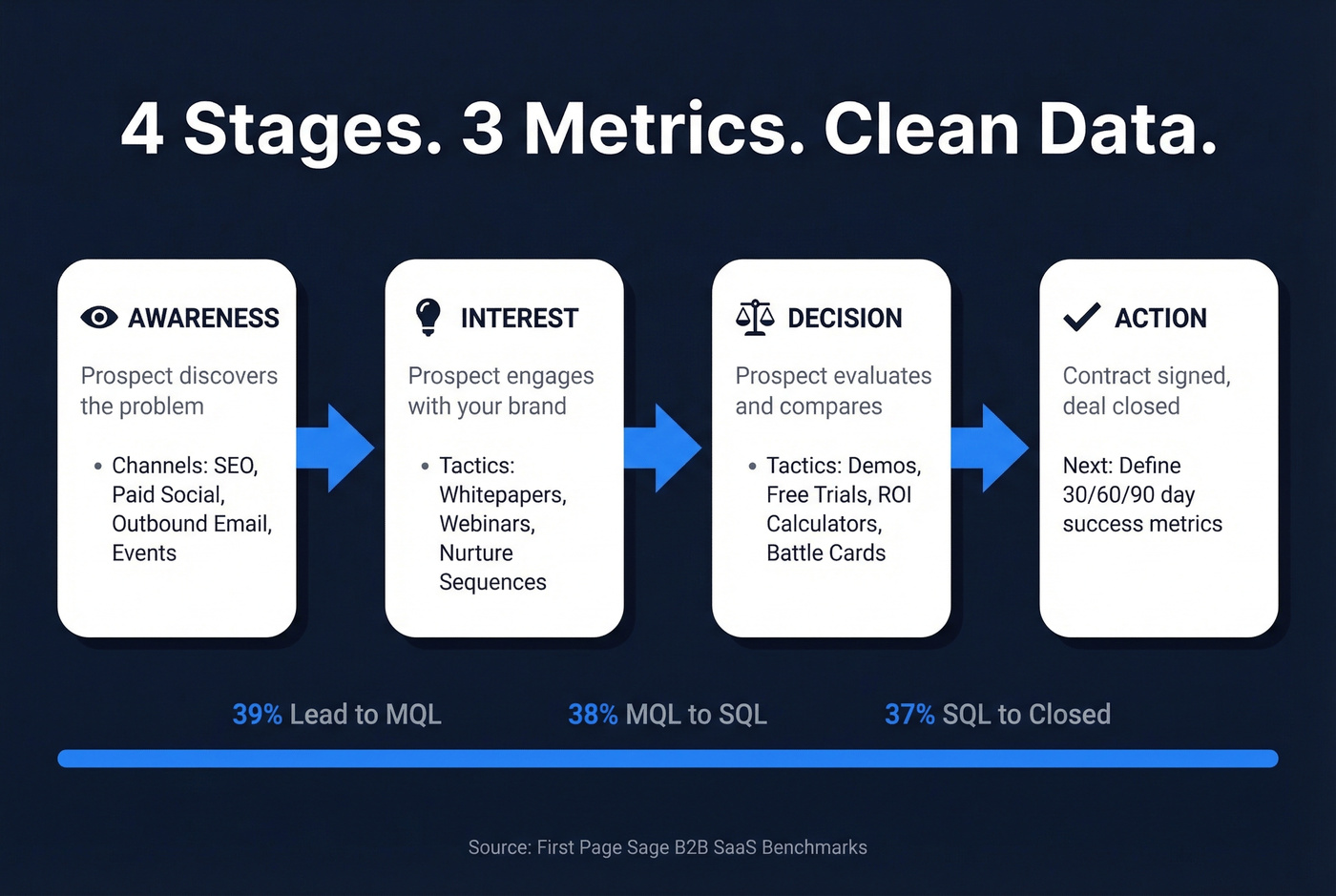
Salesforce's funnel model uses six stages. Some enterprise frameworks stretch to seven. We've found that four stages - mapped to the classic AIDA model) - are operationally cleaner and far easier to measure. More stages create more handoff points, more measurement gaps, and more arguments about definitions in your Monday pipeline review.
Awareness & Interest
Awareness is the moment a prospect realizes they have a problem your product could solve. They're not evaluating you yet - they're Googling the problem itself. Your job is to show up where they're looking: organic search, paid social, outbound email, industry events.
Interest is where the prospect engages. They've downloaded a whitepaper, attended a webinar, or replied to a cold email. The mental shift is from "I have a problem" to "This company might solve it." Your work here is nurture sequences, targeted content, and making it dead simple to book a conversation.
Decision & Action
Decision is the evaluation stage. The prospect has narrowed their shortlist and is actively comparing. This is where demos, free trials, ROI calculators, and competitive battle cards earn their keep. Most funnel leakage happens here - not because prospects lose interest, but because they get stuck in internal approval loops or can't build a business case.
Action is the close. Contract signed, payment processed, deal won. But the process doesn't stop at the signature. Define 30/60/90-day success metrics for every new customer before the handoff to onboarding. The first 90 days determine whether this customer becomes a referral source or a churn risk - and client referrals convert 56% of leads to MQLs versus 29% for PPC.
Why 4 Stages Beat 7
A seven-stage funnel creates three problems. The distinctions between stages like "Consideration" and "Intent" are fuzzy enough that reps categorize inconsistently. More stages mean more conversion rates to track - and when every metric is a priority, none of them are. Salesforce's own funnel guidance is explicit that prospects bounce among stages or jump ahead rather than following a perfectly linear path.
Four stages. Three metrics. Clean data. That's it.
Funnel vs. Pipeline vs. Marketing Funnel
These three terms get used interchangeably in most sales orgs, and the confusion causes real problems - especially when marketing and sales are arguing about lead quality.
The sales funnel is the buyer's journey: what the prospect is experiencing and thinking at each stage. The sales pipeline is the rep's process - the actions and milestones a seller tracks to move a deal forward. The marketing funnel focuses on demand generation: attracting strangers and converting them into known leads that sales can work. Funnels are buyer-centric; pipelines are rep- and process-centric.
| Sales Funnel | Sales Pipeline | Marketing Funnel | |
|---|---|---|---|
| Perspective | Buyer's journey | Rep's process | Demand gen |
| Stages | Awareness - Action | Prospecting - Close | Attract - Convert |
| Owner | RevOps / Sales | Individual reps | Marketing |
| Key metric | Stage conversion % | Pipeline velocity | MQL volume + cost |
The MQL-to-SQL handoff is where most alignment problems live. If marketing counts a whitepaper download as an MQL and sales expects a hand-raiser, you'll fight about lead quality forever.
Benchmarks by Industry
This is the section most funnel guides skip. Definitions are easy; numbers are hard.
Stage-by-Stage Conversion Rates
Across industries, visitor-to-lead averages 1-3% and lead-to-MQL averages 31%. But those averages hide dramatic variation. The table below draws from First Page Sage's benchmark report covering roughly 65% B2B, 20% B2C, and 15% hybrid companies.
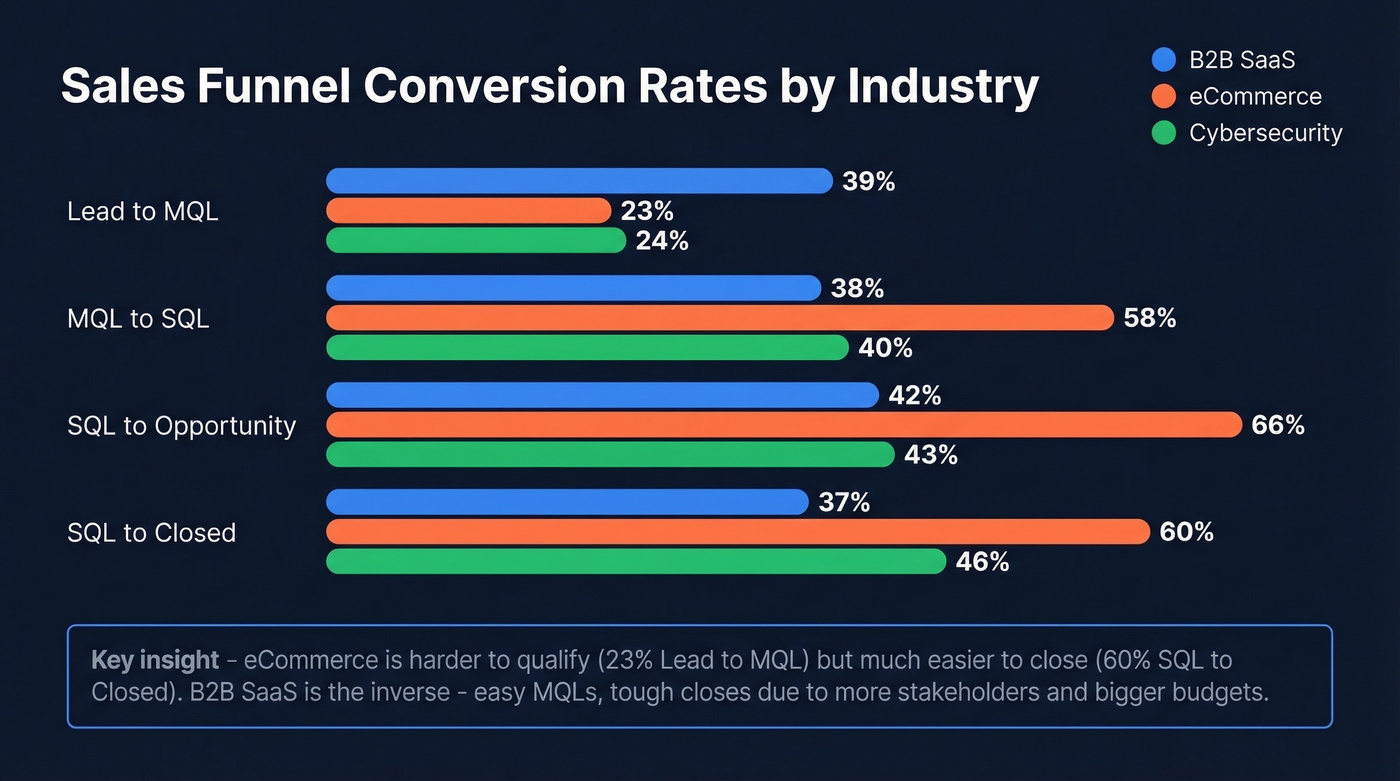
| Industry | Lead-MQL | MQL-SQL | SQL-Opp | SQL-Closed |
|---|---|---|---|---|
| B2B SaaS | 39% | 38% | 42% | 37% |
| eCommerce | 23% | 58% | 66% | 60% |
| Cybersecurity | 24% | 40% | 43% | 46% |
The pattern is revealing. eCommerce is harder to qualify (23% lead-to-MQL) but much easier to close (60% SQL-to-Closed). B2B SaaS is the inverse - relatively easy to generate MQLs, but the close rate drops because deals involve more stakeholders and bigger budgets.
Visitor-to-lead rates tell you whether you have a funnel problem or a traffic problem. Top 10% SaaS performers hit 8-15%. Average sits at 1.5-2.5%. Bottom 25% fall below 0.7%. Here's how it breaks it down:
| Industry | Visitor-Lead |
|---|---|
| Legal Services | 7.4% |
| Higher Education | 2.8% |
| Manufacturing | 2.2% |
| Financial Services | 1.9% |
| IT & Managed Services | 1.5% |
| B2B SaaS | 1.1% |
If your B2B SaaS visitor-to-lead rate is under 1%, you have a traffic quality problem or a landing page problem - not a funnel problem.
How Long Each Stage Takes
Time benchmarks are just as important as conversion rates. A 40% SQL-to-Close rate means nothing if it takes 180 days.
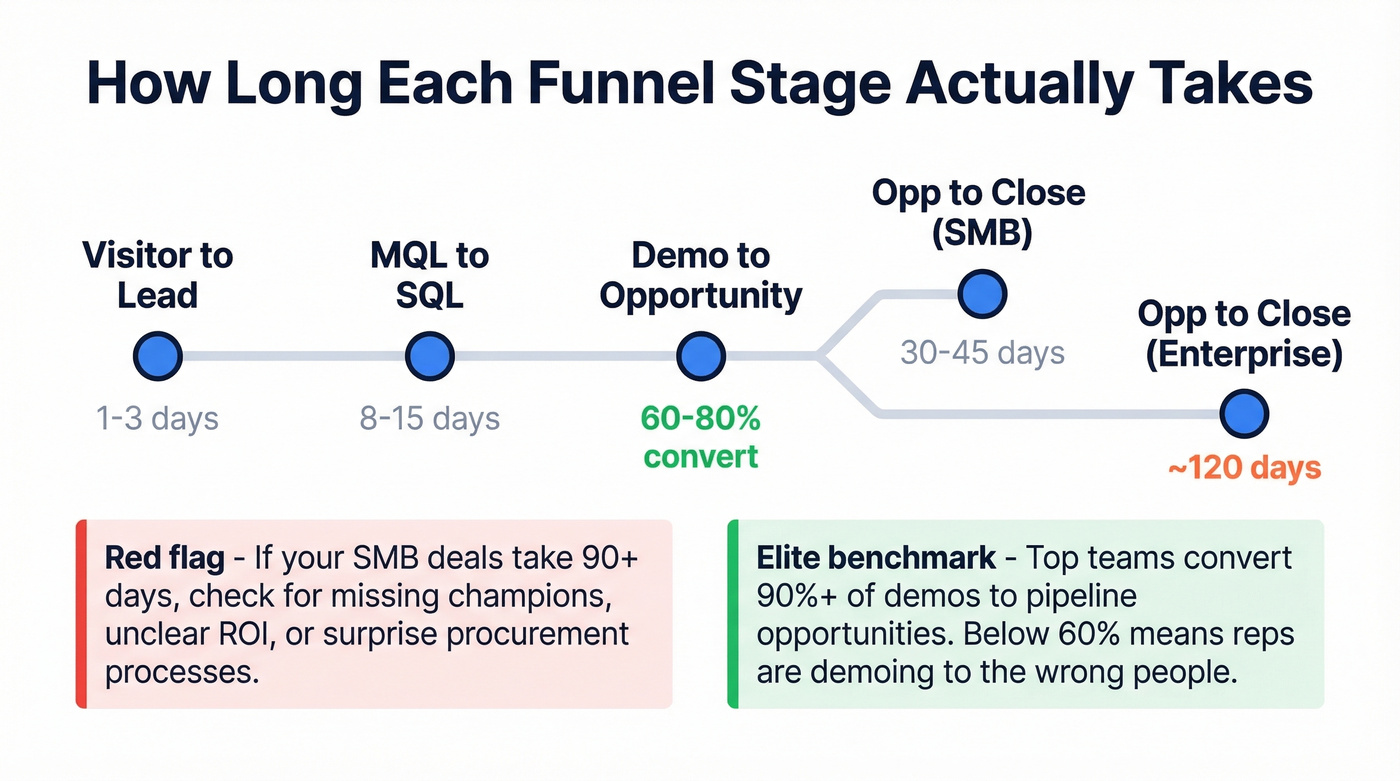
Visitor-to-lead conversion typically happens within 1-3 days. MQL-to-SQL progression runs 8-15 days in a healthy funnel. Qualified-to-meeting conversion hits a 62% median in well-run orgs. Opportunity-to-close is where the variance explodes: roughly 30-45 days for SMB deals, around 120 days for enterprise. If your SMB deals are taking 90+ days, something's broken in your decision stage - usually a missing champion, unclear ROI, or a procurement process you didn't anticipate.
The demo-to-opportunity conversion is a useful leading indicator. Average teams convert 60-80% of demos to pipeline opportunities. Elite teams hit 90%+. Below 60%? Your reps are demoing to the wrong people.
Which Channels Feed Best
Not all leads are created equal. Channel-level lead-to-MQL data shows dramatic differences:
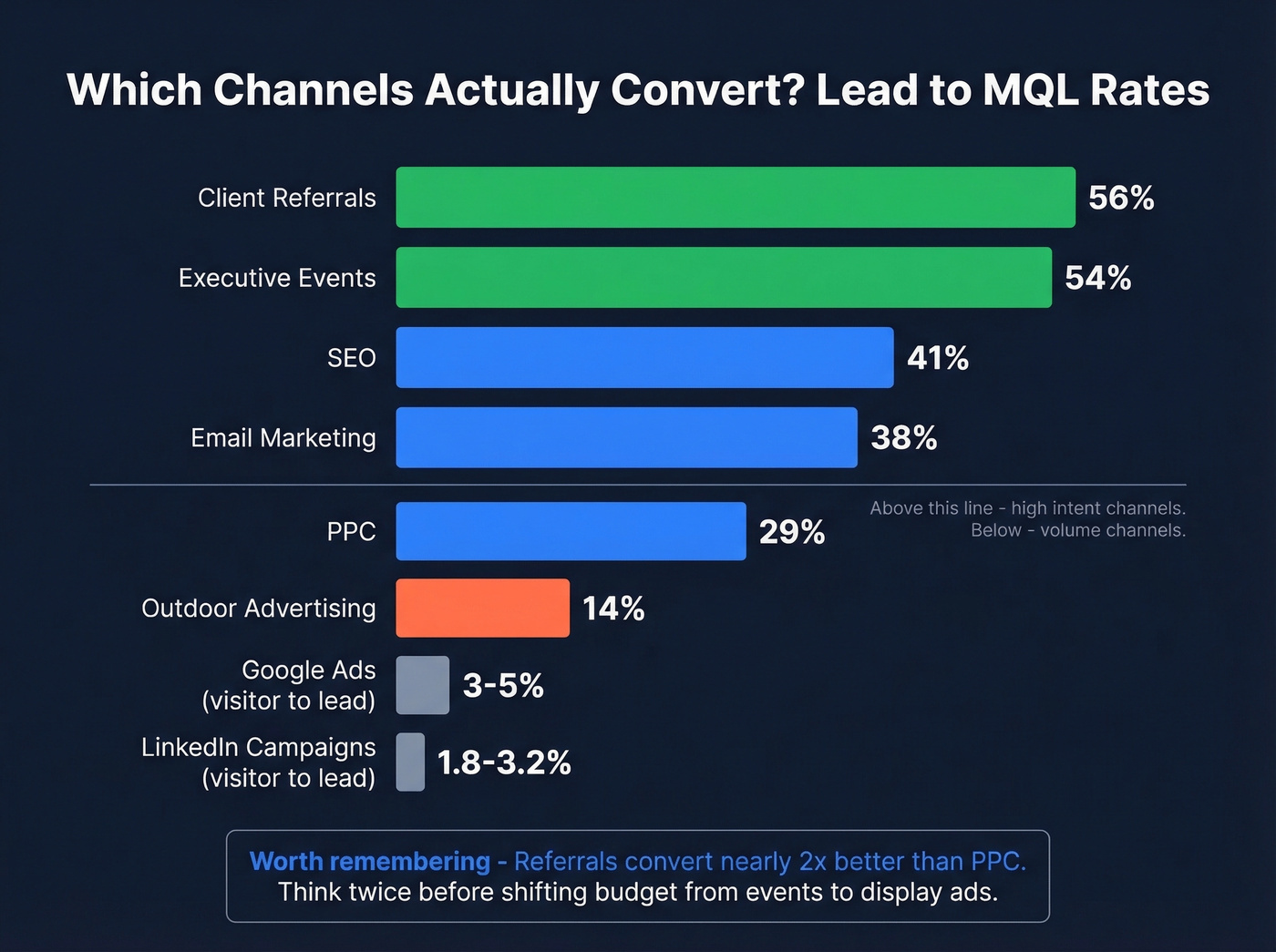
- Client referrals: 56%
- Executive events: 54%
- SEO: 41%
- Email marketing: 38%
- PPC: 29%
- Google Ads visitor-to-lead: 3-5%
- LinkedIn campaigns visitor-to-lead: 1.8-3.2%
- Outdoor advertising: 14%
Referrals are one of the highest-converting channels in the benchmark set. Worth quantifying when your CMO wants to shift budget from events to display ads.
Company stage matters too. Industry data from 500+ SaaS companies shows MQL-to-Close rates climbing with maturity: early-stage companies convert 1-2%, growth-stage 2-4%, scale-stage 3-5%, and enterprise 4-7%. If you're an early-stage company benchmarking against enterprise conversion rates, you'll think your funnel is broken when it's actually performing normally for your stage.

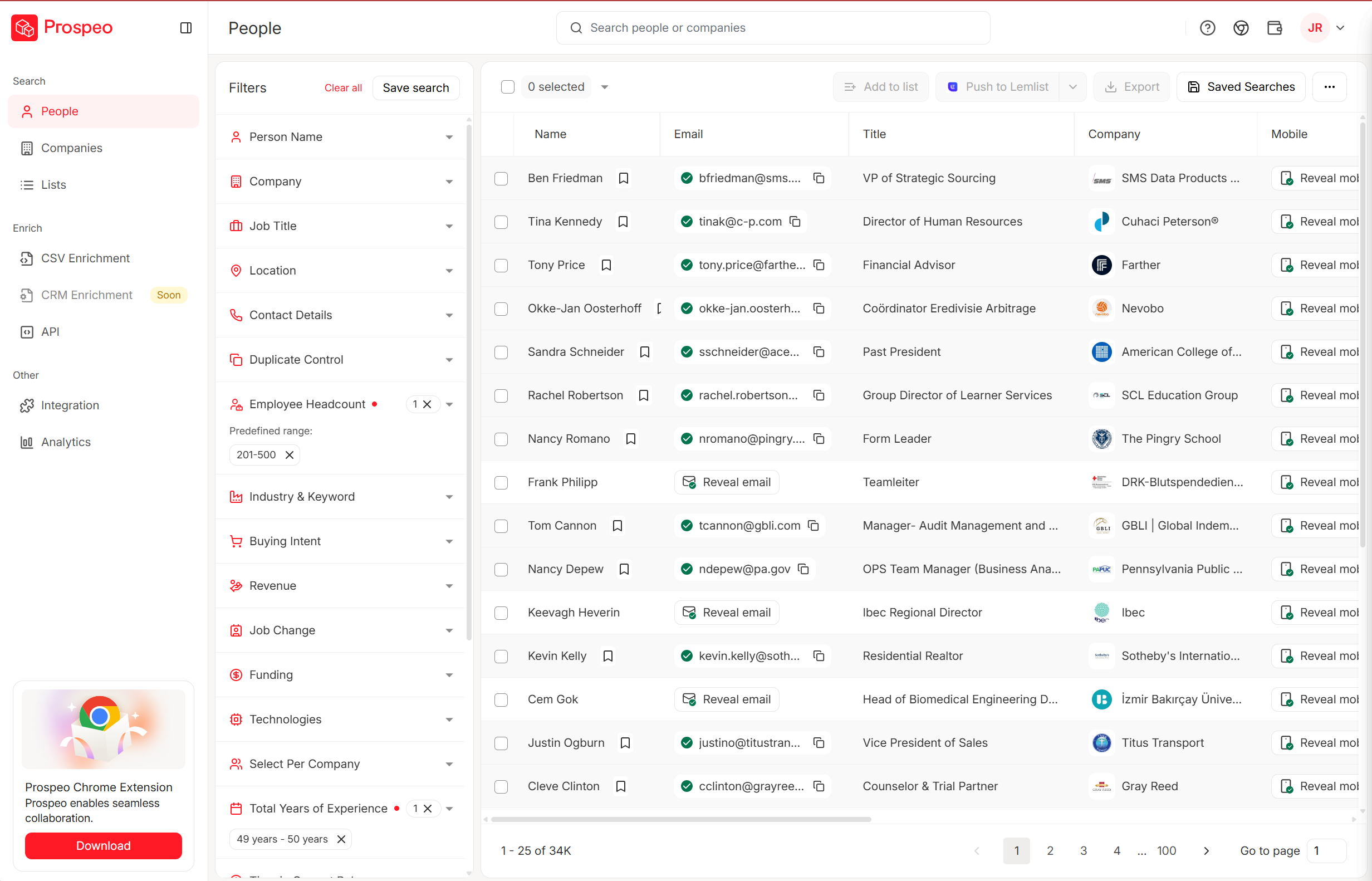
Your SQL-to-Closed rate tanks when reps chase bad contact data. Prospeo delivers 98% verified emails and 125M+ direct dials - so every prospect that enters your funnel is actually reachable. Teams using Prospeo book 26% more meetings than ZoomInfo users.
Stop losing deals to bounced emails and wrong numbers.
How to Build a Funnel That Converts
Start With Clean Data
The top of your funnel is only as good as the contact data feeding it. This sounds obvious until you realize how quickly bounced emails wreck deliverability. Every bounce damages your sender reputation, which reduces deliverability to everyone on your list - including the valid contacts.
We've seen teams spend $50K/year on a database and still bounce 20% of their outbound because they never verified the data before loading it into sequences. The database isn't the problem. The verification step is. Snyk's team of 50 AEs saw bounce rates drop from 35-40% to under 5% after switching to Prospeo's verified data, contributing to a 180% increase in AE-sourced pipeline and 200+ new opportunities per month. That kind of improvement comes from a 5-step verification process - catch-all handling, spam-trap removal, honeypot filtering - running on a 7-day refresh cycle, compared to the 6-week industry average. That freshness gap is the difference between a 4% bounce rate and a 25% bounce rate.
Map Tactics to Each Stage
Each funnel stage needs specific tactics, not generic "engage your prospects" advice.
Awareness means blogs, SEO content, paid social retargeting, and outbound email campaigns. The goal is visibility with the right audience, not maximum impressions. Zendesk's funnel templates offer a useful starting framework for mapping channels to stages.
Interest is where case studies, webinars, and email nurture sequences do the heavy lifting. The buyer is comparing options - give them ammunition to build an internal business case. "We helped a 200-person SaaS company reduce churn by 18%" beats "We help companies grow" every time.
Decision is demos, free trials, and ROI calculators. For B2B, it's about removing friction from the evaluation process: sandbox environments, transparent pricing, and fast answers to technical questions.
Action means streamlined contracts, clear next steps, and onboarding sequences that start before the ink is dry. The close isn't the end of the process - it's the beginning of retention.
Automate the Middle
Here's the thing: the mid-funnel is the biggest leak in most organizations. A prospect fills out a form, and then nothing happens for 4 hours while a rep finishes their current call block. By then, the prospect has booked a demo with your competitor.
Speed-to-lead is the most underrated metric in the entire funnel. Respond within 5 minutes and you maximize conversion potential. Wait 30+ minutes and a lead is 21x less likely to become a sale. That's not a typo - twenty-one times.
Automate four things immediately: initial response (even if it's just a confirmation plus a calendar link), initial qualification (chatbot or form logic), follow-up sequences (3-5 touches over 7 days), and meeting scheduling (self-serve booking). The goal isn't to remove humans from the funnel. It's to make sure no lead sits untouched while a human is busy.
How to Measure Performance
The Pipeline Velocity Formula
If you only track one funnel metric, make it pipeline velocity:
(Number of Opportunities x Win Rate x Average Deal Size) / Sales Cycle Length
This captures volume, quality, deal size, and speed in one number. Shortening cycle length is usually the highest-leverage move because it compounds.
Worked example: 50 opportunities x 25% win rate x $30,000 average deal = $375,000. Divide by a 60-day sales cycle, and your pipeline velocity is $6,250/day. Shorten that cycle to 45 days and you're at $8,333/day. Same pipeline, same win rate, 33% more daily revenue throughput.
Stage Conversion Rate
The formula: (contacts in later stage / contacts in earlier stage) x 100.
Calculate this for every stage transition monthly. The absolute numbers matter less than the trend. If your MQL-to-SQL rate drops from 35% to 28% over two months, you have a lead quality problem or a qualification criteria problem - and you need to diagnose it before it compounds into a pipeline gap 90 days from now.
The Full KPI Checklist
Track these monthly at minimum:
- Lead-to-customer conversion - your end-to-end funnel efficiency
- MQL-to-SQL rate - the sales-vs-marketing alignment metric; this number settles the "our leads were garbage" argument
- Opportunity-to-win rate - your closing efficiency
- CAC - what you're paying per customer acquired
- CLV/LTV - what that customer is worth over time
- Average deal size - trending up or down?
- Sales cycle length - by segment, not blended
- Funnel drop-off rate by stage - where exactly are deals dying?
Don't track all of these with equal intensity. Pick the two or three that are most broken and focus there. For most teams we talk to, that's MQL-to-SQL rate and sales cycle length.
Speed-to-lead matters, but only if you're reaching real people. Prospeo refreshes 300M+ profiles every 7 days - not the 6-week industry average - so the data entering your funnel is accurate the moment your rep picks up the phone. At $0.01 per email, fixing your top-of-funnel data costs less than one lost deal.
Fresh data in, clean pipeline out. Start with 75 free emails.
Is the Sales Funnel Dead?
The funnel isn't dead. What's dead is the assumption buyers follow a linear path.
Every year, someone publishes a "the funnel is dead" think piece. Let's be honest - the frustration is real, but the framework still works. Sales teams need a model for forecasting pipeline and allocating resources. The funnel provides that. What it doesn't provide is a realistic model of how modern buyers actually behave: bouncing between stages, looping back to research after a demo, going dark for three weeks, then reappearing with a signed PO.
The flywheel model addresses this by centering the customer rather than the transaction. Instead of a linear path ending at "close," the flywheel treats happy customers as the engine driving new business through referrals, reviews, and expansion revenue.
| Funnel | Flywheel | |
|---|---|---|
| Focus | Acquisition | Retention + growth |
| Strength | Forecasting pipeline | Compounding momentum |
| Best for | New-logo revenue | Expansion + referrals |
Use the funnel for acquisition forecasting and the flywheel for retention and advocacy. RevOps is the operational backbone that makes this work - standardizing stage definitions across teams, automating reporting, and measuring churn alongside new-logo acquisition.
The evidence supports hybrid models. Ballistic Arts rebuilt a client's non-linear journey and increased contact form submissions 650% year-over-year. PLG benchmarks tell a similar story: freemium-to-paid converts at 3.4%, free trial-to-paid at 18-29%, and CRM trial-to-paid at 29%.
The framework doesn't matter as much as the discipline of measuring stage-to-stage conversion and acting on what you find.
AI Tools for Funnel Optimization
83% of AI-using sales teams reported revenue growth compared to 66% without AI. But context matters: only 24% of B2B sales reps currently exceed quota. The right tools won't fix a broken process, but they'll amplify a good one.
| Tool | Use Case | Starting Price |
|---|---|---|
| Prospeo | Contact data + verification | ~$0.01/email (free tier) |
| HubSpot Sales Hub | CRM + AI prospecting | $100/seat/mo |
| Salesforce Einstein | Predictive scoring | $50/user/mo |
| ZoomInfo | Intent data + database | $14,995/yr |
| 6sense | ABM + intent signals | ~$55K/yr |
| Intercom Fin | Conversational AI | $29/mo + $0.99/resolution |
HubSpot Sales Hub is the mid-market sweet spot - CRM, sequences, and AI prospecting in one platform. The integration between marketing and sales hubs eliminates the MQL handoff friction that kills most funnels. Salesforce Einstein makes sense if you're already on Salesforce; if you're not, don't buy Salesforce just for Einstein. ZoomInfo at $14,995/year gets you one of the largest US contact databases plus intent data, though a 10-seat contract with intent and mobile numbers can run $40-60K/year. 6sense plays in the same intent-data space, focused more on ABM orchestration. Intercom Fin handles conversational qualification at the top of funnel - useful for high-traffic websites where you need to qualify visitors before they hit a human rep.
Skip the $55K+ tools if your average deal size is under $15K. In our experience, a verified contact database paired with a solid CRM and sequencer will outperform an expensive all-in-one platform that your team only uses at 30% capacity. The consensus on r/sales backs this up - most reps complain about paying for features they never touch.
Common Mistakes to Avoid
1. Tracking vanity metrics. Impressions and clicks don't tell you where deals die. If you can't answer "what percentage of our MQLs became SQLs last month?" within 30 seconds, your measurement is broken.
2. Optimizing the wrong stage. Teams obsess over top-of-funnel traffic when the real bottleneck is mid-funnel qualification. I've seen an audit where fixing three psychological barriers in the decision stage increased conversion 4.7% and added $28,200/month in revenue. The top of the funnel was fine - nobody was looking at the middle.
3. Slow follow-up. After 30+ minutes, a lead is 21x less likely to become a sale. A calendar link sent within 60 seconds beats a personalized email sent 4 hours later.
4. Bad contact data. This is the silent funnel killer. Meritt's pipeline tripled from $100K to $300K/week after switching to verified data - bounce rate dropped from 35% to under 4%. When a third of your emails bounce, you're not just losing those contacts. You're damaging deliverability to every contact on your list.
5. Overcomplicating stages. Seven-stage funnels create confusion and measurement gaps. Four stages, three core metrics (pipeline velocity, stage conversion rate, sales cycle length), clean data. That's the formula.
FAQ
What's the difference between a sales funnel and a marketing funnel?
The marketing funnel generates and nurtures demand from awareness through consideration; the sales funnel converts qualified leads into revenue through demos, proposals, and closing. The MQL-to-SQL handoff is where the two connect, and where most alignment problems live.
How do you calculate funnel conversion rate?
Stage conversion rate = (contacts in later stage / contacts in earlier stage) x 100. Calculate this for every stage transition monthly to spot leaks before they compound into pipeline gaps 90 days downstream.
What's a good sales funnel conversion rate?
It varies dramatically by industry. B2B SaaS averages 39% lead-to-MQL and 37% SQL-to-Closed. eCommerce averages 23% lead-to-MQL but 60% SQL-to-Closed. Compare against your industry and company stage, not generic benchmarks.
Is the sales funnel still relevant in 2026?
Yes - but not as a rigid linear model. Modern teams use the funnel for acquisition forecasting and the flywheel for retention. The framework is sound; the execution needs to account for non-linear buyer journeys and self-serve research behavior.
What free tools help with top-of-funnel data quality?
Prospeo offers 75 free verified emails per month plus 100 Chrome extension credits - enough to test data quality before committing budget. HubSpot's free CRM handles basic pipeline tracking. Pair both for a zero-cost foundation that covers contact verification and deal management.