

Best Sales Management Software in 2026: Real Pricing, Real Opinions
91% of companies with 11+ employees use a CRM. And yet, 63% of CRM initiatives fail. That's not a software problem - it's a buying problem. Teams pick the wrong sales management software, overpay for features they'll never activate, and end up with a pipeline full of decaying data nobody trusts.
Here's the thing: you don't need 15 tools. You need two, maybe three. A CRM that your reps will actually use, a data layer that keeps contacts accurate, and possibly an engagement platform if your outbound volume justifies it. Everything else is noise.
Our Picks (TL;DR)
| Scenario | Tool | Starting Price | One-Line Take |
|---|---|---|---|
| Best overall | HubSpot Sales Hub | Free tools available / paid from $20/user/mo | Easiest ramp, strong free tier, marketing built in |
| Best for small teams | Pipedrive | $14/user/mo | Visual pipeline, fair pricing, zero admin overhead |
| Best for data accuracy | Prospeo | Free (75 emails/mo) | 98% email accuracy, 7-day refresh, self-serve pricing |
| Best for enterprise | Salesforce Sales Cloud | $25/user/mo | Most powerful, most configurable, most expensive |
| Best value | Zoho CRM | $20/user/mo | Broadest feature set per dollar, especially via Zoho One |
These aren't ranked in a vacuum. A 5-person SDR team and a 200-seat enterprise org have completely different needs, and pretending one tool fits both is how you end up in that 63%.
Hot take: Most teams with deal sizes under $15K don't need Salesforce-level tooling. A lightweight CRM plus accurate contact data will outperform a bloated enterprise stack that nobody trusts. The best sales management software is the one your reps actually open every morning.
Real Pricing in 2026
Sticker price is a lie. Every vendor quotes a clean per-user-per-month number, but the real cost includes add-ons, integrations, onboarding, and the inevitable tier upgrade when you realize the feature you need is gated behind the next plan. Hidden costs typically inflate your CRM investment by 20-40% above the published price.
Done right, CRM ROI averages around $8.71 returned per $1 spent - but only if adoption and data quality are handled. Here's what you're actually looking at by company size:
All prices in USD. Vendors may bill in local currency; EU and UK pricing varies slightly.
| Team Size | Typical Range | Example (10 users, Year 1) |
|---|---|---|
| Small (1-10 reps) | $10-30/user/mo | Pipedrive Professional: ~$5,880/yr |
| Mid-market (11-50) | $40-100/user/mo | HubSpot Professional: ~$12,000/yr |
| Enterprise (50+) | $150-650/user/mo | Salesforce: $37,000+ in year one (10 users) |
That Salesforce number isn't a typo. A 10-person Salesforce implementation in year one - once you factor in setup, training, admin time, and the add-ons you'll inevitably need - runs $37K+. Pipedrive for the same team? Under $6K. The gap is enormous, and it isn't just about features. It's about how much operational overhead your team can absorb.
The consensus on r/CRMSoftware backs this up: per-seat pricing turns an advertised "$25/user/month" into $80-100/user/month once you unlock the features you actually need. Budget accordingly.
Tool-by-Tool Breakdown
HubSpot Sales Hub
Use this if: You want the fastest ramp-up time and your team touches both sales and marketing. HubSpot's free tier is genuinely useful - unlimited users, basic pipeline management, contact storage. Most teams can be productive within a day.
Skip this if: You think you'll stay on Starter. You won't. The jump from Starter ($20/user/month) to Professional is where the real features live - sequences, custom reporting, predictive lead scoring. Budget for Professional from day one, or you'll be upgrading within six months and explaining the cost increase to finance.
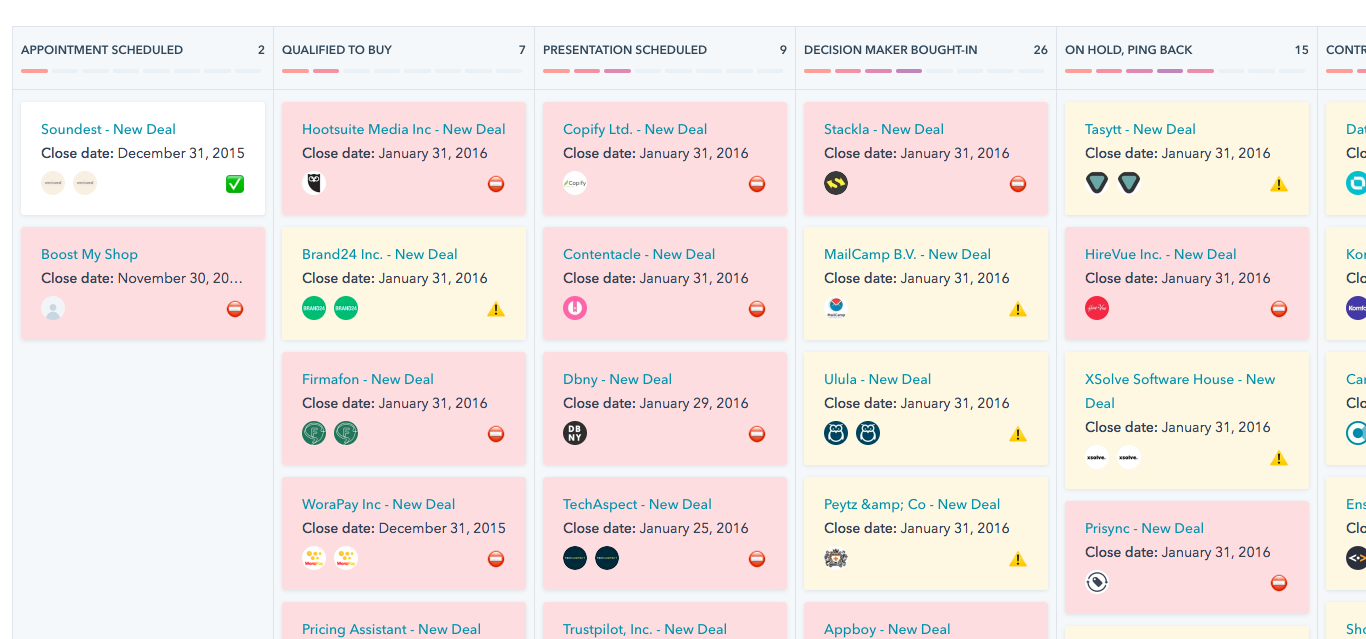
HubSpot earned a G2 top-5 spot for 2026, and the AI features are catching up fast - predictive lead scoring and an AI writing assistant are baked into Professional and above. Enterprise runs $4,300/month for 7 users, which puts it in Salesforce territory. For most mid-market teams, Professional is the sweet spot. Its built-in playbook analytics let managers see which sequences and talk tracks actually move deals forward, and the stage-aging reports alone are worth the upgrade if deals keep stalling in your pipeline.
Scenario fit: If you manage multiple pipelines (new business vs. renewals vs. upsells), HubSpot handles this cleanly out of the box.
Pipedrive
Pipedrive's visual pipeline is the best in the business for pure deal tracking. Drag, drop, done. No admin overhead, no configuration rabbit holes.
Use this if: You're a small sales team (under 20 reps) that wants a CRM you can set up over lunch. It's arguably the strongest option for small teams that prioritize simplicity over feature depth.
Skip this if: You need deep marketing automation, custom objects, or enterprise-grade reporting. Pipedrive is a sales CRM, not a platform. That's its strength and its ceiling.
Pricing runs from $14/user/month (Essential) to $99/user/month (Enterprise). Most teams land on Professional at ~$49/user/month, which includes workflow automations and email sync. AI capabilities are moderate - assistant insights and admin automation - but most small teams don't need Einstein-level AI. They need a CRM their reps will actually open. Pipedrive wins that fight.
Setup time: Under a day. Seriously. Import your CSV, configure your stages, and you're selling.
Prospeo
Most CRM conversations miss the real problem. You can buy the best pipeline tool on the market, but if your contact data decays every year, your reps are emailing dead addresses and calling disconnected numbers.
Prospeo's database covers 300M+ professional profiles, 143M+ verified emails, and 125M+ verified mobile numbers - all refreshed on a 7-day cycle. The industry average is six weeks. A contact who changed jobs three weeks ago is still current in Prospeo and stale everywhere else.

The 30+ search filters go well beyond basic firmographics. Select Job Change and Funding filters to catch companies in buying windows, then layer Bombora intent topics (15,000 available) to narrow to accounts actively researching your category. Add technographic filters to target companies running specific tools, and you've built a list that actually converts - not a spray-and-pray export.
What makes the 98% email accuracy claim credible: Prospeo runs proprietary email-finding infrastructure with a 5-step verification process including catch-all handling, spam-trap removal, and honeypot filtering. Meritt, one of Prospeo's customers, tripled their pipeline from $100K to $300K/week and dropped their bounce rate from 35% to under 4%.
Pricing is credit-based starting at ~$0.01/email, with a free tier offering 75 emails per month. Self-serve, no annual contracts, cancel anytime. Native integrations with Salesforce, HubSpot, Smartlead, Instantly, Lemlist, Clay, and Zapier mean it plugs directly into whatever CRM you choose from this list.
Salesforce Sales Cloud
Use this if: You're an enterprise org with 50+ reps, a dedicated Salesforce admin (or budget for one), and complex sales processes that need deep customization. Salesforce holds ~23.8% of the global CRM market for a reason - nothing else matches its configurability, ecosystem, or AI depth.
Skip this if: You don't have an admin. We've watched teams buy Salesforce because it's "the standard," then spend six months configuring it while reps go back to spreadsheets. Without someone owning the platform full-time, you're buying a Ferrari and leaving it in the garage.
Salesforce Sales Cloud sits in G2's Top 5 Best Sales Software Products for 2026 with a 4.7/5 rating across 436 reviews. Einstein AI is the strongest in the category - lead scoring, sentiment analysis, forecasting, next-best-action recommendations. Pricing starts at $25/user/month (Starter) and climbs to $330/user/month (Unlimited). But sticker price is misleading: that $37K+ first-year cost for a 10-person team is the number you should plan around.
Reality check: If you need call logging with mobile capture for field reps, Salesforce's mobile app is the most mature. For forecast accuracy across multiple business units, Einstein forecasting is worth the premium. The platform also excels at accountability - managers can track activity compliance, pipeline hygiene, and deal progression in granular detail.
Zoho CRM
Zoho CRM standalone runs $20/user/month (Standard) to $65/user/month (Ultimate). But the real play is Zoho One: $37/employee/month on annual billing or $45/employee/month monthly, and you get 45+ apps including CRM, helpdesk, accounting, analytics, and campaigns. It's the broadest feature set per dollar on this list. Full stop.
Use this if: You want maximum features per dollar and you're open to the Zoho ecosystem.
Skip this if: Your team is already deep in HubSpot or Salesforce. Migration costs and retraining rarely justify the savings unless you're starting fresh.
Zia AI handles forecasting, anomaly detection, and best-time-to-contact recommendations. It isn't Einstein, but it's strong - and available at price points that don't require VP-level budget approval. EU hosting via zoho.eu is a bonus for GDPR-conscious teams.
monday CRM
A project management tool wearing a CRM costume - and that's not entirely a knock. If your team already lives in monday.com, the CRM module feels natural. Visual workflows, if-this-then-that automation, and a free tier for 2 seats make it easy to test.
Paid plans run $12-24/seat/month, with Enterprise pricing on request. AI is moderate: email drafting and auto-fill columns. It won't replace a purpose-built CRM for a 30-person sales floor, but for small teams managing deals alongside projects, it's surprisingly capable.
Freshsales
The sleeper pick for SMBs who want AI without the enterprise price tag. Free for up to 3 users, with paid plans from $11/user/month (Growth) to $71/user/month (Enterprise). Freddy AI delivers lead scoring, forecast recommendations, and conversation insights - features that competitors gate behind $100+ plans. Built-in phone and email mean fewer integrations to manage. It won't scale to 200 reps, but for teams under 30 who want a modern CRM with native AI, Freshsales punches well above its weight.
Outreach
Not a CRM - sits on top of one. Outreach is a sales engagement platform built for outbound-heavy teams running multi-channel sequences at scale. Expect roughly $100-150/user/month for most teams. Best for teams with 10+ reps who need sequence management, A/B testing, and analytics.
SalesLoft
Salesloft and Outreach compete head-to-head on features - revenue orchestration, cadence management, analytics - at comparable pricing (roughly $100-150/user/month). Pick Salesloft if Salesforce is your center of gravity and you want strong rep coaching for call review and deal inspection. Its performance tracking dashboards give managers real-time visibility into activity metrics and deal health.
Nutshell
Simple CRM for teams under 20 who find even Pipedrive too much. $19-89/user/month. Solid pipeline management, clean UI, basic automation.
Creatio
Modular CRM with a no-code workflow builder. Custom pricing, typically $25-50/user/month. A legitimate Salesforce alternative for process-heavy mid-market organizations that want deep automation without hiring developers.
Field sales or service businesses? If your reps make offline visits and need route planning, look at ForceManager-style tools built for field mobility. For service businesses managing inventory, jobs, and dispatch, a CRM-only tool is the wrong category entirely - tools like Orderry or Jobber are purpose-built for that workflow.

63% of CRM initiatives fail - and bad data is the #1 reason. Prospeo feeds your sales management stack with 300M+ profiles, 98% verified emails, and a 7-day refresh cycle so your reps never waste a dial on stale contacts.
Stop managing a pipeline full of dead data. Start with contacts that connect.
Side-by-Side Comparison
| Tool | Starting Price | Best For | AI Strength | G2 Rating | Free Tier |
|---|---|---|---|---|---|
| HubSpot Sales Hub | Free tools / $20/user/mo | Mid-market all-rounder | Strong | 4.4/5 | Yes |
| Pipedrive | $14/user/mo | Small sales teams | Moderate | 4.3/5 | No |
| Salesforce | $25/user/mo | Enterprise orgs | Very Strong | 4.7/5 | Trial only |
| Zoho CRM | $20/user/mo | Best value per feature | Strong | 4.1/5 | No |
| monday CRM | Free (2 seats) | PM + CRM hybrid | Moderate | 4.6/5 | Yes |
| Freshsales | Free (3 users) | SMB with AI needs | Strong | 4.5/5 | Yes |
| Outreach | ~$100/user/mo | Outbound sequences | Strong | 4.3/5 | No |
| Salesloft | ~$100/user/mo | Enterprise engagement | Strong | 4.5/5 | No |
| Nutshell | $19/user/mo | Tiny teams, simple needs | Weak | 4.3/5 | No |
| Creatio | ~$25/user/mo | Process automation | Moderate | 4.7/5 | No |
AI and Sales Performance in 2026
The average sales rep spends 5+ hours per week manually updating CRM data. That's a full working day every two weeks spent on data entry instead of selling. AI is supposed to fix this, and in some cases, it actually does.
Let's break down where the major platforms land on AI maturity.
Einstein (Salesforce) is the benchmark - lead scoring, sentiment analysis, forecasting, next-best-action. It's the most capable AI in the CRM category, but you'll pay $150+/user/month to access the full suite. Where it really shines is helping managers stack rank reps by performance across multiple dimensions, not just closed revenue.
Zia (Zoho) delivers forecasting, anomaly detection, and best-time-to-contact at a fraction of the cost. Impressive for teams that want AI without enterprise budgets.
Freddy (Freshsales) offers lead scoring, forecast recommendations, and conversation insights - features that most competitors lock behind $100+ plans. The best AI value on this list.
HubSpot AI is improving fast. The writing assistant and predictive scoring are solid in Professional, and the roadmap suggests aggressive AI investment through 2026.
Pipedrive and monday AI handle assistant insights, admin automation, and email drafting. Functional, not game-changing.
The catch? The features that save the most time require $100-150/user/month plans - exactly the price point that prices out the teams that need them most. The AI-in-CRM market is projected to hit $48.4B by 2033, up from $11.04B today. Expect AI gating to get worse before it gets better as vendors chase that revenue.
Why 63% of CRM Rollouts Fail
That 63% failure rate traces back to three predictable causes.
Adoption kills first. SMBs stitch together 5+ tools - CRM, email marketing, forms, scheduling, Zapier - and customer data fragments across systems. Reps stop trusting the CRM because it's never the single source of truth. The r/CRMSoftware thread nailed it: per-seat pricing forces teams to buy too few seats, and the CRM becomes "one person's tool" instead of a team-wide system. Low adoption is the single biggest predictor of CRM failure, and it starts with choosing a tool that's too complex for your team's actual workflow.
Bad data kills second. 70.3% of CRM data becomes outdated every year. That's not a slow leak - it's a flood. Poor data wastes roughly 550 hours and $32,000 per sales rep annually. Your reps are calling wrong numbers, emailing people who left the company months ago, and losing trust in the pipeline data that's supposed to guide their day. A data enrichment layer that refreshes contacts weekly is the difference between a CRM that works and one that joins the 63%.
AI gating kills third. The automation features that would actually reduce manual data entry are locked behind enterprise tiers. Teams that can't afford $100+/user/month are stuck doing the grunt work that AI was supposed to eliminate. It's a frustrating cycle, and vendors show no signs of breaking it.
You just picked your CRM. Now make sure the data inside it actually works. Prospeo's 30+ filters - intent signals, job changes, funding events - build lists that convert, not lists that bounce. At $0.01 per email, it costs less than one bad meeting.
Your sales management software deserves data that's accurate this week, not last month.
How to Choose the Right Tool
Team size is the variable that matters most.
Small teams (1-10 reps): Pipedrive or Zoho CRM for the pipeline, paired with a data enrichment tool for accuracy. Budget $500-1,500/month total. You don't need Salesforce. You don't need enterprise engagement tools. You need a CRM your reps will use and contact data that doesn't bounce.
Mid-market (11-50 reps): HubSpot Professional or Freshsales Pro. Budget $2,000-6,000/month. At this size, you need reporting that actually works, some automation, and ideally native AI for lead scoring. Pipeline visibility becomes critical - managers need insight into rep activity, velocity, and deal health without chasing down spreadsheets.
Enterprise (50+ reps): Salesforce plus an engagement tool like Outreach or Salesloft. Budget $15K-40K+/year - and that's before implementation. You'll need a dedicated admin, probably a consultant for the first 90 days, and a data enrichment layer to keep 50+ reps fed with accurate contacts. At this scale, accountability isn't optional: you need adoption tracking to ensure the tools you're paying for are actually being used.
For teams that run heavy outbound, we've found that the CRM choice matters less than the data feeding it. A $14/month Pipedrive seat with clean, verified contacts will outperform a $150/month Salesforce seat running on stale data every single time.
Deals stuck in late stages? Prioritize tools with stage-aging alerts and deal rot notifications. HubSpot Professional and Salesforce both handle this well. Pipedrive's rot feature is simpler but effective for small teams.
Running multiple pipelines? HubSpot and Salesforce support this natively. Pipedrive added multi-pipeline support, but it's less flexible for complex segmentation like new biz vs. renewals vs. partner deals.
Whatever size you are, add 20-40% to the sticker price for the real cost. In our experience, every team underestimates CRM total cost of ownership in year one. If you want a deeper framework, see how to choose a CRM.
FAQ
What's the best free sales management software?
HubSpot CRM offers the strongest free tier - unlimited users with basic pipeline management and contact storage. monday CRM is free for 2 seats, and Freshsales covers up to 3 users at no cost.
How much does this software cost per user?
Expect $10-30/user/month for small teams, $40-100 for mid-market, and $150-650 for enterprise deployments. Always budget 20-40% above the published price for add-ons, integrations, onboarding, and the inevitable tier upgrade when you hit a feature gate.
Do I need a separate data tool alongside my CRM?
Yes, if outbound is a meaningful part of your revenue motion. CRM data decays 70% annually - that's not a slow problem. A dedicated data platform keeps emails and phone numbers verified on a weekly refresh cycle so reps aren't wasting hours on dead contacts.
Which CRM has the best AI features in 2026?
Salesforce Einstein is the most advanced, covering lead scoring, sentiment analysis, forecasting, and next-best-action recommendations. Zoho Zia and Freshsales Freddy offer strong AI at significantly lower price points - Freddy's lead scoring alone rivals features competitors gate behind $100+/user plans.
How long does CRM implementation take?
Pipedrive and monday CRM can be set up in under a day. HubSpot Professional takes 2-4 weeks for a proper rollout. Salesforce implementations often take 2-6 months and usually require a dedicated admin or implementation consultant. Complexity scales directly with customization depth.