

Sales Meeting Training: A Practical Playbook for 2026
A RevOps lead we know ran weekly "training" meetings for six months - slides, monologues, the works. When she surveyed her team, the top feedback was: "I tune out after slide three." That's not a people problem. It's a format problem.
Here's how to fix your sales meeting training so it actually changes behavior on calls.
Why Weekly Meetings Beat Annual Training Days
The annual sales kickoff feels important. It's also where training goes to die. Consistent coaching correlates with 32% higher win rates and 28% higher quota attainment. Without reinforcement, 50% of learning disappears within five weeks and 84% is gone by 90 days. Meanwhile, 62% of reps cite outdated training as their biggest barrier.
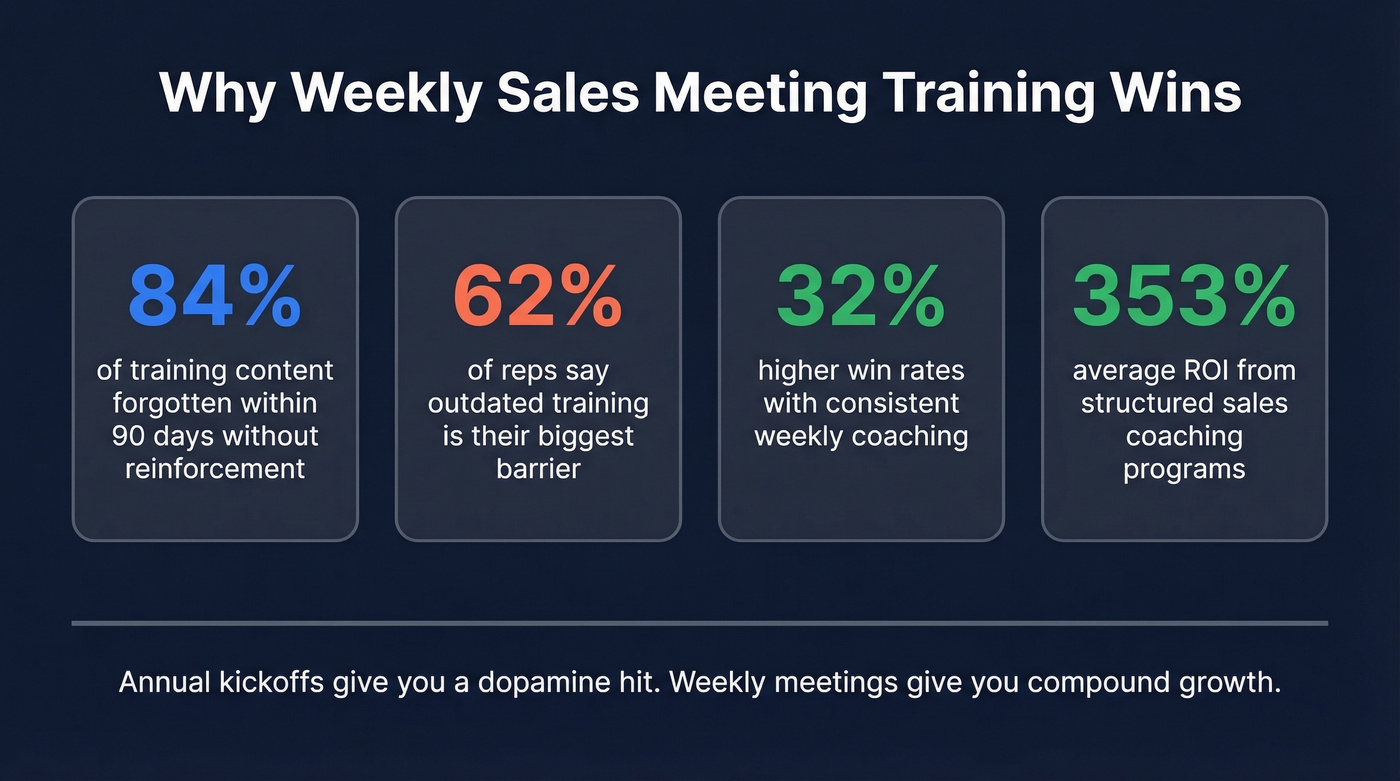
Weekly meetings create a compounding loop: teach a concept, practice it, get feedback, apply it on real calls, revisit the next week. That loop is what builds skill. Training days give you a dopamine hit. Meetings give you compound growth - and companies that invest in structured coaching report an average 353% ROI.
How to Structure Every Session
65% of professionals feel they regularly waste time in meetings. The fix isn't fewer meetings - it's tighter structure.
Use this pre-meeting checklist:
- Set an objective - use this fill-in-the-blank: "By the end of this meeting, reps will be able to _____ as measured by _____."
- Choose one topic. Resist the urge to cover three things poorly.
- Assign roles - facilitator, timekeeper, designated challenger.
- Allocate time. Every block gets a clock. No exceptions.
- Plan engagement - role-play, live drill, or group critique. Not "any questions?"
- Define action items - each rep leaves with one thing to do before next week.
Here's the facilitator rule: if you're talking for more than a minute straight, you've lost the room. Aim for a 1:2 ratio - one minute of teaching, two minutes of doing. We've tested this with small and mid-sized teams, and the ratio holds regardless of industry or deal size.
Copy-Paste Agenda: 45 Minutes
| Time | Block | Notes |
|---|---|---|
| 0-5 min | Context + objective | State the one skill. Share a real example. |
| 5-15 min | Micro-teach + demo | Walk through the framework. Keep it tight. |
| 15-35 min | Practice in pairs | Role-play or live drill. Rotate partners. |
| 35-40 min | Group debrief | 2-3 reps share what clicked. |
| 40-45 min | Action items | Each rep states one takeaway + next step. |
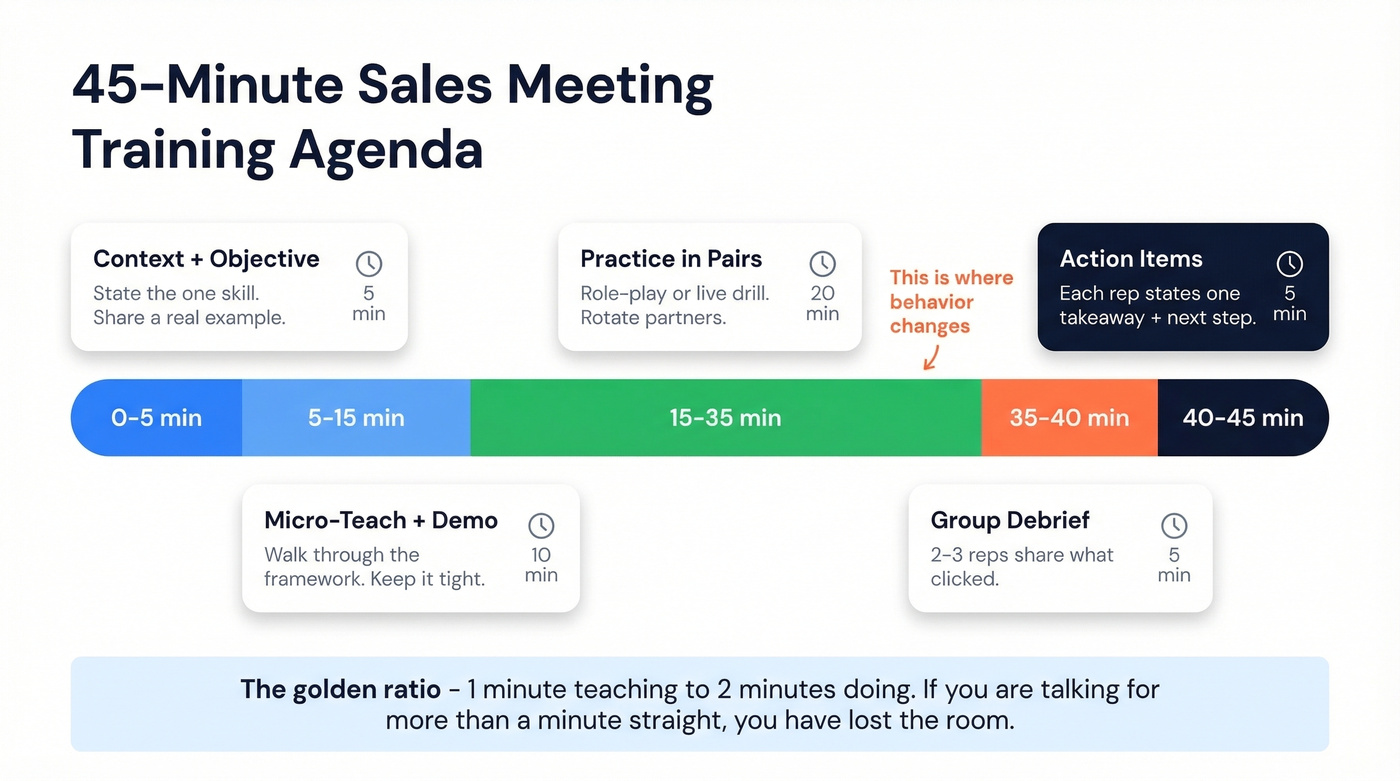
Rotate who delivers the micro-teach each week. For monthly deep-dives, add a recorded call review scored against your rubric and a scorecard comparison to the previous month. Those two additions turn training from event into system.
Drills That Actually Change Behavior
Role-play fails when it feels like forced office improv. Reps consistently complain about lecture-heavy sessions and awkward, unrealistic scenarios. The fix: structure, rubrics, and realistic buyer language.
Objection Gauntlet
Four scenarios, back-to-back, three minutes each. One rep sells, one plays the buyer using these exact lines:
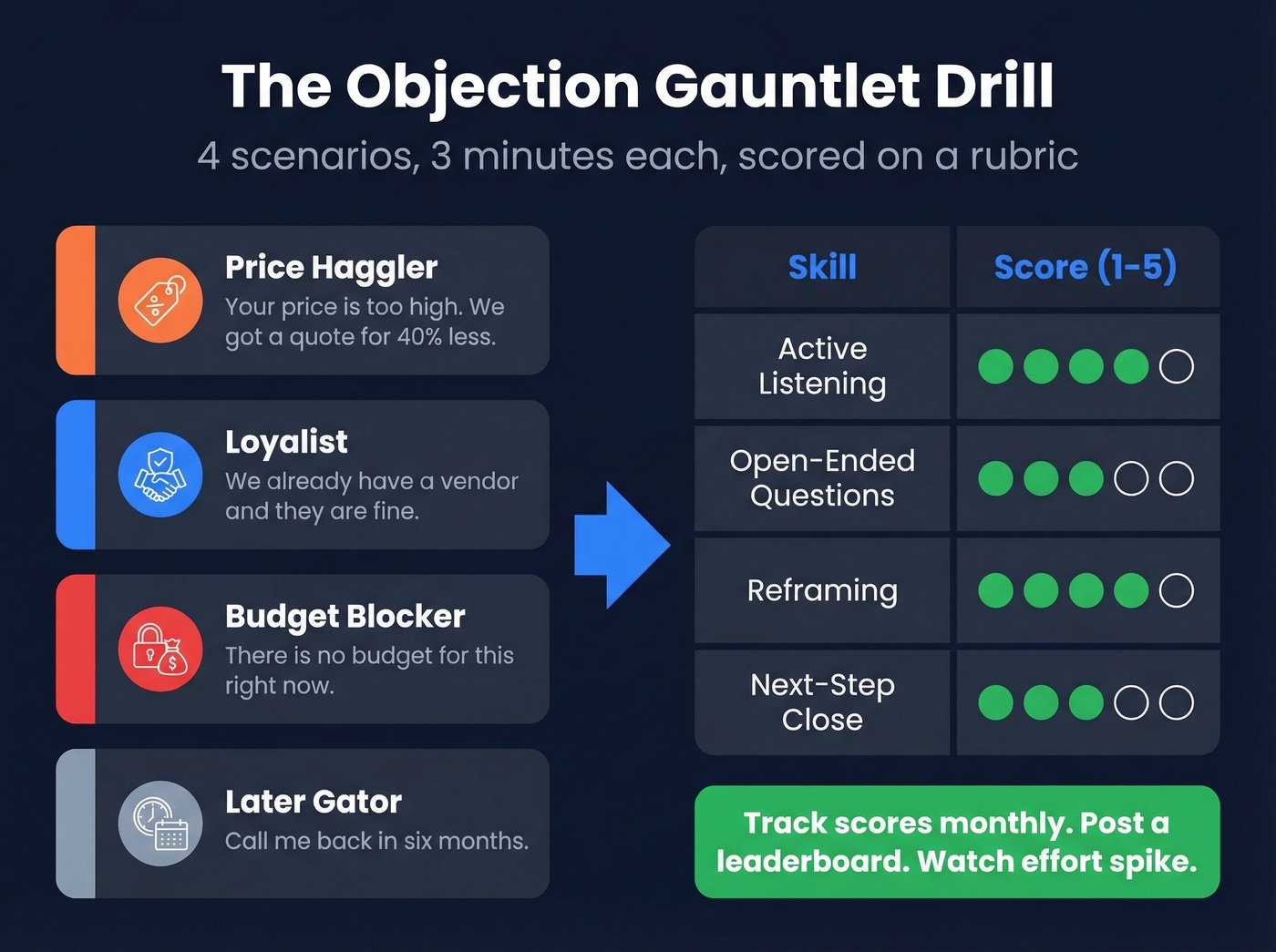
- Price haggler: "Your price is too high. We got a quote for 40% less."
- Loyalist: "We already have a vendor and they're fine."
- Budget blocker: "There's no budget for this right now."
- Later gator: "Call me back in six months."
Score each round on a rubric covering active listening, open-ended questions, reframing, and next-step close on a 1-5 scale per criterion. Track scores monthly - this is how you prove coaching works. In our experience, the objection gauntlet produces the fastest behavior change of any drill we've run. Gamify it: post a leaderboard of highest rubric scores and watch effort spike.
Live Prospecting Drill (10 Minutes)
Call Teardown
Pull a recorded call and score it against your rubric. Conversation intelligence tools like Gong or Chorus often land around ~$1,000-$2,500/user/year. AI role-play tools run $50-$200/user/month. If that's out of budget, skip this one - a screen recording and a shared rubric get you 80% of the value for free.

Your live prospecting drill is only as good as the data behind it. Prospeo gives reps 98% accurate emails and 125M+ verified mobile numbers - so training translates to real conversations, not bounced emails and voicemail dead ends.
Stop training reps on skills they can't use because the data fails them.
Common Mistakes Worth Fixing
More than 1 in 4 B2B sales pros describe their training as ineffective, and 72% of sales leaders say it fails because it's one-size-fits-all.
The most common mistake is lecture-only delivery. If nobody's practicing, it's not training - it's a presentation with a captive audience. Replace every lecture block with the 1:2 teach-to-practice ratio.
The second killer is missing reinforcement. Without follow-up, that 84% retention decay is inevitable. Assign one action item per meeting and check it the following week.
Third, stop running the same content for all experience levels. New hires need discovery fundamentals; senior reps need advanced negotiation tactics and complex deal strategy. Segment your sessions or rotate topics on a schedule that serves both groups. And let's be honest - peer-led sessions build more buy-in than manager-led ones. Rotate the facilitator role monthly. The rep who teaches a concept learns it twice.
How to Prove Training Worked
Only 33% of teams use assessments to measure training ROI. Two-thirds are running sessions on faith.
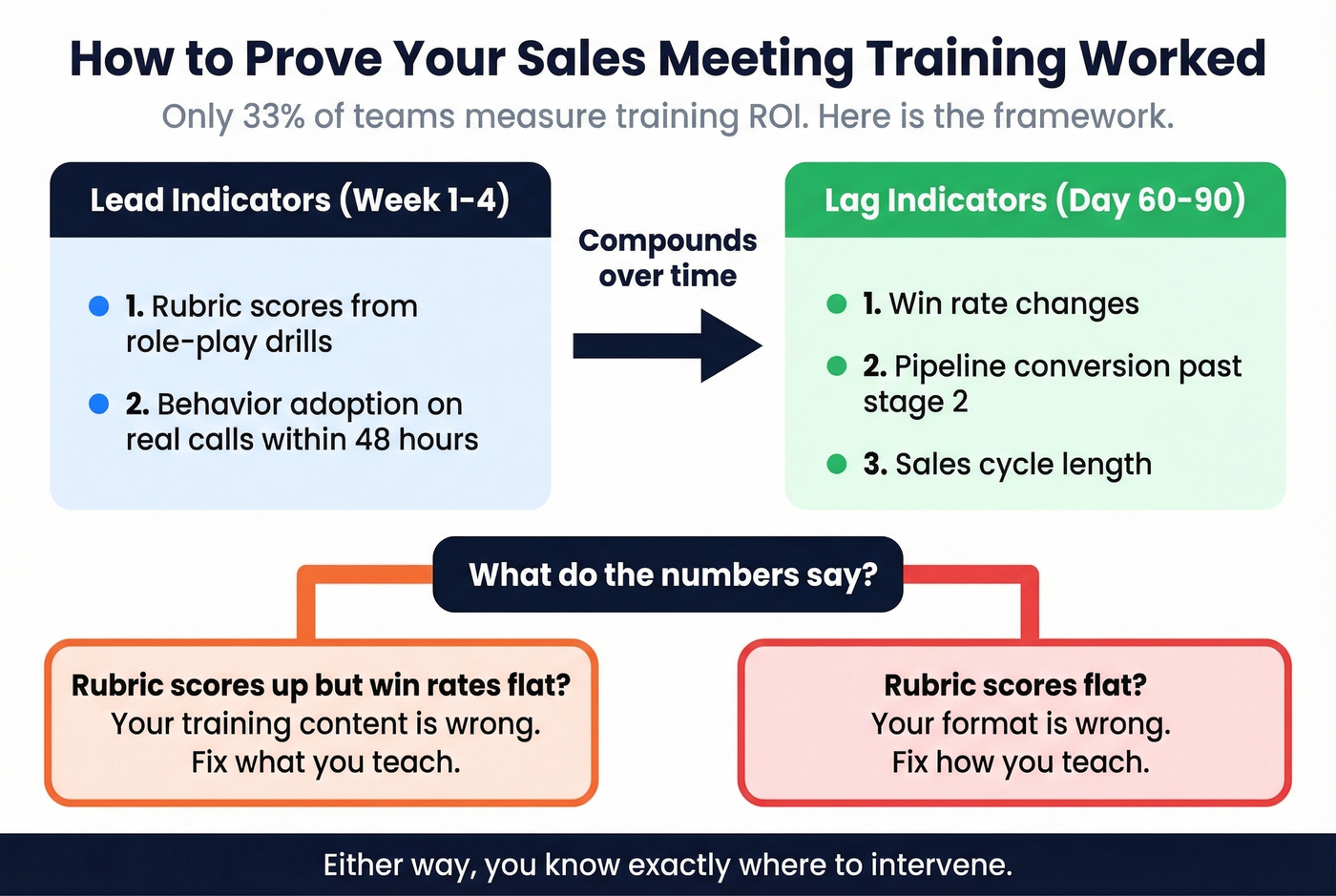
Most sales training fails not because the content is bad, but because nobody measures anything. If you track one thing, track rubric scores from role-play. That's your lead indicator. Pair it with these lag indicators over 60-90 days:
- Win rate changes - the clearest signal that new skills are translating to revenue.
- Pipeline conversion rate - are more deals moving past stage 2?
- Sales cycle length - shorter cycles often mean sharper discovery and objection handling.
If rubric scores climb but win rates don't, the training content is wrong. If rubric scores are flat, the format is wrong. Either way, you know exactly where to intervene.
Virtual + Hybrid Execution
90% of US sales leaders use a mix of in-person and virtual training. Your platform needs to handle four modes: live in-person, live virtual, recorded for in-person teams, and recorded for remote teams. That means screen sharing for call teardowns, breakout rooms for paired role-play, polls for pulse checks, and recording so async participants catch up within 24 hours.
Look - if your remote reps are just watching a screen share while in-office reps do the role-play, you've built a two-tier system. Assign remote reps to breakout pairs first. Give them priority on the debrief. Overcompensate for the distance.
7-Day Reinforcement Plan
- Day 1 (meeting day): Deliver training. Each rep leaves with one action item and a completed scorecard.
- Day 2-3: Rep practices the skill on one real call. Logs the outcome in Slack or your CRM.
- Day 4-5: Manager reviews one logged call per rep. Sends 2-sentence async feedback.
- Day 6-7: Rep refines their talk track based on feedback. Brings the updated version to next week's meeting.
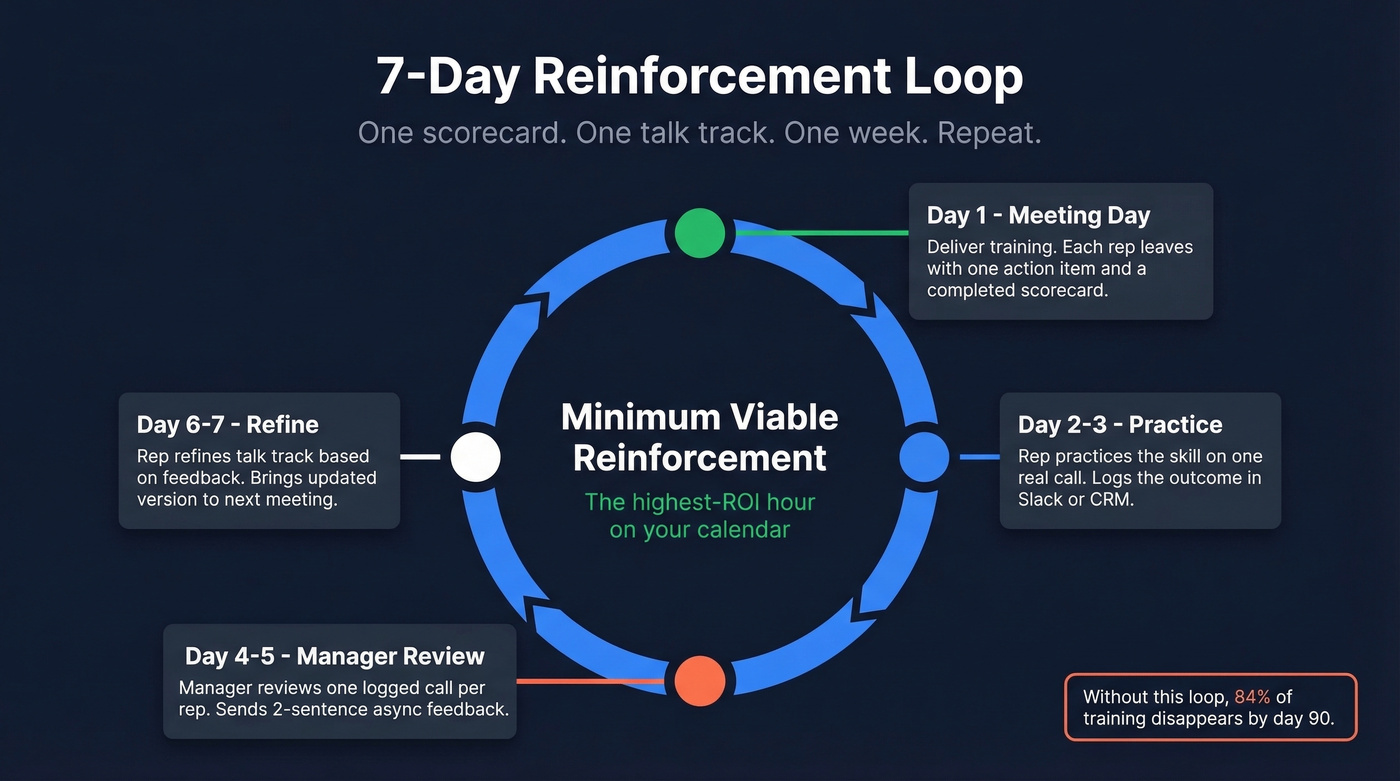
One scorecard. One talk track. One week.
That's the minimum viable reinforcement loop - small, repeatable actions anchored to real pipeline activity rather than abstract theory. Nail this cycle and your sales meeting training becomes the highest-ROI hour on your team's calendar.
You're tracking rubric scores and win rates to prove training works. Don't let bad contact data pollute your results. Prospeo refreshes 300M+ profiles every 7 days - so when reps apply what they learned, they reach real buyers at $0.01 per email.
Measure coaching impact without dirty data skewing every metric.
FAQ
How long should a training meeting be?
Aim for 30-60 minutes, with at least half the time dedicated to practice. A tight 45-minute session with structured role-play beats a 90-minute lecture every time. Time-box every block and assign a timekeeper - meetings expand to fill whatever space you give them.
What should we measure after each session?
Start with lead indicators: rubric scores from role-play and whether reps adopted the new behavior on real calls within 48 hours. Then track lag indicators like win rate and pipeline conversion over 60-90 days. If you aren't scoring drills, you aren't measuring training.
What's a fast prospecting drill we can run live?
Pick a target persona, have each rep build a 5-10 contact list using a B2B database with 30+ search filters, verify emails in bulk, and export the list as that rep's outbound for the week. Prospeo's free tier gives you 75 email credits per month - enough for several live sessions without spending a dollar.