

How to Write a Sales Pitch Value Proposition That Actually Gets Replies
You sent 200 cold emails last week. Three replies - all some version of "not interested." The problem isn't your product, your timing, or your list. It's your sales pitch value proposition. That single statement determines whether a prospect hits reply or hits delete, and most teams get it wrong for the same handful of reasons. Here's how to fix it.
The Quick Version
- Best template for cold outreach: Steve Blank's "We help X do Y by doing Z" - fastest to fill in, hardest to make generic.
- Best framework for complex B2B: The Value Proposition Canvas - forces you to map buyer jobs, pains, and gains before writing a word.
- Best test: Send 100 emails with version A, 100 with version B. Measure reply rate. Everything else is guessing.
What Is a Value Proposition?
A value proposition is a clear statement of the specific outcome a buyer gets from working with you, written in their language, about their problem. Your USP says what makes you different. Your value proposition says why that difference matters to the person reading your email.
With 80% of B2B sales interactions now happening in digital channels per Gartner's research, your value proposition does the selling before you ever get on a call. Think of it as the elevator pitch you'd deliver if you had fifteen seconds with a decision-maker - except it lives in an inbox, competing with 47 other unread messages.
Why Most Value Propositions Fail
Salesforce's [State of the Connected Customer report](https://www.salesforce.com/resources/research-reports/state-of-the-connected-customer/) found that 86% of business buyers are more likely to buy when they feel understood - yet 59% say most reps don't bother understanding their goals. That gap is where value propositions go to die.
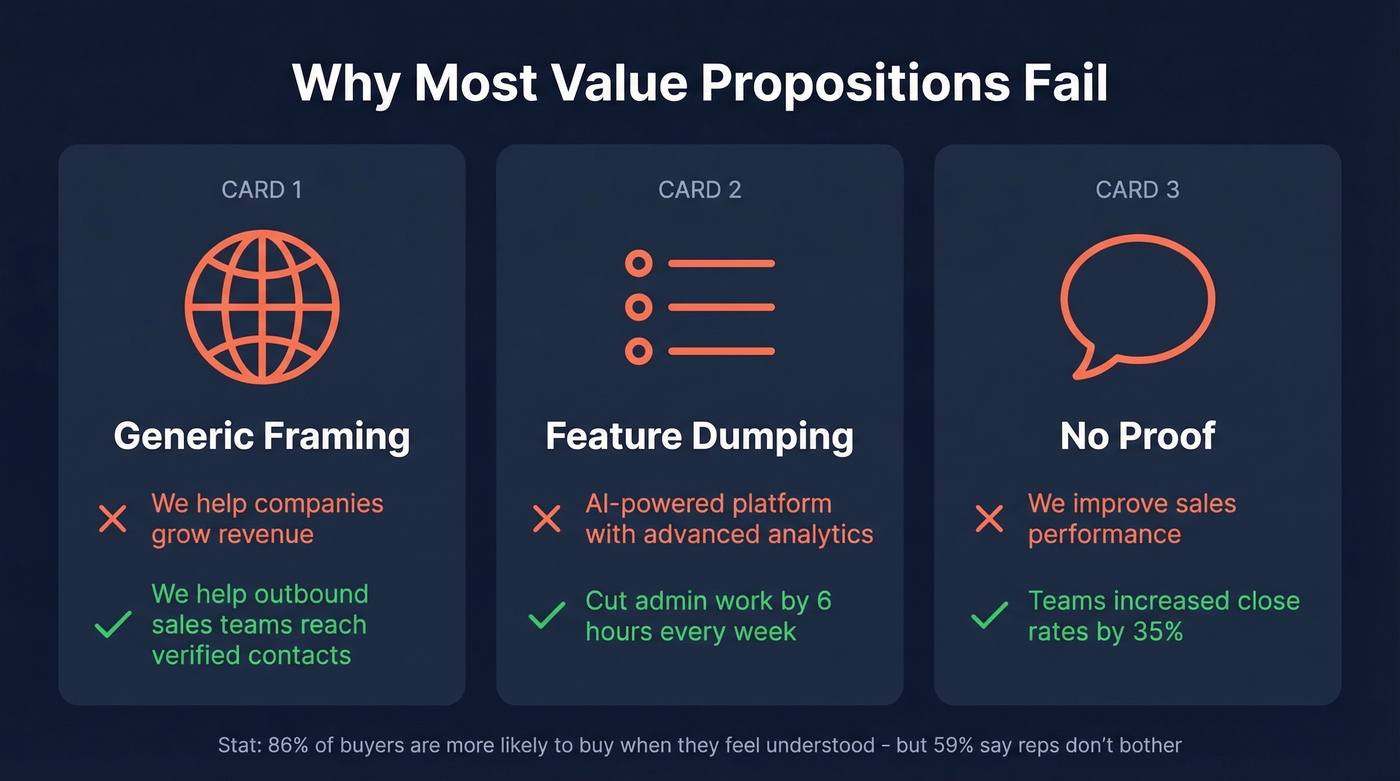
Three failure modes kill most of them:
- Generic framing. "We help companies grow revenue" could describe 10,000 vendors. If your prospect can swap in a competitor's name and the sentence still works, it's wallpaper.
- Feature-dumping. Listing what your product does instead of what the buyer gets. Nobody cares about your "AI-powered platform." They care about time saved, risk reduced, or deals moved forward.
- No proof. "Teams using this increased close rates by 35%" beats "we improve sales performance" every time. A claim without evidence is just an opinion.
Here's the thing most guides miss: in mid-market B2B, buying committees average 7 people. If your value prop doesn't survive being paraphrased in a Slack message, it's dead on arrival. Even structured frameworks like the Value Proposition Canvas produce generic output if you skip buyer discovery and jump straight to filling in boxes.

You just spent time crafting the perfect value proposition. Don't waste it on bad data. Prospeo gives you 300M+ verified contacts with 98% email accuracy, so your carefully written pitch actually lands in the right inbox - not a bounce folder.
Start testing your value props on verified contacts for free.
Templates You Can Copy Today
Pick a template, fill it in, refine from there. A good sales pitch structure follows the same pattern regardless of format: name the audience, state the problem, deliver the outcome.
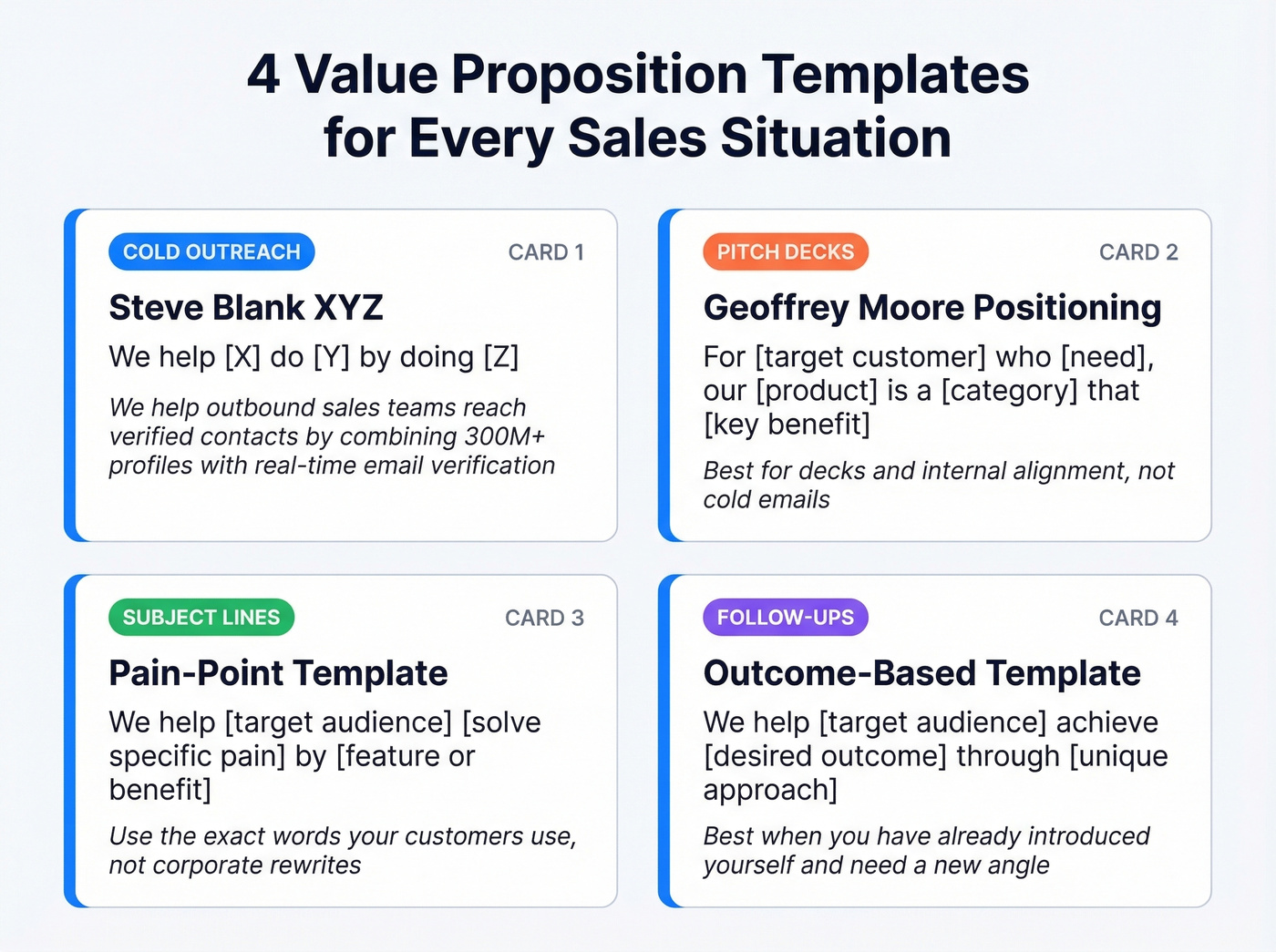
1. Steve Blank XYZ (cold outreach)
"We help [X] do [Y] by doing [Z]."
Example: "We help outbound sales teams reach verified contacts by combining 300M+ professional profiles with real-time email verification." It works because it names who, what, and how in one sentence. No filler.
2. Geoffrey Moore Positioning Statement (pitch decks)
From Crossing the Chasm: "For [target customer] who [need], our [product] is a [category] that [key benefit]." This one's heavier - save it for decks and internal alignment docs, not cold emails.
3. Pain-Point Template (cold email subject lines)
"We help [target audience] [solve specific pain] by [feature/benefit]."
Write it in the words your customers actually use. If they say "emails slipping through the cracks," don't rewrite it as "suboptimal communication workflows."
4. Outcome-Based Template (follow-ups)
"We help [target audience] achieve [desired outcome] through [unique approach]."
Best for follow-up emails where you've already introduced yourself and need to restate the value with a slightly different angle.
Before and After Examples
The CRM pitch
- Before: "Our software increases efficiency."
- After: "Wasting hours on manual processes? Teams using [product] cut admin work by 6 hours every week."
The second version names the pain and the result. The first says nothing.
The cold email overhaul
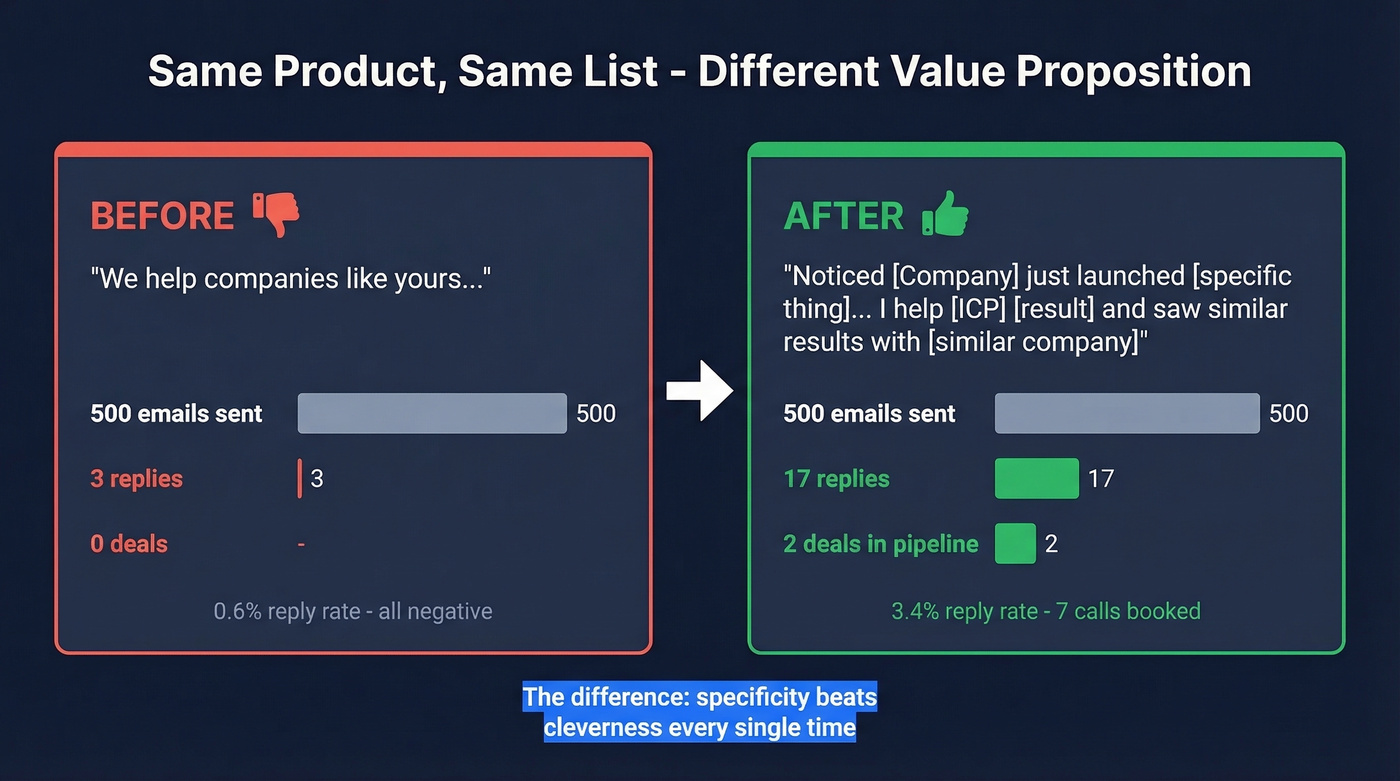
One cold emailer documented the shift on r/coldemail. They sent 500 generic emails - "We help companies like yours..." - and got 3 replies, all negative. Then they switched to specificity-driven openers referencing earnings calls, hiring plans, and job posts. Next 500 emails: 17 replies, 7 calls booked, 2 deals in pipeline. Same product, same list size. We've seen this pattern repeatedly in our own outreach - specificity beats cleverness every single time.
Real-World Propositions That Convert
Notion: "The AI workspace that works for you." Names the category, the differentiator, and makes the buyer the subject. Clean.
Hubstaff: "Time tracking software for the global workforce." Simple, specific, immediately tells you who it's for and what it does.
The Reddit cold emailer who reported a 23% reply rate used this structure: "Noticed [Company] just launched [specific thing]... I help [ICP] [result] and saw similar results with [similar company]." Not clever. Specific. That's why it works, and the consensus on r/sales backs this up - personalization that references something real outperforms template-swapped first names by a wide margin.
Test It, Don't Guess
Let's be honest: most teams spend weeks workshopping the "perfect" value proposition in a conference room. That's backwards. Write five bad ones, test them, and let the data pick the winner.
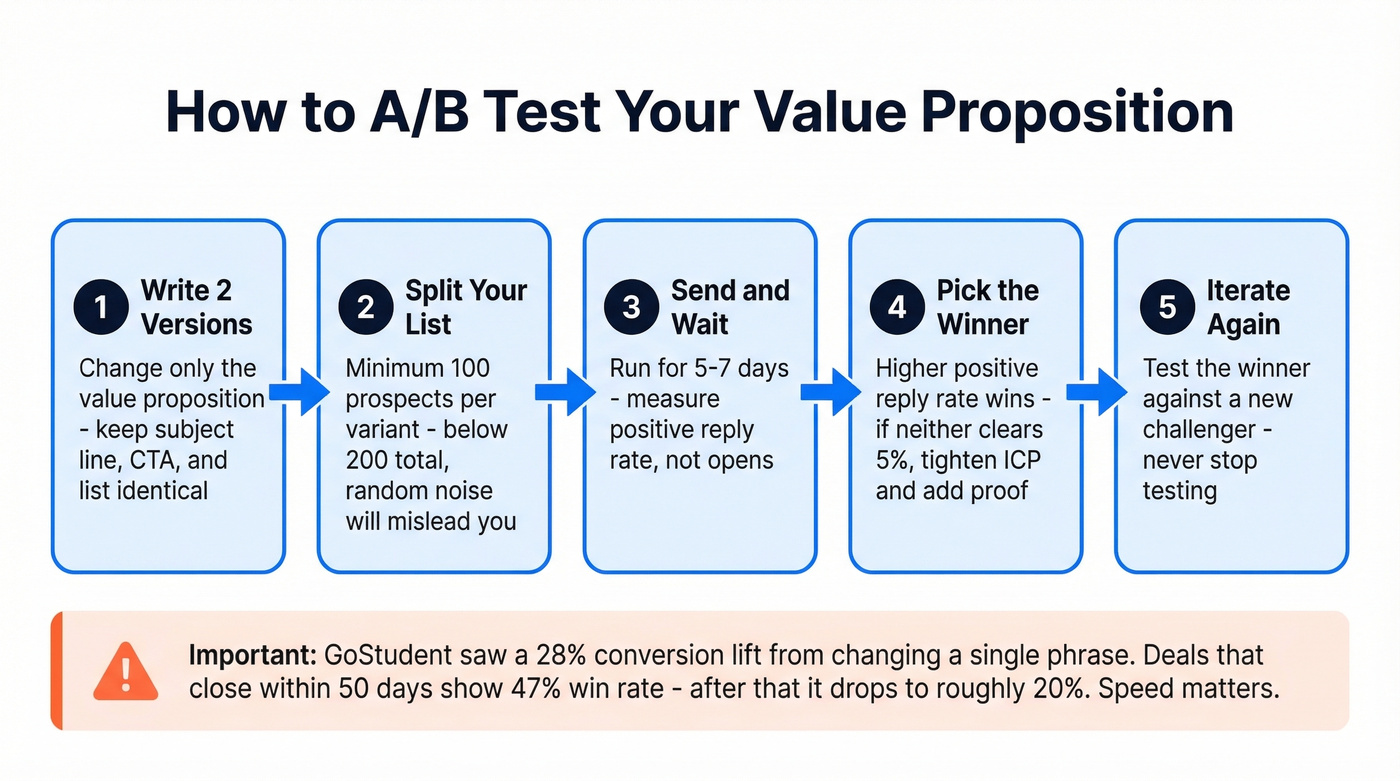
Test one variable at a time, use 100-200 prospects per variant, and measure positive reply rate. GoStudent ran a CTA wording test and saw a +28% conversion lift from changing a single phrase. Opportunities that close within 50 days show a 47% win rate - after that, it drops to roughly 20% or lower. The faster you find the right message, the faster you close.
Skip the A/B test if you don't have at least 200 prospects per variant. Below that threshold, random noise will mislead you more than the data will help.
A great sales pitch value proposition means nothing if it bounces. Before you hit send, verify your list with Prospeo - 98% email accuracy and a free tier of 75 emails per month so you can start testing immediately. Teams like Snyk cut bounce rates from 35-40% to under 5% after switching, which means more of those carefully crafted value props actually reach an inbox.
FAQ
What's the difference between a value proposition and a USP?
A value proposition explains the outcome a buyer gets. A USP identifies what makes you different from competitors. Your value prop includes your USP but adds buyer context and proof. Think of the USP as the ingredient and the value proposition as the full recipe.
How long should a value proposition be?
One to two sentences for cold emails. For verbal delivery, under 30 seconds - roughly 60 words at conversational pace. If you can't say it in 60 words, you haven't refined it enough.
How do I A/B test my value proposition?
Send 100 cold emails with version A, 100 with version B, and measure positive reply rate. If neither clears around 5%, tighten the ICP, name a sharper pain, and add proof - a number, a mini case result, or a concrete "before to after" outcome.
What tools help deliver a tested value proposition at scale?
You need verified contact data so your message actually lands. Pair a data platform like Prospeo with a sequencing tool like Instantly or Lemlist to run A/B tests across hundreds of prospects without burning your domain.
Snyk's 50 AEs cut bounce rates from 35% to under 5% and generated 200+ new opportunities per month with Prospeo's verified data. Your sales pitch value proposition only converts when it reaches real buyers - 98% accuracy makes that happen.
Stop perfecting copy that bounces. Fix the data first.