

The Sales Presentation Script Guide That Isn't a Cold Call Template
Your last three demos went 45 minutes each. The prospect said "this looks great" and then ghosted. The problem isn't your product - it's that you walked in with a slide deck instead of a conversation framework.
Most sales presentation script guides online are cold call templates dressed up with a new headline. This one's for the live selling presentation you're giving tomorrow.
What a Presentation Script Actually Is
A sales presentation script isn't a teleprompter. It's a conversational roadmap - key messages, questions, and objection responses organized in a logical flow. Talk tracks are the flexible building blocks; the script is the arc that holds them together.
Structured sales conversations convert at 2.5x higher rates than unstructured ones. Most buyers show up with roughly 90% of their research already done. A script gives you the confidence to connect dots without rambling. Mid-market SaaS demos typically convert at 15-30% depending on lead source, and a structured framework helps you compete toward the top of that range.
The Buyer-Centric Framework
Most reps default to a seller-centric flow: company intro, product features, pricing, awkward close attempt. That's a monologue, not a presentation. Flip it.
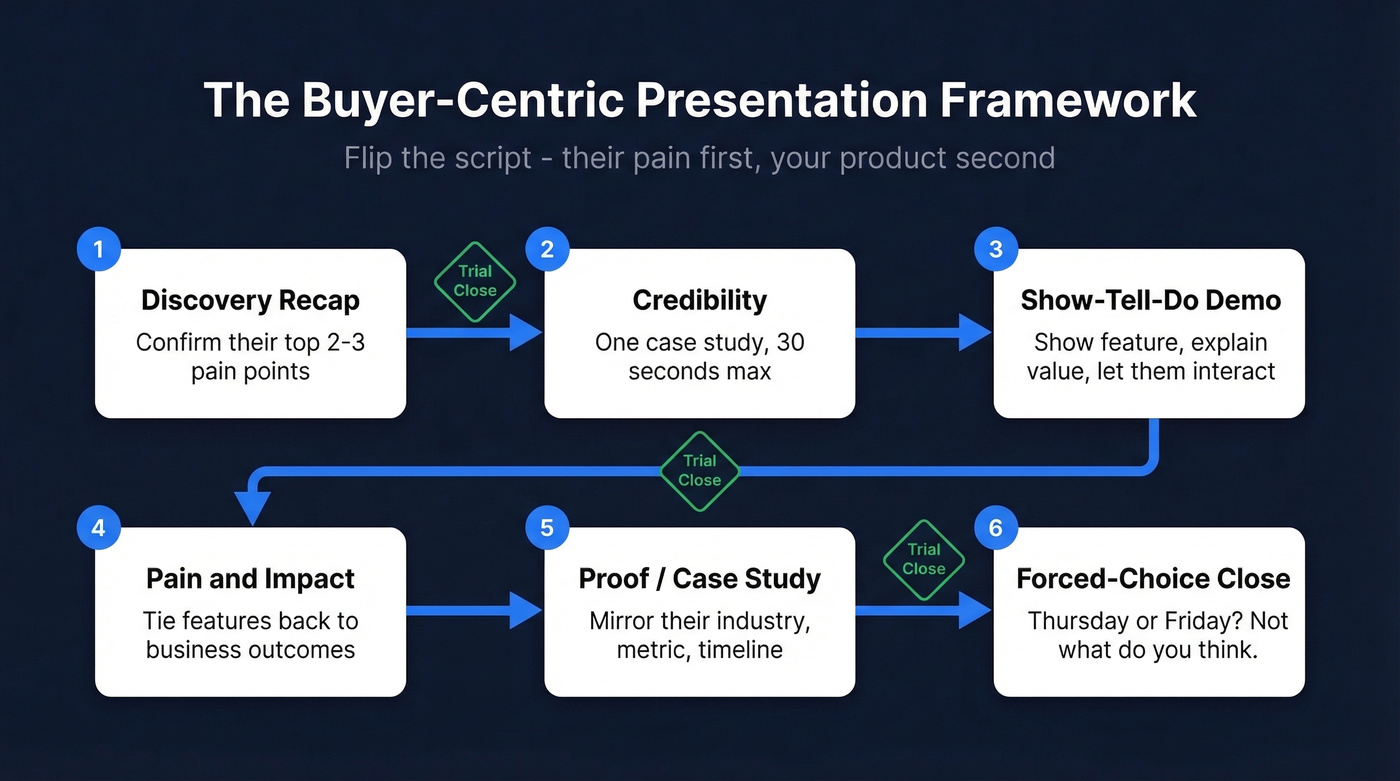
- Discovery Recap - Summarize what you learned. Confirm their top 2-3 pain points. This proves you listened and earns the right to present.
- Credibility - One relevant case study or metric. Thirty seconds, not five minutes.
- Demo via Show-Tell-Do - Show the feature, tell them why it matters for their workflow, then let them interact. Micro-questions throughout: "Does that match your process?"
- Pain & Impact - Tie what you showed back to business impact. Quantify where possible.
- Proof / Case Study - A customer story that mirrors their situation. Name the industry, the metric, the timeline.
- Next Steps with Forced-Choice Close - Don't ask "what do you think?" Propose two options: "Thursday or Friday for a follow-up with your team?"
Timebox upfront: "We'll cover three things in 25 minutes, then leave time for questions." Build in trial closes after the agenda, after the discovery recap, and mid-demo.
In our experience, reps who skip the discovery recap lose the room in the first five minutes. The prospect mentally checks out because you haven't proven you understand their world.
Copy-Paste Demo Script Templates
Opening & Agenda-Setting
"Thanks for making time. Based on what you shared in our last call, I've built this around [specific pain]. I'll recap what we discussed, show you how we solve [pain 1] and [pain 2], and leave 10 minutes for questions. Sound good?"
That last question is your first trial close. If they correct you or add context, even better - you just learned something.
Mid-Presentation Check-Ins
Don't wait until the end to find out you've been demoing the wrong thing. Drop these in every 5-7 minutes:
"Does that match your actual workflow, or is your process different?"
"Before I move on - does this address the [pain point] you flagged, or should we dig deeper?"
These micro-questions keep the talk-to-listen ratio healthy and surface objections before they fester.
Closing & Next Steps
"Based on what we've covered, does this solve [their stated problem]?"
If yes:
"Which works best - Thursday or Friday for a follow-up with [decision-maker name]?"
Never end with "What do you think?" That's an invitation to stall. A forced-choice close gives them a concrete action to say yes to.

A perfect presentation script means nothing if you're demoing to the wrong people. Prospeo's 300M+ profiles with 30+ filters - including buyer intent, job changes, and department headcount - help you find and verify every stakeholder before you book the call. 98% email accuracy. 125M+ verified mobiles. Multi-thread from day one.
Stop rehearsing for champions. Start closing with decision-makers.
Objection Talk Tracks
Competitive mentions in sales conversations are up 57% since 2022. Reps who discuss competitors early win enterprise deals at a 32% higher rate. Don't dodge comparisons - lean into them.
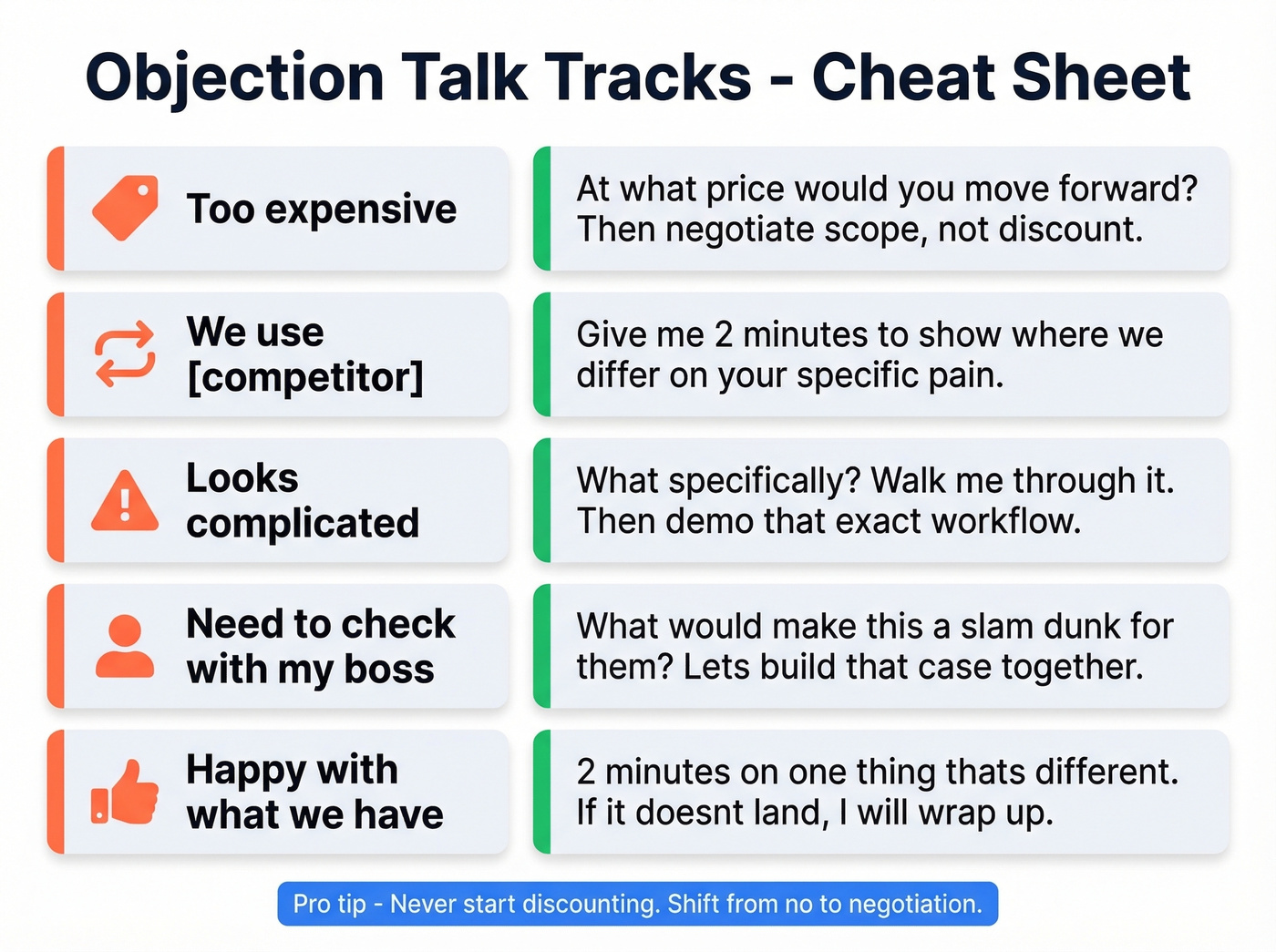
| Objection | Response |
|---|---|
| "Too expensive" | "At what price would you move forward?" Then negotiate scope. |
| "We use [competitor]" | "Give me 2 minutes to show where we differ on [their pain]." |
| "Looks complicated" | "What specifically? Walk me through it." Then demo that workflow. |
| "Need to check with my boss" | "What would make this a slam dunk for them? Let's build that case together." |
| "Happy with what we have" | "2 minutes on one thing that's different. If it doesn't land, I'll wrap up." |
The "too expensive" objection trips up more reps than any other because they immediately start discounting. Resist that urge. Asking "at what price would you move forward?" forces the prospect to name a number, which shifts the conversation from "no" to negotiation - a fundamentally different dynamic.
Data-Backed Delivery Tips
Talk less. The optimal ratio is 43% talking, 57% listening. Low performers swing to 64% talk time in lost deals. That's the single clearest signal something's wrong.
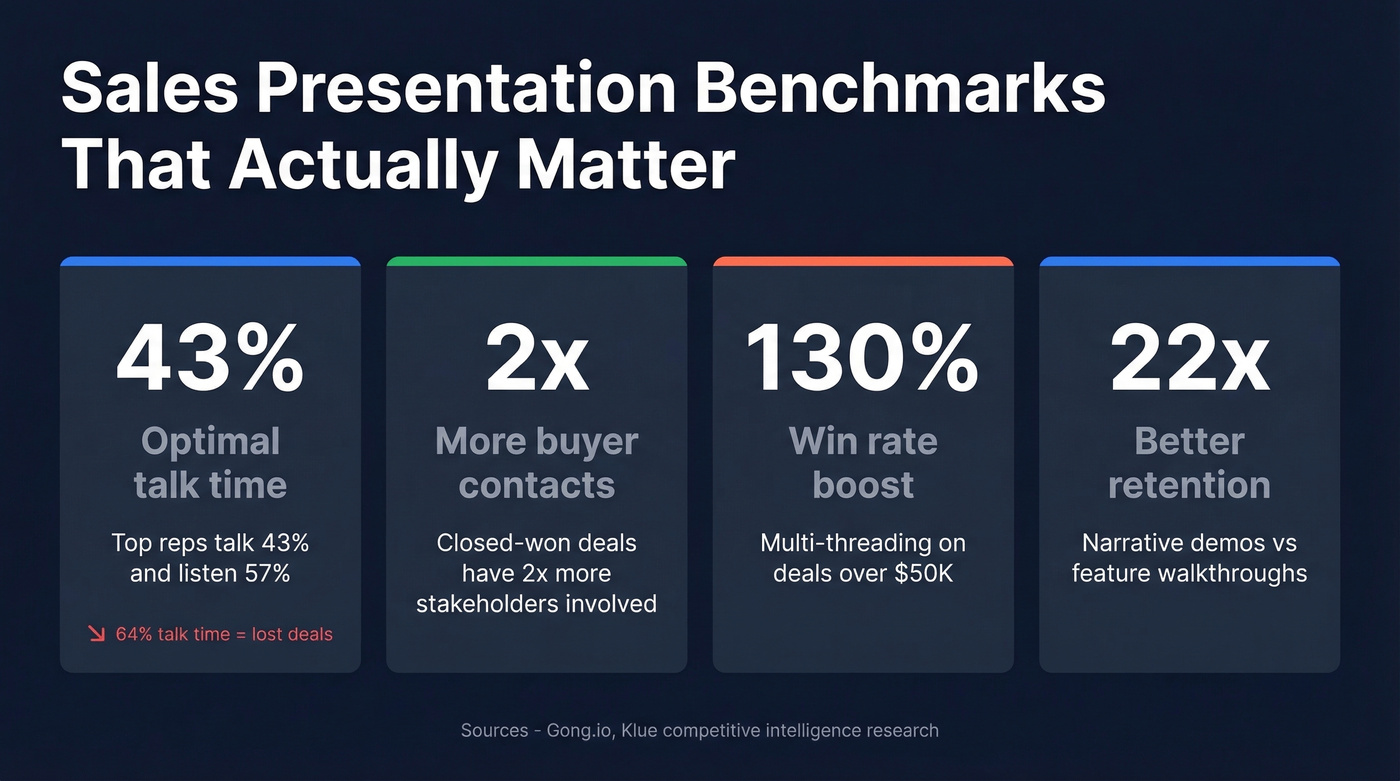
Multi-thread relentlessly. Closed-won deals have 2x more buyer contacts than closed-lost. For deals north of $50K, multi-threading boosts win rates by 130%. We've seen teams transform their close rates just by getting three stakeholders on the second call instead of one.
Use narrative, not feature lists. Narrative-driven demos yield 22x greater retention than feature walkthroughs. Interactive demos can lift conversion by up to 50%. When selling with slides, every visual should reinforce a story - not display a spec sheet.
Go short. Aim for 20-30 minutes of content plus Q&A. Buyer attention drops fast, and a tight presentation signals confidence. If you can't explain the value in 25 minutes, you don't understand it well enough.
Mistakes That Kill Presentations
One of the fastest ways to lose a deal is leading with "about us" slides before addressing the prospect's problems. Nobody cares about your founding story when they have a budget meeting in 20 minutes. Flip the order - their pain first, your credibility second.
Data dumping is the second killer. Every slide should earn its spot, and if you're talking 64% of the time, you're in lost-deal territory. The fix is simple: pause every 5-7 minutes and ask a question.
Here's the hot take most sales trainers won't give you: if the economic buyer isn't in the room and isn't scheduled, consider canceling the meeting. Presenting to a champion who "will relay the info" is rehearsing, not closing. Use MEDDIC qualification to confirm the Economic Buyer is present or scheduled before you invest 30 minutes of your best material. Harsh? Yes. But it'll save you dozens of hours per quarter chasing deals that were never real.
Let's be honest - the consensus on r/sales backs this up. Thread after thread of reps lamenting "great demo, no follow-up" almost always traces back to presenting to someone who couldn't sign the check.
Pre-Presentation Checklist
- Confirm pain points from discovery - don't assume they haven't changed
- Identify all stakeholders on the call and confirm the economic buyer is present
- Prepare your demo environment with prospect-specific data and scenarios
- Rehearse until delivery sounds natural, not memorized
- Prep objection talk tracks for the 3-5 most likely pushbacks
- Pull verified contact data for the full buying committee before the call
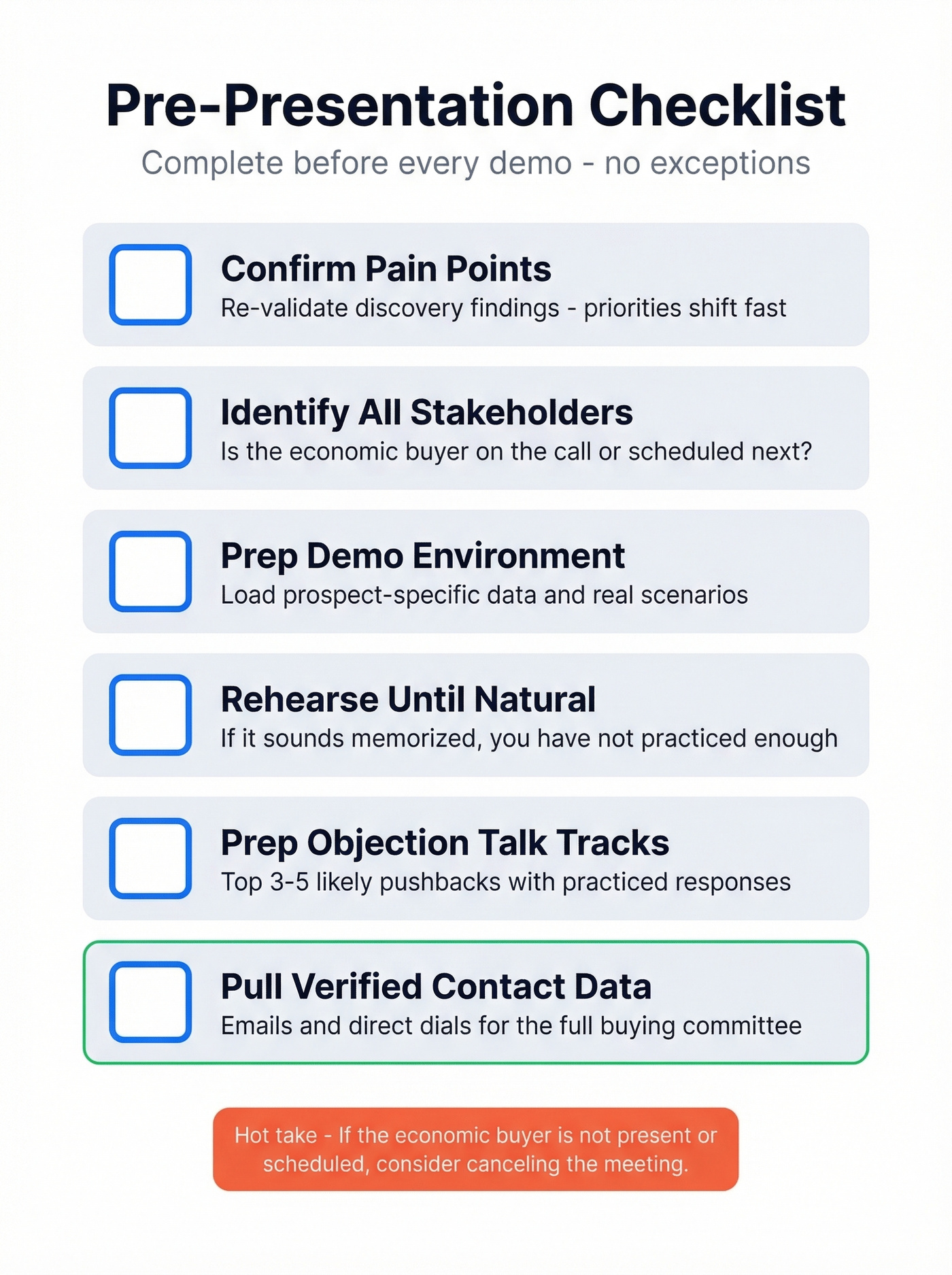
That last point matters more than most reps realize. You can't multi-thread if you don't have emails and direct dials for the CFO, the VP, and the end users. Tools like Prospeo cover 300M+ professional profiles with 98% email accuracy - pull the full buying committee's contact data before your presentation, not after.
Skip this step if you're selling to a single decision-maker with no committee. But for any deal with two or more stakeholders, having verified contact info for the full group before you present is the difference between a follow-up and a dead thread.
You just read that multi-threading boosts win rates by 130% on deals over $50K. That only works if you have verified contact data for every stakeholder in the room. Prospeo returns 50+ data points per contact at $0.01/email - so you can map the entire buying committee before your next demo.
Map the full buying committee in minutes, not days.
FAQ
How do you write a sales presentation script?
Start with your buyer's pain points, not your product features. Build a six-step arc: discovery recap, credibility, demo, pain-to-impact bridge, proof, and a forced-choice close. Write talk tracks for each step, then rehearse until delivery sounds conversational - not memorized.
Should you read from a script during a demo?
Use it as guardrails, not a teleprompter. One sales engineer on Reddit admitted they still read from a self-written, customer-tailored script - but practiced until it sounded natural. If it sounds robotic, you haven't rehearsed enough.
What's the ideal talk-to-listen ratio?
43% talking, 57% listening. Low performers hit 64% talk time in lost deals. Even during a selling presentation, build in micro-questions every 5-7 minutes to keep the conversation balanced and surface hidden objections early.
How do you find contact info for the full buying committee?
Use a B2B data platform before the call, not after. Multi-threading starts with having the right contacts loaded into your CRM before you present - verified emails, direct dials, and org chart context so you know who to loop in and when.