

Sales Stages: Benchmarks, Exit Criteria, and the Operating Manual Every Other Guide Skips
A rep on r/sales got so frustrated with his company's CRM stages that he started building his own iOS app. His reasoning? "Sick of my company's CRM; it provides very little value." That's not an edge case - it's the norm. 58% of B2B professionals reported longer sales cycles in a recent survey, 44% of sales leaders say "no decision" losses are increasing, and most teams are running pipeline stages that were designed for a CRM demo, not their actual business.
The problem isn't that sales stages are complicated. It's that most guides hand you a generic seven-step list with zero operational detail - no exit criteria, no benchmarks, no framework for deciding which stages your team actually needs. You end up with pipeline phases that look clean in a board deck but tell reps nothing about what to do next.
What You Need (Quick Version)
- Start with 5-7 stages. High-velocity SMB deals can work with 3-5. Enterprise deals above $100K ACV typically need 8-9 to account for security reviews, legal, and pilots.
- Define exit criteria for every stage based on buyer commitments, not seller actions. "Proposal sent" isn't an exit criterion - it's a task you completed. "Budget confirmed and stakeholders aligned" is an exit criterion.
- Benchmark your conversion rates against your industry. If you don't know what "good" looks like, you can't diagnose what's broken.
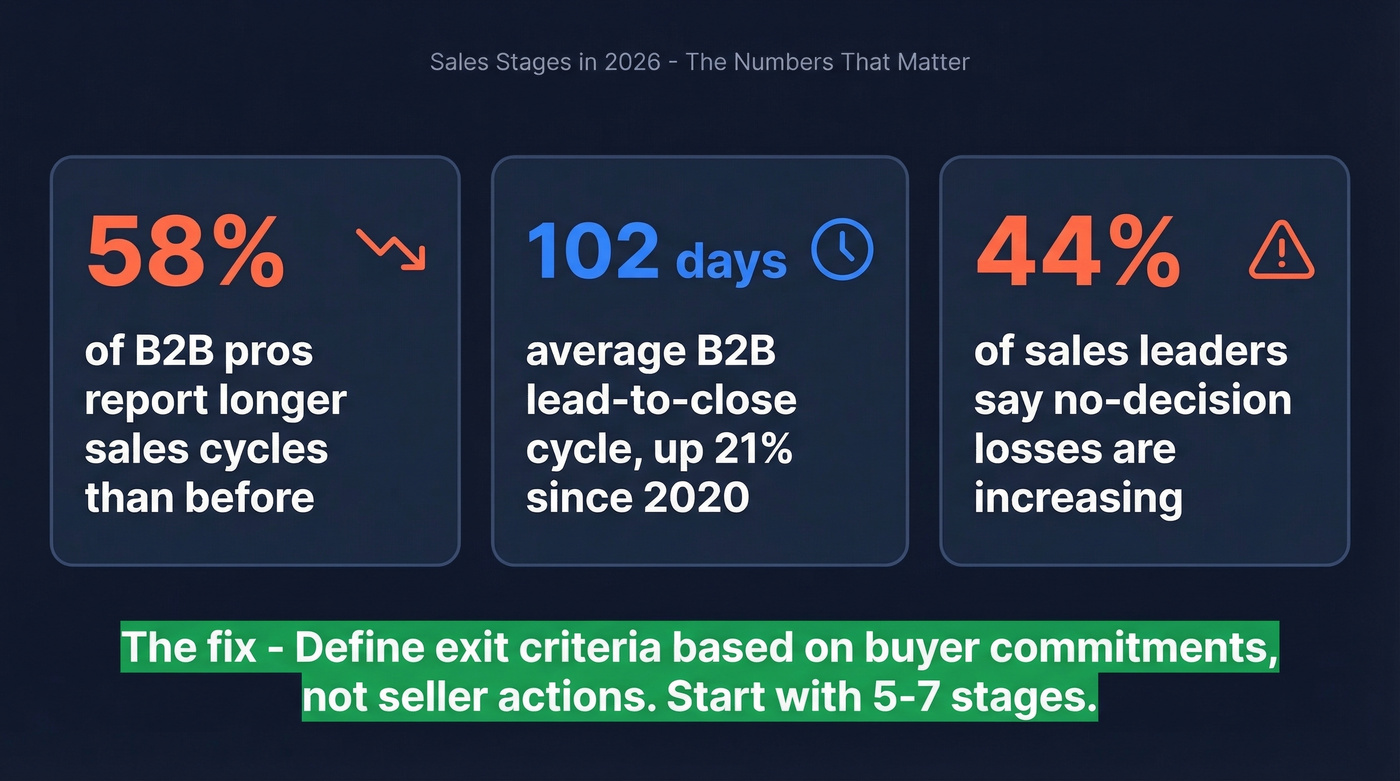
Below you'll find the benchmark tables, exit criteria templates, and qualification framework matrix. Jump to cycle benchmarks, conversion rates, or the qualification framework matrix if you already know the basics.
What Are Sales Stages?
Sales stages are the high-level phases a deal passes through from first contact to closed-won. They're the milestones your pipeline is organized around - used for forecasting, coaching, and figuring out where deals are stalling. When you define each stage clearly, every rep knows exactly what "progress" looks like at each point in the deal.
Stages aren't the same as steps. Stages are structural: Qualification, Discovery, Proposal. Steps are tactical: send the follow-up email, book the demo, loop in the champion. Stages tell leadership where a deal sits; steps tell reps what to do next. Conflating the two is how you end up with 14-stage pipelines where "Missed Call" is somehow a deal phase.
Stages vs Pipeline vs Funnel vs Process
These four terms get used interchangeably, and they shouldn't.
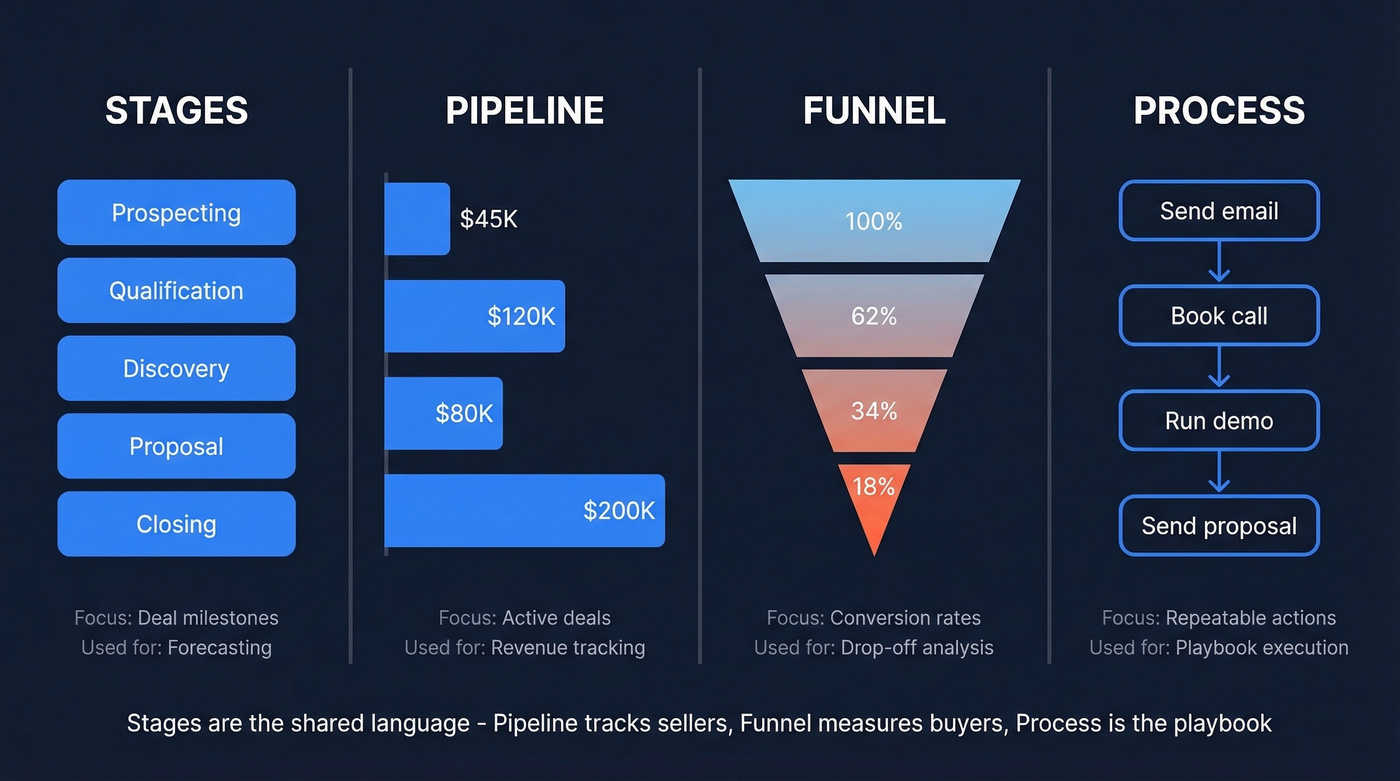
| Term | Focus | Perspective | Visualization | Purpose |
|---|---|---|---|---|
| Stages | Deal milestones | Seller + buyer | Kanban columns | Forecasting |
| Pipeline | Active deals | Seller | Horizontal bar chart | Revenue tracking |
| Funnel | Conversion rates | Buyer journey | Inverted triangle | Drop-off analysis |
| Process | Repeatable actions | Seller | Flowchart / playbook | Playbook execution |
Pipeline tracks what sellers do; funnel measures what buyers do. Stages are the shared language between the two. Process is the playbook that moves deals through stages consistently.
The 7 Core Sales Stages (With Exit Criteria)
Every stage needs three things: entry criteria (what qualifies a deal to be here), exit criteria (what must be true before it advances), and a bad-exit-criteria example so your team knows what doesn't count. I'll walk through each stage, then give you the consolidated table at the end - the one your VP of Sales will screenshot and pin in Slack.
Prospecting
This is where pipeline quality is won or lost. Exit criteria: ICP fit confirmed, verified contact data in hand, initial engagement signal such as a reply, click, or accepted meeting.
Here's the thing - if 30% of your emails bounce at this stage, you're not prospecting. You're spamming. Bad contact data at Stage 1 poisons every downstream metric: inflated pipeline, garbage conversion rates, wasted rep time. The data on outreach cadence is unforgiving: sellers have roughly 14 days to engage a new lead before interest decays, and the most successful reps reach out at least 9 times across that window. You can't execute a 9-touch cadence if half your contacts bounce on touch one.
Tools like Prospeo solve this at the source - 98% email accuracy with a 7-day data refresh cycle means every contact entering your pipeline is actually reachable. Start with the free tier (75 verified emails/month + 100 Chrome extension credits/month) and see what clean Stage 1 data does to your pipeline.
Qualification
Most reps treat qualification as a checkbox. It's actually the stage where you save yourself from wasting the next 90 days.
Bad exit criterion first: "Had a good call, they seemed interested." That tells you nothing. A deal exits Qualification when a budget path is identified, decision-making authority is confirmed, timeline is established, success criteria are defined, and the prospect agrees to next steps. The key word is "path" - in 2026, budget often gets created after you build a business case, so "Do you have budget?" is the wrong question. "How does your team fund new initiatives?" is better.
Qualification fail signals to watch for: no clear use case, wrong ICP fit, no urgency, no budget path, competitor already purchased, decision-makers inaccessible, or the prospect is using you as RFP filler. Any of these should move the deal to disqualified, not let it linger.
Discovery / Needs Analysis
We've seen this stage cause more forecast damage than any other. A rep marks Discovery as "complete" after one call where the prospect nodded along. Three months later, the deal is dead because nobody actually uncovered the real pain.
Exit criteria: confirmed business pain articulated by the prospect in their own words (not assumed by your rep), buying roles and influence mapped, and the prospect agrees to a specific next step - usually a demo or technical deep-dive. Discovery isn't a single call. It's the stage where your rep earns the right to present. If the prospect can't articulate why they'd change from the status quo, you haven't completed discovery.
Demo / Presentation
Exit criteria: prospect confirms the solution fits their stated need, agrees to a decision process and timeline, and key stakeholders are identified, even if they haven't all attended yet.
Bad exit criterion: "Demo completed." That's a seller action. The buyer confirming fit is the milestone that matters. If you're running demos for people who haven't been through proper discovery, you'll see this stage's conversion rate crater - and you'll blame the product instead of the process.
Proposal
A deal that's been sitting in Proposal for six-plus weeks when your typical proposal-to-close is closer to 2-3 weeks? That deal is either dead or missing a champion. Flag it.
Exit criteria: budget confirmed in writing or via procurement process, stakeholders aligned on the solution, decision timeline agreed, and the prospect has reviewed pricing without sticker shock. The "without sticker shock" part matters - if pricing surprises the buyer at this stage, your Discovery was incomplete.
Negotiation
Exit criteria: legal or procurement review initiated, commercial terms discussed and largely agreed, and there's a clear path to a signed agreement. This stage exists to handle redlines, security reviews, and procurement workflows - not to be a parking lot for deals that aren't actually progressing.
Let's be honest: if Negotiation is consistently where deals pile up, you don't have a negotiation problem. You have a qualification problem. Deals that were properly qualified and discovered don't stall here. They stall here because someone skipped a step upstream and is now paying for it.
Closing & Post-Sale
Exit criteria: signed agreement received, handoff to customer success or onboarding initiated. Most teams stop here, but "retaining" is an often-missed pipeline phase. If your expansion revenue matters - and for most SaaS companies it's the majority of growth - post-sale needs its own exit criteria: onboarding complete, first value milestone hit, renewal conversation scheduled.
Consolidated Exit Criteria Table
This is the table worth bookmarking. Screenshot it, share it with your team, and use it as the starting template for your own pipeline design.
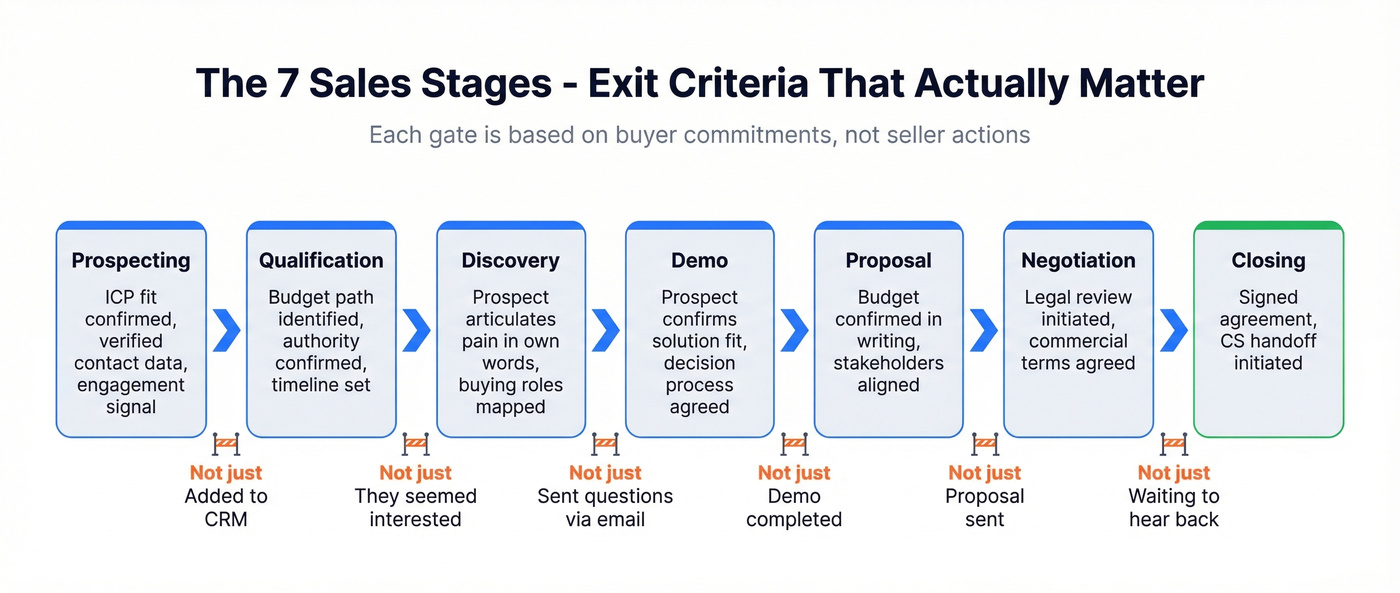
| Stage | Entry Criteria | Exit Criteria | Bad Exit Criteria Example |
|---|---|---|---|
| Prospecting | Matches ICP profile | ICP fit confirmed, verified contact data, engagement signal received | "Added to CRM" |
| Qualification | Engagement signal received | Budget path identified, authority confirmed, timeline set, prospect agrees to next steps | "Had a good call, they seemed interested" |
| Discovery | Qualified opportunity | Prospect articulates pain in own words, buying roles mapped, specific next step agreed | "Sent discovery questions via email" |
| Demo / Presentation | Discovery complete | Prospect confirms solution fit, decision process and timeline agreed, stakeholders identified | "Demo completed" |
| Proposal | Solution fit confirmed | Budget confirmed in writing, stakeholders aligned, timeline agreed, pricing reviewed | "Proposal sent" |
| Negotiation | Proposal reviewed | Legal/procurement review initiated, commercial terms largely agreed, clear path to signature | "Waiting to hear back" |
| Closing & Post-Sale | Terms agreed | Signed agreement received, CS/onboarding handoff initiated, first value milestone scheduled | "Verbal yes" |
Sales Cycle Benchmarks
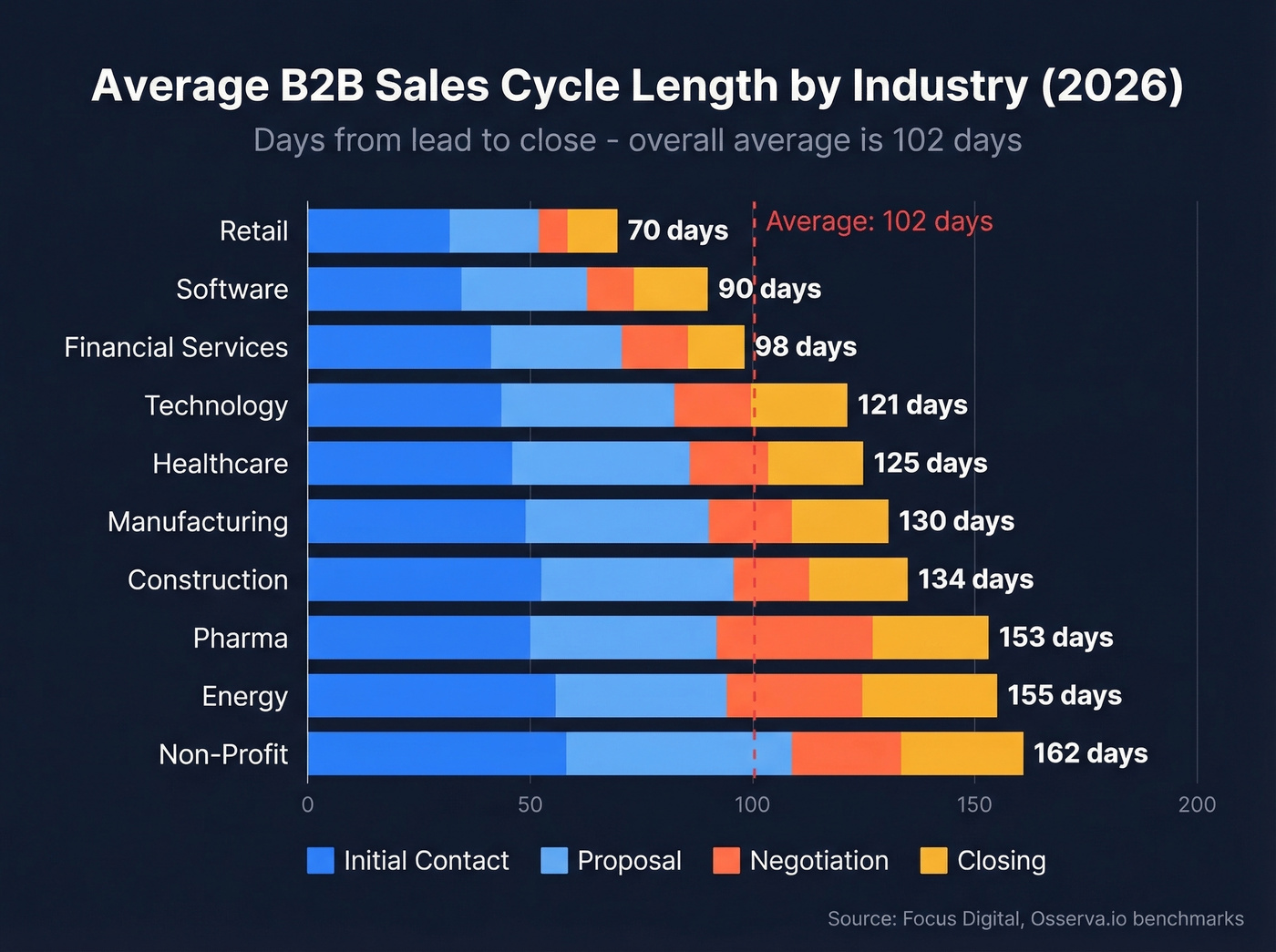
The average B2B lead-to-close cycle runs 102 days. That number is 21% longer than it was in 2020, and it's still climbing. But averages hide enormous variation by industry, company size, deal value, and lead source channel.
By Industry
| Industry | Total Days | Initial Contact | Proposal | Negotiation | Closing |
|---|---|---|---|---|---|
| Retail | 70 | 10 | 20 | 20 | 20 |
| Software | 90 | 14 | 30 | 25 | 21 |
| Financial Svcs | 98 | 15 | 28 | 30 | 25 |
| Technology | 121 | 18 | 35 | 35 | 33 |
| Healthcare | 125 | 20 | 35 | 35 | 35 |
| Manufacturing | 130 | 20 | 38 | 38 | 34 |
| Construction | 134 | 22 | 38 | 40 | 34 |
| Pharma | 153 | 25 | 42 | 45 | 41 |
| Energy | 155 | 25 | 45 | 45 | 40 |
| Non-Profit | 162 | 28 | 45 | 48 | 41 |
By Company Size
| Prospect Size | Avg Days |
|---|---|
| 1-10 employees | 38 |
| 11-50 | 57 |
| 51-200 | 77 |
| 201-500 | 95 |
| 501-1,000 | 115 |
| 1,001-5,000 | 135 |
| 5,001-10,000 | 158 |
| 10,001+ | 185 |
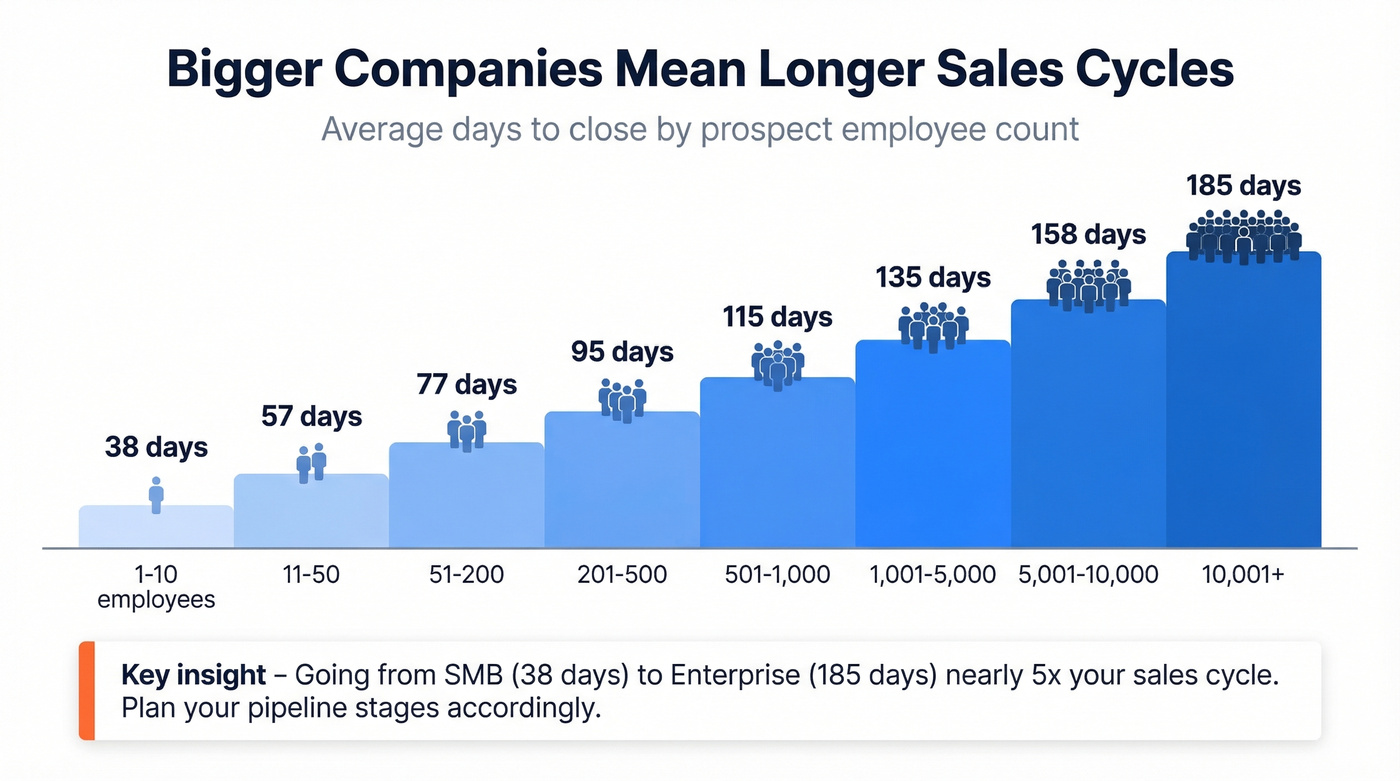
More employees means more stakeholders, more procurement layers, and more security reviews. A 10,000-person company doesn't move faster just because your product is simple.
By Deal Size (ACV)
| ACV Range | Avg Days |
|---|---|
| < $1K | 25 |
| $1K-$5K | 40 |
| $5K-$10K | 55 |
| $10K-$50K | 75 |
| $50K-$100K | 120 |
| $100K-$250K | 170 |
| $250K-$500K | 220 |
| > $500K | 270 |
By Lead Source Channel
Not all pipeline enters at the same velocity. Where a lead originates dramatically affects how long it takes to close.
| Channel / Complexity | Avg Days |
|---|---|
| SEO inbound (low complexity) | 28 |
| Paid search (medium complexity) | 55 |
| Referral / partner | 45 |
| Cold calling (high complexity) | 110 |
| Trade shows | 150 |
Inbound leads from SEO close over 5x faster than trade show leads. If your pipeline is heavily weighted toward outbound and events, your cycle benchmarks should reflect that - don't compare yourself to a company running a PLG inbound motion.
The Win-Rate Cliff
This is the stat that should change how you think about stage duration. Deals closed within 50 days have a 47% win rate. After that threshold, win rates drop to roughly 20% or lower.
We've seen this play out repeatedly: deals that cross the 50-day mark without a signed agreement enter a death spiral of "checking in" emails and rescheduled calls. 34% of revenue teams report average cycles of 1-2 quarters, which means a huge chunk of the market is operating right at the edge of that decay curve.
One underused lever: AI-powered conversation coaching. Teams using real-time AI coaching tools have reported closing deals 11 days faster with a 10-percentage-point win rate improvement on $50K+ deals. That's not marginal - it's the difference between landing on the right side of the cliff or the wrong one.

Your prospecting stage sets the ceiling for every conversion rate downstream. If 30% of emails bounce at Stage 1, your pipeline metrics are fiction. Prospeo delivers 98% email accuracy on a 7-day refresh cycle - so every contact entering your pipeline is actually reachable.
Clean Stage 1 data starts at $0.01 per verified email.
Conversion Rate Benchmarks
Most teams guess at what "good" looks like. Here are actual numbers from a FirstPageSage dataset spanning 2017-2025:
| Industry | Lead-MQL | MQL-SQL | SQL-Opp | SQL-Closed |
|---|---|---|---|---|
| B2B SaaS | 39% | 38% | 42% | 37% |
| Cybersecurity | 36% | 35% | 40% | 33% |
| Financial Svcs | 38% | 34% | 39% | 31% |
| Healthcare | 34% | 31% | 37% | 28% |
| Manufacturing | 32% | 29% | 35% | 26% |
The biggest bottleneck across SaaS companies is consistently the MQL-to-SQL handoff. The FirstPageSage B2B SaaS benchmark shows 38%, but Digital Bloom's broader SaaS analysis finds typical performance running just 15-21%. That gap is usually a qualification problem, not a volume problem.
For teams that need segment-level precision: SMB and mid-market motions typically see higher MQL-to-SQL conversion (around 39%) compared to enterprise motions (closer to 31%), because enterprise leads require more validation before sales accepts them. SaaS-specific benchmarks paint a fuller picture: median cycle of 84 days, typical win rates of 20-30%, and a median deal size of $26,265 for private SaaS companies. 68% of companies lack formal funnel measurement entirely - which means if you're tracking these numbers at all, you're already ahead of most of your competitors.
If your MQL-to-SQL conversion is below 20%, don't buy more leads. Fix your qualification criteria and your marketing-to-sales handoff definition first.
Choosing a Qualification Framework
Not every deal needs the same qualification rigor. Using BANT on a $200K enterprise deal is malpractice - you'll miss the champion dynamics, the economic buyer's priorities, and the metrics that justify the purchase. Using MEDDIC on a $3K self-serve deal is overkill that'll slow your reps to a crawl.
| Framework | Best For | Deal Size | Cycle | Complexity | Key Question |
|---|---|---|---|---|---|
| BANT | SMB, transactional | Under $10K | < 30 days | Low | "Is there budget?" |
| MEDDIC | Enterprise, complex | $50K+ | 90+ days | High | "Who's the champion?" |
| SPICED | SaaS, PLG, renewal | Varies | Varies | Medium | "What's the impact?" |
BANT works as a pre-filter - a quick screen to see if a deal is worth pursuing. Its biggest weakness is the "B." In enterprise sales, budget often gets created after you build a business case. Asking "Do you have budget?" on the first call disqualifies deals that would've closed at six figures if you'd led with impact instead.
MEDDIC earns its complexity when you're dealing with 6-10+ stakeholders in an enterprise buying committee. The "Champion" and "Economic Buyer" components force reps to map the political landscape, not just the technical requirements.
SPICED (Situation, Problem, Impact, Critical Event, Decision) fits SaaS and subscription businesses because it centers on the buyer's timeline and the cost of inaction. It's particularly strong for expansion and renewal motions where the "problem" isn't net-new - it's evolving.
Our recommendation: start every deal with BANT as a 60-second screen. If the ACV is above $25K, switch to MEDDIC or SPICED immediately. The worst thing you can do is let a framework designed for speed govern a deal that requires depth.
Customizing Stages by Motion
Your sales stages should mirror how your buyers actually buy, not how your CRM vendor designed their default template. Different motions need different pipelines - and each opportunity stage should reflect a genuine buyer commitment, not an internal workflow step.
Self-serve / PLG: 3-5 stages max. The "sales cycle" is really a product-led conversion funnel. Free trials can extend the cycle by 7-30 days, so account for that in your stage timing. Stages might look like: Trial Started, Activation Milestone, Sales-Assisted, Closed.
Transactional (mid-market): The classic 5-7 stages work here. Demos, proposals, and light negotiation. Cycle runs 30-90 days. This is where most of the advice in this article applies directly.
Enterprise: 8-9 stages, with additions for security/compliance review, legal/procurement, and pilot or POC phases. Enterprise cycles run 6-18 months with $100K-$500K+ ACV. Skipping the security review stage doesn't make it go away - it just means the deal stalls in "Negotiation" for three months while your rep has no idea what's happening. Build the stage, set an SLA, and give your rep visibility into what's actually blocking the deal.
In our experience, the most common structural mistake is forcing different motions into one pipeline. If outside sales and account managers share the same stages, you'll end up with stages that serve neither. Build separate pipelines for new business and expansion, even if they share a CRM.
5 Mistakes That Kill Your Pipeline
1. Copying default CRM stages. Your CRM vendor designed those for demo purposes, not your business. What looks clean in a template often breaks the moment you have security review, procurement, and a real buying committee.
2. Confusing stages with statuses. One agency posted their pipeline on Reddit: "Lead Interested, Info Request, Meeting Request, Never Replied to Book Meeting, Meeting Booked, Missed Call, Meh Call, Great Call, Proposal Sent, Won, Lost." The OP's own diagnosis? "Seems like overkill." It is. "Missed Call" and "Meh Call" are activity outcomes - they belong in a call disposition field, not as pipeline stages. Stages represent buyer milestones; statuses track where a lead sits at a given moment.
3. No exit criteria. Your VP asks why 40% of deals have been in "Proposal" for six-plus weeks. Nobody can answer because there's no definition of what "Proposal" means beyond "we sent a PDF." Without exit criteria, pipeline reviews become opinion sessions instead of diagnostic conversations. Use the exit criteria table above as your starting point.
4. Ignoring stale deals. Look - if a deal has been in Negotiation for 90 days and your average negotiation phase is 14, that deal is dead. It's just too uncomfortable to admit. Set a stale-deal threshold at 2x the average stage duration and enforce it. Dead deals in your pipeline inflate coverage ratios and destroy forecast accuracy.
5. Bad data at Stage 1. Your SDR team generated 200 leads last month. By Stage 3, only 30 are left - and half of those had bad contact data from the start. It takes an average of 8 touches to generate a meeting, and you can't execute that cadence against contacts who bounce on touch one. Verify contact data before it enters your pipeline. Skip this step and you're just pouring money into a leaky bucket.
Measuring Stage Health
A pipeline full of deals means nothing if those deals aren't moving. Here are the metrics that actually matter:
Pipeline coverage ratio: You need 3x-5x your quota in active pipeline. Below 3x and you're relying on every deal to close. Above 5x and your pipeline is probably full of stale deals inflating the number.
Stage conversion rate: What percentage of deals advance from each stage to the next? If Discovery-to-Demo runs 80% but Demo-to-Proposal drops to 25%, your demos aren't landing. That's a coaching problem, not a volume problem.
Average time in stage is the metric most teams track at the wrong altitude. They look at total cycle length when the real diagnostic power is per-stage duration. A deal that flies through Discovery in 3 days but sits in Proposal for 45 is telling you something specific - and it's not "the cycle is long."
Pipeline velocity - (Number of deals x average deal size x win rate) / average cycle length - is the single number that tells you how fast your pipeline generates revenue. Track it monthly and watch for trends, not snapshots.
Lead response time: Contacting leads within 24 hours increases conversion 5x. This is the easiest metric to improve and the one most teams ignore.
Set stage SLAs based on your benchmarks. Flag anything exceeding 2x the average stage duration as stale. Review weekly. Kill what's dead. Understanding how deals move through each of your sales stages - and where they stall - is the difference between a forecast you trust and one you hope is right.
You just defined exit criteria for every sales stage. Now make sure your reps aren't wasting Discovery calls on unverifiable contacts. Prospeo gives you 300M+ profiles with 30+ filters - buyer intent, job changes, headcount growth - so deals enter qualification already ICP-confirmed.
Stop letting bad data inflate your pipeline. Verify before you qualify.
FAQ
How many sales stages should I have?
Five to seven for most B2B teams. High-velocity SMB deals can run with 3-5 stages, while enterprise deals above $100K ACV often need 8-9 to cover security reviews, legal, and pilots. More stages aren't better - each one should represent a distinct buyer commitment.
What's the difference between sales stages and a sales pipeline?
Sales stages are the milestones a deal passes through - Qualification, Discovery, Proposal. A pipeline is all your active deals organized by those milestones. Stages are the structure; the pipeline is the view that lets you forecast revenue and spot bottlenecks.
How long should each stage take?
Software averages 90 days total: roughly 14 days initial contact, 30 days proposal, 25 days negotiation, 21 days closing. Set stage SLAs at 2x the average duration - anything beyond that threshold is stale and should be reviewed or killed.
What are exit criteria and why do they matter?
Exit criteria are specific buyer-confirmed conditions that must be met before a deal advances. "Budget confirmed and stakeholders aligned" is strong. "Proposal sent" is not - that's a seller action. Without exit criteria, pipeline reviews become guesswork and forecasts collapse.
How do I fix bad data at the prospecting stage?
Verify contact data before it enters your pipeline. Teams like Snyk cut bounce rates from 35-40% to under 5% after switching to verified-first prospecting tools, and their AE-sourced pipeline jumped 180%. Bad data at the top compounds into wasted effort at every downstream stage.