

The Scarcity Close: How to Create Real Urgency Without Burning Trust
The scarcity close is one of the most misused techniques in B2B sales - and one of the most effective when it's real. We've watched deals die dozens of times the same way: your champion says "love it, circle back next quarter," enthusiasm fades, a reorg happens, budget gets reallocated, and an 80% deal goes cold. Stalled deals drag down win rates. This technique prevents that, but only if you anchor it to something true.
This isn't a survey of 15 closing techniques. It's a focused playbook on one.
What Is a Scarcity Close?
Robert Cialdini's scarcity principle is simple: people want more of what they can have less of. His team recommends going beyond listing benefits - highlight what the buyer stands to lose if they delay. It works because humans weigh potential losses more heavily than equivalent gains, a bias that's been replicated in study after study since Kahneman and Tversky's original prospect theory work. When British Airways announced it was discontinuing Concorde flights in 2003, sales spiked the next day. The plane didn't get faster. It just became scarce.
Three related techniques overlap but aren't the same:
- Scarcity close - uses limited availability: slots, inventory, pricing windows.
- Urgency close - broader, covering any time pressure, including the buyer's own deadlines.
- Now-or-never close - the aggressive cousin: sign today or the deal changes.
The scarcity-based approach is the most defensible because it's anchored to something real.
Why Deal Momentum Matters More Than Ever
Outreach's 2025 analysis found that opportunities closed within 50 days have a 47% win rate, compared to 20% or lower after that threshold. The longer a deal sits open, the worse your odds get.
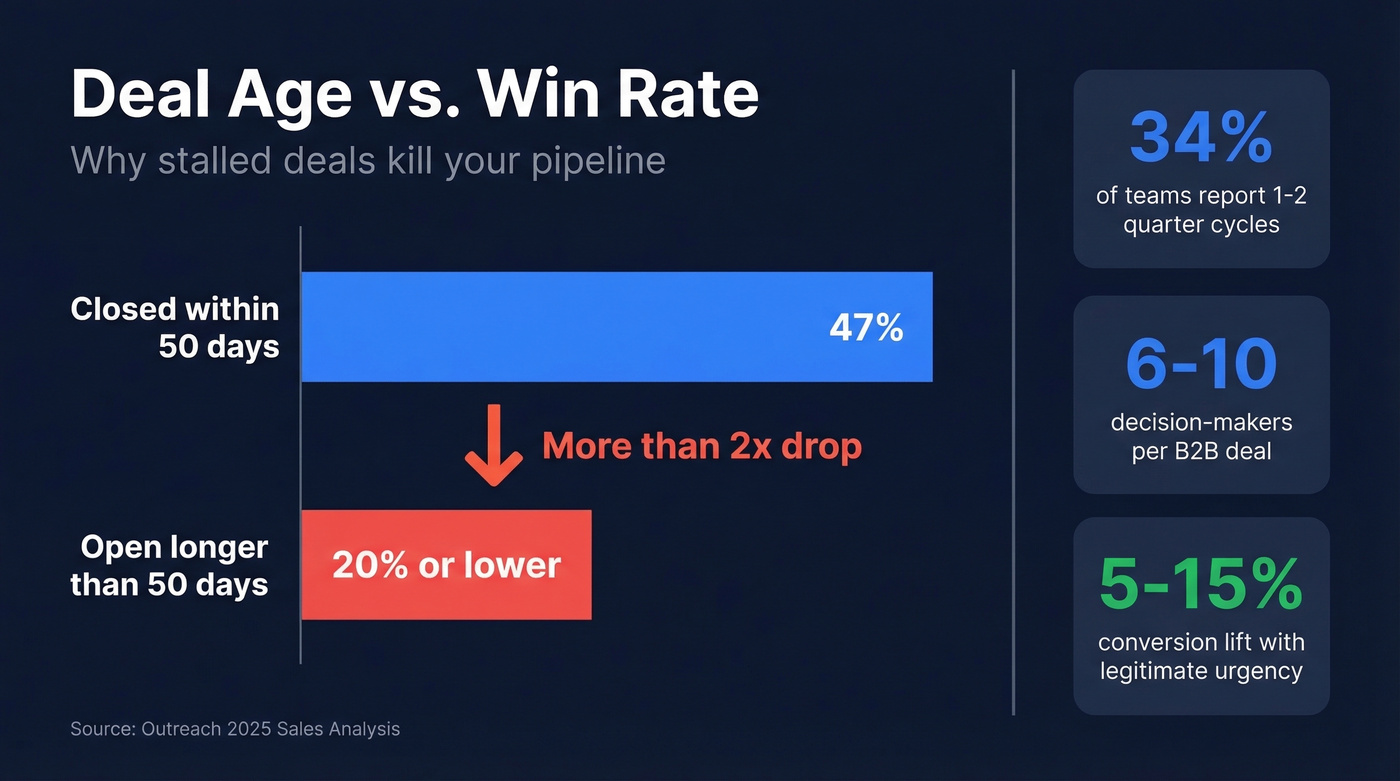
And deals are getting harder to close. 34% of revenue teams report average cycles of one to two quarters, with 6-10 decision-makers involved in a typical B2B purchase. That's a lot of calendars to align. A 5-15% lift in meeting-to-close conversion is common when you introduce legitimate urgency early - not because you're pressuring buyers, but because you're giving buying committees a reason to prioritize your deal over the twelve other initiatives competing for their attention this quarter.
When to Use It (and When Not To)
Use it when there's a real, documentable constraint (pricing window, onboarding capacity, regulatory deadline), the buyer has shared a business-critical timeline, you've built enough trust for a direct ask, and the deal needs a nudge - not new information.
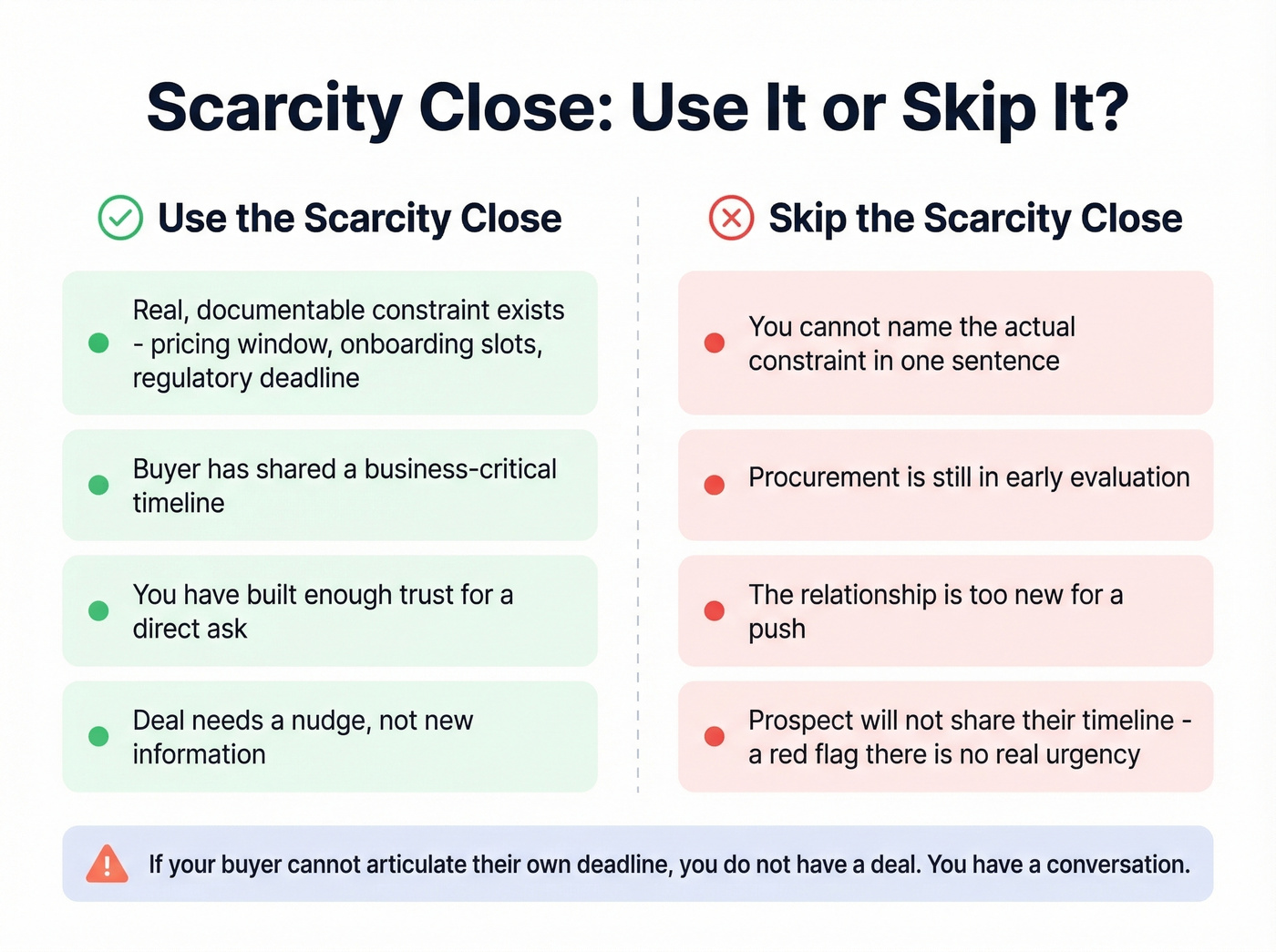
Skip it when you can't name the actual constraint in one sentence. Also skip it if procurement is still in early evaluation, the relationship is too new for a push, or the prospect won't share their timeline - a red flag that there's no real urgency on their side either.
Here's the thing: if your buyer can't articulate their own deadline, you don't have a deal. You have a conversation. No scarcity technique fixes that. Qualify harder before you close harder.

You just read it: deals that stall past 50 days drop to a 20% win rate. Your scarcity close only works if you're reaching the actual decision-maker - not a gatekeeper. Prospeo gives you 98% accurate emails and 125M+ verified mobile numbers so your urgency message hits the right person before the window closes.
Stop losing deals to bad contact data. Reach decision-makers directly.
The Legitimate Scarcity Menu
Scarcity works best when it's documented early and simply repeated at the end - not introduced as a last-minute trick. Build these into your deal cycle from day one.
| Scarcity Source | Example Phrasing | Best For |
|---|---|---|
| Onboarding capacity | "3 implementation slots left this Q" | Hands-on SaaS onboarding |
| Pricing effective date | "Current pricing locks through [date]" | End-of-quarter deals |
| Buyer's own timeline | "You need this live by [date]..." | Any deal with a stated goal |
| Expiring budget | "Fiscal year ends [date] - use or lose" | Enterprise / public sector |
| Compliance window | "Audit is Q2 - review takes 6 weeks" | Regulated industries |
| Event-driven deadline | "Running before [conference/launch]?" | Marketing-adjacent tools |
Scripts That Work
Deadline Discount
"We have a 15% discount for new customers that ends this Friday. If you sign by then, I can lock that pricing in for the full year."
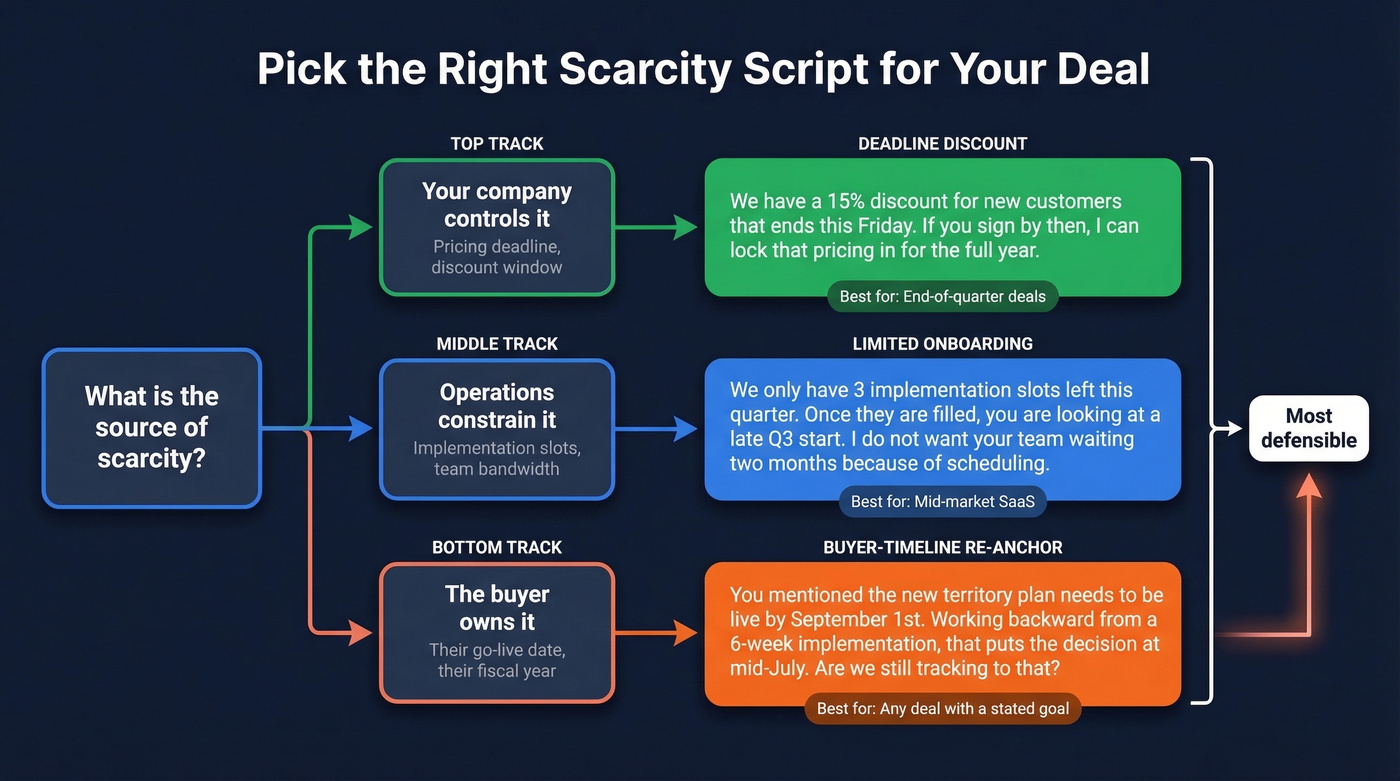
This is Topo's classic SaaS script. One rule: only use it when the deadline is contractually real. If the discount magically reappears next Monday, you've torched your credibility.
Limited Onboarding Capacity
The onboarding-capacity close rarely feels slimy - because implementation capacity is genuinely finite. We've seen this version land consistently across mid-market SaaS deals:
"We only have 3 implementation slots left this quarter. Once they're filled, you're looking at a late Q3 start. I don't want your team waiting two months because of scheduling."
Why does this work so well? It frames the constraint as something you're protecting the buyer from, not something you're wielding against them. The rep sounds like an ally, not an auctioneer.
Buyer-Timeline Re-Anchor
"You mentioned the new territory plan needs to be live by September 1st. Working backward from a 6-week implementation, that puts the decision at mid-July. Are we still tracking to that?"
This is the most defensible version because the constraint belongs to the prospect, not you. You're reflecting their reality back to them - the ChannelFutures "scarcity of time" framework in action. Most reps say "our price goes up Friday." Better reps say "you told me go-live is August 1 - working backward, this week is the decision point." Anchoring to their constraint feels collaborative, not transactional.
Risks and Guardrails
Research summaries from Zamfir (2024) and Verma (2025) link artificial urgency to higher buyer regret, weaker loyalty, and long-term trust damage - even when it boosts short-term conversion. Fake scarcity destroys trust. In our experience, it backfires hardest when reps can't answer "what's the actual constraint?" in one sentence.
Roughly 10-20% of prospects react negatively when scarcity feels manufactured, and that number climbs in procurement-led enterprise deals where buyers hear "price goes up Friday" all day long. The difference between trusted advisors and pushy reps? Trusted advisors can point to the constraint in writing. Pushy reps change the subject.
Let's be honest: if you can't name the real constraint, you're not closing on scarcity. You're doing pressure. (If you want a clean ethical line, start with ethics in sales.)
The 3-Point Legitimacy Check
Before you deploy any scarcity message, run this pre-flight:
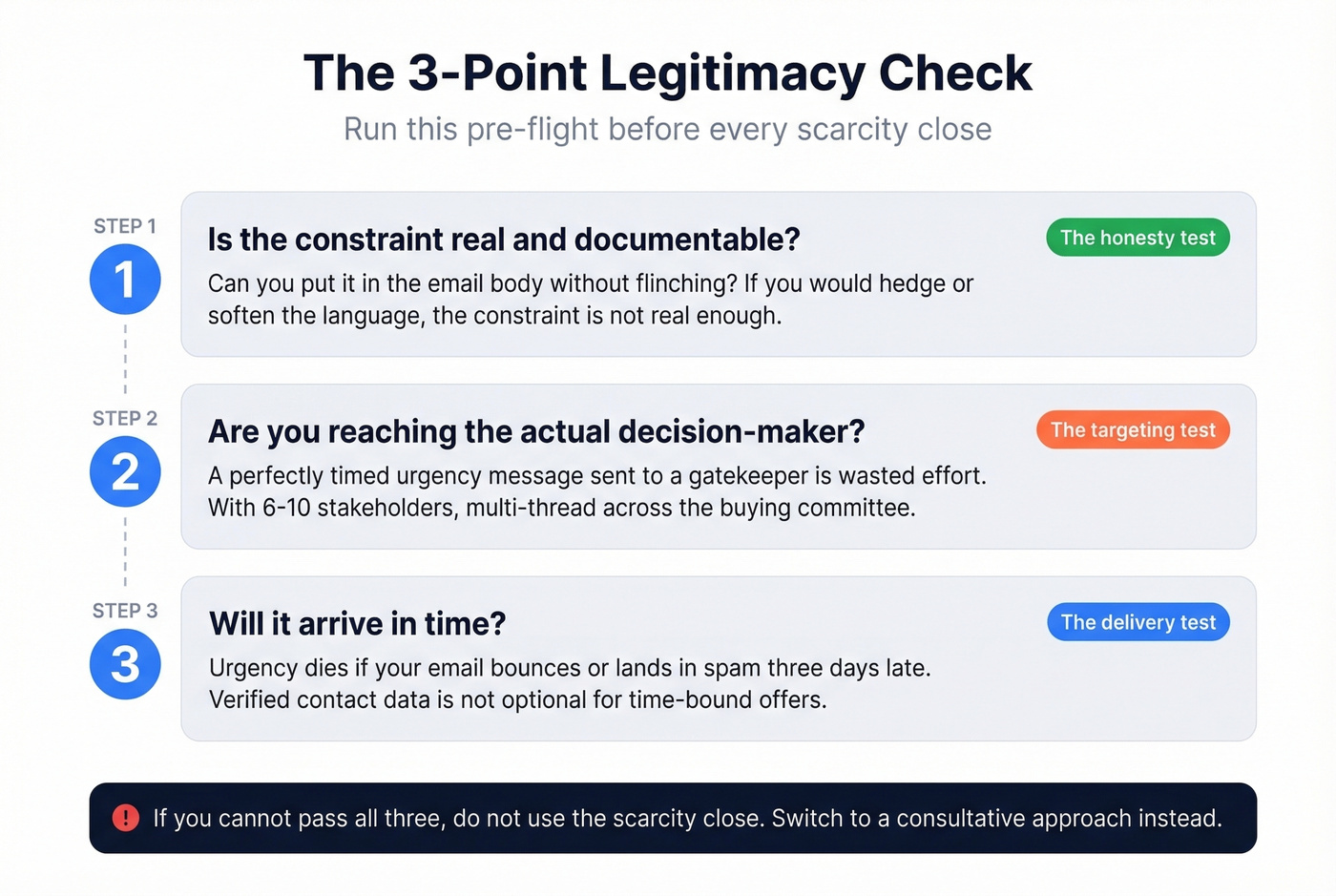
- Is the constraint real and documentable? Can you put it in the email body without flinching? Good.
- Are you reaching the actual decision-maker? A perfectly timed urgency message sent to a gatekeeper is wasted effort. In deals with 6-10 stakeholders, you need to multi-thread across the buying committee so one blocker doesn't kill the timeline.
- Will it arrive in time? Urgency dies if your email bounces or lands in spam three days late. If you're running a time-bound offer, bad contact data kills the window before the prospect even sees your message. Prospeo's 7-day data refresh cycle and 98% email accuracy help you reach the right stakeholder before the deadline passes.
Multi-threading across 6-10 stakeholders means you need verified contact data for the entire buying committee - not just one champion. Prospeo's database covers 300M+ profiles with 30+ filters including job title, department, and seniority. Build your full committee list in minutes, not days.
Your perfectly timed close is worthless if it reaches the wrong person.
FAQ
Is the scarcity close manipulative?
Only if the scarcity is fake. Legitimate constraints - onboarding capacity, pricing windows, the buyer's own timeline - are facts, not tricks. The ethical test: can you document the constraint in writing and send it without hedging? If yes, you're on solid ground.
What if the prospect pushes back?
Acknowledge it directly and restate the business reason: "Totally fair - the reason I flagged it is [real constraint]." If you can't restate a real reason, you were bluffing. Back off and switch to a consultative approach. That pivot actually builds more trust than doubling down ever would.
Does this work in enterprise deals with 6-10 stakeholders?
Yes, but the scarcity has to map to a next step - a calendar hold, a mutual action plan milestone - not "sign today." Multi-thread your stakeholders so one blocker doesn't kill the timeline. Tools like Prospeo let you find verified contacts across the entire buying committee with 30+ filters, so you're not dependent on a single champion to relay urgency internally.
How do I avoid sounding like every other rep?
Lead with the buyer's timeline, not yours. Anchor to their constraint. That single shift - from "our deadline" to "your deadline" - changes the entire dynamic of the conversation from transactional to collaborative.