

Scrape.do Review 2026: Pricing, Pros, Cons, and What the Ratings Don't Tell You
Every scraping API pricing page uses a different unit. Credits, successful requests, API calls, "results" - none of them mean the same thing once you factor in multipliers. With roughly half of all internet traffic now non-human and bot-detection services doubling from 36 to 60 between 2022 and 2024, scraping APIs are more necessary and more confusing than ever.
This breakdown covers Scrape.do's pricing, reviews, pros and cons - plus what 118+ reviewers actually say and how the credit math works in practice.
30-Second Verdict
Scrape.do is one of the cheapest scraping APIs on a per-request basis, with success rates close to Bright Data (98.19% vs 98.44% in Scrape.do's own benchmark). The catch: JS rendering is locked behind the $99/mo plan, residential/mobile proxies are locked behind the $249/mo plan, and credit multipliers can shrink your quota by 25x.
It's best for developers scraping mostly static HTML at scale. If you need enterprise infrastructure, go with Bright Data. If you need 40+ concurrent threads from day one, skip straight to the $249/mo Business plan - the lower tiers will bottleneck you.
What Is Scrape.do?
Scrape.do is a web scraping API that handles proxy rotation, JS rendering, CAPTCHA solving, and geotargeting so you don't have to. It runs a 95M+ proxy pool across 150+ countries and charges only for successful requests - failed ones don't count against your credits. Send a URL, get back HTML or rendered content, and let Scrape.do deal with anti-bot escalation.
Pricing Breakdown
| Plan | Price | Credits/mo | Concurrency | Key Features |
|---|---|---|---|---|
| Free | $0 | 1,000 | 5 | Every Scrape.do feature |
| Hobby | $29/mo | 250,000 | 5 | Datacenter proxies |
| Pro | $99/mo | 1,250,000 | 15 | + JS rendering, geo |
| Business | $249/mo | 3,500,000 | 40 | + Residential/mobile |
| Advanced | $699/mo | 10,000,000 | 200 | Custom SLA, Slack |
| Enterprise | Custom | Unlimited | Unlimited | Custom bypass logic |
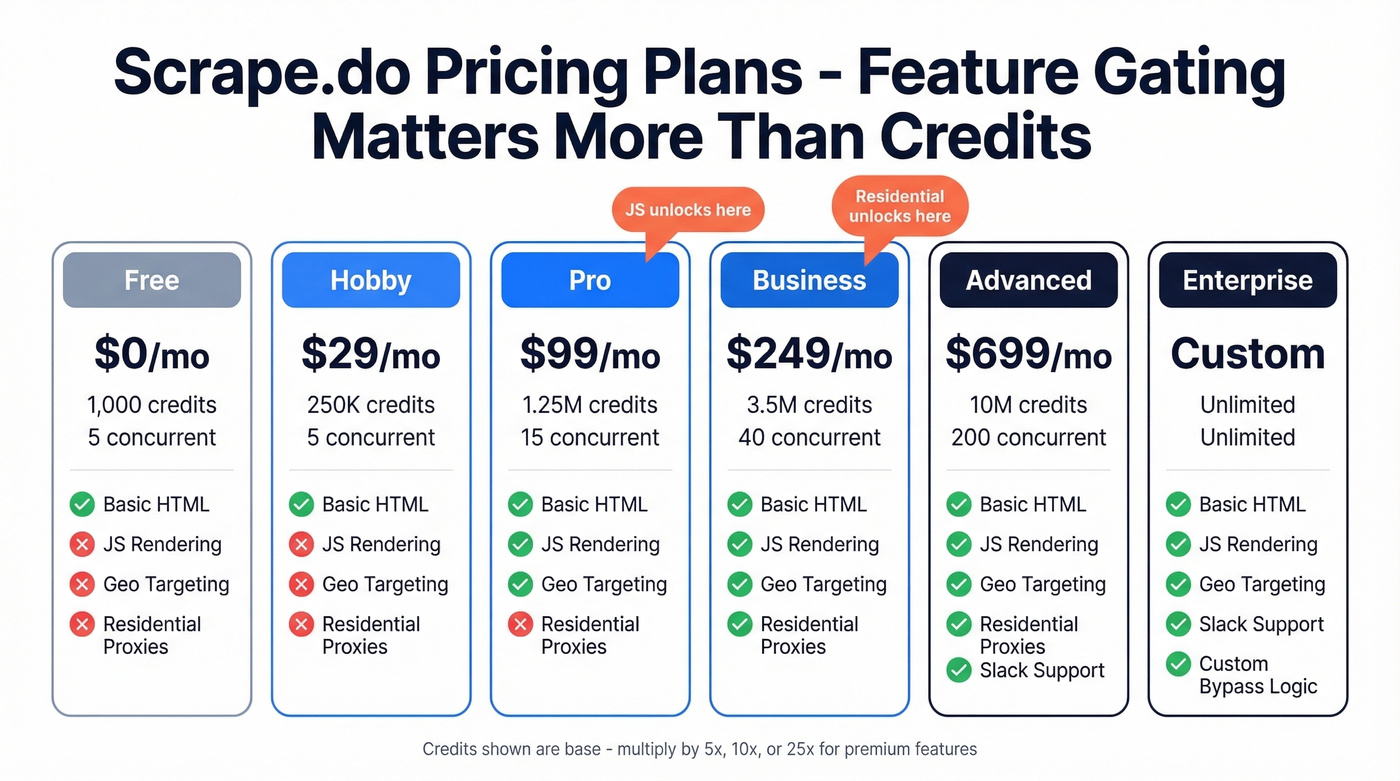
Feature gating matters more than credit counts here. JS rendering and geotargeting don't unlock until the $99/mo Pro plan. Residential and mobile proxies require the $249/mo Business plan. If you're scraping JS-heavy sites - which is most of the modern web - the Free and Hobby tiers won't cut it for production.
The $699/mo Advanced plan is where serious concurrency (200 threads) and dedicated Slack support kick in.
Credit Multiplier Math
Here's the thing: this is where the pricing gets tricky, and where most buyers miscalculate. Basic HTML requests cost 1 credit each. Premium features multiply the cost:
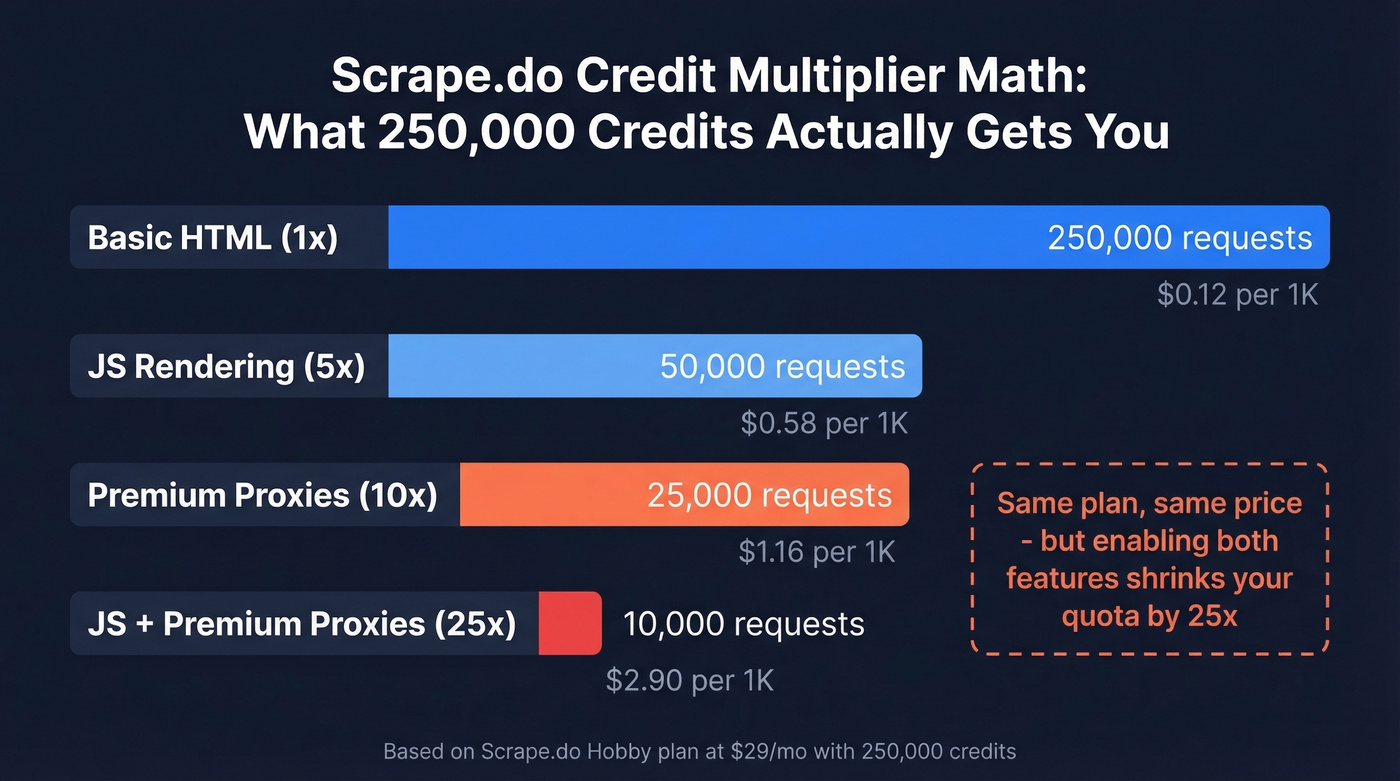
- JS rendering: 5x credits per request
- Premium proxies (residential/mobile): 10x credits
- Both together: 25x credits
We ran the math on the Hobby plan's 250,000 credits. At 1x, that's 250K requests - about $0.12 per 1K, which is outstanding value. Enable JS rendering and it drops to 50K requests ($0.58/1K). Turn on premium proxies too and you're down to just 10,000 requests ($2.90/1K). That's a 25x reduction from the headline number on the pricing page, and it's the kind of thing that'll wreck your budget if you don't plan for it.
ZenRows uses the exact same multiplier structure (5x/10x/25x), so this isn't a Scrape.do-specific gotcha - it's an industry pattern. Budget accordingly.
What 118+ Reviews Say
Across four platforms, Scrape.do's ratings are nearly perfect. G2 shows 5.0/5 from 4 reviews. GetApp and Software Advice both land at 5.0/5 from 46 verified reviews each. Trustpilot sits at 4.8/5 across 64 reviews.
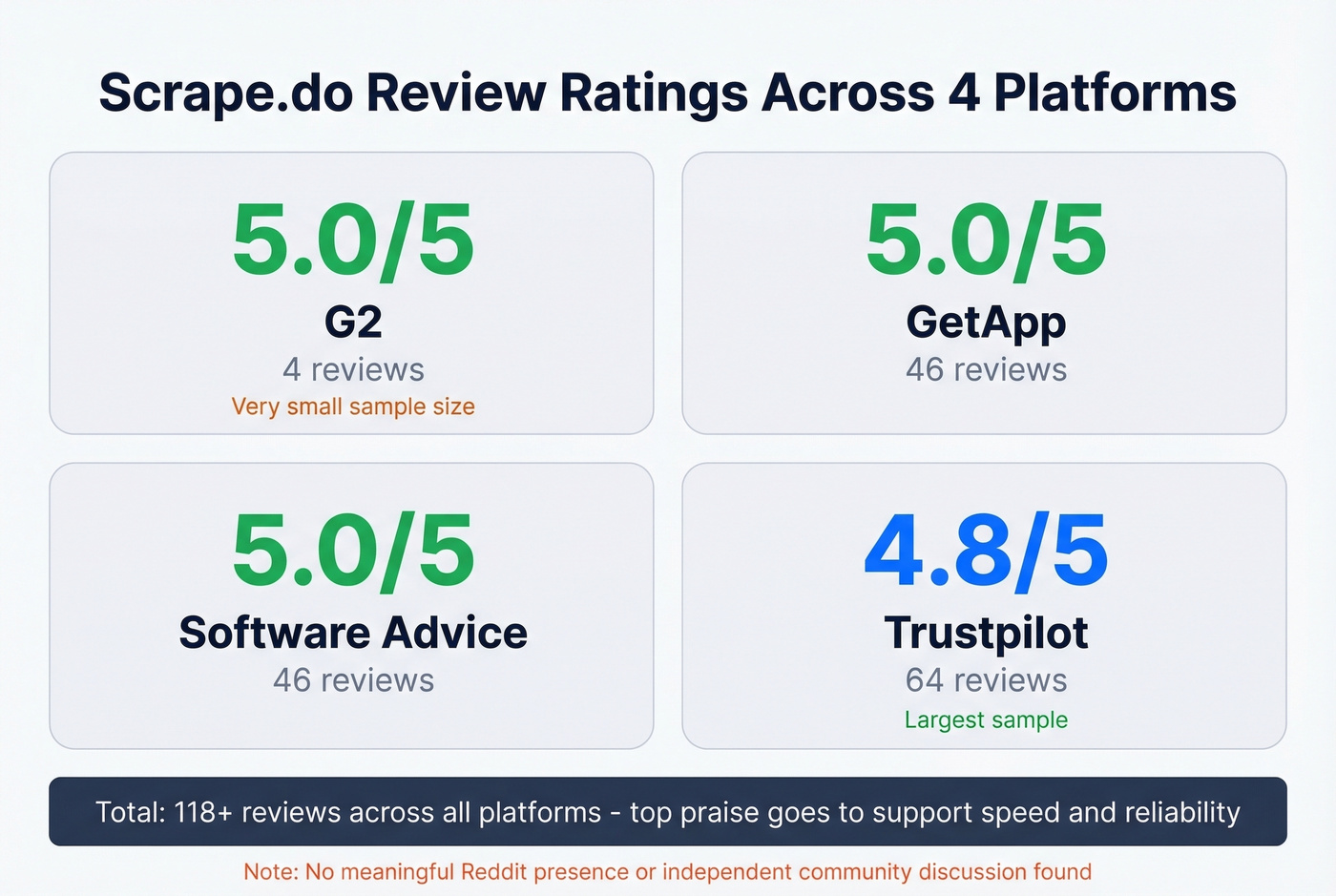
The consistent theme is support quality. Trustpilot reviewers describe the team fixing issues fast - one case reportedly resolved "under five minutes." On G2, a reviewer noted the team was "very reliable for not getting blocked, even on heavily defended sites." Multiple reviews highlight that support will troubleshoot implementation issues directly, not just point you to docs.
The honest caveat: G2 only has 4 reviews. The GetApp and Trustpilot numbers are more meaningful, but even 46 reviews isn't a massive dataset. There's also virtually no Reddit presence or independent community discussion around Scrape.do, which makes it harder to find unfiltered opinions. We'd recommend running your own tests on the free tier before committing budget.

If you're scraping websites to find B2B contact data, you're solving the wrong problem. Prospeo gives you 300M+ professional profiles with 98% verified emails and 125M+ direct dials - no proxies, no credit multipliers, no parsing HTML. At $0.01 per email, it's cheaper than any scraping API once you factor in the 25x multiplier math.
Get verified emails directly instead of scraping for them.
Pros and Cons
Pros:
- Lowest per-request cost among the APIs in Scrape.do's benchmark set - about $0.12/1K on basic HTML requests (Hobby plan)
- 98.19% average success rate across benchmark tests with 4.7s average response time, the fastest among tested APIs
- Free tier with no credit card required
- Pay-per-success model: failed requests don't burn credits
- Support quality praised consistently across all review platforms
Cons:
- JS rendering, geotargeting, and residential proxies gated behind $99-$249/mo plans - the Free and Hobby tiers are HTML-only in practice
- 5 concurrent requests on Free and Hobby is restrictive for production workloads
- Credit multipliers (up to 25x) are easy to miss if you only look at headline credits
- Thin review footprint - only 4 G2 reviews and no meaningful Reddit discussion
How Scrape.do Compares
| Tool | Starting Price | Cost/1K Requests | Avg Success Rate | Avg Response |
|---|---|---|---|---|
| Scrape.do | Free/$29/mo | $0.80 | 98.19% | 4.7s |
| Bright Data | ~$499/mo | $1.50-$2.50 | 98.44% | 10.6s |
| ZenRows | $69.99/mo | $4.48 | 92.64% | 10.0s |
| ScraperAPI | $49/mo | $8.49 | 92.70% | 15.7s |
| ScrapingBee | $49/mo | $3.90 | 92.69% | 11.7s |
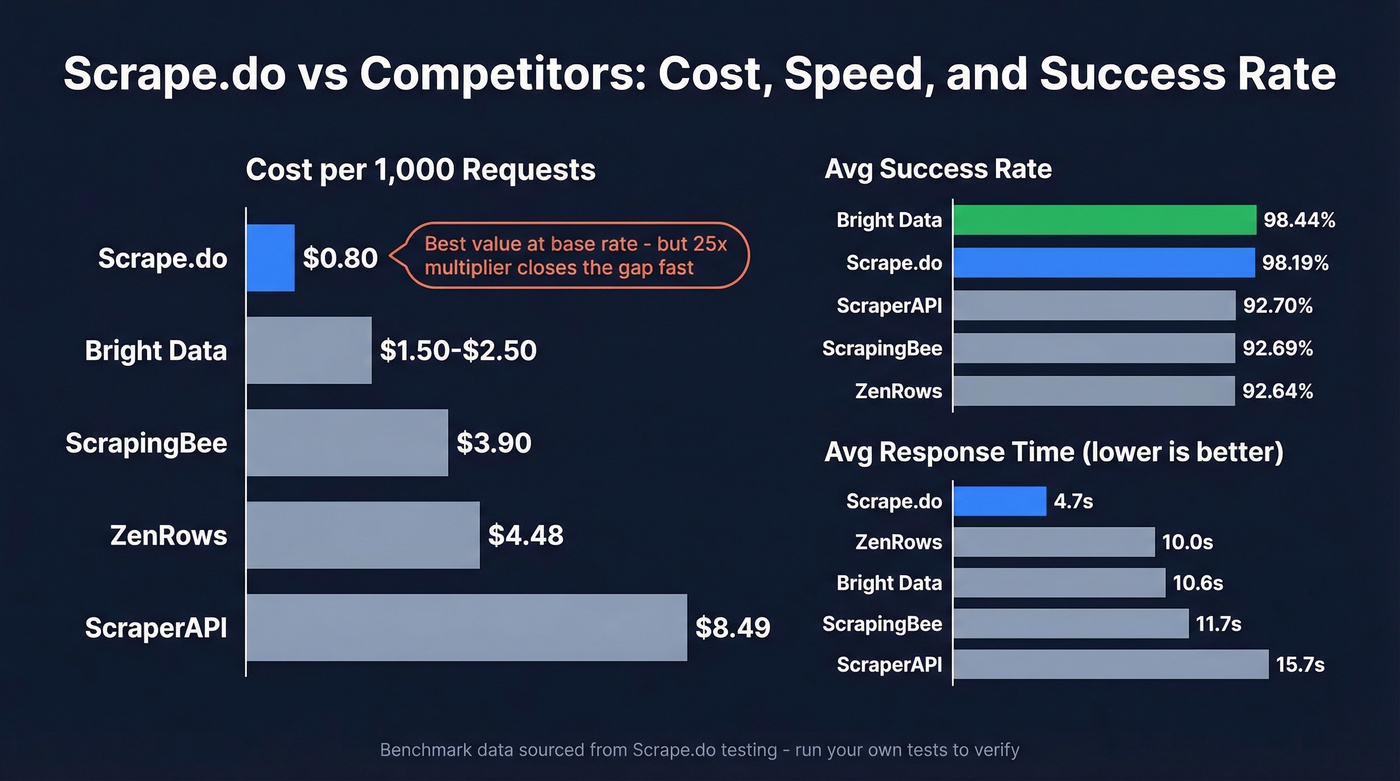
Benchmark figures sourced from Scrape.do's own testing.
Scrape.do is 2-10x cheaper per request than every competitor in this table while matching or beating their success rates. Bright Data edges it on raw success (98.44% vs 98.19%) but is more than 2x slower on response times in the same benchmark. ScraperAPI is the hardest to justify at $8.49/1K - that's over 10x Scrape.do's cost for a lower success rate.
Let's be real: Scrape.do is the best value scraping API on the market right now. But "best value" assumes you're scraping static HTML. The moment you need JS rendering and residential proxies on every request, the 25x multiplier closes the gap with Bright Data fast. If more than half your targets are JS-heavy, run the multiplier math before you commit - you'll land closer to Bright Data's effective cost than you'd expect.
Who Should Use Scrape.do
Good fit: developers scraping HTML-heavy sites at scale, teams that need geotargeting on a budget (Pro plan at $99/mo), or anyone who wants to test scraping workflows without a credit card commitment.
Credit multipliers, concurrency limits, JS rendering gates - that's the cost of extracting raw HTML. If your end goal is B2B emails and phone numbers, Prospeo delivers 143M+ verified emails and 125M+ mobile numbers with 30+ search filters. No rendering. No proxy rotation. No failed requests burning your budget.
Stop paying 25x per request when the data already exists.
Final Take
Scrape.do delivers the best value among web scraping APIs for developers who don't need enterprise hand-holding. Start with the free 1,000 credits to test against your target sites. If you need JS rendering, budget for the $99/mo Pro plan minimum. The pay-per-success model means failed requests don't eat your credits, and the 5.0 ratings track with what we've seen in reviews - but 1,000 free credits is enough to validate against your specific targets before scaling up.
FAQ
Does Scrape.do have a free plan?
Yes. Scrape.do offers 1,000 free API credits per month with no credit card required and 5 concurrent requests. That's enough to test against a handful of target sites and validate success rates before upgrading.
How do credit multipliers work?
JavaScript rendering costs 5x credits per request, premium proxies cost 10x, and both together cost 25x. A 250K-credit Hobby plan becomes just 10,000 requests if you enable both features - a detail that's easy to miss on the pricing page.
How does Scrape.do compare to Bright Data?
Scrape.do is significantly cheaper ($0.80 vs $1.50-$2.50 per 1K requests) in its own benchmark and has no contracts. Bright Data has a slightly higher success rate (98.44% vs 98.19%) and enterprise-grade infrastructure, but starts around $499/month with more complex billing.
Is Scrape.do good for B2B lead scraping?
Scrape.do handles the raw scraping layer well, but you still need to parse HTML and verify contact data yourself. For B2B prospecting specifically, Prospeo provides verified emails and phone numbers directly from 300M+ profiles - no scraping or proxy management needed.