

Web Scraping Lead Generation: 2026 Guide
Web scraping for lead generation works - until it doesn't. You scrape thousands of leads from Google Maps, load them into your sequencer, and a painful chunk bounces on the first send. Your domain reputation tanks. Anti-scraping defenses on dynamic sites push invalid lead rates to 40-60%, and 80% of leads never convert without proper qualification.
The scraping itself isn't hard. Verification, enrichment, and deliverability - that's where pipelines break.
What You Actually Need
Here's the short version:
- Raw web scraping (Google Maps, directories, niche sites): Apify or Browse AI.
- Verified B2B contacts without scraping: Prospeo - 98% email accuracy, free tier.
- Orchestration and enrichment: Clay.
If your ICP is defined by job title, industry, and company size, you probably don't need to scrape anything. A database with good filters and verified emails gets you there faster, cheaper, and without ban risk. Scrape when your target data doesn't live in any database - hyper-local businesses, niche event attendees, obscure industry directories. That's where scraping earns its keep.
Building a Scraping-to-Outreach Pipeline
Most teams treat scraping as one step. It's five, and skipping any of them guarantees bad data downstream.
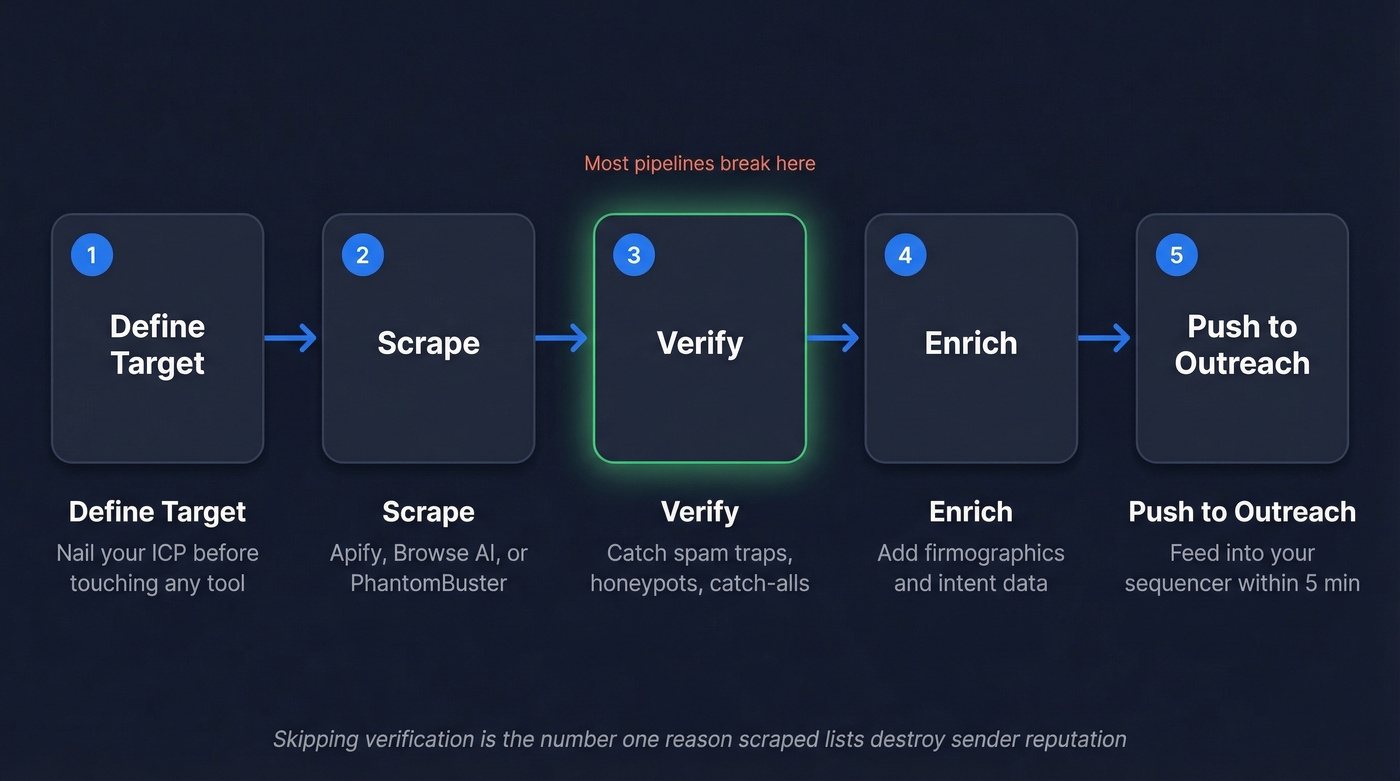
1. Define Your Target
Nail down your ICP before touching a tool. We've seen teams burn weeks scraping broad lists only to realize half the contacts don't match their actual buyer profile. One recruiter workflow we came across delivers solid results: build a filtered list from a professional network, pipe those profiles through PhantomBuster to extract data, run the emails through verification, then layer AI-generated personalized opening lines before sequencing. The specificity of the targeting matters more than the volume of the scrape.
2. Scrape
Apify handles flexible, code-optional scraping across Google Maps, directories, and company websites. It supports Python scripts and proxy rotation for advanced users. Browse AI covers basic no-code extraction. PhantomBuster works for social platform automation, though it carries real ban risk at aggressive volumes.
3. Verify
This is where most pipelines fail. Unverified scraped lists bounce far more than verified contacts, and we've watched teams torch sender reputations in a single campaign because they skipped this step. Run your list through email verification that catches spam traps, honeypots, and catch-all domains before you send a single message. Prospeo's 5-step verification process - built on proprietary infrastructure, not third-party providers - handles catch-all domains, spam traps, and honeypots. Teams like Snyk cut bounce rates from 35-40% to under 5% after switching.
4. Enrich
Add firmographic and intent data. Clay pulls from dozens of providers and lets you build enrichment waterfalls - alongside newer tools like Trigify. Pair with n8n or Zapier for automation that runs without manual intervention.
5. Push to Outreach
Feed your verified, enriched list into Instantly, Lemlist, Smartlead - whatever you're running. Responding within 5 minutes makes a lead 21x more likely to convert than waiting an hour. Speed beats perfection.

You built the scraper, rotated the proxies, and parsed the HTML. Now half your list bounces. Prospeo's 5-step verification catches spam traps, honeypots, and catch-all domains before they torch your sender reputation - 98% email accuracy at ~$0.01 per lead. No scraping infrastructure required.
Skip the scrape. Start with verified data.
Tool Comparison for Scraping Leads
| Tool | Best For | Starts At | Scope |
|---|---|---|---|
| Prospeo | Verification + B2B database | Free (75 emails/mo) | 300M+ profiles, 98% email accuracy, 7-day refresh |
| Apify | Flexible scraping | Free (includes $5 usage); $29/mo | Code-optional raw scraping |
| PhantomBuster | Social automation | $69/mo (20h execution) | Platform-specific extraction |
| Browse AI | No-code scraping | Free (50 credits/mo); $19/mo annual | Point-and-click extraction |
| Apollo | B2B database (275M+) | Free; $49/user/mo annual | Database with engagement tools |
| Clay | Orchestration + enrichment | Free; $149/mo paid | Multi-source data routing |
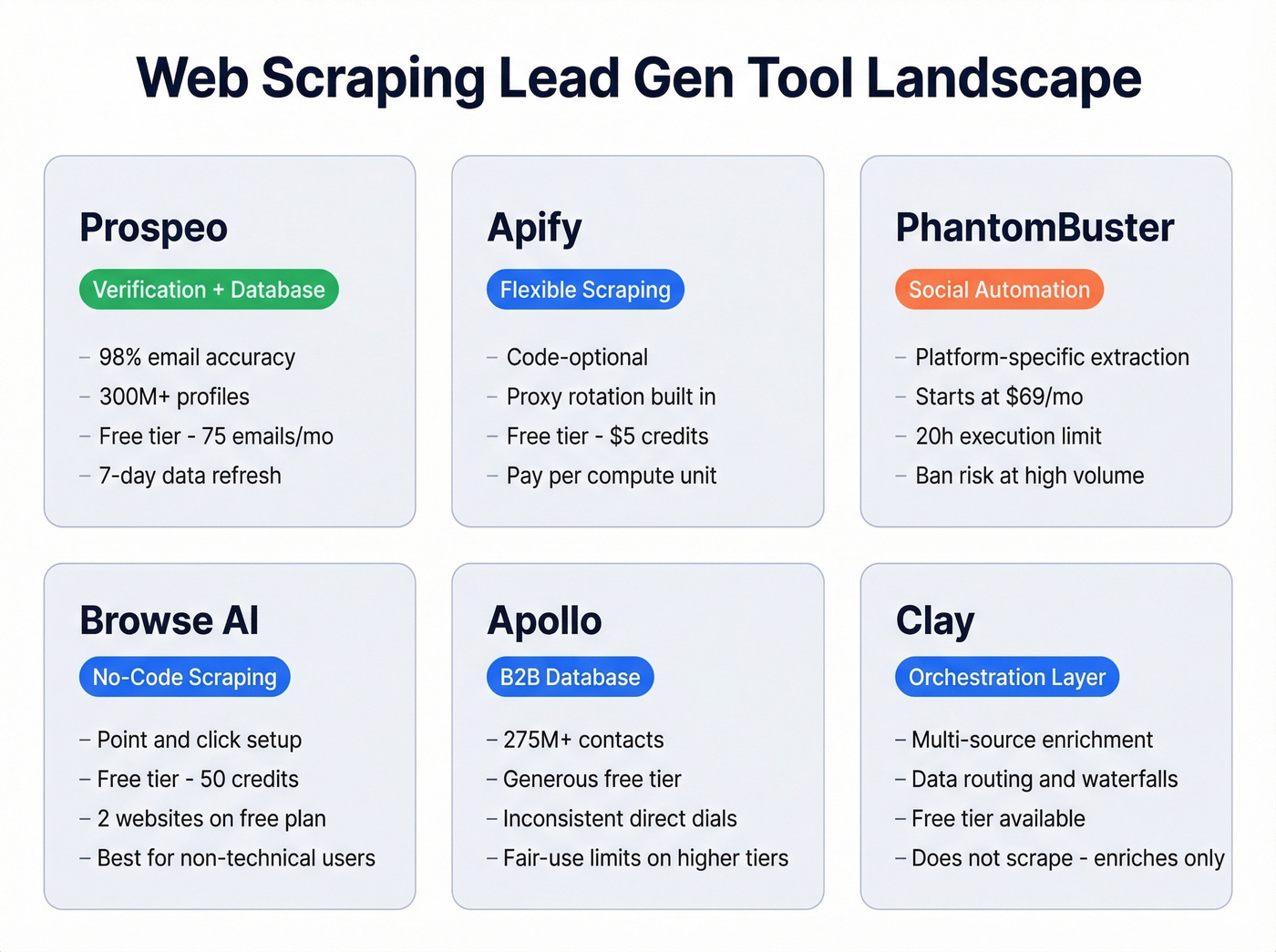
Apify runs on compute units - roughly $0.20-$0.30 per CU, where one CU equals 1 GB of RAM per hour. That model is powerful but opaque until you've run a few jobs. The free tier's $5 in credits is enough to run small test scrapes and validate your workflow before you scale.
Skip PhantomBuster if you aren't comfortable managing rate limits and session cookies. Aggressive automation gets accounts banned, the UX has a steep learning curve, and execution time limits (20 hours on the $69/mo Start plan) constrain scaling. But if you know what you're doing, the social-to-email pipeline is effective.
Browse AI is the simplest option - point, click, extract. It's limited to 2 websites on the free tier, but perfect for non-technical users scraping a handful of sites.
Apollo has 275M+ contacts with a generous free tier, but direct-dial quality is inconsistent and "unlimited" credits on higher tiers come with fair-use limits. Solid database. Don't expect scraping capabilities.
Clay is the orchestration layer practitioners on r/sales keep recommending. It doesn't scrape - it enriches and routes data from dozens of sources. If you're stitching together a multi-tool pipeline, Clay is the glue.
Snyk's 50 AEs cut bounce rates from 35-40% to under 5% by running contacts through Prospeo instead of trusting raw scraped data. With 300M+ profiles refreshed every 7 days and 30+ filters for buyer intent, technographics, and headcount growth, the data you'd scrape already exists - verified and ready to sequence.
Your scraped list needs verification. Prospeo handles it in seconds.
Where to Scrape for Leads
Not all sources are equal. Over 10% of global web traffic already comes from scrapers, and anti-bot defenses get smarter every quarter.
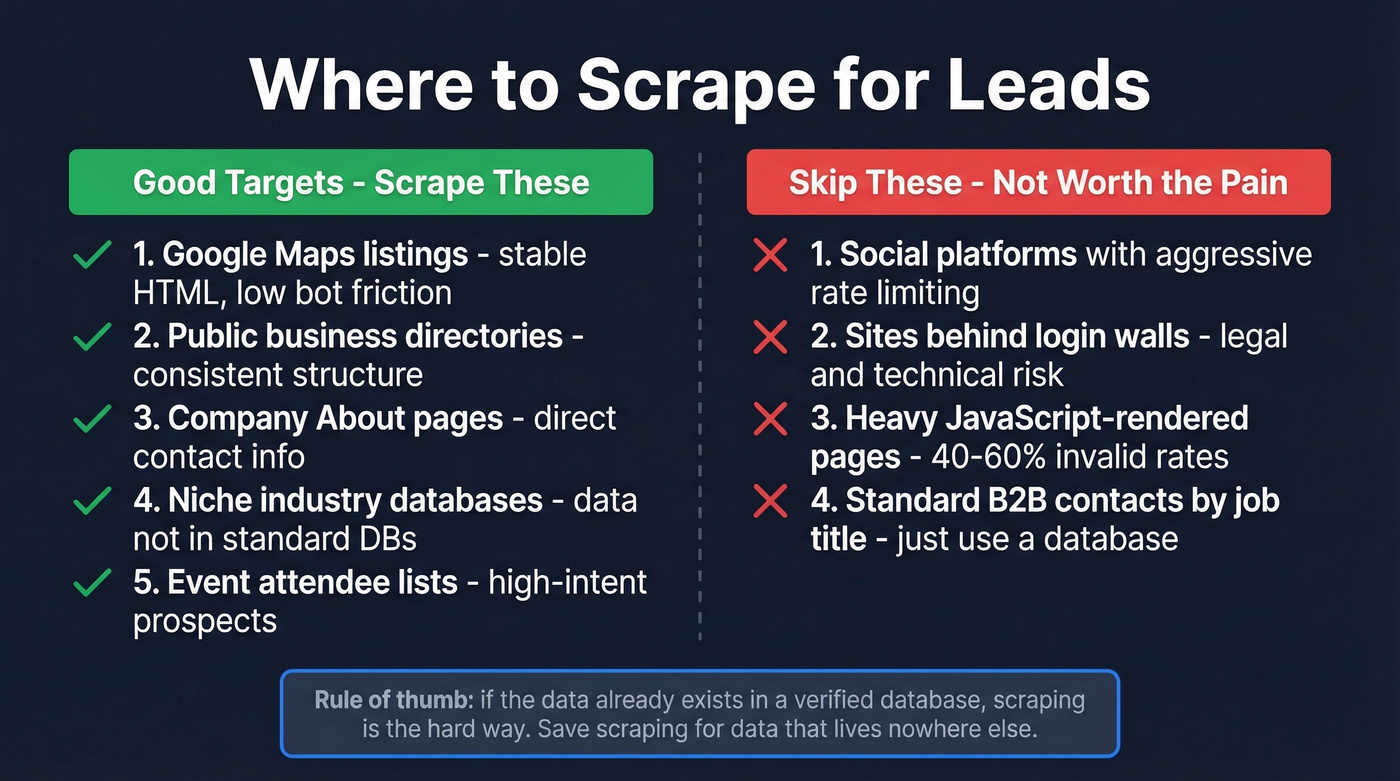
Good targets: Google Maps listings, public business directories, company "About" pages, niche industry databases, event attendee lists. These have stable HTML, low anti-bot friction, and data that doesn't exist in standard B2B databases.
Skip these: Social platforms with aggressive rate limiting, anything behind a login wall, and sites that rely heavily on dynamic JavaScript rendering. Those are where invalid lead rates spike hardest.
Let's be honest - if you're scraping to get job titles and work emails for people at mid-market SaaS companies, you're doing it the hard way. That data already exists in verified databases. At roughly $0.01 per lead, a database approach costs a fraction of what most teams spend on scraping infrastructure, proxies, and maintenance.
Compliance Checklist
Privacy enforcement is real. The California Privacy Protection Agency approved a $1.35M settlement with Tractor Supply Company and has hundreds of active investigations. Substantive CCPA regulatory changes took effect January 2026, with ADMT compliance requirements phasing in January 2027.
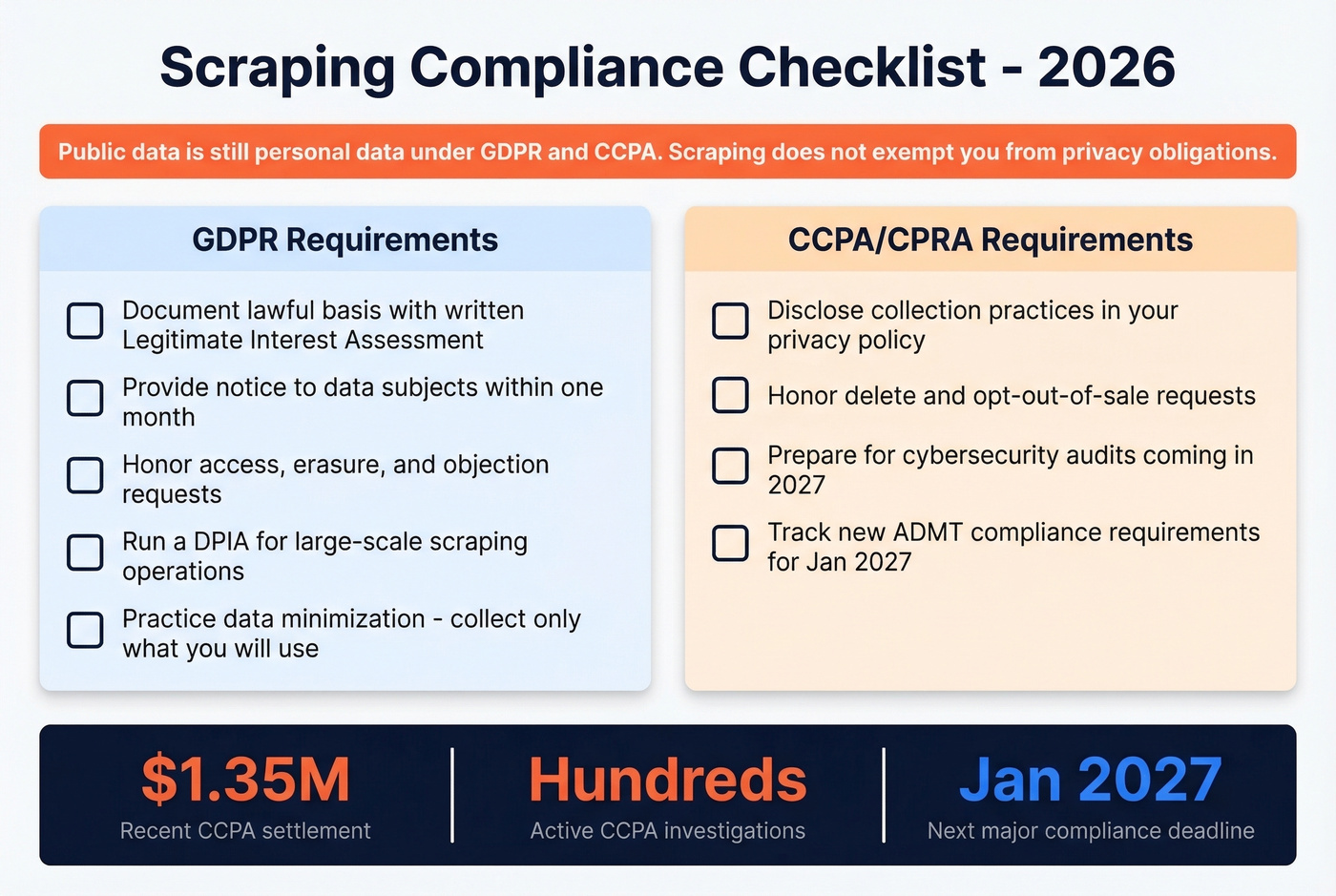
GDPR: Document a lawful basis with a written Legitimate Interest Assessment. Provide notice within one month. Honor access, erasure, and objection requests. Run a DPIA for large-scale scraping. Practice data minimization - collect only what you'll actually use.
CCPA/CPRA: Disclose collection practices in your privacy policy. Honor delete and opt-out-of-sale requests. Prepare for new cybersecurity audits and risk assessments coming in 2027.
The principle most teams miss: public data is still personal data under both GDPR and CCPA. Scraping someone's work email from a company website doesn't exempt you from privacy obligations. Any lead generation strategy built on scraped web data needs compliance baked in from step one, not bolted on after the fact.
FAQ
Is web scraping for lead generation legal?
Privacy laws don't ban scraping - they regulate how you collect and use personal data. You need a lawful basis (GDPR) or proper disclosure (CCPA), and you must honor opt-out and deletion requests. Enforcement is active, with hundreds of CCPA investigations in progress and fines exceeding $1M.
What's the best free tool for scraping leads?
Apify's free tier includes $5 in compute credits for raw web scraping across Google Maps and directories. For verified B2B contacts without scraping, Prospeo's free tier gives you 75 verified emails per month at 98% accuracy - enough to test a real outbound campaign without risking your domain.
Should I scrape or use a B2B database?
Scrape when your target data doesn't exist in any database - hyper-local businesses, niche directories, event attendee lists. For standard B2B contacts filtered by job title, industry, or company size, a verified database gets you there in minutes without code or ban risk.
How do I keep scraped leads from bouncing?
Never send to an unverified list. Run every scraped email through a verification tool that checks for catch-all domains, spam traps, and honeypots. In our experience, teams that add a verification step consistently drop bounce rates below 5% - Stack Optimize, for example, maintains 94%+ deliverability across all client campaigns with this approach.