

Seismic vs Spekit: Honest Comparison for 2026
The Seismic vs Spekit decision got more complicated on February 12, 2026, when Seismic and Highspot signed a definitive agreement to merge. The combined company will operate under the Seismic name, led by CEO Rob Tarkoff, with Permira as controlling shareholder. That's the biggest consolidation the enablement space has seen - and it means every buyer evaluating these platforms needs to think harder about what they're actually signing up for.
30-Second Verdict
Choose Seismic if you're enterprise (500+ reps), have a dedicated enablement ops team, and need deep content governance, analytics, and learning modules. Negotiate hard - the merger gives you leverage.
Choose Spekit if you're mid-market (50-500 reps), want fast deployment, run a Salesforce-centric workflow, and don't need a full enablement suite. Lighter admin, lower cost, faster time to value.
Skip both if you're under 50 reps. Both platforms are overkill at that size. You'll get more ROI from a lightweight knowledge base and investing in accurate prospect data through a tool like Prospeo - that's a better spend than a five-figure enablement contract when your team is still building pipeline.
Feature-by-Feature Comparison
| Metric | Seismic | Spekit | Winner |
|---|---|---|---|
| G2 Rating | 4.7/5 (1,683 reviews) | 4.7/5 (286 reviews) | Tie |
| Gartner Peer Insights | 4.7/5 (307 ratings) | N/A | Seismic |
| Ease of Setup | 8.1 | 8.9 | Spekit |
| Ease of Admin | 8.1 | 9.1 | Spekit |
| Quality of Support | 9.1 | 9.5 | Spekit |
| Good Partner in Business | 9.2 | 9.7 | Spekit |
| Segment Skew | 60.7% enterprise | 67.6% mid-market | Depends on your size |
| SelectHub Sentiment | 90% (664 reviews) | 93% (291 reviews) | Spekit |
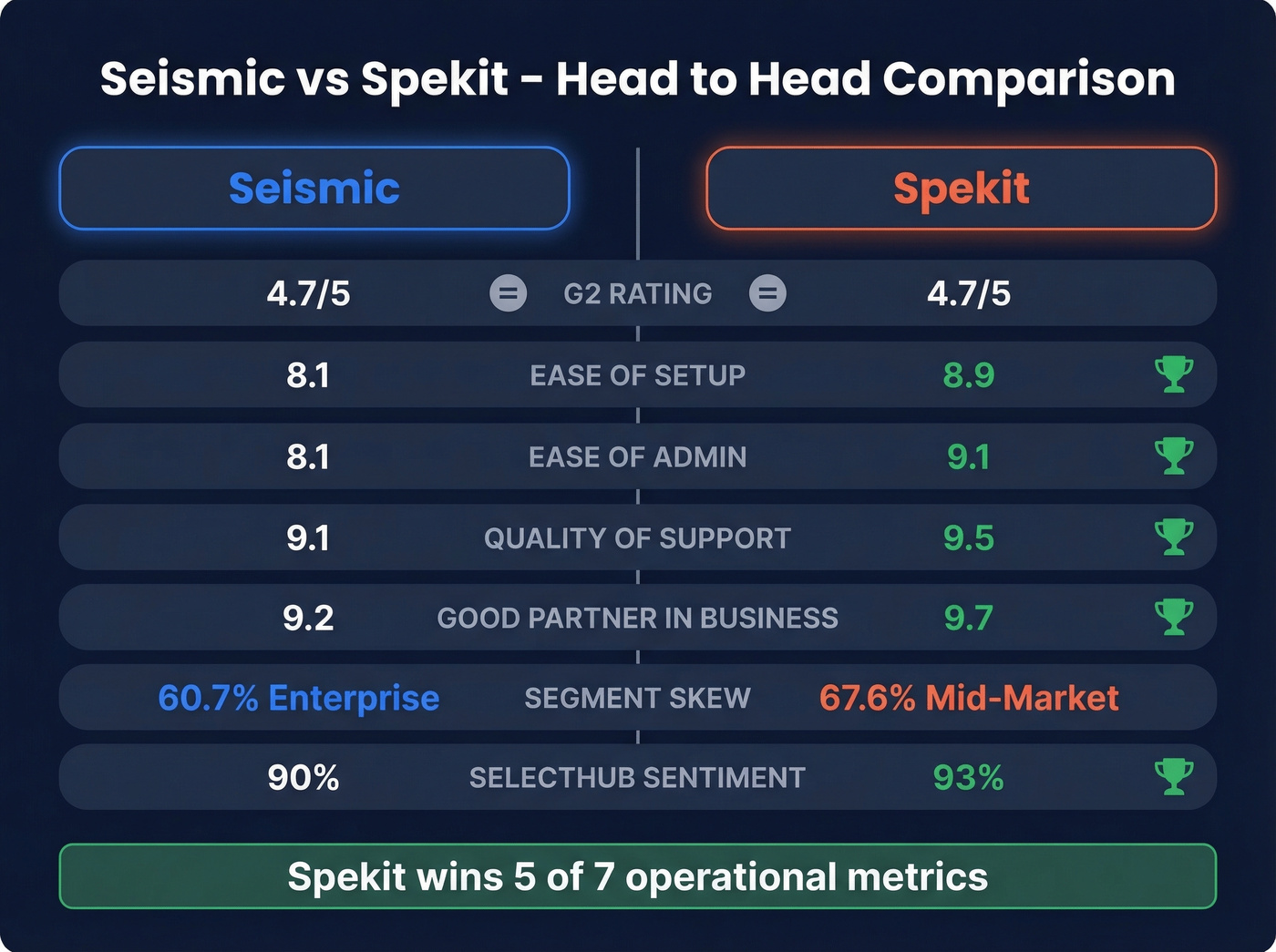
The top-line G2 ratings are identical, but the operational metrics tell the real story. Spekit wins five of seven comparable rows. That's not surprising given its mid-market DNA - Seismic's G2 reviews skew heavily enterprise, where complexity is expected and tolerated. The real question isn't "which is better?" It's "which matches your team's operational maturity?"
Pricing Breakdown
Seismic
Comparison sites that list "$32/month" are misleading at best. That figure doesn't reflect what any real buyer pays for a production deployment.
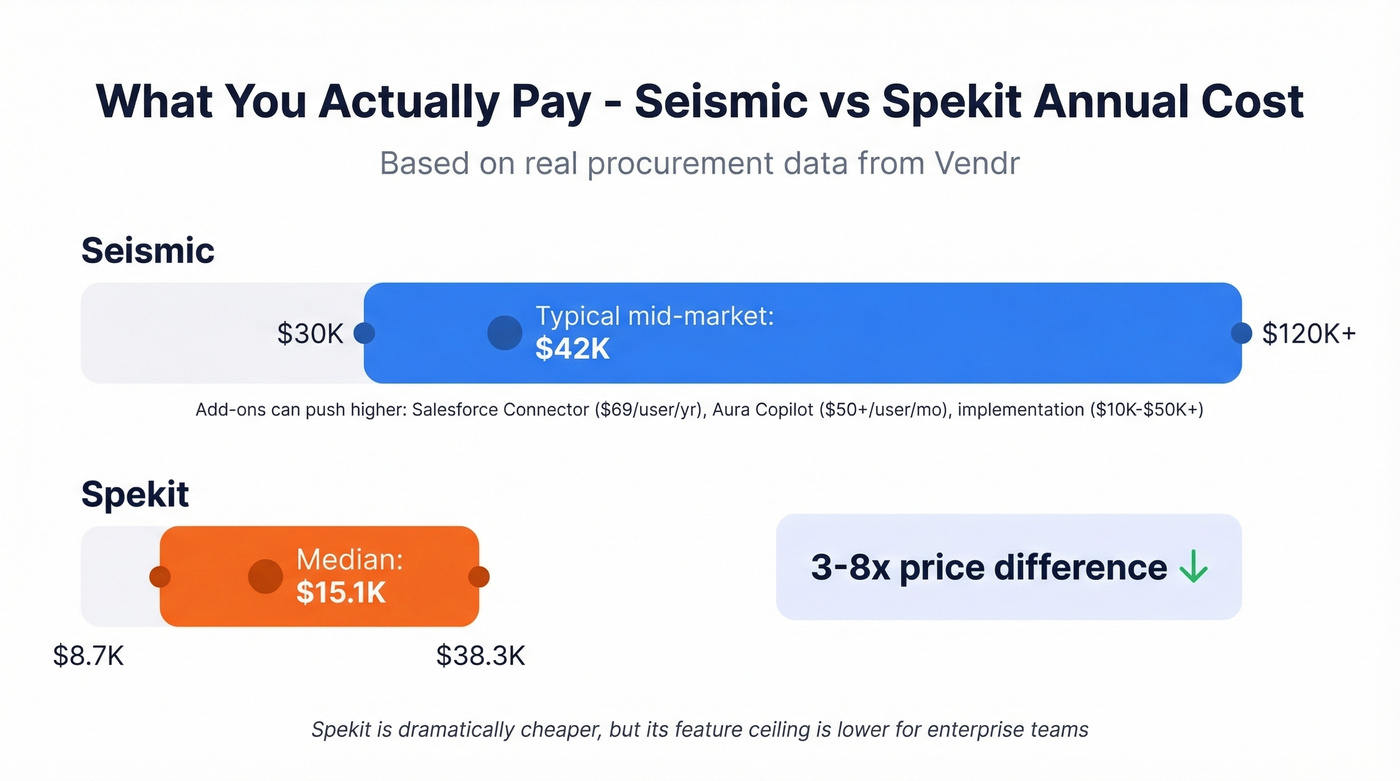
Vendr's procurement benchmarks paint a clearer picture. Seismic Professional lists at ~$630/user/year. At 100 seats, buyers negotiate 32-68% off (median 42%), landing around $42,714/year. At 500 seats, discounts run 43-76% (median 57%), putting you at roughly $180,810/year. Enterprise Premier drops to ~$494/user/year at scale - counterintuitively cheaper per seat. Seismic Learning adds ~$362/seat/year if you want the full suite.
Add-ons stack fast: Salesforce Connector at ~$69/user/year, Aura Copilot at $50+/user/month, and implementation services from $10k to $50k+. In our experience, most mid-market teams land in the $30k-$50k range once add-ons are factored in. Enterprise deployments hit $70k-$120k+.
Spekit
Dramatically lower. Vendr data from 32 real purchases shows a median annual spend of $15,145, with a range of $8,749-$38,326/year on a per-user, per-month subscription model.
One thing to watch: Spekit started charging separately for integrations that were previously included. If you're renewing, audit your integration fees carefully.

You're comparing $15K-$120K enablement platforms - but neither Seismic nor Spekit fixes the data feeding your reps' outreach. Teams using Prospeo cut bounce rates from 35% to under 4% and triple pipeline output with 98% email accuracy, refreshed every 7 days.
Fix the data upstream before you spend five figures downstream.
What Users Actually Say
Seismic strengths: centralized content library, strong document filtering, responsive support (9.1/10).
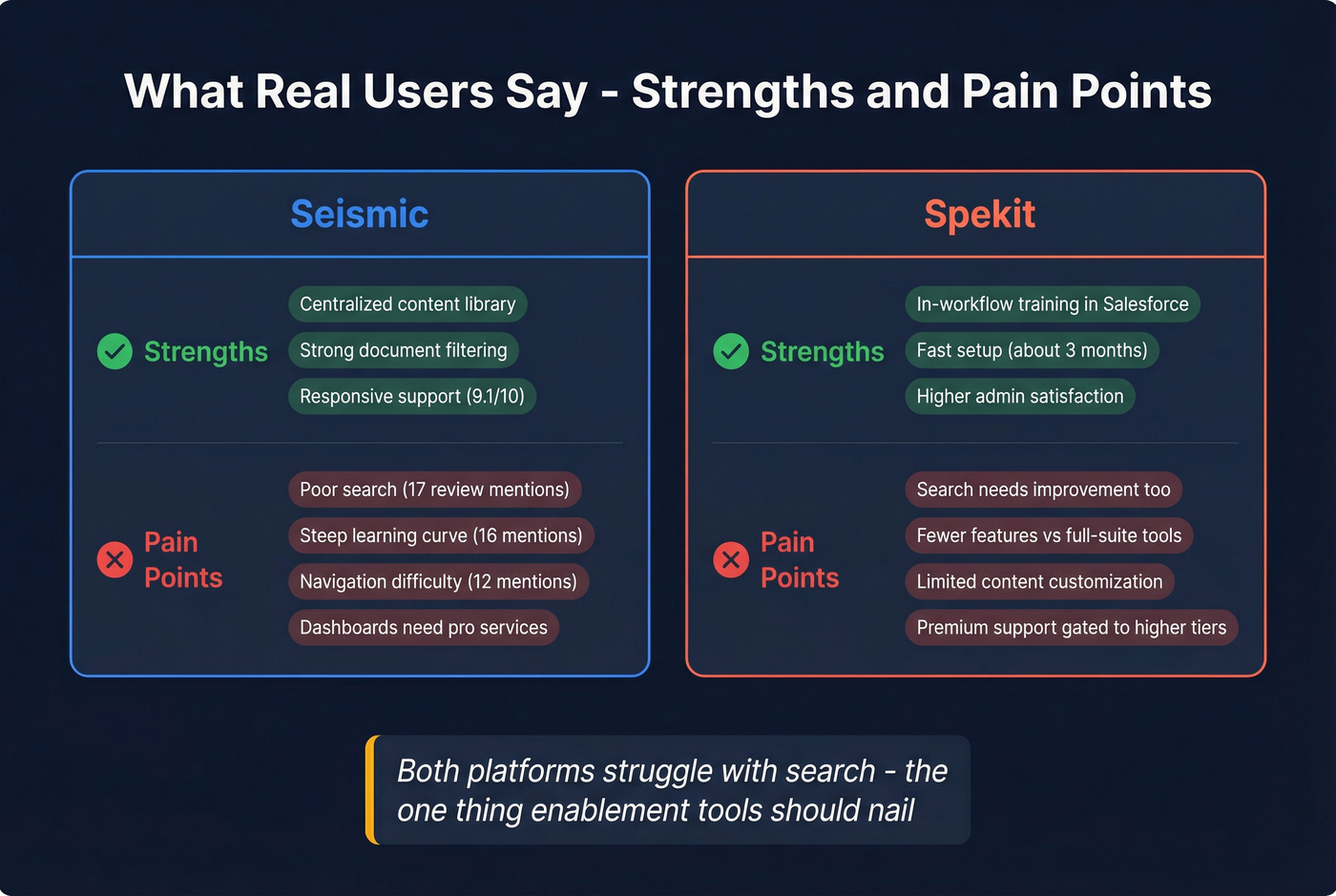
Seismic pain points: poor search functionality (17 review mentions - for an enablement platform, that's rough), steep learning curve (16 mentions), navigation difficulty (12 mentions), and dashboards that often require professional services to configure.
Spekit strengths: in-workflow training directly inside Salesforce, time to implement around 3 months per G2, higher admin satisfaction across the board.
Spekit pain points: search needs improvement (sound familiar?), missing features compared to full-suite platforms, limited customization for in-app content creation, premium support gated to higher tiers.
Here's the thing: both enablement platforms - tools designed to help reps find the right content - struggle with search. We've seen this frustrate enablement teams more than almost any other issue, because it directly undermines the core value proposition. A thread in r/LearningDevelopment includes a blunt takeaway from a team "currently using Seismic Lessonly": "not a great experience with them overall."
The Merger Factor
The Seismic-Highspot merger is a definitive agreement, not a rumor, but it's still pending regulatory approval. Both platforms will be supported post-close, per the official announcement. The combined entity is massive - Highspot alone has 40+ customers running 5,000+ reps, with its largest deployment exceeding 50,000 users.
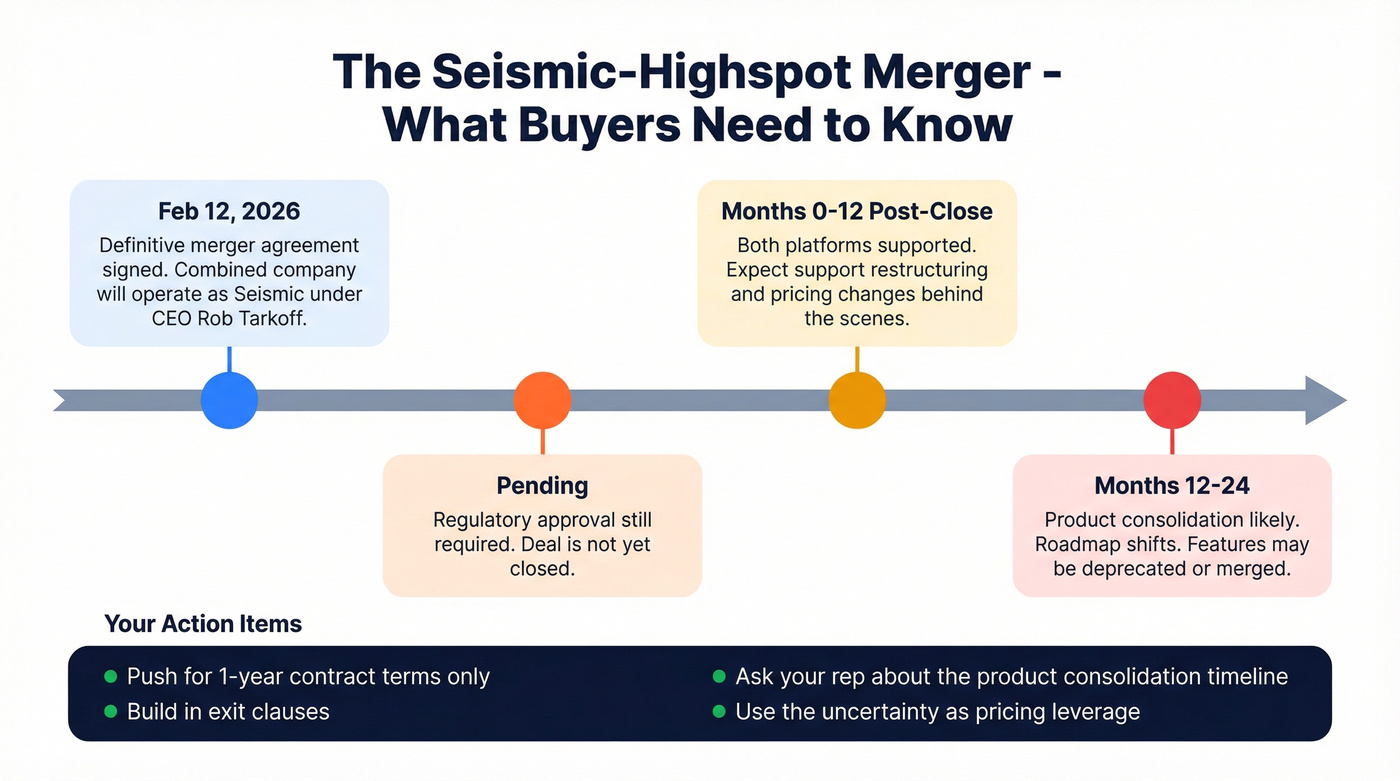
Let's be honest: we've watched enough SaaS mergers to know that "both platforms will be supported" is a 12-month promise, not a permanent one. Expect product roadmap shifts, support restructuring, and pricing changes as the combined company figures out what to consolidate. If you're signing a Seismic contract right now, push for a 1-year term. Build in exit clauses. Ask your rep directly about the product consolidation timeline.
Silence on that question tells you everything.
The Data Problem Neither Tool Solves
Neither Seismic nor Spekit touches the upstream data quality problem. You can build the most polished playbooks, the most perfectly tagged content library, the best-designed digital sales rooms - and none of it matters if your reps' emails bounce and their phone numbers are disconnected. We've seen teams pour $80k into enablement only to watch reps struggle with 30%+ bounce rates because nobody fixed the data feeding the pipeline. Prospeo sits in that upstream layer with 98% email accuracy and a 7-day data refresh cycle, ensuring the contacts feeding your pipeline are actually reachable. Pair it with whichever enablement platform you choose, and your reps will actually reach the people they're enabled to sell to.

Seismic and Spekit both struggle with search - imagine what happens when the contacts in your CRM are wrong too. Prospeo delivers 300M+ verified profiles at $0.01/email with a 7-day refresh cycle, so your reps actually reach the buyers your enablement content was built for.
Great playbooks deserve reachable prospects. Start with accurate data.
FAQ
Is Spekit cheaper than Seismic?
Yes - significantly. Median Spekit spend is ~$15k/year versus $30k-$120k+ for Seismic. But Spekit's feature ceiling is lower, so enterprise teams needing deep content governance and analytics should expect to pay the Seismic premium.
What happens to Seismic after the Highspot merger?
The combined company operates as Seismic under CEO Rob Tarkoff. Both platforms will be supported post-close, but expect product consolidation over 12-24 months. Negotiate shorter contracts and build in exit clauses before signing.
How do I make sure reps actually use enablement content?
Start with accurate prospect data. Reps ignore enablement tools when their outreach bounces. Fix the data layer first, then optimize the content and training workflows. That sequencing matters more than most enablement vendors will admit.
Should I wait for the merger to close before buying?
Don't wait - but use the uncertainty as leverage. Both Seismic and Spekit sales teams are motivated to lock in contracts right now. Push for 1-year terms, price protections, and written commitments on feature availability post-merger.