

Spam Words: The Full List + What Actually Sends Your Emails to Spam
You rewrote your subject line three times to dodge spam words. You swapped "guaranteed" for "proven." You removed the exclamation point. Your email still landed in spam.
You were solving the wrong problem. Modern email filters evaluate hundreds of signals - sender reputation, authentication records, engagement history, complaint rates, HTML structure - and individual words barely register on that list. Spam word lists aren't useless, but they're the email marketing equivalent of horoscopes: vaguely true, rarely actionable, and wildly overweighted by people who should be fixing their DNS records instead.
Let's get into what actually matters, then give you the word list you came for.
What Are Spam Words?
Spam words are terms and phrases historically associated with unsolicited email - think "act now," "100% free," "no obligation" - that older filters used to flag automatically. In 2026, they're one of dozens of content signals and far from the most important.
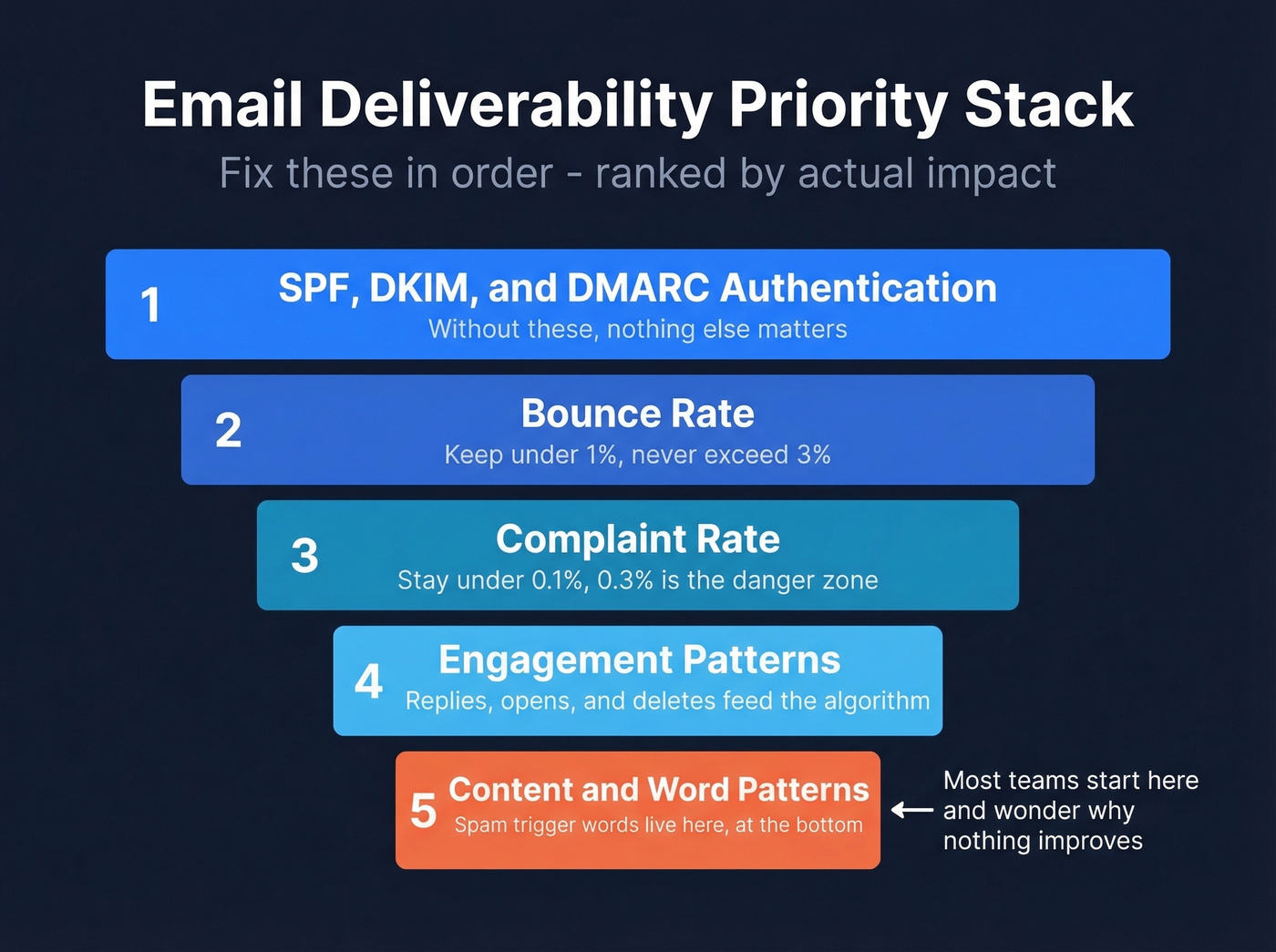
The priority stack, ranked by actual impact on deliverability:
- SPF, DKIM, and DMARC authentication - without these, nothing else matters
- Bounce rate - keep it under 1% and never exceed 3%
- Complaint rate - aim to stay under 0.1%; 0.3% is a serious danger zone
- Engagement patterns - replies, opens, and deletes all feed the algorithm
- Content and word patterns - yes, trigger words live here, at the bottom
Fix these in order. Most teams skip straight to #5 and wonder why nothing improves.
Do Spam Trigger Words Still Matter in 2026?
Short answer: barely. Longer answer: they matter in context, as part of a pattern, when everything else is already borderline.
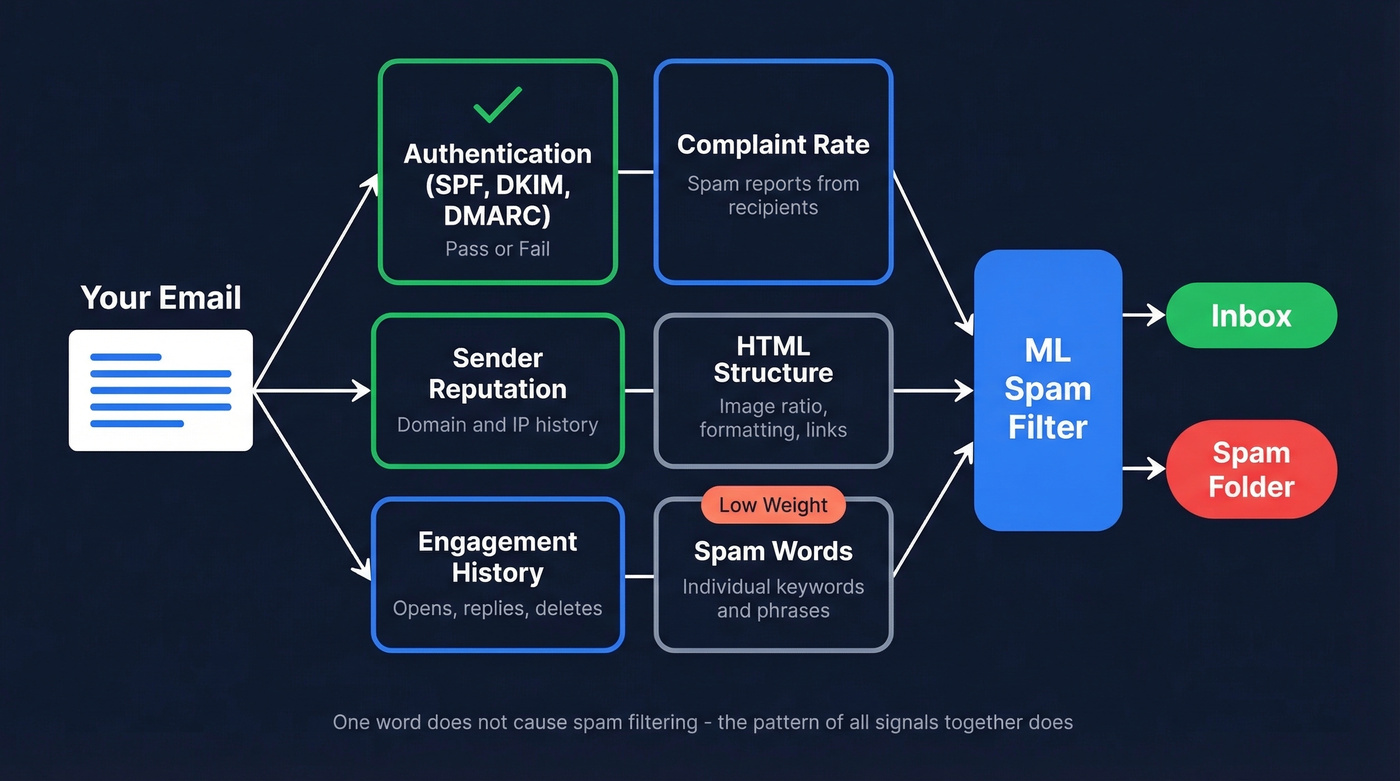
Gmail, Outlook, and every major ISP run machine-learning systems that evaluate hundreds of signals simultaneously. A single word like "free" in a well-authenticated email from a reputable domain won't move the needle. But stack "FREE!!!" in the subject line with ALL CAPS body text, broken DKIM, a 2% complaint rate, and a purchased list - and yeah, you're going to spam. The word didn't cause it. The pattern did.
Flagged email spam terms can increase filtering risk by over 20%, but mainly when combined with other negative signals. Swapping "free trial" for "complimentary trial" on its own won't save an email that's failing authentication checks. Well-run permission-based programs typically see around 80-90% inbox placement, and with strong fundamentals, word choice is rarely the deciding factor.
Here's the caveat. Legacy filters - particularly older SpamAssassin installations still running on corporate mail servers and smaller ISPs - weigh keyword heuristics more heavily than Gmail or Outlook do. If your recipients sit behind enterprise email gateways or niche hosting providers, individual trigger phrases carry more weight. That's why the list below still has practical value even though the major providers have moved on.
These lists are table stakes. Know them. Don't obsess over them.
The Complete Spam Words List
These are the terms that show up most frequently in filter heuristics, organized by category. Treat this as a reference, not a rulebook - context matters more than any individual word.
Financial and Money Triggers
| Word/Phrase | Word/Phrase | Word/Phrase |
|---|---|---|
| No cost | Earn money | Cash bonus |
| Double your income | Financial freedom | No hidden fees |
| Money back | Credit card | Lowest price |
| Save big | Extra income | Billion dollars |
| No investment | Refinance | Eliminate debt |
| Fast cash | Make money | Cheap |
| Pre-approved | Investment opportunity | No credit check |
| Consolidate debt | Low interest rate | Mortgage rates |
Urgency and Scarcity
| Word/Phrase | Word/Phrase | Word/Phrase |
|---|---|---|
| Act now | Limited time | Urgent |
| Expires today | Last chance | Don't miss out |
| Only X left | Hurry | Before it's gone |
| Deadline | Immediately | Time is running out |
| Now or never | One time only | Supplies running out |
| Final call | Instant access | Rush |
Free and Giveaway Language
| Word/Phrase | Word/Phrase | Word/Phrase |
|---|---|---|
| 100% free | Free gift | Free access |
| Free trial | Free consultation | Complimentary |
| No charge | Freebie | Free membership |
| Free download | Risk-free | Free sample |
| Free bonus | Free preview | Free installation |
| Free hosting | Free DVD | Free priority mail |
Exaggerated Claims
| Word/Phrase | Word/Phrase | Word/Phrase |
|---|---|---|
| Guaranteed | Amazing results | Miracle |
| Once in a lifetime | Revolutionary | Breakthrough |
| Best ever | Incredible deal | Unbelievable |
| Proven system | Secret method | Unlimited |
| Fantastic offer | Outstanding | Life-changing |
| #1 rated | Satisfaction guaranteed | Phenomenal |
Sales Pressure and CTAs
| Word/Phrase | Word/Phrase | Word/Phrase |
|---|---|---|
| Buy now | Order today | Call now |
| Click here | Sign up free | Don't delete |
| Apply now | Get it now | What are you waiting for |
| Exclusive deal | Special promotion | While supplies last |
| Buy one get one | Double your order | Click below |
| Shop now | Deal ending | Subscribe now |
Shady and Deceptive Phrases
| Word/Phrase | Word/Phrase | Word/Phrase |
|---|---|---|
| No obligation | This isn't spam | You've been selected |
| Congratulations | You're a winner | As seen on |
| Not junk | Dear friend | Multi-level marketing |
| No questions asked | No strings attached | Confidential |
| This is not a scam | You have been chosen | Undisclosed recipient |
| Hidden assets | Information you requested | Message from a friend |
Medical and Health Triggers
| Word/Phrase | Word/Phrase | Word/Phrase |
|---|---|---|
| Cure | Weight loss | Lose weight |
| Miracle pill | Anti-aging | Pharmacy discount |
| Online pharmacy | Prescription-free | Natural remedy |
| Diagnose | Life insurance | Medicare |
Legal and Compliance Jargon
| Word/Phrase | Word/Phrase | Word/Phrase |
|---|---|---|
| Terms and conditions | Legal notice | Pursuant to |
| In accordance with | Compliance required | Mandatory |
| Cease and desist | Legally binding | Court order |
| Tribunal | Settlement | Subpoena |
This list could easily be three times longer. ActiveCampaign maintains a list of 188+, and Mailmeteor catalogs over 349. The point isn't memorizing every word - it's recognizing the patterns. Financial promises, fake urgency, exaggerated claims, medical quackery, and deceptive framing are the categories that trip filters when combined with other red flags.
What to Say Instead
Knowing the words is step one. Knowing the rewrites is what actually helps you ship emails faster.
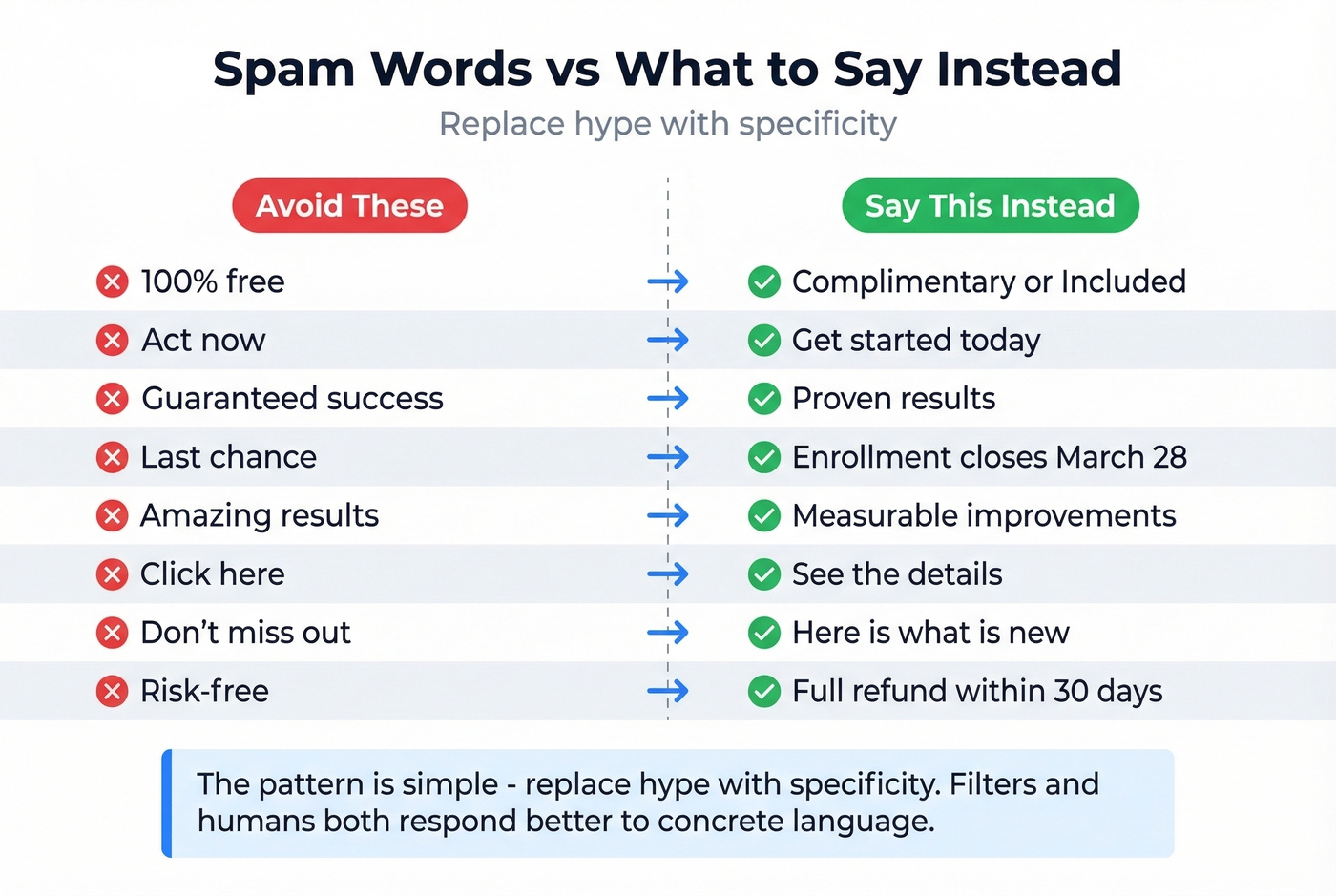
| Spam Trigger | Safer Alternative |
|---|---|
| 100% free | Complimentary / Included |
| Act now | Get started today |
| No hidden fees | Transparent pricing |
| Guaranteed success | Proven results |
| Last chance | Enrollment closes [date] |
| Amazing results | Measurable improvements |
| Buy now | Start your trial |
| Don't miss out | Here's what's new |
| Earn extra cash | Grow your revenue |
| Click here | See the details |
| No obligation | Try it yourself |
| Limited time offer | Available through [date] |
| You've been selected | You qualify |
| Double your income | Accelerate your growth |
| Risk-free | Full refund within 30 days |
| Lose weight fast | Reach your health goals |
| Miracle cure | Evidence-based approach |
| Legally binding | Per our agreement |
The pattern is simple: replace hype with specificity. "Guaranteed results" is vague and spammy. "Teams see 35% higher reply rates" is specific and credible. Filters and humans both respond better to concrete language.

You just read that bounce rate matters more than any spam word. Prospeo's 5-step email verification delivers 98% accuracy - teams using it cut bounce rates from 35% to under 4%. Fix the signal that actually moves the needle.
Stop rewriting subject lines. Start sending to verified emails.
Formatting Triggers That Hurt More Than Words
Words get all the attention, but formatting mistakes hurt you just as much - sometimes more.
Image-to-text ratio above 70% is a big one. If your email is mostly images with minimal text, filters treat it as suspicious because some spam is sent as a single image to dodge text-based scanning. Keep your emails text-forward.
Excessive exclamation marks are another classic tell. One is fine. Three in a row is a red flag. Five is a death sentence for your inbox placement.
ALL CAPS in subject lines or body text screams spam to both filters and humans. "FREE OFFER INSIDE" is the fastest way to get filtered. Character substitution - writing "fr33" or "w1n" to dodge filters - actually triggers them harder. Filters caught on to this trick years ago.
A few more to watch: emoji strings in subject lines (one is fine, five rocket ships isn't), missing plain-text alternatives for HTML emails, and odd fonts or colors like red text or tiny white-on-white text. Heavy templates with massive footers full of legal disclaimers and social links can also trigger filters - try a stripped-down version and compare placement.
What Actually Sends Emails to Spam
This is the section that matters most. Fix these three things and you can use the word "free" all day long.
Authentication: SPF, DKIM, DMARC
If your authentication isn't set up correctly, it doesn't matter what your email says. SPF, DKIM, and DMARC are the baseline requirements for every major inbox provider. Gmail and Yahoo enforce these for bulk senders pushing 5,000+ emails per day, and non-compliant messages get rejected outright. Since the requirement took effect, Google reported a 65% reduction in unauthenticated messages reaching Gmail users.
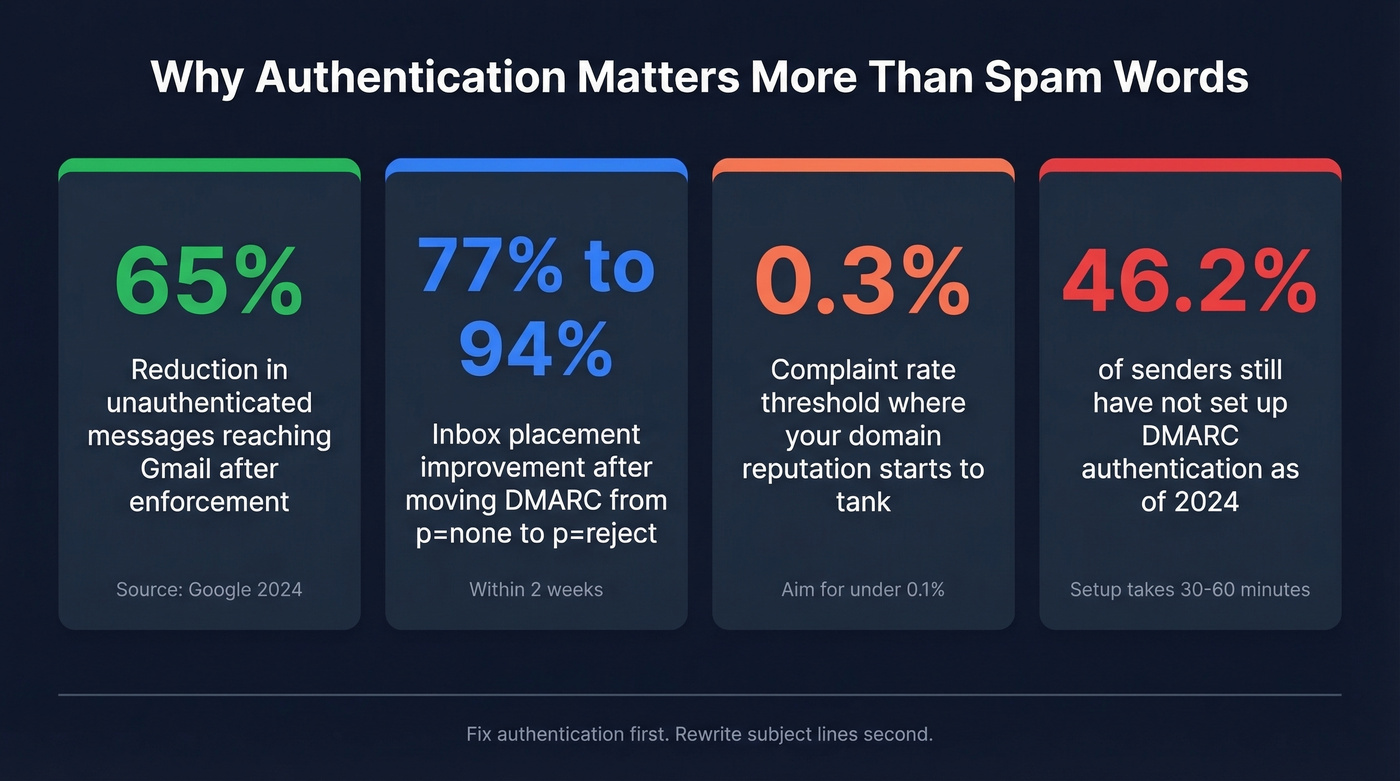
Setup takes 30-60 minutes. DMARC adoption reached 53.8% by 2024, up from 42.6% the year before - which means a huge chunk of senders still haven't done this basic work. One practitioner reported that moving their DMARC policy from p=none to p=reject improved inbox placement from 77% to 94% within two weeks.
A few technical pitfalls: SPF has a 10 DNS lookup limit, and you can't publish multiple SPF records for the same domain - you need to merge them into one. If you're using multiple sending services, consider dedicated subdomains for each. Use Google Postmaster Tools, email reputation, and Microsoft SNDS to monitor your standing. They're free and take minutes to set up.
Sender Reputation and Complaint Rates
Gmail tracks everything: reads, deletes, ignores, replies, and - most critically - spam reports. Keep complaint rates under 0.1%. Push toward 0.3% and your domain reputation can tank, affecting every email you send from that domain going forward.
Gmail now weighs domain reputation more heavily than IP reputation. Shared IP infrastructure means your IP address is less stable as an identifier, but your domain follows you everywhere. One bad campaign can poison months of sending.
Engagement Signals
Gmail's algorithm watches how recipients interact with your emails. Replies are the strongest positive signal - they tell the algorithm this is a real conversation, not broadcast spam. Opens matter too, though Apple Mail Privacy Protection has made open-rate data unreliable since 2021.
The practical takeaway: suppress unengaged recipients. If someone hasn't opened or clicked in 90 days, remove them. Every ignored email drags down your engagement ratios, which drags down your reputation, which sends more of your emails to spam. It's a vicious cycle, and the fix is simple list hygiene.
Spam Words in Cold Email - Different Rules
Cold email and marketing email have completely different deliverability dynamics. Every guide treats them the same. That's a mistake.
Cold email faces stricter scrutiny because recipients haven't opted in. The filters know this. Your recipients know this. And the margin for error is razor-thin.
Here's the thing: if your bounce rate is above 3%, no amount of subject-line optimization will save you. We've seen teams spend weeks A/B testing "free" vs. "complimentary" while sending to lists with 8% invalid addresses. They were rearranging deck chairs on the Titanic.
Volume and format matter more than vocabulary. Cap at 50 emails per day per inbox, and during warm-up - the first two or more weeks - stay at 5-10 per day and scale gradually. Send plain text only, with no tracking pixels, no images, and no HTML templates. Disable open tracking entirely, because the tracking pixel itself can hurt deliverability.
Your first email should contain no links, no attachments, and no calendar invites. Just text and a question. Keep the body short - shorter emails tend to earn more replies, and replies improve your reputation. Use secondary domains for cold outreach to protect your primary domain reputation, and run warm-up for at least two weeks before sending.
Before you send a single cold email, verify every address on your list. Prospeo's 5-step verification with catch-all handling and spam-trap removal means fewer bounces and a cleaner sender reputation from day one.
The consensus on r/coldemail and r/sales is consistent: authentication, warm-up, low volume, and personalization matter infinitely more than avoiding the word "discount" in your subject line.
The Data Quality Problem Nobody Talks About
No spam word list will fix bad data.
The chain is simple. Bad email addresses lead to bounces, bounces lead to reputation damage, and reputation damage leads to the spam folder. A 5% bounce rate does more damage to your sender reputation than every trigger phrase in this article combined.
We've seen this pattern dozens of times. A team buys a list or exports contacts from a database that hasn't been refreshed in months. They load it into their sequencer and hit send. Two weeks later, even their emails to known-good contacts are landing in spam. Bounce rates spiked to 8-10%, the domain reputation cratered, and now everything is poisoned. The domain is cooked.
The results from teams that verify before sending speak for themselves. Meritt dropped their bounce rate from 35% to under 4%. Snyk went from 35-40% bounces to under 5% across 50 AEs. Stack Optimize maintains 94%+ deliverability across all clients with bounce rates under 3% and zero domain flags.
No word swap saves an email sent to a dead address. Prospeo refreshes 300M+ profiles every 7 days - not every 6 weeks - so your list stays clean and your domain stays safe. At $0.01 per email, clean data costs less than one spam complaint.
Protect your sender reputation with data that's never more than a week old.
How to Test What Actually Matters
Stop testing subject line synonyms. Start testing the variables that affect inbox placement.
Measure inbox placement and reply rate, not open rate. Open rates are unreliable thanks to Apple Mail Privacy Protection and various caching behaviors. Replies and actual inbox placement are the signals worth tracking.
Keep links to two or fewer per email - every additional link increases your spam risk, and in cold email, zero links in the first touch is ideal. Test one variable at a time over 3-7 days. Changing your subject line, CTA, and send time simultaneously tells you nothing.
Set stop-loss rules: if a test variant sees bounce rates spike above 3% or complaint rates above 0.1%, kill it immediately. Protecting your domain reputation is more important than finishing an experiment. And test HTML weight and footer size - heavy templates with massive footers full of legal disclaimers and social links can trigger filters. Try a stripped-down version and compare.
Skip this section if you haven't set up authentication yet. Testing content variables before your SPF, DKIM, and DMARC are clean is a waste of time. The Allegrow testing framework is worth reading for a deeper methodology, but the core principle is simple: optimize for the inbox first, conversions second.
FAQ
Does the word "free" trigger spam filters?
Not on its own. Gmail processes billions of emails daily - if "free" auto-triggered spam, half of SaaS would be out of business. The word only contributes to scoring when combined with other red flags like poor authentication, high complaint rates, or heavy promotional formatting. Use it when it's accurate. Just don't pair it with ALL CAPS and three exclamation marks.
How many spam words is too many?
There's no magic number. Modern filters evaluate patterns, not word counts. A single "free" in a well-authenticated email from a reputable domain won't matter. A subject line stuffed with "FREE!!! ACT NOW!!! GUARANTEED!!!" alongside broken authentication absolutely will. Focus on the overall pattern, not a word tally.
Do trigger words matter more in subject lines or body text?
Subject lines carry slightly more weight because filters evaluate them first and recipients make snap judgments based on them. But subject line and body contribute roughly 50/50 to inbox placement overall. Fix both - or better yet, fix your authentication first, since that outweighs any word choice.
What's the fastest way to stop emails going to spam?
Set up SPF, DKIM, and DMARC. It takes 30-60 minutes and has the single biggest impact on deliverability. Then verify your email list to catch invalid addresses and spam traps before they damage your domain. These two fixes outperform any amount of subject-line wordsmithing.
Are the rules different for cold email?
Yes. Cold email faces stricter scrutiny because recipients haven't opted in. Plain text, no tracking pixels, no links in the first email, and verified addresses matter far more than individual word choices. Keep volume under 50 per day per inbox and warm up for at least two weeks before scaling.