

Cold Email Subject Lines: What Actually Works in 2026
You've rewritten your subject line six times. You've A/B tested three variants. Your open rate is still 4%.
Here's the uncomfortable truth: writing the perfect subject line for a cold email is the wrong starting point. The real issue is a combination of deliverability, list quality, and psychology - and the subject line is just the visible tip of a much bigger problem that most teams refuse to diagnose because rewriting copy feels productive while auditing infrastructure feels tedious.
What You Need (Quick Version)
- Front-load your key message in the first 33 characters. That's all Gmail shows on most Android phones. If your hook starts at character 40, it's invisible.
- Stop measuring open rates - measure reply rates. The 2026 benchmark: 3.43% average reply rate, 10.7%+ for top performers.
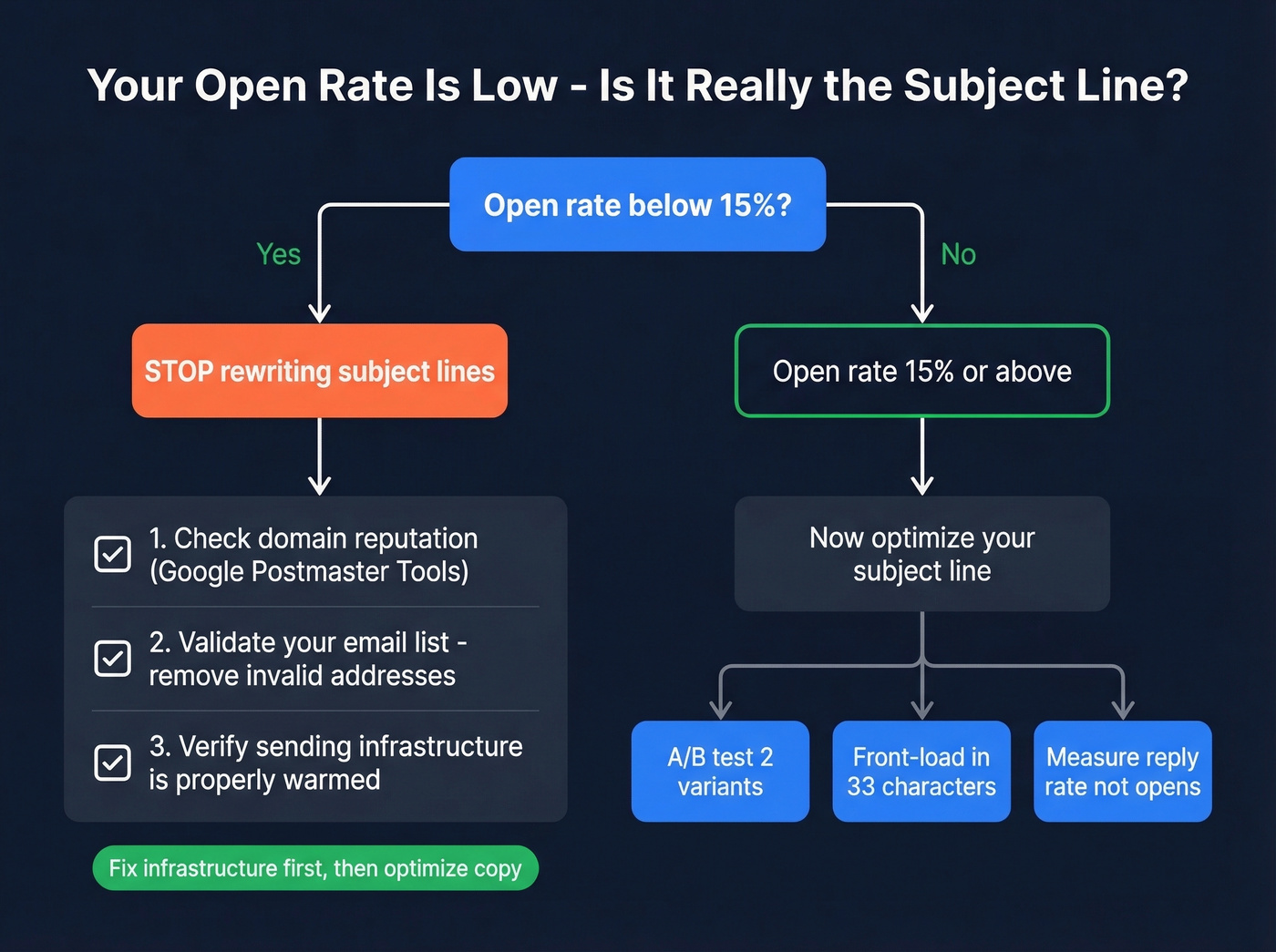
- If your open rate is below 15%, the problem isn't your subject line. It's deliverability or list quality. Rewriting copy won't fix a burned domain or a list full of invalid addresses.
One outbound team on r/b2bmarketing reported a 2% open rate after sending 1,000+ emails across multiple warmed domains. They kept rewriting cold email subject lines. The actual problem? Bad data and domain reputation damage. Classic case of a data quality issue masquerading as a copywriting problem.
2026 Benchmarks
Let's ground this in real numbers. The 2026 cold email benchmark report analyzed billions of interactions across thousands of active workspaces:
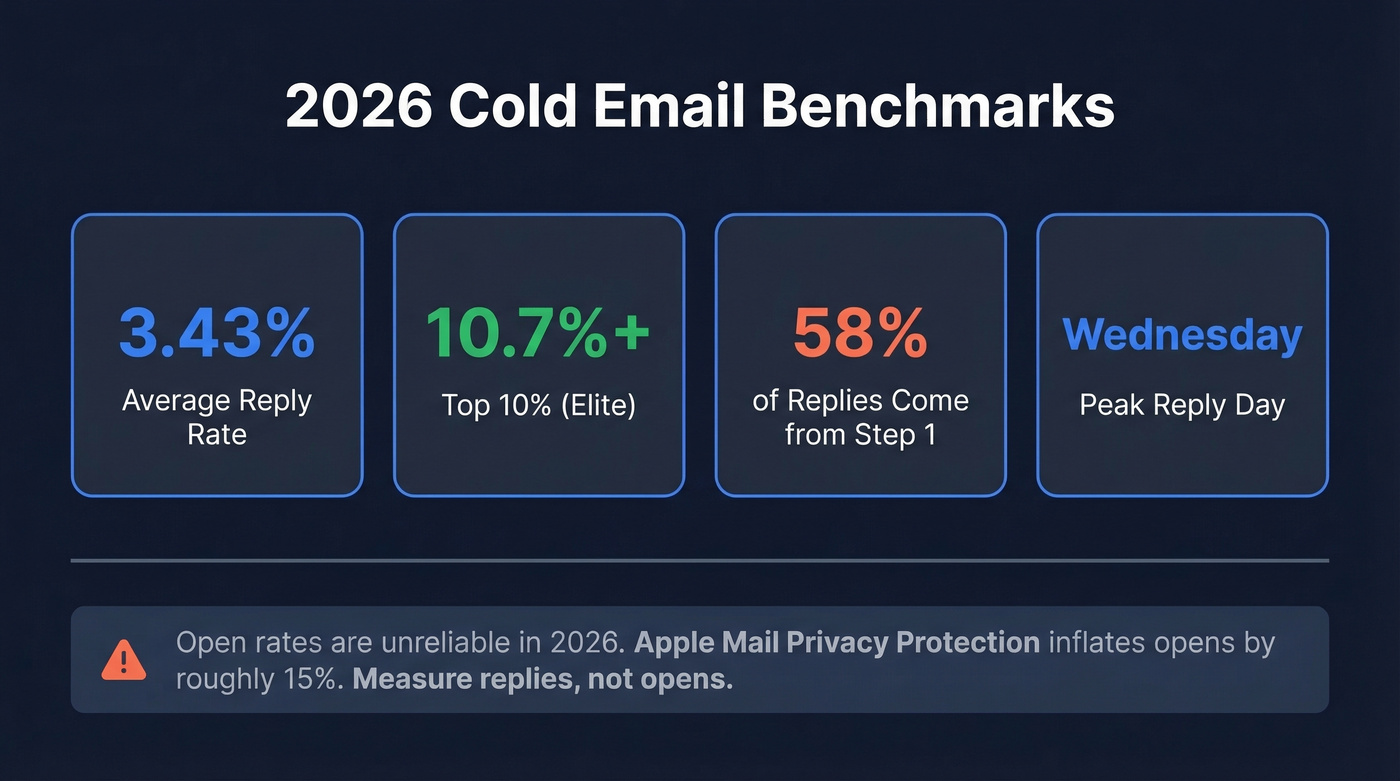
- Average reply rate: 3.43%
- Top quartile: 5.5%+
- Top 10% (elite): 10.7%+
- 58% of all replies come from Step 1 - your first email and its subject line carry the majority of the weight
- Peak reply day: Wednesday, with Tuesday close behind
For context, email averages around a 2.3% CTR across industries. Cold outbound plays by entirely different rules.
Now the caveat nobody talks about enough: open rates are increasingly unreliable. Apple Mail Privacy Protection pre-fetches email content, inflating open rates. Apple Mail leads email client share at roughly 57%, so your "45% open rate" could be 30% real opens and 15% Apple bots. Opens are vanity. Replies are the metric.
Anatomy of a Subject Line That Gets Replies
Forget cleverness. The best subject lines for cold emails share four traits, and none require a copywriting degree.
Front-load in 33 characters. This is the hard constraint. Gmail on a Pixel 7 shows 33 characters. "I wanted to reach out about your company's Q3 hiring plans" becomes "I wanted to reach out about yo..." - which is nothing. Flip it: "Your Q3 hiring plan - quick idea" puts the hook first.
Lead with relevance, not curiosity. Curiosity gaps work in marketing email. In cold outbound, they feel like spam. "Saw [Company] just raised Series B" beats "You won't believe this one trick" every time. Specificity signals homework.
Treat preview text as your second headline. Many clients show roughly 37-99 characters of preview text, pulled from your email's first sentence. If your opener is "Hi {{FirstName}}, hope you're doing well," you've wasted the most valuable real estate in the inbox. Make line one a continuation of the subject line's hook.
Write for deliverability first. A subject that triggers spam filters never gets seen. No ALL CAPS, no excessive punctuation, no "FREE" or "ACT NOW." Write like a human colleague, not a marketer. Top-performing campaigns keep emails under 80 words - brevity signals respect for the reader's time.
Device Truncation Limits
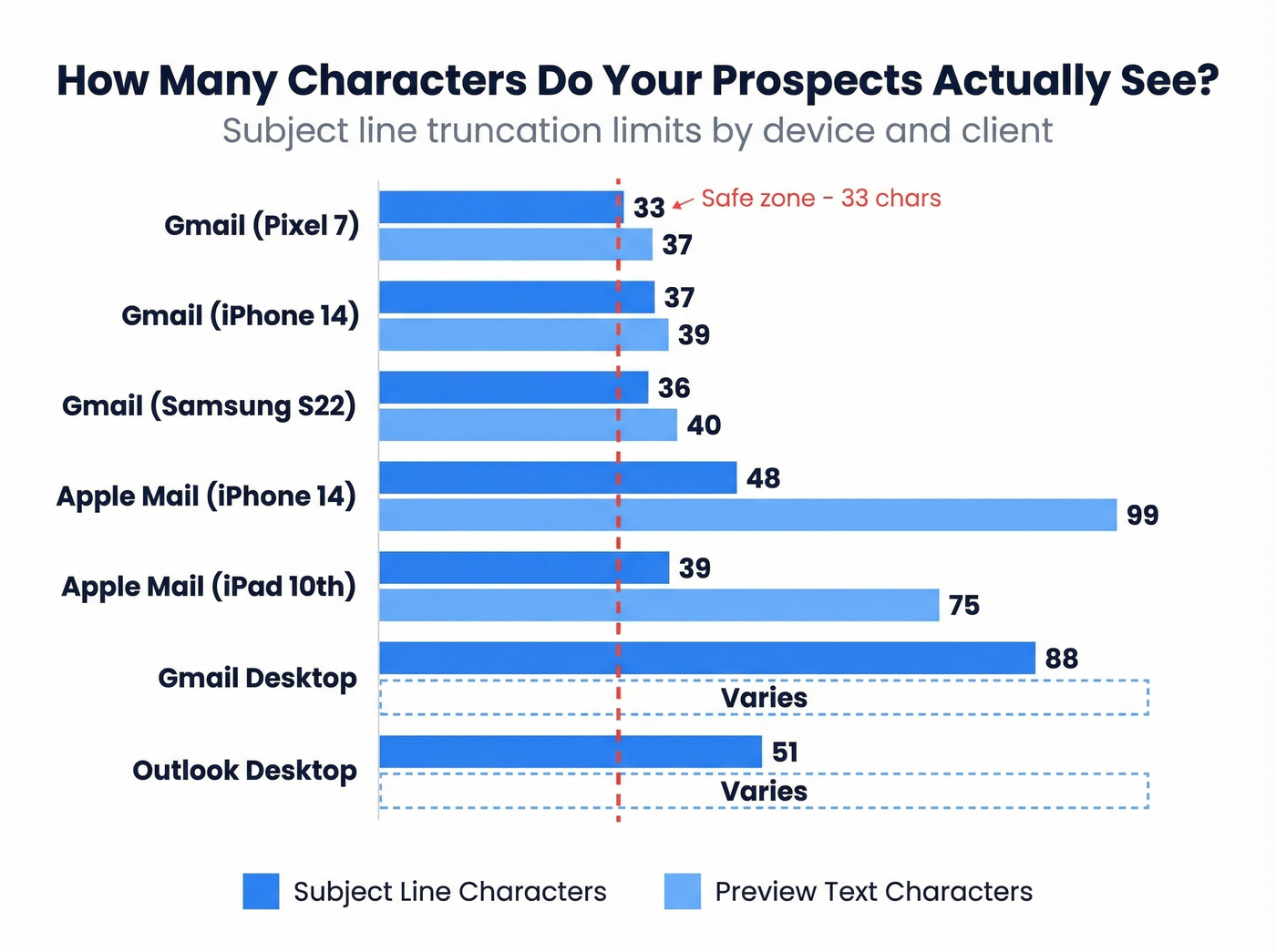
EmailToolTester ran hands-on tests across real devices. These numbers should change how you write:
| Client / Device | Subject Line | Preview Text |
|---|---|---|
| Gmail (Pixel 7) | 33 chars | 37 chars |
| Gmail (iPhone 14) | 37 chars | 39 chars |
| Gmail (Samsung S22) | 36 chars | 40 chars |
| Apple Mail (iPhone 14) | 48 chars | 99 chars |
| Apple Mail (iPad 10th) | 39 chars | 75 chars |
| Gmail Desktop | ~88 chars | Varies |
| Outlook Desktop | ~51 chars | Varies |
The takeaway is stark. On mobile - where about 42% of emails are opened - you've got 33-48 characters before truncation. Desktop gives you more room, but you can't control which device your prospect uses. Front-load or be invisible.

The article said it: if your open rate is below 15%, the problem isn't your subject line - it's your data. Prospeo delivers 98% email accuracy with a 7-day refresh cycle, so your perfectly crafted subject lines actually reach real inboxes instead of bouncing into the void.
Stop rewriting subject lines for emails that never arrive.
Subject Lines That Actually Work
You don't need 200 examples. You need 3 strong patterns and a system to test them.
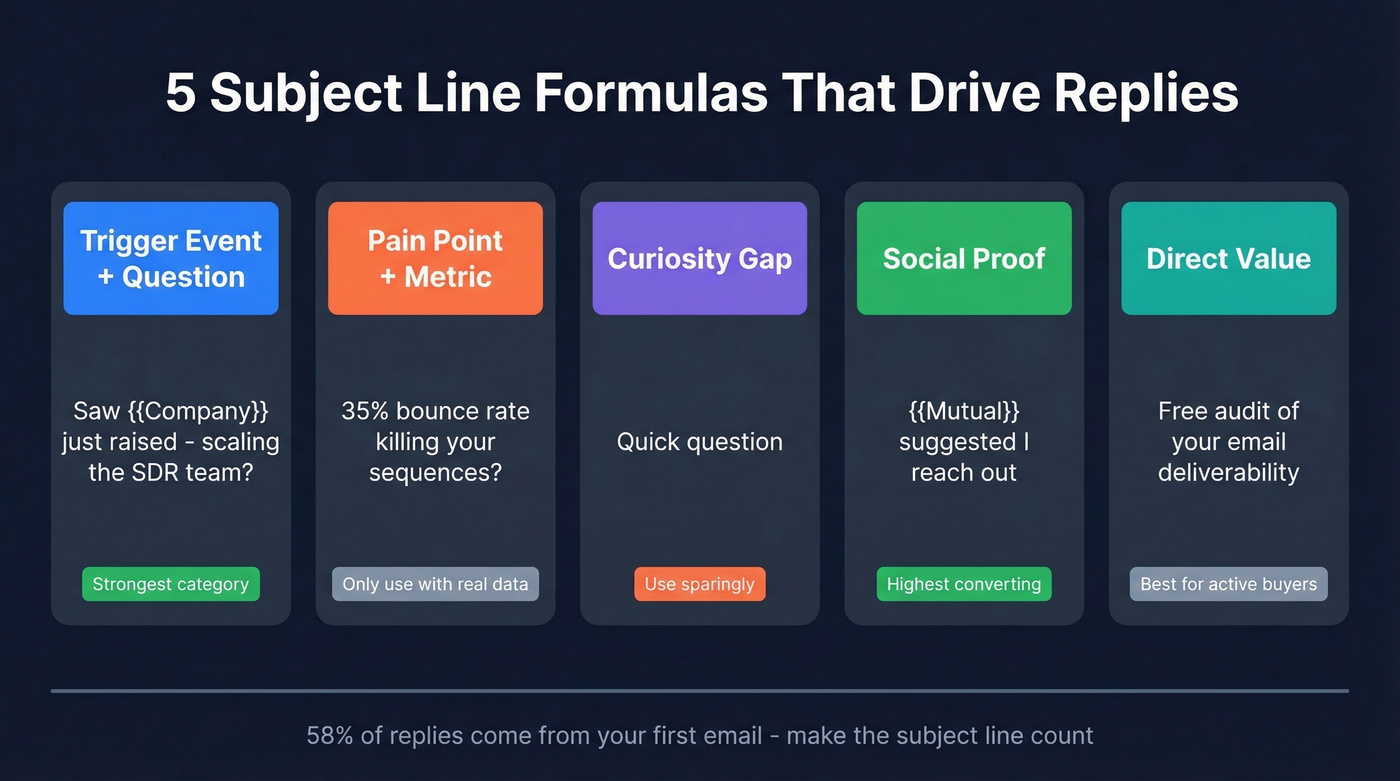
Trigger Event + Question
This is the strongest category, full stop. It combines a specific signal with a question that invites response, and the prospect knows you've been paying attention.
- Saw {{Company}} just raised - scaling the SDR team?
- {{Company}} hiring 3 AEs - outbound infrastructure ready?
- Congrats on the launch - what's the pipeline plan?
- New CRO at {{Company}} - rethinking the tech stack?
- {{Company}} opened a London office - EMEA prospecting sorted?
- Idea for {{Company}}
Strongest pick: "Saw {{Company}} just raised - scaling the SDR team?" Specific, timely, under 50 characters.
Pain Point + Metric
Skip this category if you don't have real data to back it up. Naming a specific pain with a number attached signals expertise, but a made-up stat will destroy trust faster than a generic opener.
| Weak Version | Strong Version |
|---|---|
| Having email problems? | 35% bounce rate killing your sequences? |
| Your team could be more efficient | Reps spending 4 hrs/day on manual prospecting? |
| Data issues hurting pipeline? | Paying $40k/yr for data your reps don't trust? |
Also strong: "Pipeline down 20% QoQ - is it the data?" and "12% connect rate on cold calls - fixable."
Curiosity Gap
Use sparingly. These work best when paired with genuine relevance, not clickbait. The gap should be closeable by reading the email, not by clicking a link.
- The metric your competitors track that you don't
- What {{Competitor}} changed last quarter
- Quick math on your pipeline coverage
- Something I noticed about {{Company}}'s approach
- Quick question
Here's the thing about curiosity gaps: most cold emailers overuse them because they're easy to write. An ultra-short "Quick question" can outperform a clever curiosity line simply because it looks like an internal email, not a sales pitch. But if your entire sequence relies on curiosity, you're training prospects to expect disappointment.
Social Proof / Mutual Connection
Nothing beats a real referral. "{{Mutual Connection}} suggested I reach out" is one of the highest-converting subject lines in outbound. When you don't have a direct referral, shared context still cuts through noise:
- How we helped {{Similar Company}} cut bounce rates 80%
- {{Investor}} portfolio company - quick question
- 3 other {{Industry}} teams made this switch last month
- {{Colleague}} on your team pointed me your way
Even a shared investor or industry peer creates enough social proof to earn the open.
Direct Value / Benefit
No tricks, no gaps - just a clear statement of what you're offering. These work for prospects who are actively looking for solutions.
- 98% verified emails for your outbound team
- Cut list-building from 15 hrs to 3 hrs/week
- Direct dials for your top 50 target accounts
- Free audit of your current email deliverability
- Your ICP list, verified, in 10 minutes
Strongest pick: "Free audit of your current email deliverability" - low-commitment and immediately valuable.
Follow-Up Sequences
58% of replies come from Step 1, but the other 42% matter. The sweet spot is 4-7 touchpoints per sequence. Beyond 7, diminishing returns kick in unless each step adds genuinely new value.
The best follow-up subject lines don't scream "I'm following up." They create a natural reason to re-engage. We've seen "Forgot to mention one thing" outperform "Just checking in" by 3x in reply rate because it implies new information rather than nagging. Other patterns that work:
- Re: {{Original subject}} (genuine reply thread only)
- Bumping this - still relevant?
- Quick follow-up on {{specific topic}}
- Last note on this - then I'll stop
Fake "Re:" prefixes on a first email are a different story - we'll cover why those will destroy your domain in the deliverability section below.
Personalization Beyond {{FirstName}}
{{FirstName}} isn't personalization anymore. Every cold email tool inserts it automatically. Your prospect's inbox has 15 emails that start with their name. It's table stakes, not a differentiator.
Real personalization references something specific to the prospect's professional context. Personalized subject lines hit a 46% open rate versus 35% without, and reply rates jump from 3% to 7%. That's a 2x lift from context alone - and it's what separates a great subject line for a cold email from one that gets deleted in half a second.
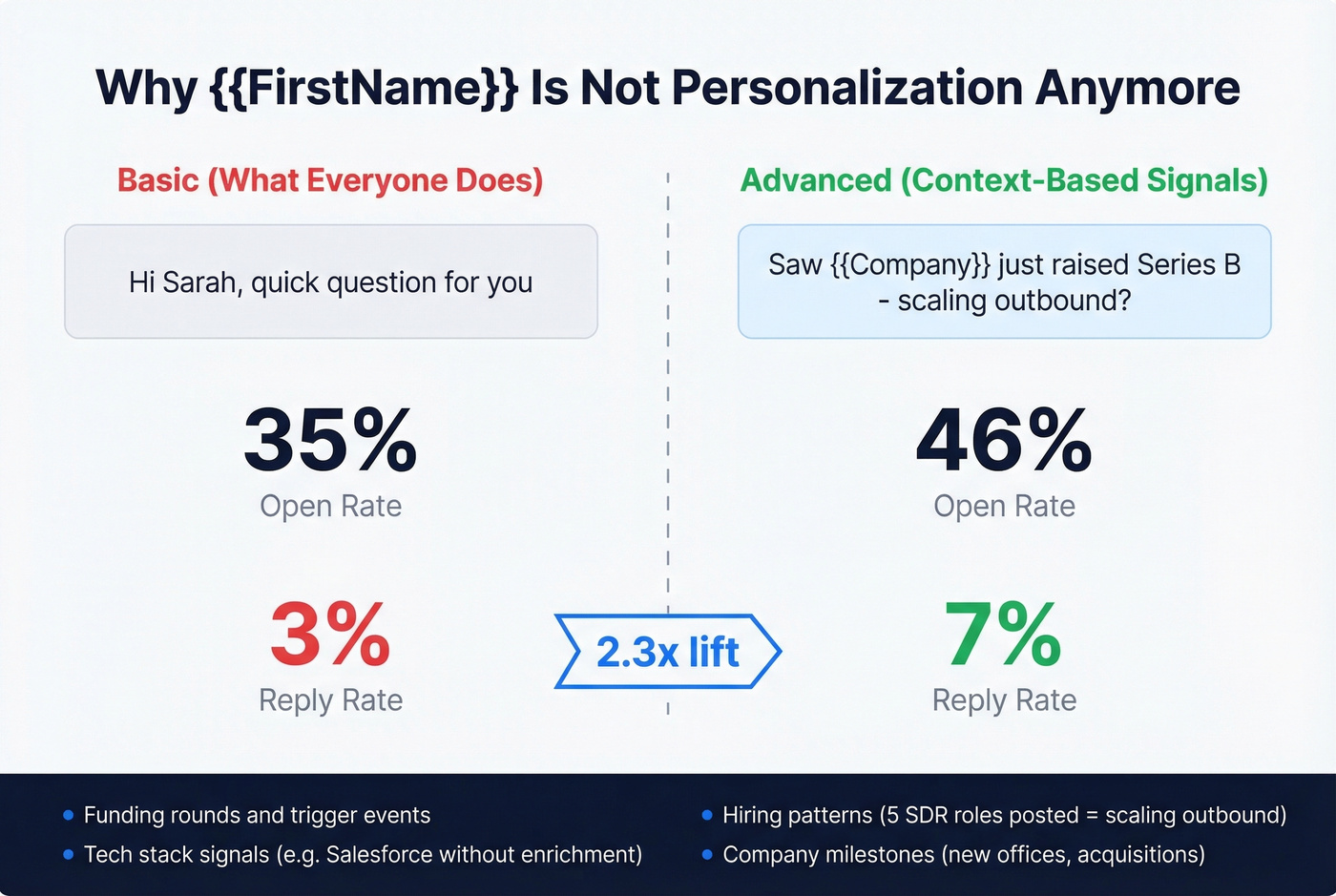
The scalable variables that work: trigger events like funding rounds and executive hires, tech stack signals like using Salesforce without an enrichment tool, hiring patterns such as posting 5 SDR roles that signal outbound scaling, and company milestones like new offices or acquisitions. All public professional data - not creepy, just relevant.
One powerful technique: use your email's first line as an extension of the subject. "Saw {{Company}} just raised" followed by a first line of "Series B usually means scaling outbound - here's how {{Similar Company}} handled it" creates a one-two punch in the inbox. Pulling this off at scale requires accurate, current data on your prospects. Prospeo surfaces 50+ data points per contact - including tech stack, funding status, and hiring signals - on a 7-day refresh cycle, so the signals you reference are actually current rather than months stale.
Spam Triggers and Deliverability Killers
Your subject line doesn't just affect opens - it affects whether your email reaches the inbox at all. ESPs track engagement signals like delete-without-open and spam complaints. A pattern of low engagement trains filters to bury your entire domain.
Common spam triggers and their safer rewrites:
| Spam Trigger | Safer Rewrite |
|---|---|
| Cheap / Free | Cost-effective / No cost |
| Act now | Get started today |
| Limited time only | Available through [date] |
| Guaranteed results | Proven approach |
| $$$ or emoji spam | Remove entirely |
| URGENT!!! | Lowercase, no punctuation |
| Click here | See how it works |
Real talk: fake "Re:" and "Fwd:" prefixes are the laziest trick in cold email. They spike opens for one send, then tank your domain reputation for months. They can violate CAN-SPAM if the subject is deceptive, and they raise GDPR Article 5 transparency issues. Don't do it.
The triage rule we use: if your open rate is below 15%, stop rewriting subject lines. The problem is upstream - either your domain reputation is damaged, your list has too many invalid addresses, or your sending infrastructure isn't properly warmed. A properly warmed domain with a clean list should see 40-60% open rates. Below that, the issue is infrastructure, not copy.
A/B Testing That Produces Results
Most teams A/B test wrong. They test two subject lines on 50 emails each, pick the "winner" after 24 hours, and call it data-driven. That's not testing - that's guessing with extra steps.
One variable at a time. If you change the subject line AND the first line AND the CTA, you've learned nothing. Isolate the subject line. Keep everything else identical.
Sample size matters. For directional results, you need 250+ sends per variant. For statistical significance at 95% confidence, aim for 1,000+ per variant. Treat sub-500 results as signals, not conclusions.
Measure positive reply rate, not opens. A clickbait headline that spikes opens but kills replies is actively damaging your sender reputation. ESPs notice when people open, read two seconds, and hit delete.
Run tests for 1-2 weeks to capture day-of-week effects, and rotate winning lines every 4-6 weeks. Even the best-performing subject fatigues in a finite market.
The Step Before the Subject Line
None of this matters if your emails bounce. If 35% of your list is invalid, your sender reputation tanks and even the perfect subject line lands in spam. We've seen this pattern over and over: teams obsess over copy while their foundation is crumbling.
Meritt, an outbound agency, was running a 35% bounce rate before switching their data source. After moving to Prospeo, bounces dropped to under 4% and their pipeline tripled from $100K to $300K per week. That's not a subject line fix - that's a data quality fix. Prospeo's 98% email accuracy and 5-step verification process, including catch-all handling, spam-trap removal, and honeypot filtering, means your sends actually reach real inboxes.
Trigger-event subject lines only work when you spot the trigger first. Prospeo tracks 15,000 intent topics, job changes, funding rounds, and headcount growth - so you can write "Saw {{Company}} just raised" and actually mean it. 300M+ profiles. 30+ filters. $0.01 per email.
Find the trigger events that make your subject lines impossible to ignore.
FAQ
How long should a cold email subject line be?
Aim for 33-50 characters. Gmail on Android shows as few as 33 characters before truncating, while Apple Mail on iPhone allows up to 48. Front-load your hook - the company name, pain point, or trigger event - in the first 33 characters so it's visible regardless of device.
What's a good reply rate for cold emails in 2026?
The 2026 benchmark is 3.43% average, 5.5%+ for top quartile, and 10.7%+ for the top 10%. Above 5% means you're outperforming most teams. Below 2%, investigate deliverability and list quality before rewriting copy.
Do subject lines affect email deliverability?
Yes. ESPs track engagement signals like delete-without-open rates and spam complaints. Deceptive subject lines - fake Re:/Fwd: prefixes, misleading claims - train inbox filters to deprioritize your domain over time. One viral opener that generates spam reports can damage deliverability for months.
Why are my open rates low even with strong subject lines?
If opens are below 15%, the problem is almost certainly deliverability or data quality, not copy. Invalid addresses generate bounces that tank sender reputation. Verify your list first - a clean list with a properly warmed domain should produce 40-60% open rates before you even think about subject line optimization.