

SugarCRM vs Vtiger CRM: Which One Actually Fits Your Team?
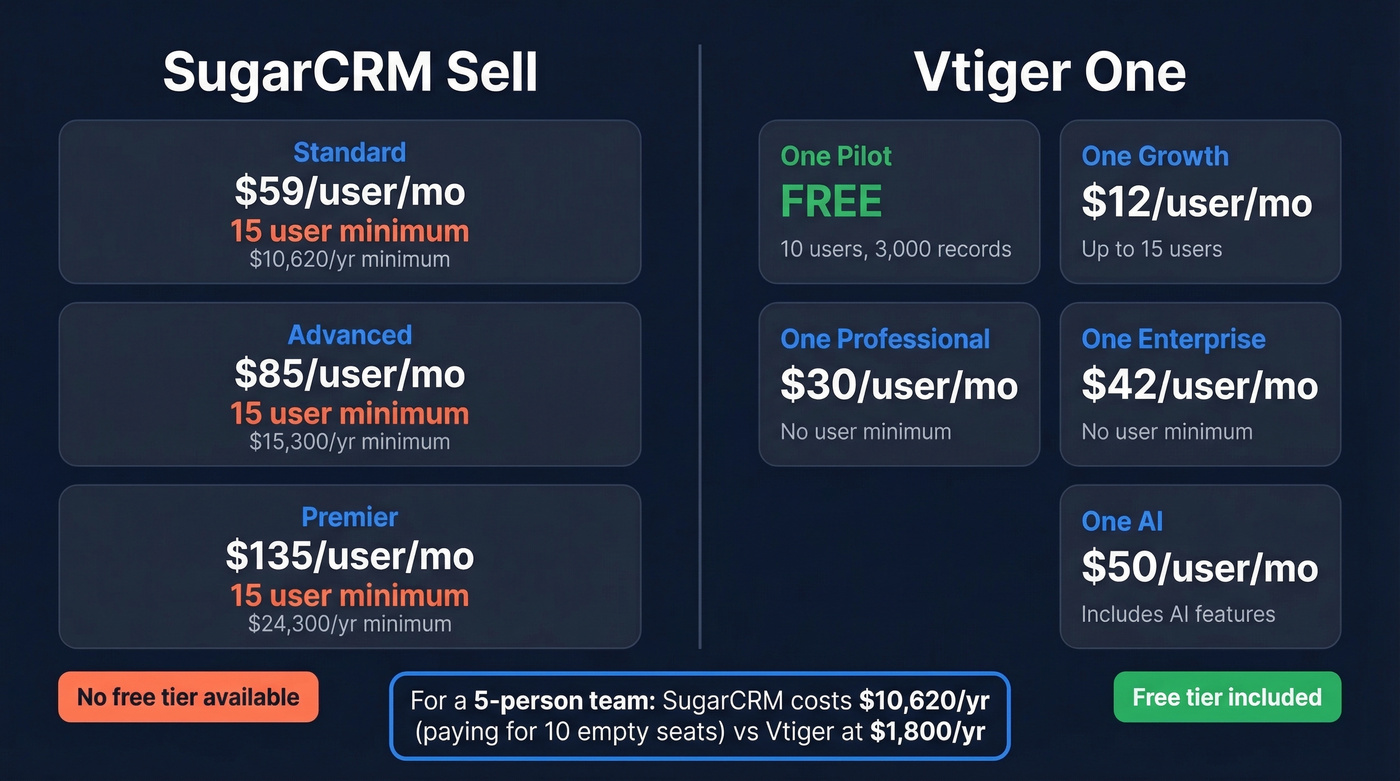
The SugarCRM vs Vtiger CRM comparison changes the moment you see Sugar Sell's 15-user minimum. That's $885/month before a single rep logs in. For a 5-person sales team, you're paying for 10 ghost seats. Vtiger doesn't have a minimum-seat requirement like that, but it has its own tradeoffs.
Here's what actually matters.
30-Second Verdict
Choose Vtiger if you're under 50 users, budget-conscious, and want sales + service + inventory in one platform. The free tier gets you started; paid plans begin at $12/user/mo.
Choose SugarCRM if you have 15+ reps, need strong ERP integration, and can invest in implementation. It's a serious mid-market platform - priced like one.
Skip both if you have fewer than 15 CRM users and want simplicity. HubSpot's free CRM or Odoo's open-source stack will serve you better.
Pricing Compared
This is where the conversation gets real.
| Vtiger One Professional | SugarCRM Sell Standard | |
|---|---|---|
| Price (annual) | $30/user/mo | $59/user/mo |
| Minimum users | None | 15 |
| Min annual cost | $360 (1 user) | $10,620 (15 users) |
| Free tier | Yes (10 users, 3K records) | No |
| Best value for teams under 15 | ✓ | N/A (15-user min) |
SugarCRM's annual commitment escalates fast: Sell Standard is $10,620/year, Advanced is $15,300/year, and Premier is $24,300/year - all requiring 15 seats minimum, billed annually. Stack on Sugar Market at $1,000/mo for 10K contacts or Sugar Serve at $80/user/mo and you're looking at a serious line item. Factor in implementation, data migration, and admin training, and a realistic year-one total for a 15-seat Standard rollout often lands around $16,000-$22,000.
Vtiger's tier breakdown is more straightforward: One Pilot (free, 10 users, 3,000 records), One Growth ($12/user/mo), One Professional ($30/user/mo), One Enterprise ($42/user/mo), One AI ($50/user/mo) - all billed annually.
Two things most buyers miss about Vtiger:
First, the Growth tier caps at 15 users and 100,000 records, with a limit of 5 email sequences per user. Teams expecting to scale past that need Professional or higher.
Second, Vtiger offers "Single App User" licenses at $20-$38/user/mo depending on tier. If someone only needs access to one module - say, support tickets - with view-only access to everything else, you avoid paying full-seat pricing. For mixed teams, that's a genuinely clever cost lever.
Features Head-to-Head
On Software Advice aggregate scores, Vtiger leads across every category: ease of use (4.2 vs 3.7), value for money (4.5 vs 3.8), customer support (4.2 vs 3.7), and functionality (4.2 vs 3.8). Those aren't small gaps.
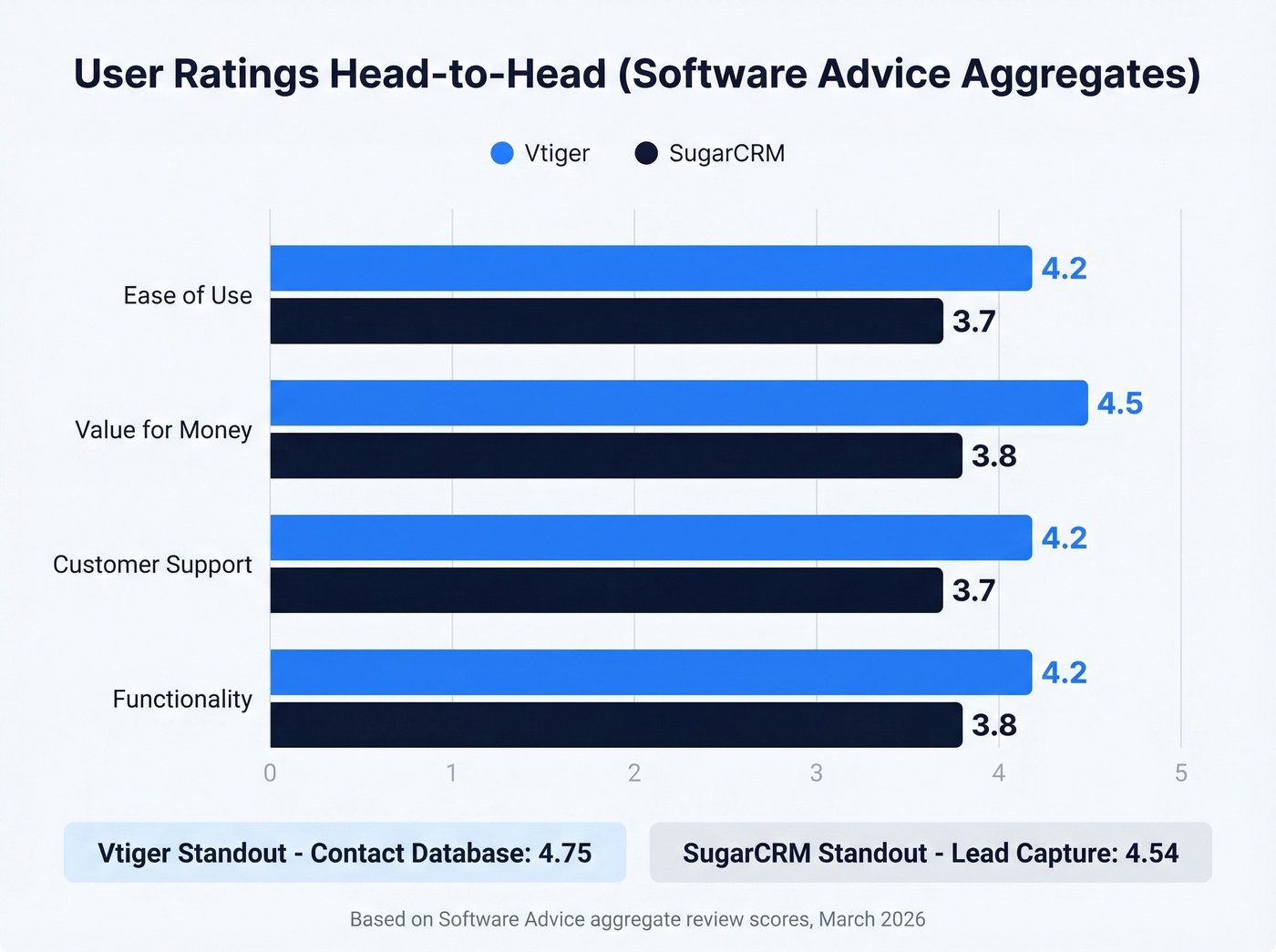
At the feature level, Vtiger's Contact Database scores a 4.75 and Support Ticket Management a 4.71, while SugarCRM's standout is Lead Capture at 4.54. Vtiger ships a lot out of the box - including Deal Room, a customer-facing microsite for deals, and Process Designer for visual workflow automation - with an "all-in-one" philosophy that appeals to SMB teams trying to avoid a stack of add-ons.
SugarCRM's strength is different. It's built for teams that need a highly customizable CRM with strong workflow automation through Sugar Studio and SugarBPM, plus a broader ecosystem spanning Sell, Serve, and Market. If your sales process touches manufacturing or distribution ERP systems, Sugar's integration depth is hard to beat.
Here's the thing: for 80% of teams comparing these two, Vtiger is the better CRM. SugarCRM wins only when ERP integration is a non-negotiable requirement - and most teams overestimate how much they actually need that.
AI Capabilities in 2026
Both platforms are investing heavily in AI. Vtiger's Calculus AI handles conversation analysis and next-action recommendations, with newer additions like Agent Builder and Predictive AI Designer. SugarCRM includes AI-powered summaries, next actions, and predictive/generative analysis. Neither is a clear AI winner yet - both are building fast, and we'd wait another year before making a CRM decision based on AI features alone.

Neither SugarCRM nor Vtiger ships with verified contact data. Teams load thousands of stale records on day one and wonder why reps abandon the CRM within weeks. Prospeo's enrichment API returns 50+ data points per contact at a 92% match rate - refreshed every 7 days, not every 6 weeks.
Enrich your CRM data before migration - 75 free emails, no contract.
User Ratings and Sentiment
Vtiger holds a 4.3/5 on G2 (413 reviews) and 4.3/5 on Capterra (336 reviews). The user base skews SMB - 280 small business, 118 mid-market, and 14 enterprise reviews on G2. Users consistently praise ease of use and customization flexibility. The recurring complaint? It can be slow at times.
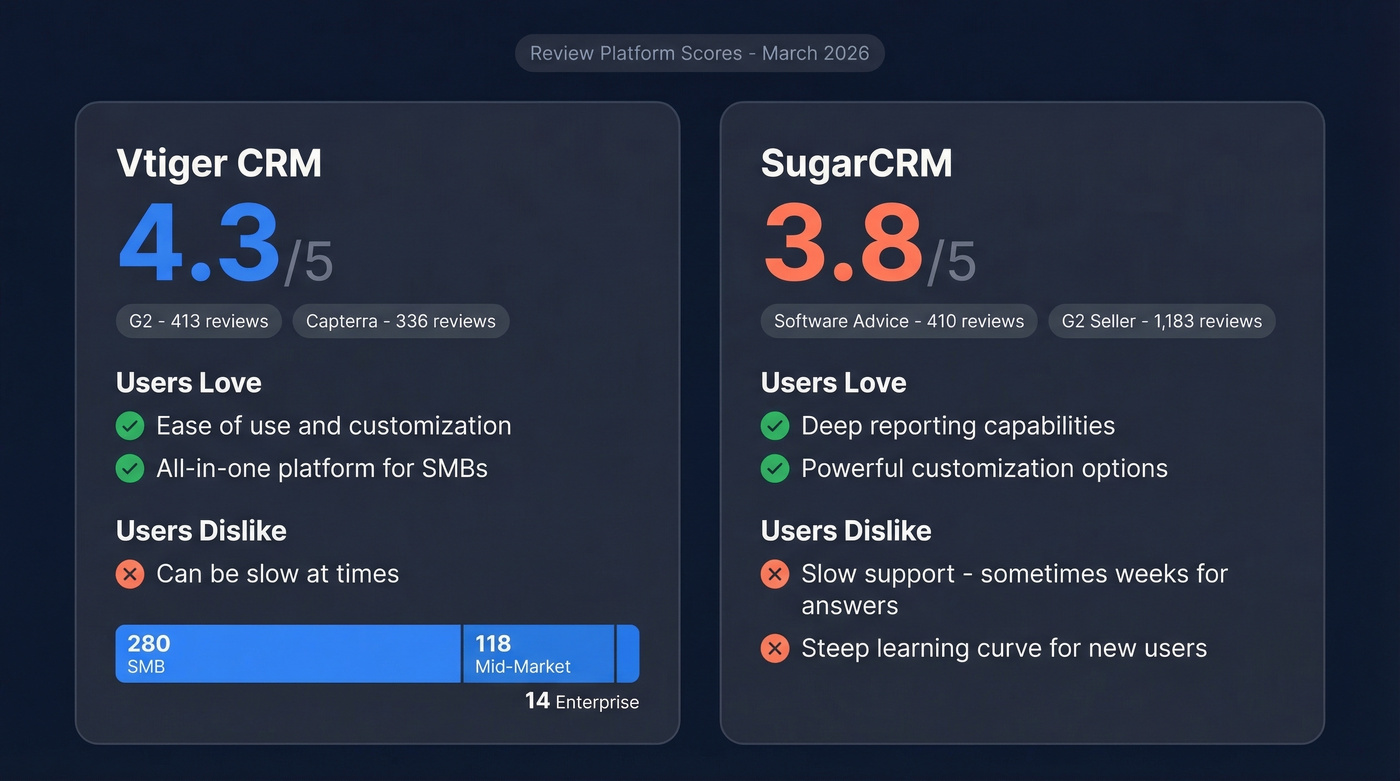
SugarCRM sits at 3.8/5 on Software Advice (410 reviews), with the G2 seller aggregate pulling 1,183 reviews across Sugar Sell, Sugar Market, and Sugar Serve. Users praise deep reporting and customization. The complaints are pointed: slow support response times - some reviewers mention weeks to get answers - and a steep learning curve compared to more modern CRMs. We've seen this pattern before with enterprise-grade platforms: powerful once configured, painful to get there.
The consensus on r/CRM tends to echo the review sites. Vtiger gets recommended for smaller teams that want everything in one place. SugarCRM comes up when someone specifically asks about manufacturing or distribution workflows. Nobody's raving about either platform's onboarding experience.
Open-Source Status in 2026
Let's be honest: neither is a real open-source play anymore.
SugarCRM Community Edition was discontinued years ago. It's dead. Don't plan around it. Vtiger has Community Edition heritage, but the commercial cloud product is clearly the focus, and practitioner sentiment raises questions about how active the Community Edition ecosystem really is today.
If you need a genuine self-hosted open-source CRM, look at SuiteCRM, Odoo, or EspoCRM instead.
Who Should Choose Which
Choose Vtiger if you have a team under 50 users, want sales + service + inventory in one platform, need a free tier to start, and care about value for money and fast onboarding. It's the right pick for SMBs and mid-market teams without heavy ERP dependencies.
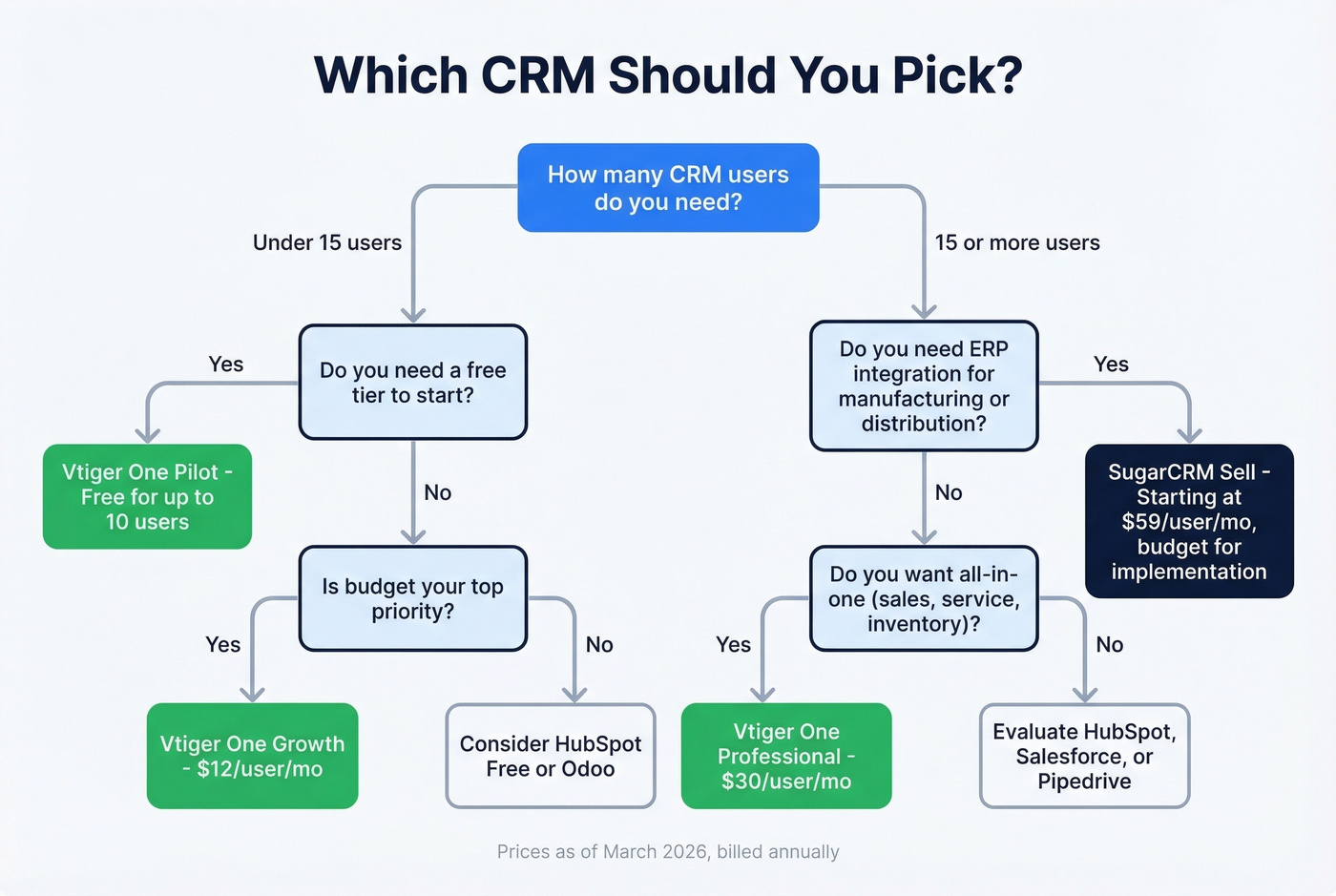
Choose SugarCRM if you have 15+ reps, need ERP integration for manufacturing or distribution workflows, require enterprise-grade workflow customization, and can invest in professional implementation. The on-premises deployment option is a bonus for regulated industries.
For teams under 15 users who want simplicity, skip both. HubSpot's free tier or Odoo will get you further, faster.
Clean Data Makes Either CRM Work
The best CRM in the world is useless if it's full of stale emails and disconnected phone numbers. We've watched teams spend months agonizing over SugarCRM vs Vtiger CRM, then load 20,000 contacts with a 15% bounce rate on day one - killing rep trust immediately. That first week sets the tone for whether your team actually uses the system or quietly reverts to spreadsheets.
Prospeo's CRM enrichment returns 50+ data points per contact at a 92% match rate, with records refreshed on a 7-day cycle. Enrich before migration, keep data clean after, and your CRM actually gets used.
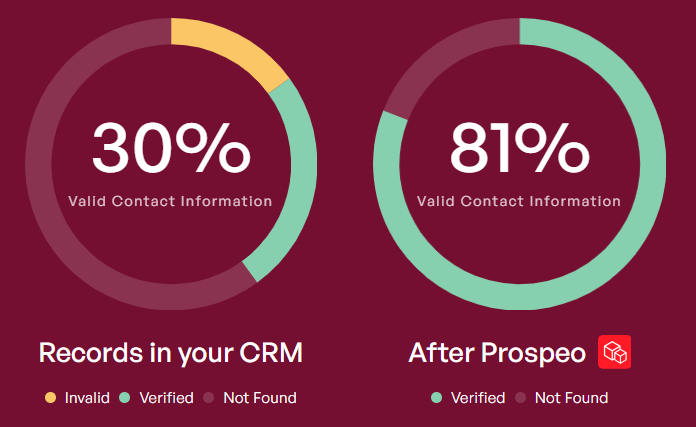
You're about to spend $10,620/year on SugarCRM or $4,320/year on Vtiger. Don't feed either platform a contact list with a 15% bounce rate. Prospeo verifies emails at 98% accuracy for ~$0.01 each - so your reps actually trust the system from week one.
Clean data is the difference between CRM adoption and expensive shelfware.
FAQ
Can I use SugarCRM with fewer than 15 users?
No. Sugar Sell plans require a 15-user minimum. You'll pay for 15 seats even if only 5 people log in - that's $10,620/year minimum on the Standard tier. Teams under 15 reps should look at Vtiger, HubSpot, or Odoo instead.
Is Vtiger CRM really free?
The One Pilot plan is free for up to 10 users and 3,000 records. It covers basic contact management and pipeline tracking. Paid plans start at $12/user/mo on annual billing, unlocking email sequences, automation, and higher record limits.
How do I keep CRM data accurate after migration?
Use a data enrichment tool to verify emails and enrich contacts before and after import. A 7-day refresh cycle - compared to the 6-week industry average - prevents the data decay that makes reps stop trusting the system. At 98% email accuracy, you avoid the bounce-rate spikes that tank domain reputation on day one.