

The Talk Track Template You'll Actually Use (Copy-Paste Ready)
Most cold call scripts sound like cold call scripts. That's the problem. A talk track template gives your SDRs a flexible framework they internalize and riff on - not a teleprompter they read from while a prospect zones out. One rep on r/sales nailed the frustration: they had the opener, the "why you," the product pitch, and the meeting ask - but still sounded "too pitchy/salesy" because the whole thing was a monologue, not a conversation.
Below are six copy-paste templates, plus the delivery and data hygiene details that separate booked meetings from wasted dials.
Talk Tracks vs. Scripts
| Script | Talk Track | |
|---|---|---|
| Format | Word-for-word | Bullet-point framework |
| Best for | New reps, voicemails | Complex sales, experienced reps |
| Risk | Sounds robotic | Rep goes off-message without training |
| Flexibility | None - read as written | High - riff within structure |
Scripts aren't evil. They're great for onboarding reps who don't know the product yet, or for leaving voicemails where consistency matters. But once a rep has basic product fluency, a sales talk track lets them sound human instead of rehearsed. That's the whole point.
The Universal Five-Field Framework
Every talk track follows the same five-field skeleton:
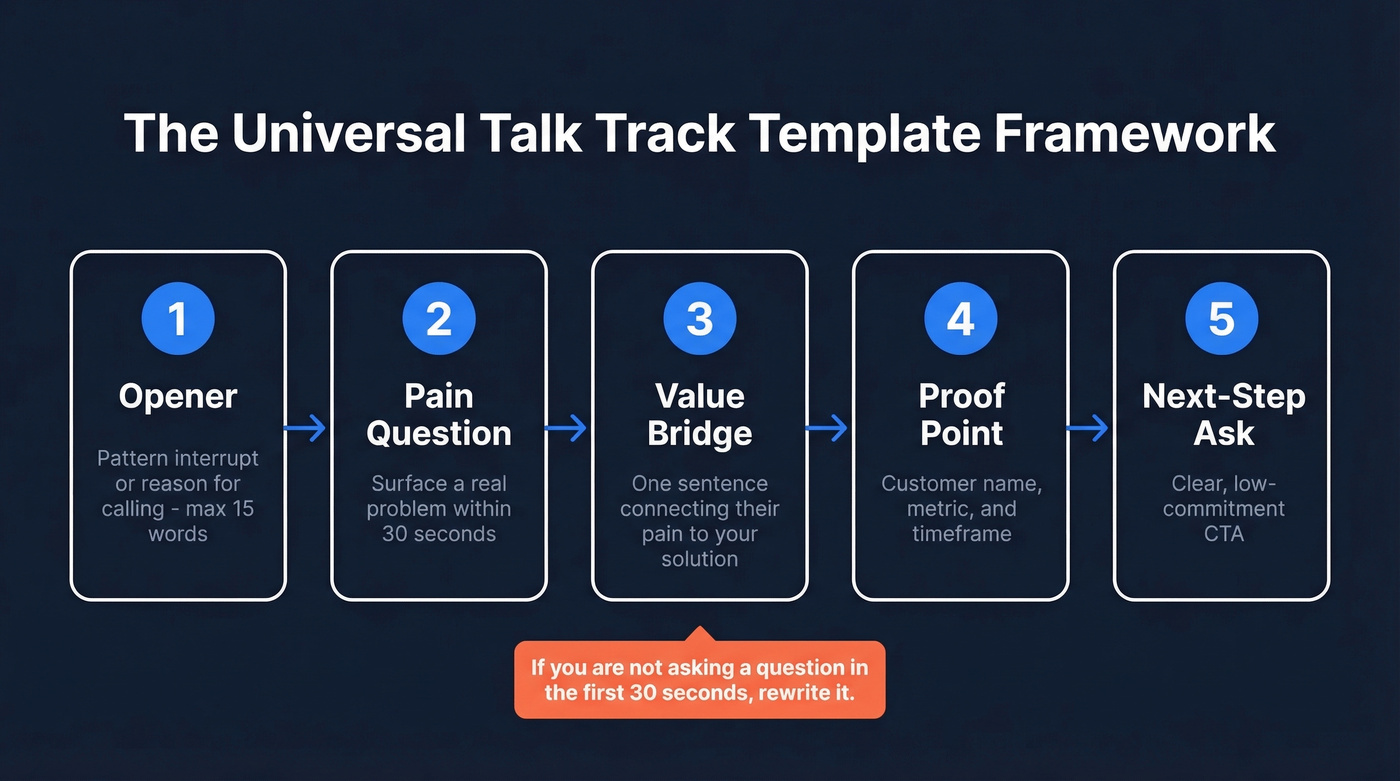
- Opener: Pattern interrupt or reason for calling - max 15 words.
- Pain question: One question that surfaces a real problem, asked within 30 seconds.
- Value bridge: One sentence connecting their pain to your solution.
- Proof point: Specific result - customer name, metric, timeframe.
- Next-step ask: Clear, low-commitment CTA.
If your framework doesn't force you to ask a question in the first 30 seconds, rewrite it.
Before (the classic Reddit SDR structure): "Hey, caught you out of the blue - worst possible time? The reason I'm calling is we help companies like yours automate outreach, manage pipeline, and close more deals. I'd love to set up 30 minutes to walk you through a demo."
After: "Hey [Name], quick question - how's your team tracking deals that stall after the second call right now?"
The first version is a pitch disguised as a conversation. The second actually starts one.
6 Sales Talk Track Templates by Scenario
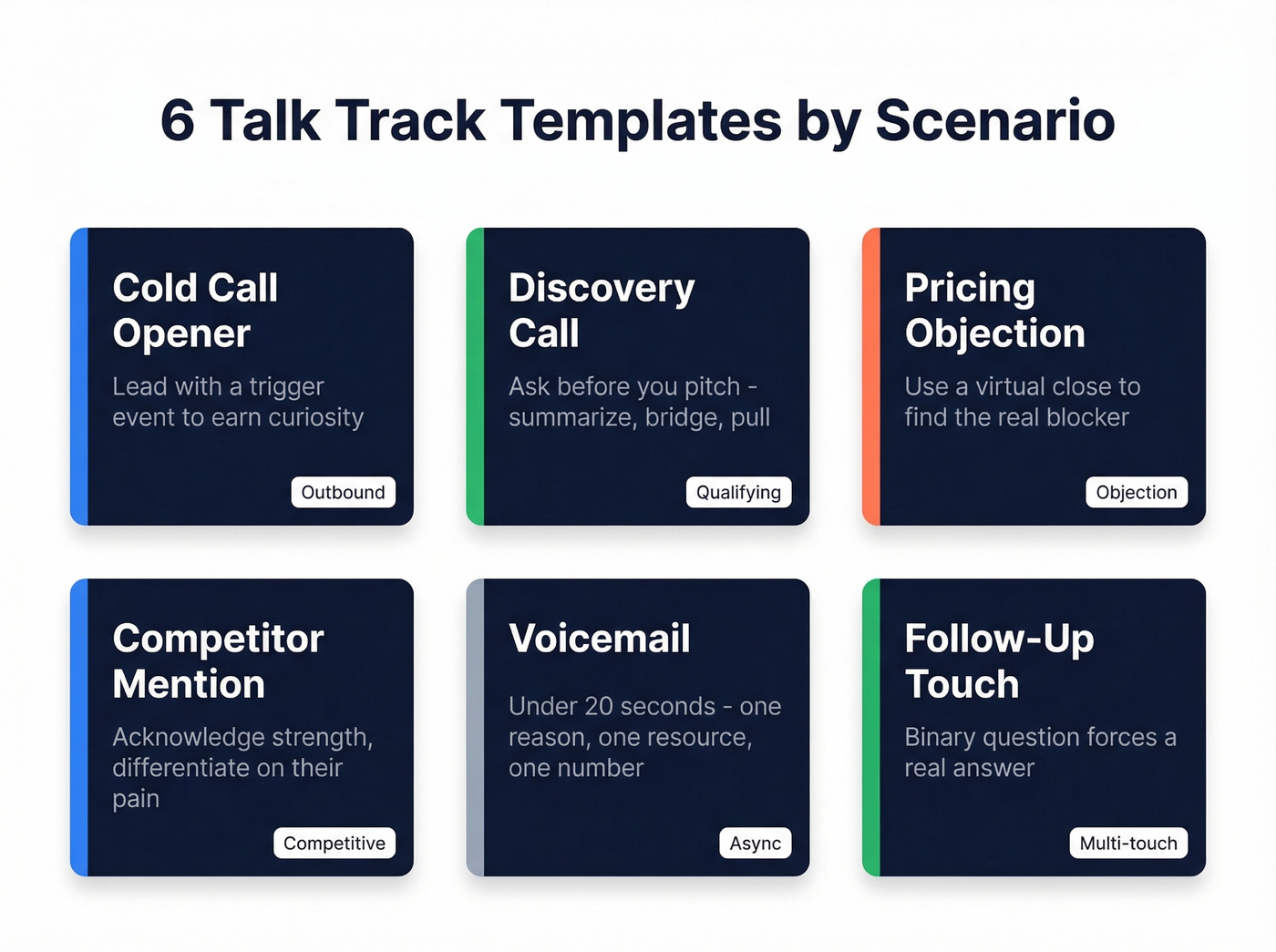
1. Cold Call Opener
"Hey [Name], we haven't spoken before. I noticed [company] just [trigger event - hiring, funding, expansion]. Quick question: how are you handling [specific pain related to trigger] right now?"
If they engage: → Value bridge → Proof point → Ask for 15 minutes If gatekeeper: "I'm following up on something I sent [Name] - can you connect me?"
Roughly 60% of cold calls run into an "I'm not interested" objection before the rep finishes their second sentence. The trigger event buys you a moment of curiosity - use it before it evaporates.
2. Discovery / Qualifying Call
"Thanks for taking the time, [Name]. Before I walk through anything - can you walk me through how your team currently handles [process your product improves]?"
Follow-up probes: "What happens when that breaks down?" / "How does that affect [metric they care about]?"
This follows Skip Miller's Summarize, Bridge, Pull framework: summarize what you've heard, bridge to agreement, then pull toward next steps. We've found it works especially well when reps resist the urge to jump into a demo too early.
3. Pricing Objection
"Totally fair - budget matters. What price range would make this a no-brainer for you?"
[Pause. Let them answer.]
"If we could get to [their number or close], would we have a deal today?"
That "virtual close" surfaces whether price is the real blocker or a smokescreen for something else. Nine times out of ten, it's something else.
4. Competitor Mention
"Good - glad you're evaluating options. [Competitor] does [genuine strength]. Where we're different is [specific differentiator tied to their pain]. [Customer name] switched from [competitor] and saw [metric] in [timeframe]. Worth a 15-minute comparison?"
Don't trash the competitor. Acknowledge their strength, differentiate on the pain point that matters to this prospect, and let the proof point do the selling.
5. Voicemail
"Hey [Name], [your name] from [company]. I'm calling because [one-sentence reason tied to their world, not yours]. I'll send a quick email with [specific resource]. My number is [number]. Talk soon."
Under 20 seconds. One reason, one resource, one callback number. That's it.
6. Follow-Up / Second Touch
"Hey [Name], [your name] again. I left you a voicemail on [day] about [pain topic]. Quick question: is [pain] something your team is actively trying to fix this quarter, or is it more of a back-half-of-2026 priority?"
The binary question forces a real answer instead of a vague brush-off. Either way, you learn something useful - and you've earned the right to a third touch.

The best talk track in the world dies on a bad phone number. Prospeo gives you 125M+ verified mobile numbers with a 30% pickup rate - so your reps spend time running the framework, not chasing dead dials.
Stop perfecting scripts for numbers that never pick up.
How to Customize Per Persona
You don't need 10 variations. You need three great ones customized per persona.
Start by organizing into four docs: FAQs, common objections, qualifying/discovery, and demo flow. Close's four-doc system keeps things findable for outbound teams without overcomplicating the structure. Tag each doc by persona and industry - a call framework for a VP of Finance sounds nothing like one for a Director of Engineering, and healthcare alone has compliance constraints that require dedicated tracks.
Refresh quarterly at minimum. Update immediately when your product ships major features, a competitor changes pricing, or reps report the same new objection three times. And store everything where reps already live - Google Docs, Notion, your CRM. A framework buried in a PDF nobody opens doesn't exist.
Delivery Tips That Actually Move the Needle
Slow down. Top performers handle objections at around 176 words per minute; flustered reps speed up to 188 wpm. That gap sounds small on paper, but on a call it's the difference between confident and panicked.
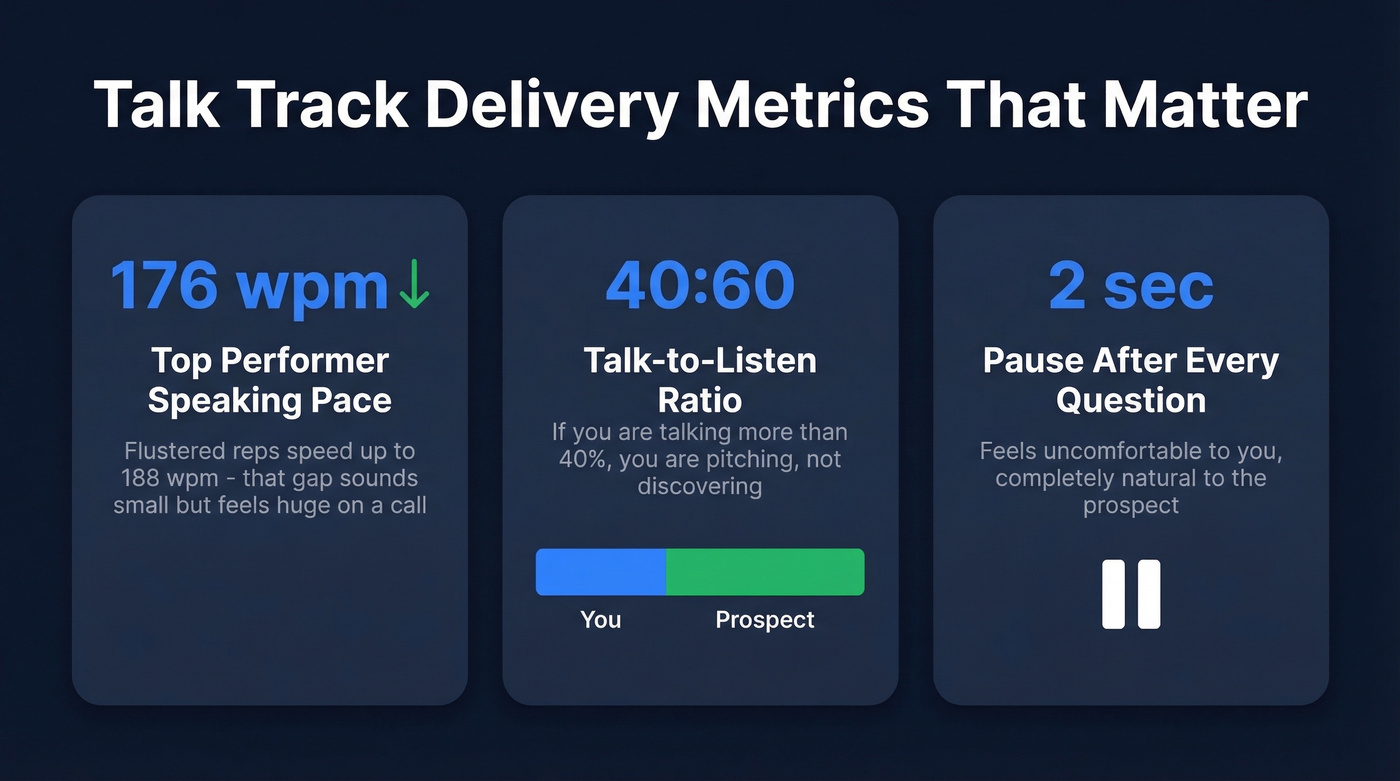
Hit a 40:60 talk-to-listen ratio. If you're talking more than 40%, you're pitching, not discovering. We've reviewed hundreds of call recordings across our team, and the pattern is consistent: reps who listen more book more.
Pause after every question. Two full seconds of silence feels uncomfortable to you and completely natural to the prospect. It signals you actually want an answer.
Let's be honest about one more thing: don't read your talk track. Internalize the structure and riff. Record your calls and review them in Gong or Chorus to see which phrases actually correlate with booked meetings. The data will surprise you.
Mistakes That Kill Your Calls
Feature-dumping without asking questions. The fastest way to lose a prospect is rattling off capabilities like a product page. Your call framework should have more question marks than periods.
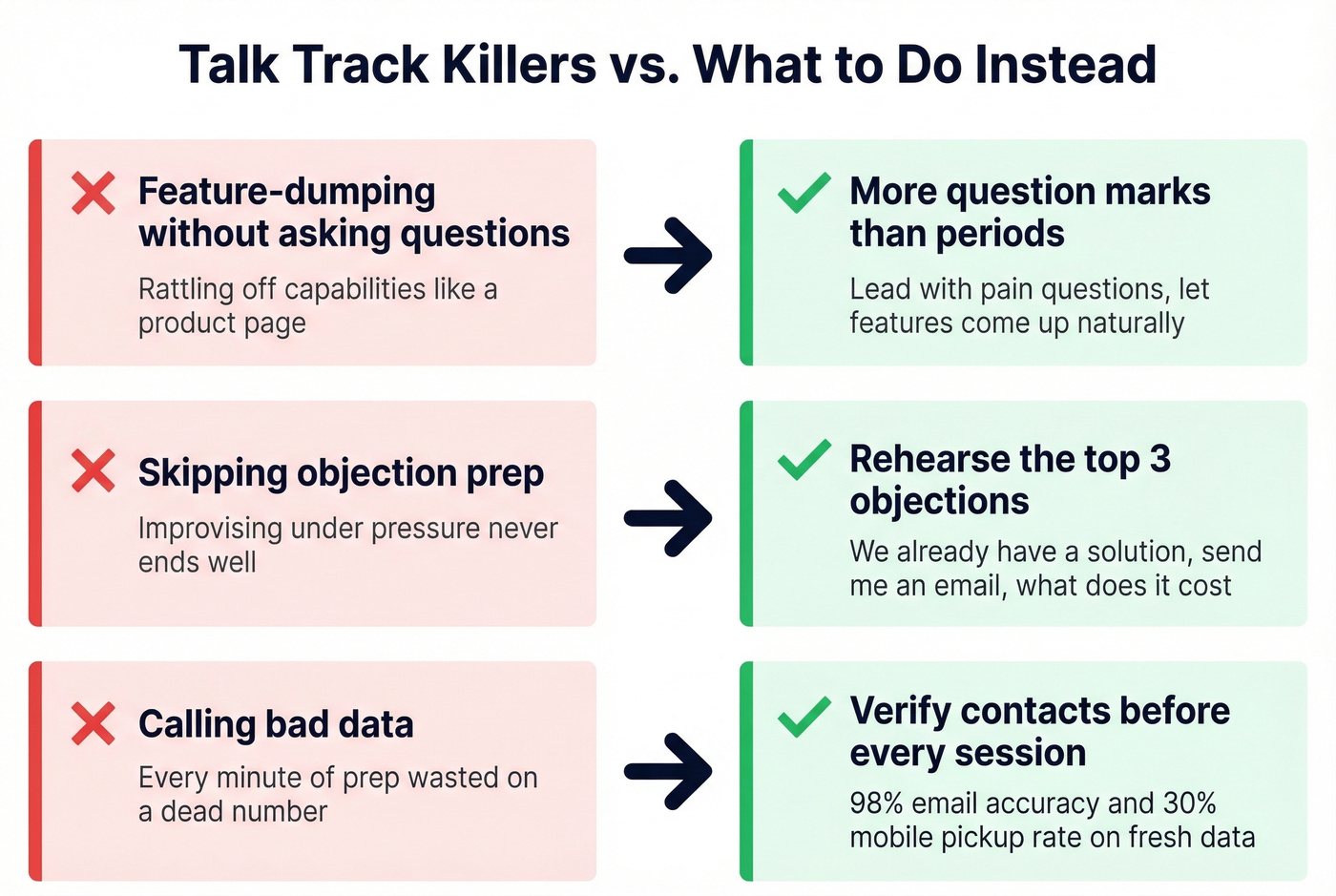
Skipping objection prep. If you haven't rehearsed responses to "we already have a solution," "send me an email," and "what does it cost," you're improvising under pressure. That never ends well.
Calling bad data. Here's the thing most sales enablement teams ignore: your talk track template is only as good as the number you're dialing. If you're calling disconnected numbers or emailing bounced addresses, every minute of prep is wasted. We ran into this ourselves before switching to Prospeo for contact verification - 98% email accuracy and a 30% mobile pickup rate on a 7-day refresh cycle means your carefully crafted opener actually reaches a human instead of a dead line.
If you want more sales prospecting techniques that pair well with talk tracks, start there.
You just built a killer talk track with trigger-based openers. Now you need the triggers. Prospeo tracks 15,000 intent topics, job changes, funding rounds, and headcount growth - so every opener in your framework hits a real, timely pain point.
Pair your talk tracks with real-time buyer signals for $0.01 per lead.
FAQ
How long should a talk track be?
One page max - five sections, one to three bullets each. If you can't scan the entire framework in 10 seconds, trim it. Reps won't reference anything longer mid-call.
How often should you update your call frameworks?
Quarterly at minimum. Update immediately after major product launches, competitor pricing changes, or when reps report the same new objection three times in one week.
What's the fastest way to test a new talk track?
Dial 20 verified contacts in one session, record the calls, and compare your connect-to-meeting rate against baseline. Tools like Gong can flag which specific phrases drive bookings versus which ones trigger hang-ups.
What's the difference between a talk track and a sales playbook?
A talk track covers a single conversation scenario - one opener, one pain question, one CTA. A sales playbook is the full collection: multiple talk tracks organized by persona, stage, and objection type, plus competitive intel and qualification criteria. Think of the talk track as one page in a much bigger book.