

Tech Sales in 2026: What It Pays, How Hard It Is, and Whether It's Still Worth It
You just saw a post about someone making $300K in tech sales. Here's what that post usually skips: fewer than half of reps hit quota, about 154,000 US tech workers were laid off through November 2025, and AI is already squeezing the transactional roles that used to be easy money.
The ceiling's still sky-high. The floor dropped.
What You Need to Know
Tech sales usually means selling B2B SaaS subscriptions to businesses. The money's real: median on-target earnings (OTE) runs from about $85K for an entry-level SDR to $300K for a Strategic Account Executive, with top performers clearing $700K+ in strong years. But OTE isn't a paycheck. It's what you earn at 100% of quota.
Quota attainment is the part people don't want to talk about. Average attainment sits around 43%, which means most reps miss their number and take home less than the offer letter implies. That's why "great OTE" and "great job" aren't the same thing.
The 2021 gold rush - where an SDR could get promoted to AE in 12 months and coast on inbound - is over. What's left is still one of the highest-ceiling careers you can enter without a specific degree, but you can't sleepwalk into it anymore.
What Is Technical Sales?
At its core, technical sales is selling software and technology services to other companies. In 2026, that overwhelmingly means SaaS: subscription software priced on annual recurring revenue (ARR) or annual contract value (ACV). Think Salesforce, Snowflake, Datadog, or any of the thousands of B2B platforms sold on monthly or annual contracts.
The subscription model is what makes tech sales feel different from a lot of other sales jobs. You're not closing a one-time deal and moving on; you're selling a recurring relationship, so retention and expansion matter almost as much as the initial close. A $50K ACV deal that churns after one year is worth less than a $30K deal that expands to $100K over three years, and that reality shapes comp plans, org design, and what gets you promoted.
Tech sales vs. IT sales gets mixed up constantly. IT sales often means hardware, infrastructure, and reseller/VAR channels: servers, networking equipment, managed services. SaaS selling is mostly software with a recurring revenue engine, different sales cycles, and a more standardized ladder.
If someone says "I'm in tech sales," nine times out of ten they mean SaaS.
What Tech Sales Actually Pays
Let's get to the numbers. The table below is based on RepVue's 2026 salary guide, which aggregates self-reported compensation data across thousands of reps.
2026 Compensation by Role
| Role | Median Base | Median OTE | Top Performers | Quota Attainment |
|---|---|---|---|---|
| SDR/BDR | $60,000 | $85,000 | $127,955 | 57.3% |
| SMB AE | $70,000 | $130,000 | $269,489 | 44.8% |
| Mid-Market AE | $90,000 | $175,000 | $391,399 | 43.9% |
| Enterprise AE | $135,000 | $265,000 | $627,527 | 40.9% |
| Strategic AE | $150,000 | $300,000 | $705,215 | 47.0% |
| Sales Engineer | $145,000 | $200,000 | $327,388 | 56.8% |
| Sales Manager | $150,000 | $280,000 | $508,044 | 51.3% |
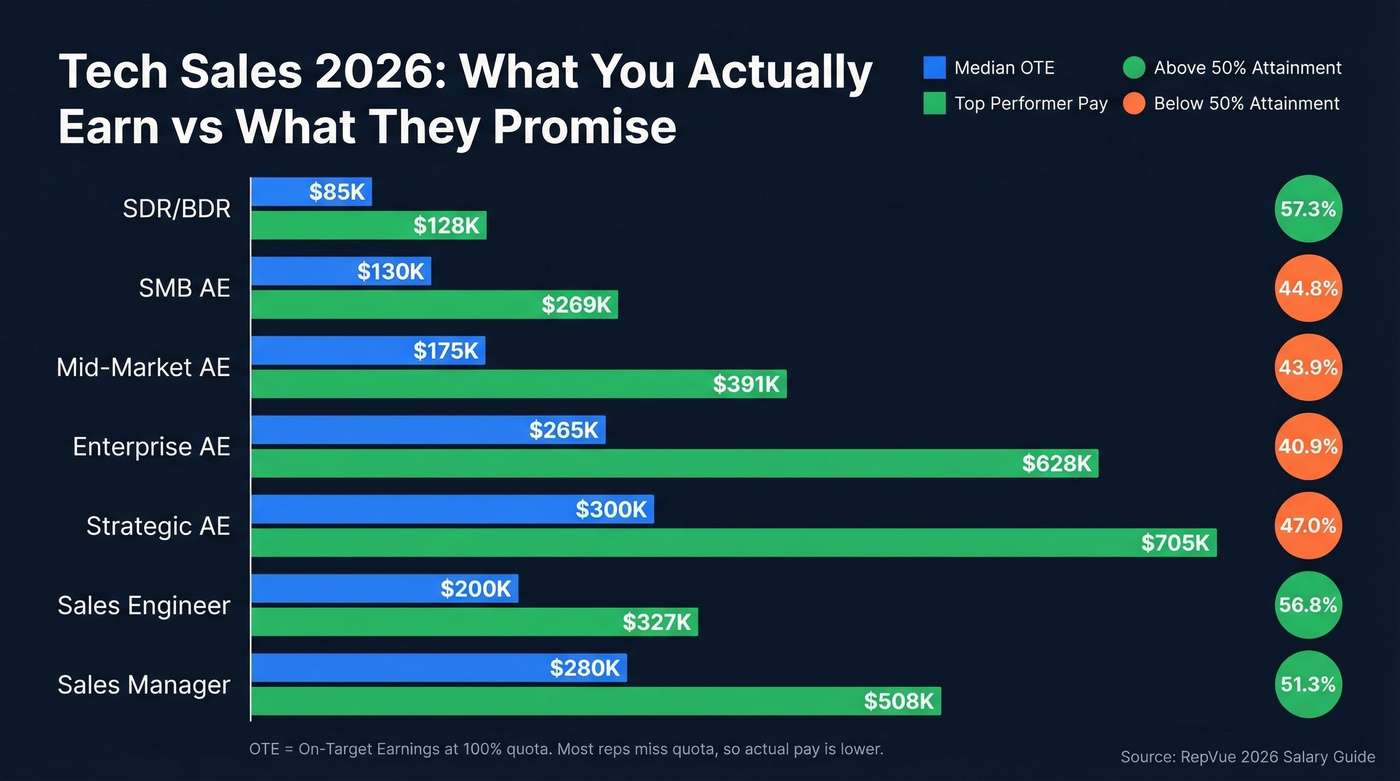
A few things jump out.
First, OTE isn't "what you make." It's what you make if you hit plan. SDR comp splits often land around 60/40 to 70/30 (base/variable), so a big chunk of that $85K depends on meetings booked and accepted. For AEs, variable comp is a larger share, which means your income swings with pipeline quality, territory, and whether leadership decides to "recalibrate" quota mid-year.
Second, look at quota attainment. Only 57% of SDRs hit their number - and that's the best attainment rate on the board. Enterprise AEs? 40.9%. When fewer than half the team hits quota, you should assume the comp plan is designed to underpay.
Our rule: always ask what percentage of the team hit quota last quarter before you sign. If the answer's vague, defensive, or under 50%, the OTE on your offer letter is marketing, not math.
One more thing, because this trips people up: a higher OTE with a low base can be worse than a lower OTE with a strong base if attainment's bad. If the company knows most reps won't hit, they'll push variable-heavy plans. Don't accept that at face value.
The Enterprise Ladder
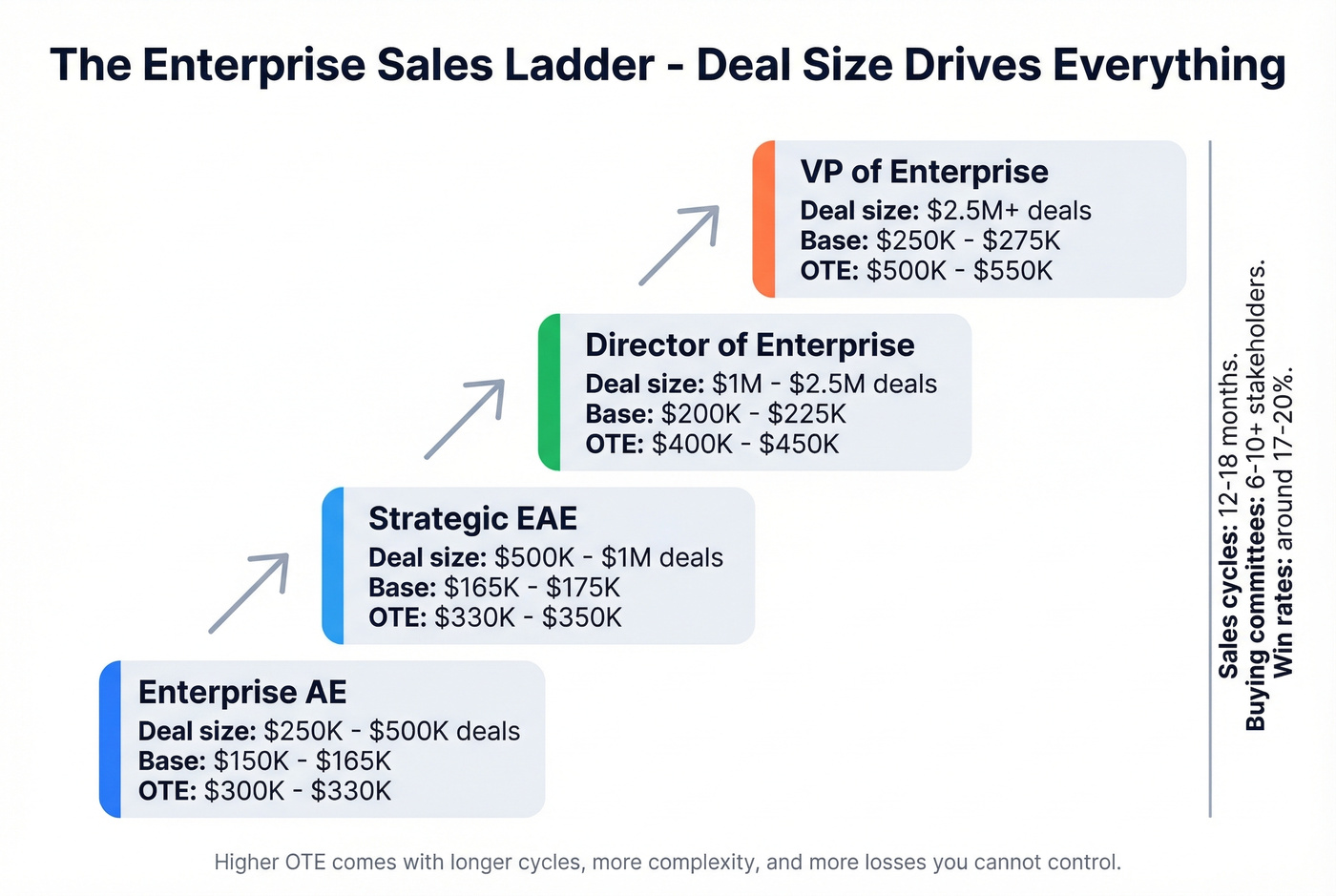
If you're eyeing the top of the comp curve, enterprise sales has a pretty clear tiering structure tied to deal size. These ranges come from Betts Recruiting's 2025 analysis, and they're still directionally useful for 2026 planning.
| Level | Deal Size Band | Base Range | OTE Range |
|---|---|---|---|
| Enterprise AE | $250K-$500K | $150K-$165K | $300K-$330K |
| Strategic EAE | $500K-$1M | $165K-$175K | $330K-$350K |
| Director of Enterprise | $1M-$2.5M | $200K-$225K | $400K-$450K |
| VP of Enterprise | $2.5M+ | $250K-$275K | $500K-$550K |
These numbers are real, but so is the context: enterprise deals can run 12-18 months, involve a buying committee, and drag you through procurement and legal in ways that feel absurd until you've lived it. You're not closing these deals with a slick demo and a discount. You're running a multi-threaded campaign across IT, security, finance, procurement, and exec sponsors for over a year, and you still lose plenty of them for reasons that have nothing to do with you.
The 2026 Market Reality
The comp tables look great in isolation. The market is the part that makes people hesitate.
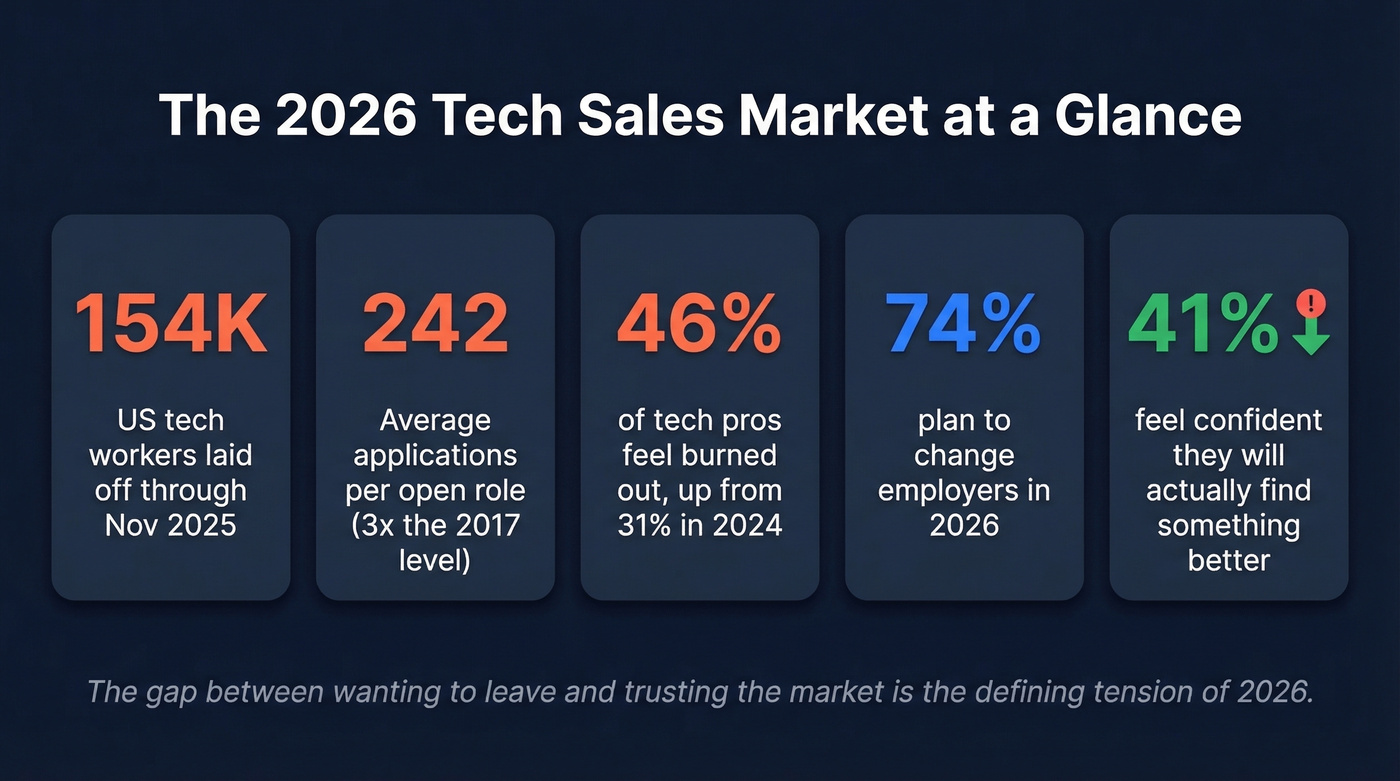
Through November 2025, roughly 154,000 US tech workers were laid off, and job postings are still down compared to the early-2020 baseline after peaking in 2022. Open roles also get swarmed: Greenhouse has reported an average of 242 applications per opening, nearly triple 2017 levels. That doesn't mean every sales job is impossible to get; it means your resume isn't competing with five other people anymore. It's competing with hundreds, and a chunk of them already have SaaS logos on their LinkedIn.
The sentiment data isn't pretty either. A Dice survey of 1,159 US tech professionals found 46% feel burned out (up from 31% in 2024), 55% are actively job searching, and 74% plan to change employers in 2026 even though only 41% feel confident they'll find something better. That gap - wanting to leave but not trusting the market - is the defining tension of 2026.
Look, this isn't "tech is dead." It's "the easy era is over." Companies are hiring, but they're hiring fewer reps, expecting more output per head, and taking longer to extend offers. If you're breaking in, you need a plan and you need to pick your first role carefully.
Authoritative reads if you want to go deeper:
- Layoff and market coverage: https://www.businessinsider.com/big-tech-job-market-hiring-cracked-layoffs-amazon-microsoft-2025-12
- Burnout and job-search sentiment: https://www.staffingindustry.com/news/global-daily-news/burned-out-us-tech-pros-eye-exits-despite-shaky-outlook
- Quota/attainment benchmarks: https://www.hyperbound.ai/blog/b2b-sales-performance-benchmark-2025
How AI Is Changing Sales Strategies
The AI conversation in sales has moved past hype into real structural change. SaaStr draws a clear line: transactional sales - smaller deals, simple qualification, high-volume motions - is the most exposed. AI can run product tours, qualify, follow up, and even negotiate within guardrails for straightforward deals, which means the bottom slice of performance in SMB and commercial segments is under real pressure.
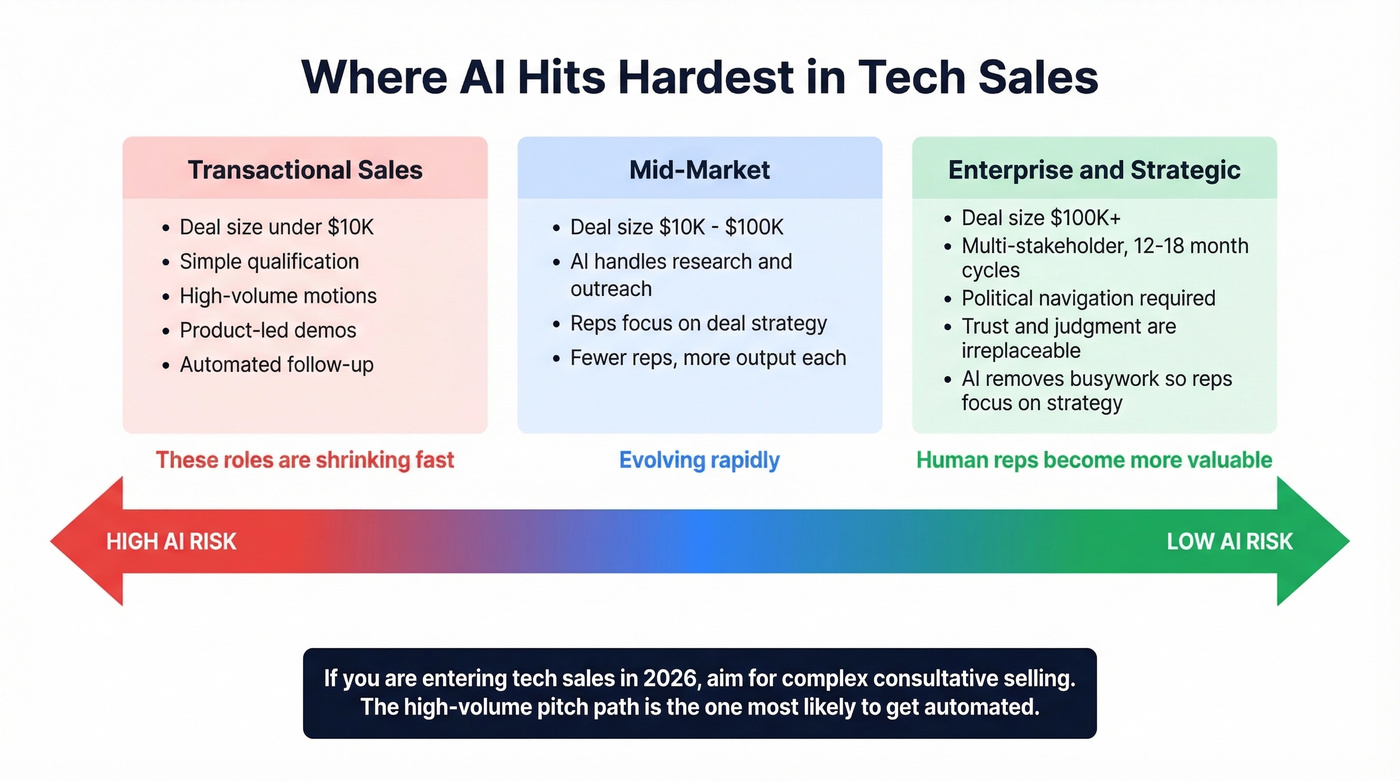
What AI won't replace is strategic relationship selling. Multi-stakeholder enterprise deals with long cycles, political dynamics, and custom procurement still require human judgment, trust, and the ability to navigate messy internal decision-making. SaaStr's take is that some companies are growing sales headcount because AI makes good reps more productive rather than replacing them.
Let's be honest: if your average deal size is under $10K, a lot of orgs won't need a traditional human sales team for much longer. That motion's getting compressed fast. If you're selling $100K+ deals to enterprise buyers, the human rep becomes more valuable because AI takes the busywork off your plate and you spend more time on strategy, stakeholders, and deal control.
Practical takeaway: if you're entering tech sales in 2026, aim for roles that involve complex, consultative selling. The "dial 100 numbers and pitch a $5K product" path is the one most likely to get automated, outsourced, or turned into a smaller team with heavier tooling.

When only 43% of AEs hit quota, pipeline quality isn't optional - it's survival. Prospeo gives tech sales teams 300M+ profiles with 98% email accuracy and 125M+ verified mobile numbers, so every dial and send counts.
Stop burning quota on bad data. Start connecting with real buyers.
Tech Sales Roles Explained
SDR/BDR - The Entry Point
The Sales Development Rep (or Business Development Rep) is where most people start. Your job is to create qualified meetings for AEs.
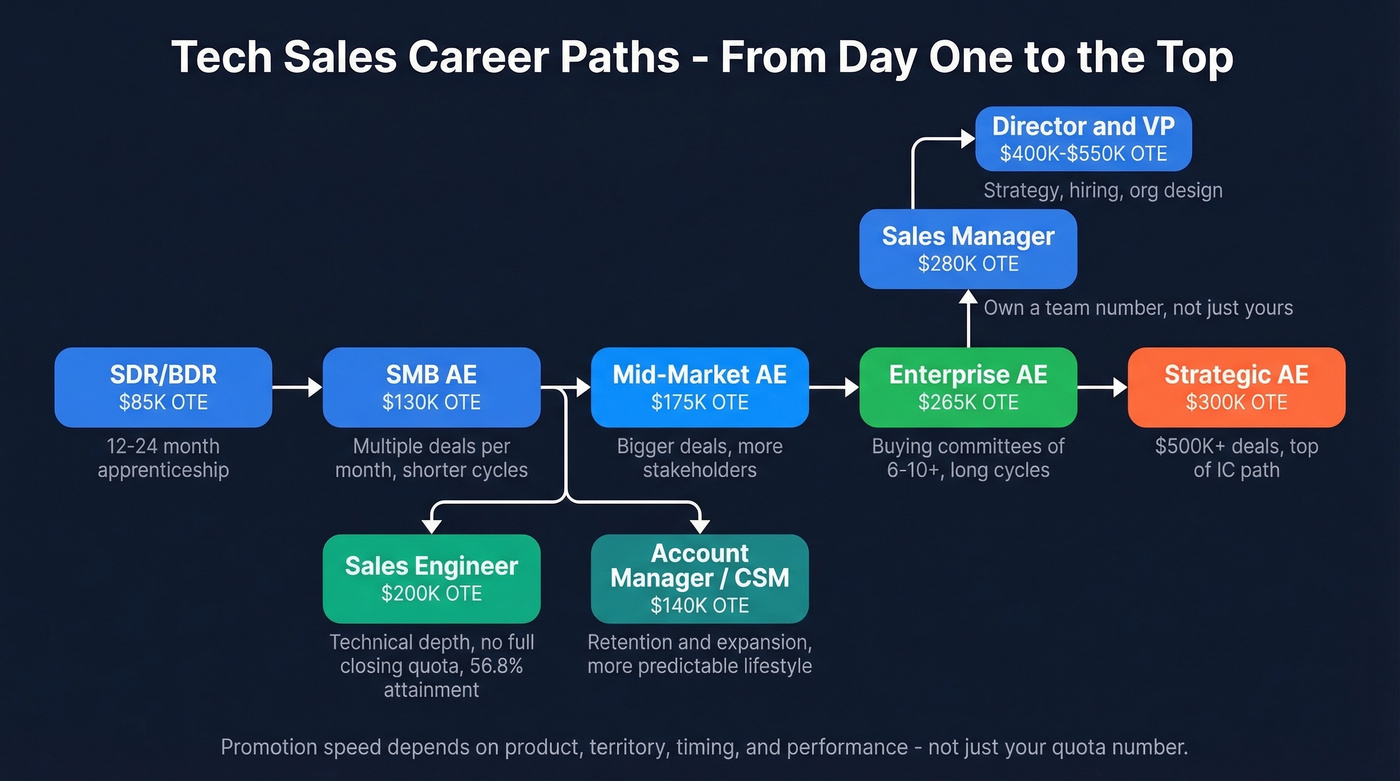
In high-volume orgs, that can mean 50-100 dials a day plus sequences. In targeted enterprise motions, it's fewer dials but more research, tighter account lists, and more coordination with the AE. Either way, it's a proving ground. Treat it like a 12-24 month apprenticeship where you learn the product, the buyer, and the sales motion - then push hard for promotion or move to a company that promotes.
Account Executive - Where the Money Lives
AEs run the full cycle: discovery to close. The ladder usually goes SMB -> mid-market -> enterprise -> strategic, with each step bringing longer cycles, larger deal sizes, and more stakeholders.
At SMB, you might close multiple deals a month with shorter cycles. At enterprise, you're working fewer deals, but each one has a buying committee. Everstage has cited buying committees of 6-10+ stakeholders, and average B2B win rates often sit around 17-20%, which means you lose most of what you work. That's the part that burns people out faster than cold calls: you can do a lot right and still get "no decision" after months of work.
Sales Engineer, AM, and Leadership
Sales Engineers are the under-discussed gem of the industry. With a median OTE of $200K and strong attainment (56.8% in the RepVue snapshot), SEs combine technical depth with sales impact. If you've got technical chops and you don't want to carry a full closing number, this is a great lane.
Account Managers and CSMs focus on retention and expansion. It's less adrenaline than new business, but the lifestyle is more predictable and the skills are durable. Sales Managers are player-coaches at many orgs, and the stress changes shape: you stop owning just your number and start owning a team number.
What Nobody Tells You (But You Should Know Anyway)
We've seen this pattern a lot: someone reads a comp guide, gets excited about $300K OTE, takes an SDR role, and hits a wall inside six months. Here's what the glossy posts leave out.
SDR purgatory is real. Companies overhired SDRs in 2021-2022, and the promotion pipeline is still clogged in plenty of orgs. The reps who get promoted fastest aren't always the ones with the best scripts; they're the ones with the right product, territory, and timing. The consensus on r/techsales is blunt: product, territory, and timing matter more than your pitch. Two SDRs with identical skill can get wildly different outcomes if one has a hot patch and the other has a graveyard.
PIP culture is rampant, and it's infuriating. We've watched reps get put on a performance plan after a single bad month - not a bad quarter, a bad month - even when the broader team was missing. If over half the team misses quota, that's a company problem. But the rep's the one who gets managed out.
Here's a quick scenario we keep seeing: you join a "rocketship" with a big OTE, you ramp for 90 days, and then leadership changes the ICP, splits territories, and raises quota because "the board wants efficiency." Your activity stays high, your skills improve, and your attainment still drops because the inputs changed. That's why you can't evaluate a role on comp alone.
The Modern Sales Tool Stack
Most reps live inside 4-6 tools every day. Some are table stakes. Some are optional.
CRM: Salesforce (roughly $25-165/user/month depending on edition) or HubSpot (free CRM; Sales Hub is typically in the $20-150/user/month range). Salesforce dominates enterprise; HubSpot wins a lot of SMB and mid-market.
Sequencing: Outreach or Salesloft, often around the $100-150/user/month range. This is where cadences live.
Call intelligence: Gong is the big name for recording and coaching, often in that same $100-150/user/month ballpark.
Workflow and enrichment: Clay (pricing varies by credits) and Zapier (free tier plus paid plans) handle the glue work: enrichment, routing, syncing, and automations.
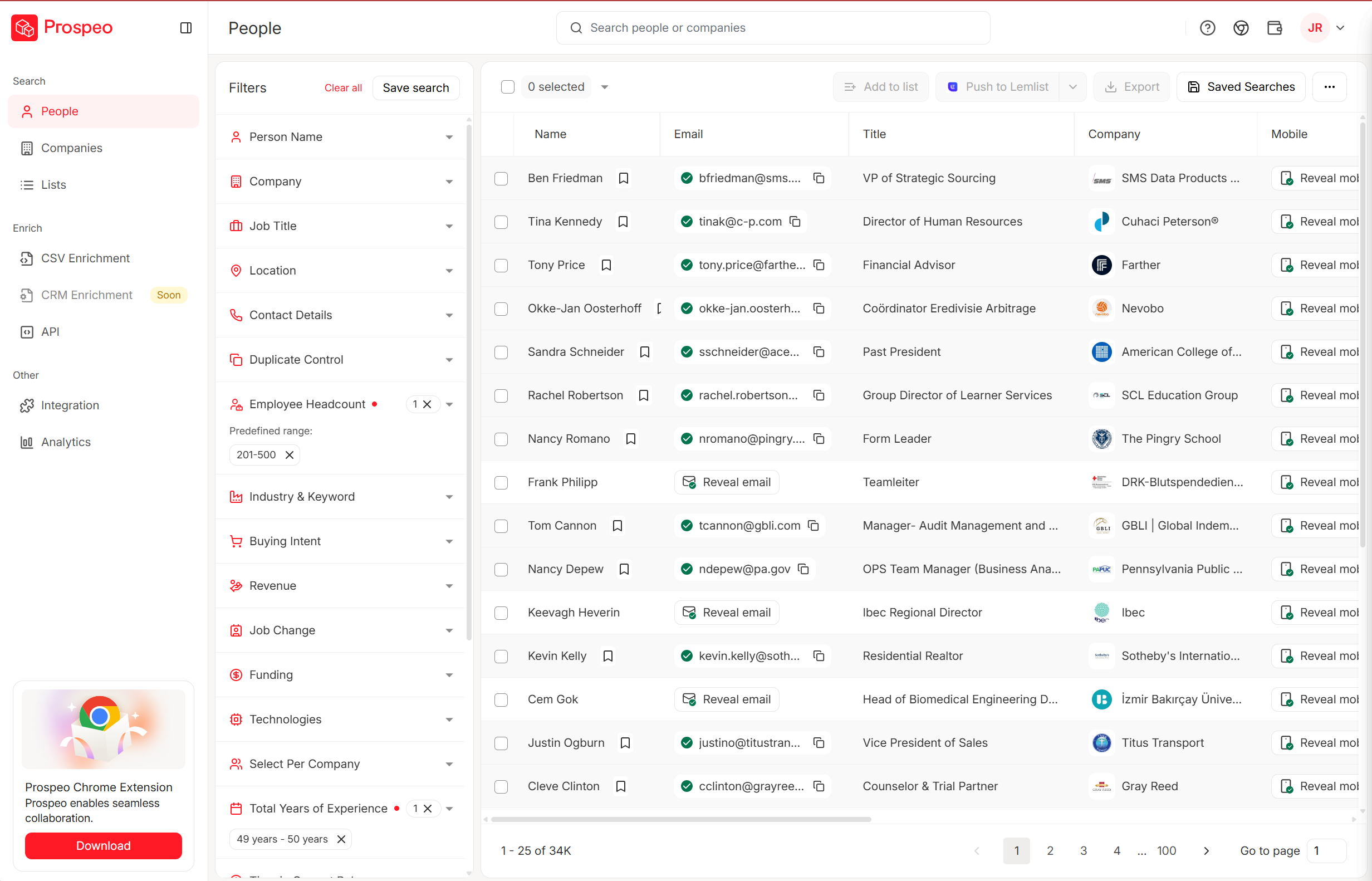
Prospecting data: this is where teams either win quietly or bleed out slowly. Bad data wrecks deliverability, wastes dials, and makes "activity" look high while results stay flat. In our experience, Prospeo is one of the best picks if you care about accuracy and freshness without getting locked into a contract: 300M+ professional profiles, 143M+ verified emails at 98% accuracy, and 125M+ verified mobile numbers, with records refreshed every 7 days (the industry norm is closer to 6 weeks). It's self-serve, credit-based (about $0.01 per email), and there's a free tier.
Skip the fancy stack if you're new. Seriously. If you're an SDR in month one, you don't need ten tools; you need a clean list, a working sequence, and a manager who'll coach you on talk tracks and account strategy.
How to Break Into Tech Sales
Skills That Transfer
You don't need a degree. You need communication skills, comfort with rejection, and the ability to run a structured conversation.
You also need to sound like you understand how B2B buying works. MEDDPICC is one of the most common enterprise qualification frameworks (Metrics, Economic Buyer, Decision Criteria, Decision Process, Identify Pain, Champion, Competition). SPIN and Challenger come up a lot too. You don't need to be a methodology robot, but you should be able to explain how you qualify and why.
The best SDRs we've worked with came from hospitality, retail, teaching, and the military. One rep we worked with went from managing a restaurant to landing an SDR role and was on a $180K OTE AE plan 14 months later at a Series C company. His edge wasn't product knowledge. It was staying calm under pressure and handling objections like it was a Friday-night rush.
Tactical Steps That Actually Work
Target mid-stage SaaS companies (often Series B through D). They've got product-market fit, a real sales process, and enough headcount that promotions happen. Early-stage startups can be great, but the SDR at a 20-person company often ends up doing everything with no clear path up.
Network directly with sales leaders. Cold outreach works because it's literally the job. Don't send a generic "I'd love to learn more" note and call it networking; send a tight message that shows you understand their buyer and can write like a rep.
And yes, video can work. A 60-second personalized video to a VP of Sales can beat a templated email, especially if you keep it specific: who you sell to, why you think their ICP fits your background, and one smart question about their pipeline motion.
Before you reach out, make sure you're emailing the right address. Bounces are a dumb way to lose a first impression, and it's easy to avoid with a verification step.
Finally: prep for role-plays. Most interviews include a mock cold call or discovery. Practice until you can take an objection without panicking and without arguing.
Best Bootcamps for 2026
If you're coming from outside sales, a bootcamp can compress your ramp. These programs are frequently recommended on Course Report:
| Program | Reviews | Rating | Job Guarantee |
|---|---|---|---|
| SV Academy | 226 | 4.80 | Yes |
| Elevate | 163 | 4.75 | - |
| Hyrise Academy | 25 | 4.96 | Yes |
| Vendition | 40+ | 4.60 | Yes |
| Sales Platoon | 19 | 4.95 | Yes |
| School16 | 27 | 4.93 | - |
| Fuel Sales Academy | 22 | 4.45 | - |
Tuition varies a lot. Some programs use a placement model (no upfront cost, then a cut of your first salary). Cohort programs often run $3,000-$10,000+. Self-paced courses are cheaper but offer less structure and fewer warm intros.
One strong opinion from our side: skip a bootcamp if you already have credible closing experience and can get interviews on your own. Put that money into time - daily outreach, role-play practice, and a tight resume - and you'll often get the same outcome without the bill.
Tech Sales vs. Regular Sales
Traditional sales roles like insurance, real estate, auto, or general B2B services share the same fundamentals: prospecting, objection handling, closing. The mechanics diverge fast, though.
SaaS comp is tied to recurring revenue, and orgs tend to have a clearer ladder (SDR -> AE -> enterprise -> leadership). Traditional sales often has faster time-to-commission, but you can feel like you're starting from zero every month, and the ceiling is usually lower unless you're in a top-tier niche.
The tradeoff is complexity. SaaS sales cycles are longer, products are more technical, and you need enough credibility to talk to IT and business stakeholders without sounding lost.
Tech Sales vs. Medical Sales
This comparison comes up constantly.
| Factor | Tech Sales | Medical Sales |
|---|---|---|
| Work model | Mostly remote/hybrid | Mostly in-person |
| Regulation | Light | Heavy (Sunshine Act) |
| Buyer type | IT/business leaders | Clinical/hospital admin |
| AI disruption risk | Higher (transactional) | Lower (relationship) |
| Comp ceiling | Higher but volatile | Lower but more stable |
| Stability | Layoff-prone cycles | More recession-resistant |
For a lot of people, the decision is lifestyle first. If you want remote work and you're comfortable with volatility, tech sales is hard to beat. If you want stability and don't mind being on the road visiting clinics most days, medical sales can be a better fit.
FAQ
Is tech sales hard?
Yes. Quota attainment hovers around 43%, win rates often land in the 17-20% range, and buying committees can include 6-10+ stakeholders. The earning ceiling is high, but the day-to-day is rejection, deal slippage, and quarterly pressure.
Do you need a degree?
No. Most SaaS companies care more about communication, coachability, and consistency than formal education. Bootcamps can help, and plenty of top reps come from hospitality, teaching, retail, and the military.
Can you work remotely?
Yes. Most B2B SaaS sales roles are remote or hybrid. Enterprise AEs may travel for on-sites, but even those roles are often hybrid rather than fully office-based.
What's the best entry-level role?
SDR/BDR at a mid-stage SaaS company with a real track record of promoting SDRs to AE. Ask how many SDRs got promoted in the last 12 months. If the answer's zero or vague, keep looking.
What prospecting tools do reps actually use?
Most reps use a CRM (Salesforce or HubSpot), a sequencing tool (Outreach or Salesloft), call recording/coaching (often Gong), and a data provider for verified emails and direct dials. Prospeo is a strong option for self-serve data because it pairs 98% verified email accuracy with a 7-day refresh cycle and a free tier, and teams can layer workflow tools like Clay and Zapier on top.
Enterprise deals take 12-18 months and run through multi-threaded buying committees. You need direct dials and verified emails for every stakeholder - not guesses. Prospeo's 30% mobile pickup rate and 7-day data refresh keep your contacts current through the entire cycle.
Reach the full buying committee with data that's never more than a week old.