


The Data City: Pricing, Reviews, Pros & Cons (2026)
£8,000 a year for a single seat on a sector classification platform. That's the entry point for The Data City - and for policy teams mapping the UK's emerging economy, it's genuinely worth it. For everyone else, the pricing demands scrutiny.
We've dug into the actual costs, user sentiment, government adoption signals, and the alternatives worth considering so you can decide before committing budget.
30-Second Verdict
Best for: Government policy teams, economic researchers, and innovation agencies with budgets of £8K-£30K/year who need emerging sector classification beyond SIC codes.
Not ideal for: Solo consultants, small teams on tight budgets, or sales teams looking for B2B contact data. If you need verified emails and phone numbers for outbound, you're in the wrong product category entirely - skip to the alternatives section.
Price range: £8,000-£30,000/year before add-ons.
What Is The Data City?
The Data City is a UK-focused data-as-a-service platform that classifies companies using AI-driven Real-Time Industrial Classifications (RTICs) instead of the UK's outdated SIC codes, which haven't been updated since 2007. It covers the UK business base of over 9 million companies and start-ups, with 500+ emerging economy sector classifications - including areas like quantum technologies, genomics, and other sectors that simply don't exist in the SIC taxonomy.
Think of it as a lens for seeing the economy the way it actually works today, not the way it was categorized two decades ago.
Full Pricing Breakdown
The Data City publishes transparent pricing on their pricing page, which is refreshingly rare for this category.
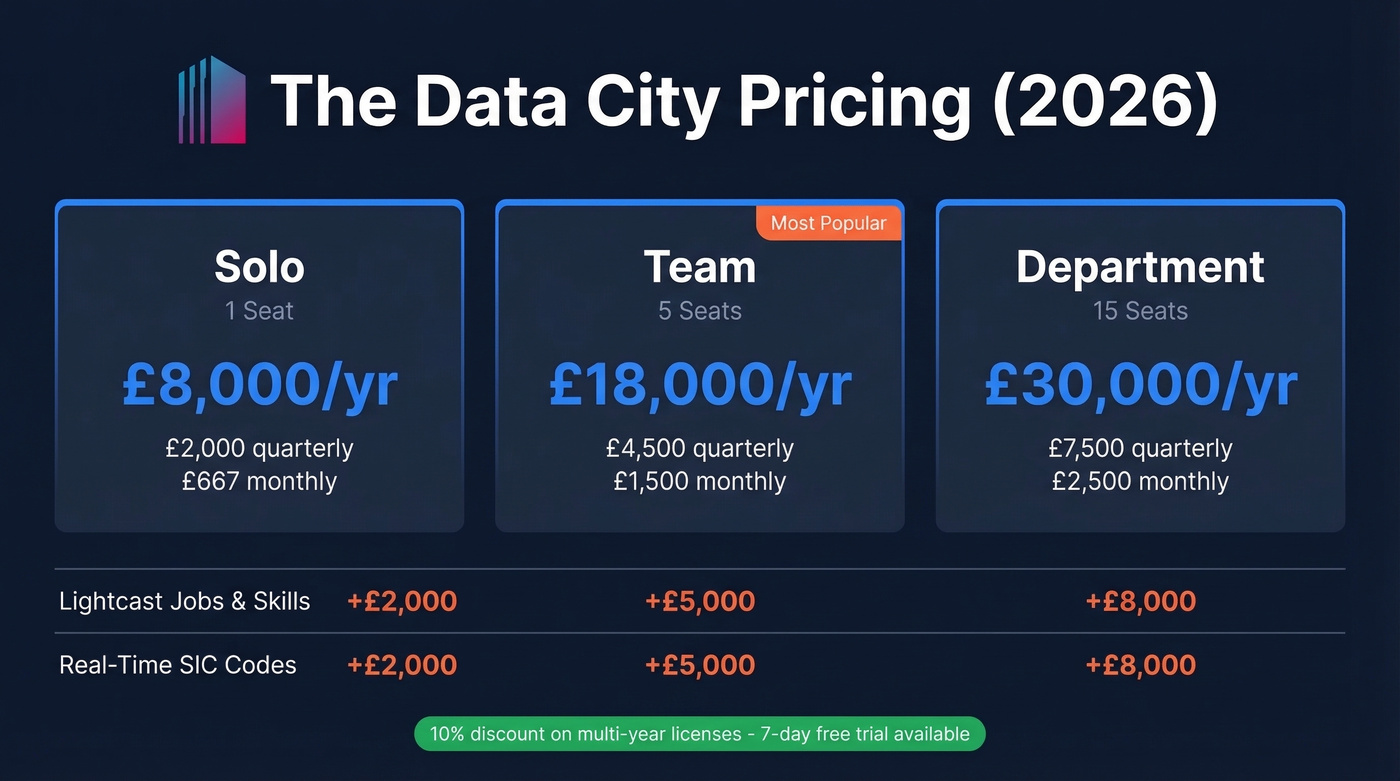
| Plan | Seats | Annual | Quarterly | Monthly |
|---|---|---|---|---|
| Solo | 1 | £8,000 | £2,000 | £667 |
| Team | 5 | £18,000 | £4,500 | £1,500 |
| Department | 15 | £30,000 | £7,500 | £2,500 |
Add-ons scale with your plan tier:
| Add-On | Solo | Team | Department |
|---|---|---|---|
| Lightcast Jobs & Skills | +£2,000 | +£5,000 | +£8,000 |
| Real-Time SIC Codes | +£2,000 | +£5,000 | +£8,000 |
Multi-year licenses get a 10% discount. Cluster projects - bespoke sector mapping and analysis - start from £20,000. A Team plan with both add-ons runs £28,000/year; lock in a multi-year deal and that drops to £25,200. Still serious money, but in line with typical UK private-company intelligence tools for similar seat counts.
There's a 7-day free trial with a one-to-one demo included. Use it.

£8,000/year gets you sector classifications. $0.01/email gets you verified contact data for the people inside those sectors. Prospeo covers 300M+ profiles with 98% email accuracy and a 7-day refresh cycle - no annual contracts, no "contact sales" gates.
Start with 75 free emails. No credit card required.
Pros and Cons
Pros
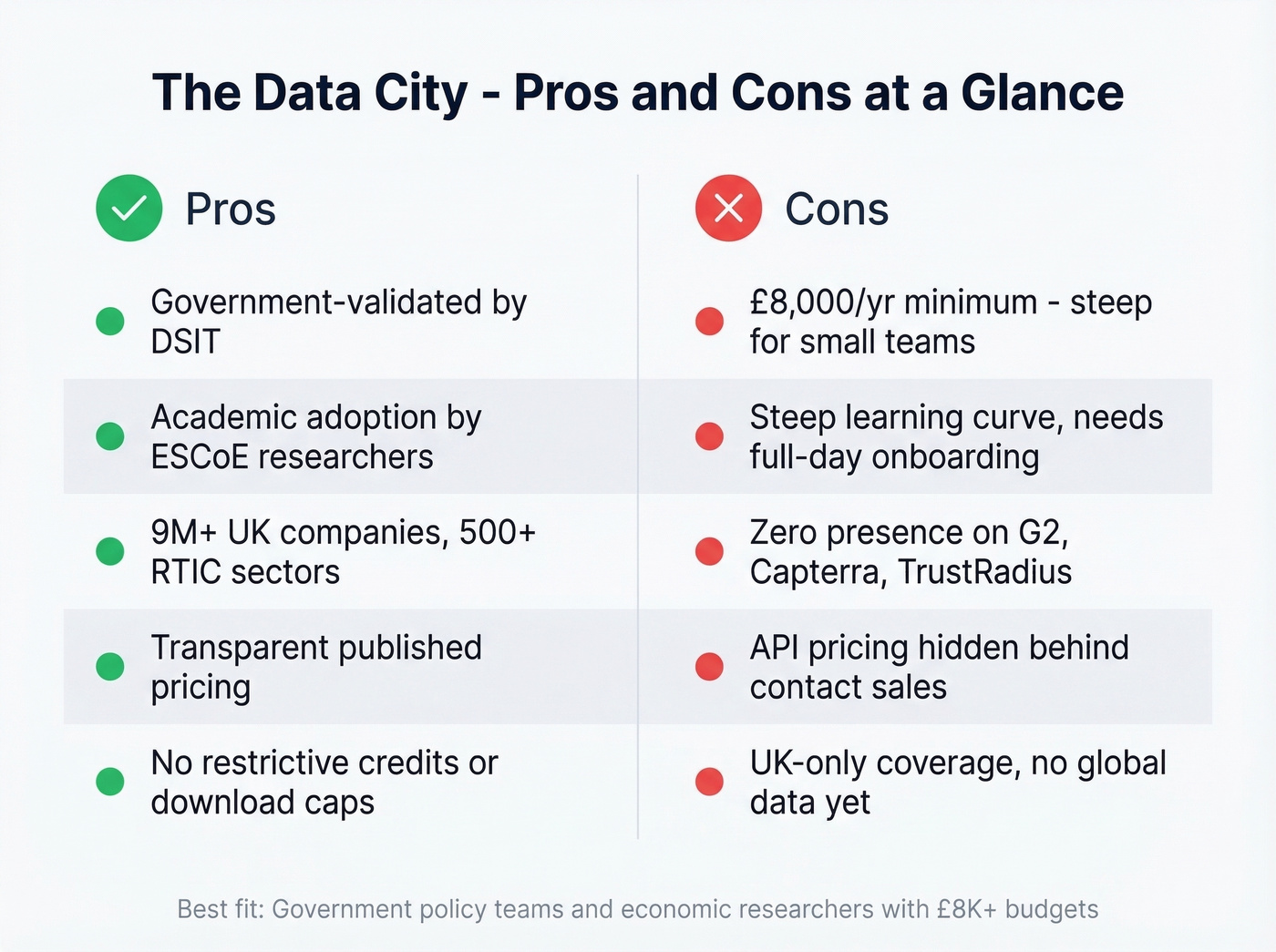
- Government-validated methodology. DSIT's Innovation Clusters Map explicitly uses The Data City's RTIC sectors for emerging areas that SIC codes can't capture. That's about as strong a credibility signal as you'll find.
- Independent academic adoption. ESCoE researchers built a dataset of 200,000+ companies across 385 sub-sectors using these classifications - real research infrastructure, not just a vendor claim.
- Serious investor backing. Oxford Economics put £2M in at a £19M post-money valuation, with a planned US joint venture announced alongside the investment.
- Strong UK coverage. A University of Birmingham comparison puts The Data City's coverage at 5,107,631 UK businesses versus Red Flag Alert's 2,350,895. More than double the coverage matters when you're mapping niche sectors.
- No restrictive credits or download caps. Generous limits that won't hit a paywall mid-analysis.
- ML-powered list building that works. CPI's case study describes feeding example companies into the platform and getting curated lists in niches like genomics, proteomics, and liquid biopsy - lists that helped them win projects and support regional funding bids.
- Transparent published pricing in a space where "contact sales" is the norm.
Cons
- £8,000/year minimum prices out small teams. A solo consultant simply can't justify this for occasional sector research.
- Steep learning curve. The Birmingham comparison notes the platform is "complicated to learn all its features." Budget a full day for onboarding, minimum.
- No presence on review aggregators. No G2, no Capterra, no TrustRadius. For a product at this price point, that's a gap buyers will notice.
- API and RTIC licensing pricing is opaque. Despite otherwise transparent pricing, API access is "contact sales" - frustrating when everything else is published.
- UK-focused only. No global coverage yet, though the Oxford Economics partnership hints at North America expansion.
User Reviews and Sentiment
The Data City has a 3.7/5 on Trustpilot based on a single review, which praises "excellent customer service" and "reliable and high-quality data." One review isn't statistically meaningful, and the platform is absent from G2, Capterra, and TrustRadius entirely.
Here's the thing: platforms at this price point that lack review aggregator presence tend to sell almost exclusively through enterprise and government procurement cycles. The government and academic adoption signals carry more weight here than star ratings. In our experience evaluating niche data tools, institutional validation like DSIT adoption is a stronger buying signal than a handful of G2 reviews anyway.
Alternatives to Consider
| Tool | Best For | UK Coverage | Starting Price | Reviews |
|---|---|---|---|---|
| The Data City | Emerging sector mapping | 9M+ companies | £8,000/yr | 3.7/5 (1 review) |
| Beauhurst | Private company intelligence | Broad | ~£10,000/yr | 4.6/5 (31 reviews) |
| Red Flag Alert | Credit risk monitoring | 2.35M | ~£5,000/yr | Not public |
| Glass.AI | Signal tracking at scale | Broad | ~£15,000/yr | Not public |
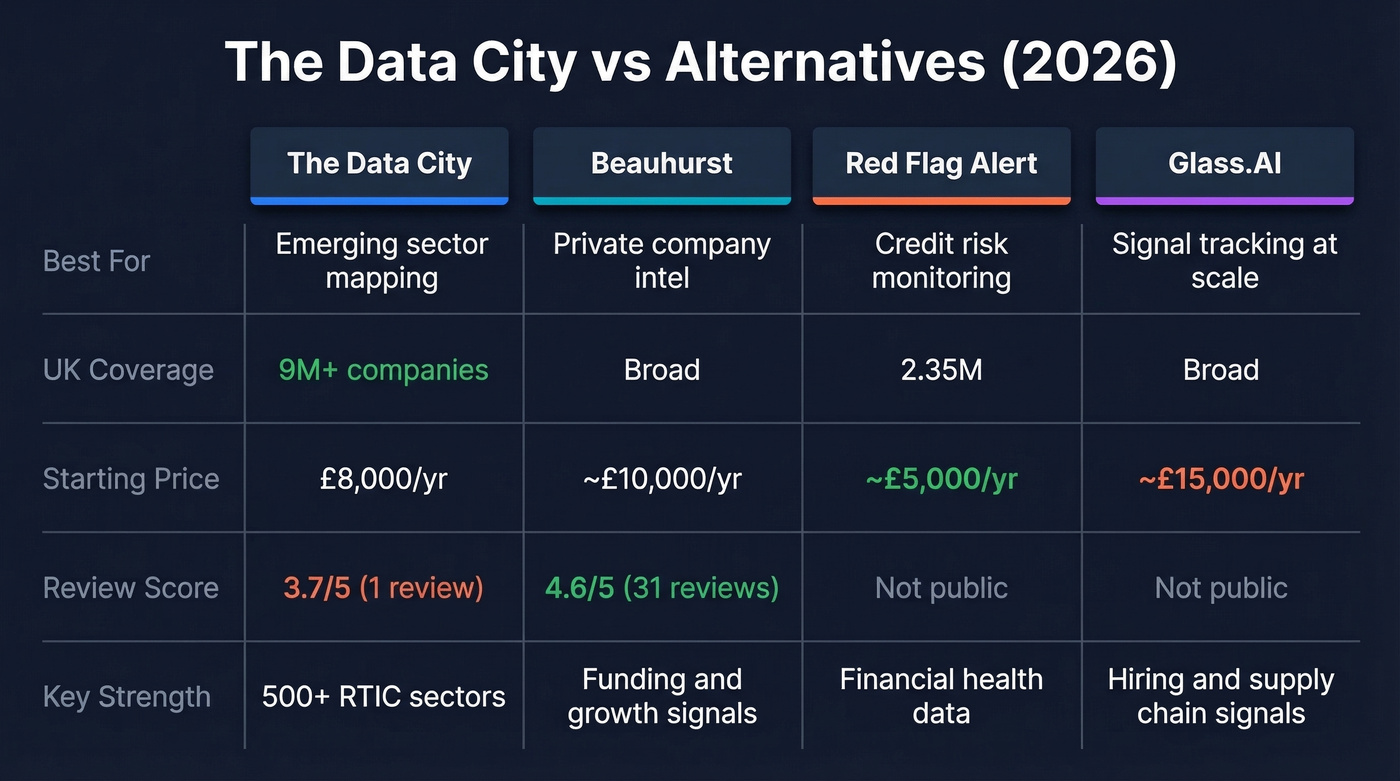
Beauhurst is the closest direct competitor, covering private company intelligence - funding rounds, C-level changes, growth signals - with a 4.6/5 on G2 from 31 reviews. If you need company-level intelligence more than sector classification, Beauhurst is the stronger pick. Expect ~£10K-£30K+/year.
Red Flag Alert focuses on financial health monitoring and credit risk. It covers 2.35M UK businesses, is easier to learn, and is typically more affordable. Different use case, simpler tool.
Glass.AI tracks company signals - hiring trends, funding, product launches, supply chain moves. Worth evaluating if you need signal tracking more than sector taxonomy. Expect ~£15K-£60K+/year for enterprise.
Different Category Entirely: B2B Contact Data
If you landed here looking for verified B2B contact data for sales outreach, you're in the wrong product category. The Data City classifies sectors; it doesn't give you a VP of Sales' email address. Prospeo covers 300M+ professional profiles with 98% email accuracy and a 7-day data refresh cycle - 75 free emails/month, no annual contract required.
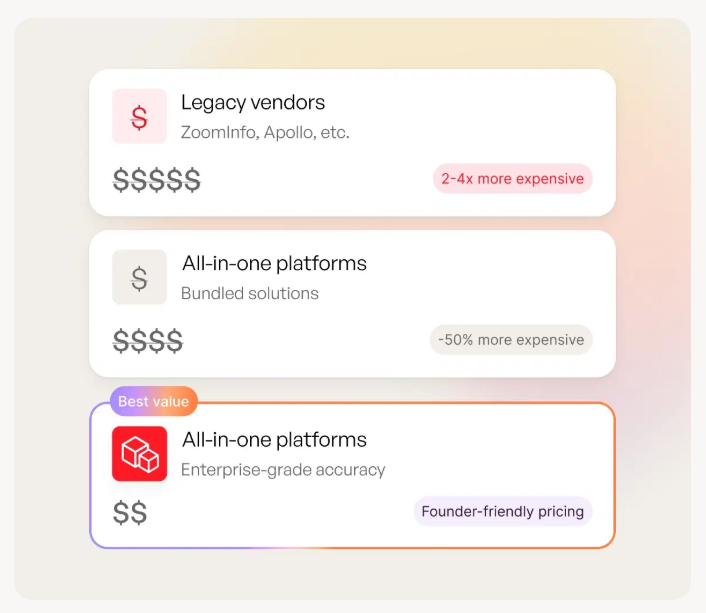
If you're evaluating The Data City for outbound sales, stop. It classifies industries - it doesn't find buyers. Prospeo gives you verified emails, 125M+ direct dials, and 30+ filters including intent data across 15,000 topics. That's how teams book 35% more meetings than Apollo users.
Find decision-makers, not sector taxonomies.
Is The Data City Worth It in 2026?
For government policy teams, economic development agencies, and research groups with three or more analysts, The Data City fills a gap that no other platform covers as well. RTICs are genuinely useful, the methodology has government and academic validation, and the coverage numbers are strong.
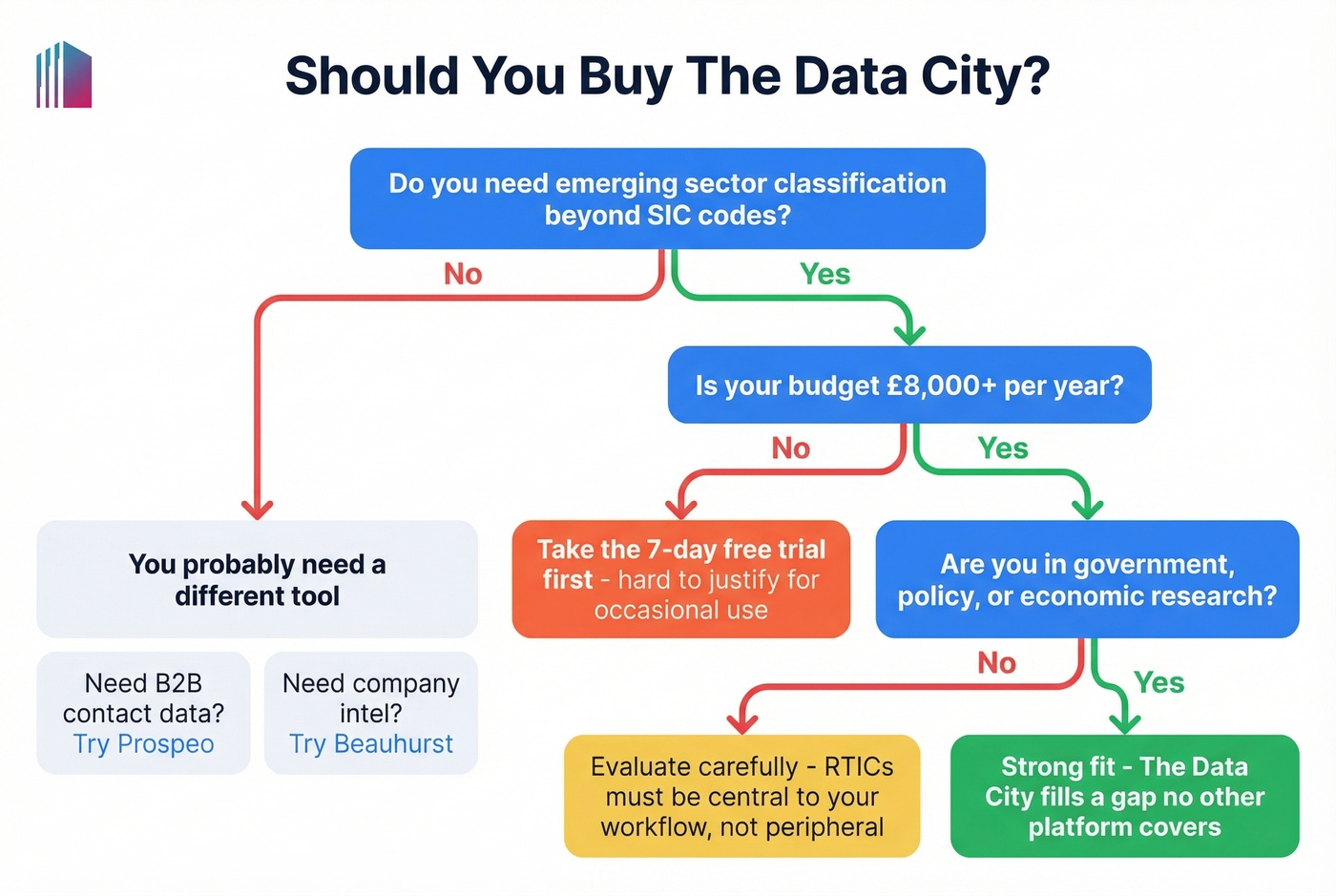
Let's be honest though: the platform is overpriced for what most buyers actually need. If you're not writing policy reports or mapping emerging sectors for government funding decisions, you're paying £8K+ for a classification layer you could approximate with Companies House data and manual research. It earns its price only when RTICs are central to your workflow - not peripheral.
For solo consultants or teams under budget pressure, £8,000/year is steep for a niche tool. Take the 7-day free trial before committing. It's the fastest way to know if the platform fits your workflow or if you're paying for capability you'll barely touch.
FAQ
Is The Data City worth £8,000 a year?
For policy teams and economic researchers who rely on emerging sector classifications daily, yes - no other platform matches its RTIC coverage of 500+ sectors across 9M+ UK companies. Solo consultants doing occasional research should explore the 7-day free trial first, as the annual commitment is hard to justify for intermittent use.
How does The Data City compare to Beauhurst?
The Data City specializes in AI-driven sector classification (RTICs), while Beauhurst focuses on private company intelligence - funding rounds, leadership changes, and growth signals. Beauhurst has stronger review presence (4.6/5 on G2, 31 reviews) and similar pricing (~£10K-£30K/year). Choose based on whether you need sector taxonomy or company-level tracking.
Does The Data City provide B2B contact data?
No. The Data City classifies companies into sectors - it doesn't provide emails, phone numbers, or individual contact details. For verified B2B contact data, tools like Prospeo with 300M+ profiles and 98% email accuracy are the right category.
What are the main drawbacks of The Data City?
The £8,000/year minimum is prohibitive for small teams, the learning curve is steep, and the platform has virtually no presence on review sites like G2 or Capterra. API and RTIC licensing costs are also hidden behind "contact sales," which undermines the otherwise transparent pricing model.