

Unique Click Rate: Definition, Benchmarks, and How to Actually Improve It
You're staring at your Monday morning dashboard. Opens look great - 45%, maybe higher. But clicks? Stuck at 2.3%, same as last month. A B2B marketer on r/Emailmarketing described this exact frustration: strong opens, a unique click rate "always ~2-3%," no idea what to change. The gap between opens and clicks is where most email programs quietly die.
The problem isn't always your content. Sometimes it's your data, sometimes it's bots, and sometimes it's that you're benchmarking against the wrong number entirely. Let's fix all three.
The Short Version
- The formula: Unique clicks / recipients who received the message x 100. Some ESPs use "sent" or "delivered" as the denominator - just make sure you know which one you're looking at.
- Real benchmarks: Campaign average is 1.69%. Automated flow average is 5.58%. That "2-5% is good" range everyone quotes is lazy - it blends two completely different email types.
- The thing nobody tells you: Bot clicks can inflate your number by a low double-digit percentage. When Brevo enabled bot filtering on their own newsletter, CTR dropped 9.4%. If your ESP recently updated its filtering, your "drop" is actually your real rate showing up for the first time.
What Is Unique Click Rate?
Unique click rate measures how many individual recipients clicked at least one link in your email or SMS, expressed as a percentage of messages received. One subscriber clicking three different links still counts as one unique click. Three total clicks, one unique.
Think of it as reach vs. depth. Unique clicks tell you how many people engaged. Total clicks tell you how deeply they engaged. For most campaign-level reporting, the unique number is the one that matters - it answers "what percentage of my audience took action?"
This applies to SMS too, not just email. Klaviyo's glossary defines unique clicks across both channels. The practical difference is that SMS should have one CTA link, period. Email can handle up to three CTAs before engagement starts diluting - more than three and you're asking the reader to make decisions instead of taking action.
Click Rate vs. CTR vs. CTOR
Every ESP defines "click rate" differently, and none of them bother to explain which denominator they're using.
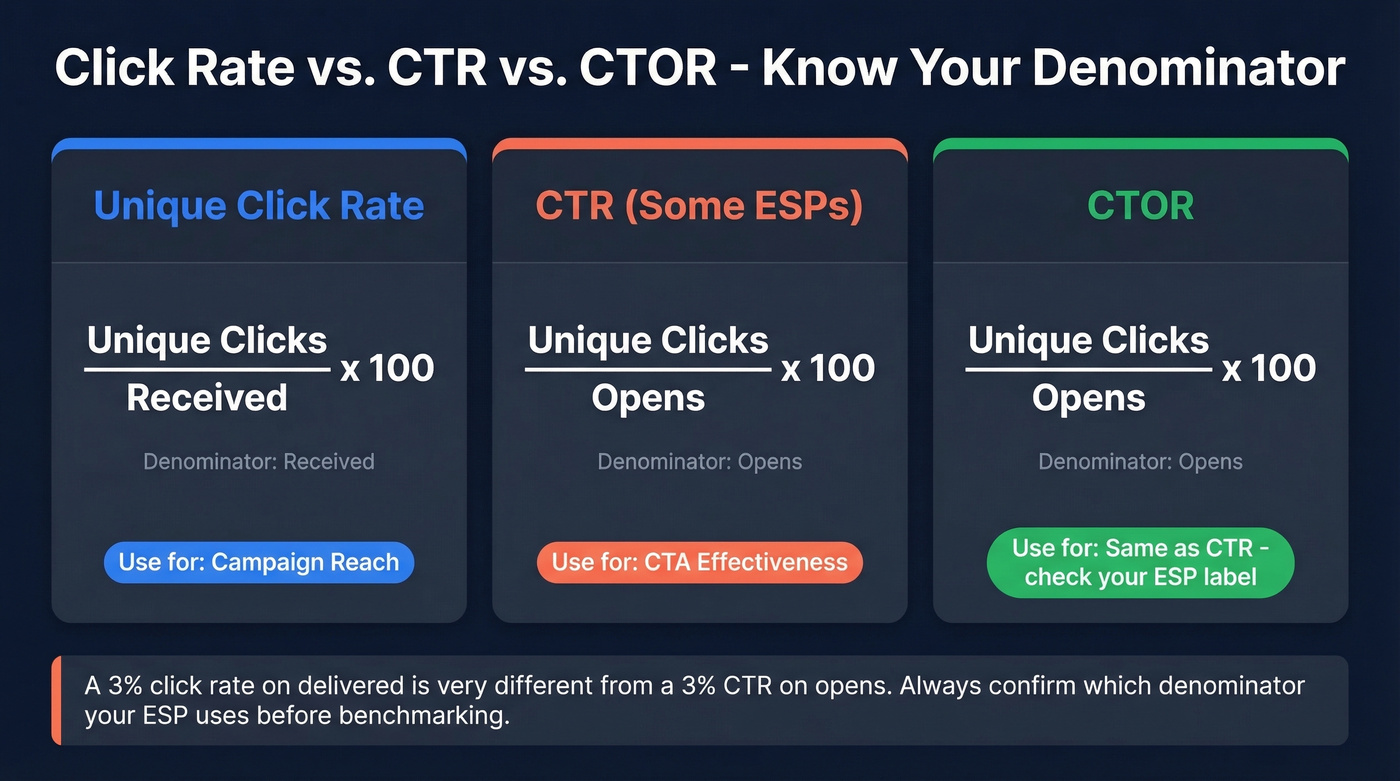
This is genuinely frustrating if you're trying to compare performance across platforms. A HubSpot community accepted solution defines click rate as clicks divided by delivered emails, and click-through rate as clicks divided by opens. Mailchimp treats click rate and click-through rate as interchangeable - "technically the same metric" - then separately reports "clicks per unique opens." Same concept, different label. When someone references a unique click through rate, they almost always mean clicks divided by delivered or received, not opens.
| Metric | Formula | Denominator | When to Use |
|---|---|---|---|
| Unique Click Rate | Unique clicks / Received x 100 | Received | Campaign reach |
| CTR (some ESPs) | Unique clicks / Opens x 100 | Opens | CTA effectiveness |
| CTOR | Same as above | Opens | Same - check your ESP's label |
Before you benchmark anything, confirm which denominator your ESP uses. A "3% click rate" on delivered is very different from a "3% CTR" on opens.

Your unique click rate can't improve if half your list never receives the email. Prospeo's 98% email accuracy and 7-day data refresh mean fewer bounces, cleaner lists, and clicks from real humans - not dead addresses inflating your denominator.
Stop optimizing CTAs on a list full of bad emails.
2026 Benchmarks by Industry
The "2-5% is a good click rate" advice floating around the internet is useless without context. A 2% rate on a broadcast campaign is above average. A 2% rate on an abandoned cart flow is terrible.
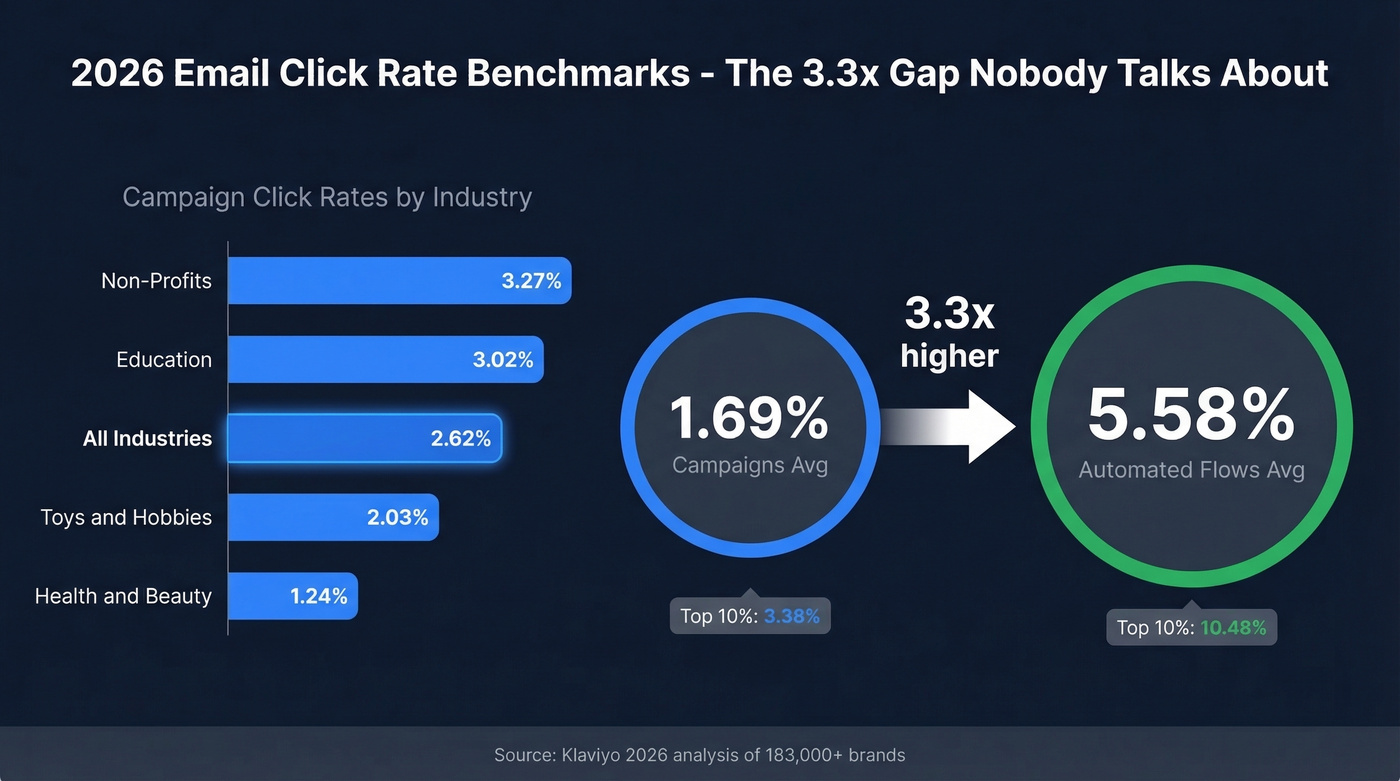
Klaviyo analyzed 183,000+ brands for their 2026 benchmarks. Mailchimp scanned billions of emails across campaigns sent to 1,000+ subscribers.
Campaign click rates by industry:
| Industry | Klaviyo Avg | Klaviyo Top 10% | Mailchimp Avg |
|---|---|---|---|
| All Industries | 1.69% | 3.38% | 2.62% |
| Toys & Hobbies | 2.03% | - | - |
| Electronics | 1.85% | - | - |
| Education & Training | - | - | 3.02% |
| Non-Profits | - | - | 3.27% |
| Ecommerce | - | - | 1.74% |
| Health & Beauty | 1.24% | - | - |
Now here's the number that actually matters:
| Email Type | Avg Click Rate | Top 10% |
|---|---|---|
| Campaigns | 1.69% | 3.38% |
| Automated Flows | 5.58% | 10.48% |
That's a 3.3x gap. Automated flows crush campaigns because they're triggered by behavior - the recipient already did something that signals intent. If you're only running campaigns and wondering why your numbers are "low," you're comparing yourself to the wrong benchmark.
One more thing the benchmarks won't tell you: timing matters. Early emails in a sequence consistently outperform later ones due to novelty, and seasonal patterns shift engagement significantly - a "low" rate in December might be perfectly normal for your vertical. Don't panic-optimize based on a single month.
Why Your Numbers Are Probably Wrong
Here's the thing: your click performance probably improved recently. You just can't see it because your ESP started filtering bots.
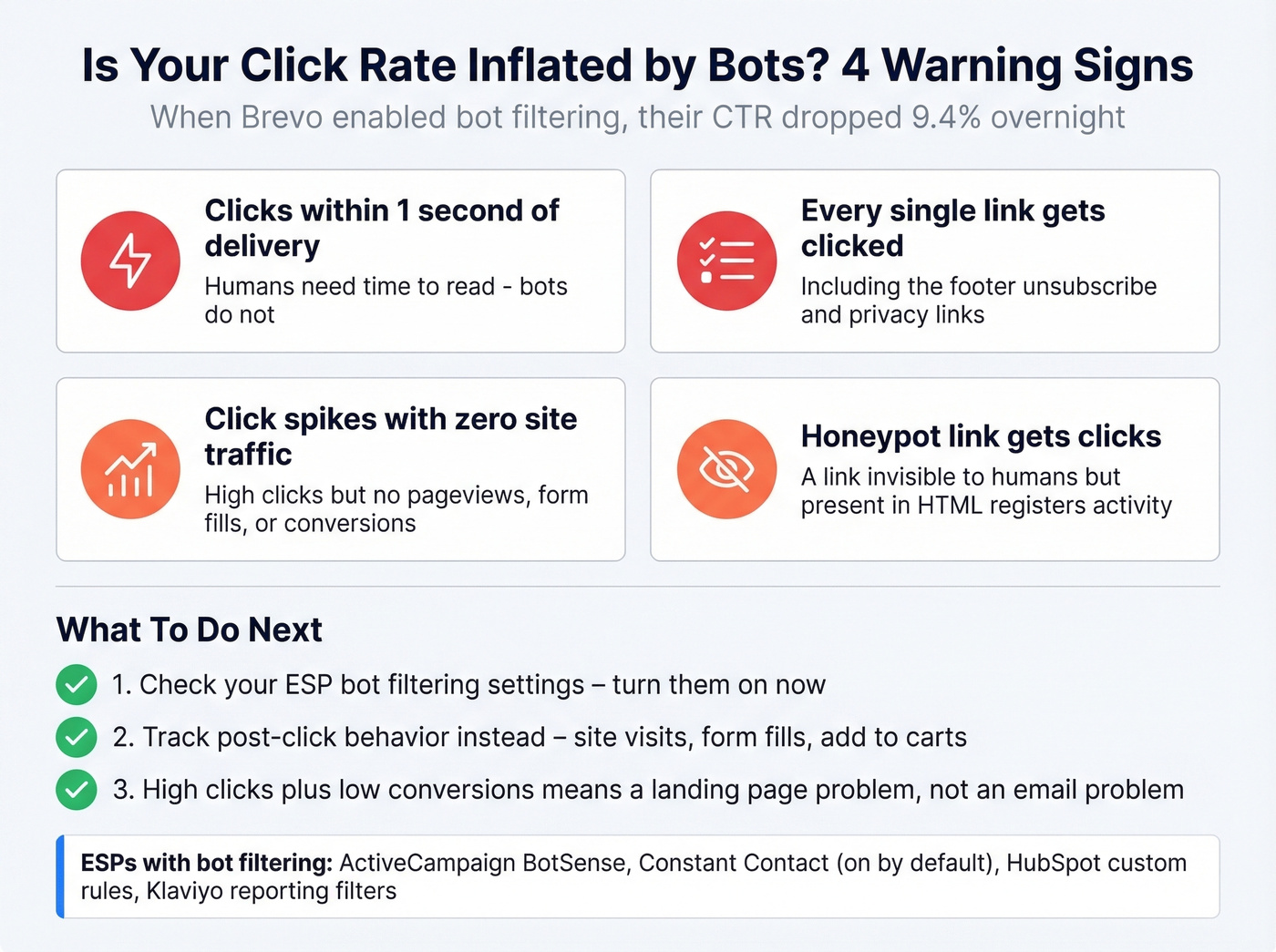
A marketer on r/marketingcloud reported a cliff-like drop in clicks starting September 2024, suspecting their ESP had changed how it filters bot clicks. When Brevo enabled bot filtering on their own newsletter, CTR dropped 9.4%. That's not a performance decline - that's reality showing up.
Security scanners auto-click every link in your email to check for phishing. They inflate your unique click count, break A/B tests, and can even trigger automations incorrectly. We've seen lists where bot clicks accounted for over half of reported engagement - the "real" rate was buried underneath.
Four signals you've got a bot problem:
- Clicks within 1 second of delivery
- Every link in the email gets clicked, including the footer
- Click spikes with zero corresponding site traffic or conversions
- A hidden "honeypot" link - invisible to humans but visible in the HTML - registers clicks
On top of bots, Apple Mail Privacy Protection makes opens unreliable by preloading tracking pixels. Apple's Link Tracking Protection can also strip UTMs, breaking your campaign attribution entirely. Twilio cites a study where 77% of marketers believe Apple MPP activates automatically - it doesn't, users must opt in - but enough have opted in that your open data is directionally useful at best.
If bots are inflating your clicks, track what happens after the click instead. Site visits via UTMs, form fills, add-to-carts - these can't be faked. High clicks paired with low conversions usually signals a landing page problem, not an email problem. The click did its job; something downstream didn't.
Check your ESP's bot filtering settings. ActiveCampaign's BotSense (Pro/Enterprise) filters bot activity in some reports but not workflow triggers. Constant Contact filters by default. HubSpot supports known-bot filtering plus custom rules (not retroactive). Klaviyo can filter bot clicks in reporting and attribution views. If you haven't turned these on, your "real" engagement is lower than what you see - and that's actually good news, because now you can measure what's actually working.
How to Improve Your Unique Click Rate
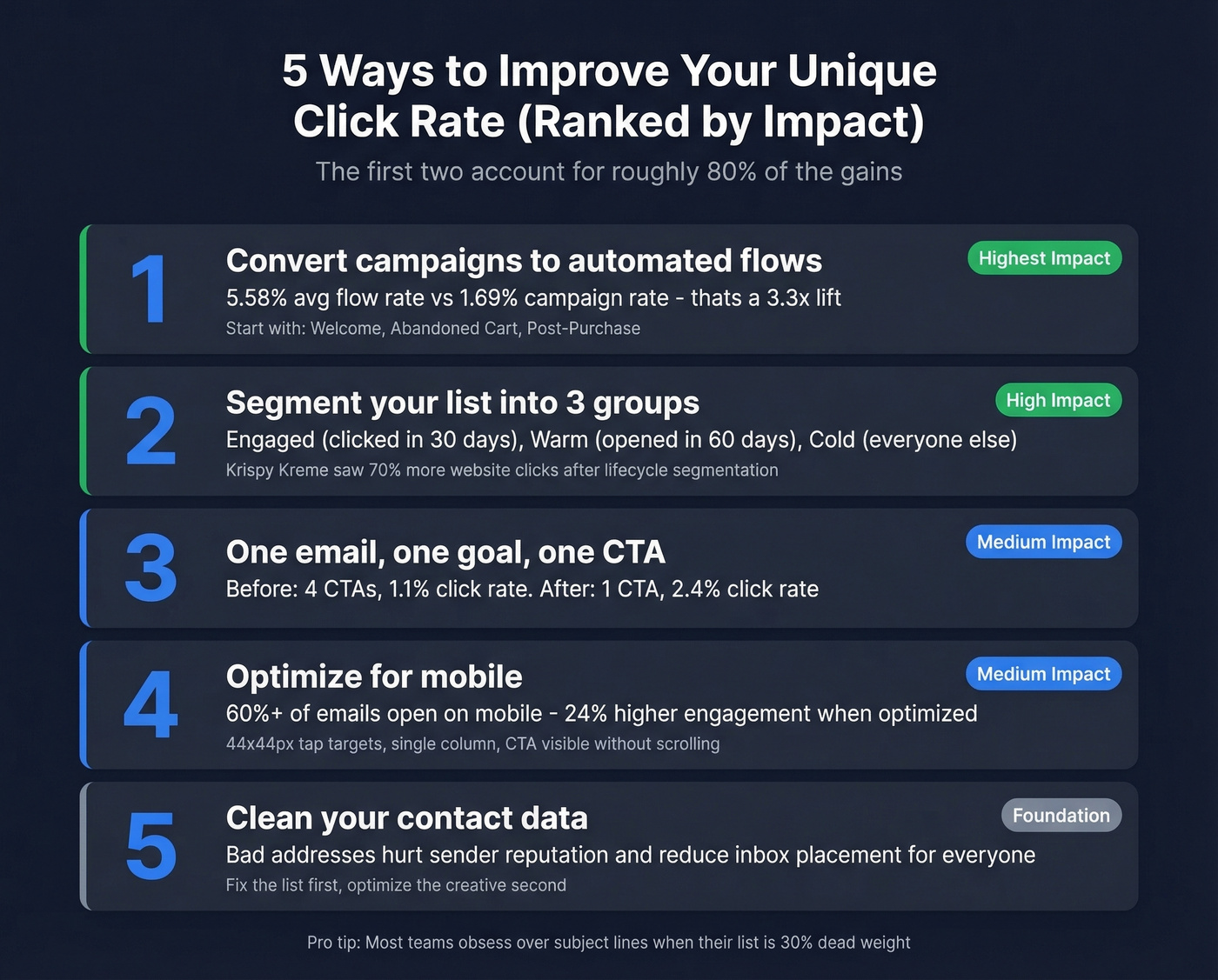
Five tactics, ordered by impact. In our experience, the first two account for 80% of the gains.
1. Convert campaigns to automated flows
Flows average 5.58% click rate vs. 1.69% for campaigns - a 3.3x lift. Welcome sequences alone generate 4x more opens and 10x more clicks than standard campaigns. If you're still batch-and-blasting your entire list weekly, this is the single highest-impact change you can make. Start with three flows: welcome, abandoned cart, and post-purchase. You can build all three in a weekend.
2. Segment your list
Krispy Kreme saw 70% more website clicks after implementing lifecycle segmentation. You don't need 47 micro-segments. Start with three: engaged (clicked in last 30 days), warm (opened in last 60), and cold (everyone else). Send different content to each. Segmented campaigns deliver up to 50% more clicks than batch sends, and the setup takes an afternoon, not a quarter.
3. One email, one goal
Here's a before/after that makes this concrete:
- Before: A newsletter with a product announcement, a blog link, a webinar invite, and a survey. Four CTAs competing for attention. Click rate: 1.1%.
- After: Same newsletter stripped to one announcement with one button. Click rate: 2.4%.
Emails with a single objective achieve 20% higher CTR. Pick the one thing you want the reader to do. Remove everything else.
4. Mobile optimization
Over 60% of emails open on mobile, and mobile-optimized emails see 24% higher engagement. Run through this before every send: single-column layout, buttons instead of text links with minimum 44x44px tap targets, preview text that doesn't get cut off at 35 characters, images under 100KB, and CTA visible without scrolling. Skip this if your audience is 80%+ desktop (check your ESP's device report) - but that's rare outside enterprise B2B.
5. Clean your contact data
Bad addresses don't click - and too many bounces hurt your sender reputation, which reduces inbox placement for everyone else on the list. Clean data improves deliverability, and deliverability is what makes click engagement possible in the first place. Prospeo's 5-step email verification catches bad addresses, spam traps, and catch-all domains with 98% accuracy, and the free tier covers 75 verifications per month.
Look - most teams obsess over subject lines and send times when their list is 30% dead weight. You can write the best email in the world. If a third of your "audience" is invalid addresses and spam traps, your numbers will never move. Fix the list first. Optimize the creative second.
Benchmarks only matter when your data is clean. Teams using Prospeo cut bounce rates from 35%+ to under 4% - which means every click in your dashboard is a real person taking action, not a ghost on a stale list.
Clean data is the click rate hack nobody talks about.
FAQ
What's a good unique click rate for email?
Klaviyo's 2026 benchmarks across 183,000+ brands put campaign averages at 1.69%, with top performers hitting 3.38%. Automated flows average 5.58%, top 10% reaching 10.48%. Anything above 2% on campaigns is solid; aim for 5%+ on behavioral flows.
What's the difference between unique clicks and total clicks?
Unique clicks count each recipient once, measuring reach. Total clicks count every click from every person, measuring engagement depth. One subscriber clicking five links equals one unique click and five total clicks. Use unique clicks for audience-level reporting; use total clicks to evaluate link placement and content interest.
Do bot clicks affect unique click rate?
Yes - significantly. Security scanners auto-click every link, inflating counts. When Brevo enabled bot filtering, their CTR dropped 9.4%. Check your ESP's filtering settings and watch for instant clicks or all-links-clicked patterns. A hidden honeypot link is the fastest way to confirm bots are in your data.
How does cleaner data improve click rates?
Invalid addresses inflate your denominator without generating any clicks, dragging down your rate. Cleaning your list removes that dead weight, and it also protects sender reputation - which means better inbox placement for the contacts who actually want to hear from you. The compounding effect is real: fewer bounces, better reputation, more inbox delivery, higher clicks.