

10 Upsell Techniques That Move Revenue (Not Just Metrics)
Selling to existing customers converts at 60-70%. Selling to new prospects? 5-20%. Yet most teams pour 80% of their energy into acquisition and treat upselling like an afterthought - no systemized upsell techniques, no checkout optimization, no upgrade emails anyone actually wrote. That gap is where 10-30% of your revenue sits, uncollected.
The Short Version
You don't need 16 techniques. You need three that are systemized, measured, and iterated on.
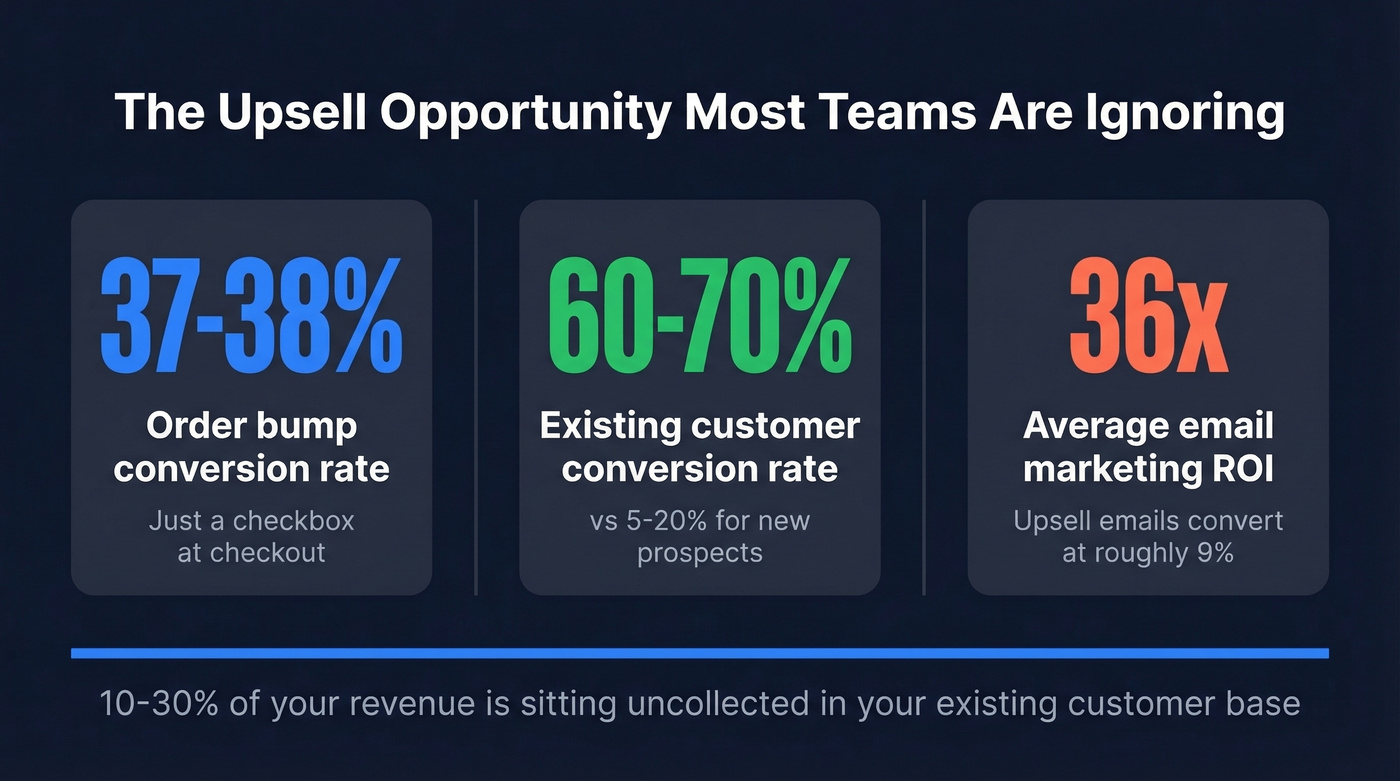
- Add an order bump at checkout. They convert at 37-38%.
- Launch a post-purchase email sequence. Email marketing averages 36x ROI, and upsell emails convert around 9%.
- Set usage-based triggers for your top 20% of customers - the ones bumping against plan limits who nobody's reaching out to.
Everything else is optimization. The rest of this guide gives you the data, psychology, scripts, and measurement framework to build a full upsell system.
Upselling vs. Cross-Selling
These get conflated constantly, and the distinction matters for how you structure offers. Upselling is a vertical move - pushing a customer to a higher tier, a bigger package, or a premium version of what they already want. Cross-selling is horizontal: adding a complementary product alongside the original purchase.
Use 25% as your ceiling. If the upsell pushes the total more than ~25% above the original price, you need stronger justification or a different offer. Beyond that threshold, you're not upselling - you're reselling, and the psychology shifts entirely.
Why Upselling Works
Every upselling guide tells you to "understand your customer's needs." Sure. But what do you actually say? What triggers the yes? Five well-documented principles do the heavy lifting.
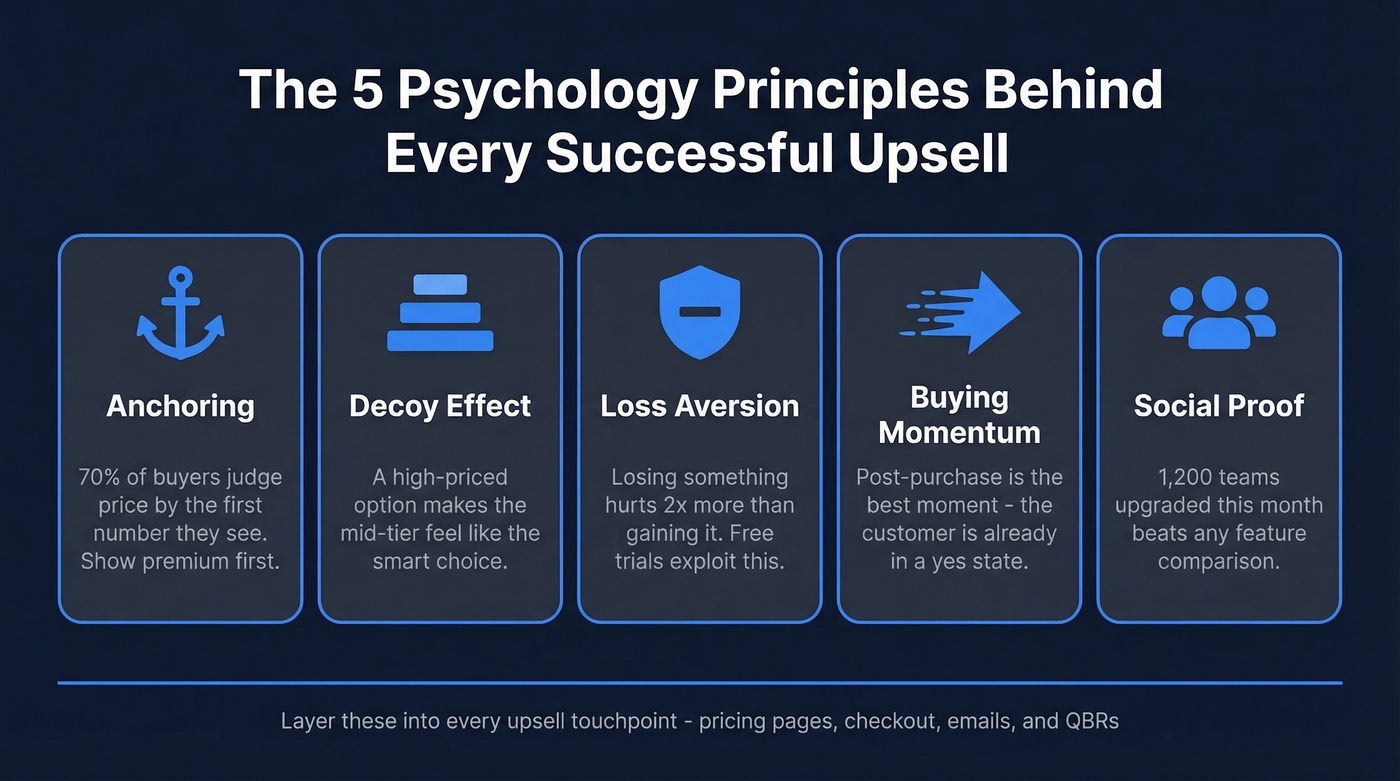
Anchoring is the foundation. Around 70% of consumers use the first price they see as a reference point for everything that follows. Show the premium tier first, and the mid-tier feels reasonable by comparison. Teams that present premium options before standard ones see customers spend 15-20% more on average.
The decoy effect takes anchoring further. When Slack introduced a higher-priced Enterprise plan, conversions to the Plus tier jumped 40% within one quarter. The Enterprise plan wasn't designed to sell Enterprise - it was designed to make Plus look like the smart choice.
Loss aversion is why free trials convert so well. Losses feel roughly twice as painful as equivalent gains. Once someone has used premium features for 14 days, taking them away triggers a response far more motivating than any feature list. "Don't lose access" messaging consistently outperforms "gain access" messaging.
Buying momentum explains why post-purchase is the single best moment to upsell. A customer who just said yes is in a "yes state" - wallet open, friction gone. This is why one-click upsells on thank-you pages convert at rates that pre-purchase modals can't touch.
Social proof rounds out the framework. "1,200 teams upgraded this month" isn't a vanity metric - it's a decision shortcut. The more specific the proof, the better it works.
10 Upsell Techniques That Actually Work
1. Tier Architecture with Decoy Pricing
Structure your pricing with three tiers where the middle option is the target. Price the top tier close enough to the middle that it makes the middle feel like obvious value, and start every pricing page with the highest tier on the left. Customers who see premium options first spend 15-20% more.
2. Post-Purchase One-Click Upsells
The thank-you page is one of the highest-converting pieces of real estate you own. Add a single, relevant upgrade offer that requires one click and no re-entry of payment info. Too many offers creates choice overload and kills the momentum you just built.
3. Order Bumps
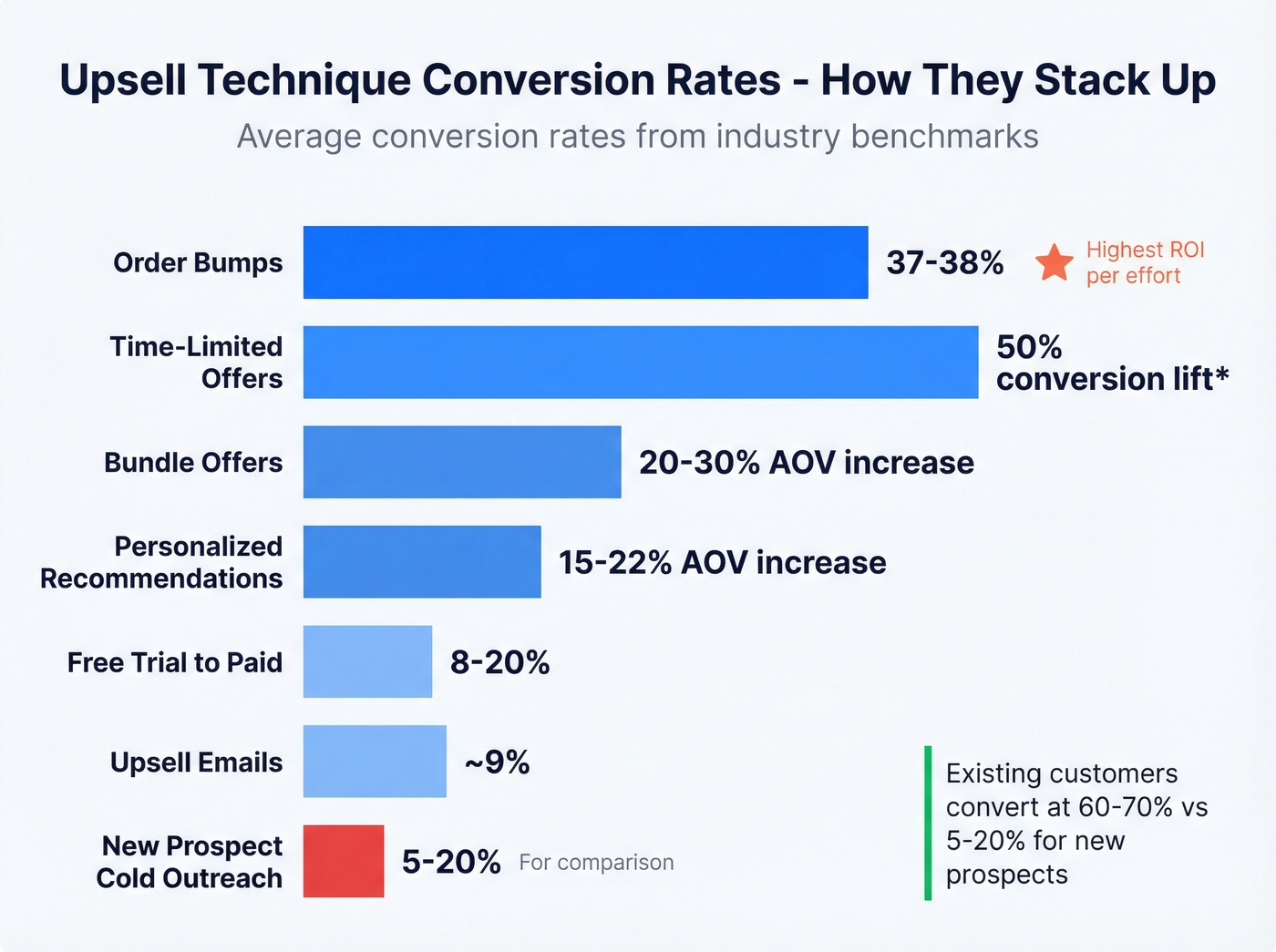
Let's be honest: if you implement one thing from this article, make it an order bump. Small add-ons presented as a checkbox during checkout convert at 37-38%. That's not a typo. Think warranty extensions, priority support, or a complementary accessory - low-friction, low-cost relative to the cart total. We've seen teams add five figures in monthly revenue just by adding a single checkbox to their checkout flow.
4. Usage-Based Triggers
Set automated alerts when customers hit 80-90% of their plan limits. Zoom does this with the 40-minute meeting cap. Dropbox does it with storage. The 80% threshold is the sweet spot - the customer feels the constraint but hasn't yet been frustrated enough to find a workaround. In our experience, triggering too early feels pushy; too late means they've already churned or hacked together an alternative.
5. Bundle Offers
Bundling related products or features increases average order value by 20-30%. The "complete the set" framing taps into a completeness bias - people want the full solution, not a partial one. Clearly communicated savings improve conversion by up to 20%, so make the math obvious. Don't make customers calculate the discount themselves.
6. Free Trial of Premium Tier
Freemium models see upgrade rates of 8-20%, and the mechanism is pure loss aversion. Give customers 14 days of premium features, then take them away. What matters: ensuring they actually use the premium features during the trial. Send onboarding emails highlighting what's different, not just that the trial exists.
7. Time-Limited Offers (Skip This If Your Urgency Is Fake)
Limited-time offers increase conversion by roughly 50%. Dollar Shave Club nails this with 24-hour free-shipping windows and "Toss more in your box" post-purchase emails. But fake countdown timers that reset on page refresh have trained customers to ignore urgency entirely. Use genuine deadlines tied to billing cycles or seasonal promotions. If the scarcity isn't real, don't manufacture it - you'll erode more trust than you gain.
8. Social Proof Messaging
"X customers upgraded this month" is more persuasive than any feature comparison. Layer social proof into your upgrade prompts - review counts, upgrade velocity numbers, and "most popular plan" badges all reduce perceived risk. "2,400 teams upgraded to Pro this quarter" beats "thousands of happy customers" every time.
9. Personalized Recommendations
AI-driven recommendations raise average order value by 15-22%, and product recommendations drive up to 35% of ecommerce sales. The Amazon "customers who bought X also bought Y" model works because it feels helpful, not salesy. Spotify does the same thing with its Premium upsells - surfacing upgrade prompts based on actual listening behavior, not generic "go Pro" banners. Generic "upgrade now" prompts convert at a fraction of the rate.
10. The Downsell Safety Net
Not every customer will say yes. That doesn't mean the conversation is over. When someone rejects the primary offer, present a smaller, lower-commitment alternative - "Not ready for Pro? Try Starter+ with just the features you need." A downsell catches revenue that would otherwise walk away entirely, and it keeps the customer moving up even if it's a smaller step.

Usage-based triggers only work when you know who's ready to buy more. Prospeo tracks buyer intent across 15,000 topics - so you can identify which existing accounts are actively researching upgrades, expansions, or competitor solutions before they churn.
Stop guessing which accounts are ready to expand. Let intent data tell you.
Upsell Email Templates You Can Steal
Email upsells convert at roughly 9%, and with 36x ROI on email marketing, even modest conversion rates generate meaningful revenue.
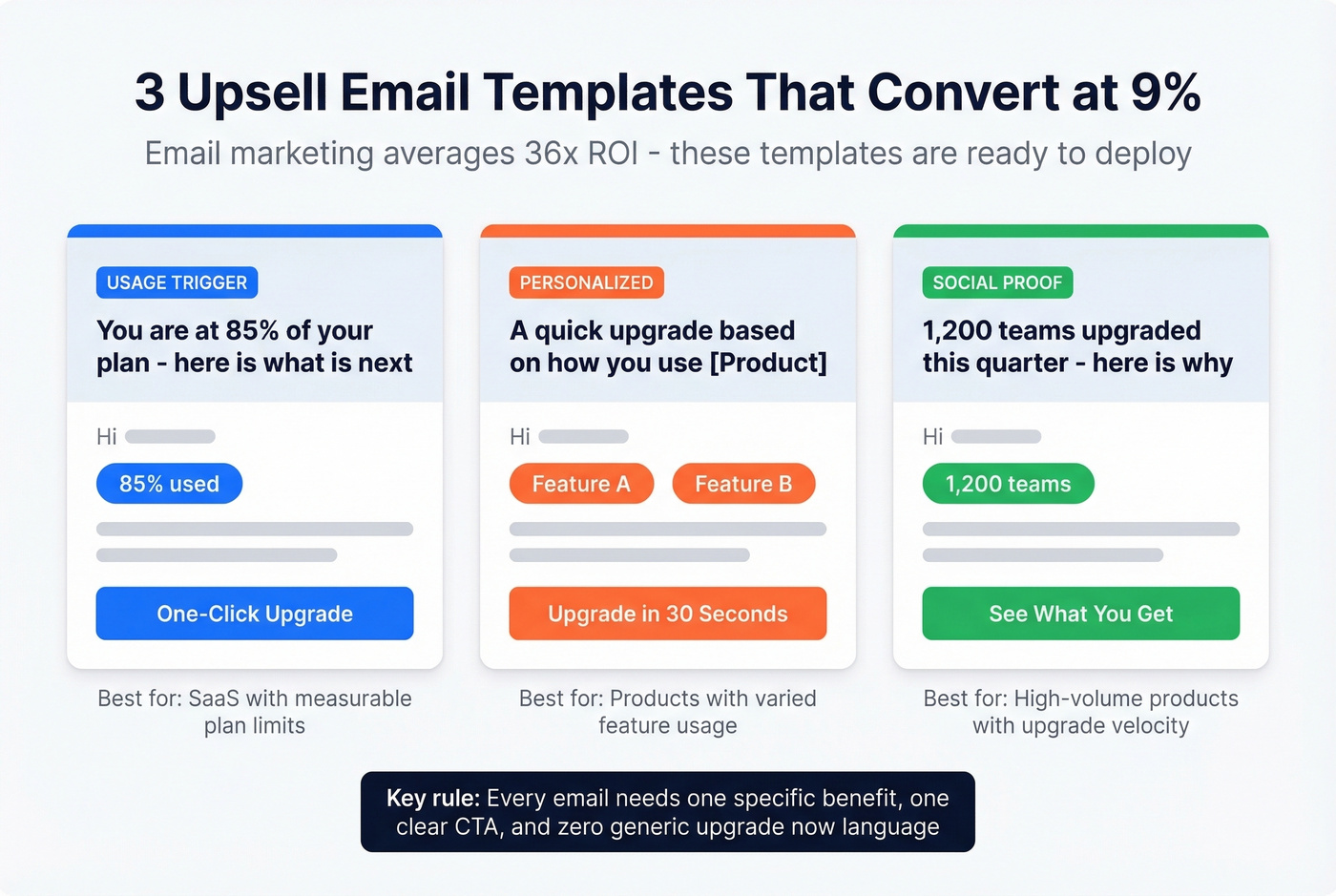
Template 1: The Usage Trigger
Subject: You're at 85% of your plan - here's what's next
Hey [First Name], you've used 85% of your [feature/storage/seats] this month. Teams at your usage level typically upgrade to [Tier Name] for [specific benefit]. One-click upgrade: [Link].
Template 2: The Personalized Recommendation
Subject: [First Name], a quick upgrade based on how you use [Product]
We noticed you've been using [Feature A] and [Feature B] heavily. Customers with similar patterns get the most value from [Tier Name]. Here's what changes: [2-3 bullets]. Upgrade takes 30 seconds: [Link].
Template 3: The Social Proof Nudge
Subject: 1,200 teams upgraded this quarter - here's why
[First Name], [X number] of teams on [Current Plan] moved to [Higher Plan] in the last 90 days. The top reason? [Specific benefit]. See what you'd get: [Link].
SaaS Expansion Playbook
Expansion revenue is where the best SaaS companies separate from the pack - and it costs 5-7x less than new customer acquisition.
| Metric | Benchmark |
|---|---|
| Net Revenue Retention | 110-130% |
| Gross Revenue Retention | 85-95% |
| Expansion % of Total Rev | 25-40% |
| Expansion Close Rate | 20-35% |
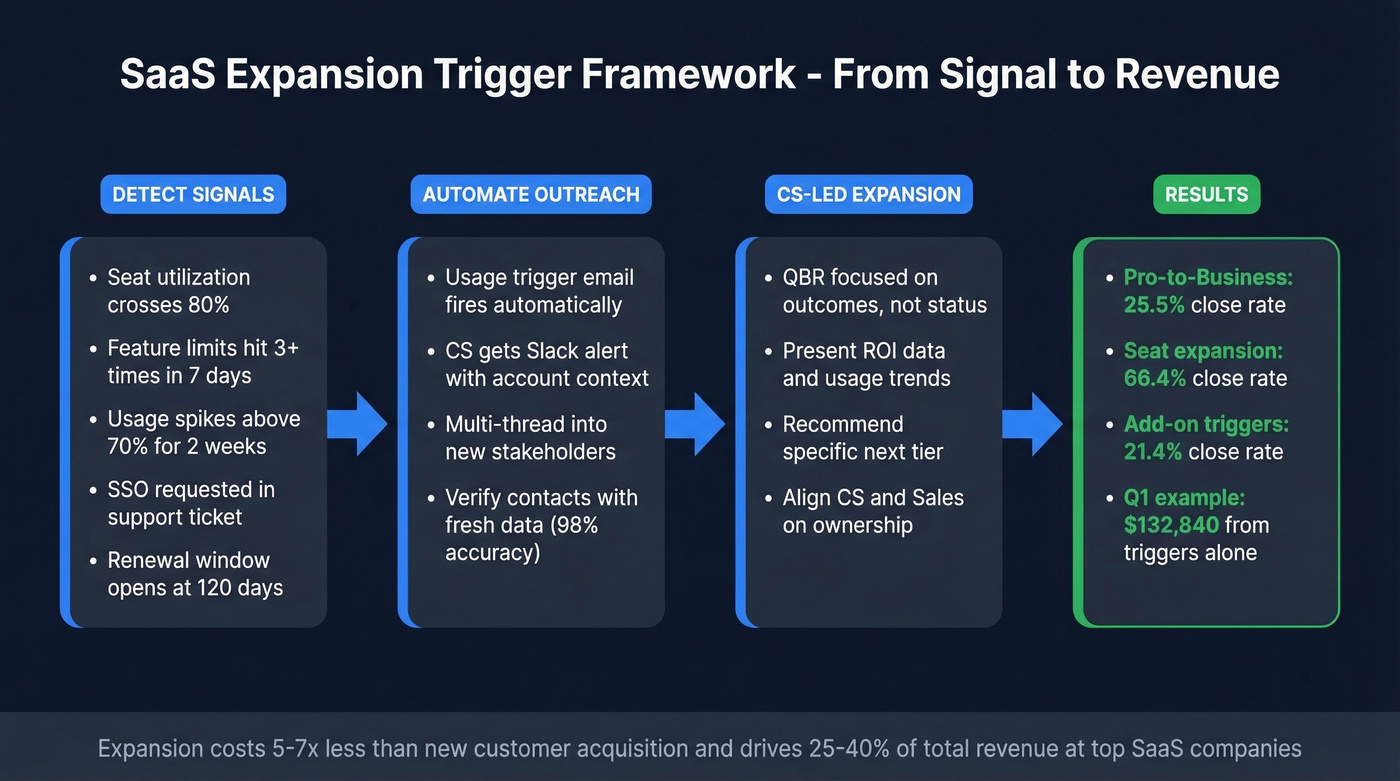
SaaS companies generate about 16% of new ACV from upselling. The best ones push that to 30-40%. Here's the trigger framework that drives those numbers.
Set triggers, not reminders. Automate alerts for these signals: seat utilization crossing 80%, feature limits hit 3+ times in 7 days, usage spikes above 70% for two consecutive weeks, SSO requested in a support ticket (that's an enterprise buying signal), and renewal windows opening at 120 days out. Expansion isn't just a sales function - customer success, support, and product teams all surface these signals.
A Q1 2026 example shows what this looks like in practice: 47 Pro-to-Business triggers produced 12 closes at 25.5% ($86,400 added), seat expansion triggers closed at 66.4% ($32,040), and analytics add-on triggers closed at 21.4% ($14,400). Total: $132,840 in one quarter from triggers alone.
Multi-thread into new stakeholders. The biggest expansion killer isn't product-market fit - it's single-threading. I've watched teams leave six figures on the table because their one champion got promoted and nobody else in the account knew the product existed. CRM data decays fast, contacts change roles, and suddenly your expansion outreach is hitting dead inboxes. Tools like Prospeo help here with 98% email accuracy and a 7-day data refresh cycle, so your outreach actually reaches verified contacts.
Run CS-led QBRs focused on outcomes. Quarterly business reviews should be expansion conversations, not status updates. Come with ROI data, usage trends, and a specific recommendation for the next tier. Map the renewal timeline 120 days out and align CS and Sales on who owns the conversation.
Mistakes That Kill Upsell Conversions
Here's the thing: most upsell programs fail not because the offer is wrong, but because the timing is. If your average deal size is under five figures, you probably don't need a complex multi-touch upgrade sequence - you need one well-timed trigger and one clean email.
The mistakes that actually kill conversions:
- Choice overload. More than 2-3 upsell options at once causes decision paralysis. One primary offer, one downsell. That's it.
- Upselling before value delivery. If the customer hasn't seen results from their current plan, an upgrade pitch feels tone-deaf. Wait until they've hit a milestone.
- Irrelevant offers. Recommending an analytics add-on to someone who only uses your basic CRM signals you don't understand their workflow.
- Generic messaging. "Upgrade to Pro for more features!" converts at a fraction of the rate of "You've hit your 5-seat limit 3 times this month - Pro gives you unlimited seats."
- No downsell fallback. When you don't offer a smaller alternative after a rejected upsell, you lose the entire opportunity.
- Ignoring mobile UX. Desktop upsell conversion runs 28-30% vs. 18-20% on mobile. If your upsell flow isn't mobile-optimized, you're leaving a 10-point gap on the table.
The most common pushback we hear from CS teams: "I don't want to damage the relationship by selling." The Feel, Felt, Found framework handles this cleanly - "I understand how you feel. Other customers felt the same way. What they found was that the upgrade actually reduced their support tickets by 40%." It reframes selling as helping, which is what good upselling actually is.
Restaurant servers have used a version of this for decades - mentioning dessert early in the meal so it's already in the customer's mind by the time they finish their entree. The best upsell doesn't feel like a pitch. It feels like a reminder.
How to Measure Upselling Success
If you're not measuring upsell ratio, you're guessing.
| KPI | Definition |
|---|---|
| Upsell Ratio | % of customers who upgraded |
| Cross-Sell Ratio | % who bought add-ons |
| Average Order Value | Revenue per transaction |
| Customer Lifetime Value | Total revenue per customer over time |
| Expansion MRR | Monthly recurring revenue from upgrades |
Run A/B tests for 2-4 weeks minimum, segmented by device and channel. Mobile and desktop convert at different rates, and blending them masks what's actually working.
The proof points are compelling. New World Hoiana Beach Resort achieved a 60% increase in upsell revenue with a 13.1x ROI after systemizing their upsell training. HGS generated $50M in annual revenue from cross-sell and upsell initiatives using speech analytics and agent scorecards, pushing NPS up 70%.
Before you send that upgrade email, verify the address. Bounced upsell emails don't just waste the opportunity - they damage your domain reputation.
Personalized upsell recommendations need real data. Prospeo enriches your CRM with 50+ data points per contact - headcount growth, funding, tech stack, department size - so your expansion plays are backed by signals, not hunches. 83% match rate on enrichment.
Enrich your customer base and surface every upsell opportunity hiding in your CRM.
FAQ
What's a good upsell conversion rate?
General upsell techniques convert at 15-30%, with SaaS averaging around 27.6%. Order bumps are the outlier at 37-38%. Email upsells land near 9%, which sounds low until you factor in near-zero marginal cost. Desktop outperforms mobile by about 10 percentage points.
When's the best time to upsell?
Immediately post-purchase, when buying momentum is highest. After that: when customers hit 80%+ usage of their current plan, and during quarterly business reviews for B2B accounts. Never upsell before the customer has experienced value from what they already bought.
How do I upsell accounts with stale contact data?
CRM data decays fast - contacts change roles, leave, or go dark. Use an enrichment tool to find verified emails and direct dials for new stakeholders at accounts you already serve. A weekly data refresh cycle and high email accuracy are non-negotiable when you're multi-threading into departments your original champion can't cover.