

How to Build and Deliver a Value Proposition That Actually Wins Deals
Only 15% of sales calls add enough value to justify the buyer's time. That's a Forrester stat, and Corporate Visions interprets it bluntly: 85-90% of sales calls communicate no value at all. The problem isn't product knowledge. It's that most teams lack a value proposition sales reps can actually deploy - consistently, across every deal stage, with every stakeholder.
A value proposition isn't a tagline. If yours fits on a Post-it note and you think you're done, you've confused marketing copy with sales strategy.
Here's the thing: a value proposition is a system you run across every sales conversation, not a sentence on your website. The biggest threat to your pipeline isn't a competitor - it's "do nothing." The majority of qualified deals die to the status quo. Below, we'll walk through the frameworks to build it, the talk tracks to deliver it, and the benchmarks to prove it matters.
What a Sales Value Proposition Actually Is
RAIN Group defines a value proposition as "the collection of reasons" why a buyer buys"](https://www.rainsalestraining.com/blog/how-to-build-a-value-proposition) - the factors that affect whether they purchase, and from whom. That's far more useful than the marketing definition, which tends to focus on a single positioning statement.
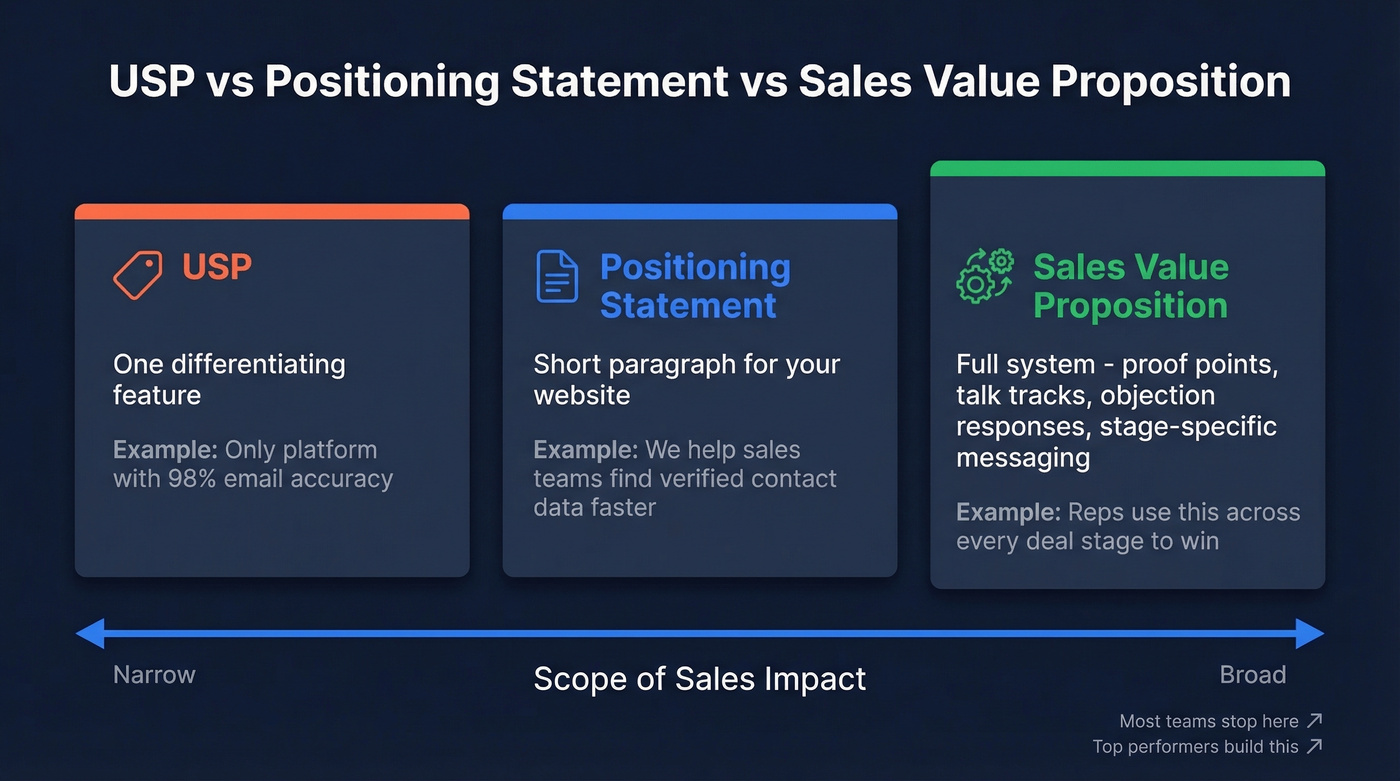
A USP is one differentiating feature. A positioning statement is a short paragraph for your website. A selling proposition for sales is the full system - proof points, talk tracks, objection responses, and stage-specific messaging - that reps use to win deals. These aren't interchangeable, and confusing them is how sales enablement programs go sideways.
There's also a useful distinction between solution selling and value-based selling. Solution selling asks "what problems can we solve?" Value-based selling asks "what specific, measurable business value can we deliver?" A strong sales value proposition lives in the second camp. It doesn't describe what you do. It quantifies what the buyer gains - and that shift is what separates reps who hit quota from those who don't.
RAIN Group breaks it into three components: your VP has to resonate (the buyer wants and needs it), differentiate (it stands out from alternatives), and substantiate (the buyer believes you can deliver). Miss any one of those, and you're back in the 85-90%.
Why This Matters More in 2026
Selling has gotten harder. Longer cycles, bigger committees, tighter budgets. Outreach's platform data shows that deals closed within 50 days hit a 47% win rate, but after that threshold, win rates crater to 20% or lower. A weak VP is the single biggest drag on cycle velocity.
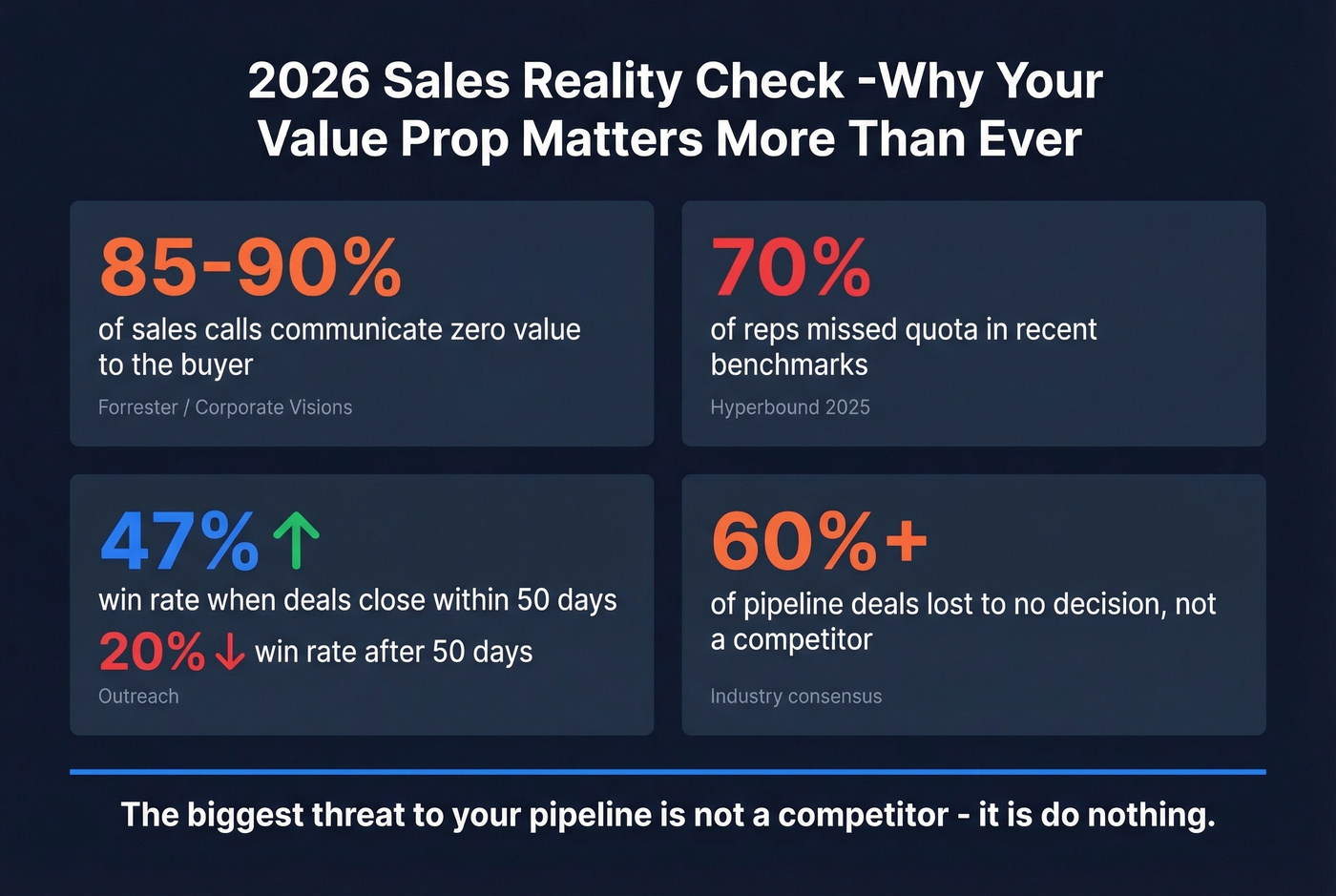
Meanwhile, up to 70% of reps missed quota in recent benchmarks, with average attainment hovering around 43%. Buying groups now run 6-10 people deep, and some enterprise deals involve 15+ stakeholders who each need a different reason to say yes depending on their role. If you can't align your customer value proposition with buyer needs at each level of the committee, the deal stalls.
But the real competitor in most of your deals isn't another vendor. It's inertia. Ask any sales team what kills their pipeline, and the answer is almost always the same: prospects who go dark after discovery. At least 60% of pipeline deals are lost to "no decision" rather than to a competitor. When deals end that way, the problem isn't competitive positioning - it's that reps can't articulate enough urgency and value to overcome the status quo.
How to Build a B2B Value Proposition That Wins
Start With Buyer Challenges
Open with the why, not the what. The most common VP failure is leading with your product's capabilities instead of the buyer's pain. Structured discovery beats assumptions every time - you need to understand the problem in the buyer's language before you can frame your solution.
Talk to customers. Run win/loss interviews. Listen to recorded calls. We've found that building a VP from real conversations will always outperform one built at your desk from assumptions, no matter how well you know your market.
Map the Business Impact
"Improve productivity" isn't a value proposition. "Save your SDR team 12 hours per week on manual research, which translates to 40 more qualified meetings per quarter" is.
Quantify the cost of inaction - what does it cost the buyer to keep doing things the old way? Every vague benefit needs a dollar figure or a metric attached to it. If you can't quantify it, you haven't done enough discovery.
Find Your Differentiation Wedge
The Value Wedge sits at the intersection of three things: what you do exceptionally well, what your competitor can't easily replicate, and what the buyer needs solved right now. The strongest wedge reveals a need the buyer hasn't considered yet - reframing their status quo as riskier than they thought. If your messaging only covers the overlap between you and your competitors, you're stuck in Value Parity.
Corporate Visions identifies three deadly sins of sales messaging: providing too much information, not describing value from the buyer's perspective, and failing to identify what's different. We've seen all three in the same pitch deck more times than we can count.
Build a Proof-Point Library
Your VP needs to pass what RAIN Group calls the "substantiate" test - can the buyer believe you'll actually deliver? In our experience, the proof points that close deals are always segment-specific. A Fortune 500 case study doesn't help you sell to a 50-person startup. Build proof by segment, by use case, and by persona.
Structure the Message
Use a repeatable structure: Trigger - Pain - Impact - Solution - Benefit. Here's a filled-in B2B example:
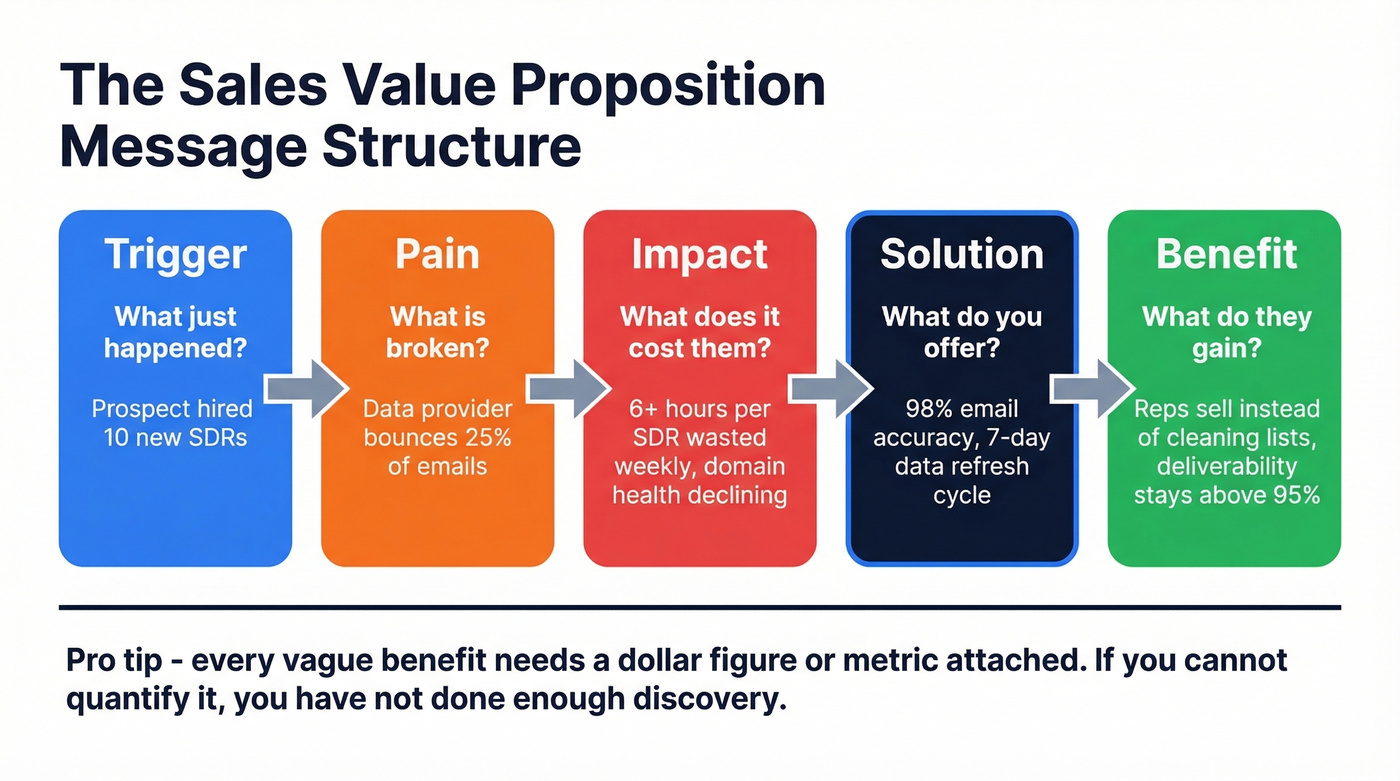
- Trigger: Your prospect just hired 10 new SDRs.
- Pain: Their current data provider bounces 25% of emails, burning sender reputation.
- Impact: Each SDR wastes 6+ hours per week on bad data, and domain health is declining.
- Solution: A verified database with 98% email accuracy and a 7-day data refresh cycle.
- Benefit: Reps spend time selling instead of cleaning lists, and deliverability stays above 95%.
Test and Iterate
A/B test your VP in cold email subject lines and opening sentences. Track win/loss patterns - are you losing deals where a specific objection keeps surfacing? That's a VP gap. Run discovery call feedback loops with your team weekly. The fastest way to improve your value prop is to treat it as a living document that evolves with your market, your buyers, and your competitive set.

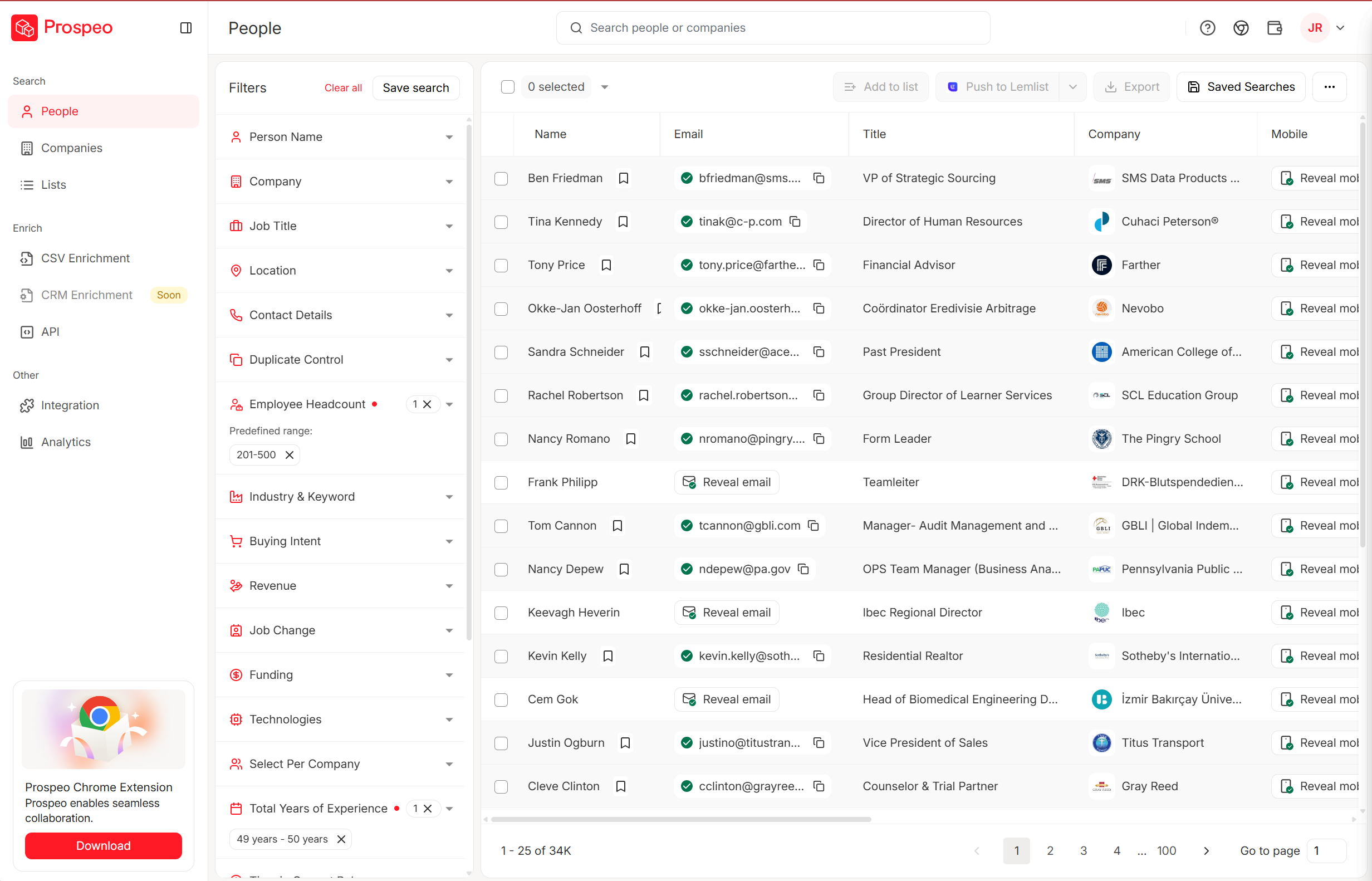
You just read that a strong value proposition needs to substantiate - the buyer has to believe you'll deliver. Here's ours: 98% email accuracy, 125M+ verified mobiles, and a 7-day data refresh cycle. 15,000+ companies trust Prospeo to connect reps with real buyers, not dead inboxes.
Stop losing deals to bad data before your value prop even lands.
Delivering Your VP Across the Cycle
Most articles on value propositions stop at the framework and leave you to figure out how to actually use it on a call. That's where deals die.
Cold Outreach
You sent 200 cold emails last month. Open rate: 2-3%. The problem isn't your subject line - it's that your first sentence sounds like every other vendor in their inbox. Lead with the trigger and the pain, not the pitch. "Noticed you just opened a London office - teams expanding into new regions often find their contact data goes stale fast" beats "Hi, I'm reaching out because we offer a data platform."
Your VP only works if it reaches the right person. If your emails bounce or land in spam, the best messaging in the world is worthless - and that's where data quality becomes a VP prerequisite. Tools like Prospeo, with 98% email accuracy and a 7-day data refresh cycle, make sure your carefully crafted message actually lands in the inbox of every stakeholder on the buying committee rather than a bounce log.
Discovery Call
Carole Mahoney's six-layer discovery framework maps the questions every buyer needs answered, in order: Why change? Why now? Why this type of solution? Why you specifically? Why your solution? Why spend the money?
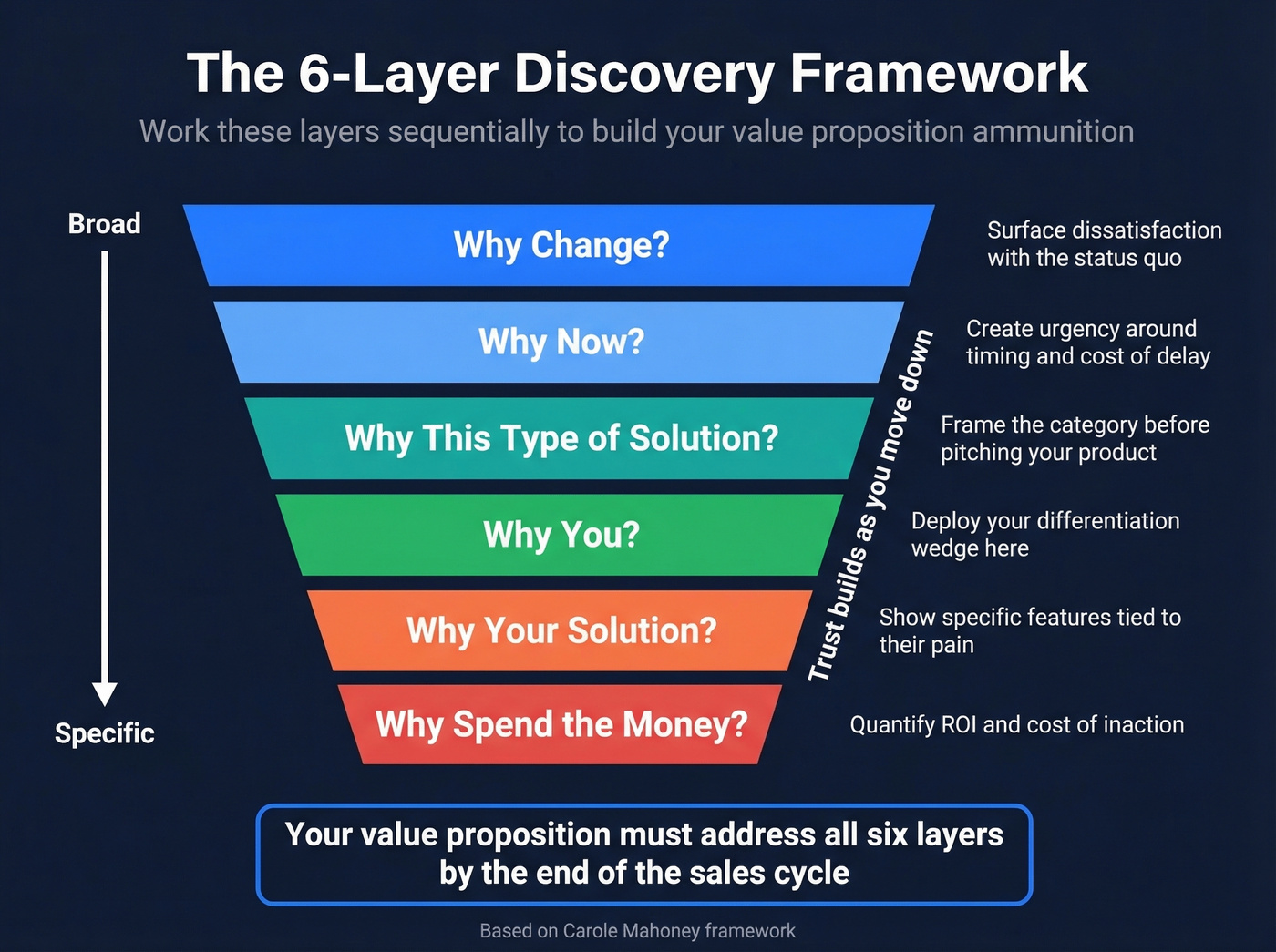
Work these layers sequentially. Start broad with "why change" to surface dissatisfaction with the status quo, then narrow toward "why you" as trust builds. Your value proposition needs to address all six layers by the end of the cycle - discovery is where you gather the ammunition.
Post-Discovery Bridge
After discovery, bridge to your VP with Mahoney's formula: "When you work with us, you can solve [specific challenge] without [previous obstacle], because [your quantifiable expertise] - which means you can [achieve their goal] and [reduce risk]."
Don't read this verbatim. It's a structure that forces you to connect what you heard to what you offer.
Demo
Three steps. That's the whole demo framework.
Summarize what you heard in discovery. Show only the feature tied to their specific challenge. Quantify the impact with the buyer, not for them. "Based on what you told me about your 35% bounce rate, here's how this works - and here's what Meritt saw when they made the change: bounce rates dropped to under 4%, and pipeline tripled from $100K to $300K per week."
Proposal and Negotiation
Your champion just forwarded your proposal to the CFO with the note "thoughts?" - and you're not in the room.
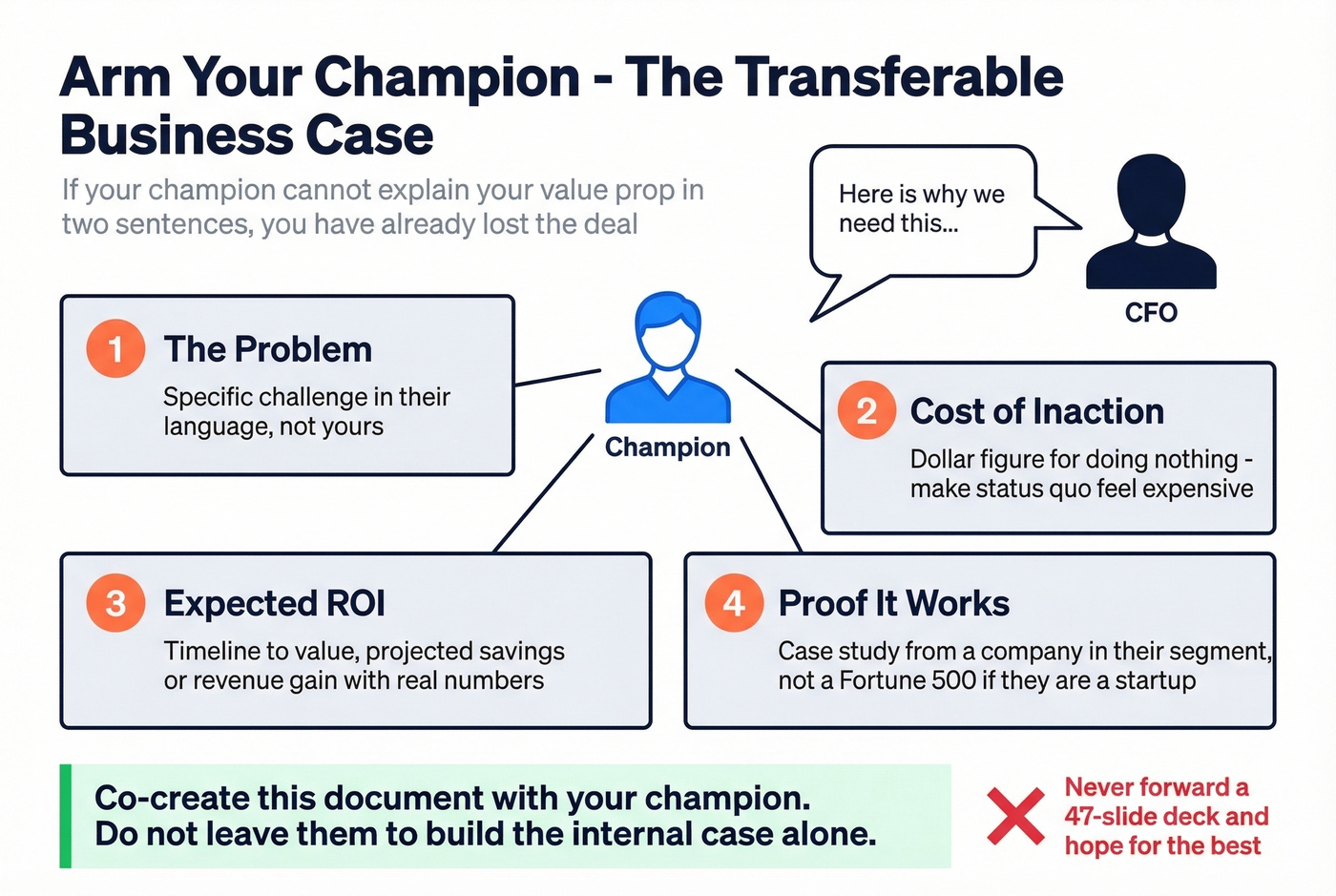
If your champion can't articulate your VP in two sentences, you've lost. Arm them with a transferable business case: the problem, the cost of inaction, the expected ROI, and the proof that it works for companies like theirs. We've watched deals die because the champion couldn't explain the ROI to their CFO. Co-create this document with them. Don't leave them to build the internal case alone.
Value Proposition Examples That Work
Slack's early VP worked because it was outcome-first. They didn't lead with features like channels or integrations. They led with the result every knowledge worker craves: less chaos and faster collaboration. Simple, specific, and impossible to misunderstand.
B2B SaaS example using the framework: An HR tech company targeting Series B startups with slow onboarding could frame it this way - "Cut time-to-productivity from 3 weeks to 5 days with role-specific workflows, saving $840K annually at your hiring pace and improving 90-day retention by 20%." Every element maps to the Trigger - Pain - Impact - Solution - Benefit structure.
Let's be honest: if your average deal size is under $10K, you probably don't need a 47-slide value proposition deck. You need a tight two-sentence VP, a proof point that matches the buyer's segment, and verified contact data so the message actually reaches a decision-maker. Complexity is the enemy of velocity at lower ACVs.
Mistakes That Kill Your Value Proposition
Feature-first messaging. Opening with what your product does instead of what the buyer gains. Flip the order - outcome first, mechanism second.
One-size-fits-all delivery. As Leslie Venetz puts it: "When we try to talk to everybody, we end up talking to nobody, and that means our sales messaging is spam." Adapt your b2b value proposition by persona, industry, and deal stage.
Leaving the champion alone. If your internal champion has to build the business case from scratch, you've failed. Co-create the ROI narrative so it survives the internal forwarding chain.
Ignoring "do nothing." The status quo is your real competitor in most deals. Quantify the cost of inaction - not just the benefit of switching.
Vague claims without numbers. "We improve efficiency" means nothing. "We cut list-building time from 15 hours to 3 hours per week" means everything. The consensus on r/sales is pretty clear on this: buyers tune out the second they hear generic benefit language without a number attached.
Every hour your SDRs spend cleaning bounced emails is an hour they're not delivering your value proposition to decision-makers. Prospeo's 5-step verified database means reps spend time selling, not scrubbing lists - at $0.01 per email, with no contracts.
Give your reps data that matches the value prop you just built.
FAQ
What's the difference between a value proposition and a USP?
A USP is one differentiating feature. A value proposition is the full collection of reasons a buyer chooses you - resonance, differentiation, and substantiated proof combined. A strong customer value proposition anchors every reason in the buyer's priorities rather than your product's feature list.
How long should a sales value proposition be?
The positioning statement should be 2-3 sentences that a champion can repeat from memory. The full VP system includes proof points, objection responses, and stage-specific talk tracks - it lives well beyond a single paragraph.
How do you test whether your value proposition works?
A/B test it in cold email subject lines, track win/loss reasons by deal stage, and ask the ultimate question: can your champion repeat your VP to their CFO without help? If win rates climb and "no decision" losses drop, your VP is landing.
What tools help deliver a value proposition to the right buyers?
The best messaging fails if it never reaches a decision-maker. Pair your VP with a verified data platform and intent signals to make sure you're reaching in-market stakeholders - not outdated contacts. Skip this step if your pipeline is already full and your bounce rates are under 3%.