

What Are OKR Goals - And How to Actually Make Them Work
A RevOps lead we know ran OKRs for three quarters straight. The first quarter, the team wrote 14 objectives. The second quarter, nobody updated them. By the third quarter, the entire framework was a running joke in Slack.
That's not an OKR problem - it's an implementation problem. And it's fixable. If you've ever asked "what are OKR goals?" and gotten a vague answer about alignment and focus without any operational detail, this guide covers the definition, real examples, and the operating cadence that separates teams who ship from teams who shrug.
The Short Version
OKRs = Objectives (what you want to achieve) + Key Results (how you'll measure it). They run on 90-day cycles. Most OKR rollouts fail because teams skip the operating cadence, write activity-based Key Results instead of outcome-based ones, or tie OKRs to performance reviews. Below: the definition, department-specific examples, and the implementation mechanics that actually make OKRs stick.
OKR Goals Defined
OKR stands for Objectives and Key Results. It's a goal-setting framework where every goal has two parts: a qualitative Objective that describes what you want to achieve, and 2-4 quantitative Key Results that measure whether you got there.
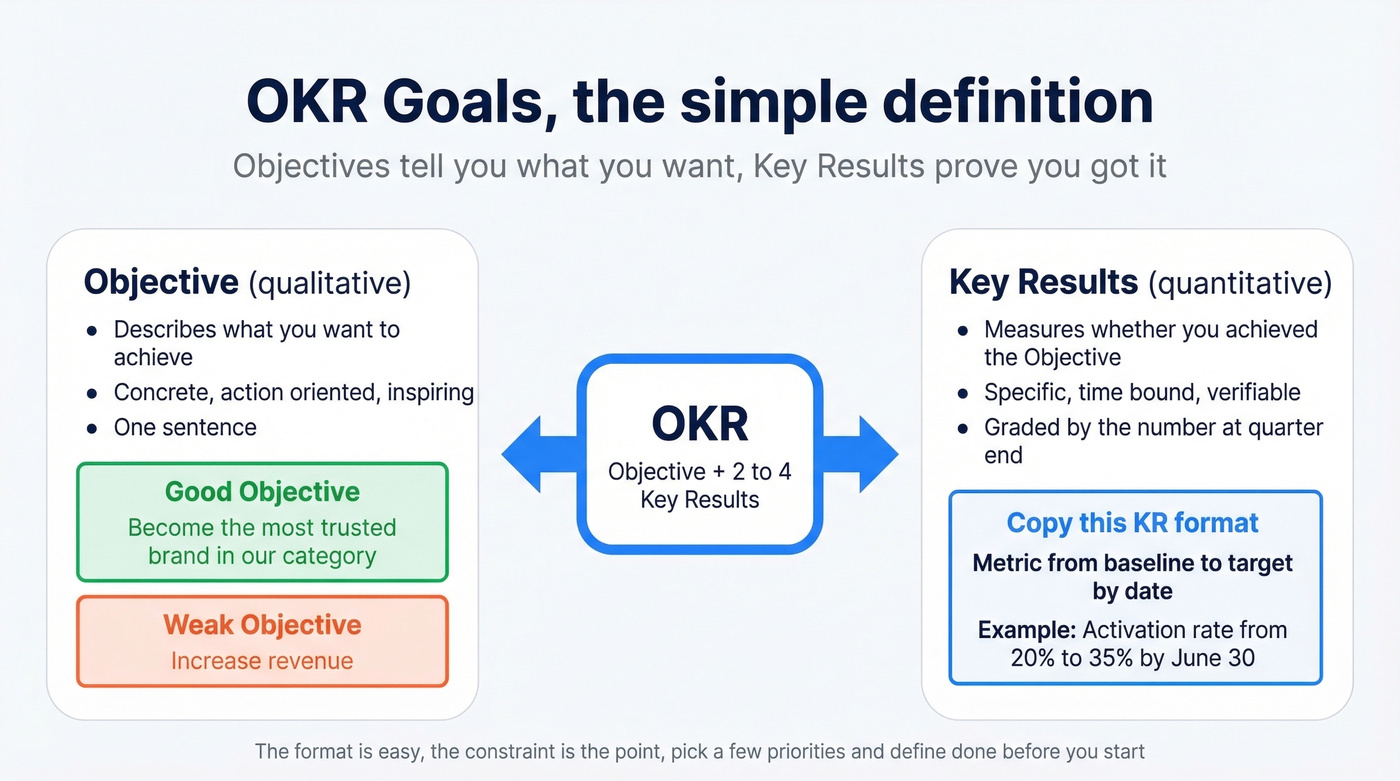
John Doerr's formula captures it cleanly: "I will [objective] as measured by [key result]."
Objectives should be significant, concrete, action-oriented, and inspirational. "Become the most trusted brand in our category" is a good Objective. "Increase revenue" is lazy. Key Results are the opposite - specific, time-bound, and verifiable. No room for interpretation. At the end of the quarter, a Key Result is graded based on the number.
The power of the framework isn't in the format. It's in the constraint. OKRs force you to pick a small number of things that matter and define what "done" looks like before you start.
A Brief History of OKRs
OKRs are generally attributed to Andy Grove at Intel in the 1970s. Grove adapted Peter Drucker's Management by Objectives (MBO) framework but made two critical changes: shorter cycles - quarterly instead of annual - and a deliberate separation from compensation. That second change is the one most companies still get wrong.
In 1999, John Doerr, a former Intel employee turned venture capitalist, introduced OKRs to Google's founders. Google adopted them company-wide, and the framework spread through Silicon Valley from there. Doerr's book Measure What Matters turned OKRs into a mainstream management concept. Today they're used well beyond tech, from municipal governments to healthcare systems.
How to Write Strong OKRs
The single biggest mistake teams make is writing Key Results that are actually tasks. "Launch the new feature" isn't a Key Result - it's a to-do item. You have no idea whether launching that feature moved anything. A real Key Result measures the outcome of the work.
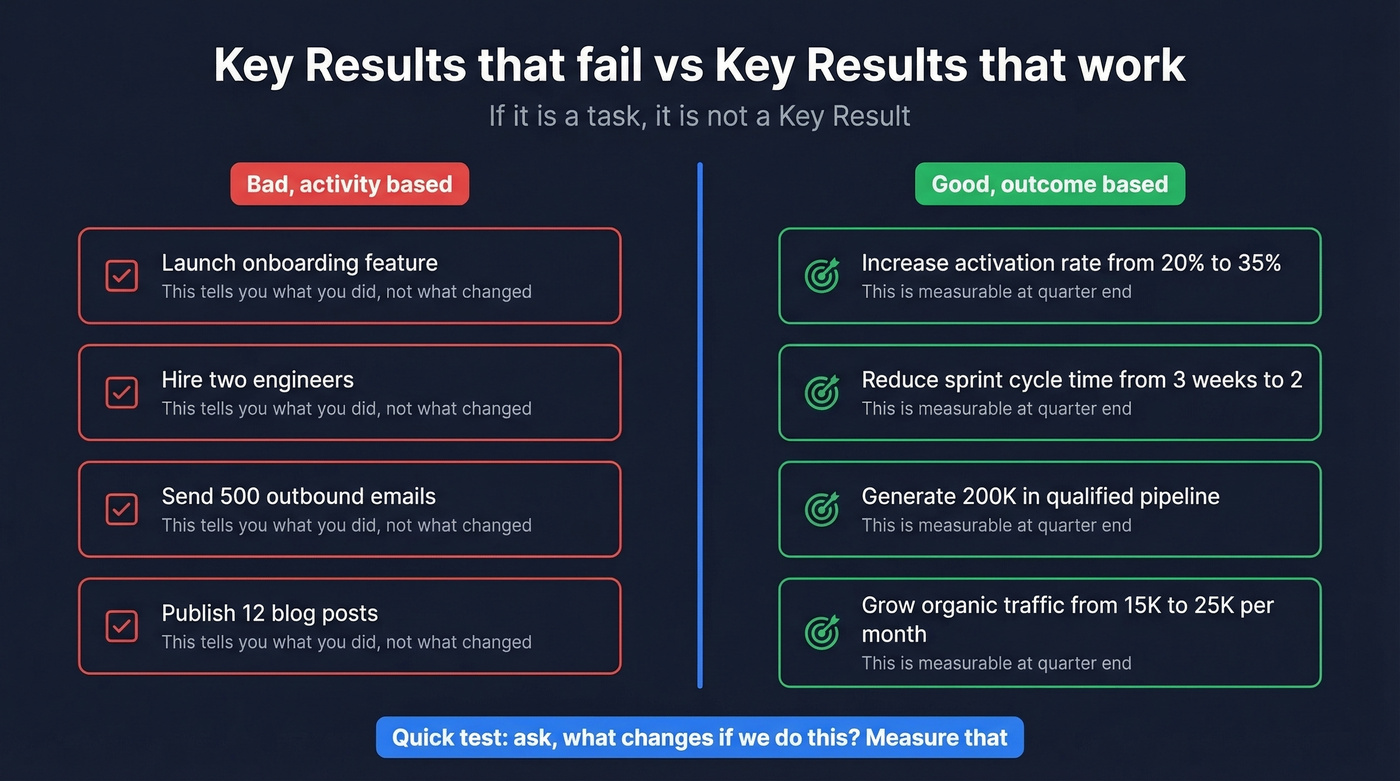
| Bad Key Result (Activity) | Good Key Result (Outcome) |
|---|---|
| Launch onboarding feature | Increase activation rate from 20% to 35% |
| Hire two engineers | Reduce sprint cycle time from 3 weeks to 2 |
| Send 500 outbound emails | Generate $200K in qualified pipeline |
| Publish 12 blog posts | Grow organic traffic from 15K to 25K/mo |
Here's a template you can copy and fill in right now:
Objective: [What you want to achieve - qualitative, inspiring]
- KR1: [Metric] from [baseline] to [target] by [date]
- KR2: [Metric] from [baseline] to [target] by [date]
- KR3: [Metric] from [baseline] to [target] by [date]
Before you finalize any OKR, run through this checklist:
- Baseline exists. You can't measure improvement without a starting number.
- Target is specific. "Improve NPS" isn't a target. "Improve NPS from 30 to 50" is.
- Single owner assigned. Every Objective and every Key Result needs one person accountable.
- Data source identified. If you can't pull the number from a dashboard or report, you won't track it.
- Cap enforced. 3-4 Objectives per level, 2-4 Key Results per Objective. We'd actually recommend starting with 2 KRs per Objective if your team is new to the framework. You can always add complexity later - you can't recover a quarter lost to scattered priorities.
One more thing before your first cycle: align on definitions. Teams that treat "Objective" and "Key Result" as interchangeable terms create misalignment from day one.
OKR Examples by Department
Abstract definitions only get you so far. Here's what objectives and key results look like across five departments, with real numbers:
| Department | Objective | Key Results |
|---|---|---|
| Engineering | Ship a bulletproof platform | Achieve 99.9% uptime; reduce critical bugs by 40% |
| Sales | Build a repeatable pipeline engine | Add $2M in qualified leads; increase win rate by 10% |
| Marketing | Become the #1 inbound channel | Deliver 300 MQLs/quarter; lower CPL from $40 to $28 |
| HR | Hire faster without sacrificing quality | Cut time-to-hire from 60 to 45 days; increase internal mobility by 15% |
| Product | Build a product users recommend | Improve NPS from 30 to 50; reduce churn from 8% to 5% |
Pipeline OKRs depend entirely on data quality. When reps work stale contact lists, half their outreach bounces and the Key Result never moves. We've seen this firsthand - teams with great OKR discipline that still miss pipeline targets because their prospect data is garbage. A verified data source like Prospeo, which refreshes contacts every 7 days at 98% email accuracy, turns outreach activity into actual pipeline movement.

Pipeline OKRs only move when outreach actually reaches real buyers. Prospeo delivers 98% email accuracy with a 7-day refresh cycle - so your reps spend time selling, not chasing bounced emails. Teams using Prospeo book 26% more meetings than ZoomInfo users.
Stop missing pipeline Key Results because of bad data.
Three Types of OKRs
Not all OKRs carry the same weight. There are three types, and confusing them creates real problems.
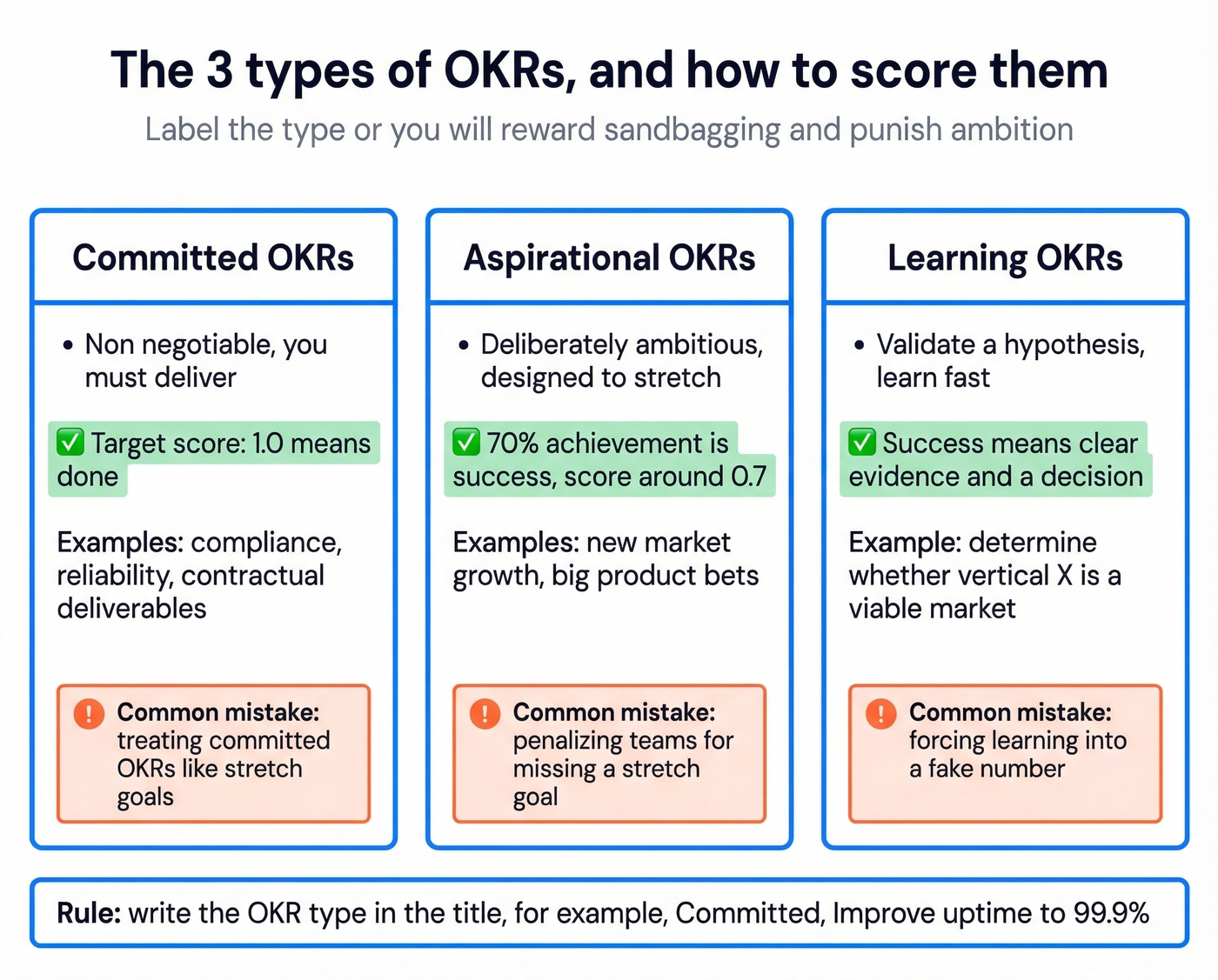
Committed OKRs are non-negotiable. The team is expected to hit 100% - a 1.0 on the scoring scale. Think compliance targets, contractual obligations, or infrastructure reliability goals.
Aspirational OKRs (sometimes called stretch goals) are deliberately ambitious - 70% achievement counts as success, or 0.7 on the 0.0-1.0 scale. They're designed to push teams beyond what feels comfortable.
Learning OKRs focus on validating hypotheses rather than hitting numbers. "Determine whether vertical X is a viable market" is a learning OKR.
Here's the thing: if your team doesn't know which type they're working with, you'll penalize high performers for missing stretch goals and reward sandbaggers for hitting easy committed ones. Label every OKR explicitly.
How to Implement OKRs
Most OKR failures aren't about writing bad objectives. They're about having no operating system around them.
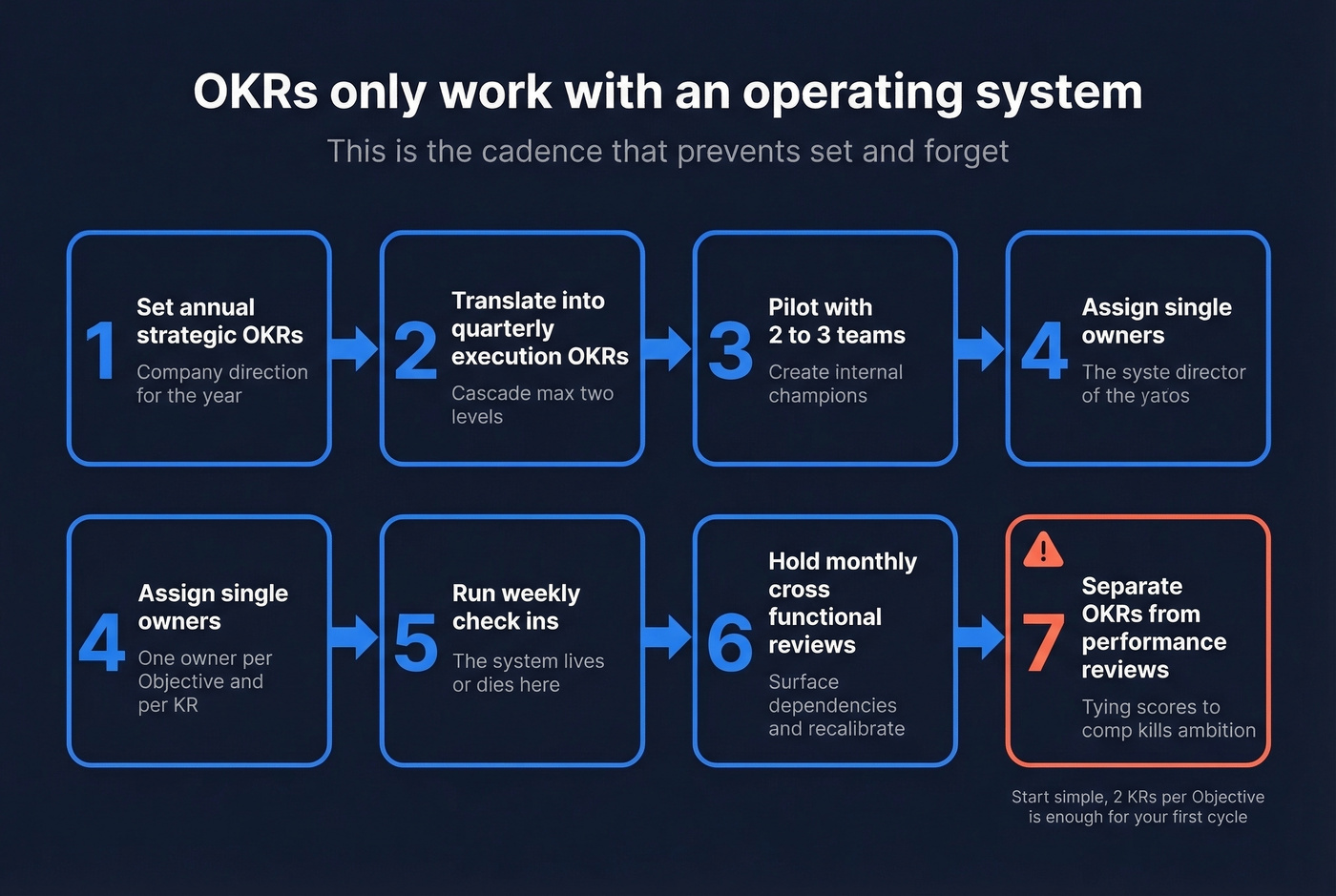
Set annual strategic OKRs at the company level. These define direction for the year - broad enough to allow quarterly pivots, specific enough to guide prioritization.
Translate into quarterly execution OKRs. Each quarter, company OKRs cascade into team-level OKRs. Limit cascading to two levels max. Going deeper creates confusion and bureaucracy.
Pilot with 2-3 teams first. Don't roll OKRs out to the entire company at once. Build internal champions before expanding.
Assign single owners. Every Objective gets one person. Every Key Result gets one person. Shared ownership means no ownership. A common failure here: leadership hands down Objectives with KRs already defined, leaving teams no ownership over the "how." KRs should be co-created with the people doing the work.
Run weekly check-ins. This is where most rollouts die. Without a weekly rhythm, OKRs become a quarterly planning exercise that nobody revisits.
Hold monthly cross-functional reviews. Teams present progress, surface dependencies, and recalibrate. This is where alignment actually happens.
Separate OKRs from performance reviews. This isn't optional. Tying OKR scores to compensation kills ambition. Google's OKR playbook makes this separation explicit, and there's a reason.
How to Run OKR Check-Ins
The average organization fails to hit 20% of strategic objectives due to poor implementation. Check-ins are the implementation. Skip them and you're just writing goals on a whiteboard and hoping.
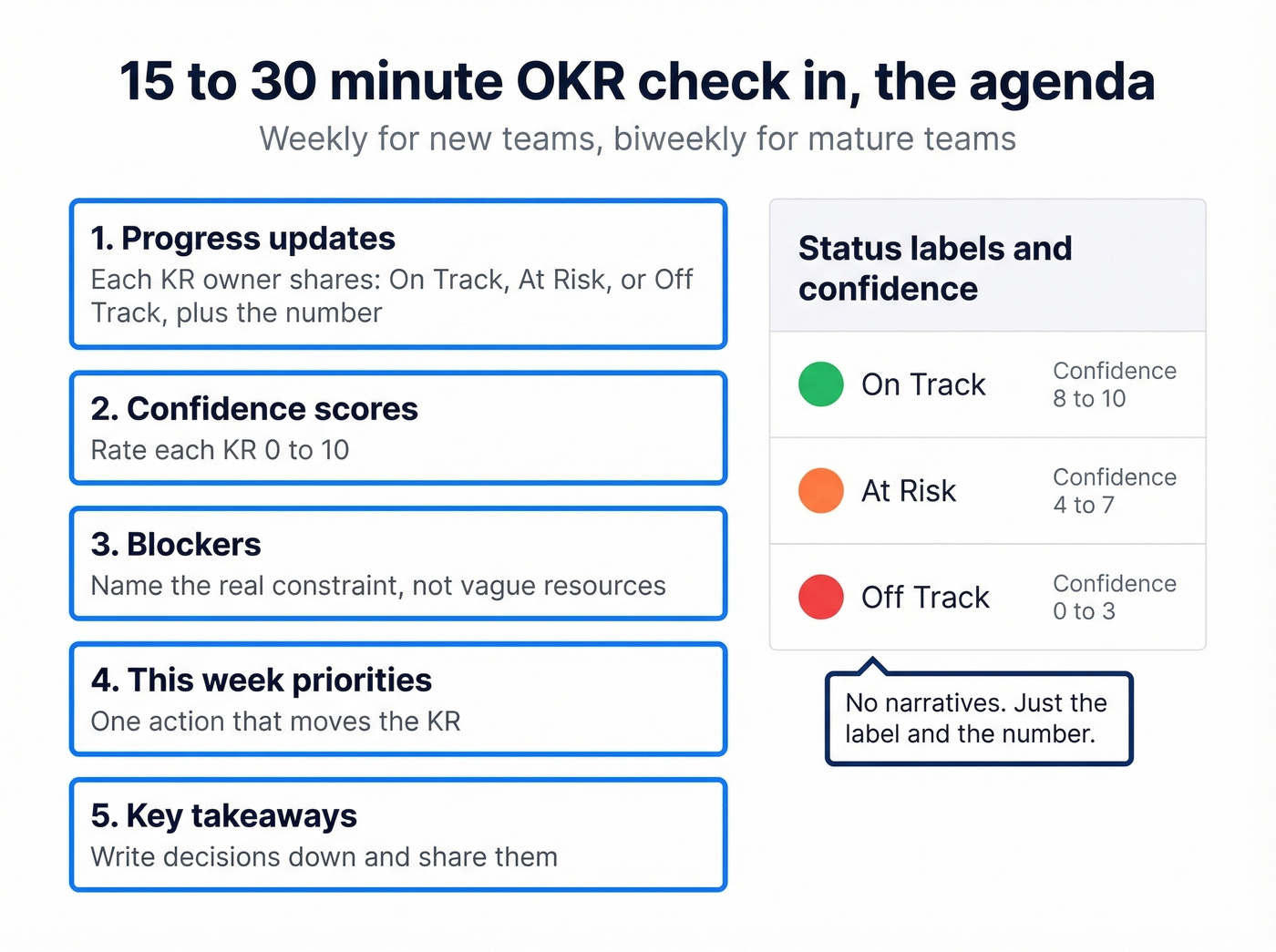
Weekly for new OKR teams, biweekly for mature ones. Monthly isn't enough - by the time you realize a Key Result is off track, the quarter's half over. Keep meetings to 15-30 minutes with a strict agenda:
- Progress updates. Each KR owner shares status: On Track, At Risk, or Off Track. No narratives - just the label and the number.
- Confidence scores. Rate each KR 0-10. Green (8-10) means you're confident. Yellow (4-7) means risks are emerging. Red (0-3) means you need intervention now.
- Blocker identification. What's in the way? Name it specifically. "Resources" isn't a blocker. "We need a data engineer for the attribution model" is.
- Action priorities. The single most important thing each owner will do this week to move their KR.
- Key takeaways. Capture decisions and share them. If it's not written down, it didn't happen.
Why OKRs Fail
The thread on r/ExperiencedDevs is blunt: across small, medium, and large companies, OKR attempts rarely stick beyond a single quarter. That tracks with what we've seen. But the framework isn't broken - the implementation is. Here are the five anti-patterns that kill OKRs.
Key Results as to-do lists. "Hire two engineers" and "launch feature X" aren't outcomes. They're activities. Fix: ask "what changes if we do this?" and measure that.
Set-and-forget. Teams write OKRs in January and don't look at them until March. Fix: weekly check-ins with the 5-step agenda above. Non-negotiable.
Too many OKRs. If everything's a priority, nothing is. We've seen teams with 8+ Objectives per quarter. That's not focus - it's a wish list. Fix: cap at 3-4 Objectives, 2 KRs each to start.
Leadership doesn't model accountability. If the CEO treats OKRs as something "for the teams" but doesn't present their own progress, nobody takes the framework seriously. Fix: leadership goes first. Every quarter. Publicly.
Tied to performance reviews. This is the most common and most damaging mistake. When OKR scores affect compensation, people play it safe instead of stretching. Aspirational goals disappear. Fix: keep OKR scoring completely separate from performance ratings.
Let's be honest about something: most OKR failures aren't a framework problem - they're a meeting problem. If your team already struggles to run effective standups, adding OKRs won't fix anything. Fix the meeting culture first, then layer in OKRs. The framework amplifies whatever operating discipline you already have, good or bad.
OKRs vs KPIs vs SMART Goals
These frameworks aren't competitors - they're complementary. The simplest framing: OKRs are a compass, KPIs are a dashboard.
| OKRs | KPIs | SMART Goals | |
|---|---|---|---|
| Purpose | Drive change | Monitor health | Define individual targets |
| Timeframe | Quarterly | Continuous | Varies |
| Structure | Objective + 2-4 KRs | Metric + target | Specific/Measurable/etc. |
| Review cadence | Weekly check-ins + quarterly scoring | Ongoing | Milestone-based |
A KPI like "monthly churn rate" tells you how the business is performing. An OKR like "reduce churn from 8% to 5% by improving onboarding completion" tells you what to change. Once you achieve that OKR, the new churn target becomes a KPI you monitor continuously.
34% of team members say they'd feel more motivated if they understood how their work connects to the company's mission. OKRs create that connection. KPIs don't - they measure outputs without explaining why.
To round out the operating system, consider pairing OKRs with CFRs - Conversations, Feedback, and Recognition. CFRs are the informal counterpart to OKRs: regular 1-on-1s where managers discuss progress, give real-time feedback, and recognize contributions. OKRs tell you what to work on. CFRs keep the humans doing the work engaged and course-correcting between formal check-ins.
Best OKR Tools in 2026
Look, you don't need OKR software to start. A shared spreadsheet works fine for a single team. You need dedicated tooling when you're scaling past 50 people and need visibility across departments, automated check-in reminders, and progress dashboards.
| Tool | Starting Price | Best For |
|---|---|---|
| Tability | $5/user/mo | Lightweight, fast setup |
| Teamflect | $7/user/mo | Microsoft Teams-native |
| Small Improvements | $3/user/mo | Budget-conscious teams |
| Quantive Results | $18/user/mo | Enterprise with analytics |
| Betterworks | ~$8-15/user/mo | Mid-market performance mgmt |
| Weekdone | $108/mo (4-10 users) | Small teams wanting structure |
Microsoft discontinued Viva Goals in 2025. If you were using it or evaluating it, it's off the table.
For sales and marketing teams whose OKRs hinge on pipeline growth, skip this section if your Key Results are purely internal metrics like NPS or uptime. But if you're measuring qualified pipeline or meetings booked, your OKR tool is only half the equation - the other half is the prospect data feeding your outreach. Stale contacts mean bounced emails, which means your pipeline KR flatlines no matter how disciplined your check-ins are.
You wrote the OKR: 'Generate $200K in qualified pipeline.' Now you need contact data that actually converts. Prospeo gives you 300M+ verified profiles with 30+ filters - buyer intent, job changes, headcount growth - so every outbound touch maps directly to your Key Results.
Turn your pipeline OKR from aspirational to committed.
FAQ
Are OKR goals the same as regular goals?
No. Every OKR pairs a qualitative Objective with 2-4 measurable Key Results on a quarterly cycle. A vague goal like "grow revenue" becomes an OKR when you add "as measured by increasing ARR from $5M to $7M and closing 15 enterprise deals." The structure forces specificity that regular goals lack.
How many OKRs should a team set?
Cap at 3-4 Objectives with 2-4 Key Results each per quarter. New teams should start with 2 Objectives and 2 Key Results each - adding complexity is easy, recovering a scattered quarter isn't.
Should OKRs be tied to performance reviews?
No. Tying OKR scores to compensation kills ambition - people sandbag instead of stretching. Google's own playbook keeps scoring separate from performance ratings. Use OKRs for alignment, reviews for evaluating contribution.
How often should you review OKRs?
Weekly check-ins for new teams, biweekly for mature ones. Monthly is too late - by mid-quarter, off-track Key Results are nearly unrecoverable. Keep sessions to 15-30 minutes with status labels and confidence scores on a 0-10 scale.
What's the difference between OKRs and KPIs?
OKRs drive change. KPIs monitor health. An OKR says "reduce churn from 8% to 5%." Once you hit that target, the new churn rate becomes a KPI you track continuously. Most teams need both - OKRs for quarterly priorities, KPIs for ongoing performance.