

What Is an RFP? Everything Most Guides Leave Out
A town of 50,000 people once put out an RFP requesting full-service maintenance for their entire computer system - all parts and labor - at an implied rate of roughly $125 per server per year. That's not a typo. That's a real procurement document that real vendors had to decide whether to spend time responding to.
So what is an RFP, and why does it matter if the process is this messy? Everyone hates them. The consensus on r/msp and r/sales is that they're bureaucratic, poorly scoped, and a time sink. But they still drive 39% of company revenue on average - and one agency recently won a $130K contract from an 18-page deck that took three hours to build. The process is broken, but informal vendor selection is worse at scale.
If you already know the basics, jump ahead:
- RFP Benchmarks That Actually Matter
- How to Score RFP Responses
- RFP vs RFI vs RFQ (and the Rest)
- Vendor Response Checklist
The RFP Defined
A Request for Proposal (RFP) is a formal document an organization issues to invite vendors to submit detailed bids for a specific project or service. It outlines what the buyer needs, how proposals will be evaluated, and the timeline for the decision. In plain terms: "Here's our problem - show us your best solution and what it'll cost."
A standard request for proposal includes:
- Scope of work (SOW) - what needs to be delivered
- Project timeline - milestones, deadlines, go-live dates
- Evaluation criteria - how proposals will be scored and weighted
- Budget guidance - sometimes a range, sometimes a ceiling, sometimes nothing at all
- Submission instructions - format, deadline, delivery method
- Terms and conditions - legal, compliance, insurance requirements
Here's the thing: buyers complete 70% of their journey before they ever contact a vendor. By the time an RFP lands in your inbox, the buyer has already defined the problem, researched the market, and narrowed their shortlist. Your proposal isn't educating them. It's competing.
How the RFP Process Works
The RFP lifecycle looks different depending on which side of the table you're sitting on. Six steps, both perspectives.
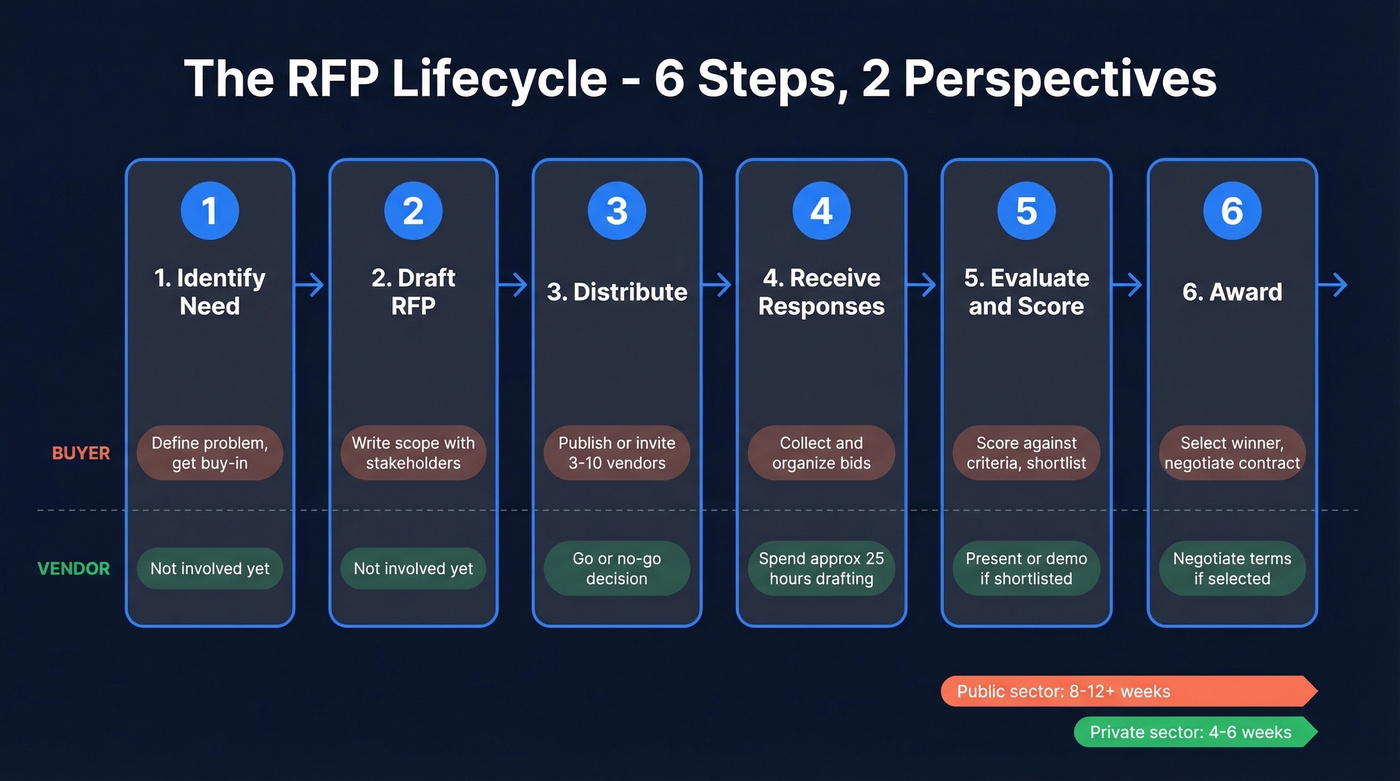
- Identify the need - Buyer defines the problem and gets internal buy-in. Vendors aren't involved yet.
- Draft the RFP - Buyer's procurement team writes the document with input from technical stakeholders and legal. Good buyers test their scope against market reality before publishing.
- Distribute - Buyer publishes the RFP (publicly for government, selectively for private sector). Private-sector RFPs typically invite 3-10 vendors; public tenders often attract dozens. Vendors receive it and start their go/no-go evaluation.
- Receive responses - Vendors submit proposals. The average vendor spends roughly 25 hours drafting and submitting a single response. That's three full workdays for one bid.
- Evaluate and score - Buyer's evaluation committee scores responses against published criteria. Shortlisted vendors get invited for presentations or demos.
- Award - Buyer selects a vendor and begins contract negotiation. The RFP itself isn't a contract - it's an invitation to bid.
Public sector timelines run longer due to statutory procedures and required procurement steps. Private-sector RFPs often wrap in 4-6 weeks from release to award; government RFPs stretch to 8-12+ weeks.
RFP response platforms like Loopio, Responsive, and RFPIO help teams move faster with compliance checks, content libraries, and AI-assisted drafting so proposal teams can focus on strategy instead of formatting.
What a Real RFP Section Looks Like
Most guides define a request for proposal without ever showing one. Here's a simplified scope section from a hypothetical IT services RFP - the kind of language you'd actually encounter:
Section 3: Scope of Work
The City of Riverside seeks a qualified vendor to provide managed IT support for 14 municipal buildings, covering approximately 850 endpoints. Services shall include 24/7 help desk support, network monitoring, patch management, and quarterly security audits. The selected vendor must maintain a minimum 99.5% uptime SLA and provide on-site support within 4 business hours of a Severity 1 ticket. Contract term: 36 months with two optional 12-month renewals. Proposals must include a fixed monthly fee and a per-incident rate for out-of-scope work.
That's 90 words, and it tells a vendor exactly what they're bidding on. If your RFP's scope section doesn't read with this level of specificity, you'll get proposals you can't compare - and you'll deserve the mess that follows.
RFP Benchmarks That Actually Matter
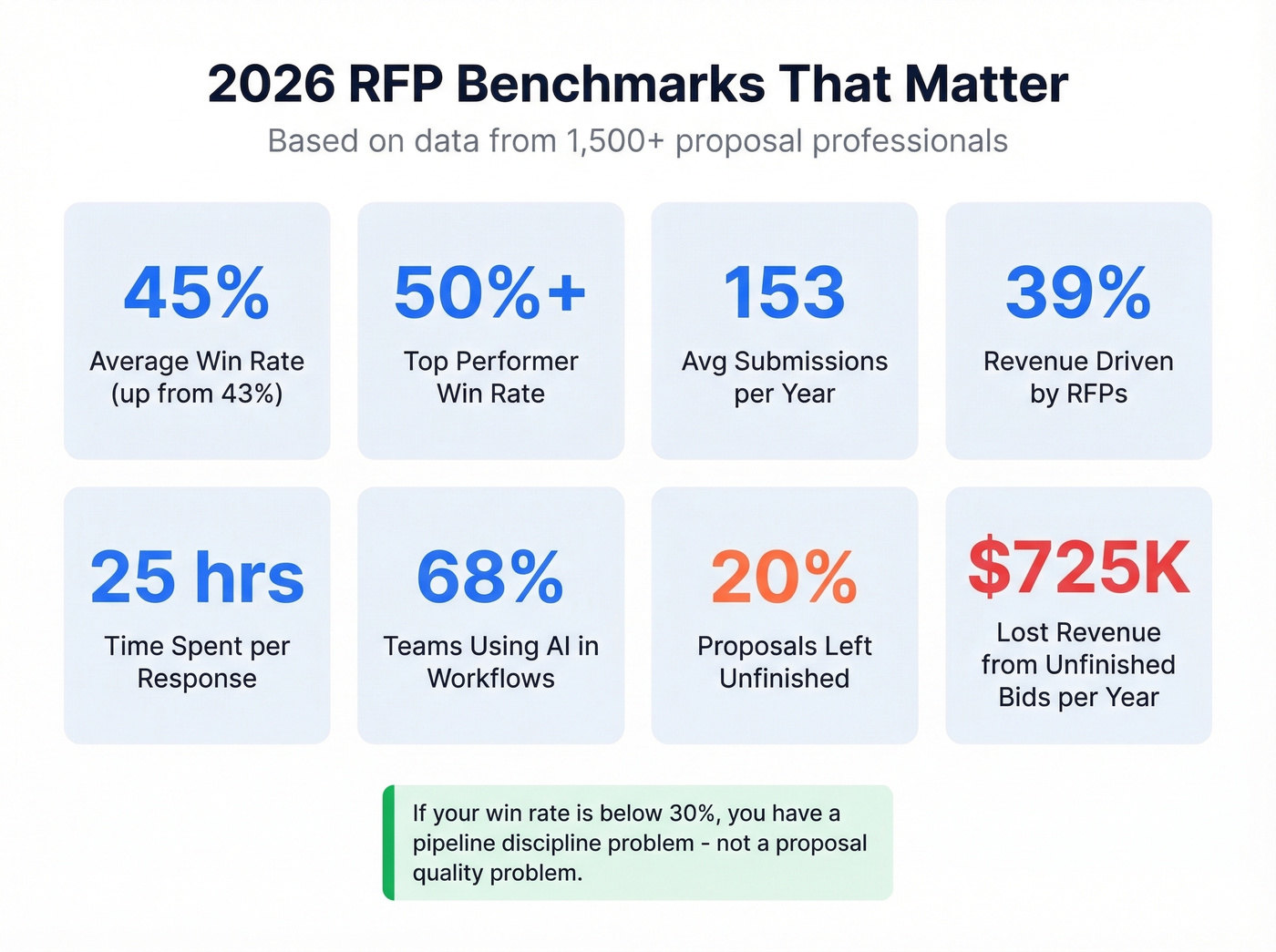
Most guides give you a definition and stop. The numbers tell a more interesting story. The 2026 Loopio Report draws on insights from 1,500+ proposal professionals across industries.
| Metric | Number |
|---|---|
| Average win rate | 45% (up from 43%) |
| Enterprise win rate | 47% |
| Top-performer win rate | 50%+ |
| Avg. submissions/year | 153 (down from 175) |
| Revenue from RFPs | 39% avg; 46% in Ad/Telecom |
| AI adoption in workflows | 68% of teams |
| Unfinished proposals | ~20% |
| Cost of unfinished proposals | ~$725K/year lost revenue |
That last row deserves a pause. One in five proposals goes unfinished, and the average organization loses an estimated $725K per year in revenue they never pursue. The discipline to say "no" to bad-fit RFPs is worth more than any AI drafting tool.
On the flip side, the ROI can be absurd when the fit is right. One agency owner on r/agency reported winning a ~$130K contract from an 18-page slide deck that took roughly three hours to create.
Let's be honest: most companies respond to too many RFPs, not too few. If your win rate is below 30%, you don't have a proposal quality problem - you have a pipeline discipline problem. Cut your submissions by a third, invest the freed-up hours in the remaining proposals, and watch win rates move toward that 45-50% range.
The shift toward AI is accelerating fast. 68% of teams already use generative AI in their RFP workflows, and the 2026 trend is moving from basic drafting assistance to agentic AI that handles compliance checks and requirement shredding automatically.

You spend 25 hours on every RFP response - don't waste them pitching the wrong stakeholder. Prospeo gives you verified emails and direct dials for the actual decision-makers behind procurement, so you can build relationships before the RFP even drops. 300M+ profiles, 98% email accuracy, 30+ filters including buyer intent.
Win more RFPs by reaching evaluators directly - starting at $0.01 per email.
How to Score RFP Responses
If you're issuing an RFP without a weighted scoring rubric, you're wasting everyone's time. Vendors invest almost 24 hours per response on average. They deserve to know how they'll be judged.
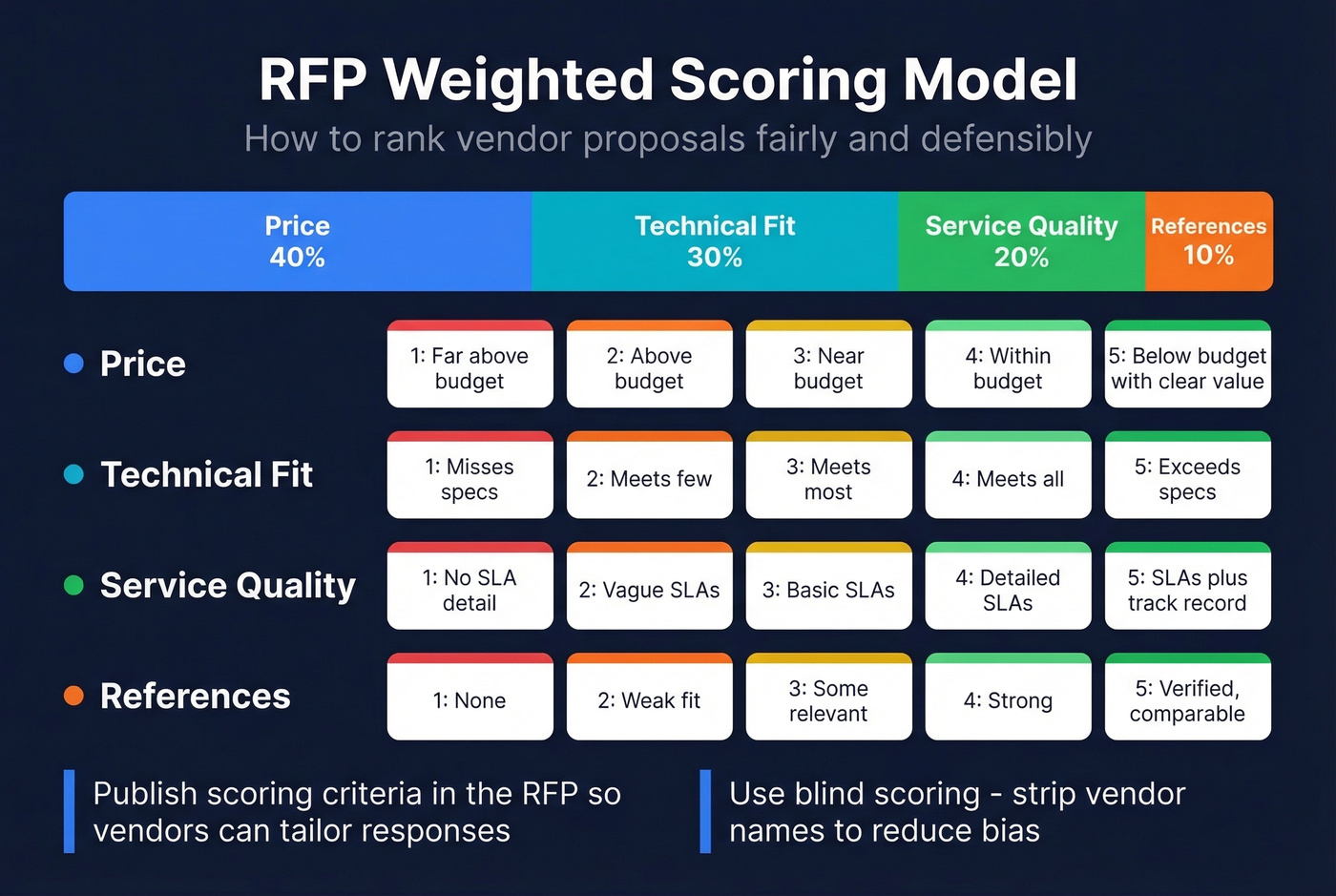
The standard approach is weighted scoring. Here's a 5-point model adapted from Responsive's scoring guide:
| Criterion | Weight | 1 (Non-compliant) | 2 (Minimally) | 3 (Partially) | 4 (Mostly) | 5 (Fully compliant) |
|---|---|---|---|---|---|---|
| Price | 40% | Far above budget | Above budget | Near budget | Within budget | Below budget with clear value |
| Technical fit | 30% | Doesn't meet specs | Meets few specs | Meets most specs | Meets all specs | Exceeds specs |
| Service quality | 20% | No SLA detail | Vague SLAs | Basic SLAs | Detailed SLAs | SLAs + proven track record |
| References | 10% | None provided | Weak relevance | Some relevant | Strong and relevant | Verified, directly comparable |
Multiply each score by its weight, sum the totals, and you've got a defensible ranking. Two practices separate good evaluators from sloppy ones: publish your scoring approach in the RFP itself so vendors can tailor their responses, and use blind scoring - strip vendor names from proposals before evaluation to reduce bias.
Assign each section to the subject-matter expert best equipped to evaluate it. Your finance team scores pricing. Your engineers score technical fit. Nobody scores everything.
RFP vs RFI vs RFQ (and the Rest)
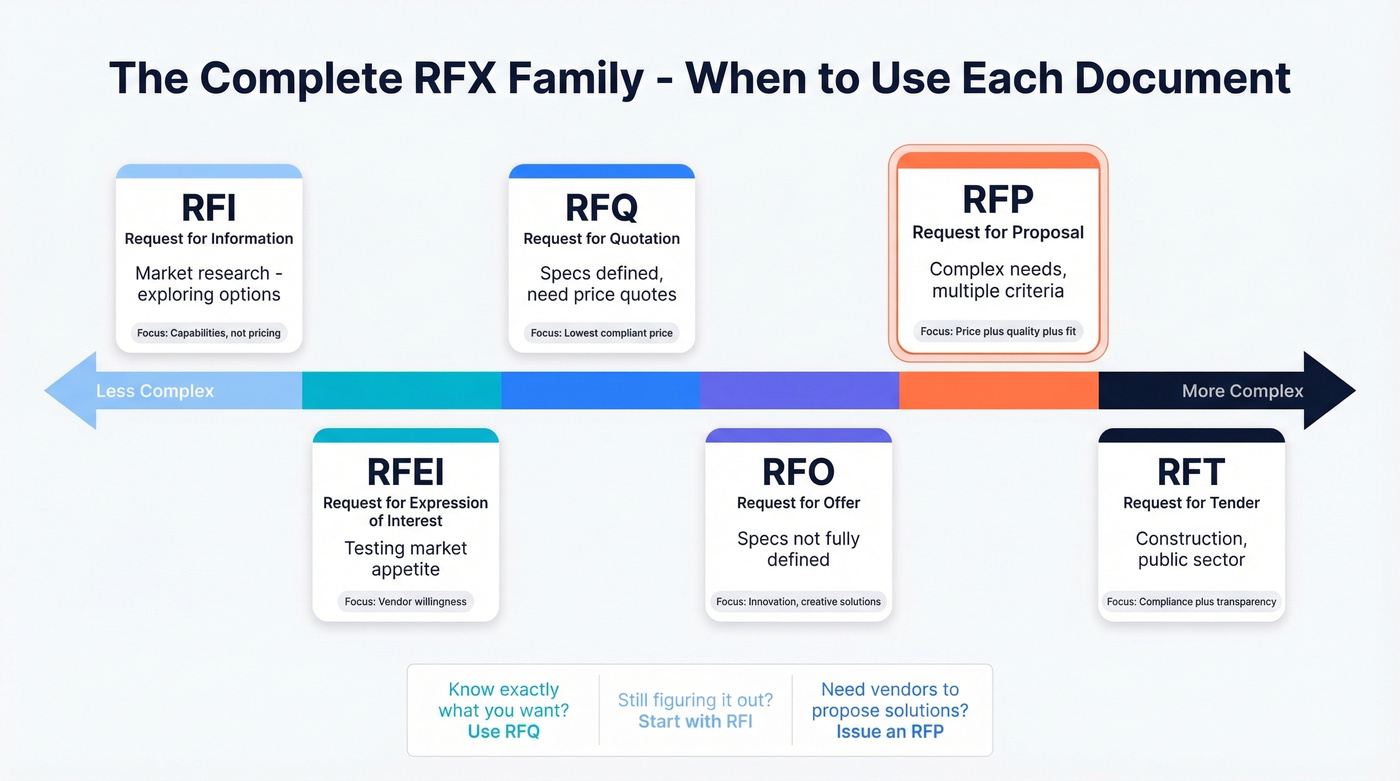
The full RFX family has six document types, and knowing when to use each one saves you from issuing the wrong document for your situation.
| Document | Purpose | When to Use | Evaluation Focus |
|---|---|---|---|
| RFI | Market research | Early stage, exploring options | Capabilities, not pricing |
| RFQ | Price comparison | Specs are defined, need quotes | Lowest compliant price |
| RFP | Solution evaluation | Complex needs, multiple criteria | Price + quality + fit |
| RFO | Open-ended solutions | Specs aren't fully defined | Innovation, creative approaches |
| RFT | Formal tender/bid | Construction, public sector | Compliance + transparency |
| RFEI | Interest gauge | Testing market appetite | Vendor willingness + capability |
The complexity spectrum runs from RFI (simplest, non-binding, just gathering information) to RFT (among the most formal and regulated, common in construction and government). A request for proposal sits in the middle - structured enough to compare vendors fairly, flexible enough to evaluate beyond price alone.
Understanding the RFI in sales contexts is especially important: it's a low-commitment way for buyers to survey the market before committing to a full procurement cycle. Sales teams that receive an RFI should treat it as an early opportunity to shape the eventual RFP criteria in their favor.
If you know exactly what you want and just need the cheapest compliant option, issue an RFQ. Still figuring out what's possible? Start with an RFI. The RFP is for when you need vendors to propose solutions, not just quote prices.
Public vs Private Sector RFPs
Whether taxpayer money is involved changes everything about how the process runs.
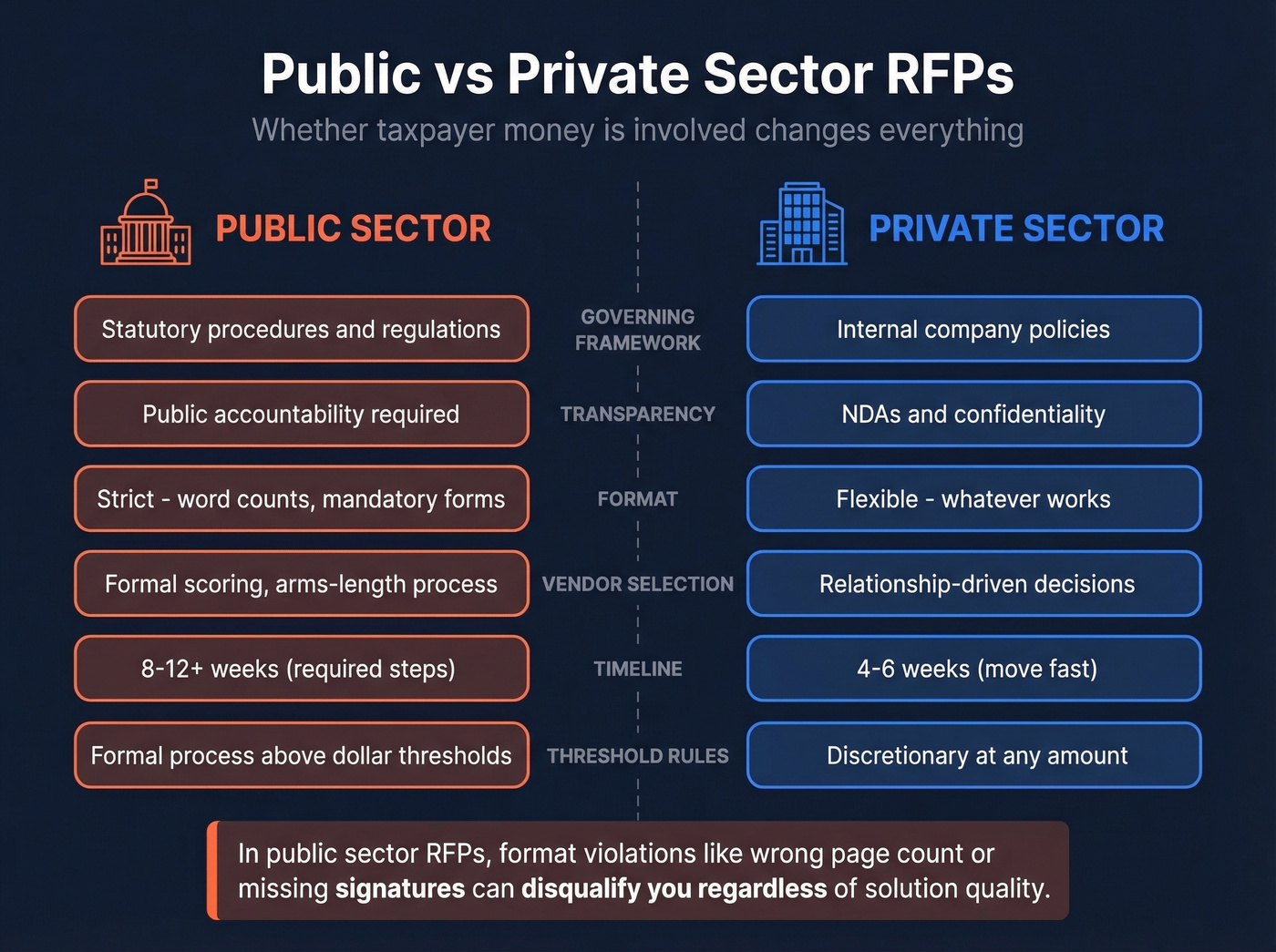
| Dimension | Public Sector | Private Sector |
|---|---|---|
| Governing framework | Statutory procedures | Internal policies |
| Transparency | Public accountability | NDAs, confidentiality |
| Format requirements | Strict (word count, forms) | Flexible |
| Vendor selection | Scoring systems, arms-length | Relationship-driven |
| Timeline | Longer (required steps) | Faster (weeks, not months) |
| Threshold rules | Formal process above $X | Discretionary |
Public sector RFPs exist in a world of mandatory transparency and accountability. Higher-value contracts trigger formal, advertised tender processes. Format violations - wrong page count, missing signatures - can disqualify you regardless of how good your solution is. We've seen strong vendors lose on technicalities that had nothing to do with their actual capabilities.
Private sector procurement is more flexible and relationship-driven. You might get invited to respond based on a referral, and the evaluation process can involve direct negotiation rather than rigid scoring. But "flexible" also means less predictable - the rules aren't always published, and sometimes the winner was picked before the RFP went out.
Common RFP Mistakes
Buyer-Side Mistakes
The $125/server RFP from the intro is a vivid example of what happens when scope and pricing assumptions don't match market reality. When your RFP doesn't reflect market-rate pricing or realistic timelines, serious vendors won't bother responding. You'll get proposals from companies desperate enough to bid on anything - and that's exactly who you don't want running your infrastructure.
There's a paradox in scoping: too prescriptive and you kill vendor innovation; too vague and you get proposals you can't compare. The best RFPs define the outcome clearly while leaving room for vendors to propose how they'll get there.
Vague evaluation criteria are a close second. If your RFP says "proposals will be evaluated on quality and value" without defining weights or rubrics, you're setting up a subjective process that's hard to defend internally. We've seen procurement teams struggle to justify their selection when a losing vendor pushes back - and the root cause is almost always criteria that were never specific enough to begin with.
Vendor-Side Mistakes
The number one vendor mistake is responding to RFPs you shouldn't. Skip the ones where you're clearly not the right fit, where the budget is unrealistic, or where the RFP reads like it was written for a specific incumbent. Lack of go/no-go discipline leads to overextended teams, rushed proposals, and the kind of quality erosion that tanks your win rate across the board.
Compliance failures are the most preventable reason proposals get rejected. Missing forms, incorrect file naming, incomplete certifications, unsigned documents, page limit violations. These aren't judgment calls - they're checkboxes. A vendor checklist framework with roughly 90 checkpoints exists specifically because these errors are so common and so avoidable.
Set internal deadlines 5-7 days before the actual submission date. That buffer accounts for executive review, upload issues, and the inevitable last-minute changes that every proposal goes through.
RFP Response Checklist for Vendors
Before you invest 25 hours in a proposal, run through this. For a more exhaustive version, the Pursuit 90-checkpoint framework covers everything from pre-bid research to post-submission follow-up.
- Go/no-go decision - Does this RFP match your capabilities, capacity, and ideal client profile? If you can't answer yes to all three, walk away. (If you need a repeatable way to define that profile, use an ideal client profile template.)
- Read the full RFP - Cover to cover, including appendices and amendments. Every single page.
- Build a compliance matrix - Map every requirement in the RFP to a section in your response. This is your insurance policy against disqualification.
- Identify the decision-makers - Know who's evaluating your proposal. For private-sector RFPs, the procurement lead's contact info isn't always published. Tools like Prospeo can help you verify the right email before you send a 25-hour proposal to a dead address.
- Assign sections to owners - Technical sections go to engineers. Pricing goes to finance. Nobody writes the whole thing alone.
- Set an internal deadline - 5-7 days before the real one. No exceptions.
- Final compliance check - File naming, page limits, signatures, required forms. Run through every submission instruction line by line.
70% of the buyer's journey happens before the RFP hits your inbox. The vendors who win at 50%+ aren't waiting for distribution - they're already in conversations with the right people. Prospeo's intent data tracks 15,000 topics so you can spot organizations actively researching your solution before they ever publish a request for proposal.
Stop reacting to RFPs. Start finding buyers before they go to market.
FAQ
What does RFP stand for?
RFP stands for Request for Proposal - a formal document organizations use to solicit detailed bids from vendors for a specific project or service. It's the standard procurement mechanism for complex purchases where price alone isn't the deciding factor.
What is an RFP in sales?
In sales, a request for proposal signals that a buyer has budget, a defined need, and a timeline - all the ingredients of a real deal. Teams that treat RFPs strategically and respond only to well-fit opportunities consistently outperform those that respond to everything. Top performers maintain 50%+ win rates by being selective.
Is an RFP legally binding?
No. An RFP is an invitation to bid, not a contract. The binding agreement comes after a vendor is selected and both parties negotiate and sign a formal contract. Either side can walk away during the RFP process without legal obligation.
How long does the RFP process take?
Expect 4-12+ weeks from release to award. Private-sector RFPs typically move faster (4-6 weeks), while public-sector RFPs stretch to 8-12+ weeks due to statutory procedures, mandatory review periods, and required approval steps.
How do I find the right contact for an RFP?
For public-sector RFPs, contact information is published in the document. For private-sector RFPs, use a B2B data platform to find and verify the procurement lead's email - especially when the RFP doesn't list a direct contact. Getting this right before you invest days in a proposal saves you from the frustrating experience of submitting great work that nobody reads.