

What Is a Sales Cycle? The Complete Guide With Benchmarks
58% of B2B professionals say their sales cycles got longer this year. The average deal now involves 6.3 stakeholders, up to 8 touchpoints, and enough internal meetings to fill a calendar for months. If you've ever wondered why your pipeline feels like it's moving through wet concrete, you're not alone. The fix isn't "more activity." It's understanding the machine your deals actually move through.
Here's the short version: a sales cycle is the repeatable sequence of stages a deal follows from first touch to closed-won. There are 7 stages. Median SaaS cycles run about 84 days, and many B2B teams hover around 120 days. The #1 mistake that silently inflates cycle time is poor qualification, followed closely by bad contact data that wastes the entire first stage.
What Is a Sales Cycle and Why Does It Matter?
A sales cycle is the repeatable sequence of stages a single deal moves through, from the moment a rep identifies a prospect to the moment the contract is signed. It gives your team a shared language for diagnosing where deals stall, why they stall, and what to do about it.
People confuse three related terms constantly:
| Term | What It Is | Think of It As |
|---|---|---|
| Sales cycle | Stages one deal follows | The journey |
| Sales process | Methodology your team uses | The playbook |
| Sales pipeline | Snapshot of all active deals | The dashboard |
Your cycle is what happens to a deal. Your sales process is how your team is trained to move deals through those stages. Your pipeline is the bird's-eye view of every deal in flight right now.
B2B vs. B2C Differences
The differences aren't subtle.
| Factor | B2B | B2C |
|---|---|---|
| Decision maker | Committee (6.3 avg) | Individual or household |
| Primary driver | Logic, ROI, risk reduction | Emotion, convenience, price |
| Typical length | 3-6+ months | Minutes to weeks |
| Touchpoints | 8+ across multiple channels | 1-3 |
B2B cycles are committee-driven and logic-based. You're selling to a group that needs internal alignment, budget approval, and often legal review. B2C is fundamentally different - individual decisions, emotion-driven, and fast. Retail ecommerce alone is projected to hit nearly $1.8 trillion by 2028, but that's a different world entirely. The rest of this guide focuses on B2B, where cycle management determines whether you hit quota.
The 7 Sales Cycle Stages
Every B2B deal moves through these stages. Some compress, some expand, but the sequence holds.
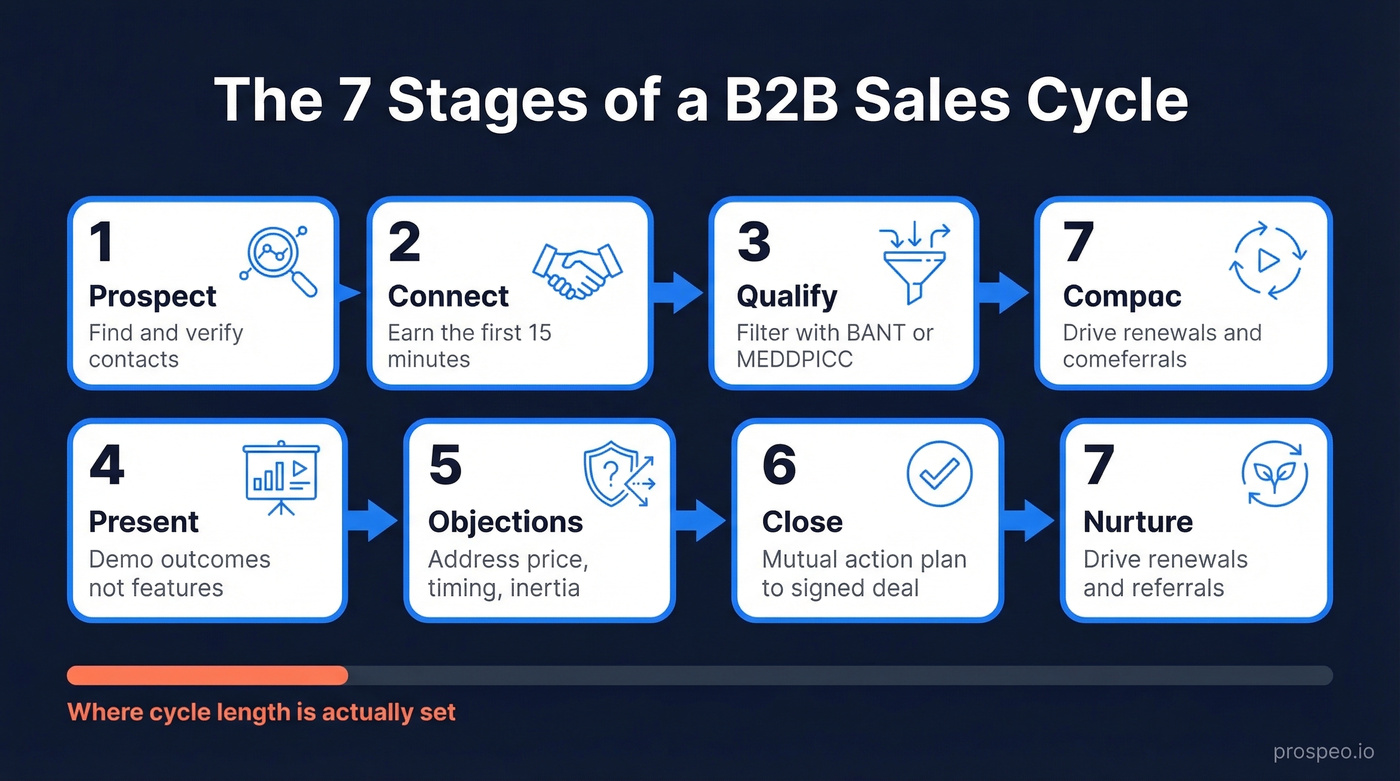
1. Prospect
This is where your cycle length is actually set. If your emails bounce, you're burning the engagement window chasing dead addresses instead of starting conversations. Outreach data suggests you have about 14 days to engage a buyer before the moment passes - bounces waste that window entirely. We've seen teams lose two or three weeks just rebuilding lists that should have been verified before a single email went out. Verify contact data before it enters your sequence; tools like Prospeo verify emails in real time with 98% accuracy, so reps start week one in conversations, not fixing contact lists.

2. Connect
First outreach - email, call, social touch, or warm intro. The goal isn't to pitch. It's to earn 15 minutes.
Reference something specific: a recent hire, a funding round, a tech stack signal. A rep who sends 50 tailored emails will outperform one who blasts 500 templates every time. Generic "I noticed your company..." openers get deleted before the second sentence.
3. Qualify Leads
This is where most cycles go wrong. Reps spend weeks nurturing prospects who were never going to buy. With 6.3 stakeholders per deal, you need to know early whether you're talking to someone with authority, budget, and urgency - or just someone who's curious.
Here's a useful heuristic: the 10-3-1 rule. For every 10 qualified prospects, expect roughly 3 serious opportunities and 1 closed deal. If your ratios are worse, your qualification criteria are too loose.
| Framework | Best For | Skip When |
|---|---|---|
| BANT | High-volume SMB, transactional deals | Budget comes after business case |
| CHAMP | Buyer-centric orgs, mid-market | You need procurement-stage rigor |
| MEDDPICC | Enterprise, multi-stakeholder, long cycles | Deal size is under $50K |
The selection rule is simple. Deals under $50K with a single decision-maker: BANT. Deals over $50K with 3+ stakeholders: MEDDPICC. CHAMP sits in the middle for teams that lead with buyer challenges rather than budget questions.
4. Present Your Solution
Don't demo features. Demo outcomes.
Build your presentation around the prospect's own words: "You mentioned X costs you Y hours a week - here's how that changes." If you qualified well, this stage flows naturally from everything the buyer already told you. The moment you start showing features nobody asked about, you've lost the room.
5. Handle Objections
The four objections you'll hear on most deals: price, timing, competitor preference, and internal inertia. Every one of these is predictable. Maintain an objection library - document every objection your team hears, the best response, and the win rate for each. Update it monthly. If you're hearing objections you didn't prepare for, your qualification was weak.
6. Close the Deal
If you've qualified well, presented to the right stakeholders, and handled objections, the close is the result of everything before it. If you're "overcoming resistance" at this stage, something broke earlier.
Two techniques that work: the mutual action plan - a shared document with both sides' next steps, deadlines, and owners - and the alternative choice close ("Would you prefer to start with the pilot in Q3 or the full rollout in Q4?"). Both eliminate the "let me check internally" black hole that can add weeks to a deal.
7. Follow Up and Nurture
The deal is signed, but the cycle isn't over. Post-close follow-up drives renewals, expansions, and referrals - and referrals close about 3x faster than cold outreach. Schedule a 30-day check-in before the contract is even signed. Make it part of the onboarding handoff, not an afterthought.
Sales Cycle Benchmarks (2026)
The average B2B sales cycle runs 84-120 days, but that number is meaningless without context. A 90-day cycle is fast for manufacturing and painfully slow for retail SaaS.
By Industry
| Industry | Avg Cycle (Days) |
|---|---|
| Retail | 70 |
| Software | 90 |
| Financial Services | 98 |
| Technology | 121 |
| Healthcare | 125 |
| Manufacturing | 130 |
| Construction | 134 |
| Pharmaceuticals | 153 |
| Energy | 155 |
| Non-Profit | 162 |
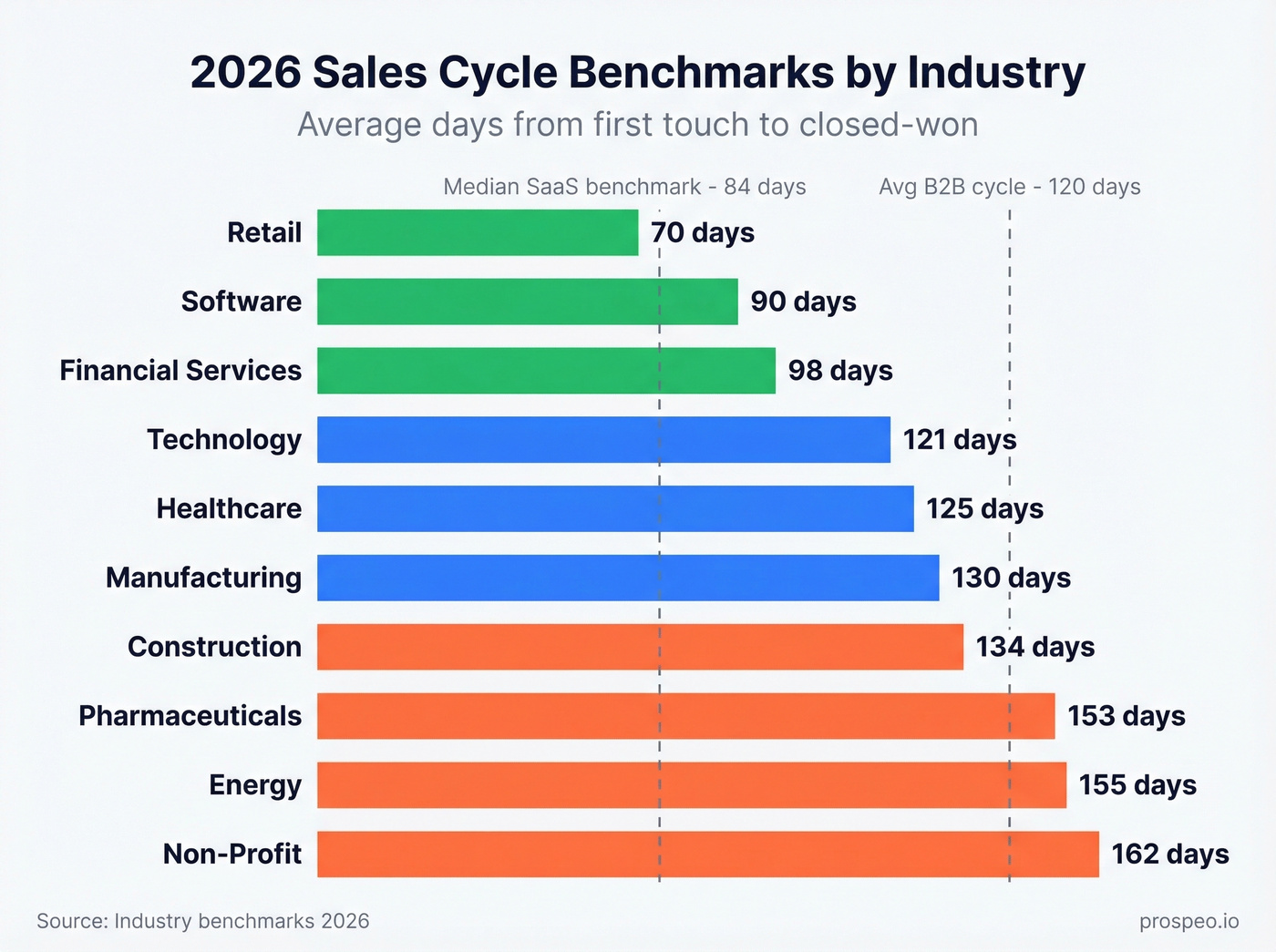
If you sell to energy or non-profits, a 5-month cycle is normal. Stop comparing yourself to SaaS.
Time Spent Per Stage
Not all stages consume equal time. Here's where deals actually sit:
| Stage | Software (days) | Manufacturing (days) | Financial Services (days) |
|---|---|---|---|
| Initial Contact | 14 | 21 | 18 |
| Proposal | 21 | 35 | 28 |
| Negotiation | 28 | 42 | 30 |
| Closing | 14 | 21 | 14 |
Negotiation eats the most time in every industry. If you want to compress your cycle, that's the stage to attack first - with better stakeholder alignment and pre-built sales assets that answer procurement questions before they're asked.
By Deal Size (ACV)
| Deal Size | Avg Cycle (Days) |
|---|---|
| < $1K | 25 |
| $1K-$5K | 40 |
| $5K-$10K | 55 |
| $10K-$50K | 75 |
| $50K-$100K | 120 |
| $100K-$250K | 170 |
| $250K-$500K | 220 |
| > $500K | 270 |
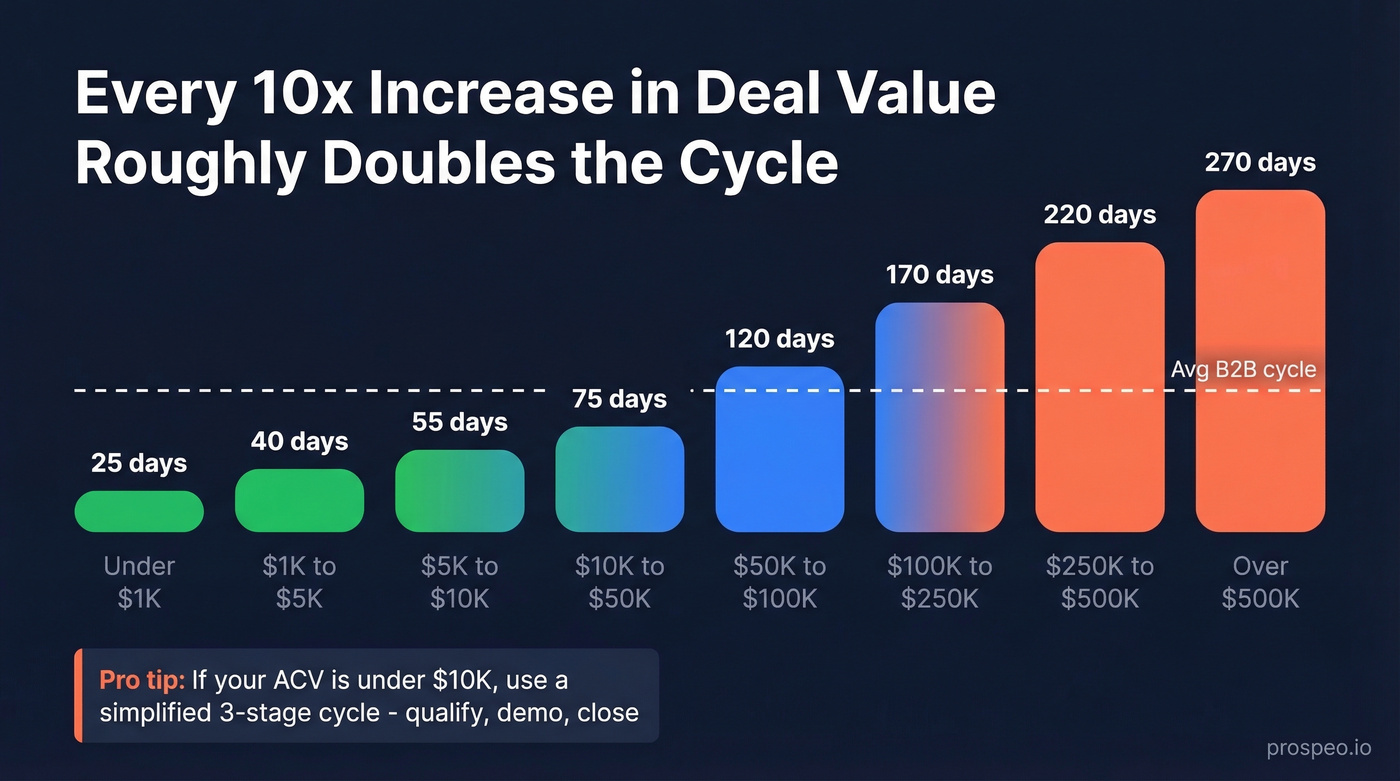
Every 10x increase in deal value roughly doubles the cycle. A $500K+ deal taking 9 months isn't a problem - it's physics.
Let's be honest: if your average contract value sits below $10K, you probably don't need a 7-stage process at all. A 3-stage cycle (qualify, demo, close) with tight timelines will outperform an enterprise playbook shoehorned onto a transactional deal. Over-engineering your cycle for small deals is one of the most common mistakes we see in pipeline reviews.
By Company Size
| Prospect Size | Avg Cycle (Days) |
|---|---|
| 1-10 employees | 38 |
| 11-200 employees | 57-77 |
| 201-1,000 employees | 95-115 |
| 1,001-10,000 employees | 135-158 |
| 10,001+ employees | 185 |
By Channel
| Channel | Low Complexity | Medium | High Complexity |
|---|---|---|---|
| Referrals | 20 | 35 | 60 |
| Email outreach | 40 | 65 | 90 |
| Social selling | 45 | 70 | 95 |
| Cold calling | 60 | 85 | 110 |
| Trade shows | 80 | 100 | 150 |
Referrals close about 3x faster than cold calling. Your channel mix isn't just a lead-gen decision - it's a cycle-length decision.

You just read it: the prospecting stage sets your entire cycle length. Bounced emails burn your 14-day engagement window chasing dead addresses. Prospeo verifies emails in real time with 98% accuracy - so reps spend week one in conversations, not rebuilding lists.
Stop losing two weeks to bad data before your cycle even starts.
Stage Conversion Rates
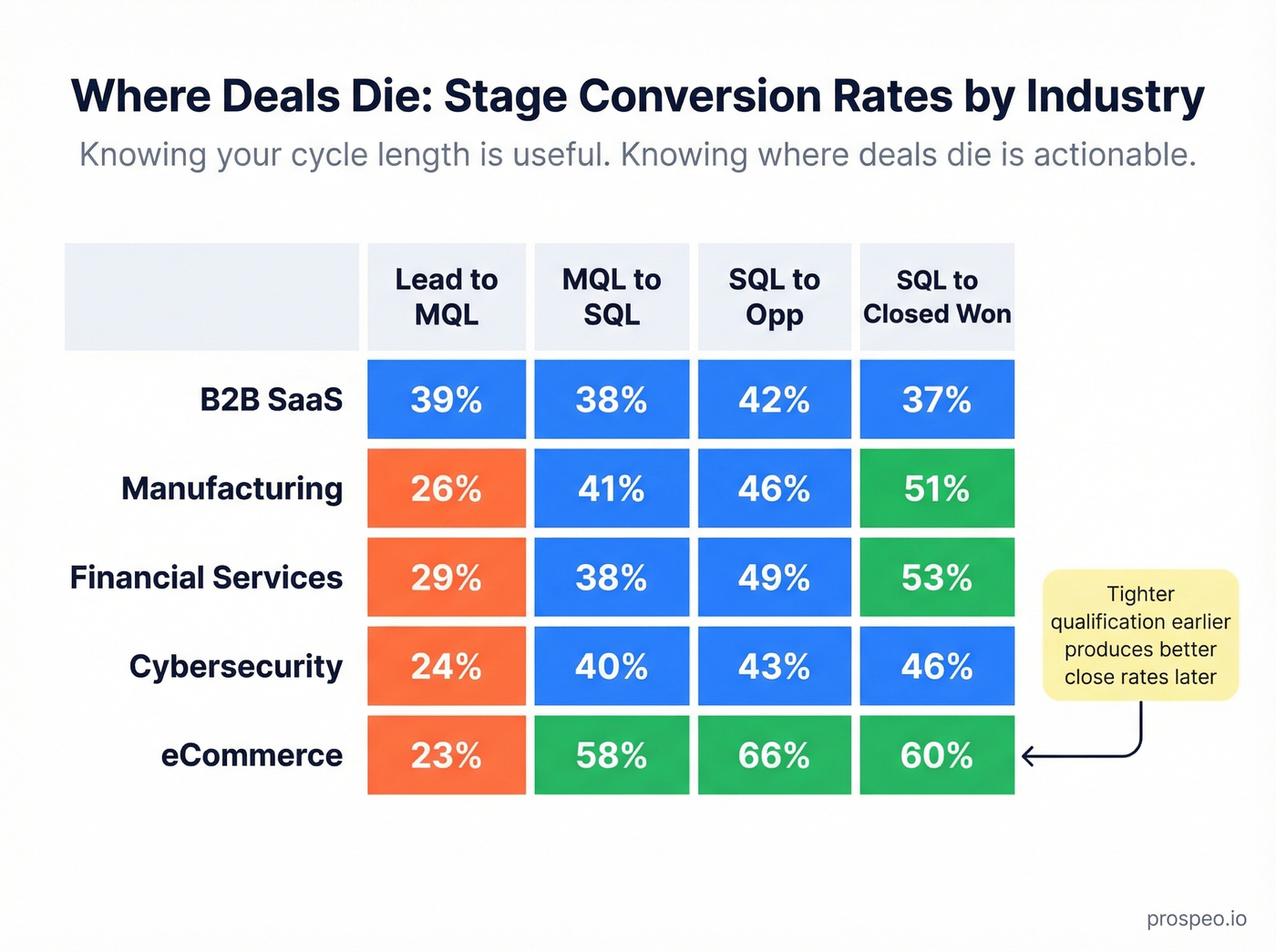
Knowing your cycle length is useful. Knowing where deals die is actionable.
| Industry | Lead to MQL | MQL to SQL | SQL to Opp | SQL to Closed Won |
|---|---|---|---|---|
| B2B SaaS | 39% | 38% | 42% | 37% |
| Manufacturing | 26% | 41% | 46% | 51% |
| Financial Services | 29% | 38% | 49% | 53% |
| Cybersecurity | 24% | 40% | 43% | 46% |
| eCommerce | 23% | 58% | 66% | 60% |
The MQL-to-SQL column deserves a closer look. While top-performing SaaS companies hit 38%, broader benchmarks put the typical rate at 15-21% - meaning most teams are well below the leaders. If your pipeline is stalling, start there, not at the top of funnel.
Look at eCommerce's SQL-to-Closed Won rate (60%) versus SaaS (37%). That's not because eCommerce reps are better closers - it's because the deals that reach SQL in eCommerce are already highly qualified. Tighter qualification earlier produces better close rates later. Every time.
Mistakes That Lengthen Your Cycle
These are the patterns we see over and over in pipeline reviews. Each one silently adds days or weeks.
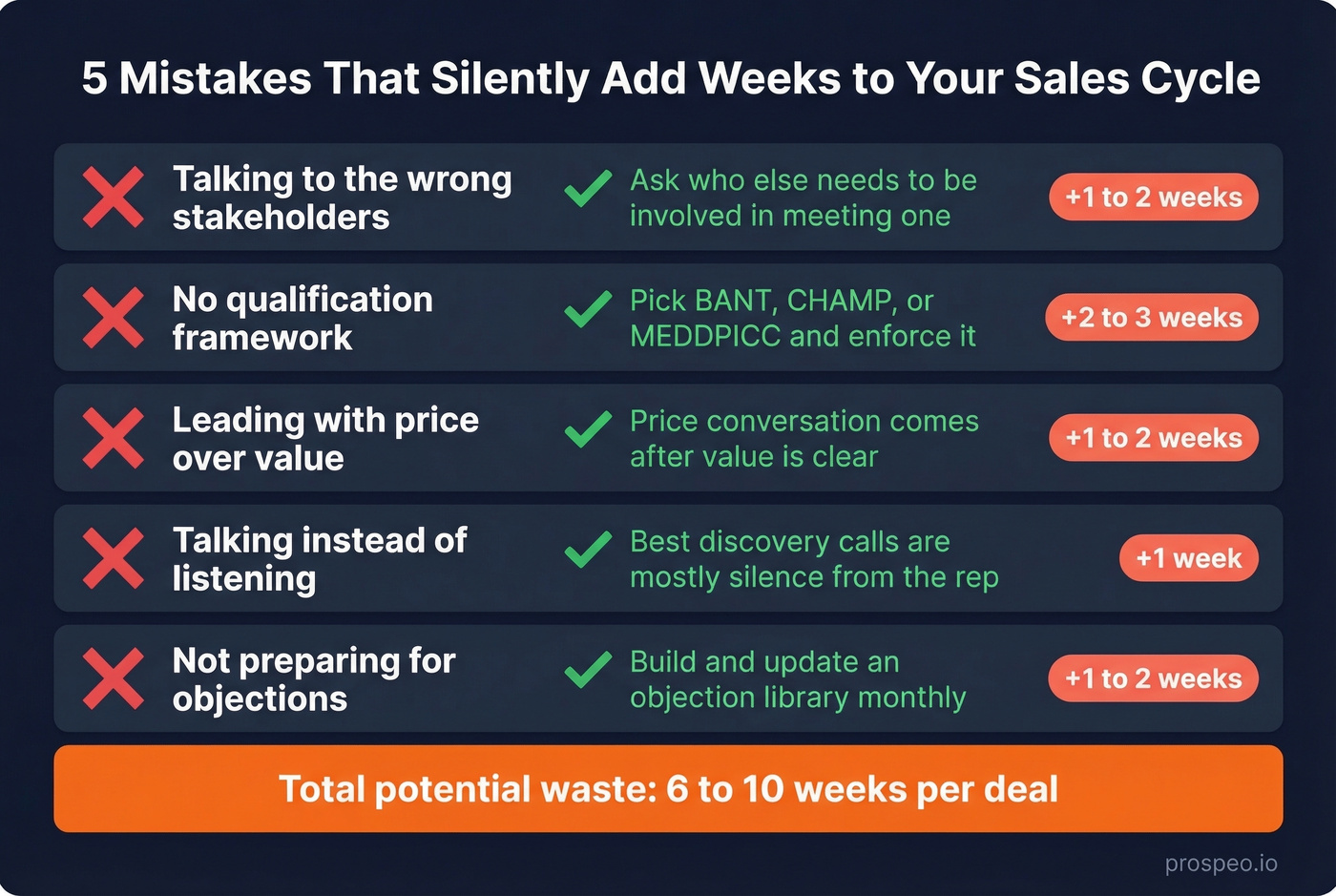
Talking to the wrong stakeholders. If you're three meetings deep with a champion who can't sign anything, you haven't progressed. Ask "who else needs to be involved?" in meeting one.
No qualification framework. Without BANT, CHAMP, or MEDDPICC, reps qualify on gut feel. Gut feel doesn't scale.
Leading with price over value. Discounts train buyers to negotiate harder and longer. The price conversation should happen after the value is clear, not before.
Talking instead of listening. The best discovery calls are mostly silence from the rep's side. If your team runs slides for 45 minutes, they're not learning what the buyer needs - they're performing.
Not preparing for objections. Every industry has predictable objections. If your team doesn't have documented responses, they're improvising under pressure, and it shows.
Using jargon buyers don't understand. Technical language impresses engineers, not CFOs. If the economic buyer can't follow your pitch, the deal stalls while your champion translates internally.
Relying on bad contact data. It's common to see 35-40% bounce rates when lists aren't verified, losing weeks at the prospecting stage rebuilding lists. Snyk cut bounce rates from 35-40% to under 5% after switching to Prospeo and grew AE-sourced pipeline 180%.
How to Shorten Your Sales Cycle
You can't eliminate stages, but you can compress them. These five tactics have the highest impact in our experience.
Multi-thread from meeting one. Don't wait until the proposal stage to discover there are three other people who need to approve. Ask directly: "Who else needs to be involved for us to move this forward?" and bring them onto the next call. This single habit can shave weeks off enterprise deals.
Use a qualification framework that matches your deal complexity. BANT for sub-$50K transactional deals. MEDDPICC for enterprise with procurement stages. Using the wrong framework is almost as bad as using none - it creates false confidence that a deal is progressing when it's actually stuck.
Fix your contact data at the prospecting stage. This is the fastest lever most teams ignore. Prospeo refreshes contact data every 7 days versus the 6-week industry average, so your list doesn't decay between campaigns. Clean data means reps spend day one sending emails that land, not troubleshooting deliverability.
Invest in automation and Digital Sales Rooms. Sales automation tools compress cycles by up to 15%, and Digital Sales Rooms - shared deal spaces with all assets in one place - can cut cycle time by up to 28%. If you're still emailing PDFs back and forth, you're leaving weeks on the table.
Track pipeline velocity. The formula: (Opportunities x Deal Value x Win Rate) / Cycle Length. This single metric tells you whether your pipeline is getting healthier or just bigger. The median SaaS optimal cycle runs 46-75 days - if you're above that, one of the four variables needs work.
With 6.3 stakeholders per deal, you need direct access to every decision-maker fast. Prospeo gives you 300M+ profiles, 125M+ verified mobiles, and 30+ filters - including buyer intent and job changes - so you qualify the full buying committee before your competitors find the first contact.
Reach all 6 stakeholders, not just the one who's curious.
FAQ
What is a sales cycle in simple terms?
A sales cycle is the full journey a single deal takes from first contact to signed contract, typically spanning seven stages: prospecting, connecting, qualifying, presenting, handling objections, closing, and follow-up. Tracking each stage helps teams identify bottlenecks and forecast revenue more accurately.
How long is the average B2B sales cycle?
84-120 days is a useful benchmark, but length varies dramatically by deal size and industry. Companies under 10 employees average 38 days; enterprises with 10,000+ staff average 185 days. Deals above $500K typically take around 270 days.
What's the difference between a sales cycle and a sales process?
A sales cycle describes the stages a single deal moves through from prospect to close. A sales process is the broader methodology - scripts, playbooks, tools - your team follows across all deals. The cycle is the journey; the process is the map.
What's the fastest way to shorten a sales cycle?
Multi-thread from the first meeting, apply a qualification framework matched to your deal size, and verify contact data upfront. Snyk cut bounce rates from 35-40% to under 5% using verified data and freed reps to spend week one in conversations instead of rebuilding lists.
How do you calculate pipeline velocity?
Pipeline Velocity = (Number of Opportunities x Average Deal Value x Win Rate) / Sales Cycle Length. Track it monthly to spot whether gains in one variable are being offset by regression in another - it's the single best health metric for your revenue engine.