

What Is CPQ? The Practitioner's Guide to Configure Price Quote Software
Your sales team just lost a $200K deal. Not because the product was wrong or the price was too high - because the quote took four days. The buyer went with a competitor who got a proposal back in 20 minutes.
That's the gap CPQ software exists to close.
So what is CPQ, exactly? Configure, Price, Quote software automates the entire journey from product configuration through pricing rules to a polished, approved proposal. Teams using it see 49% higher rep productivity, 28% shorter sales cycles, and 26% larger deals on average. Those aren't marginal improvements - they're the difference between hitting quota and missing it.
TL;DR - CPQ in 30 seconds
- Configure enforces product rules so reps can't quote incompatible components
- Price applies discounts, tiers, and contract rates automatically with margin guardrails
- Quote generates a branded, e-signable proposal and pushes it into your CRM and billing systems
- Result: multi-day, multi-person quoting collapses into a single conversation
Configure, Price, Quote: The Three Steps
CPQ breaks into three stages, each solving a distinct problem.
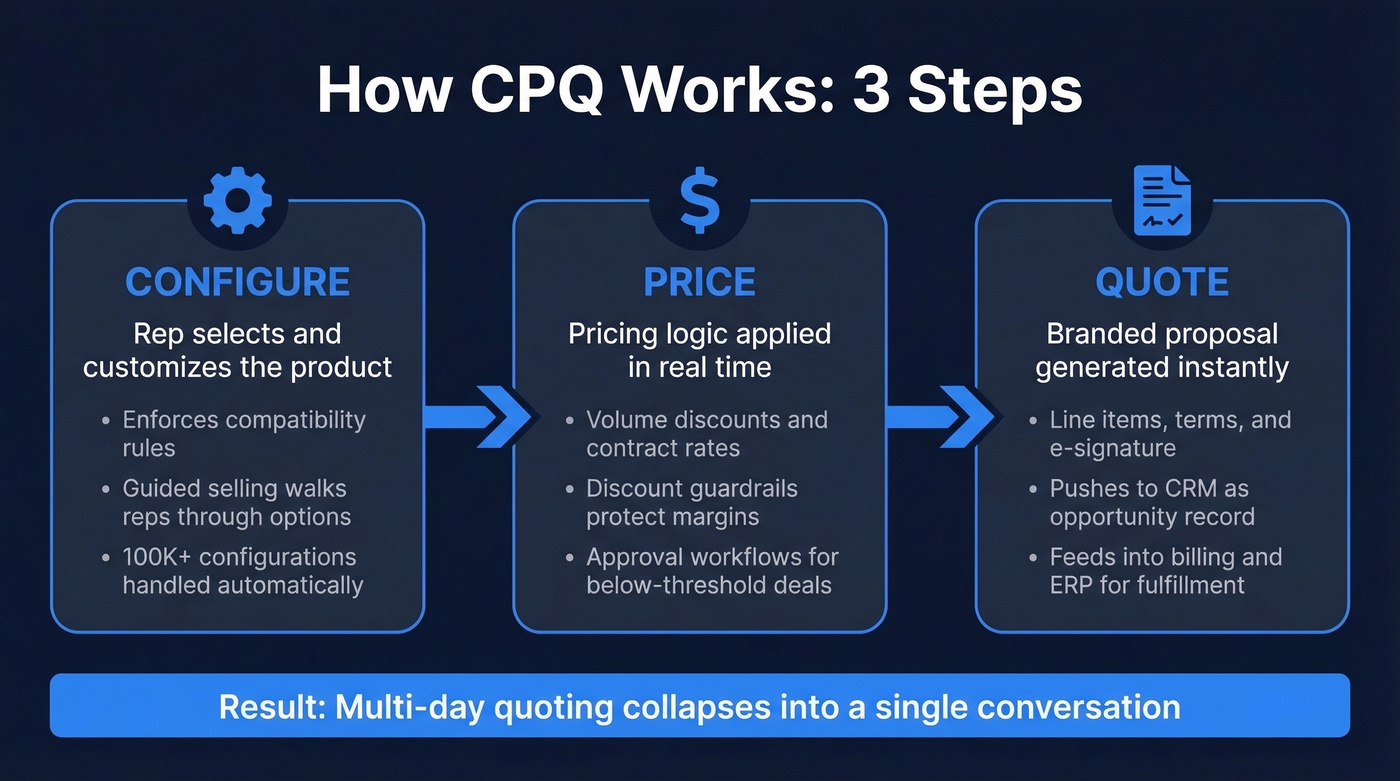
Configure is where a rep - or a buyer on a self-service portal - selects and customizes a product. Consider industrial equipment with five option categories of ten choices each: that's 100,000 possible configurations before you add a single accessory. A CPQ system enforces rules so reps can't quote incompatible components, and guided selling walks them through the decision tree without needing an engineer on the call.
Price applies the right pricing logic automatically. Volume discounts, contract-specific rates, regional adjustments, promotional tiers - all calculated in real time. Discount guardrails prevent reps from giving away margin, and approval workflows kick in when a deal falls below threshold.
Quote generates the actual document: a branded, accurate proposal with line items, terms, and e-signature capability. The best CPQ systems push this straight into your CRM as an opportunity record and downstream into billing or ERP for fulfillment. Salesforce puts it simply: it's a sales tool for companies to quickly and accurately generate quotes for orders.
The whole point is collapsing what used to be a multi-day, multi-person process into something a rep handles in a single conversation.
Why CPQ Exists
CPQ replaces the spreadsheet that only two people in the company understand. It replaces the Word doc that gets copy-pasted, edited by hand, and emailed to finance for a pricing check that takes 48 hours.
A fintech team on r/salesforce described exactly this: Word-based contracts causing billing mismatches, missing products in price lists, and manual re-entry creating discrepancies between what was quoted and what was actually charged. Sales was selling pricing models that couldn't be automatically billed - creating downstream ops debt that took months to untangle.
The Excel problem is even more insidious. Spreadsheet-based quoting works until the one person who built the formulas goes on vacation or leaves. Suddenly you've got a large, incomprehensible file that nobody trusts, version control is nonexistent, and product updates aren't reflected across teams. A configure price quote platform replaces that single point of failure with a central rules engine anyone can use.
CPQ by the Numbers
The CPQ market hit [$3.46 billion in 2025](https://www.grandviewresearch.com/industry-analysis/cpq-software-market-report) and is projected to reach $10.89 billion by 2033 - a 15.6% CAGR. That's not a niche category anymore.
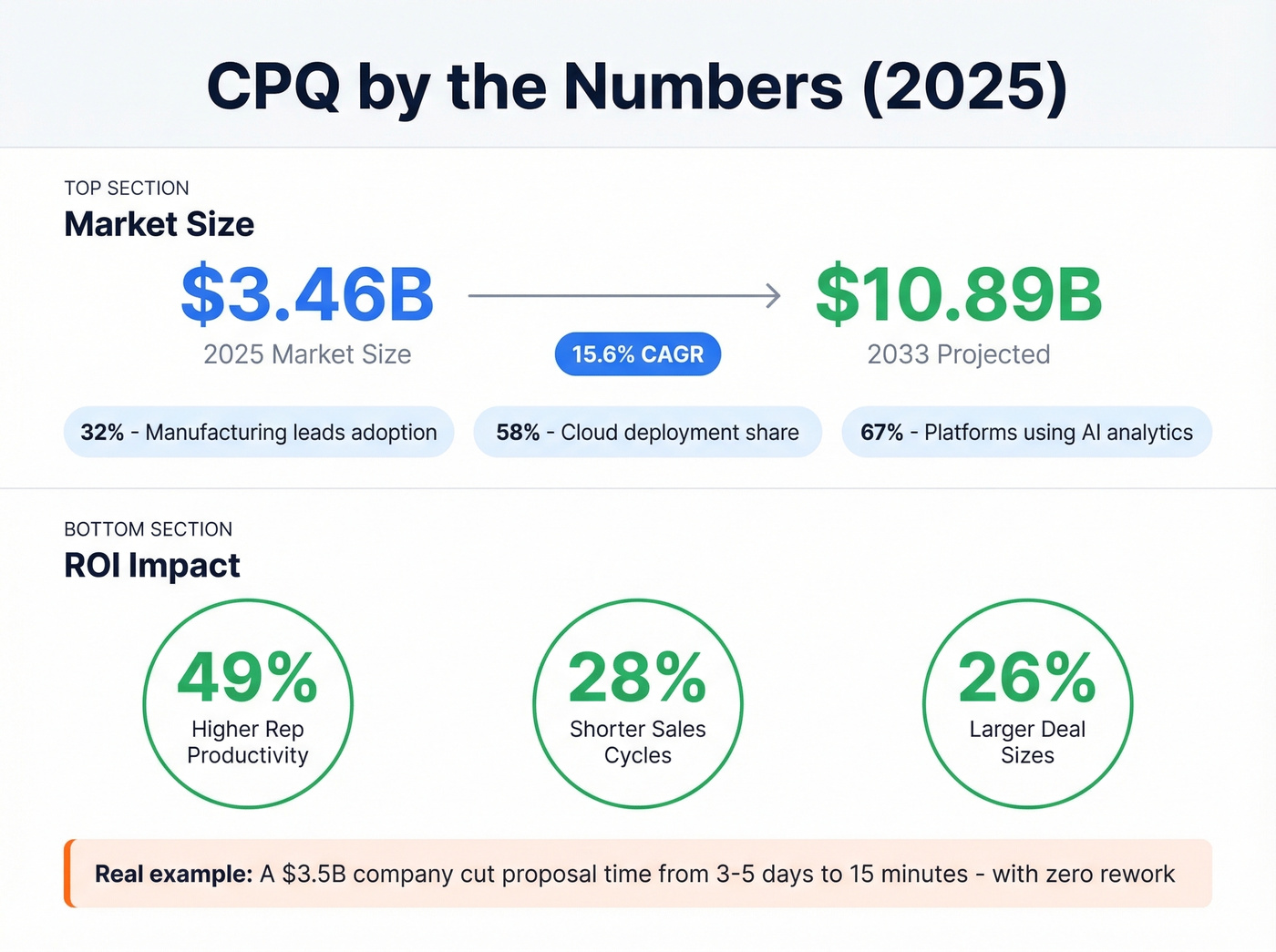
Manufacturing leads adoption with 32% of market revenue. Cloud deployment holds 58% share and is growing at nearly 19% annually. North America accounts for 37-39% of the global market depending on the research firm, but Asia-Pacific is the fastest-growing region. Nearly 67% of CPQ platforms now incorporate AI-based analytics for pricing optimization and quote accuracy.
The ROI case is straightforward. Aberdeen's benchmarks show adopters averaging 49% productivity gains, 28% shorter cycles, and 26% larger deals. One concrete example: a $3.5B power protection company cut proposal generation from 3-5 days to 15 minutes after implementation, with 100% elimination of proposal rework. That's not a rounding error. That's a fundamentally different sales motion.
Who Needs CPQ (And Who Doesn't)
You need CPQ when:
- Your products have complex configurations - industrial equipment, medical devices, specialty vehicles, IT managed services, HVAC systems
- Pricing involves volume tiers, usage-based models, contract-specific rates, or multi-year escalators
- Reps regularly quote incompatible configurations or unauthorized discounts
- Approval workflows involve 3+ people and take more than a day
Skip CPQ if you have fewer than 50 SKUs with straightforward pricing, your team is under 10 reps, and deals follow a predictable structure. That Reddit fintech team? They concluded Salesforce CPQ was "deemed overkill" for their structured pricing model. They were right.
Let's be honest: if your average deal size is under $15K and your catalog fits on one page, a proposal tool like PandaDoc plus verified prospect data gets you 80% of the benefit at 10% of the cost. Not every quoting problem requires a six-figure platform.

CPQ solves the quoting bottleneck. But the bigger bottleneck? Finding the right buyers to quote in the first place. Prospeo gives your reps 300M+ verified contacts with 30+ filters - buyer intent, technographics, funding, headcount growth - so your CPQ pipeline never runs dry.
Fill your CPQ pipeline with verified decision-makers at $0.01 per email.
Top CPQ Vendors Compared
Here's how major players stack up based on Gartner Peer Insights ratings, plus typical market pricing:
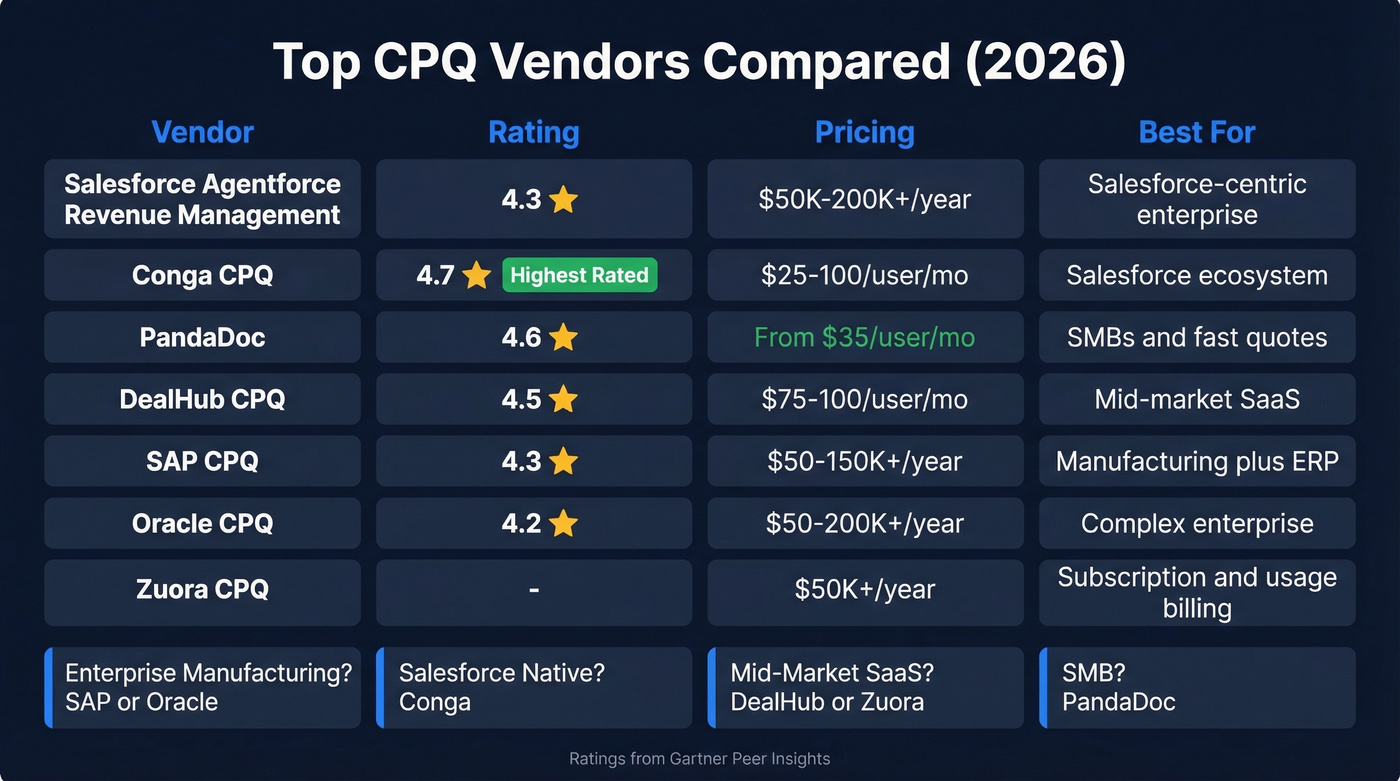
| Vendor | Rating | Reviews | Pricing | Best For |
|---|---|---|---|---|
| Salesforce Agentforce Revenue Management | 4.3 | 271 | $50K-200K+/year | Salesforce-centric enterprise |
| Conga CPQ | 4.7 | 267 | $25-100/user/mo | Salesforce ecosystem |
| PandaDoc | 4.6 | 190 | From $35/user/mo | SMBs, fast quotes |
| DealHub CPQ | 4.5 | 114 | ~$75-$100/user/mo | Mid-market SaaS |
| SAP CPQ | 4.3 | 107 | $50-150K+/year | Manufacturing + ERP |
| Oracle CPQ | 4.2 | 148 | $50-200K+/year | Complex enterprise |
| Zuora CPQ | - | - | $50K+/year | Subscription/usage |
Some vendors specialize in visual 2D/3D product configuration - a niche capability that matters enormously for manufacturers but isn't relevant for most SaaS teams.
Enterprise manufacturing with ERP integration? SAP or Oracle. They're expensive and slow to implement, but nothing else handles deep BOM configurations with the same fidelity.
Salesforce-native teams? Conga has the highest Gartner Peer Insights rating among the vendors listed above. Salesforce Agentforce Revenue Management has the most reviews but a lower rating, and the SteelBrick end of sale in March 2025 created migration anxiety that still hasn't settled. If you're starting fresh, Conga deserves the first demo.
Mid-market SaaS with subscription complexity? DealHub or Zuora. DealHub is more accessible; Zuora goes deeper on usage-based billing.
SMBs who just need faster, cleaner quotes? PandaDoc. It's not a "real" CPQ in the enterprise sense, but for teams with simpler catalogs, it handles 90% of what you need at a fraction of the cost.
Why CPQ Implementations Fail
We've seen enough CPQ rollouts to know the pattern. The technology works. The implementation is where things break.
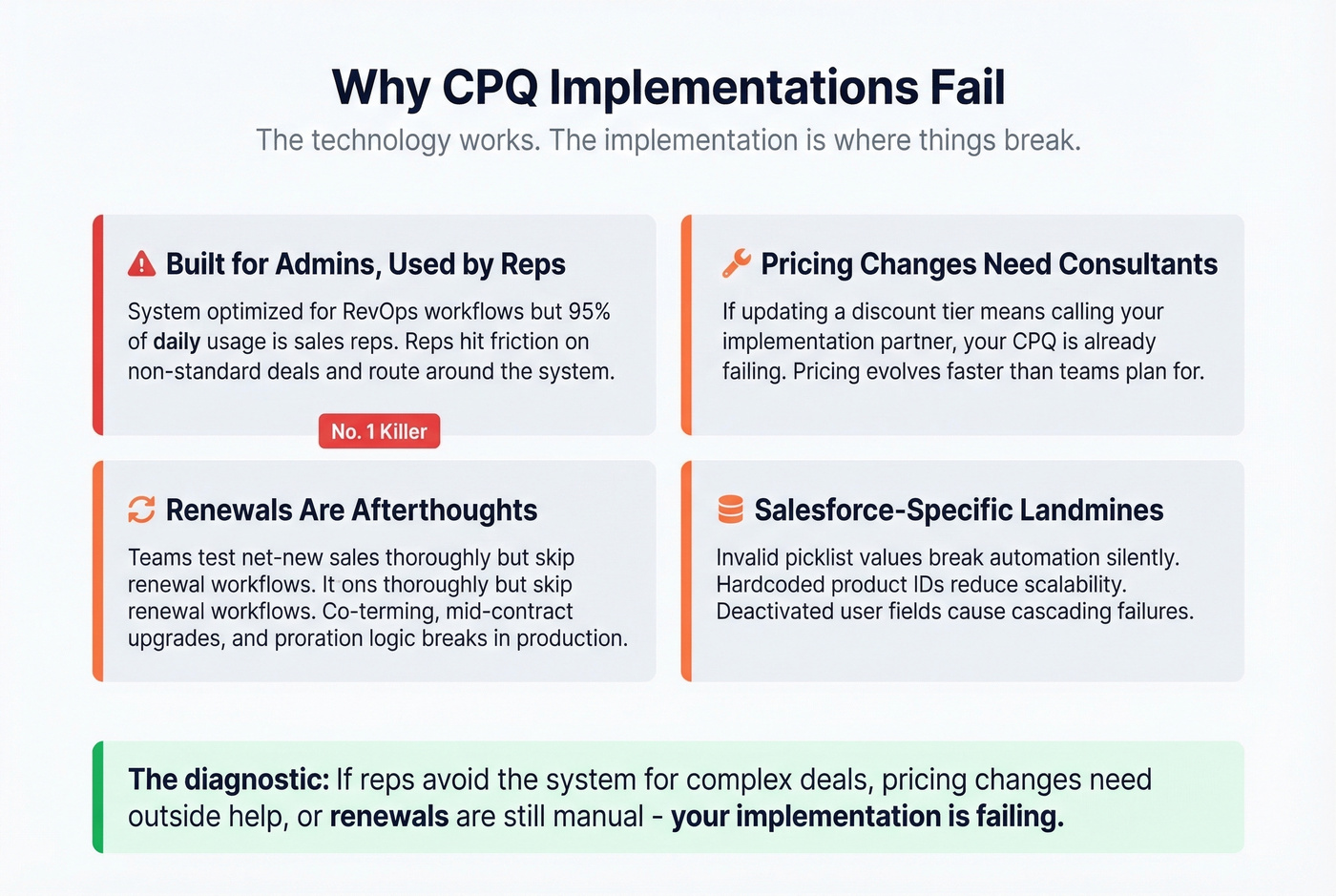
Built for admins, used by reps. The system gets optimized for RevOps workflows, but 95% of daily usage is sales reps. When reps hit friction on non-standard deals, they route around the system - and adoption craters. This is the number one killer, and it's almost always a design choice made in the first month of implementation that nobody revisits.
Pricing changes require consultants. If updating a discount tier means calling your implementation partner, your CPQ is already failing. Pricing evolves faster than most teams plan for.
Renewals are afterthoughts. Teams test net-new sales thoroughly but skip renewal workflows. Then co-terming, mid-contract upgrades, and proration logic breaks in production. We've watched this happen at three different companies in the past year alone.
Salesforce-specific landmines. Bulk product uploads with invalid picklist values break automation silently. Hardcoded product IDs reduce scalability. Renewal Owner fields pointing to deactivated users cause cascading failures that are maddening to debug.
The diagnostic is simple: if reps avoid the system for complex deals, if pricing changes need outside help, or if renewals are still manual - your implementation is failing regardless of what the dashboard says.
The Data Problem Upstream of CPQ
Here's the thing nobody talks about on vendor pages: your quote is only as good as the contact it's sent to.
You can build a perfect quoting system - flawless configurations, dynamic pricing, automated approvals, beautiful branded proposals. But if 15% of your CRM emails bounce, that investment leaks revenue before it starts.

This is where your data stack matters. In our experience, teams that skip the data audit before CPQ implementation regret it within 90 days. Prospeo solves this upstream - 98% email accuracy across 143M+ verified addresses with a 7-day refresh cycle means your automated quotes actually land in the right inbox. And 125M+ verified mobile numbers with a 30% pickup rate mean reps can follow up by phone the moment a quote arrives, which is when conversion probability peaks.
Clean data isn't optional when you're running configure price quote software. It's the prerequisite that makes the investment pay off.
Teams using CPQ see 28% shorter sales cycles. Teams pairing CPQ with accurate prospect data close even faster. Prospeo delivers 98% email accuracy and 125M+ verified mobile numbers - so reps spend time configuring quotes, not hunting for contact info.
Stop losing deals to bad data before the quote even starts.
AI and Agentic CPQ in 2026
The CPQ category is shifting fast. Salesforce's SteelBrick entered end of sale in March 2025, forcing thousands of teams to evaluate migrations - and most are looking at AI-native alternatives rather than like-for-like replacements.
Modern AI capabilities go beyond rule engines: contract data extraction via NLP, intelligent product recommendations based on deal history, automated handling of usage-based and hybrid pricing models, and no/low-code admin interfaces that reduce consultant dependency. The next frontier is agentic CPQ - autonomous pricing agents that negotiate within guardrails, adjust quotes based on real-time competitive signals, and handle multi-party approval chains without human intervention.
We're not fully there yet, but the trajectory is clear. Teams evaluating solutions in 2026 should weight AI roadmap heavily in vendor selection. The platforms that treat AI as a bolt-on will fall behind the ones building it into the pricing engine itself.
FAQ
What does CPQ stand for?
CPQ stands for Configure, Price, Quote - the three steps of turning a product configuration into a customer-ready proposal with accurate pricing and automated approvals. It's both an acronym and a software category covering tools from $35/user/month to $200K+/year.
How much does CPQ software cost?
SMB tools like PandaDoc start at $35/user/month. Mid-market platforms like DealHub run $75-100/user/month. Enterprise solutions from SAP, Oracle, or Salesforce typically cost $50K-200K+/year depending on seats, modules, and integration scope.
How long does implementation take?
SMB implementations can go live in weeks. Mid-market rollouts take 2-4 months. Enterprise CPQ with ERP integration typically spans 6-12 months and requires specialized consultants. The timeline scales with pricing complexity, not company size.
What's the difference between CPQ and a proposal tool?
Proposal tools generate documents. CPQ handles complex product configuration rules, dynamic pricing logic, discount governance, and approval workflows before generating the proposal. CPQ is the engine; the proposal is the output.
Do I need clean CRM data before implementing CPQ?
Yes - it's the single highest-ROI prep step. CPQ automates quoting, but quotes go to people. If your contact data is stale, quotes bounce and follow-up calls go nowhere. Verify your database before rollout so automated proposals actually reach decision-makers.