

What to Say Instead of "Just Following Up" - Templates That Get Replies
The average office worker receives over 120 emails per day. Your "just checking in" message is competing with all of them - and it's losing. Follow-ups contribute 42% of all cold email replies, which means nearly half your pipeline depends on what you write after the first send. If you're wondering what to say instead of following up with the same tired phrases, the answer is anything that gives the recipient a reason to care today.
The Only Framework Worth Memorizing
Three steps:
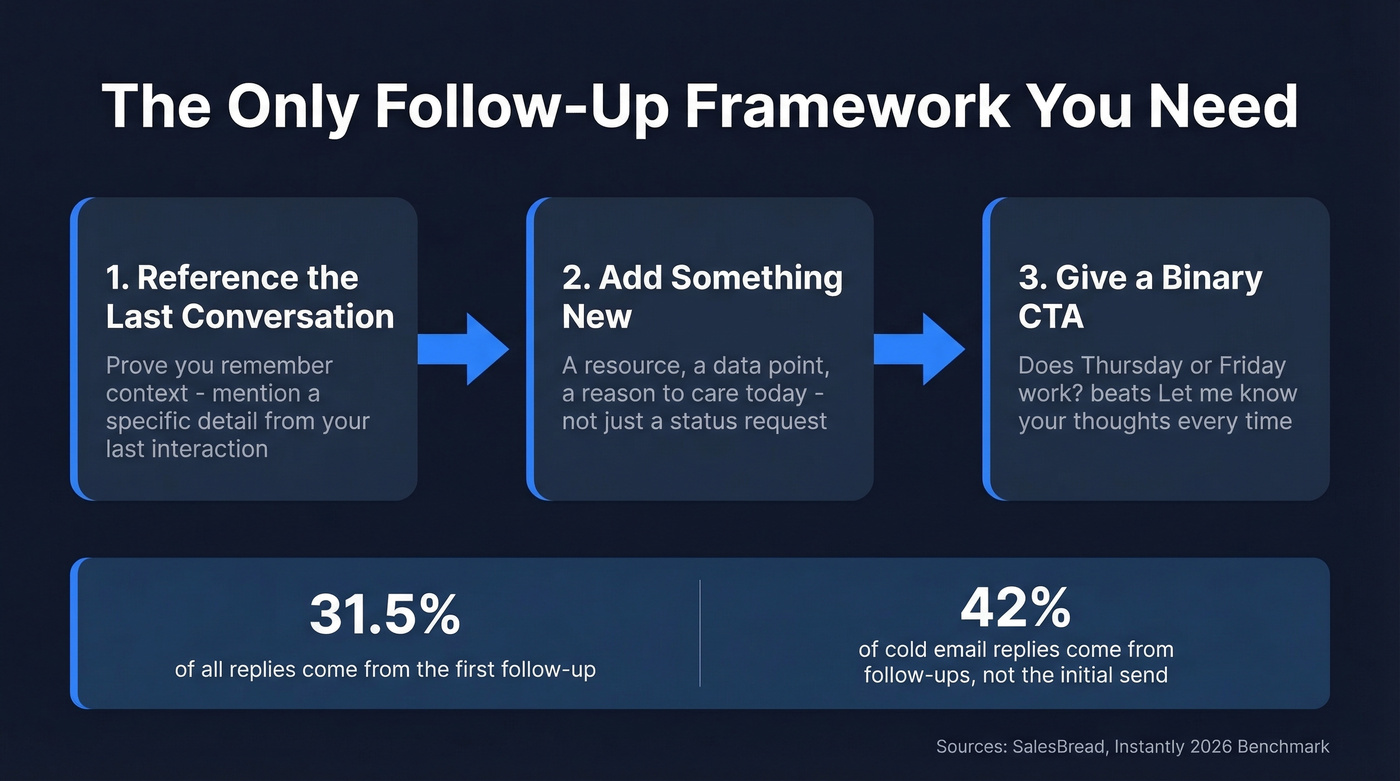
- Reference the last conversation - prove you're a human who remembers context.
- Add something new - a resource, a data point, a reason to care today.
- Give a binary CTA - "Does Thursday or Friday work?" beats "Let me know your thoughts."
Your first follow-up captures 31.5% of all replies in a sequence. That makes it a second first impression, not an afterthought. And if you care about reply rates, prioritize Tuesday and Wednesday - Wednesday consistently generates the highest numbers.
Why "Just Checking In" Kills Replies
"Just following up" doesn't fail because it's rude. It fails because it's invisible. It adds zero new information to a thread that already didn't get a response. The same goes for its cousin - if you're searching for what to say instead of checking in, the fix is identical: lead with value, not a status request.
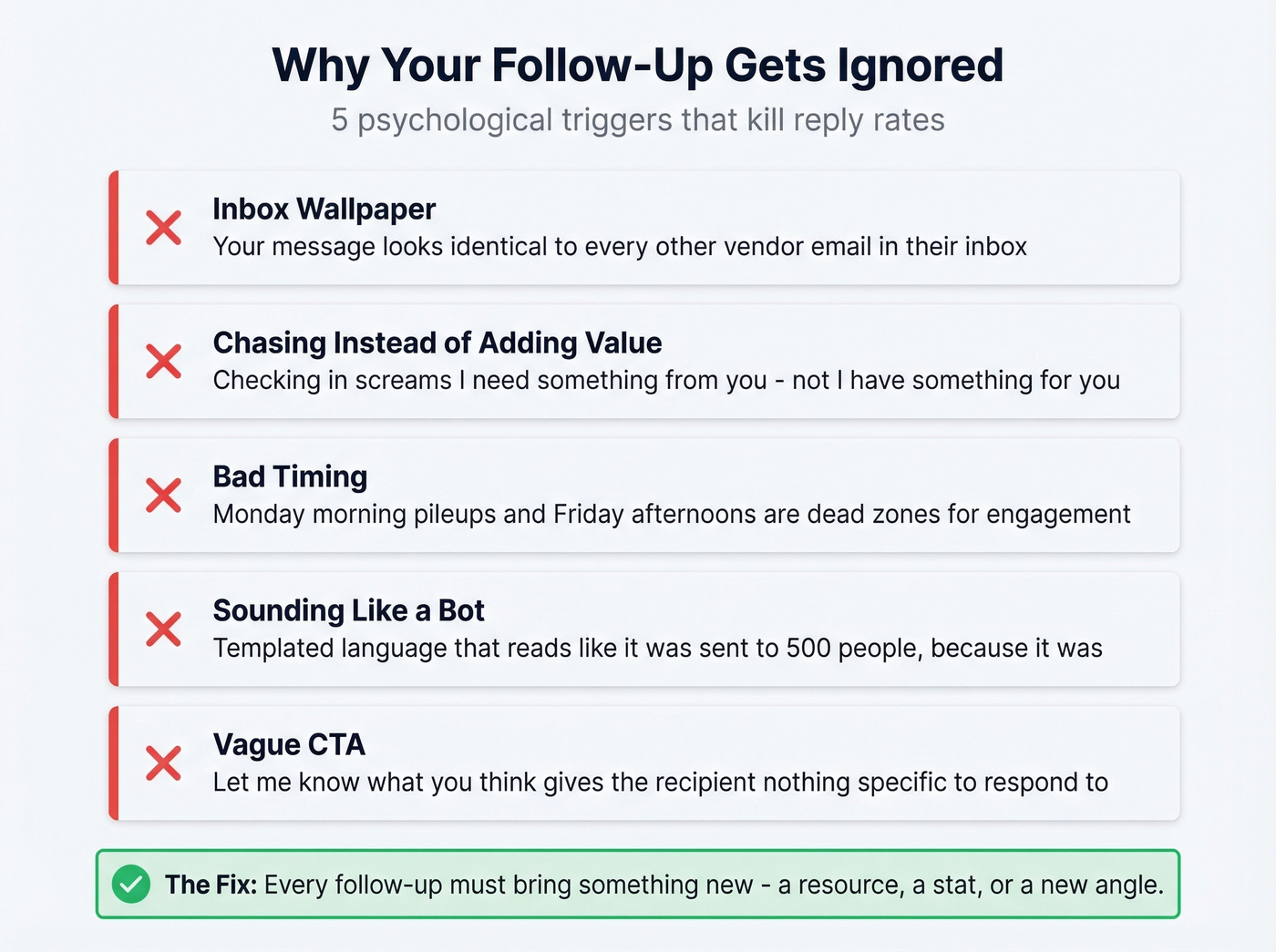
Woodpecker breaks down the psychology of ignored follow-ups, and five triggers show up repeatedly:
- Inbox wallpaper - your message looks identical to every other vendor email
- Chasing instead of adding value - "checking in" screams "I need something from you"
- Bad timing - Monday morning pileups and Friday afternoons are dead zones
- Sounding like a bot - templated language that reads like it was sent to 500 people (because it was)
- Vague CTA - "let me know what you think" gives the recipient nothing specific to respond to
Here's a process-level insight that changed how we think about this: if you always need to follow up, your meeting process is broken. Schedule the next step before ending the current one. A follow-up should be a nudge, not a lifeline.
15 Better Follow-Up Phrases (With Templates)
Belkins has sent 100K+ follow-up emails over eight years and reports 50%-200% pipeline growth from optimized follow-up sequences. Their golden rule is simple: every follow-up must bring something new. A new resource, a new angle, a new reason to reply today. If you can't articulate what's new, you're not ready to send.
When You're Adding New Value
1. Share a relevant resource
Subject: Thought this was relevant to [their initiative]
Hi [Name], saw this [article/report/benchmark] on [topic you discussed] and thought of your team. The section on [specific detail] maps to what you mentioned about [their challenge]. Does Wednesday or Thursday work for a quick call?
You're giving before asking. The recipient opens the email and immediately gets something useful, which triggers reciprocity.
2. Send a case study
Subject: How [similar company] solved [their problem]
[Name], we just published a case study with [company in their industry] - they cut [metric] by [number] in [timeframe]. Reminded me of the [specific challenge] you mentioned. Would it be useful to compare notes on what they did differently?
3. Reference a new data point
Subject: New numbers on [their priority]
Hi [Name], [industry report/benchmark] just dropped showing [relevant stat]. Given your focus on [initiative], figured this was worth flagging. Want me to send the full breakdown?
New data creates urgency that didn't exist before. It gives the prospect a reason to re-engage today rather than "eventually."
4. Mention a product update
Subject: Quick update since we last spoke
[Name], since our conversation we've shipped [feature/update] that directly addresses the [specific concern] you raised. Two-minute demo would show it better than I can explain it. Open to a quick look this week?
5. Link to something you created about them
This one comes from a creative angle that most sellers miss entirely. Instead of sending generic content, reference something you built that features the prospect's company - a blog post, a benchmark, a comparison chart where they appear.
Subject: Featured [their company] in our latest [post/report]
[Name], I linked to [their company's website/blog/product page] in a piece we published on [topic]. Thought you'd want to see the context. Here's the link - and happy to chat about the broader trends if you're interested.
Flattery backed by action. You didn't just compliment them - you invested effort that benefits their brand, which makes ignoring you feel rude.
When You Need a Decision
6. The schedule-finalization frame
A practitioner on r/sales shared this one and it works because it assumes forward motion rather than asking for permission to continue the conversation.
Subject: Finalizing my schedule for next week
Hi [Name], I'm locking in my calendar for next week - does Tuesday at 2 PM or Thursday at 10 AM work better for you?
7. The binary CTA
Subject: Quick question on [project]
[Name], want to make sure this doesn't fall through the cracks on either end. Are you still looking to move forward this quarter, or should I circle back in Q3?
Binary questions are dramatically easier to answer than open-ended ones. You're reducing the cognitive load from "compose a thoughtful reply" to "pick A or B."
8. The soft deadline
Subject: Wrapping up [topic] proposals this week
Hi [Name], we're finalizing our [onboarding/implementation] schedule for [month]. If you want to be included in this cohort, I'd need a thumbs up by Friday. If the timing's off, no pressure - just let me know and I'll follow up next quarter.
When You're Re-Engaging a Cold Lead
9. Reference a trigger event
Subject: Congrats on [funding round/new hire/expansion]
[Name], saw the news about [specific event]. That usually means [relevant implication for their role]. When we spoke in [month], you mentioned [challenge] - is that still on the radar?
10. The "since we last spoke" pivot
Subject: Things have changed since [month]
Hi [Name], it's been a few months since we connected. Since then, we've [added feature/signed competitor/published result] that's directly relevant to [your use case]. Worth a fresh conversation?
Let's look at the before/after on this one. A bad version reads: "Hi [Name], just following up on our conversation from a few months ago. Wanted to see if you had any updates." That's a dead email. The good version leads with what you've changed, not what they haven't done.
11. Social proof from their peer group
Subject: [Competitor/peer company] just signed on
[Name], wanted to share that [company in their space] started using [your product] last month for [specific use case]. Early results: [metric]. Thought you'd want to know given the overlap with what you're building.
Peer pressure is the most underrated force in B2B sales. Nobody wants to be the last company in their space to adopt something their competitors already use.
12. The mutual connection reactivation
Subject: [Mutual contact] mentioned your name
[Name], I was catching up with [mutual connection] and your [project/initiative] came up. They mentioned you're still working on [challenge]. Since that's exactly what we've been focused on with [similar company], figured it was worth reconnecting. Open to a quick chat?
When It's Time to Break Up
13. The breakup email
Subject: Should I close your file?
[Name], I've reached out a few times and haven't heard back - totally understand if the timing isn't right. I'll assume this isn't a priority right now and won't reach out again. If things change, my calendar link is below. Either way, no hard feelings.
14. The permission-based close
Subject: One last note from me
Hi [Name], I don't want to be the person clogging your inbox. If [solution] isn't relevant right now, just reply "not now" and I'll check back in 6 months. If it is, I'm here.
15. The "door's open" close
Skip the guilt trip. This one works when you've had a genuine conversation that went cold and you want to preserve the relationship for a future cycle.
Subject: No hard feelings
[Name], I know priorities shift - no need to explain. I'll stop reaching out for now, but if [challenge] comes back up, I'm a quick reply away. Wishing you a strong [quarter/year].
One tactical note: use low-commitment CTAs ("worth a look?" / "want me to send it?") for colder leads and high-commitment CTAs ("does Thursday work?") for warmer ones. Match the ask to the relationship temperature.

Every follow-up template on this page is worthless if it bounces. Prospeo's 98% email accuracy means your carefully crafted "instead of just checking in" message actually lands in the inbox - not the void.
Stop perfecting copy that never gets delivered. Fix the data first.
Follow-Up Cadence: How Many and When
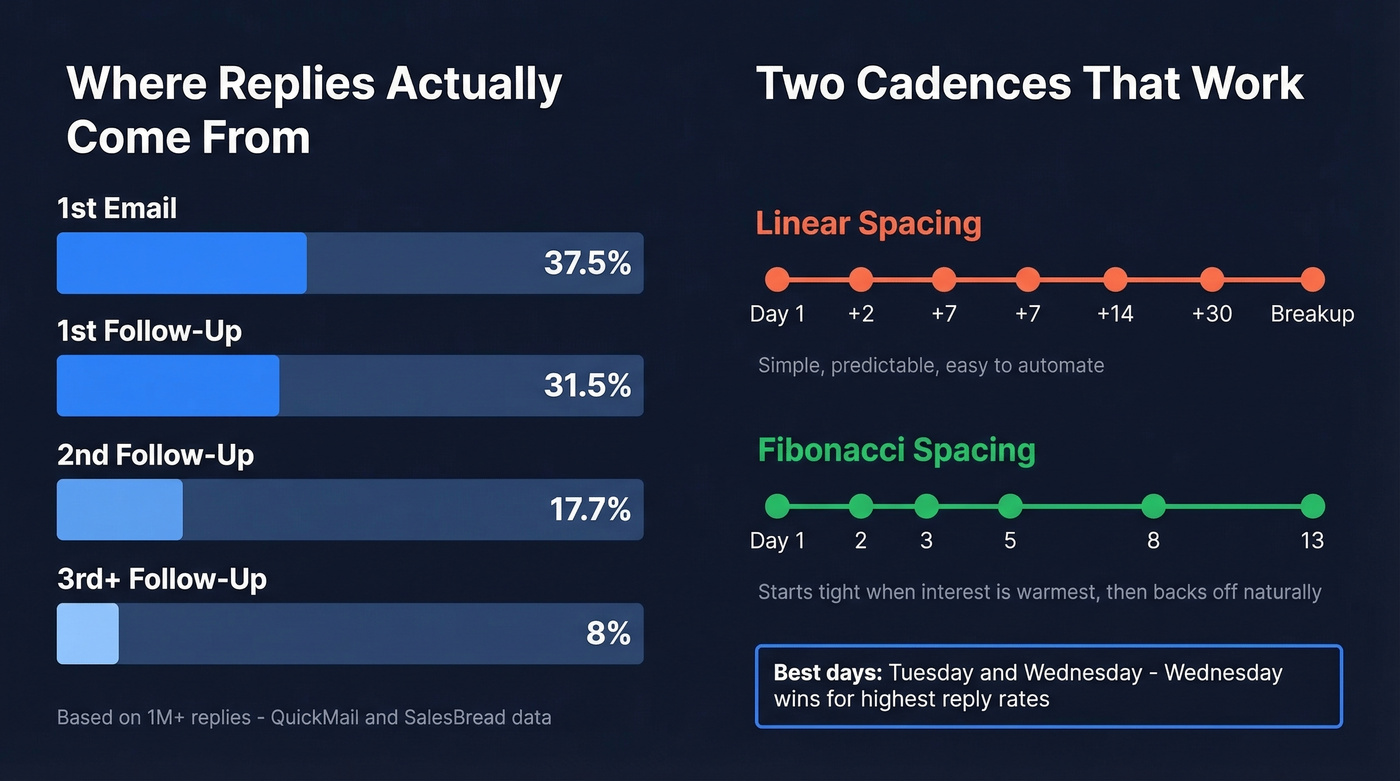
Timing matters as much as language. Here's where replies actually come from, based on QuickMail data across 1 million replies:
| Touch | Share of Replies |
|---|---|
| 1st (initial email) | 37.5% |
| 2nd (first follow-up) | 31.5% |
| 3rd | 17.7% |
| 4th+ | 8% |
The sweet spot is 4-7 touchpoints. Beyond that, you're chasing diminishing returns unless each touch genuinely adds something new.
Two cadence options that work:
Linear spacing: Day 1 -> +2 -> +7 -> +7 -> +14 -> +30, then breakup email. Simple, predictable, easy to automate.
Fibonacci spacing: Day 1, 2, 3, 5, 8, 13. Starts tight when interest is warmest, then backs off naturally. We've seen this work well for higher-value deals where you don't want to seem desperate but need to stay visible.
Best days are Tuesday and Wednesday. Wednesday edges out everything else for reply rates. After the initial email plus six follow-ups with no response, send the breakup email and move on.
None of this matters if your emails bounce. Meritt saw bounce rates drop from 35% to under 4% after switching to verified contact data - the difference between a sequence that builds pipeline and one that burns your domain reputation. Prospeo refreshes records every 7 days and verifies emails at 98% accuracy, so your carefully crafted follow-up actually lands where it's supposed to.
Five Mistakes That Kill Reply Rates
Mistake 1: Bumping with no new information. "Just making sure you saw this" tells the recipient you have nothing new to offer. Every touch needs a resource, a stat, or a new angle.
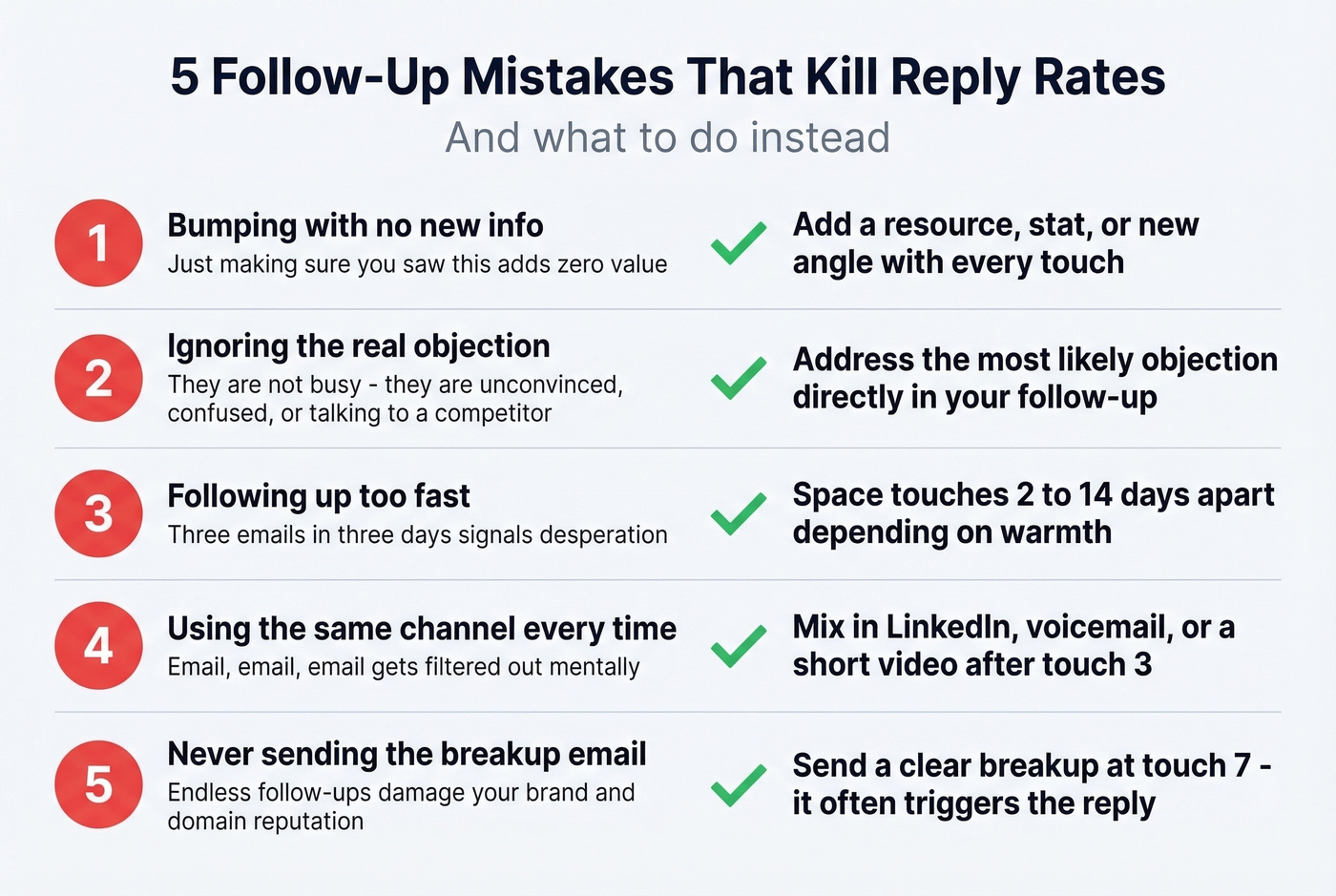
Mistake 2: Ignoring the real objection. GMass identifies five core reasons people don't respond - no need, value not worth cost, no urgency, don't want it, or don't trust you. Every non-response maps to one of these. Your follow-up should address the most likely one, not just repeat the original pitch louder. If you suspect trust is the issue, send social proof. If it's urgency, create a deadline. Diagnosing the silence is half the battle.
Mistake 3: Follow-ups that don't look real. HTML templates with logos and buttons scream "mass email." Plain text, short paragraphs, sent as a reply to the original thread - that's what a real person's email looks like.
Mistake 4: Same subject line every time. Vary your subject lines across touches. A fresh subject line can reset attention, especially on touch three or four when the original thread is buried. If you need ideas, steal from a swipe file of subject lines.
Mistake 5: Sending to bad data. The best follow-up copy in the world doesn't matter if the email bounces or reaches someone who left the company six months ago. Run your list through a verification tool before launching any sequence. Prospeo's free tier covers 75 email verifications per month - enough to gut-check a list before you hit send.
Trigger-based follow-ups like funding rounds, new hires, and expansion signals work best when you have fresh data. Prospeo refreshes every 7 days - not 6 weeks - so your re-engagement emails reach the right person at the right company, every time.
Real-time data turns cold follow-ups into warm conversations.
Job-Seeker Follow-Ups That Work
Sales follow-ups and job-seeker follow-ups share the same core problem - you need a response from someone who holds the power - but the dynamics are different. You can't send a breakup email to a hiring manager.
A hiring manager on Reddit with a decade of experience recommends following up at four distinct stages:
Post-application (within 48 hours): Don't wait for the ATS to do its job. Find the hiring manager or recruiter and reach out directly with a brief note connecting your experience to the role's top requirement. One sentence on why you applied, one sentence on what you'd bring, one link to your profile or portfolio.
Within 24 hours of an interview: Send a thank-you that references something specific - not "thanks for your time." Reference their answer about the team's biggest challenge or the key attributes they're looking for.
Subject: Great speaking with you, [Name]
Thanks for walking me through the [role/team]. Your point about [specific challenge they mentioned] resonated - it's exactly the kind of problem I tackled at [previous company] when we [brief relevant result]. Looking forward to next steps.
5-7 business days with no response: A short status check. Keep it to three sentences max.
Subject: Checking in on [Role Title] next steps
Hi [Name], wanted to follow up on our conversation last [day]. I'm still very interested in the [role] and happy to provide any additional information. Is there a timeline for next steps?
10-14 business days: Final check. The Muse recommends spacing follow-ups by about a week. After two follow-ups with silence, one more is appropriate - then let it go. If someone referred you to the role, loop them in on your progress. It keeps your advocate engaged and often triggers an internal nudge you couldn't make yourself.
FAQ
How many follow-up emails is too many?
Four to seven touches is the sweet spot based on aggregate data. After the initial email plus six follow-ups with no response, send a breakup email and move on. Touch four captures just 8% of replies - beyond that, you're burning goodwill for diminishing returns.
What's the best day to send a follow-up?
Wednesday consistently generates the highest reply rates, followed closely by Tuesday. Avoid Monday mornings when inboxes are buried under weekend pileup, and skip Friday afternoons when people have already mentally checked out.
How long should I wait before following up?
Wait two business days after the initial send for your first follow-up, then extend the gap with each subsequent touch. The Fibonacci pattern (2, 3, 5, 8, 13 days) mirrors natural human patience and avoids the "desperate daily pinger" reputation.
Should I follow up by email or phone?
Email for the first two touches, then mix in a phone call on touch three or four. A voicemail that references your email thread ("I sent you something on Tuesday about [topic]") creates a multi-channel touchpoint that's harder to ignore than another inbox notification.
Look, most people don't need better follow-up templates. They need fewer, better-targeted prospects and the discipline to add genuine value with every touch. If your average deal is under five figures, three follow-ups with real substance will outperform a 12-step sequence of "just checking in" every single time.
Every follow-up is a second chance to earn a reply. Now you know what to say instead of following up with empty filler - make each touch count by saying something worth responding to.