

10 Sales Closing Techniques That Actually Work in 2026
A huge chunk of qualified, budget-confirmed B2B opportunities die somewhere between "looks great" and "let's do this." The average SaaS team converts just 37% of SQLs to Closed Won. That's a lot of revenue evaporating after you've already done the hard work.
Most closing advice treats the close as a single moment - some magic phrase you deploy at the finish line. That's backwards. The close is a process that starts at discovery, and the 10 sales closing techniques below are frameworks for guiding a decision that should already feel inevitable by the time you ask.
What You Need (Quick Version)
You don't need 13 techniques. Master three - the assumptive close, the summary close, and the takeaway close - and you'll cover 90% of B2B scenarios. Add the empathy close for enterprise deals where emotional stakes and buying committees run deep. The rest of this article gives you scripts, benchmarks, and a decision framework so you can pick the right close for every situation.
What a Good Close Rate Looks Like
"Close rate" means different things depending on where you measure. The metric that actually matters for closing technique is SQL-to-Closed Won - the conversion rate after a lead is qualified and handed to a rep.
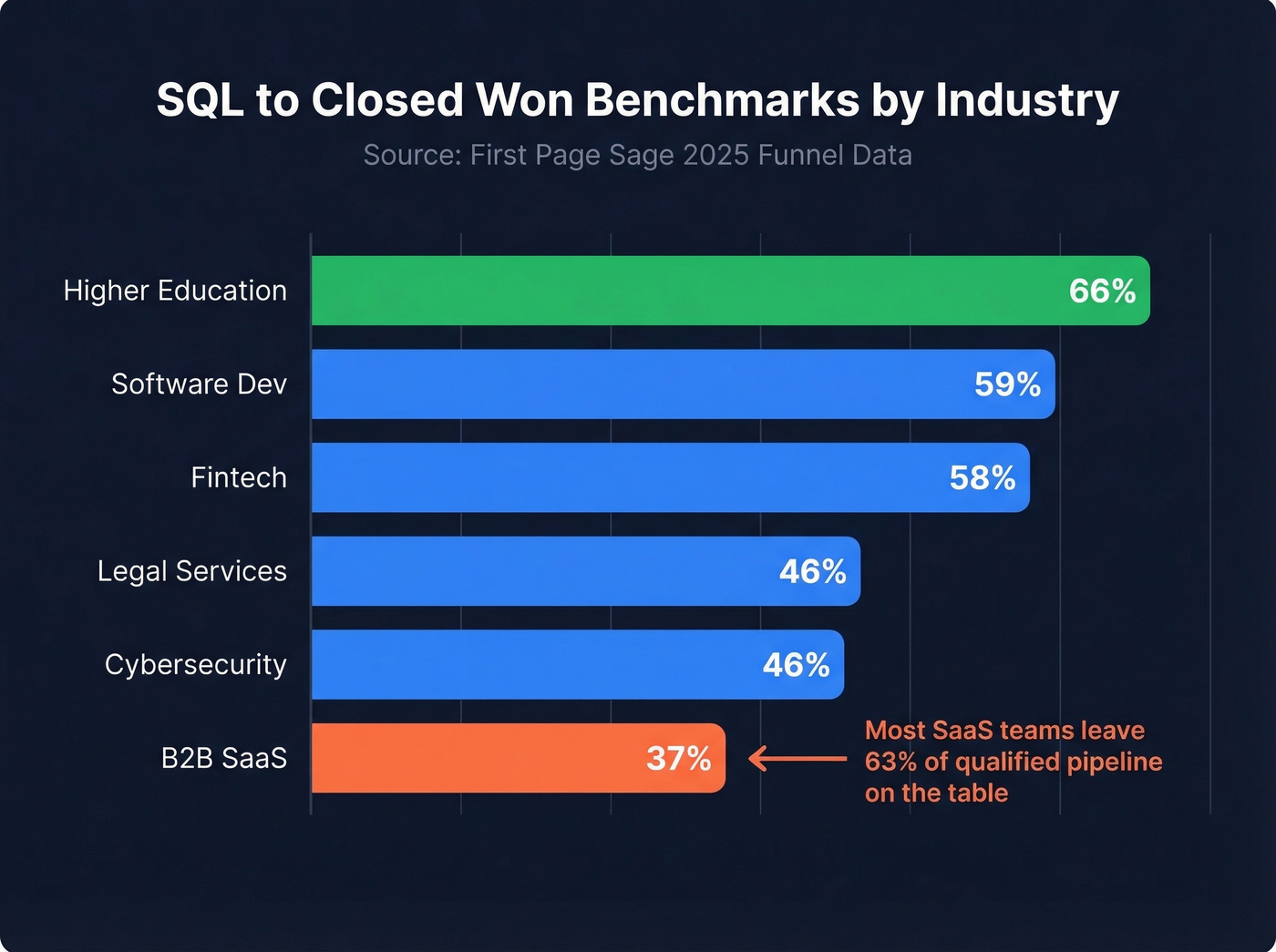
Benchmarks across industries, per First Page Sage's funnel data:
| Industry | SQL to Closed Won |
|---|---|
| B2B SaaS | 37% |
| Cybersecurity | 46% |
| Legal Services | 46% |
| Fintech | 58% |
| Software Dev | 59% |
| Higher Education | 66% |
If you're selling SaaS at $25k ARR through outbound and sitting at 8% discovery-to-close - a number one r/sales rep shared as their baseline - you're not broken. You're normal. But "normal" leaves a lot of revenue on the table, and refining how you close is one of the fastest levers to pull.
The 10 Techniques: Scripts, Buyer Fit, and When to Walk Away
The right close depends on three things: where the deal sits in the pipeline, who you're talking to, and what's blocking the decision. An analytical CFO needs a different approach than a relationship-driven VP of Sales. We've mapped each technique below to the deal stage, buyer type, and situation where it works best.
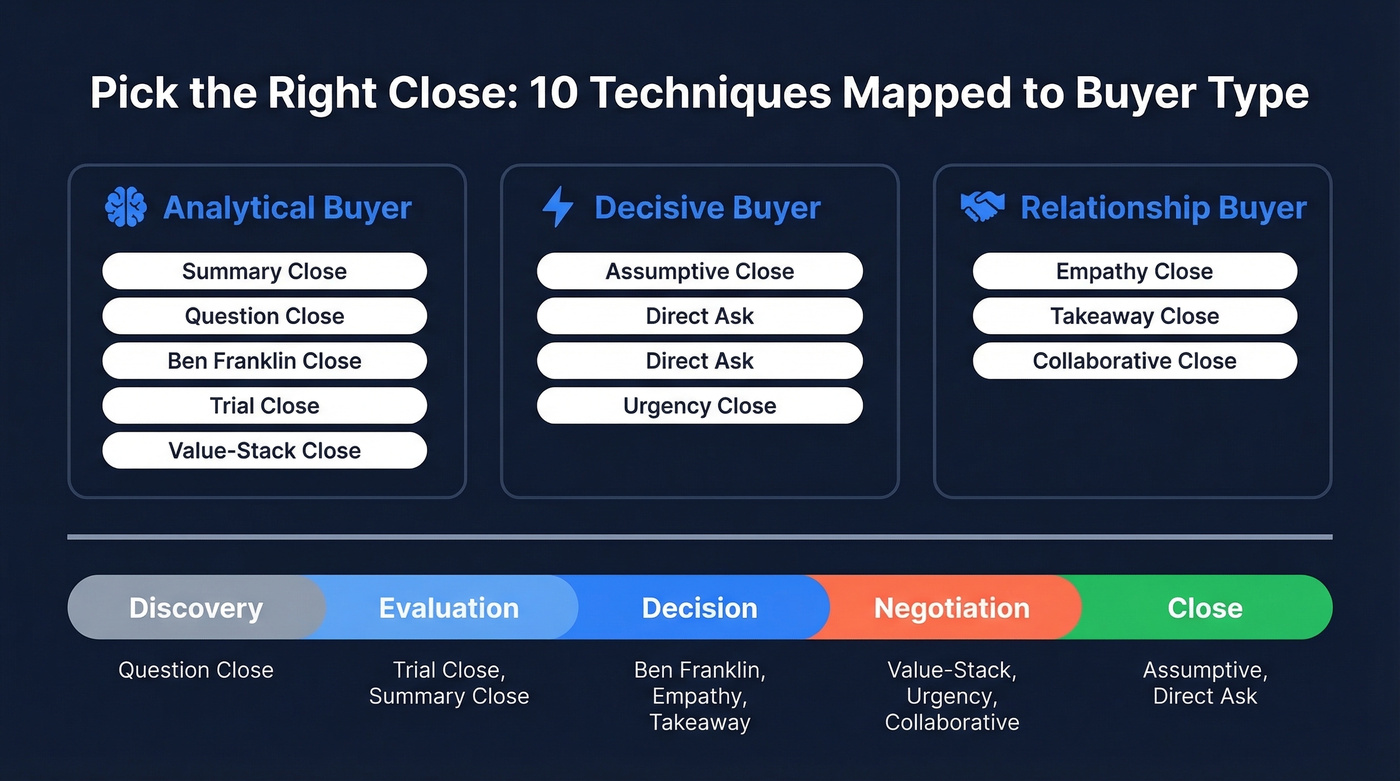
1. Assumptive Close
You skip "would you like to move forward?" entirely and move straight to logistics - as if the decision is already made.
Best for: Decisive buyers who've given strong signals. They've asked about implementation timelines, introduced you to procurement, or started using "when" language instead of "if."
Skip this if: You haven't confirmed budget, timeline, and decision authority. Steve Weinberg argues this technique is manipulative when used prematurely. Assuming the close before earning the right feels presumptuous, not confident.
Script: "Great - so it sounds like the 50-seat plan covers your team. I'll send the order form this afternoon. Does your procurement team need anything specific, or can we route it directly to [economic buyer's name]?"
The follow-up question is the key. You're moving the conversation into execution mode, which forces the prospect to either confirm or surface a real objection.
2. Summary Close
You recap every piece of value the prospect has acknowledged, stack it into a single narrative, then ask for the commitment. This one is especially effective on Zoom calls, where attention spans are shorter and prospects forget what excited them three meetings ago.
Best for: Analytical buyers who need logical justification, and multi-touchpoint deals where value has been established across several conversations.
Script: "Let me make sure I've got this right. You said your team's spending 6 hours a week on manual data entry, your current tool's bounce rate is killing deliverability, and you need to be live before Q3 planning. We've mapped all three - the automation cuts that 6 hours to under one, accuracy runs 98%, and onboarding takes two weeks. Does that match what you need to bring to [decision-maker]?"
The prospect either confirms - and you've built their internal business case for them - or corrects something, which surfaces the real blocker.
3. Takeaway Close
You suggest that your solution isn't the right fit. This triggers loss aversion - the prospect suddenly has to argue for buying instead of against it.
Here's the thing: the consensus on r/sales is that "maybe we're not a fit" triggers FOMO more reliably than any hard close. It works especially well with relationship-focused buyers who hate feeling pressured. But don't use it on a warm deal. Introducing doubt into a prospect who's already leaning yes is self-sabotage.
Script: "Honestly, based on what you've described, I'm not sure we're the best fit for your team right now. Your volume might be too low to justify the investment. What do you think - am I wrong?"
Most prospects will push back and re-sell themselves. The ones who don't were never going to close anyway.
4. Empathy Close
Enterprise buyers carry career risk. A bad vendor choice can cost someone their reputation internally. The empathy close acknowledges that weight before asking for the commitment.
Best for: Risk-averse buyers on six-figure deals who are personally invested in the outcome. You sense hesitation rooted in fear rather than logic. Skip this on transactional deals - empathy on a $200/month subscription feels disproportionate and a little weird.
Script: "I know this is a big decision, and I know your name is on it internally. That's exactly why we structured the pilot the way we did - so you can prove the ROI before going to the full committee. What would make you feel confident enough to move forward?"
5. Question Close vs. Direct Ask
These two sit at opposite ends of the same spectrum. The question close digs for hidden objections. The direct ask assumes there aren't any.
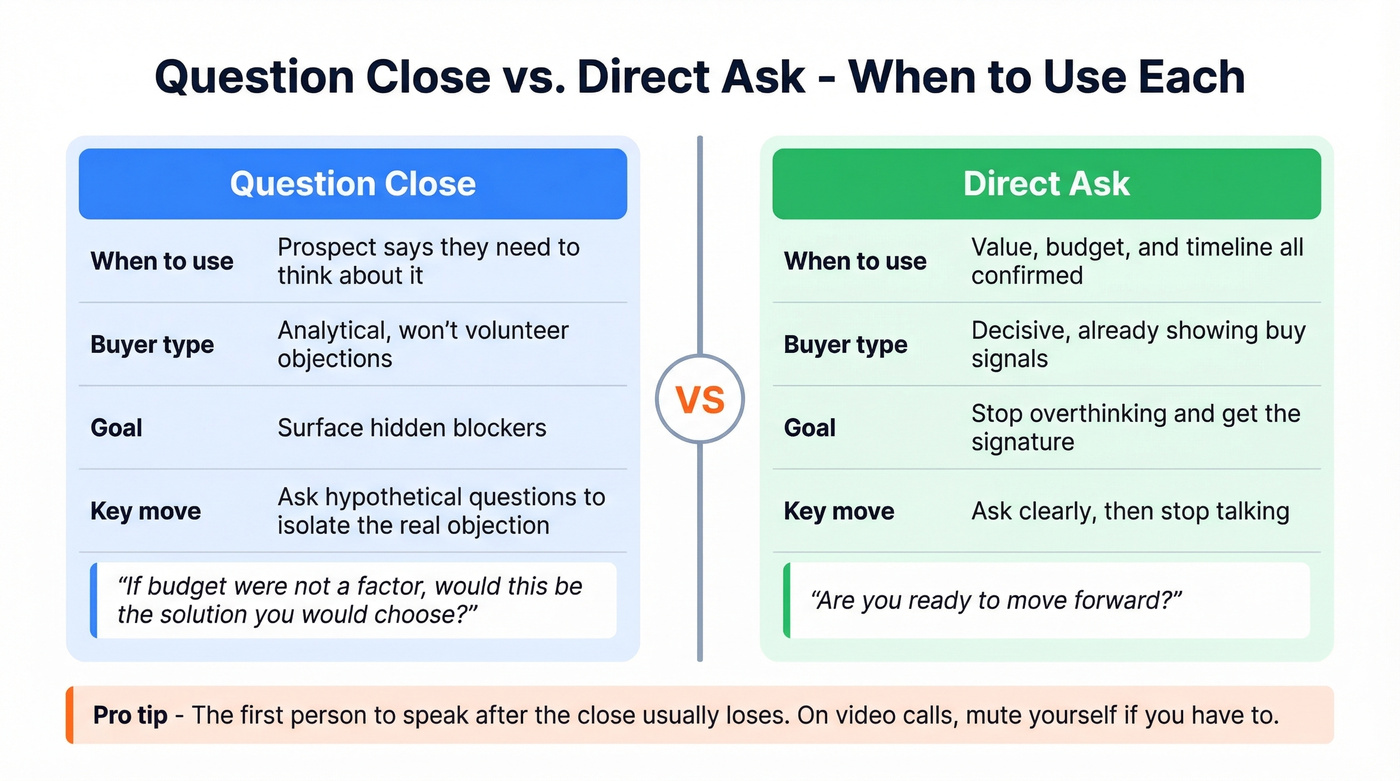
Question close - use when the prospect says "we need to think about it" but you sense something deeper. This is consultative selling at its purest, and it's the go-to for analytical buyers who won't volunteer objections unprompted.
"If budget weren't a factor, would this be the solution you'd choose? ... Okay, so let's talk about what budget conversation needs to happen."
Direct ask - use when the prospect has confirmed value, budget, and timeline. Everything lines up. Reps overthink this moment constantly - they add one more slide, one more case study. Meanwhile, the prospect was ready to sign ten minutes ago.
"Based on everything we've discussed, I think this is a strong fit. Are you ready to move forward?"
Then stop talking. The first person to speak after the close usually loses. On video calls, mute yourself if you have to.
6. Urgency Close
You create a time-bound reason to act now. The ethical version uses real constraints - end of budget cycle, limited implementation slots, pricing changes. The manipulative version invents fake deadlines, and buyers see through it instantly.
Best for: Decisive buyers who need a forcing function. Quarter-end discounts, capacity constraints, or a prospect's own internal deadline all qualify. If the urgency isn't genuine, retire this technique - it destroys trust faster than any other close.
Script: "Our implementation team has two slots left before Q3 freeze. If you want to be live by August, we'd need the contract signed by Friday. Is that timeline realistic on your end?"
7. Trial / Puppy Dog Close
Let the prospect use the product before committing. In SaaS, this is the free trial or paid pilot. Once they're inside, switching costs make the close easier - a natural fit for analytical buyers who need to see data before deciding.
If your trial-to-paid conversion is below ~15%, the problem isn't the close. It's the trial experience. Fix onboarding first.
Script: "Let's do this - start a 14-day pilot with your team. I'll check in on day 3 and day 10. If the numbers don't speak for themselves, no hard feelings."
8. Collaborative / Consensus Close
Enterprise deals don't close because one person says yes. They close because 13 stakeholders on average don't say no. The consensus close maps every stakeholder, aligns them individually, then orchestrates a group decision.
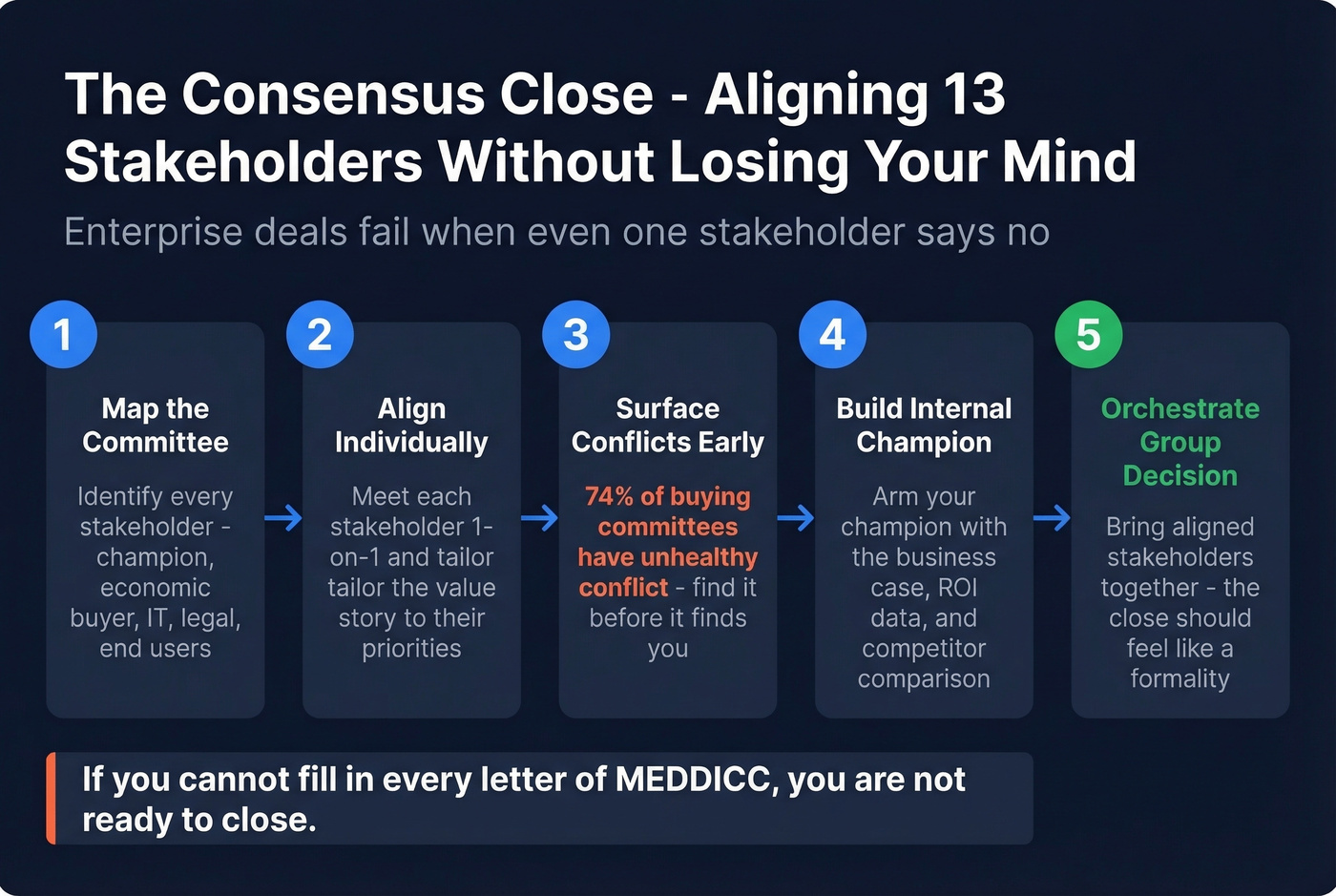
Use this when buying committees run deep and 74% of those committees experience unhealthy conflict during the decision process. If you can't fill in every letter of MEDDIC, you're not ready to close.
Script: "We've aligned with [Champion], [IT lead], and [Finance]. The one stakeholder I haven't connected with is [VP of Ops]. Can we set up a 15-minute call this week so they hear the same story?"
9. Value-Stack Close
Before asking for the commitment, you reframe total value against the price. This is the antidote to the most common closing mistake: dropping price instead of demonstrating value.
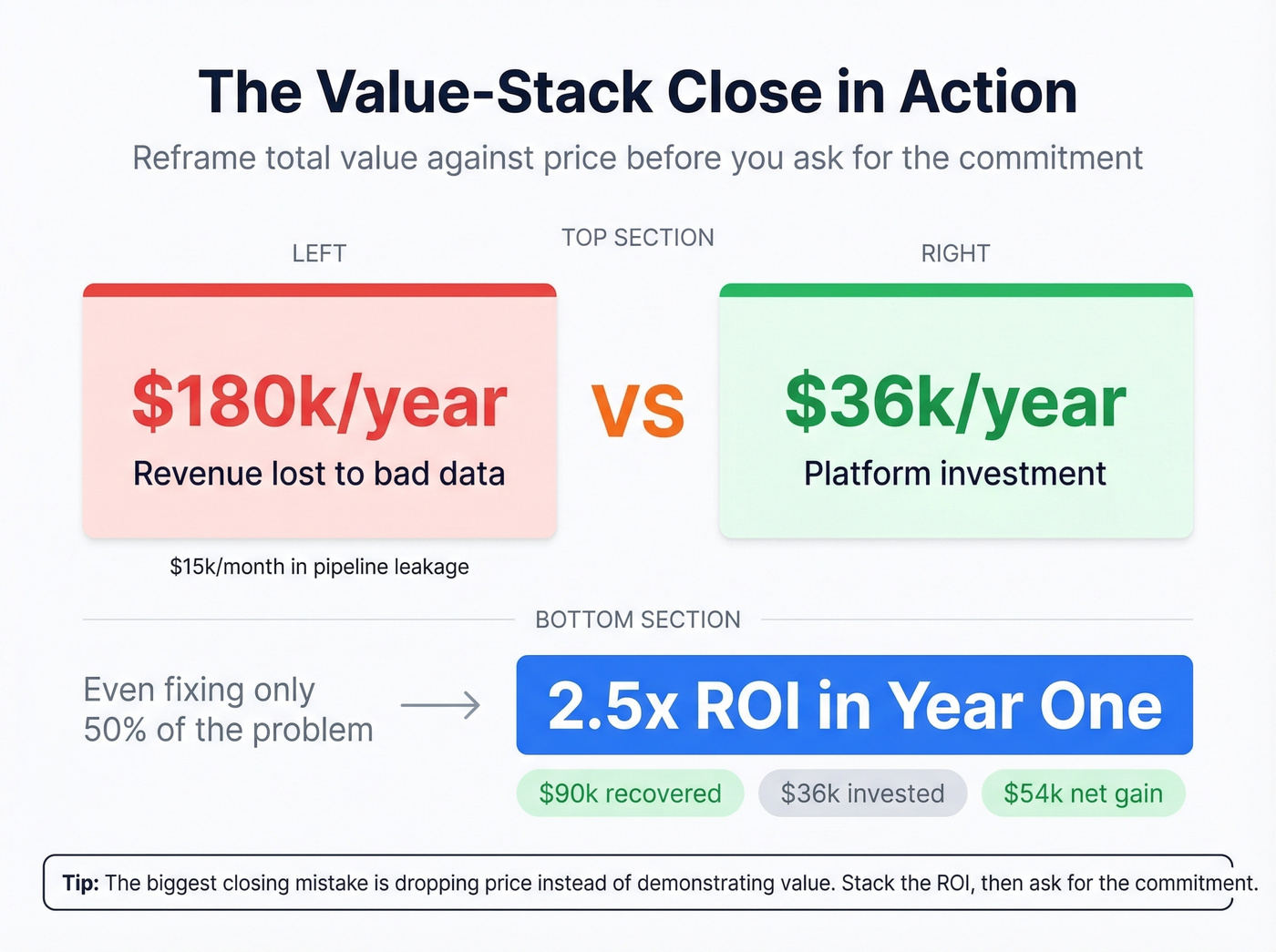
Script: "So the platform is $36k/year. Your team told me they're losing roughly $15k/month in pipeline to bad data alone. That's $180k/year. Even if we only fix half of that, you're looking at a 2.5x return in year one."
Don't over-justify when the prospect is already sold. If they're nodding, switch to the direct ask.
10. Ben Franklin Close
Old-school, but it still works on analytical buyers stuck in analysis paralysis. You literally walk through the pros and cons together - on a shared screen or whiteboard - and let the math speak.
The trick: you've been building the "pros" column throughout the entire sales process. By the time you write them down, the list is lopsided. The prospect sees the imbalance and the decision becomes obvious.
"Let's map this out. On one side, we've got the 6 hours saved per week, the 98% accuracy, the Q3 timeline fit, and the 2.5x ROI projection. On the other side, what concerns are still open?"

Your closing technique is only as good as the prospect you're pitching. If 35% of your emails bounce, you never reach the decision-maker - and no assumptive close can save a conversation that never happens. Prospeo delivers 98% email accuracy and 125M+ verified mobiles with a 30% pickup rate, so your reps spend time closing, not chasing dead contacts.
Fix the top of your funnel and watch your close rate follow.
How to Close Enterprise Deals
Enterprise sales is a different sport. You're not closing a person - you're closing a committee. Thirteen stakeholders on average, and 61% of those buyers would prefer to buy without talking to a rep at all.
The consensus close is your default, but only if you've done the qualification work. Before you attempt any close on a six-figure deal, run through this checklist:
- Economic buyer identified? Not your champion - the person who controls the budget.
- Decision criteria documented? What are they evaluating you against?
- Champion willing to sell internally? Will they advocate when you're not in the room?
- All stakeholders mapped? Every person who can say no.
- Competition known? Including "do nothing."
- Timeline confirmed? With a real internal driver, not your quota deadline.
Most enterprise deals don't die because of a bad close. They die because the rep was talking to the wrong person, or because a stakeholder they never met killed it in a meeting they didn't know about. Multi-threading - building relationships with 3-5 contacts across the buying committee - is the real closing strategy at the enterprise level. That starts with having verified contact data for every stakeholder, not just your champion.
Why Video Calls Change the Close
70-80% of B2B buyers now prefer virtual interactions, but only 26% think reps are actually good at selling virtually. And 88% of sellers say building relationships is harder on video. That gap is where deals go to die.
Use the summary close more aggressively on Zoom - prospects genuinely forget what excited them. Keep meetings tight and structured. Enforce cameras-on as a norm, not a request. And silence after the ask? It's harder on video - the instinct to fill dead air is overwhelming - but it's even more powerful. Ask the question, then wait.
5 Mistakes That Kill Deals
Even the best closing techniques fall apart when reps make avoidable errors. We've seen all five of these torpedo deals that should've been won.
1. Dropping price instead of demonstrating value. The moment you discount without being asked, you've told the prospect your product isn't worth what you quoted. Stack value instead of debating price.
2. Talking past the ask. If you're doing most of the talking in a closing conversation, you're missing signals and burying your own ask under noise. Say less.
3. Answering the wrong objection. The prospect says "we need to think about it," and you start addressing timing concerns - but the real objection is that their CFO hasn't bought in. Ask "what specifically do you need to think about?" before responding to anything.
4. Speaking to the wrong stakeholder. You can run a flawless close on someone who can't sign. Confirm decision authority early - not at the finish line.
5. Following up with dead data. You nail the close, send the follow-up, and it bounces. Or you call a direct dial and reach someone who left six months ago. This one is infuriating because it's entirely preventable. Prospeo verifies emails and phone numbers on a 7-day refresh cycle, so your follow-ups actually reach the right person. Meritt switched and watched their bounce rate drop from 35% to under 4% while pipeline tripled.
Your Closing Tech Stack
Great technique means nothing if your tools let you down. Here's the minimum stack we'd recommend:
- CRM (Salesforce, HubSpot): Track every touchpoint, every stakeholder, every objection. If it's not in the CRM, it didn't happen.
- Verified contact data (Prospeo): The layer most teams overlook. 98% email accuracy across 143M+ verified emails and 125M+ verified mobile numbers, refreshed every 7 days versus the 6-week industry average. Your close is only as good as your ability to reach the right person afterward.
- Video conferencing (Zoom, Teams): Camera-on, recording-enabled, reliable connection.
- Conversation intelligence (Gong, MeetGeek): Review your closes, find the moment you talked past the ask, and identify which techniques actually convert for your team. This is coaching gold.
- E-signature (DocuSign, PandaDoc): Every hour of delay between "yes" and "signed" is a chance for the deal to stall.
If you want to tighten the full motion (not just the close), pair this with a repeatable sales process and a clear pipeline health view.

That summary close script above mentions cutting bounce rates and hitting 98% accuracy - those aren't hypothetical numbers. Prospeo users like Snyk dropped bounce rates from 35% to under 5% and generated 200+ new opportunities per month across 50 AEs. When reps connect with real buyers, closing techniques actually work.
Give your reps prospects worth closing - starting at $0.01 per email.
FAQ
What Is the 10-3-1 Rule in Sales?
The 10-3-1 rule is a pipeline math shortcut: for every 10 prospects you engage, expect roughly 3 meaningful conversations and 1 closed deal. B2B SaaS runs about 37% SQL-to-close, while software development teams see closer to 59%. Use it as a mental model for pipeline coverage, not a hard formula.
What's a Good Close Rate for B2B SaaS?
The benchmark for SQL-to-Closed Won in B2B SaaS is 37%. Inbound leads close at higher rates than outbound, and sub-$15k deals close faster than six-figure contracts. Above 40% means you're outperforming most of the market. Pairing strong closing technique with accurate pipeline data is how top teams consistently beat that number.
Which Technique Works Best for Enterprise?
The collaborative/consensus close paired with MEDDICC qualification. With 13 average stakeholders involved, no single-threaded technique works. Align each stakeholder individually, arm your champion with the business case, and orchestrate the group decision.
What Are 5 Techniques Every Rep Should Know?
The assumptive close, summary close, takeaway close, empathy close, and direct ask cover the widest range of scenarios. Master those five and you'll have a reliable approach regardless of buyer type, deal size, or sales motion. Add the consensus close once you start working enterprise accounts with buying committees.
What Does "Always Be Closing" Mean Today?
The original ABC mantra was about constant pressure. The modern version is about constant qualification - always confirming pain, budget, timeline, and authority so the decision feels inevitable by the close. For deals under $20k ARR, a strong discovery call plus a direct ask will outperform any elaborate multi-step technique.