

6 Best 80legs Alternatives Worth Switching To in 2026
If you're looking for 80legs alternatives, the answer doesn't always involve crawling. In a lot of cases, you don't need more HTML - you need usable data. We've tested the major options and narrowed it down to six that actually deserve your time, depending on what you're trying to accomplish.
Our Picks (TL;DR)
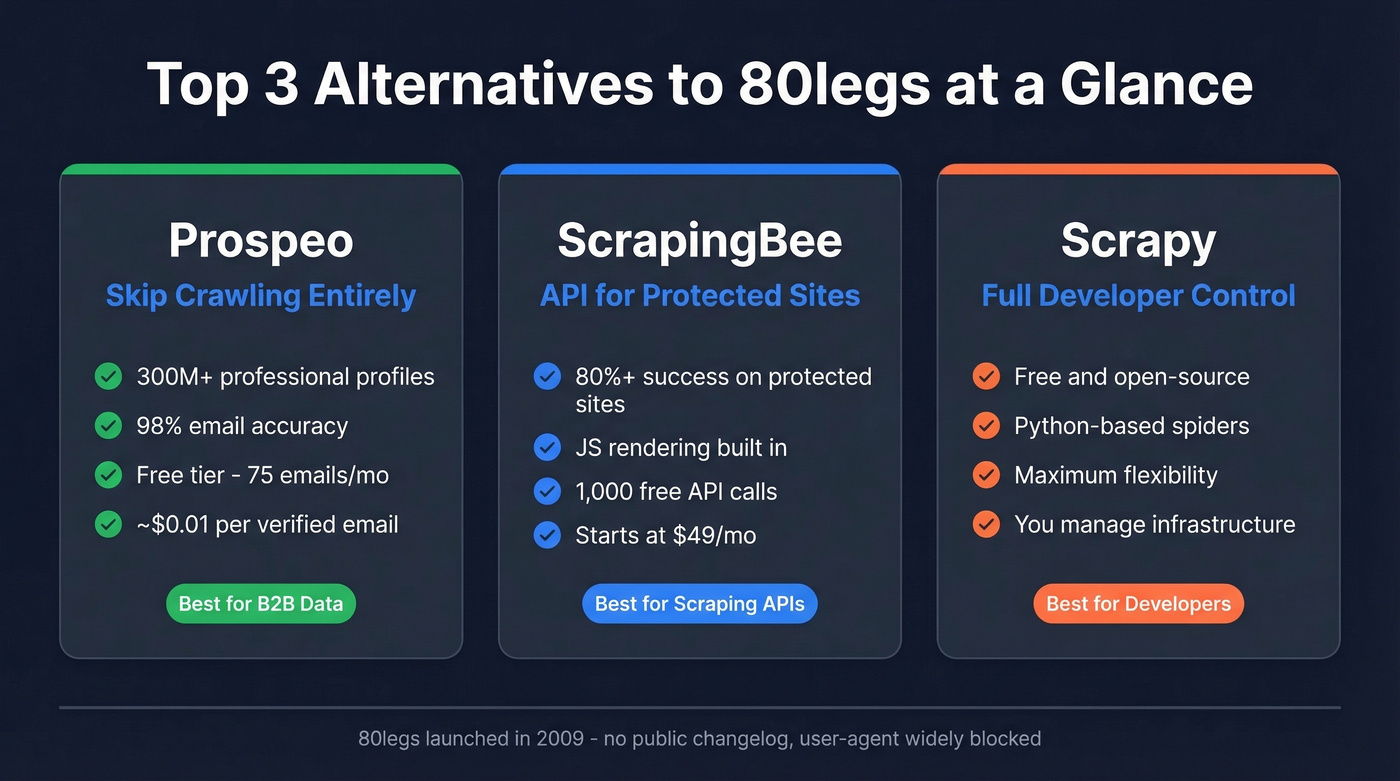
- Prospeo - If your goal is B2B contact data, skip crawling entirely. 300M+ profiles, 98% email accuracy, free tier included.
- ScrapingBee - Best API for protected sites. 80%+ success rate in the Proxyway 2025 benchmark, starts at $49/mo.
- Scrapy - Free, open-source, full developer control for static sites.
Why Replace 80legs?
80legs launched in September 2009 under Datafiniti, LLC, running on a distributed grid computing network of around 50,000 computers. It's still live - plans from Free to $299/mo - but it's a legacy tool in a market that's moved fast.
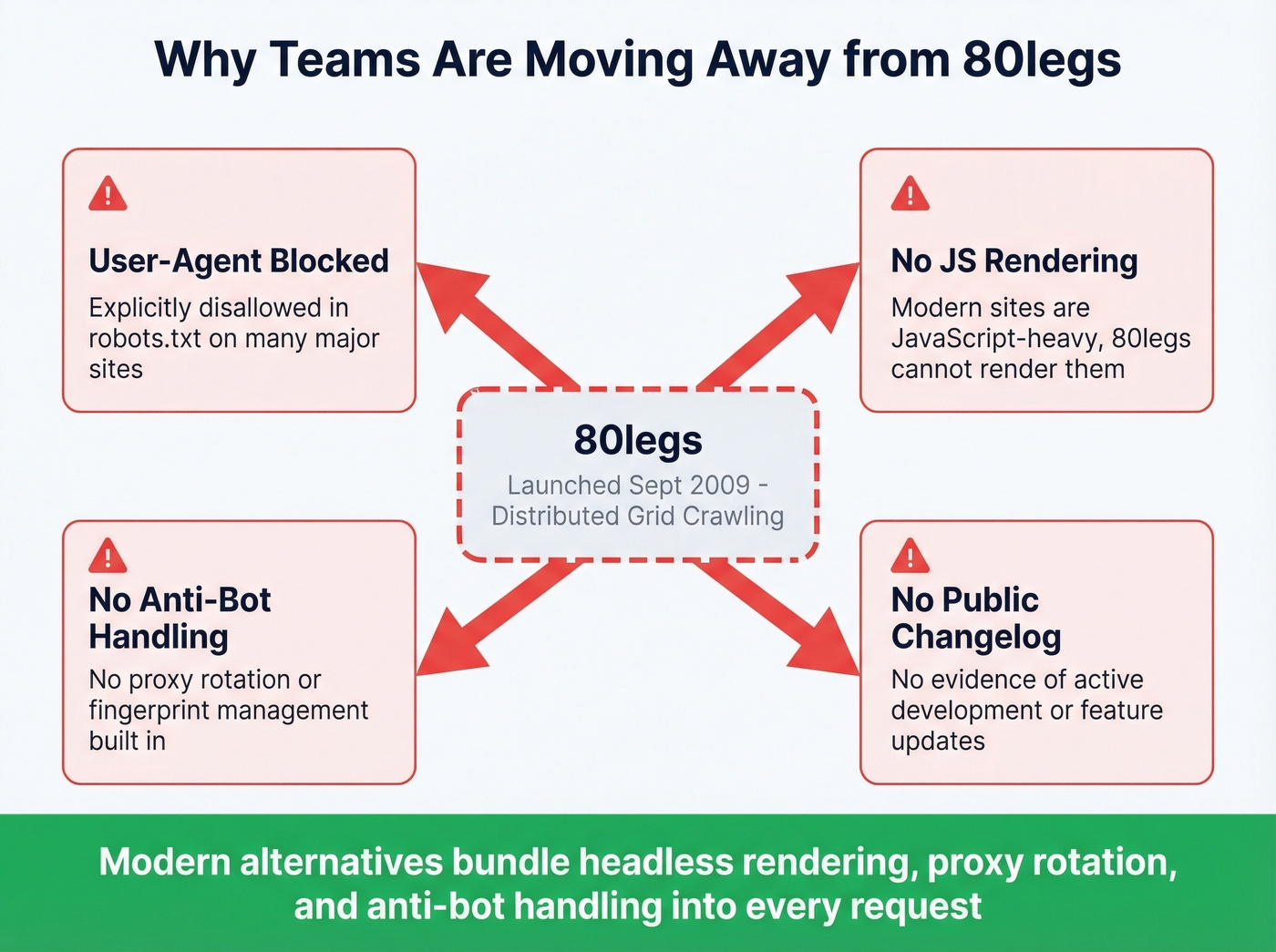
Here's the thing: the 80legs user-agent is explicitly disallowed on a huge number of sites. An r/SEO thread shows it listed alongside other bots in a standard robots.txt file. That alone is a dealbreaker for many use cases.
Modern sites are JS-heavy and increasingly aggressive about bot detection, so teams have shifted toward scraping APIs that bundle headless-browser rendering and anti-bot handling into each request. 80legs doesn't offer that, and there's no public changelog or release notes to suggest it's catching up.
Best Alternatives to 80legs
Prospeo - Skip the Crawler, Get the Data
If you're crawling websites to build a prospect list, you're doing it the hard way. Prospeo's database covers 300M+ professional profiles, 143M+ verified emails with 98% accuracy, and 125M+ verified mobile numbers - all refreshed on a 7-day cycle, which is roughly six times faster than the industry average. Search with 30+ filters, export verified contacts, push them to your sequencer. No crawling, no parsing, no cleaning.
The Chrome extension has 40K+ users. The free tier gives you 75 verified emails per month, and paid plans run about $0.01/email with no annual contracts. One of our customers, Founder Led Sales, cut their list-building time from 15 hours to 2-3 hours per week after switching from a crawl-based pipeline - and that's not unusual.


You're replacing 80legs because you need data, not HTML. Prospeo delivers 143M+ verified emails at 98% accuracy and 125M+ mobile numbers - refreshed every 7 days. No spiders to maintain, no proxies to rotate, no DOM changes to debug.
Get the data crawlers promise but rarely deliver - starting free.
ScrapingBee - Best API for Protected Sites
ScrapingBee is the tool to reach for when you need to scrape pages that fight back. In the Proxyway October 2025 benchmark testing 11 scraping APIs against 15 protected websites, ScrapingBee was one of four providers that opened protected sites over 80% of the time. JS rendering and anti-bot handling are built into every request.
Pricing starts at $49/mo for 250K API credits with 10 concurrent requests. Enterprise tiers scale to $2,399.99/mo for 41M credits. You also get 1,000 free API calls to test without a credit card. Where basic crawlers get blocked, ScrapingBee gets through - rotating proxies and headless browser rendering are handled server-side, so you don't manage any of that infrastructure yourself.

Scrapy - Open-Source Developer Control
Scrapy is free, open-source, and the default choice for developers who want full control. As one Reddit practitioner put it: "Super fast on static sites, though adding support for dynamic content took extra work."
The tradeoff is real. You handle infrastructure, proxies, rate limiting, and maintenance yourself. No dashboard, no support team. If you're comfortable running your own servers and writing Python spiders, Scrapy gives you more flexibility than any paid tool. If that sounds like a headache, keep reading.
Apify - Pre-Built Scrapers in the Cloud
Apify sits between "write everything yourself" and "just call an API." It's a cloud platform for automated data extraction with reusable actors, scheduling, storage, and API integrations. Billing runs on compute units (about $0.20-$0.30/CU), with tiers from Free ($5 credit) to Business at $999/mo.
The consensus on Reddit is that Apify has solid infrastructure and pre-built actors, but it can feel heavier than necessary for smaller jobs. Best when you need variety across multiple site types and don't want to maintain a fleet of custom spiders.
ZenRows - Watch the Multipliers
ZenRows looks cheap until you turn on features. Base CPM: $0.28 per 1,000 requests. JS rendering jumps that 5x. Premium proxies push it to 25x the base - $7.00 CPM. Plans start at $69.99/mo.
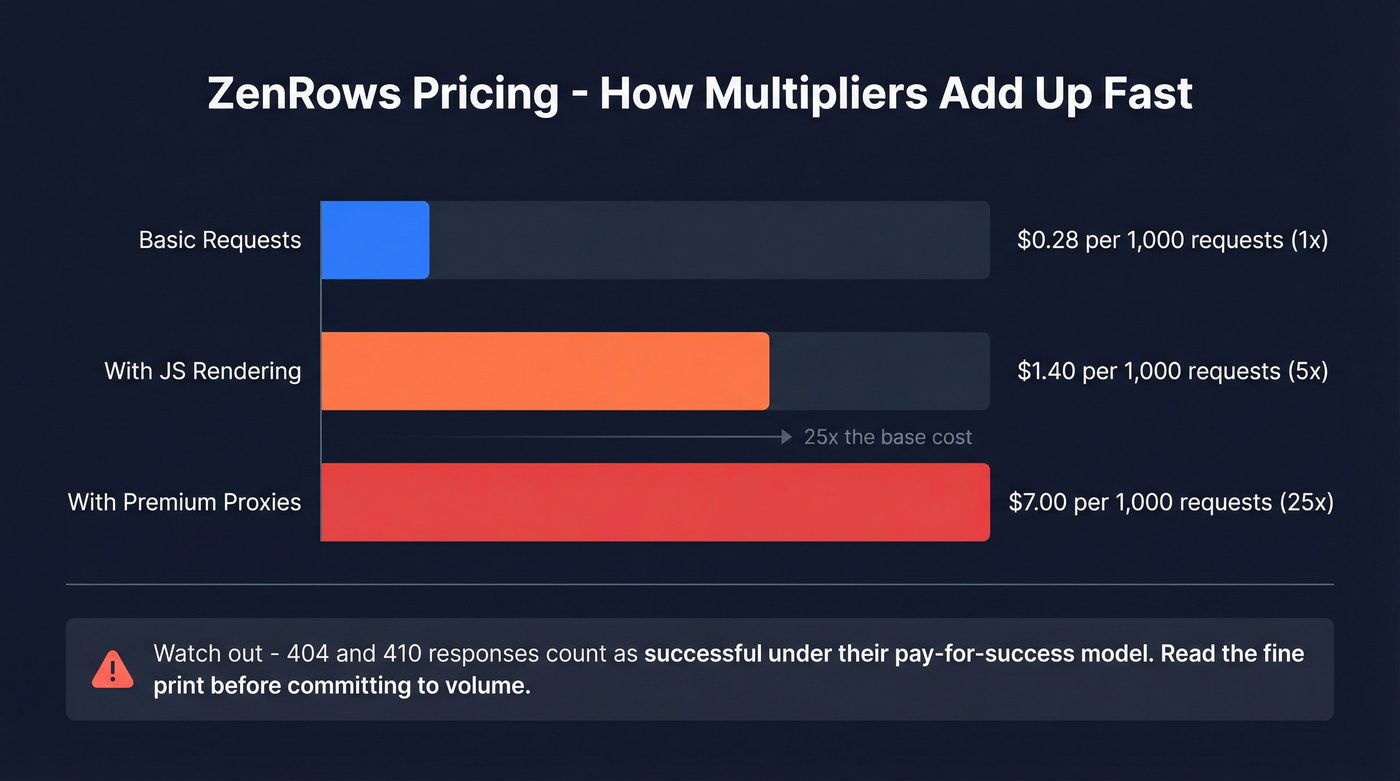
One catch worth flagging: 404 and 410 responses count as "successful" under their pay-for-success model. Read the fine print before committing to volume. We've seen teams get surprised by this.
Bright Data - Enterprise Scale
Bright Data is the enterprise heavyweight: 150M+ residential IPs across 195+ countries, scraper APIs, unblocking tools, and a datasets marketplace. Expect $500-$3,000+/mo depending on volume.
If you need massive scale and have the budget for a sales conversation, it belongs on your shortlist. For teams spending under $500/mo on data, skip this one - it's overkill and the onboarding process alone will eat a week.
Teams switching from crawl-based pipelines to Prospeo cut list-building from 15 hours to under 3 hours per week. At ~$0.01/email with no contracts, you spend less than a single month of 80legs' Pro plan - and get verified contacts instead of raw HTML.
Stop parsing pages. Start closing deals.
The Real Question Most Teams Should Ask
Let's be honest: most teams searching for 80legs alternatives don't actually need a web crawler. They need the data a crawler would produce. If your end goal is contact info or company data, a purpose-built data platform gets you there in minutes instead of weeks - and you won't burn engineering time maintaining spiders that break every time a site updates its DOM.
Pricing at a Glance
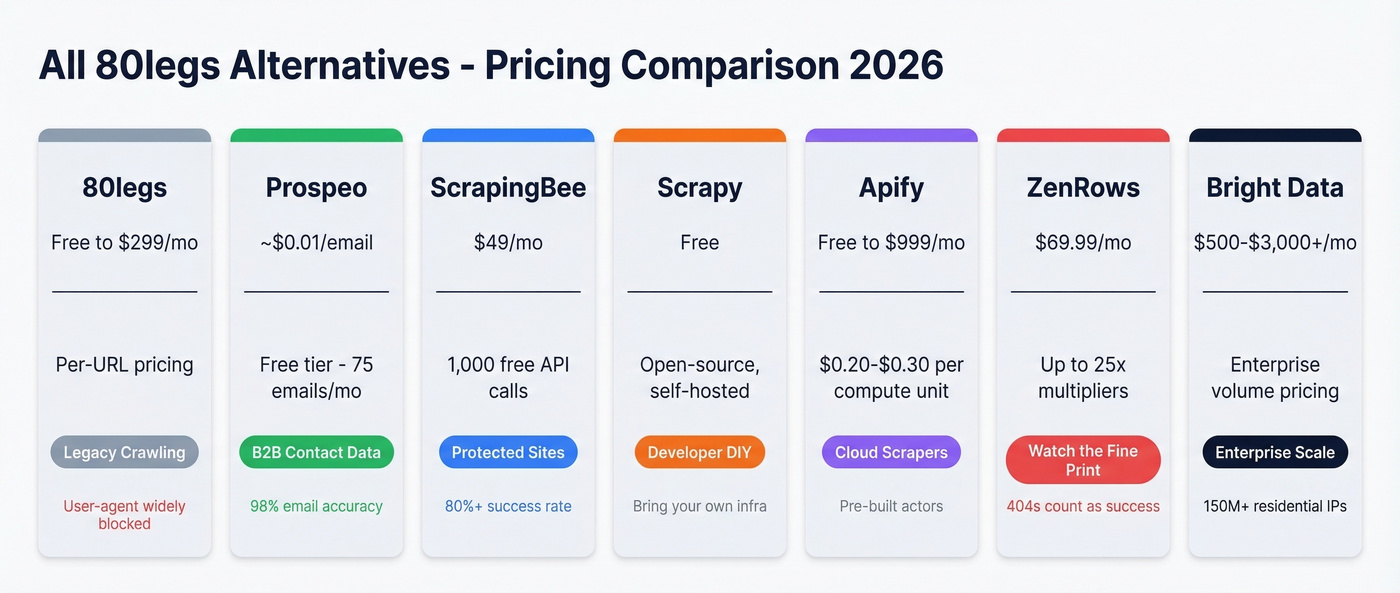
| Tool | Starts At | Free Tier | Pricing Model | Best For |
|---|---|---|---|---|
| 80legs | Free | Yes (10K URLs/crawl) | Per-URL | Legacy distributed crawling |
| Prospeo | ~$0.01/email | Yes (75 emails/mo) | Per-lead | B2B contact data |
| ScrapingBee | $49/mo | Yes (1K calls) | Per-API-credit | Protected site scraping |
| Scrapy | Free | N/A (open-source) | Self-hosted | Dev-controlled crawling |
| Apify | Free | Yes ($5 credit) | Compute-unit | Pre-built scrapers |
| ZenRows | $69.99/mo | Yes (1,000 basic + 40 protected results) | Per-request (multipliers) | Usage-based API |
| Bright Data | ~$500/mo | No | Enterprise/volume | Large-scale proxy |
Which One Should You Pick?
Need B2B contact data? Go with Prospeo. Don't crawl what you can query directly.
Need to scrape protected websites via API? ScrapingBee. It's proven in independent benchmarks, and the free trial is generous enough to validate your use case.
Want full control and zero cost? Scrapy - but bring your own infrastructure and be ready to maintain it.
Need pre-built scrapers in the cloud? Apify is a good middle ground between DIY and fully managed. For budget-conscious teams that only need a handful of scrapers, start with their free tier and see if the compute-unit model works for your volume.
FAQ
Is 80legs still active in 2026?
Yes - it has a live pricing page with plans from Free to Enterprise. It launched in September 2009, there's no public changelog, and its user-agent is widely blocked. Don't expect the "render + unblock by default" experience you get from modern scraping APIs.
What's the cheapest alternative to 80legs?
Scrapy is free and open-source, but you're paying for your own servers and proxies. For managed APIs, ScrapingBee starts at $49/mo with 1,000 free trial calls. For B2B data specifically, Prospeo's free tier gives you 75 verified emails per month with zero infrastructure costs.
Do I need a web crawler for B2B lead generation?
Usually not. If your end goal is emails, phone numbers, or company data, a dedicated data platform gives you verified contacts directly - no crawling, parsing, or deduplication required. Teams that switch from crawl-based pipelines typically cut list-building time from 15+ hours to 2-3 hours per week.