

ABM Attribution: The Practitioner's Field Guide
Your VP just asked what revenue ABM drove last quarter. You've got engagement dashboards, account scores, and a 9-month buying journey where 6.8 stakeholders touched everything from a LinkedIn ad to a webinar to a direct mail piece - and the CRM credits it all to the last demo request.
That's the ABM attribution problem in one sentence. Fewer than 25% of B2B teams rate their measurement practices as even fair. The bar to beat is genuinely low.
What Account-Based Attribution Actually Is
Standard marketing attribution tracks individual leads through a linear funnel. Account-based attribution tracks buying groups at the account level - and that distinction changes everything. When the average B2B deal involves 6.8 decision-makers, crediting a single form fill is absurd.
The time dimension shifts too. Standard attribution windows run 7-30 days. ABM cycles demand 90-365 day windows because enterprise deals don't close in a month. A Gartner survey found 39% of marketers cite attribution as their top ABM challenge, with another 36% saying measuring overall ABM success is equally difficult.
Why It Matters Now
82% of teams have adopted ABM. Demandbase's latest benchmark across 300+ marketers reported 81% higher ROI with account-based approaches, and 87% say ABM outperforms every other marketing investment. The adoption question is settled. The measurement question isn't.
The gap between "we do ABM" and "we can prove ABM works" is where most teams are stuck. A marketing leader on r/SaaSMarketing summed it up well: ABM looks good in theory, but it's hard to prove once you're dealing with long cycles and multiple stakeholders.
Here's the thing: if your average deal size is under $25K, you probably don't need a six-figure attribution platform. You need clean data, a W-shaped model in a spreadsheet, and discipline.
Why Account-Based Attribution Breaks
Four failure modes account for most broken setups.
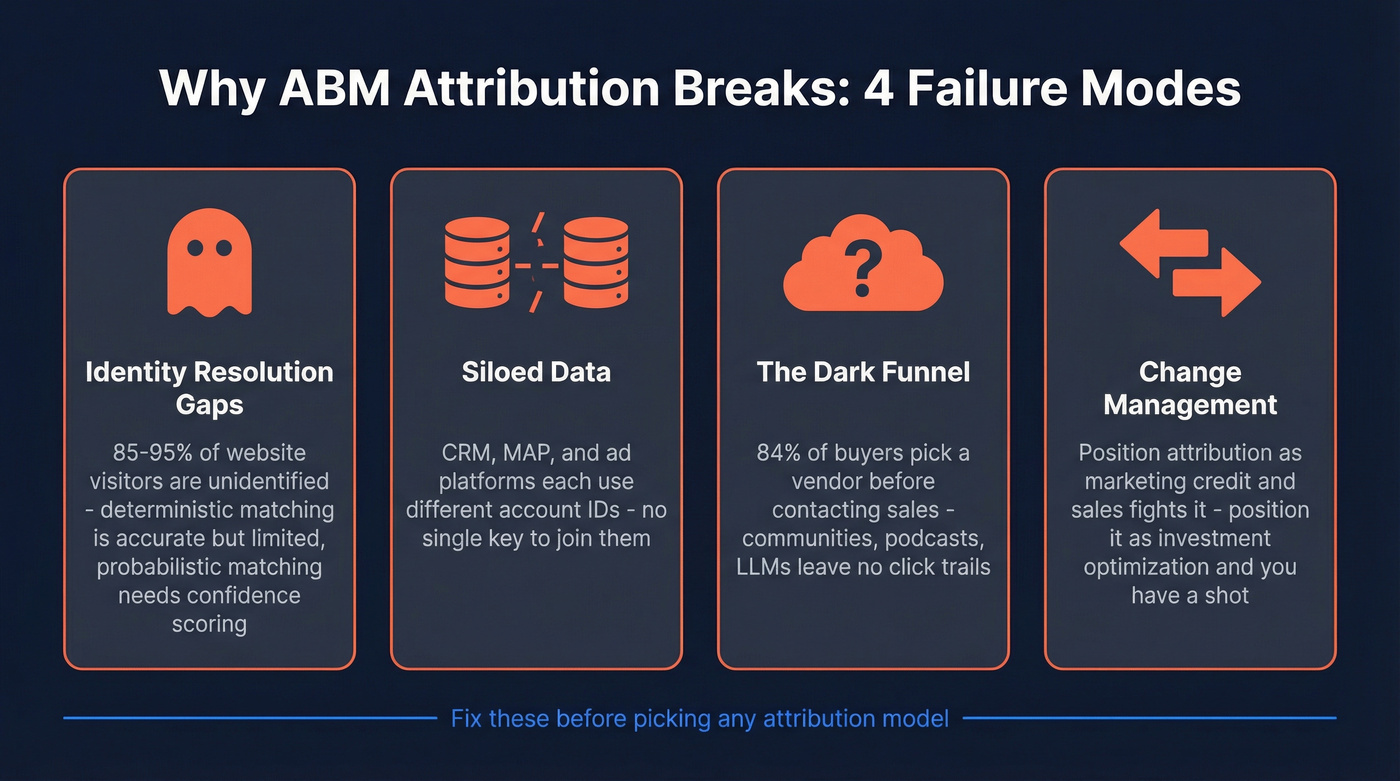
Identity resolution gaps. The industry standard for visitor identification sits at 5-15%. That means 85-95% of your website visitors are ghosts. Deterministic matching through hashed emails and login IDs is accurate but limited in reach, while probabilistic matching via IP patterns and device fingerprinting covers more ground but requires confidence scoring to be useful.
Siloed data. Your CRM uses one account identifier, your MAP uses another, and your ad platforms use a third. Before you can attribute anything, you need a single account key - domain, CRM Account ID, or a dedicated CompanyID - that joins everything.
The dark funnel. 84% of B2B buyers pick a vendor before contacting sales. Communities, podcasts, peer conversations, and LLM-mediated research all happen outside your tracking.
Change management. Multi-touch attribution's failure rate is staggering, and the root cause is usually organizational, not technical. Position attribution as "marketing credit" and sales will fight it. Position it as investment optimization and you've got a shot.
The Dark Funnel Problem
You can't attribute what you can't see. A Ruler Analytics test across 350+ leads found that 72% of self-reported attribution responses were inaccurate or missing. Combining self-reported data with behavioral attribution pushed accuracy to 81% - better, but still leaving gaps.
Three methods work in combination. First, add a "How did you hear about us?" open text field - not a dropdown, because dropdowns bias toward the first option. Second, track proxy metrics like branded search volume and correlate spikes with content drops or event appearances. Third, layer in third-party intent data from providers like Bombora or G2 Buyer Intent to catch signals outside your owned channels.
LLMs are the newest dark funnel layer. When a buyer researches your category through ChatGPT or Claude, there are no click paths, no referral data, no attribution signals. This isn't a future problem. It's happening right now, and nobody has a clean answer for it yet.

You just read it: 85-95% of visitors are ghosts, and stale contacts kill account matching before attribution even starts. Prospeo's 300M+ profiles refresh every 7 days - not the 6-week industry average - so your buying group coverage reflects reality, not last quarter's org chart.
Stop debugging attribution when the real problem is dead data.
Pick a Model and Move
Single-touch models are useless for ABM. A 6-month buying journey with 5 stakeholders and 20+ touchpoints doesn't collapse to one moment. Skip them.
For most ABM teams, W-shaped multi-touch is the right starting point. It weights first touch, opportunity creation, and closed-won at 30% each, distributing 10% across middle touches. It respects the three moments that actually matter while still giving credit to the nurture in between. We've reviewed dozens of ABM attribution setups, and W-shaped consistently outperforms linear in every one.
Run influence reporting alongside your attribution model - 57% of marketers already use both sourced and influenced measures.
Worked Example: W-Shaped Model
A $100K deal, 5 stakeholders, 6-month cycle. This is the math your VP actually wants to see.
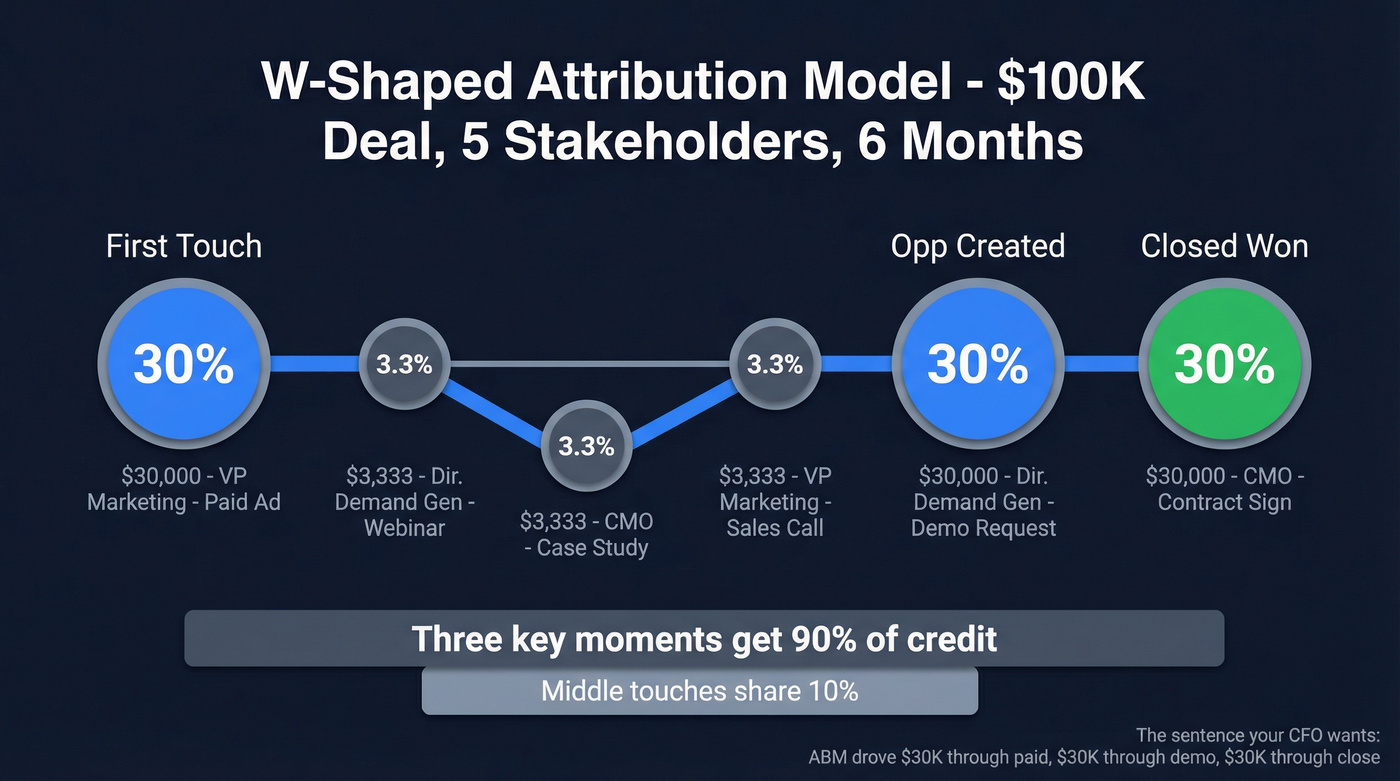
| Touchpoint | Stakeholder | Channel | Weight | Credit |
|---|---|---|---|---|
| First touch | VP Marketing | Paid ad | 30% | $30,000 |
| Webinar | Dir. Demand Gen | Content | 3.3% | $3,333 |
| Case study | CMO | Email nurture | 3.3% | $3,333 |
| Sales call | VP Marketing | Outbound | 3.3% | $3,333 |
| Opp created | Dir. Demand Gen | Demo request | 30% | $30,000 |
| Closed-won | CMO | Contract sign | 30% | $30,000 |
The middle touches split that 10% evenly. Not "ABM drove engagement" - ABM drove $30K of pipeline credit through paid acquisition, $30K through the demo that created the opportunity, and $30K through the close. That's a sentence a CFO can act on.
Reporting Metrics That Matter
| Tier | Metrics |
|---|---|
| Leading | Account engagement score, buying group coverage (are you reaching all 6.8 stakeholders or just 2?), content depth per account |
| Pipeline | Target-to-opportunity conversion, pipeline velocity, account-influenced pipeline value |
| Revenue | Win rate for influenced vs. non-influenced accounts, deal size delta, sales cycle length, CLV by ABM tier |
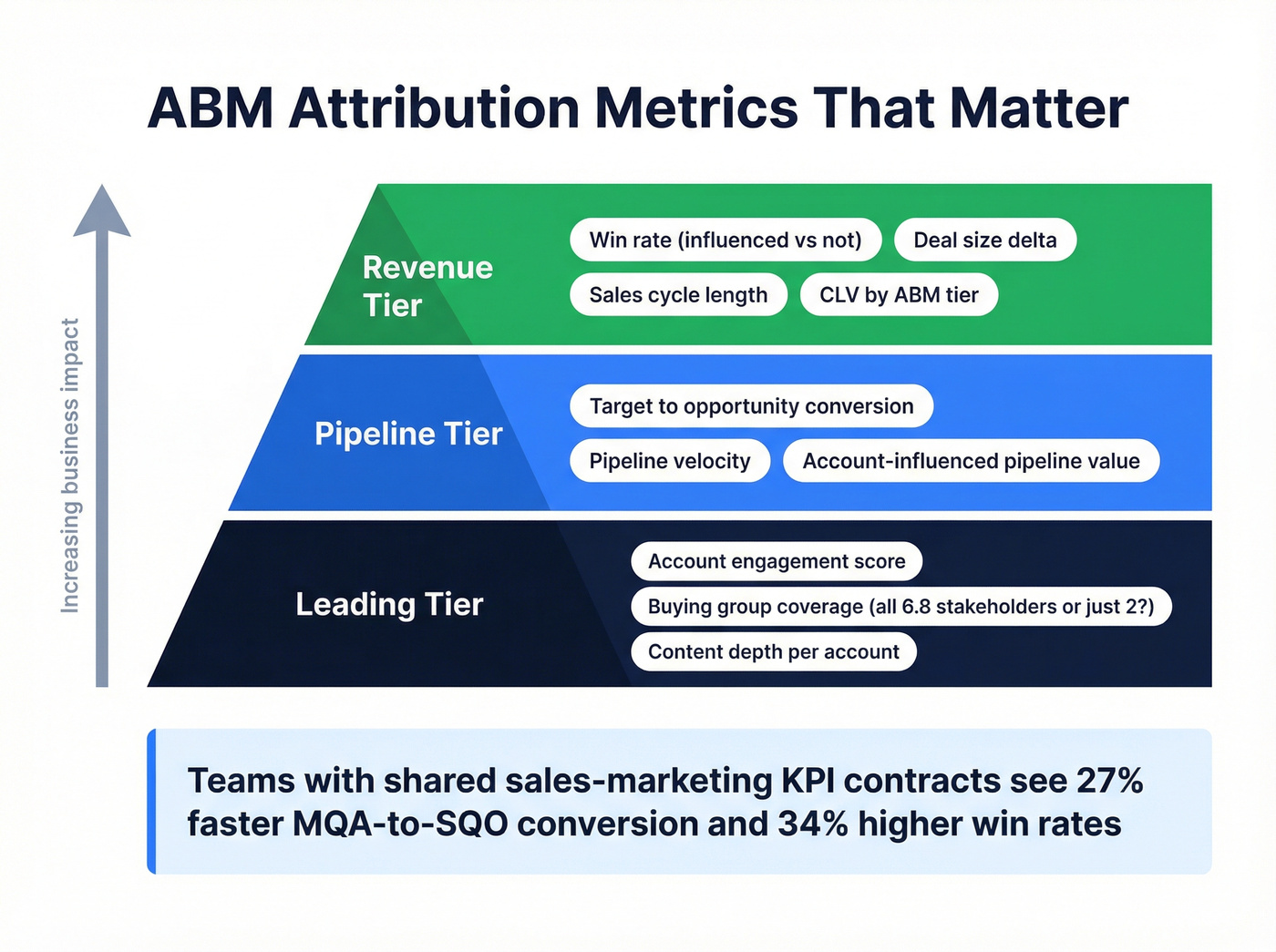
Teams that establish shared KPI contracts between sales and marketing see 27% faster MQA-to-SQO conversion and 34% higher win rates. Alignment isn't a soft goal - it's a measurable accelerant.
Fix Your Data First
Let's be honest: you don't have an attribution problem. You have a data quality problem. If 30% of your contact records are stale - wrong titles, dead emails, people who changed jobs two quarters ago - your account-to-contact matching is broken before you ever pick a model. In our experience, teams that skip the data audit waste 2-3 months debugging attribution outputs that were doomed from the start.
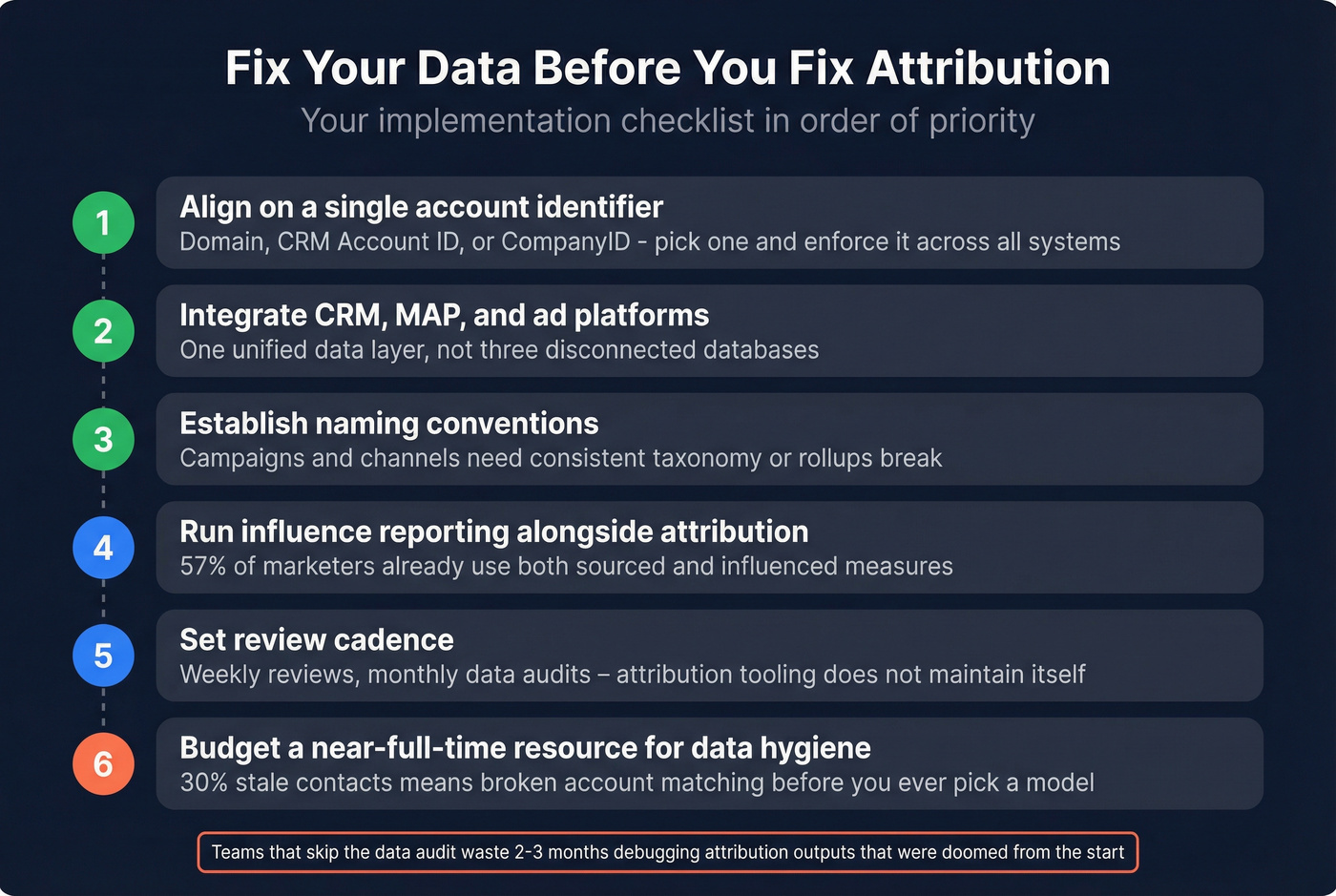
No account-based attribution framework survives dirty data.
We use Prospeo for contact enrichment before running any attribution analysis. A 98% email accuracy rate on a 7-day refresh cycle means account-to-contact matching doesn't silently degrade between reviews, and an 83% enrichment match rate across 300M+ profiles closes the coverage gap that kills most attribution setups.
Your implementation checklist:
- Align on a single account identifier across all systems
- Integrate CRM, MAP, and ad platforms into one data layer
- Establish naming conventions for campaigns and channels
- Run influence reporting alongside attribution from day one
- Set a weekly review cadence and a monthly data audit
- Budget a near-full-time resource for data hygiene - attribution tooling doesn't maintain itself
Reaching all 6.8 stakeholders per deal requires verified contact data, not guesswork. Prospeo delivers 98% email accuracy and 125M+ verified mobile numbers - so your W-shaped model credits real touchpoints with real buyers, not bounced emails and wrong numbers.
Cover the full buying group at $0.01 per verified email.
ABM Attribution Tools
| Tool | Starting Price | Best For | Note |
|---|---|---|---|
| HockeyStack | Custom | Revenue analytics | G2 4.7/5, strongest dashboards |
| Dreamdata | $750/mo | Mid-market attribution | Native W-shaped support |
| Demandbase | $30-100K+/yr | Enterprise ABM | Full-stack platform |
| 6sense | ~$60K/yr | Enterprise intent + ABM | G2 4.2/5 |
| Factors.ai | $399/mo | Mid-market ABM | G2 4.6/5 |
| CaliberMind | ~$1,500-4,000/mo | Mid-market multi-touch | Strong model flexibility |
| HubSpot Attribution | ~$800/mo (Marketing Hub Professional) | Budget / starter | Limited but low-friction |
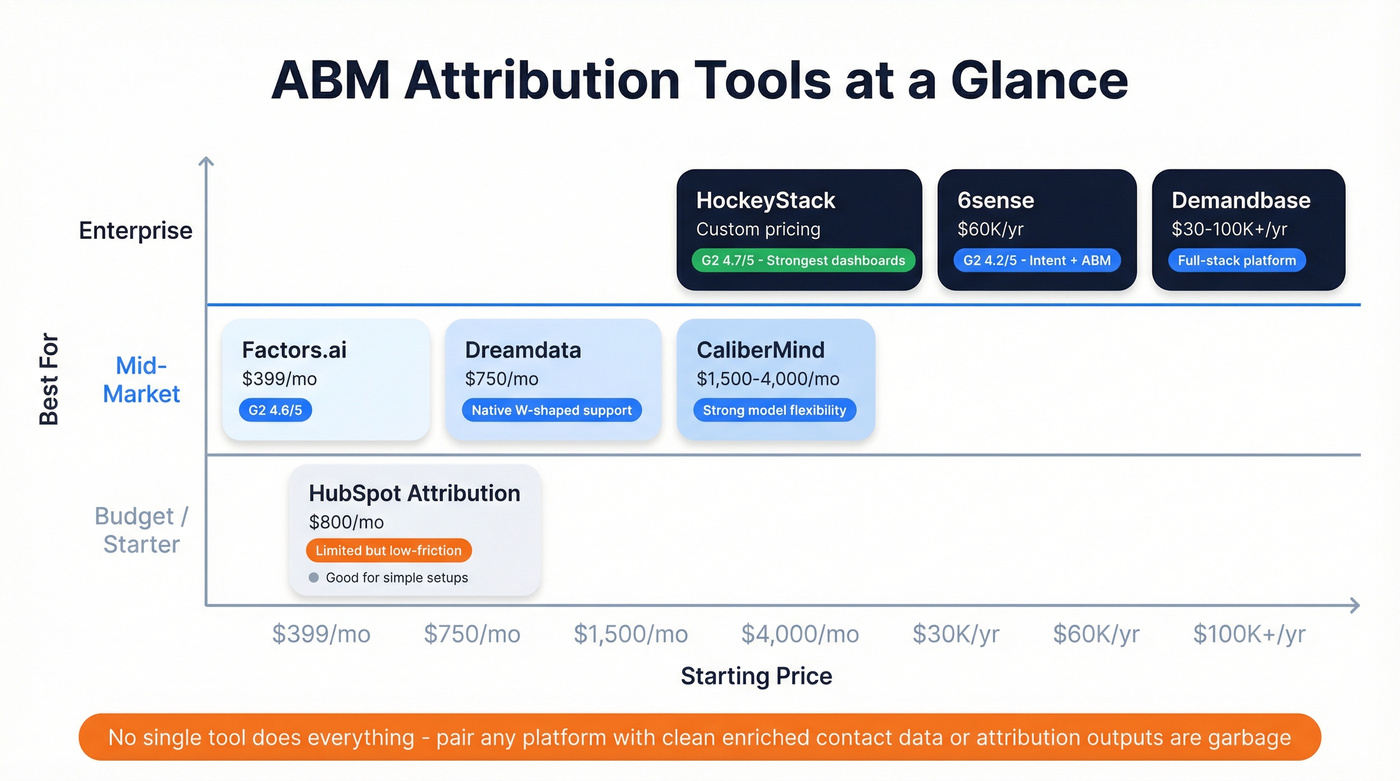
No single tool does everything. Pair any platform above with a clean enrichment layer - garbage contacts in means garbage attribution out. The best pipeline attribution comes from combining platform-level analytics with verified, enriched contact data that keeps your account graphs accurate.
Skip HubSpot's built-in attribution if you're running ABM across more than one ad platform and a MAP. It works for simple setups, but it'll frustrate you the moment you need account-level rollups across channels.
FAQ
What's the difference between ABM attribution and standard marketing attribution?
Standard attribution tracks individual leads through a linear funnel. Account-based attribution tracks buying groups at the account level across 90-365 day cycles and 6.8 stakeholders per deal, making lead-level models fundamentally inadequate for enterprise sales.
Which attribution model works best for ABM?
W-shaped multi-touch is the strongest starting point. It weights first touch, opportunity creation, and closed-won at 30% each, with 10% across middle touches. Pair it with influence reporting - 57% of marketers already run both.
How does data quality affect ABM attribution?
Stale contact records break account-to-contact matching, so your model assigns credit to the wrong people or misses stakeholders entirely. Enrichment tools with short refresh cycles and high accuracy rates prevent the silent degradation that makes attribution unreliable over time.
How do you measure the dark funnel in ABM?
Combine a "How did you hear about us?" open text field with branded search volume tracking and third-party intent data from Bombora or G2. No single method captures everything - layering self-reported and behavioral signals pushes accuracy to roughly 81%.