Dark Funnel Marketing: The Data-Backed Guide for 2026
A prospect books a demo. Your CRM says organic search. You ask how they actually found you, and they say a colleague mentioned your product in a Slack group six months ago.
That's dark funnel marketing - the majority of the buyer's journey that attribution software never sees. 84% of B2B buyers have already selected their preferred vendor before contacting sales, and 92% of B2B purchases involve groups of three or more, generating over 4,000 digital and human interactions along the way. Most happen where your analytics can't reach.
The short version: You can't eliminate the dark funnel, but you can build for it. Use self-reported attribution with an open text field. Layer intent data to surface in-market accounts. Invest in channels where buyers actually research - communities, podcasts, peer conversations - and when accounts surface, act fast with verified contact data.
What Is the Dark Funnel?
The dark funnel is every part of the buyer's journey that standard attribution can't track. The podcast episode where a VP of Marketing first hears your name. The private Slack community where someone asks "anyone used [your product]?" The ChatGPT conversation where a buyer compares three vendors and never clicks a single link.
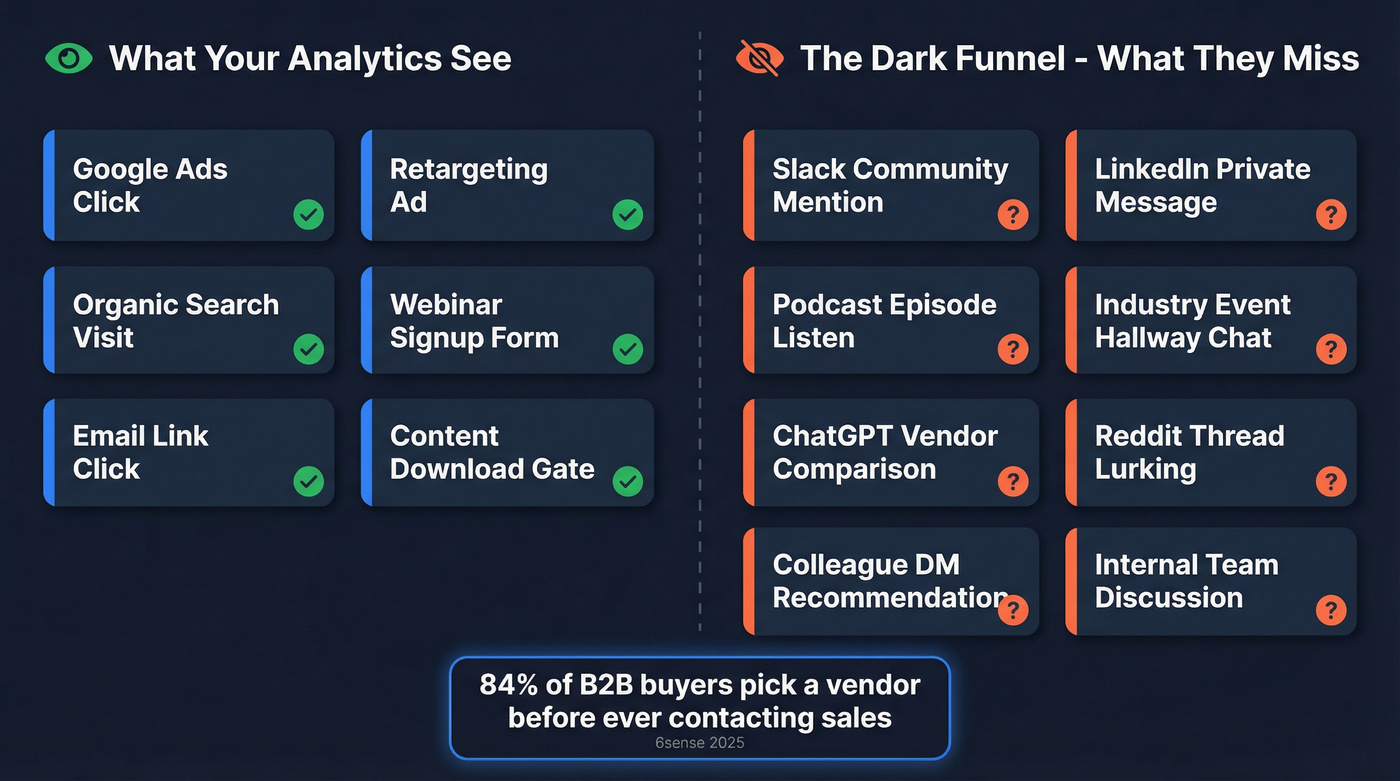
Word of mouth, events, DMs, review site browsing, internal team discussions - all shaping purchase decisions without generating a trackable touchpoint.
Understanding B2B marketing in 2026 means accepting that most of the buying process now happens in places your dashboards will never see. Dark social is a subset of the dark funnel. Dark social covers private sharing - DMs, messaging apps, texts. The dark funnel is broader: offline conversations, podcast consumption, community lurking, AI-mediated research, and everything else that shapes opinions before a buyer touches your website.
Why the Dark Funnel Keeps Growing
Three forces are expanding untrackable buyer activity faster than most marketing teams realize.
LLMs are the newest dark channel. When a buyer researches solutions in ChatGPT, Claude, or Gemini, there are zero click paths, zero referral data, and zero attribution signals. The entire research phase happens inside an LLM, your analytics see nothing, and the eventual site visit gets logged as "direct traffic." That tells you exactly nothing.
The trackable surface keeps shrinking. Ad blockers and privacy regulations erode pixel-based tracking year over year. Around 1 in 6 website visitors now arrive through messaging apps and private channels that strip referral data entirely. Account-level signals are the only reliable approach left.
Buyers trust peers, not vendors. The 2026 Edelman Trust Barometer found that 7 in 10 people worldwide have an insular trust mindset - they rely on close circles for information. Buyers ask colleagues, read community threads, and listen to practitioners on podcasts. They're not filling out your gated content forms. Peer trust outweighs brand messaging every time, which is why community-led growth in B2B keeps accelerating.
Five Signs Your Attribution Is Lying to You
If three or more of these sound familiar, you've got a problem:
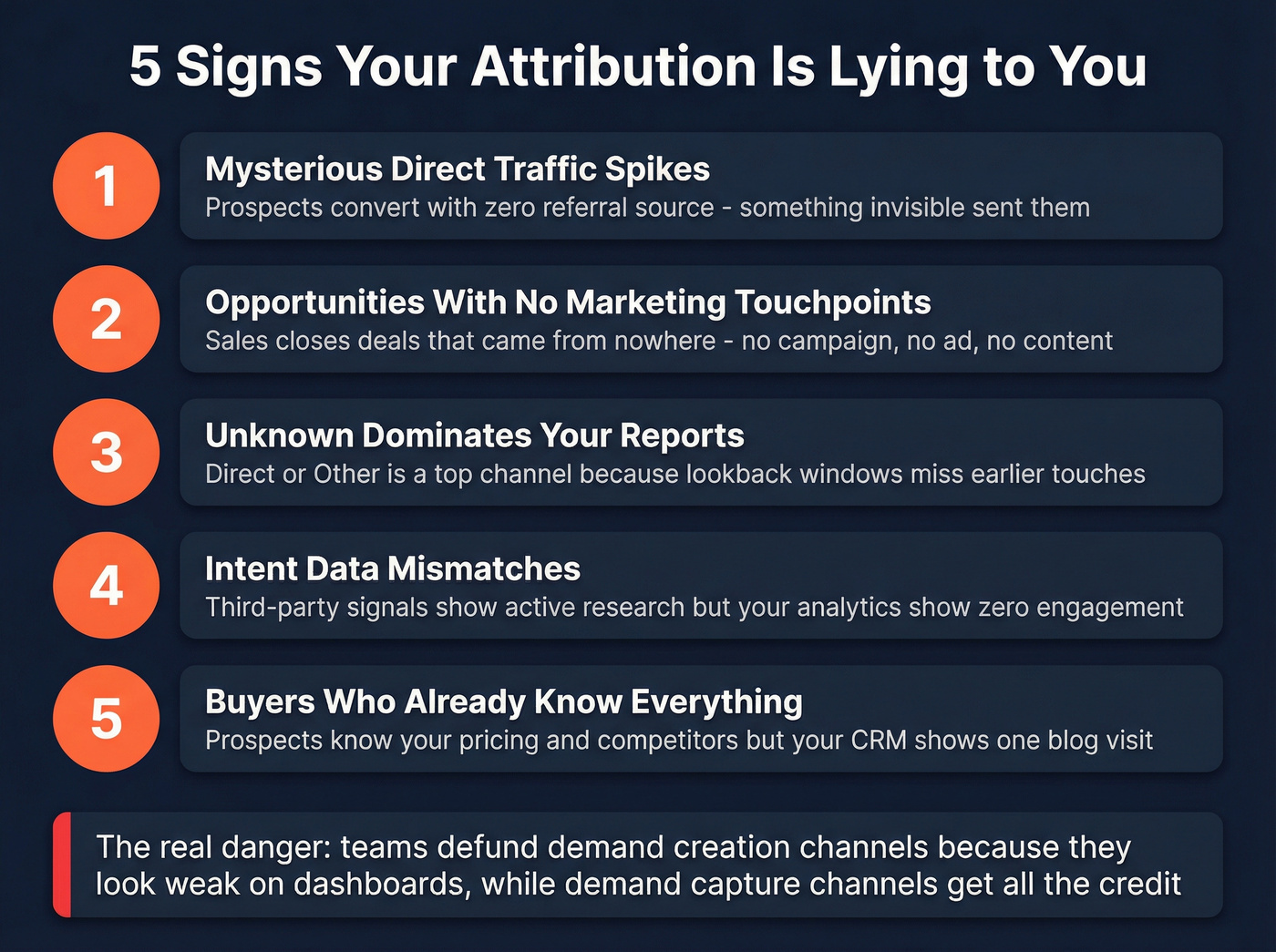
- Spikes in direct traffic conversions. Prospects convert without any trackable referral source. They didn't guess your URL - something invisible sent them.
- Opportunities with no marketing touchpoints. Sales closes deals that "came from nowhere." No campaign, no content download, no ad click.
- "Unknown" dominates your reports. "Direct" or "other" shows up as a top channel - often an artifact of 90-day lookback windows missing earlier touchpoints.
- Intent data mismatches. Third-party intent signals show accounts researching your category, but your analytics show zero engagement from those accounts.
- Buyers who already know everything. A prospect shows up to a demo knowing your pricing, differentiators, and competitor weaknesses. Your system shows they visited one blog post.
This creates a dangerous dashboard distortion. Demand capture channels like paid search and retargeting look hyper-efficient because they catch buyers at the finish line. Demand creation channels - podcasts, communities, ungated content - look weak because their influence is invisible. Teams that optimize purely on attribution data end up defunding the channels that actually create demand. That's the real cost of ignoring the dark funnel, and it's one of the most common strategic mistakes in B2B today.
The 95-5 Rule
Here's the thing: the dark funnel problem compounds because of the 95-5 rule. At any given time, only about 5% of your target accounts are actively in-market. The other 95% are future buyers forming opinions through exactly the untrackable channels we've been discussing.
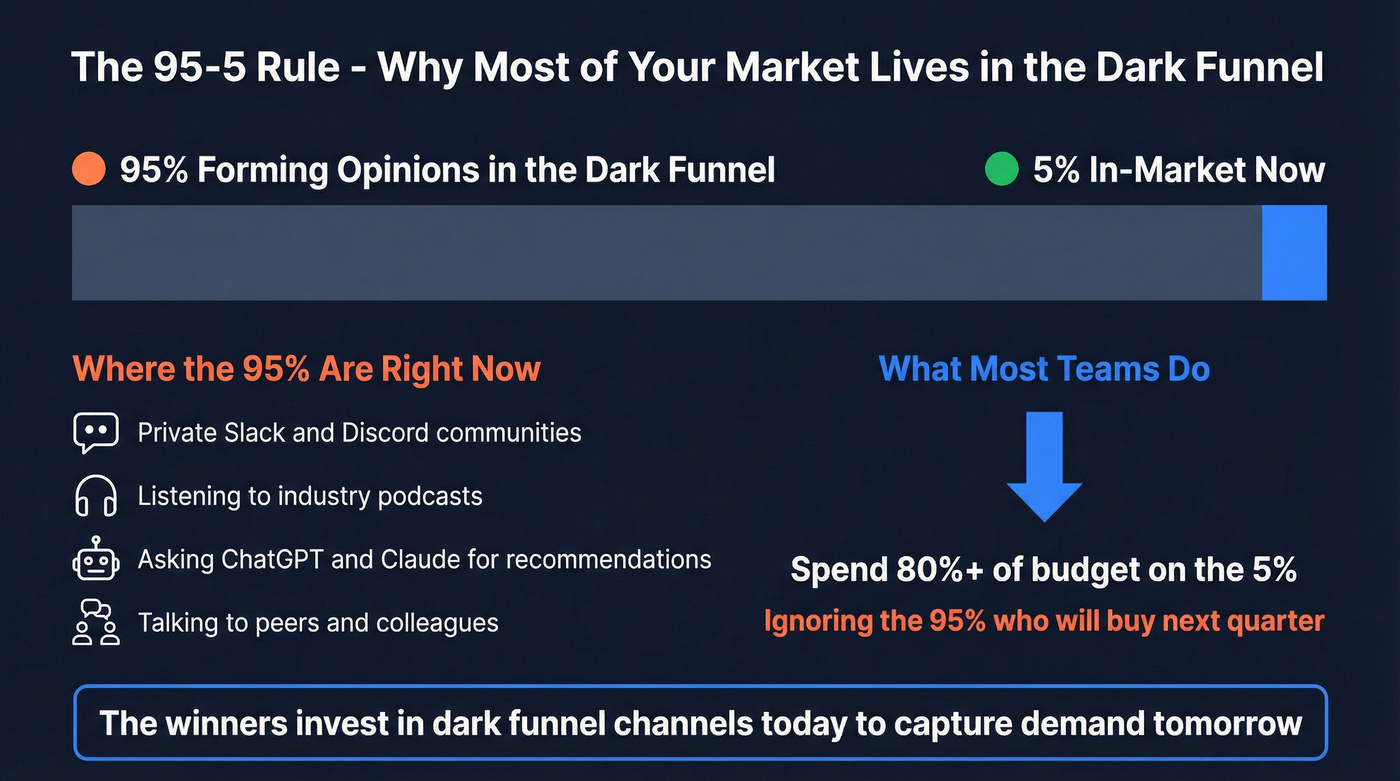
If your marketing only targets the 5% who are ready to buy right now, you're ceding the entire opinion-forming stage to competitors who show up in communities, podcasts, and peer conversations. The best strategies account for both the in-market minority and the out-of-market majority.

95% of your market is forming opinions in the dark funnel right now. Prospeo tracks 15,000 intent topics via Bombora so you can spot in-market accounts the moment they surface - then reach decision-makers with 98% accurate emails and 125M+ verified mobiles.
Stop waiting for dark funnel buyers to find you. Find them first.
How to Measure Dark Funnel Activity
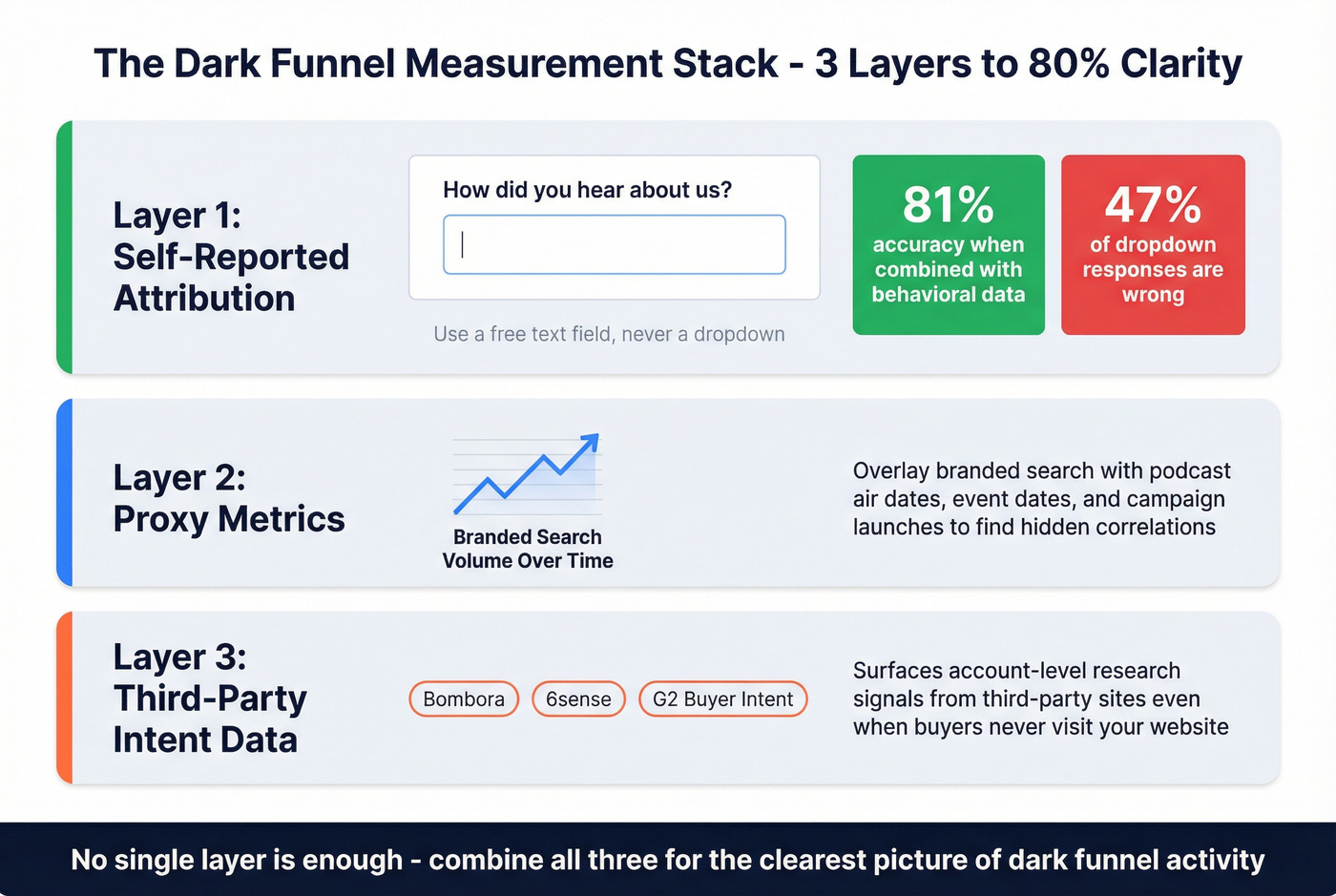
You can't track everything. But you can get to roughly 80% clarity by combining three approaches.
Self-Reported Attribution
Add "How did you hear about us?" as a free-text field on your demo form - not a dropdown. This is the single highest-ROI change you can make to your forms.
Ruler Analytics tested self-reported attribution across 350+ leads. 72% of responses were inaccurate or missing. And 47% of leads who selected the first dropdown option were inaccurately attributed. When they combined self-reported data with behavioral attribution, accuracy jumped to 81%. Without any attribution tool, 16% of data is completely lost. A dropdown gives you garbage data because people pick the first option. An open text field gives you signal.
Proxy Metrics
Track branded search volume over time. If branded searches climb but your attribution can't explain why, dark funnel channels are working.
We've seen this play out firsthand: a VP of Marketing couldn't justify her podcast budget until she overlaid branded search volume with episode air dates. The correlation was obvious. This is one of the most underrated approaches for teams trying to prove ROI on awareness channels.
Third-Party Intent Data
Tools like Bombora, G2 Buyer Intent, and Snitcher surface account-level signals your analytics miss. When an account researches your category on third-party sites, intent data catches it even if they never visit your website. It's the closest thing to a dark funnel flashlight.
How to Market Into the Dark Funnel
Chris Walker's framework is the clearest lens here: demand creation vs. demand capture. Most B2B budgets are overwhelmingly allocated to capture - paid search, retargeting, gated content. But the dark funnel is where demand gets created.
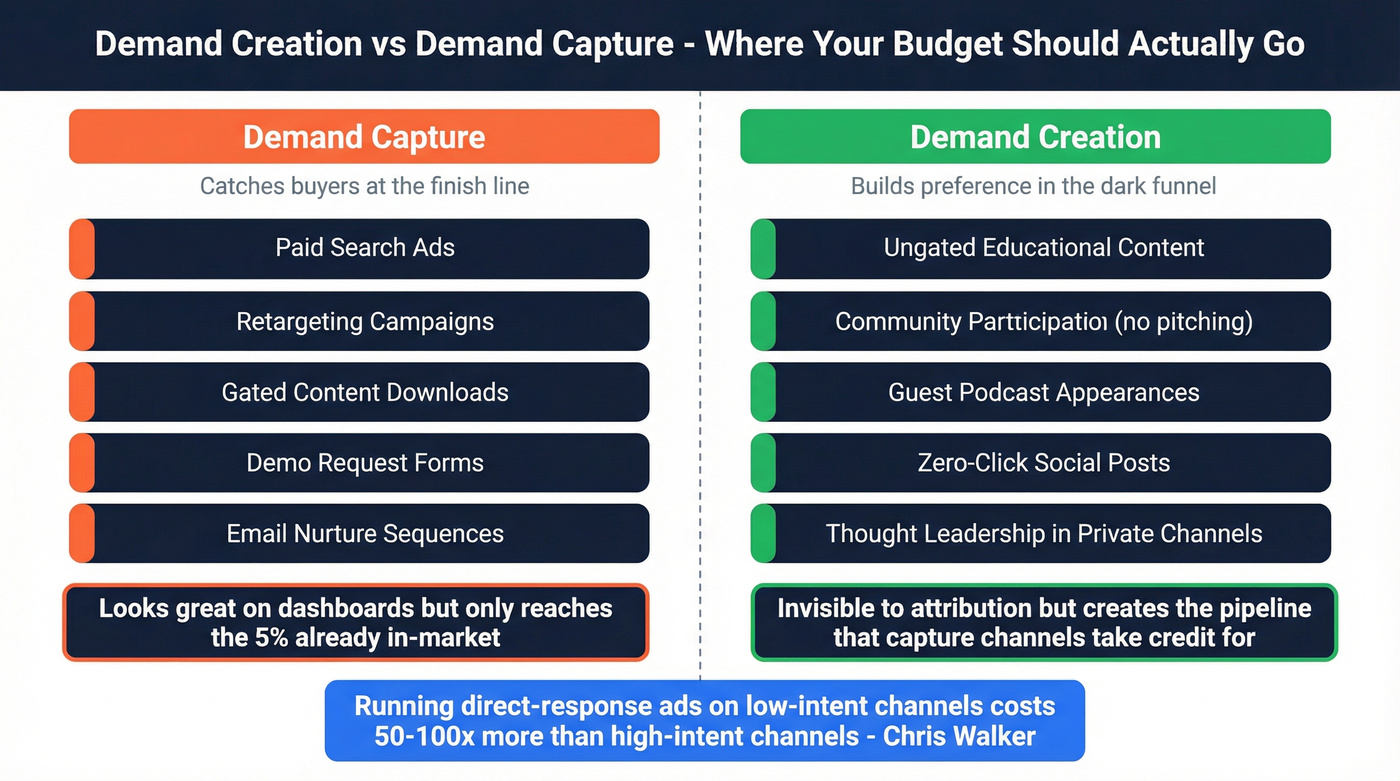
Publish ungated content that's genuinely useful. No email gate, no form - let it spread. Show up in online communities where your buyers hang out and contribute without pitching. Guest on the podcasts your ICP actually listens to; one good episode generates months of invisible pipeline. Create zero-click social content that delivers value without requiring a click to your site. These strategies don't show up in last-click attribution but consistently drive pipeline.
For technology companies especially, the dark funnel is where technical buyers do most of their evaluation. Engineers and developers don't click ads. They ask peers, read forums, and test free tiers. Your promotion strategy needs to meet them in those spaces.
Let's be honest about something most marketing leaders don't want to hear: if your average deal size is under $25k, you probably don't need multi-touch attribution software at all. A free-text "how did you hear about us?" field will tell you more than a $50k/year attribution platform, because the channels driving your pipeline - podcasts, communities, word of mouth - are invisible to software anyway.
What to avoid: don't run direct-response ads on low-intent channels and expect them to perform. Walker estimates this costs 50 to 100x more than running those same ads on high-intent channels. Gated content is demand capture theater - it measures form fills, not buying intent.
Reaching the C-Suite
Executives rarely fill out forms or click ads. They rely on board-level peer networks, private dinners, and curated content from trusted sources. A CMO strategy built around the dark funnel prioritizes executive podcasts, invite-only communities, and thought leadership that circulates through private channels. Connected TV advertising is also emerging as a way to build brand awareness with senior decision-makers in a format that generates zero trackable clicks but measurable branded search lift.
Playbook for Mid-Market Teams
Mid-market teams face a unique version of this problem: they lack the budget for enterprise intent platforms but serve buyers who still research heavily in untrackable channels.
Skip the $50k+ intent platforms for now. Focus on high-leverage, low-cost initiatives: community-driven presence where your buyers already gather, a consistent slot on one or two podcasts, and ungated content designed to be shared in private channels. Even remote teams can execute this - the channels are digital, the investment is time more than money, and the compounding effect is real. The consensus on r/sales is pretty clear: the teams winning outbound in 2026 aren't the ones with the biggest tech stacks, they're the ones showing up consistently in the right rooms.
For trade shows, the lesson is the same. The conversations that happen in hallways, at dinners, and in post-event Slack groups matter more than badge scans. Design your event presence to spark those untrackable conversations, not just collect leads.
Essential Tools
Once you accept the dark funnel exists, you need tools across three layers.
Detection - 6sense provides multi-source intent and ABM orchestration, typically $30-100k+/year. Bombora runs the largest B2B intent data co-op at roughly $20-50k/year. For smaller budgets, Snitcher identifies anonymous website visitors at the account level from ~$39/mo, and G2 Buyer Intent surfaces signals from category page activity.
Monitoring - Brand mentions across communities, forums, and social for ~$49-299/mo. Set up Google Alerts for "[your brand] vs," "[your brand] alternative," and "[your brand] review." Cheap and surprisingly effective.
Measurement - multi-touch attribution with account-level journey mapping, roughly $1,000-5,000/mo for mid-market. Integration between your intent tools and ad platforms ensures you're retargeting accounts that have already shown dark funnel signals, not cold audiences.
Execution - Intent data tells you who is in-market. But you still need to reach them. Once an account surfaces through intent signals, Prospeo layers Bombora intent data across 15,000 topics with verified contact data - 98% email accuracy and a 7-day refresh cycle - so you can act on those signals before they go cold. Plans start at ~$0.01/email with a free tier.
When a dark funnel account finally surfaces, speed kills. Prospeo's 7-day data refresh means you're reaching buyers with verified contact data - not stale records from six weeks ago. 92% API match rate, 50+ data points per contact, and emails at $0.01 each.
Dark funnel accounts surface fast and go cold faster. Act on fresh data.
FAQ
What's the difference between dark funnel and dark social?
Dark social covers private sharing - DMs, texts, messaging apps. The dark funnel is broader, including all untrackable activity: podcast consumption, community discussions, AI-mediated research, word of mouth, and offline conversations that shape buying decisions before anyone visits your site.
How do you track dark funnel activity?
Combine self-reported attribution using an open text field, proxy metrics like branded search volume, and third-party intent data from providers like Bombora and Snitcher. Together these methods get you to roughly 80% clarity - far better than relying on software attribution alone.
What tools help with dark funnel marketing?
Intent platforms like 6sense and Bombora surface in-market accounts. Snitcher identifies anonymous visitors. Brand24 monitors community mentions. For execution, you need verified contact data to act on those signals quickly - tools like Prospeo pair intent data with 98%-accurate emails so you aren't waiting days to reach accounts that are already evaluating competitors.
Why is the dark funnel growing in 2026?
LLM-based research generates zero attribution data, privacy regulations keep shrinking trackable surfaces, and buyers increasingly trust peer recommendations over vendor content. These three forces compound to make roughly 70-80% of the B2B journey invisible to analytics.
How does the dark funnel differ for service companies?
Service businesses face an amplified version because services are harder to evaluate than software - buyers rely even more on peer recommendations, case study word-of-mouth, and community discussions. Invest disproportionately in referral programs, thought leadership, and community presence where reputation compounds over time.