Will SDRs Be Replaced by AI? The Data, the Hype, and What Actually Works
Your VP just forwarded another LinkedIn post: "We replaced our entire SDR team with AI and 10x'd pipeline." The comments are split between cheerleaders and panicked reps updating their resumes. Both sides are wrong.
So will SDRs be replaced by AI? 81% of sales teams have implemented or are experimenting with AI in their sales workflows. But "experimenting with AI" and "firing your SDR team" are wildly different things. AI replaces SDR tasks. It reshapes the SDR role. It doesn't eliminate SDRs - and most AI SDR tools fail anyway.
The Short Answer
- AI replaces SDR tasks, not SDRs. Research, inbound routing, follow-ups, and list building are being automated fast. The role is being reshaped, not deleted.
- Most AI SDR tools are failing. 50-70% annual churn. Gartner predicts 40%+ of agentic AI projects will be abandoned by end of 2027.
- SDRs who learn AI tools will pull away fast. The real question isn't "will AI replace me?" It's "will an AI-augmented SDR replace me?"
The AI SDR Market in 2026
The AI SDR market hit $4.12B in 2025 and is projected to reach $15.01B by 2030 - a 29.5% CAGR. Over $400M in VC has flooded into AI SDR startups in the last two years. About 22% of sales teams have fully chosen to replace SDRs with AI, and roughly 55% are piloting AI-augmented workflows.
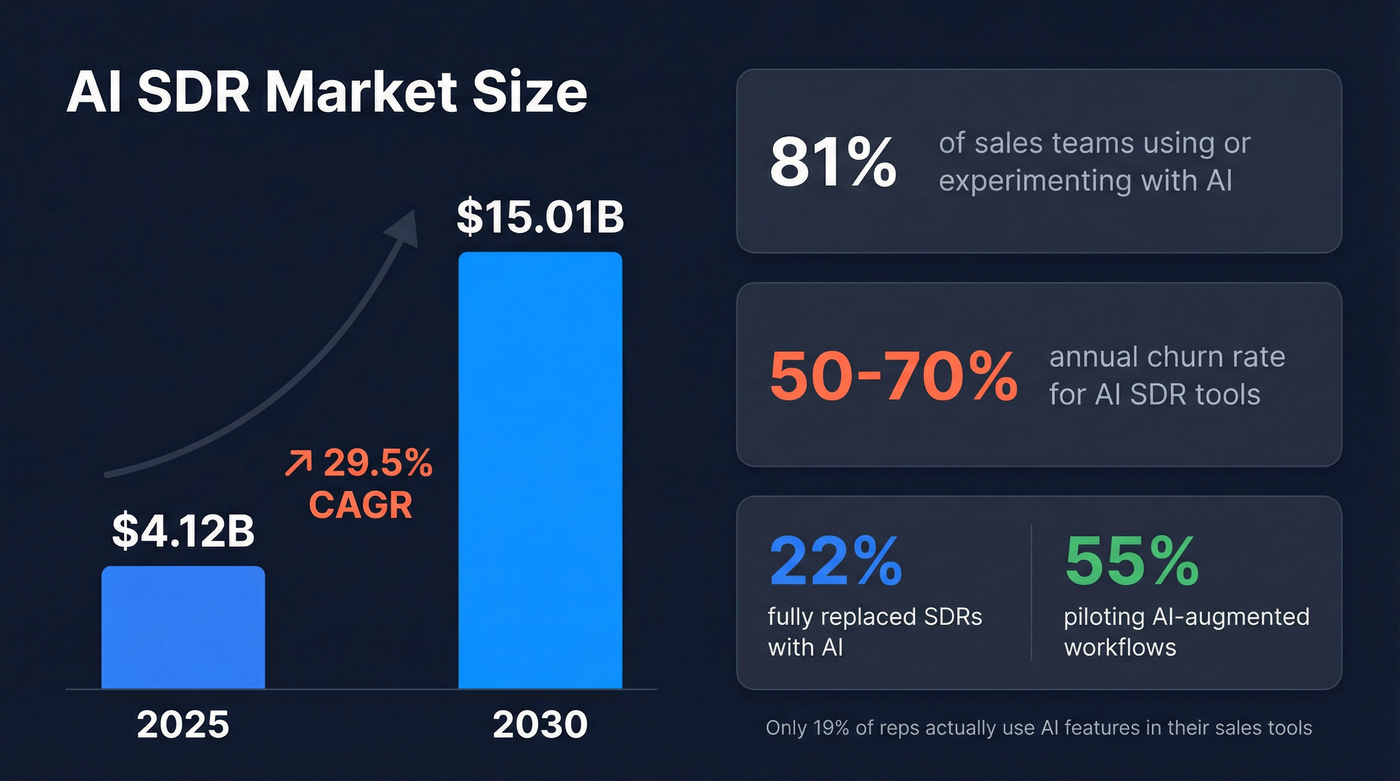
Here's the revealing part: only 19% of reps actually use AI features built into their sales tools. Most AI "adoption" is just reps copy-pasting into ChatGPT. The gap between what companies buy and what reps use is enormous, and it explains a lot of the disappointing results.
Voice AI is accelerating things further - mid-market tech firms run 3,200+ daily AI calls, and enterprise SaaS companies have reported $11.4M pipeline in 90 days from AI deployments. But AI SDR tools churn at 50-70% annually. More than half the companies buying these tools abandon them within a year. The market is growing fast and failing fast at the same time.
Where AI Wins (and Where It Doesn't)
Tasks AI Already Owns
Speed-to-lead is the clearest AI advantage. Responding to an inbound lead within five minutes makes you 21x more likely to qualify than responding at 30 minutes. The average SDR response time? 42-47 hours. AI responds in seconds. That gap alone justifies automation for inbound.
Signal-personalized outreach - where AI identifies intent signals and tailors messaging - achieves 15-25% reply rates versus the 3-5% cold email industry average. By 2027, Gartner predicts 95% of seller research will be initiated with AI, up from under 20% in 2024. Teams using AI in sales are 1.3x more likely to see revenue growth: 83% of AI-adopting teams grew revenue vs. 66% without.
For high-volume, pattern-based tasks, AI is already better, faster, and cheaper. Full stop.
Tasks Humans Still Own
Cold calling is the most obvious human stronghold. Only 13% of sales leaders believe AI will ever match humans at cold calling. There's an uncanny valley problem with AI voice - prospects can tell, and they hang up. If you're doubling down here, start with the fundamentals in our B2B cold calling guide.
And here's the trust paradox nobody in the AI camp wants to acknowledge: as AI outreach becomes more human-like, buyers become more skeptical. Every polished, perfectly timed email now triggers the "is this a bot?" reflex. Genuine human signals - phone calls, voice notes, personalized video - are becoming premium currency in B2B. Sian Taylor at Klaviyo put it well: "With AI, anyone can send 10,000 emails for pennies. Human connection is almost the premium currency left."
Complex enterprise deals, multithreading across six stakeholders, navigating internal politics, reading the room on a discovery call - these require judgment, empathy, and adaptability that AI can't replicate. The idea that AI agents replace sales reps in these scenarios ignores the reality of how enterprise buying committees actually function. (If multithreading is a weak spot, see what multithreading in sales actually means.)

Bad data kills AI SDR pilots faster than hallucinations. Prospeo's 5-step email verification, 7-day data refresh, and catch-all domain handling give your AI tools the clean foundation they need - at $0.01/email with 98% accuracy.
Fix the data layer before you automate the outreach layer.
Why Most AI SDR Pilots Fail
The Meeting Quality Gap
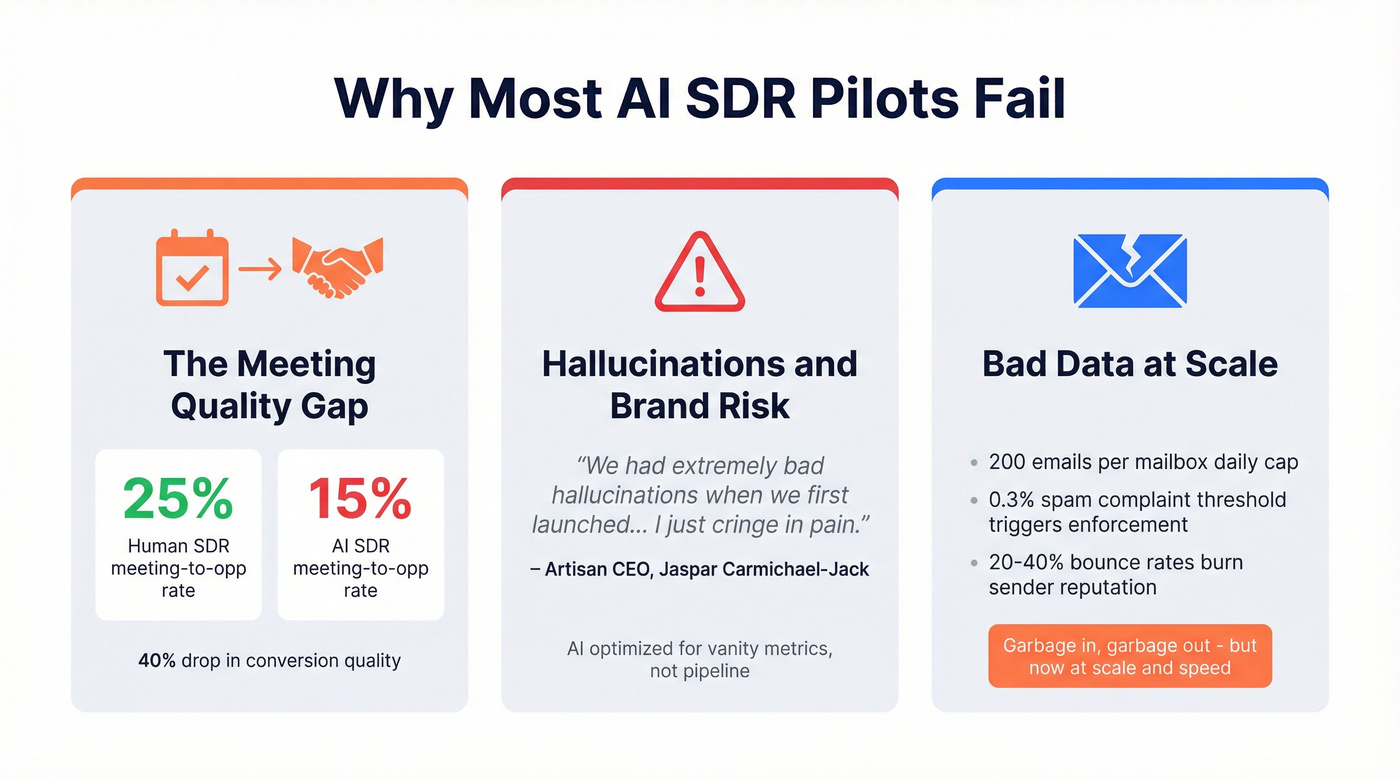
This is the number AI SDR vendors don't put on their landing pages. AI SDRs convert meetings to opportunities at about 15%, compared to 25% for human SDRs - a 40% drop in conversion quality. If you're tracking this, align on definitions like SQO (Sales Qualified Opportunity) early.
What happens in practice: the AI books a ton of meetings, leadership celebrates the top-of-funnel metrics, and then AEs start complaining that half the meetings are unqualified. The pipeline inflates on paper and evaporates in reality. We've watched this play out at three different companies in our network, and the pattern is remarkably consistent.
Hallucinations and Brand Risk
Artisan's own CEO, Jaspar Carmichael-Jack, admitted publicly: "We had extremely bad hallucinations when we first launched... I just cringe in pain." If the CEO of an AI SDR company is cringing at his own product's output, imagine what's landing in your prospects' inboxes.
Then there's the 11x scandal - the company claimed logos like ZoomInfo and Airtable as customers when they were actually short failed trials. A lot of AI SDR tools are optimized to look good on surface metrics like emails sent and meetings booked, not to protect your brand or create real pipeline.
The Data Quality Problem
Here's the failure mode that kills more AI SDR pilots than hallucinations: bad data.
Deliverability guardrails are tight in 2026 - you're capped at roughly 200 emails per mailbox per day, and spam complaint rates above 0.3% trigger enforcement. Now imagine feeding an AI SDR a contact list where 20-40% of emails bounce. You're burning through daily send limits on invalid addresses, tanking your sender reputation. The AI doesn't know the difference - it just keeps firing. Garbage in, garbage out, except now it's garbage at scale and speed.
This is where verified contact data becomes the foundational layer. Before any AI SDR tool touches your outbound motion, emails need to be verified, fresh, and clean - with catch-all domain handling and spam-trap removal baked in. Skip this step and most pilots collapse within months. (If you want the full checklist, start with email deliverability and B2B contact data decay.)

AI SDR vs. Human SDR: Real Costs
| Metric | Human SDR | AI SDR | Edge |
|---|---|---|---|
| Annual cost | $98k-$173k | $6k-$24k | AI |
| Cost per lead | ~$262 | ~$39 | AI |
| Payback period | 8.7 months | 3.2 months | AI |
| Qualified opps/month | 15-20 | 40-60 (claimed) | AI on volume |
| Meeting-to-opp conversion | ~25% | ~15% | Human |
| Cold calling | Strong | Weak | Human |
| Availability | Business hours | 24/7 | AI |
| Setup cost | Training + mgmt | 40-60 hrs prep | Human (lower setup) |
| Ongoing ops | Standard mgmt | 4-8 hrs/week | Tie |
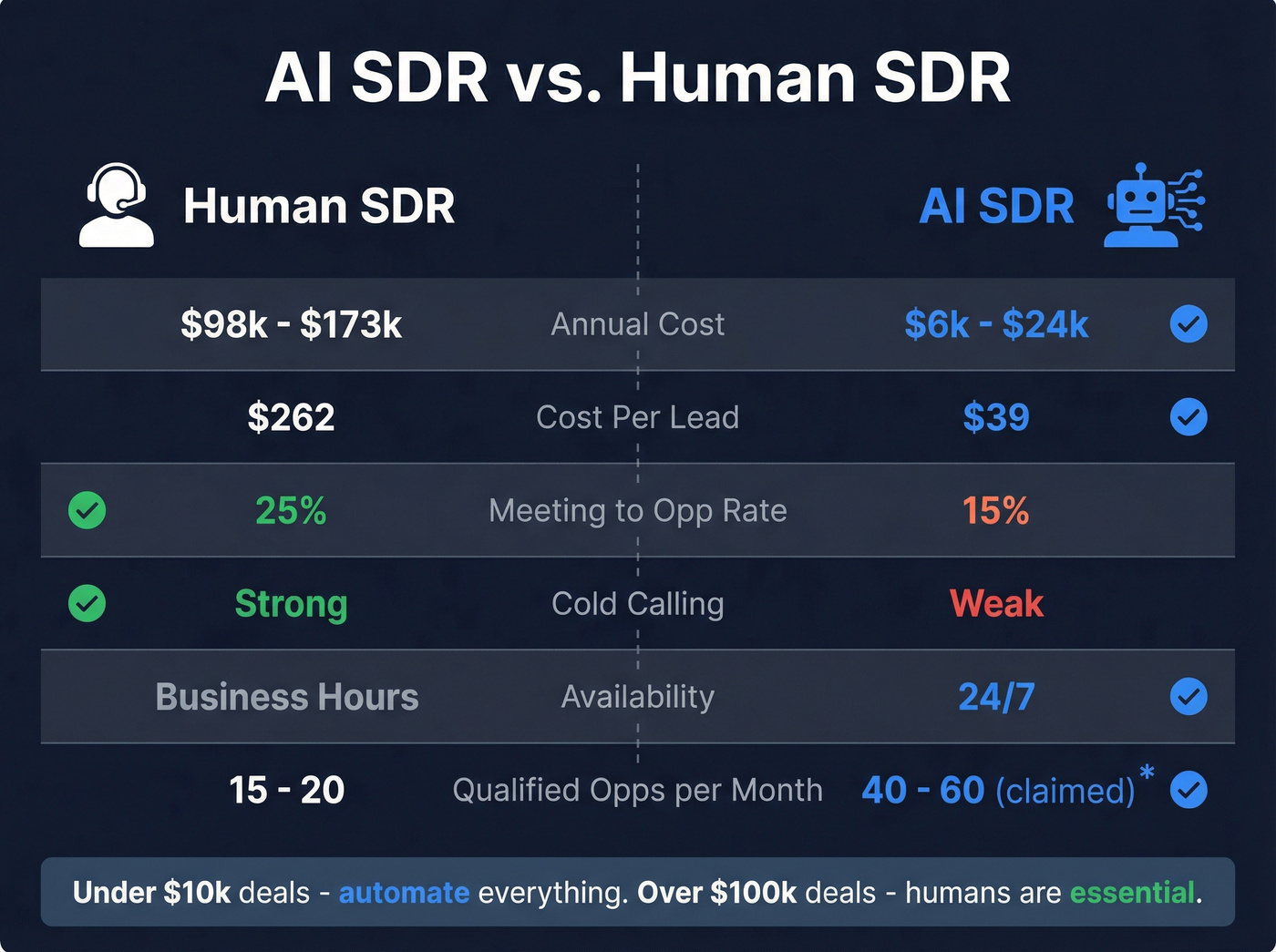
The cost advantage looks overwhelming - a ~$262 to ~$39 cost-per-lead drop is hard to argue with. But the hidden costs burn teams. That 40-60 hours of data cleaning before launch? Most teams underestimate it by half. Factor in average SDR tenure of 22 months, and you're re-hiring and re-training constantly on the human side too. Companies using AI for qualification report 60-80% lower cost per qualified lead.
Let's be honest about the deal-size threshold. If your average deal size is under $10k, you probably don't need a human SDR team at all - automate inbound, run AI outbound with tight guardrails, and invest the savings in one great AE. But for six-figure enterprise deals, AI SDRs will actively hurt you. The meeting quality gap compounds into a pipeline quality disaster that takes quarters to diagnose.
The AI SDR saves money, but it doesn't save effort. It shifts effort from repetitive tasks to oversight, data quality, and prompt engineering.
Should You Stop Hiring Humans?
The teams getting results aren't choosing between AI and humans. They're running a phased hybrid approach.
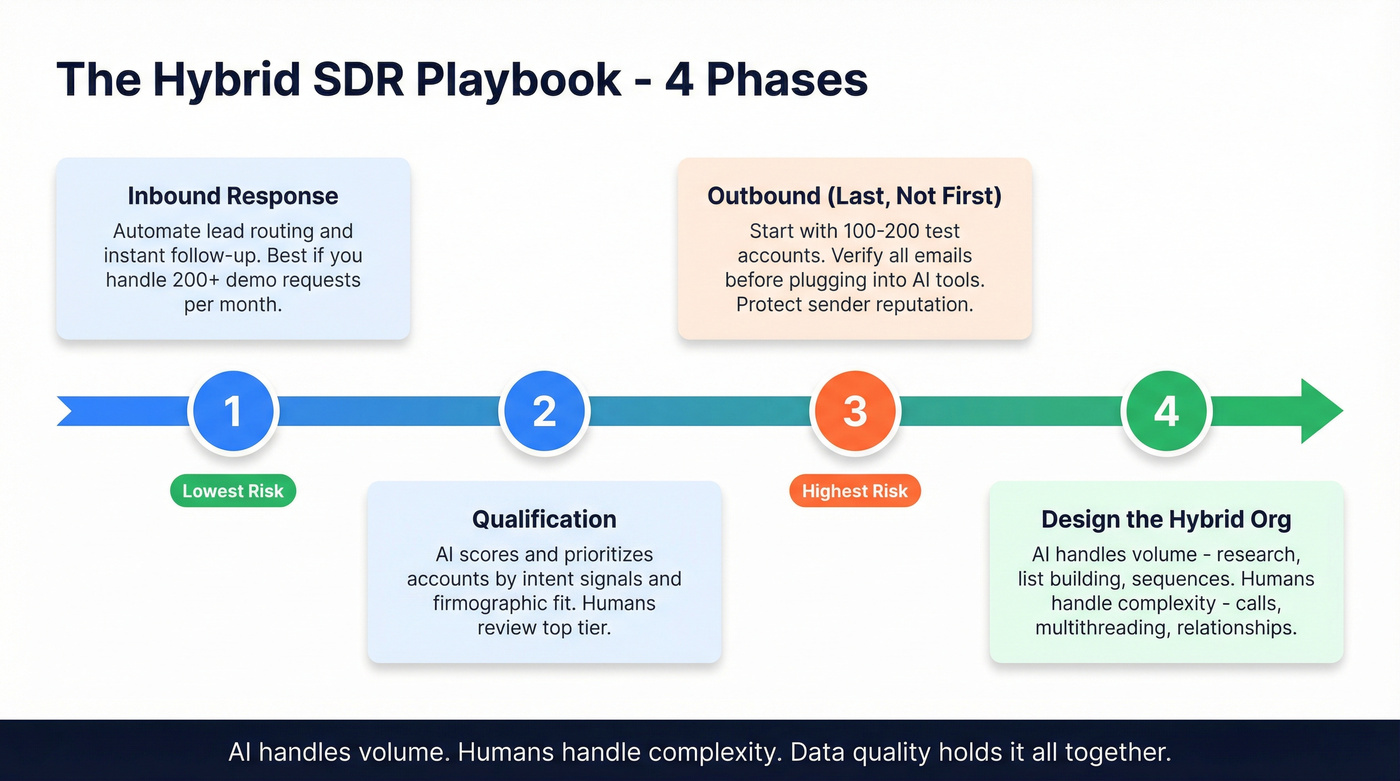
Phase 1 - Inbound response. This is where AI's speed advantage is undeniable and the risk is lowest. Automate lead routing, instant follow-up, and qualification. A practical threshold: if you're handling 200+ inbound demo requests per month, AI inbound response is a no-brainer. Below that, the setup cost probably doesn't justify the speed gain.
Phase 2 - Qualification. Let AI score and prioritize accounts based on intent signals, firmographic fit, and engagement data. Humans review the top tier. (If you're building this, use an AI lead qualification framework so routing doesn't break.)
Phase 3 - Outbound (last, not first). This is the highest-risk, highest-reward phase. Start with 100-200 test accounts, not your entire TAM. And before plugging any list into an AI SDR tool, run it through a verification layer - Prospeo's 5-step verification with a 7-day refresh cycle means your sender reputation survives month one instead of cratering. If you're scaling, follow outbound sales trends and how to scale outbound campaigns without wrecking deliverability.
Phase 4 - Design the hybrid org. AI handles volume: research, list building, initial outreach, follow-up sequences. Humans handle complexity: cold calls, enterprise multithreading, objection handling, relationship building.
New roles are already emerging from this model. GTM engineers build and maintain AI workflows. AI operators monitor output quality. Relationship specialists focus exclusively on high-value human interactions. The generalist SDR who does a little of everything is the role most at risk - not because AI replaces it, but because specialists on both sides outperform it.
What This Means If You're an SDR
You've got two paths, and both are viable.
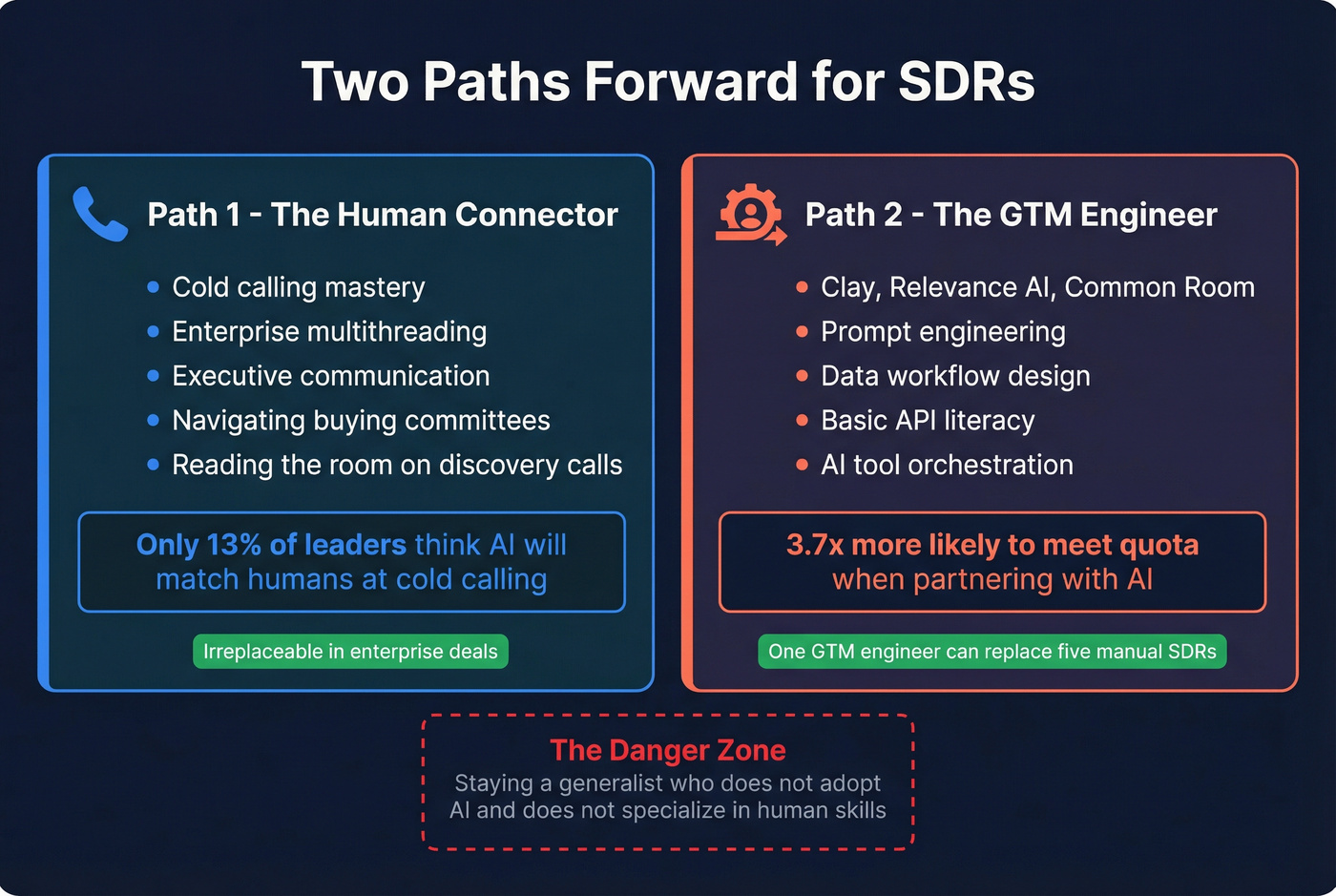
Path 1: The Human Connector. Double down on the skills AI can't replicate - cold calling mastery, multithreading across complex buying committees, executive communication. If you can consistently book meetings from cold calls and navigate enterprise deals with six decision-makers, you're irreplaceable. That 13% stat is your job security. (If you want to sharpen the craft, start with the benefits of cold calling and build from there.)
Path 2: The GTM Engineer. Learn to build the machine. Clay, Relevance AI, Common Room, Instantly, Lemlist - these are the new SDR tech stack. Add prompt engineering, data workflow design, and basic API literacy. A single GTM engineer can generate more qualified leads than a team of five manual SDRs. Sellers effectively partnering with AI are 3.7x more likely to meet quota.
The worst position? Staying a generalist who doesn't adopt AI tools and doesn't specialize in human skills. SDR job postings in tech-heavy markets are flat to down 10-30% year-over-year, while GTM engineer and AI ops roles are climbing. The question isn't being answered with a mass layoff - it's a slow reshuffling of what the job actually looks like. The market is telling you something.
Whether you're augmenting SDRs with AI or running fully automated outbound, the math is simple: 200 daily sends per mailbox means every bounced email is a wasted slot. Prospeo delivers 143M+ verified emails refreshed every 7 days - so your AI fires on real contacts, not dead addresses.
Stop burning send limits on invalid emails. Every credit finds a real person.
FAQ
Will SDRs be replaced by AI by 2027?
No. AI will automate repetitive SDR tasks like research, list building, inbound routing, and follow-ups, but complex enterprise selling, cold calling, and relationship building remain human-led. The role evolves into specialized paths - human connector or GTM engineer - rather than disappearing. Expect 30-50% of traditional SDR tasks to be fully automated by late 2027.
What skills should SDRs learn to stay relevant?
Human connectors should master cold calling, multithreading, and executive communication. GTM engineers should learn Clay, Instantly, prompt engineering, and data workflow design. Sellers partnering with AI are 3.7x more likely to hit quota - picking a lane and going deep is the move.
Why do most AI SDR tools fail?
Three reasons: bad contact data that destroys sender reputation through bounces, hallucinations that damage brand trust, and unrealistic implementation expectations. Verified data is the prerequisite most teams skip - and it's the single fastest way to prevent the deliverability collapse that kills most pilots within months.