Business Buying Behavior: What the Data Actually Says in 2026
Thirteen internal stakeholders. Nine external participants. And 80% of the decision-making happens before a seller even enters the room.
Business buying behavior has fundamentally shifted - if you're still running a one-champion, one-demo, one-close motion, you're selling into a process that no longer exists. Forrester's 2025 Buyers' Journey Survey, reported in January 2026, paints a picture of B2B purchasing that's more collaborative, more risk-averse, and more dependent on AI-assisted research than anything we've seen before. Buying committees have ballooned to 13+ stakeholders. Buyers are 70% through their journey before contacting any vendor. Over 60% trial before committing. And procurement isn't a late-stage rubber stamp - 53% identify as decision-makers from day one.
Let's break down what this means for how you sell.
What Is Business Buying Behavior?
Business buying behavior - sometimes called organizational buying behavior in academic literature - describes how companies make purchasing decisions. It covers the full arc from recognizing a need through evaluating suppliers, negotiating terms, and reviewing performance after the deal closes.
What separates it from consumer buying is structural. A consumer sees a pair of shoes, feels something, and buys. An organization identifies a capability gap, assembles a cross-functional team, evaluates three to five vendors against technical and financial criteria, routes the decision through procurement and legal, and signs a contract months later. The motivations are rational: ROI, TCO, risk mitigation. The cycles are long. And the number of people involved keeps growing - that last point is the defining feature of organizational purchasing in 2026.
Academic models like Webster & Wind's organizational buying model and the Sheth model mapped these dynamics decades ago. The scale of today's committees would have stunned those researchers.
B2B vs B2C Buying Differences
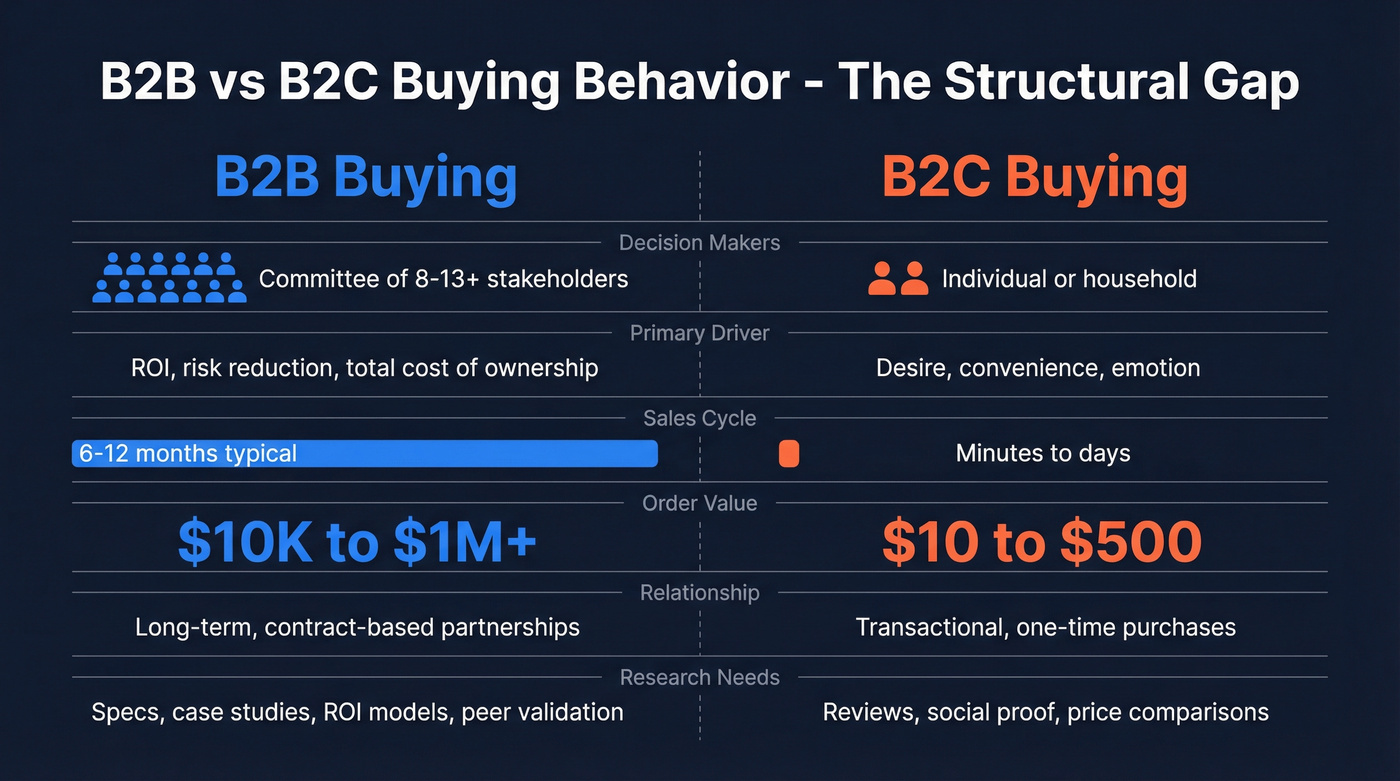
The gap between how businesses and consumers buy isn't subtle. It's structural, and it affects every part of your go-to-market.
| Dimension | B2B | B2C |
|---|---|---|
| Decision-makers | Committee (8-13+) | Individual or household |
| Primary motivation | ROI, risk reduction, TCO | Desire, convenience, emotion |
| Cycle length | 6-12 months typical | Minutes to days |
| Order value | $10K-$1M+ common | $10-$500 typical |
| Relationship focus | Long-term, contract-based | Transactional |
| Information needs | Specs, case studies, ROI models | Reviews, social proof, price |
The cycle length difference catches most consumer-trained marketers off guard. A B2B deal that closes in under three months is considered fast. Enterprise deals routinely stretch past a year. And unlike B2C, where a single bad review can kill a sale, B2B buyers navigate internal politics, competing budget priorities, and compliance requirements that have nothing to do with your product's quality. The b2b vs b2c buying process diverges most sharply in this middle phase, where organizational complexity compounds at every step.
Three Types of Buying Situations
Not every B2B purchase triggers the same process. Robinson, Faris, and Wind's BuyGrid model - published in the late 1960s and still the most useful framework here - identifies three core situations.
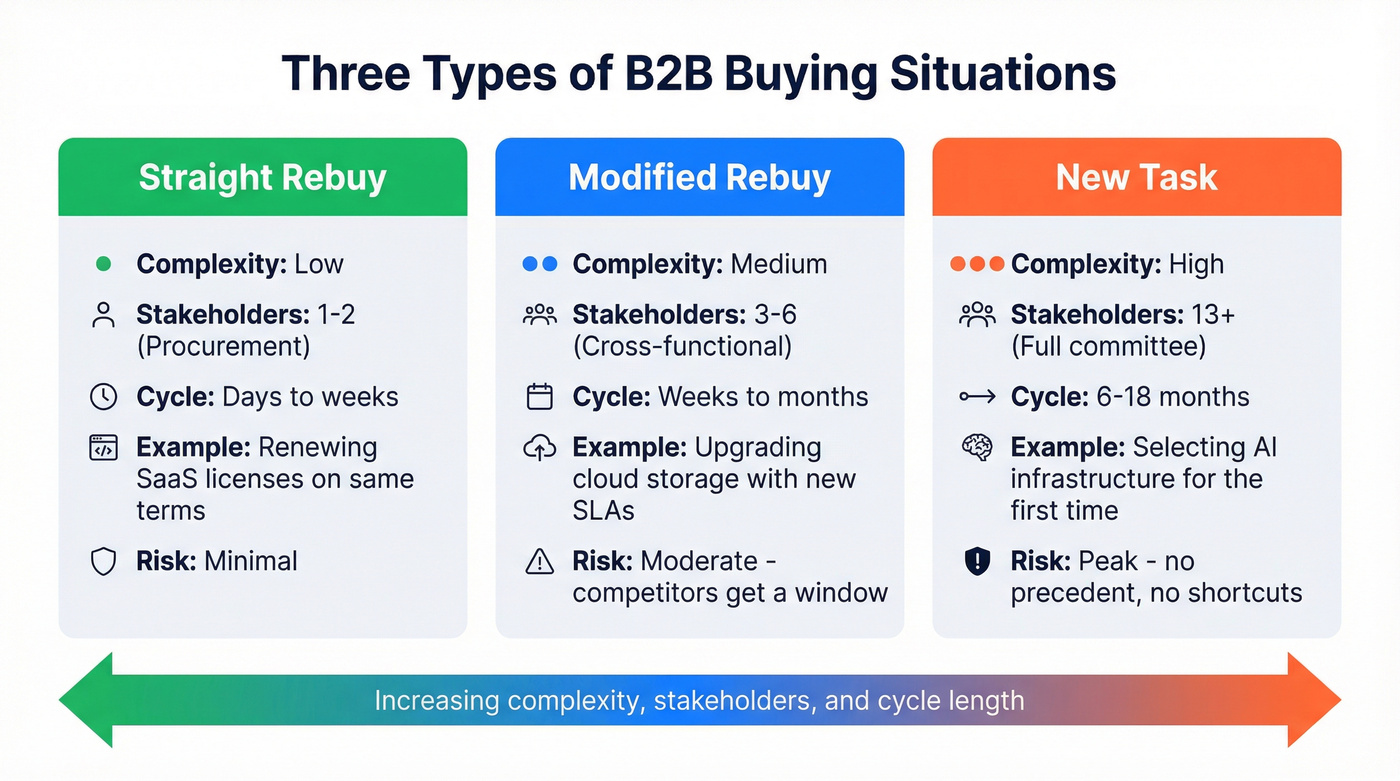
Straight rebuy is the simplest. You're reordering something you've bought before - renewing SaaS licenses, restocking supplies, extending a cloud contract on the same terms. Procurement handles it, often automatically. Minimal stakeholder involvement, minimal drama.
Modified rebuy introduces complexity. The need is familiar, but something's changed - more storage, different SLAs, a new compliance regulation. The original vendor has an advantage, but competitors get a window. More stakeholders weigh in, and the evaluation process reopens.
New task is where things get genuinely difficult. You're evaluating AI infrastructure for the first time, or selecting a cybersecurity vendor for a threat category you've never addressed. No precedent, no existing supplier relationship, no internal expertise to shortcut the process. Buying committees expand, cycles stretch, and risk aversion peaks. These are the deals that take 12-18 months and involve every stakeholder from the CTO to the CFO to the intern who has to actually use the thing.
A fourth situation - systems buying - combines elements of both new-task and straight-rebuy dynamics. Think ERP implementations or full-stack marketing platforms, where an organization purchases an integrated bundle of products and services as a single solution, inheriting the complexity of a new task with the vendor lock-in of a rebuy.
Who's Actually Deciding
The single most important trend in B2B buyer behavior over the past decade is the relentless expansion of the buying committee.
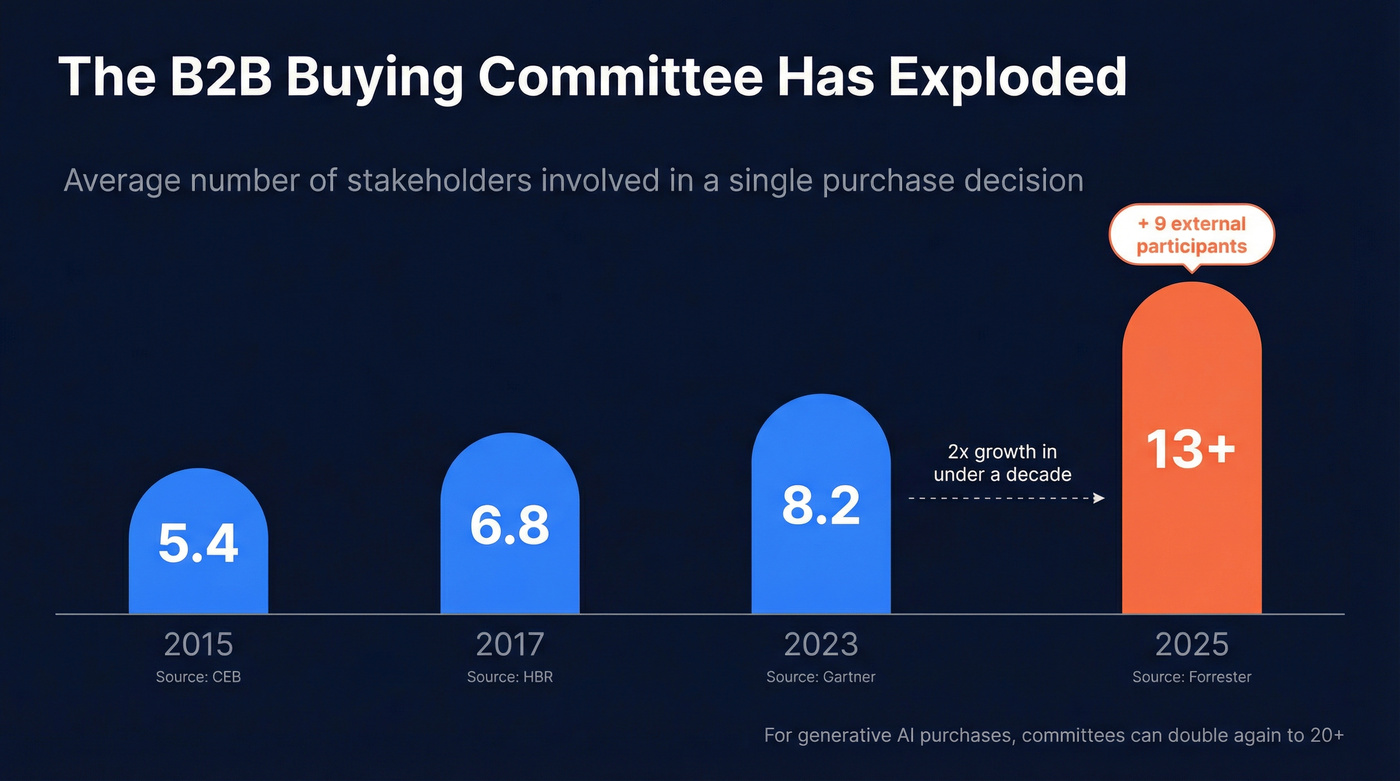
| Year | Avg. Stakeholders | Source |
|---|---|---|
| 2015 | 5.4 | CEB |
| 2017 | 6.8 | HBR |
| 2023 | 8.2 | Gartner |
| 2025 | 13 internal + 9 external | Forrester |
The buying committee has roughly doubled in a decade. And when the purchase involves generative AI features, the same survey found the buying group doubles again. You could be selling into 20+ internal stakeholders for a single deal.
The classic buying center model identifies six roles. The initiator flags the need. Users live with the product daily. Influencers - often technical evaluators or consultants - shape requirements. The decider has final authority. Gatekeepers control information flow. And the buyer/approver handles commercial terms and signs the PO.
Here's what's changed about who holds power. C-suite executives identify as decision-makers in 68% of B2B purchases. But procurement isn't waiting in the wings - 53% identify as decision-makers from the earliest stages. If your sales motion ignores procurement until the redline phase, you're already behind. Those nine external participants include consultants, analysts, peer references, and other third parties buyers use to validate vendor claims.
The Modern B2B Buying Process
The textbook six-stage model still holds as a framework, but the 2026 data makes each stage look very different from what you'd find in a marketing textbook.
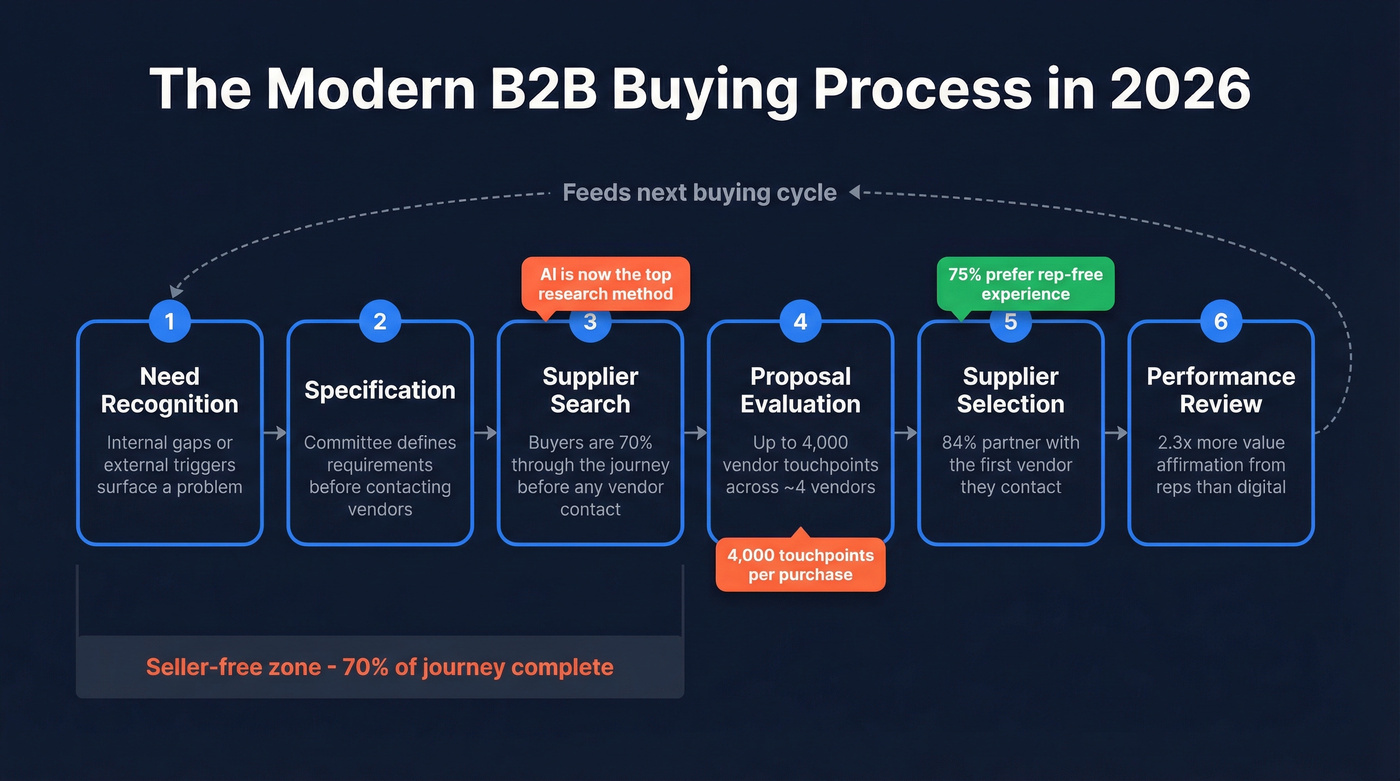
1. Need recognition. An internal trigger like a performance gap, new initiative, or contract expiration - or an external trigger like regulatory change or competitive pressure - surfaces a problem. Increasingly, AI tools surface these proactively.
2. Specification development. The buying committee defines requirements. Technical influencers and users have outsized impact here. Specifications often get written before any vendor is contacted.
3. Supplier search. Buyers are 70% through this journey before they reach out to a single vendor. They've already researched, compared, and shortlisted using peer networks, analyst reports, and generative AI.
4. Proposal evaluation. With roughly four vendors considered, buying committees generate up to 4,000 vendor touchpoints per purchase - website visits, content downloads, demo views, peer conversations, and AI-assisted research. That number still surprises us every time we see it.
5. Supplier selection. 75% of B2B buyers say they prefer a rep-free experience. And 84% partner with the first vendor they contact. But here's the nuance most articles miss: Gartner found that customers who made self-service digital purchases were 1.65x more likely to experience purchase regret. Buyers want self-service, but they make better decisions with human guidance. Speed-to-lead isn't a nice-to-have - it's the ballgame.
6. Performance review. Post-purchase evaluation feeds the next cycle. Buyers are 2.3x more likely to receive value affirmation from sales reps than digital channels, which means the post-sale relationship still matters enormously.

When buying committees hit 13+ stakeholders, you can't afford to reach only the champion. Prospeo's 300M+ profiles with 30+ filters - including department headcount, job changes, and buyer intent - let you map the entire committee and pull verified contact data for every decision-maker, influencer, and gatekeeper. 98% email accuracy means your outreach actually lands.
Stop selling to one person when thirteen are deciding.
2026 Trends Reshaping Buying
AI as the Top Research Method
Generative AI was the single most-cited meaningful interaction type for researching purchases in the 2025 Buyers' Journey Survey. Buyers are using tools like ChatGPT, Perplexity, and Copilot to summarize vendor comparisons, draft requirements documents, and pressure-test sales claims.
But there's a trust gap. 36% of buyers said AI research made them more confident. 20% said it made them less confident due to unreliable information. Buyers use AI as a starting point, then validate with human experts and direct vendor engagement. Your content needs to be AI-readable and AI-accurate, because that's where the first impression happens now.
Omnichannel Is Non-Negotiable
McKinsey's rule of thirds - a pattern identified in its B2B Pulse surveys - is now entrenched: buyers want in-person, remote, and self-service interactions in roughly equal measure throughout the purchasing journey. Not just at the top of funnel.
72% of B2B companies selling via seven or more channels grew their market share. If you're running a single-channel motion - even if that channel is "really good outbound" - you're leaving share on the table.
Trial Culture and the Demo Cliff
Over 60% of B2B buyers now trial before committing. The post-trial splits tell the real story: 36% convert with the same provider, 35% switch to a different vendor, and 10% start a new trial with yet another option.
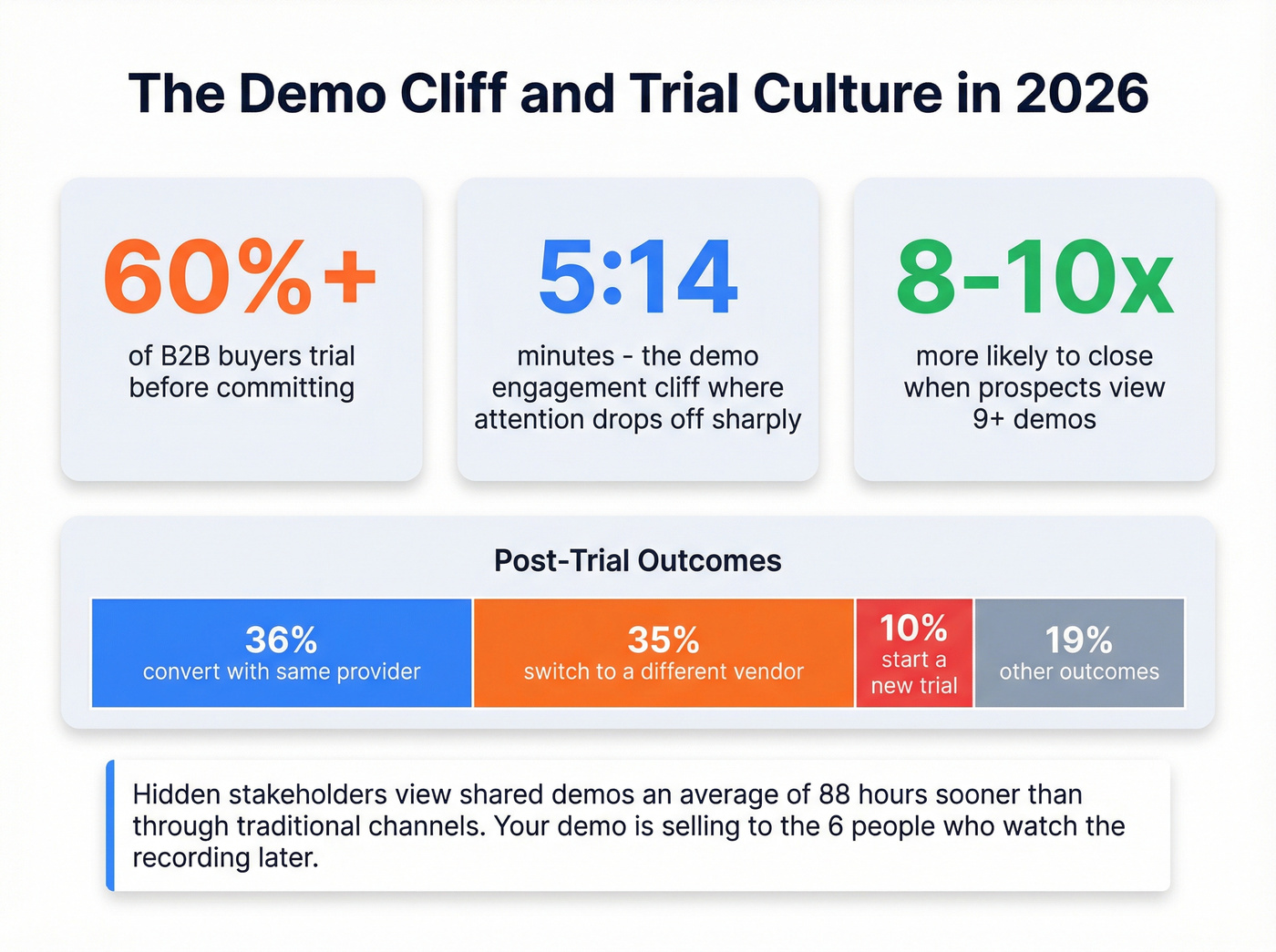
Your trial experience is effectively a second sales process.
The Consensus 2026 Buyer Behavior Report adds granularity. Prospects who view nine or more demos are 8-10x more likely to close - but engagement drops off sharply after 5 minutes and 14 seconds. That's your demo cliff. And when buying committees share demos internally, hidden stakeholders view them an average of 88 hours sooner than they would through traditional channels. Your demo isn't just selling to the person in the room. It's selling to the six people who watch the recording later.
Most B2B companies obsess over top-of-funnel lead gen when the real conversion lever is the trial and demo experience. If your win rate from trial-to-close is below 40%, fixing that will move revenue faster than doubling your pipeline.
Procurement Owns the Table
Procurement professionals identify as decision-makers in 53% of B2B purchases, and they're involved from the earliest stages. Modern procurement teams evaluate vendors on security posture, compliance, total cost of ownership, and integration requirements before a demo is even scheduled. Skip this stakeholder at your own risk.
Speed-to-Lead Wins Deals
84% of buyers partner with the first vendor they contact. 83% prefer to initiate that contact themselves. The combination means you need to be visible and accessible when the buyer is ready - not when your cadence says it's time to call.
Factors That Influence B2B Purchases
Buying decisions don't happen in a vacuum. Internal and external forces shape every stage, often in ways that have nothing to do with your product.
| Internal Factors | External Factors |
|---|---|
| Budget constraints / fiscal timing | Economic conditions / uncertainty |
| Org structure / approval chains | Regulatory / compliance needs |
| Company culture and risk tolerance | Competitive pressure / market shifts |
| Past vendor relationships / switching costs | Technology disruption / platform shifts |
| Internal politics / departmental priorities | Industry trends / peer adoption |
| TCO framing vs sticker price | Vendor ecosystem stability |
Real talk: internal politics kill more deals than pricing does. We've watched deals die because the VP who championed the evaluation left the company, or because two departments couldn't agree on who "owns" the tool. TCO framing matters more than sticker price at the enterprise level, but getting the organization to agree on what counts as "total cost" is itself a political exercise.
Traditional vs Modern B2B Buying
Compare the buying process of even five years ago to what Forrester and Gartner describe today, and the shift is stark.
Traditional B2B buying was linear: a champion identified a need, contacted a few vendors, sat through demos, and pushed a recommendation up the chain. The seller controlled the narrative and the timeline. Modern B2B purchasing is nonlinear, committee-driven, and largely invisible to sellers until the late stages. Buyers loop back between stages, conduct parallel evaluations, and use AI to compress research that once took weeks into hours. The seller's role has shifted from educator to validator - you're no longer introducing buyers to possibilities, you're confirming conclusions they've already reached.
That's a fundamentally different job.
Real-World Examples
SMART Technologies created a "Unified Commercial Engine" that mapped five distinct buying jobs across their customer base and reassigned 250+ team members to align with how buyers actually purchase. The results over 18 months: +50% lead volume, +35% lead acceptance rate, and +48% year-over-year growth. Cited by HBR via INFUSE, the case proves that aligning your org to buying behavior isn't theoretical - it's a growth lever.
Steelcase faced a different challenge. With 25 quadrillion possible SKUs from extreme product customization, their B2B buyers needed a way to configure, price, and approve orders without calling a rep for every variation. They implemented punch-out catalog integration, letting buyers shop within Steelcase's store directly from internal e-procurement systems, then return the cart for approvals and PO generation. 90% of Steelcase's B2B sales now flow through digital channels. That's what self-service looks like at scale.
Acting on Buying Behavior Insights
Understanding business buying behavior is academic until you translate it into execution. Three strategies matter most.
Map the full buying committee early. Don't sell to one champion and hope they'll evangelize internally. With 13+ stakeholders influencing the average deal, you need to identify the decider, the technical influencer, the procurement lead, and the end users - ideally before your first demo. Multi-threading isn't optional anymore. Prospeo's B2B database covers 300M+ professional profiles with 30+ filters including buyer intent, technographics, and job changes, so you can map an entire buying committee while they're still in-market.

Time outreach to intent signals. If 84% of buyers partner with the first vendor they contact, being early is everything. Monitor which accounts are actively researching your category and reach them during the research phase - not after they've already built a shortlist. In our experience, teams that layer intent data on top of ICP filters see dramatically better response rates than those blasting cold lists.
Design your trial as a sales process. If 35% of buyers switch vendors after trialing, your product experience is a competitive battleground. Instrument it. Measure time-to-value. Follow up before the 5:14 attention cliff hits. A tight post-demo motion helps you keep momentum when stakeholders watch recordings asynchronously.
Buyers are 70% through their journey before they talk to you. The only way to get in earlier is to reach the right people with the right signal at the right time. Prospeo tracks 15,000 intent topics so you can identify in-market buying committees before they've even shortlisted vendors - then reach them with 98% accurate emails and 125M+ verified mobile numbers.
Catch buying committees while they're still researching, not after they've decided.
FAQ
What are the three types of business buying situations?
Straight rebuy (routine reorder), modified rebuy (existing purchase with changed requirements), and new task (first-time purchase with no precedent). Complexity and stakeholder count increase from straight rebuy to new task. Systems buying is sometimes considered a fourth type.
How many stakeholders join a B2B buying decision?
Forrester's 2025 survey found 13 internal stakeholders and 9 external participants per average B2B purchase. For AI-related purchases, the buying group roughly doubles to 20+ participants.
How long is the average B2B sales cycle?
SMB deals typically close in 1-3 months, mid-market in 3-6 months, and enterprise in 6-18 months. New-task purchases and AI infrastructure deals skew toward the longer end.
How can sellers identify in-market B2B buyers?
Use intent data platforms that track topic-level research activity across the web. Prospeo monitors 15,000 intent topics via Bombora to flag accounts actively researching your category, paired with 98%-accurate verified contact data refreshed every 7 days.
What's the biggest difference between B2B and B2C buying?
B2B involves committees of 8-13+ decision-makers, 6-18 month cycles, and formal procurement evaluation - while B2C is individual, faster, and more emotionally driven. The gap widens at the enterprise level, where compliance, security reviews, and multi-department sign-offs add layers absent in consumer purchases.