

ABM Best Practices: A No-BS Playbook for Teams That Need Results
You bought an ABM platform six months ago. Pipeline hasn't moved. Your reps are still running the same outbound sequences, just with fancier dashboards. Marketing calls it "account-based." Sales calls it Tuesday.
The macro picture makes this worse. Pavilion's B2B benchmarks show win rates down 18%, deal values down 21%, sales cycles up 16%, and 69% of reps missing quota. Traditional outbound is breaking. The gap between ABM as a strategy and ABM as a label is where most programs die - and it's exactly what these ABM best practices are built to fix.
71.2% of organizations now run some form of ABM, and 49.7% plan to increase their ABM budgets this year. Those numbers sound great until you talk to practitioners on r/DigitalMarketing. They'll tell you ABM is frequently just outbound with a new label - narrow targeting plus tailored content presented as a revolution. They're not wrong. Most ABM programs aren't ABM. They're slightly personalized email sequences with a budget line item.
Real ABM requires operational change. Shared metrics. Joint account ownership. Multi-channel orchestration measured at the account level, not the lead level. We've built this playbook because we've seen too many teams confuse activity with strategy.
What You Need (Quick Version)
- Check if ABM fits your business. Average deal size above $30K, sales cycles longer than 180 days, TAM under 1,000 accounts. If you're selling $5K deals to 50,000 companies, ABM isn't your play.
- Start small and scrappy. 15-25 accounts, a pod structure (AE + SDR + ABM manager), and verified contact data. You don't need a $60K platform on day one.
- Measure account progression, not MQLs. The KPI framework below replaces vanity metrics with indicators that actually predict revenue.
Is ABM Right for You?
Not every B2B company should run ABM. Here's the readiness checklist, adapted from FullFunnel's framework:
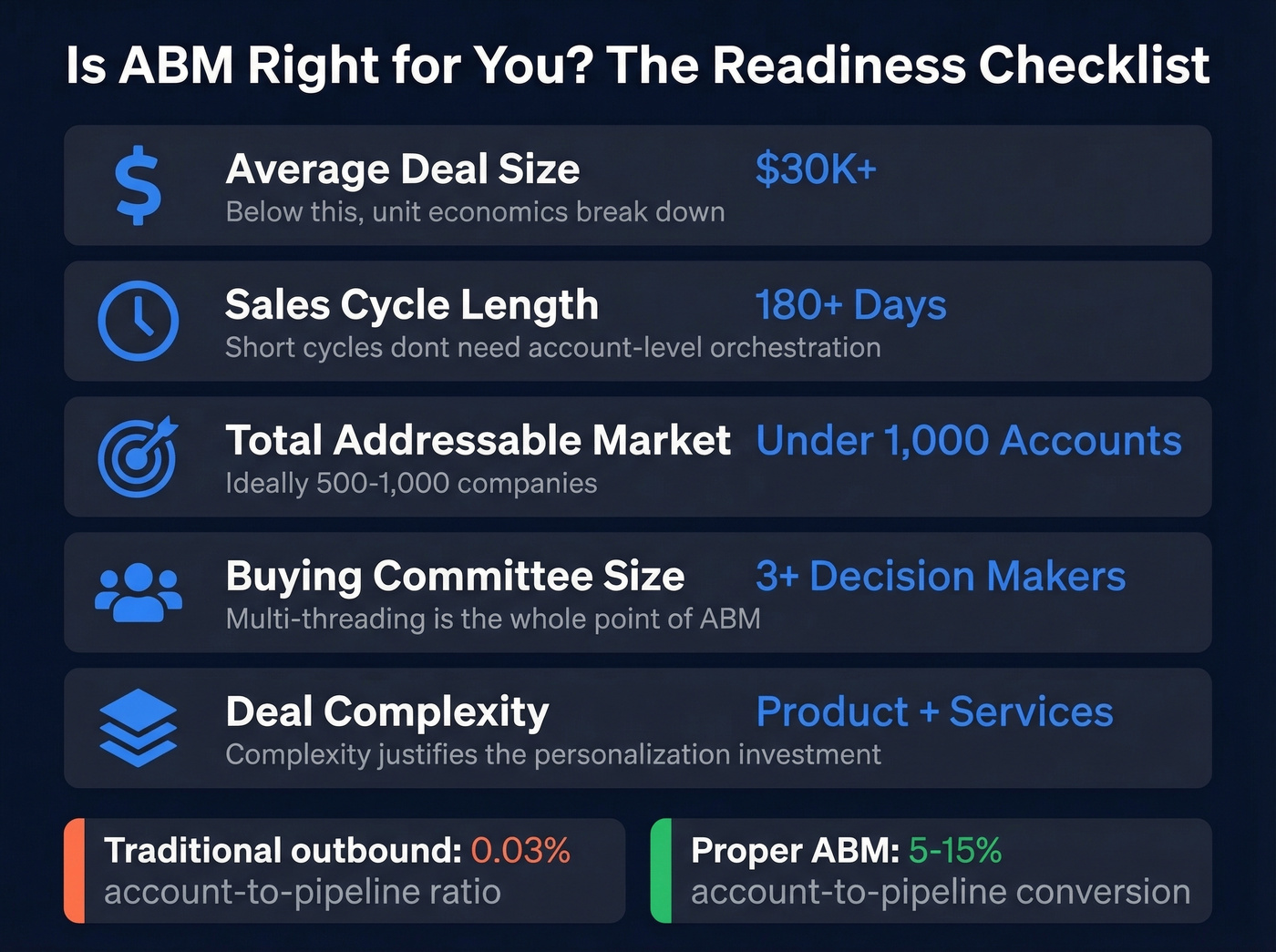
- Average deal size above $30K. Below that, the unit economics of personalized, multi-touch campaigns don't work.
- Sales cycles longer than 180 days. ABM is a long game. If you close in 30 days, you don't need account-level orchestration.
- TAM under 1,000 companies. Ideally 500-1,000. If your market is 50,000 companies, demand gen is your primary motion.
- 3+ buyers in the decision. ABM shines when you need to multi-thread into a buying committee, not when one person signs the PO.
- Hybrid sale with product + services. The complexity justifies the investment in account-level campaigns.
The performance contrast is stark. Complex B2B SaaS averages roughly a 0.03% account-to-pipeline ratio with traditional outbound - one opportunity per roughly 3,000 accounts touched. Properly executed ABM programs convert 5-15% of selected accounts into pipeline. Directive's case studies include LiveRamp generating $50M in pipeline from just 15 named accounts. A small, focused list can outperform a broad one by orders of magnitude.
Planning Your Account Strategy
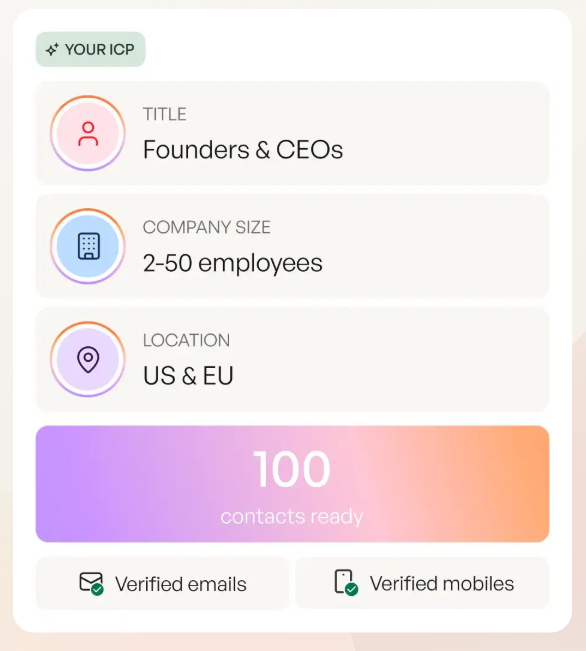
Define Your ICP From Existing Wins
Don't build your ICP from a whiteboard exercise. Start from your best customers and work backward. Pixelz takes this approach - analyzing why their top accounts bought, what triggered the deal, and what made them successful post-sale.
Score accounts using the FIRE framework: Fit (firmographic match), Intent (active buying signals), Recency (how fresh the signal is), and Engagement (interactions with your brand). ICP is the foundation. Intent signals come second. We've seen teams chase intent data from accounts that were never a good fit, and it's a fast way to burn cycles on deals that were never going to close.
Build a Focused Account List
Start with 15-25 accounts for your pilot. Not 200. Not 500.
Cognism's ABM team builds their list through three steps: marketing data analysis to identify patterns, sales validation to confirm the accounts are real targets, and trigger event monitoring to time the outreach. The key is joint selection - marketing and sales pick the accounts together. If sales doesn't believe in the list, they won't work it. This is one of the most critical steps that teams skip, and it's the single biggest predictor of whether a pilot succeeds or quietly dies after 60 days.
Tier Your Accounts
Not every account gets the same treatment. The standard model:
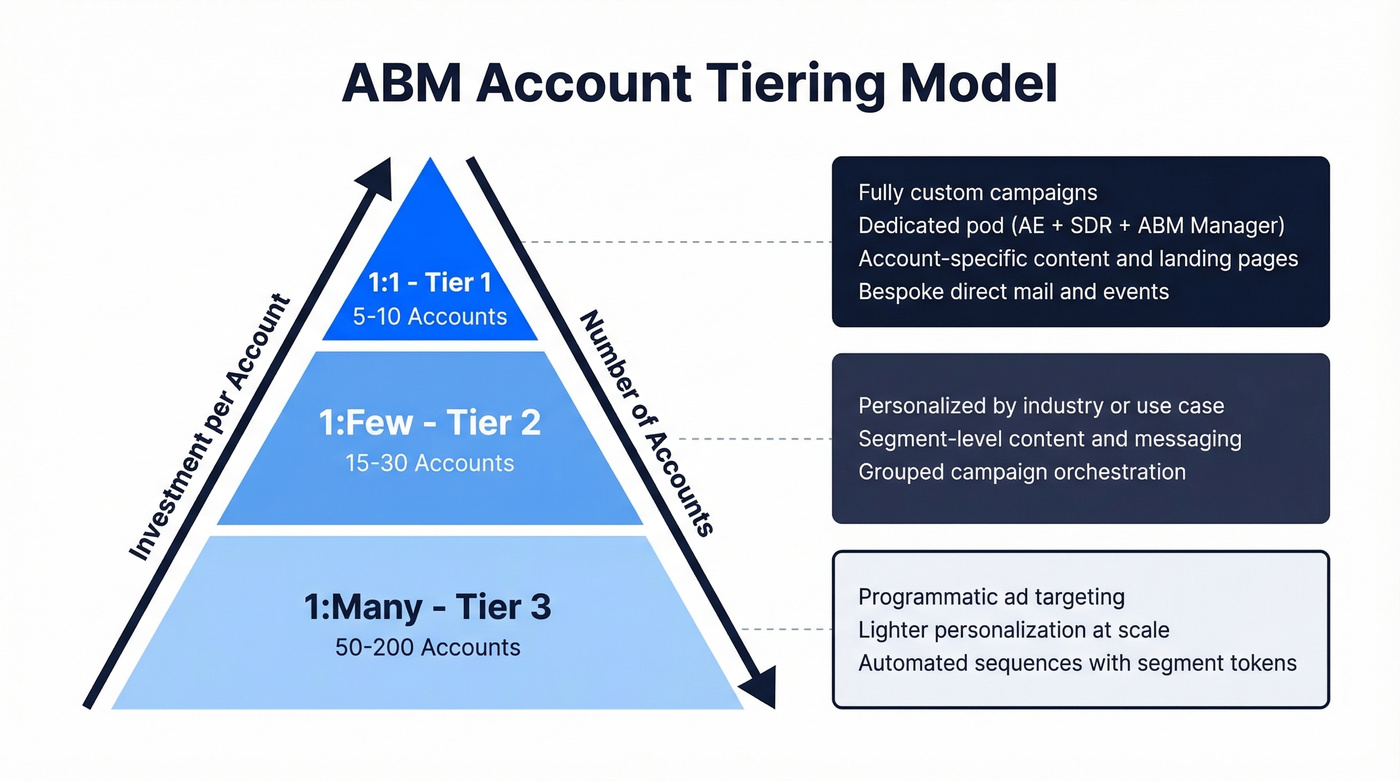
- 1:1, 1:Few, 1:Many
- 1:1 (Tier 1): 5-10 accounts. Fully custom campaigns, dedicated resources, account-specific content. Hyperexponential runs a pod structure here - one AE, one SDR, and one ABM manager per cluster.
- 1:Few (Tier 2): 15-30 accounts grouped by industry or use case. Personalized by segment, not individually.
- 1:Many (Tier 3): 50-200 accounts. Programmatic targeting with lighter personalization.
For enterprise programs, consider mapping a Revenue Opportunity Matrix - current revenue vs. total addressable spend by business unit - to prioritize which tier-1 accounts deserve the most resources.
Align Sales and Marketing Operationally
Alignment isn't a slide deck. It's what happens on a Tuesday morning.
A weekly 30-minute sync where sales and marketing review account engagement data together, flag accounts showing buying signals, and agree on next actions. Shared metrics - pipeline created, account progression, meetings booked - not separate MQL and SQL targets. Run a 90-day pilot. Dedicate about 70% of one person's time to ABM for that period. Agree on leading and lagging indicators before you start. If you can't commit to that, you're not ready for ABM - you're ready for better outbound.
Execution That Drives Pipeline
Personalize Beyond the Subject Line
86% of buyers embrace personalized communication from brands. But personalization doesn't mean inserting {{first_name}} and {{company}} into a template. Your prospects see right through token insertion.
Real personalization means industry-specific content that addresses the account's actual business challenges. Account-specific landing pages. Custom case studies featuring companies in their vertical. A one-pager that references their recent earnings call or product launch. The effort scales down by tier - tier-1 gets bespoke content, tier-3 gets segment-level personalization - but the principle holds everywhere.
Here's the thing: these details sound simple, but they separate programs that generate pipeline from programs that generate reports.
Orchestrate Across Channels
ABM isn't an email campaign. It's a coordinated sequence across email, targeted ads, direct mail, events, and social touches. Start with awareness through ads and thought leadership, move to engagement with personalized outreach, then drive conversion through demos and custom proposals.
Don't blast all channels simultaneously. That's not orchestration - it's noise. Stagger your touches. Let the prospect engage with one channel before introducing the next. A well-timed direct mail piece - even a $30 handwritten note - after three weeks of ad impressions hits differently than a cold package. Directive's data shows Clearwave reduced their sales cycle length by 20% with this kind of sequenced approach.
Map the Buying Committee
The average B2B buying committee includes roughly 7 decision-makers. Your AE probably knows one, maybe two. If you're only talking to the champion, you're one reorg away from a dead deal.
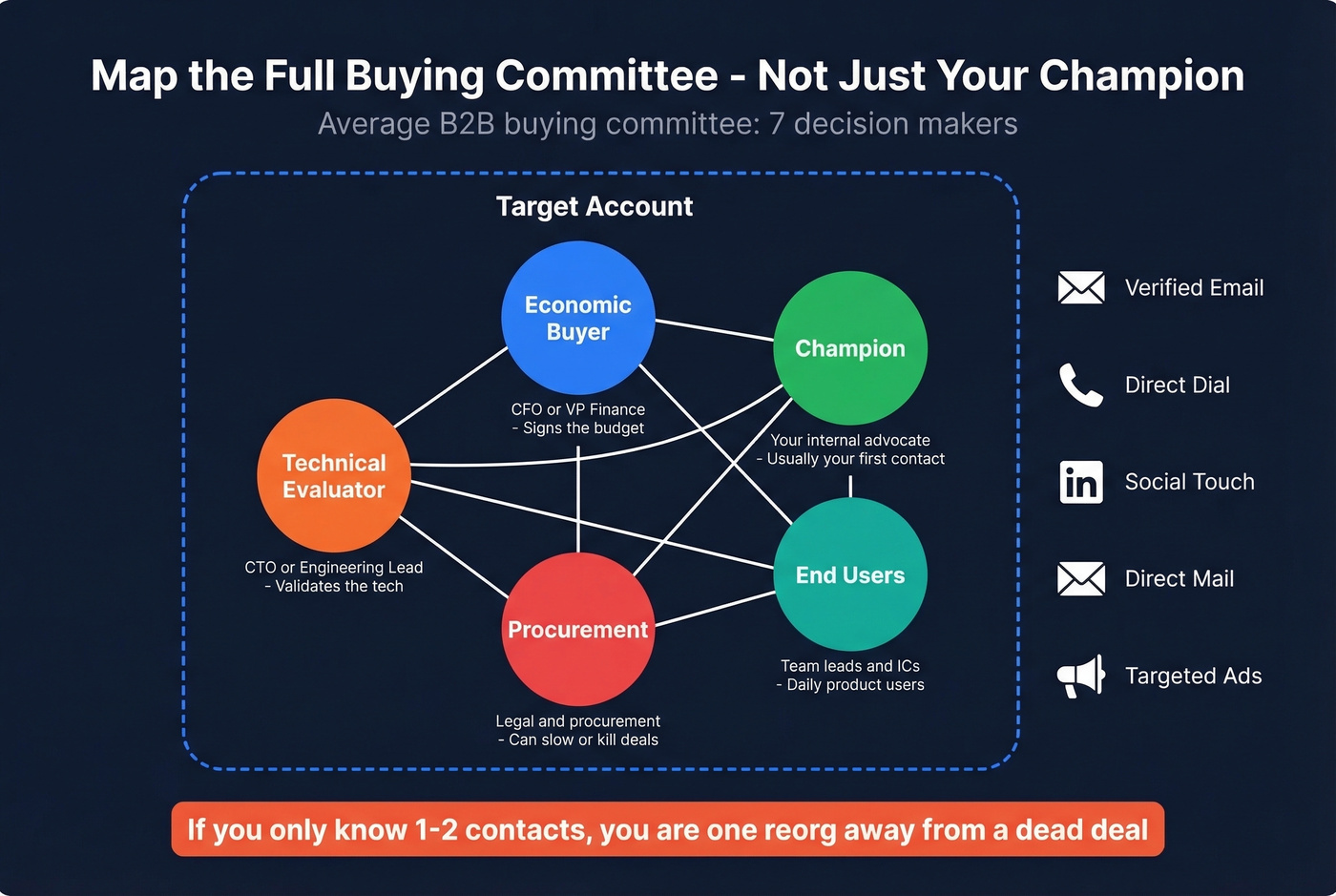
Map every stakeholder: the economic buyer, the technical evaluator, the end users, the procurement gatekeeper. Then find verified emails and direct dials for every member - not just the contact who responded to your first email. Multi-threading isn't optional in account-based programs. It's the whole point.

ABM fails when reps reach out and emails bounce. Prospeo's 98% email accuracy and 125M+ verified mobile numbers mean your tier-1 accounts actually hear from you. Multi-thread into buying committees with 30+ filters - by intent, job change, department headcount, and technographics.
Stop orchestrating campaigns to invalid contacts. Fix the data layer first.
The Data Problem That Kills ABM
The best strategy in the world fails if your emails bounce. 40% of businesses report struggling to gather the account and contact data they need for ABM. That's not a minor inconvenience - it's the bottleneck that kills programs before they produce results.
Let's be honest about this: poor data quality is the silent saboteur nobody talks about at conferences. It undermines every account-based effort you launch.
The impact of fixing it is measurable. Snyk's team of 50 AEs was running bounce rates of 35-40%. After switching to Prospeo, bounces dropped under 5%, AE-sourced pipeline jumped 180%, and they now generate 200+ new opportunities per month. The platform covers 300M+ professional profiles with 98% email accuracy, 143M+ verified emails, and 125M+ verified mobile numbers. Intent data tracks 15,000 topics via Bombora, so you can layer buying signals on top of your ICP filters. The 7-day data refresh cycle means you're not reaching out to people who changed jobs six weeks ago.

Your ICP scoring needs fresh data. Prospeo refreshes every 7 days - not the 6-week industry average - so your FIRE framework scores reflect reality. Layer Bombora intent data across 15,000 topics to identify which target accounts are actively in-market before you spend a dollar on personalization.
Real ABM runs on real-time data. Build your account list on a 7-day refresh cycle.
Measuring Account Progression
Replace MQLs With Stage-Based Metrics
If your marketing team reports MQLs and your sales team tracks dials-per-day, you're measuring two different games. ABM requires account-level metrics tied to progression stages. Here's a framework adapted from FullFunnel's KPI model:
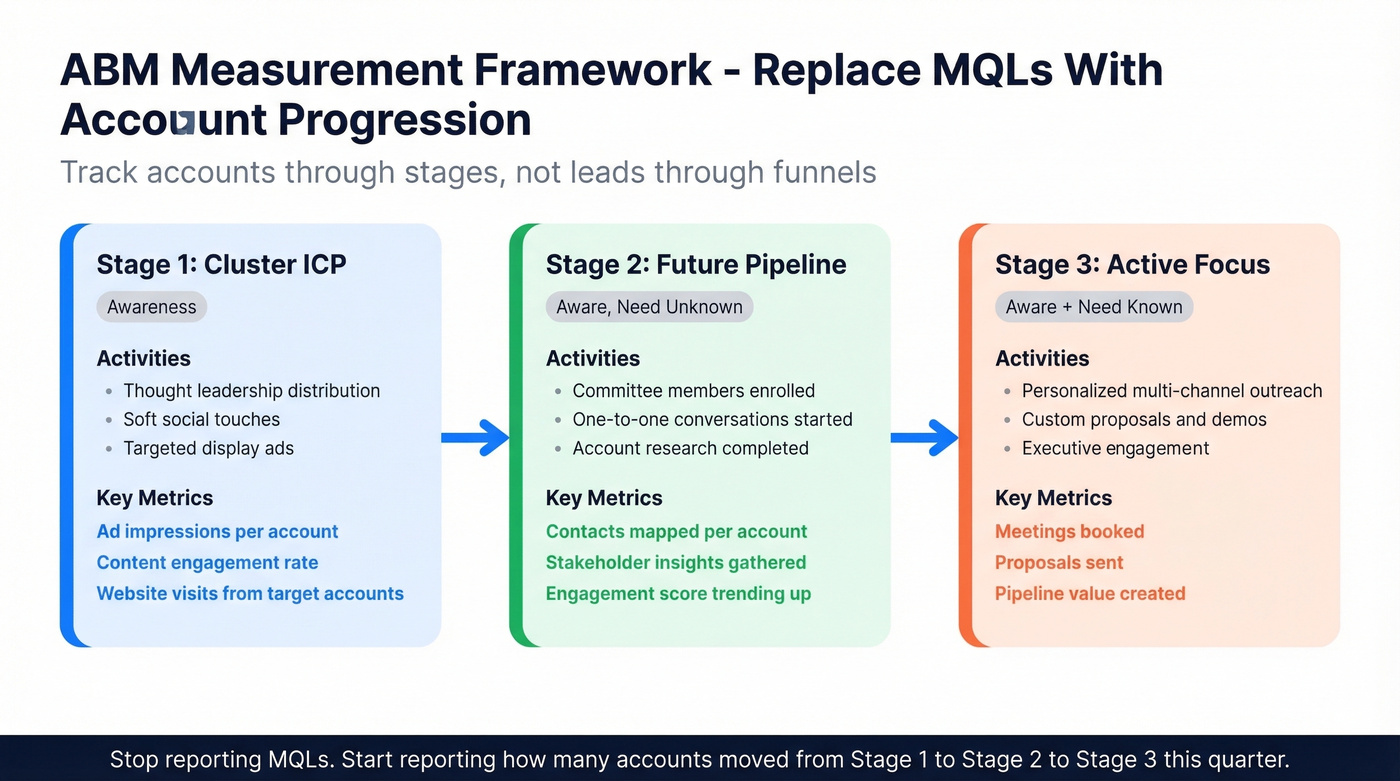
| Account Stage | Status | Key Activities | Metrics |
|---|---|---|---|
| Cluster ICP | Awareness | Thought leadership, soft touches | Impressions, engagement rate |
| Future Pipeline | Aware, need unknown | Committee enrolled, 1:1 talks | Contacts mapped, insights gathered |
| Active Focus | Aware + need known | Personalized outreach, signals | Meetings booked, proposals sent |
In our experience, teams switching from MQL reporting to this kind of account-stage tracking start seeing clearer pipeline signals within 90 days. The point isn't which framework you pick. It's that you're measuring movement through stages, not counting leads.
Track Leading and Lagging Indicators
Leading indicators tell you if ABM is working before pipeline shows up. Track engagement scores with a decaying model - a webinar visit three months ago matters less than a pricing page visit yesterday. Monitor account coverage percentage and multi-threaded contact depth. Healthy programs hit 90%+ account matches within 24 hours and keep unknown touches under 5%.
Lagging indicators are what the board cares about: pipeline created, deal velocity, and revenue influenced. Gartner reports ABM lifts pipeline conversion by 14%. That's meaningful, but you won't see it in month one. Leading indicators keep the program alive long enough for lagging indicators to materialize.
Why ABM Programs Fail
Most ABM failures aren't strategy failures. They're execution failures. Six kill programs most often:
- Targeting too broadly. 500 accounts isn't ABM - it's demand gen with extra steps. Cut to 15-25 for your pilot.
- Sales-marketing misalignment. If sales didn't help pick the accounts, they won't work them. Joint selection, shared metrics, weekly syncs.
- Measuring MQLs instead of account progression. MQLs are a demand gen metric. Using the wrong KPIs guarantees the wrong conclusions.
- Superficial personalization. If your "ABM content" looks identical across 50 accounts, it's not ABM.
- Treating ABM as a campaign. ABM isn't a six-week sprint. It's a permanent change in how sales and marketing collaborate.
- Ignoring data quality. You can't multi-thread into a buying committee if your emails bounce. Fix the data layer first.
The Reddit consensus mirrors this list. Practitioners on r/sales and r/DigitalMarketing consistently flag that "ABM" gets slapped onto slightly personalized outbound without any operational change underneath. If your process, metrics, and team structure haven't changed, you've adopted a label, not a strategy.
ABM Tools and Platforms
You don't need 10 tools. The recommended starting stack is a CRM, a data provider, and one orchestration platform. We've tested most of these, and the ones that deliver start with clean data - not the fanciest dashboard.
| Tool | Category | Best For | Starting Price |
|---|---|---|---|
| Prospeo | Data & Enrichment | Verified contacts + intent signals | ~$0.01/email, free tier |
| 6sense | ABM Platform | AI prediction + intent | ~$15K-$20K/yr |
| Demandbase | ABM Platform | Buying-group intelligence | ~$18K-$32K/yr |
| RollWorks | ABM Platform | Ad-focused ABM for SMBs | ~$850/mo |
| HubSpot | CRM + ABM Features | Teams on HubSpot already | ~$800/mo (Pro) |
Skip the enterprise platform if your average contract value is under $25K. Start with a data layer, prove the model with a 15-account pilot, and invest in orchestration once you have pipeline to show for it. Enterprise ABM platforms typically rate 4.0-4.5 on major review sites, but ratings don't matter if your team of three can't operate the tool.

When evaluating platforms, focus on four pillars from Directive's framework: data coverage and accuracy, intent detection quality, integration depth with your existing stack, and team fit.
How AI Changes ABM in 2026
78.7% of ABM teams already use AI in some capacity. But the value isn't evenly distributed. Here's a realistic time-horizon model adapted from MarketingProfs:
| Time Horizon | AI Use Case | Maturity Level |
|---|---|---|
| Now | List building, data cleanup, signal detection | Production-ready |
| 6-12 months | Personalization at scale, creative testing | Emerging |
| 12-24 months | Custom models for channel/content mix per account | Experimental |
The short-term wins are real and accessible today. AI-powered list building can compress manual research from 15 hours to 2-3 hours per week - that's time your SDRs get back for actual selling. The long-term vision, where AI tells you exactly which channel, content, and touchpoint to use for each tier-1 account, is coming, but it requires clean data and consistent execution to train on.
One warning: martech shifts fast enough that tools can be obsolete before they're fully deployed. Buy for today's problems, not tomorrow's demos.
FAQ
What is account-based marketing?
ABM is a B2B strategy where sales and marketing jointly target a defined set of high-value accounts with personalized, multi-channel campaigns - measured by account progression and pipeline, not lead volume. It works best when deal sizes exceed $30K and buying committees involve 3+ stakeholders.
How long before ABM shows results?
Expect 3-6 months for early signals like engagement spikes and meetings booked, and 6-12 months for meaningful pipeline impact. Start with a 15-25 account pilot to prove the model before scaling.
What's the minimum budget to run ABM?
You can run a meaningful pilot with a CRM, a data provider at ~$0.01/email, and manual orchestration - under $500/month total. Enterprise platforms start at $15K/year but aren't necessary to validate the approach.
ABM vs. demand gen - which should I choose?
They're not mutually exclusive. ABM works best for high-value, long-cycle deals with small addressable markets under 1,000 accounts. Demand gen covers broader awareness. Most mature B2B teams run both motions simultaneously.
What are the most important ABM best practices for 2026?
Start with 15-25 accounts, align sales and marketing on shared metrics, personalize beyond token insertion, multi-thread into buying committees, and measure account progression - not MQLs. The teams that see real pipeline focus on data quality and operational alignment before investing in expensive platforms.