

ABM Statistics in 2026: 40+ Stats That Tell the Real Story
77% of ABM teams report increased pipeline. Only 26% call their ABM program truly successful. That gap - between activity metrics that look great in a board deck and outcomes that actually move revenue - is the story most ABM statistics roundups ignore.
Here are the numbers that matter, the ones that don't, and what they mean for your 2026 strategy.
Three Numbers That Frame Everything
- 71% of B2B practitioners now run ABM (Demand Gen Report 2026 benchmark).
- Only 26% call their program truly successful (N.Rich 2026 analysis).
- 42% say they can't identify the right buyers within target accounts.
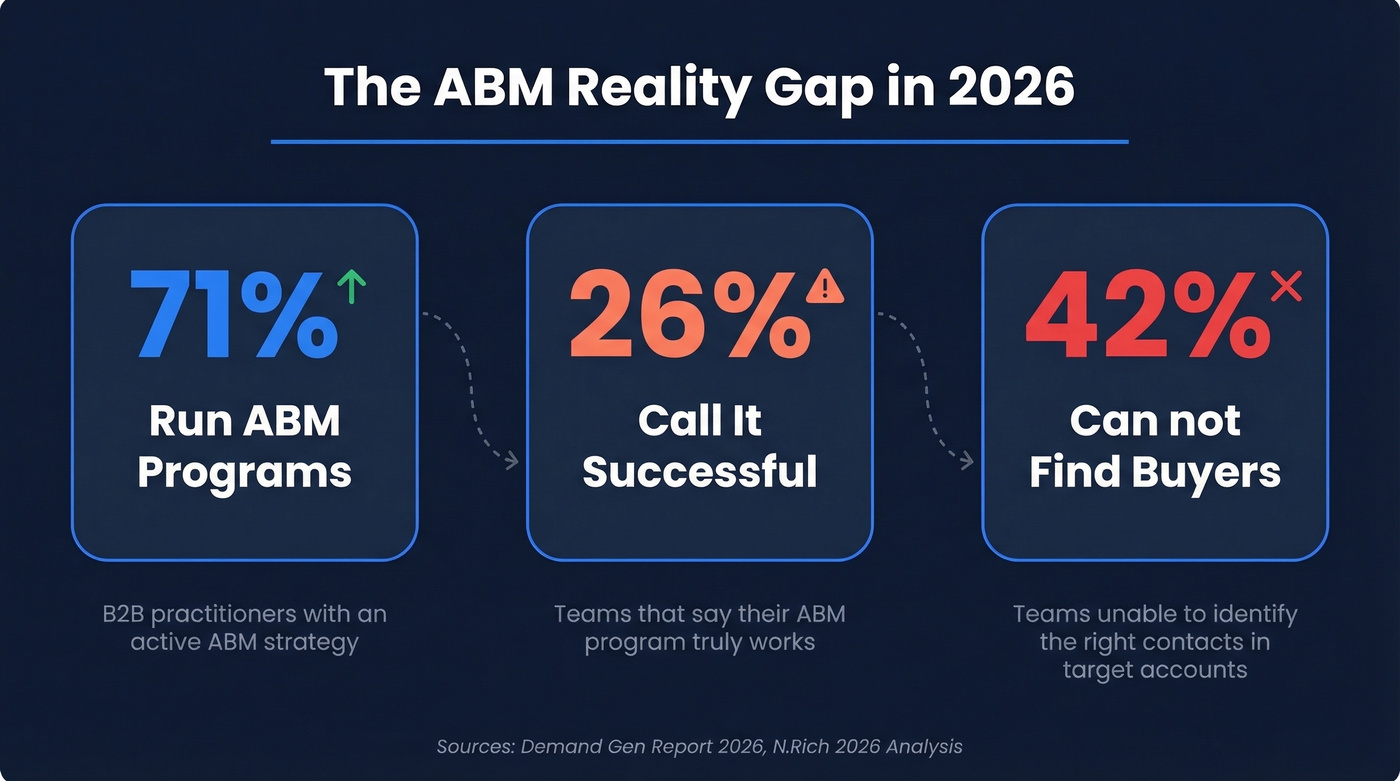
If you're building a business case, diagnosing underperformance, or deciding where to invest - start there.
Adoption and Usage
ABM isn't experimental anymore. It's the default. 71% of B2B practitioners run an ABM strategy, and the question has shifted from "should we do ABM?" to "why isn't ours working?"
What's changed recently is scope. 40% of teams now integrate ABM directly with demand generation, blurring the line between targeted account plays and broader pipeline motions. 67% of organizations define ABM not as a campaign tactic but as a strategic go-to-market alignment motion between sales and marketing - which changes how the discipline gets funded, measured, and staffed.
Market Size and Growth Forecasts
Two major research firms forecast the ABM market, and their numbers diverge enough to compare side by side:
| Metric | Grand View Research | Mordor Intelligence |
|---|---|---|
| Base year value | $1.41B (2024) | $1.03B (2025) |
| Forecast value | $3.81B (2030) | $2.02B (2031) |
| CAGR | 17.9% (2025-2030) | 11.94% (2026-2031) |
| North America share | 32%+ (2024) | 40.6% (2025) |
| Fastest region | APAC at 20.4% | APAC at 14.55% |
The gap reflects different methodologies and definitions of what counts as "ABM." Grand View Research and Mordor Intelligence both point in the same direction: sustained growth through 2030-2031.
On the segment side, tools account for 64.3% of the ABM market, with services growing faster at a 14.02% CAGR. Cloud deployment dominates at 71.4%. Programmatic ABM - the automated, scaled-down tier - is the fastest-growing segment at 19.8% CAGR, which tells you where mid-market teams are placing bets.
ROI and Revenue Benchmarks
Demandbase's 2024 benchmark - based on 300+ global marketers - reports 81% higher ROI with ABM compared to other marketing strategies. Other commonly cited numbers include a 171% increase in average deal size and a 14% lift in pipeline conversion rates. 87% of marketers say ABM outperforms every other marketing strategy on ROI.
Those are impressive. Here's the caveat.
Only 36% of ABM programs measure ROI at all. So when you see big ROI numbers, remember: a majority of teams still aren't tracking financial performance in a way that can prove - or disprove - the ROI story.
Stats Most Roundups Skip
Every roundup leads with the ROI numbers. Almost none lead with these: only 26% of teams call their ABM program truly successful. Around 80% fail to meet expectations. 55% say ABM influences just 0-20% of total company revenue, and another 26% admit they have no idea what ABM's financial impact actually is.
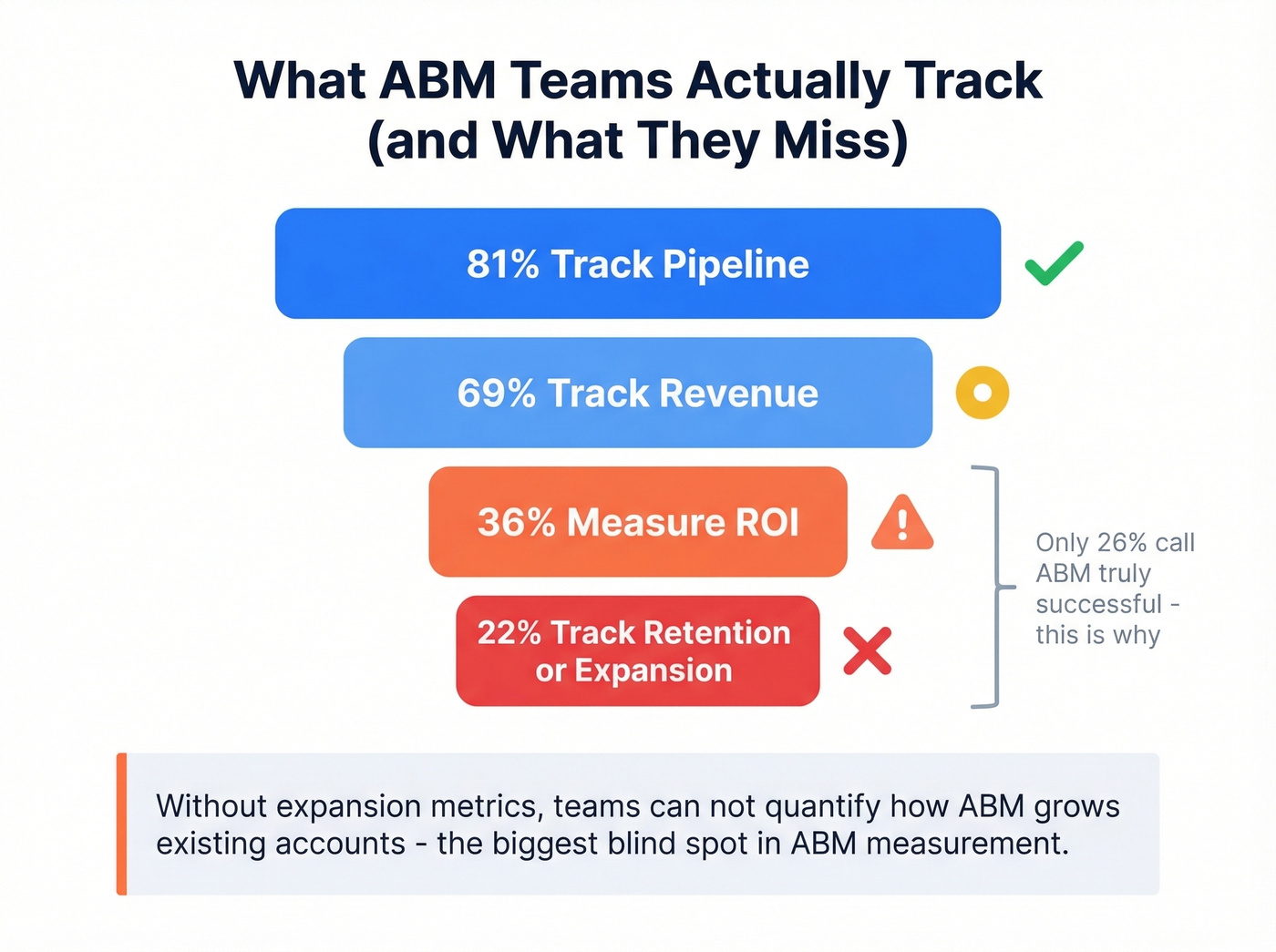
The measurement problem runs deep. 81% track pipeline, which is straightforward, but only 69% track revenue, a mere 36% measure ROI, and just 22% track retention or expansion. Without expansion metrics, teams can't quantify how ABM contributes to growing existing accounts - a blind spot that undervalues the full program.
Ownership compounds the issue. 64% of ABM programs are marketing-led, 13% sit under sales leadership, and just 8% are owned by RevOps. Only 31% of teams say marketing and sales collaborate effectively on ABM strategy. As one practitioner put it on r/b2bmarketing: "ABM tools like 6sense or Demandbase are expensive reminders to sell to your ICP." Harsh, but it captures a real sentiment - tooling often outpaces the organizational alignment needed to use it.
In our experience, the teams that struggle most with ABM aren't running bad plays. They're running blind.

80% of ABM programs fail to meet expectations - and 42% say they can't identify the right buyers. That's not a strategy problem. It's a data problem. Prospeo gives you 300M+ profiles with 98% verified email accuracy, 30+ filters including buyer intent and technographics, and a 7-day data refresh cycle so your account lists never go stale.
Stop running ABM blind. Start with data that actually connects.
What Buyers Actually Expect
Forget what your ABM platform dashboard says. What do the people on the receiving end want?
91% of B2B buyers expect at least some personalization during the purchasing process, and 51% expect high or very high personalization. Only 13% of teams actually hyper-personalize their marketing. That's a massive gap between expectation and execution.
The buyer side is evolving fast. 46% of B2B decision-makers now use generative AI tools for vendor research, which means your carefully crafted ABM content competes with AI-generated summaries of your competitors. And 83% of buyers still prefer email as their primary contact channel - making email deliverability and data accuracy a non-negotiable part of any ABM stack.
Here's the thing: if your average deal size is under $25k, you probably don't need a six-figure ABM platform. You need accurate contact data, a solid email sequence, and sales reps who actually read the accounts they're targeting.
Channels and Technology
The 2026 Demand Gen Report benchmark ranks channels delivering ABM results:
- Email: 92% of teams cite it as a top-performing channel
- In-person events: 72%
Most teams also rely on core systems like CRMs and marketing automation to operationalize ABM. But the channel mix only works if the underlying data is usable at the contact level - and that's where we've seen teams trip up most often.
When evaluating advertising performance, teams increasingly look beyond click-through rates to account-level metrics like engagement depth and pipeline influence per account. Tracking impressions per account helps distinguish genuine buying-committee reach from wasted spend.
AI in ABM: Promise vs. Reality
| What marketers say | The number |
|---|---|
| Have incorporated AI into ABM | ~80% |
| Expect AI to boost ABM ROI | 86% |
| Say AI improves targeting/segmentation | 48.5% |
| Say AI increases lead engagement efficiency | 36.4% |
| Say AI refines personas and pain points | 32.1% |
| See AI's promise for personalization | 45% |
| Find AI's current effectiveness limited | ~70% |
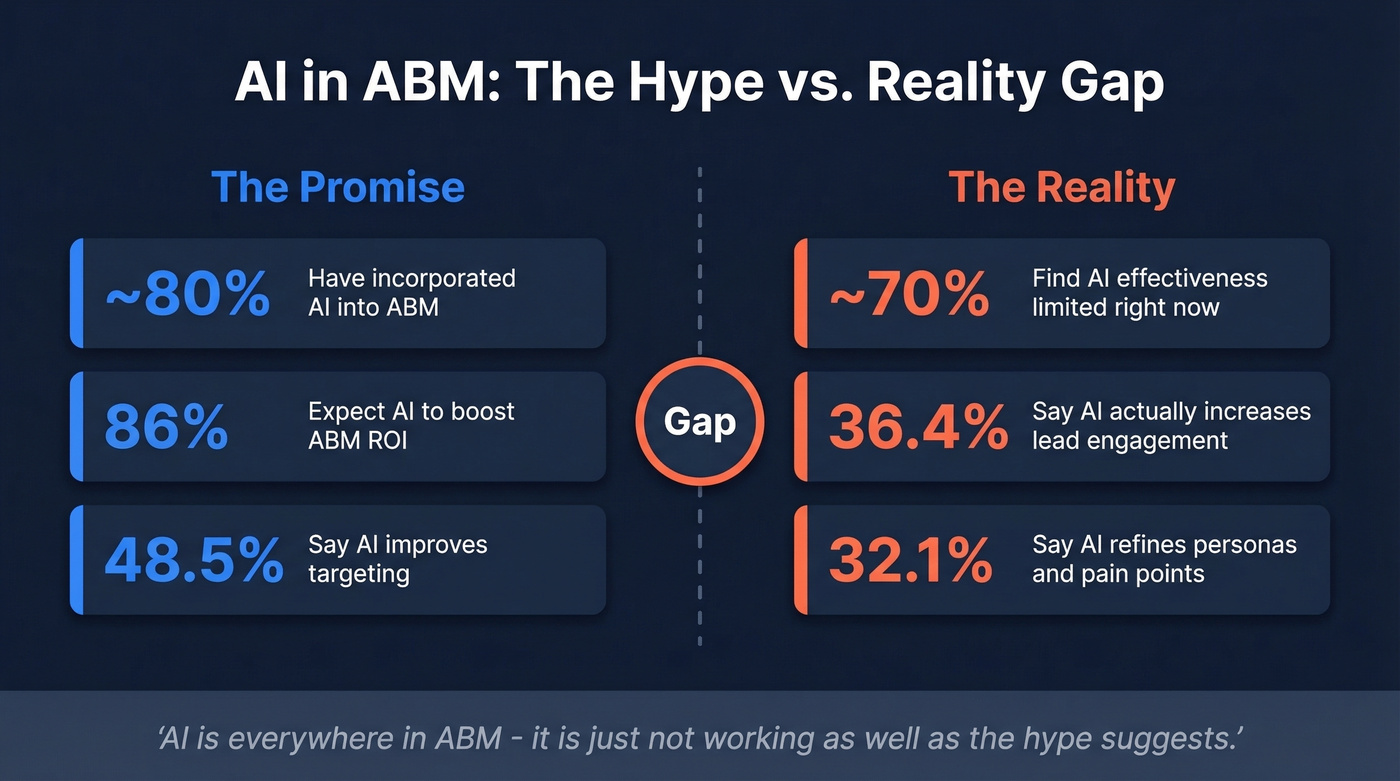
The adoption numbers look like a revolution. The effectiveness numbers don't. AI is everywhere in ABM - it's just not working as well as the hype suggests. Reddit threads in r/sales echo this: plenty of teams have AI features turned on, few have changed their workflow because of them.
Contact-Level ABM Metrics
The emerging trend worth watching is the shift from account-level to contact-level ABM. Conversion to booked meetings increases up to 74% when ABM targets specific contacts rather than accounts broadly. Pipeline conversion lifts up to 118%. And 24% of teams plan to implement contact-level ABM in the next 12 months.
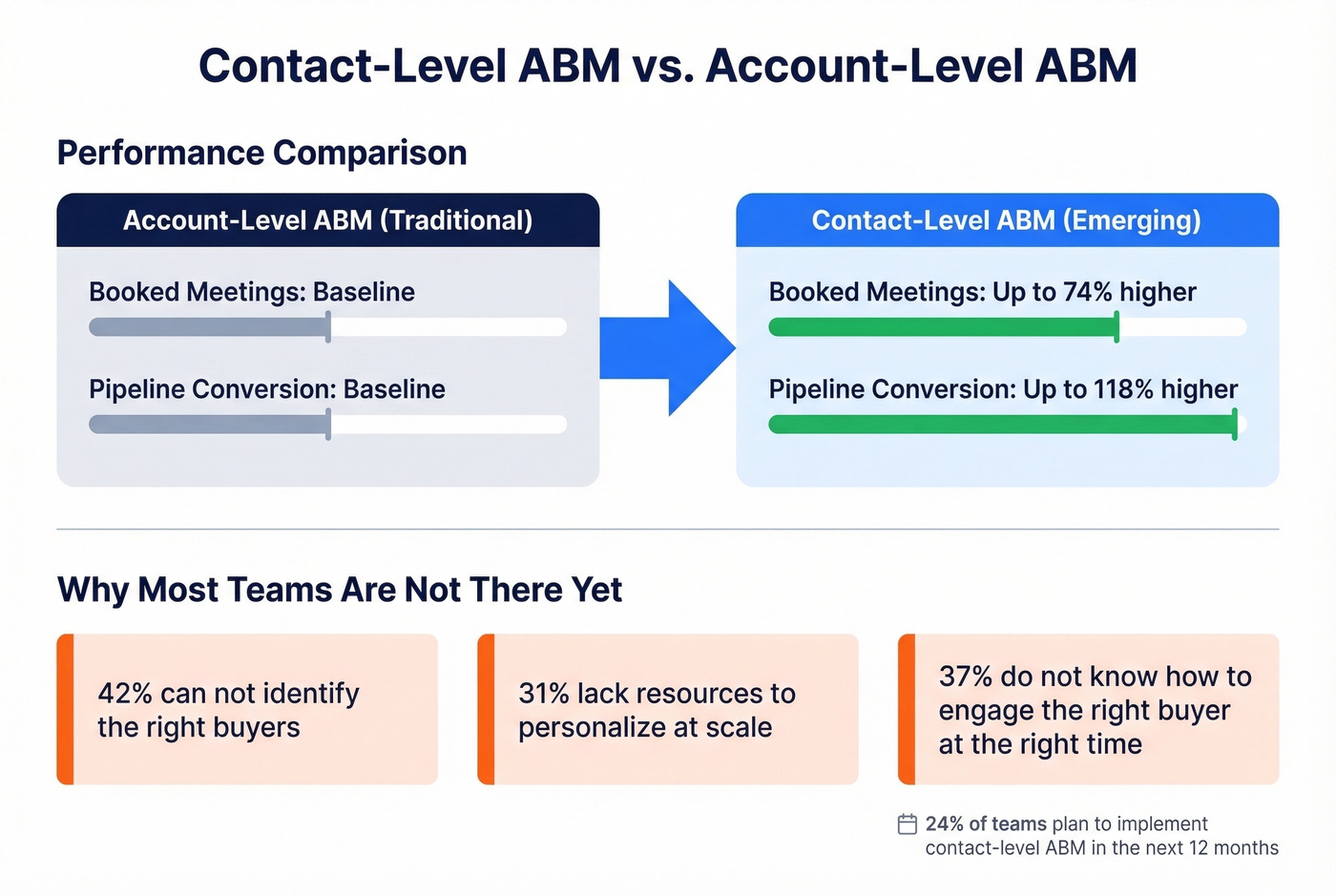
Let's be honest about the barriers, though. 42% can't identify the right buyers, 31% lack resources to personalize at scale, and 37% don't know how to engage the right buyer at the right time. Contact-level ABM is where the discipline is heading, but most teams don't have the data infrastructure to get there yet.
Tracking acquisition metrics at the contact level - cost per qualified meeting, new logo pipeline sourced, time-to-first-engagement - gives teams a clearer picture of what's actually driving new business versus what's generating vanity impressions.
Data Quality: The Hidden Variable
Every stat in this article points to the same root cause. ABM programs don't fail because of strategy. They fail because of data.
42% can't identify the right buyers. Bounce rates destroy sender reputation. Stale contact data means your personalized email lands in a spam folder - or doesn't land at all. When performance lags, the first place to look is the contact database, not the creative.

We've watched teams pour six figures into ABM platforms and still run campaigns on stale contact lists. That's the equivalent of mailing brochures to empty offices. No amount of sophisticated performance dashboards will save a program built on bad data. Skip the fancy orchestration layer if your contacts haven't been verified in the last month.
83% of B2B buyers prefer email - but email only works when it reaches real inboxes. Prospeo's proprietary 5-step verification delivers 98% email accuracy and under 4% bounce rates. At $0.01 per email, you get enterprise-grade ABM data without the six-figure platform price tag.
Your ABM ROI starts with emails that don't bounce.
FAQ
What is account-based marketing?
ABM is a B2B strategy that targets specific high-value accounts with personalized campaigns rather than casting a wide net. 67% of organizations now define it as strategic go-to-market alignment between sales and marketing, not just a campaign tactic. Adoption has become mainstream, with 71% of B2B practitioners running some form of ABM in 2026.
What's the average ROI of ABM?
Top performers report 81% higher ROI compared to other marketing strategies, with deal sizes up 171% on average. But only 36% of programs actually measure ROI - so published benchmarks skew toward the best-instrumented teams, not the median.
Why do most ABM programs underperform?
Only 26% of teams call their ABM program truly successful, and 42% can't identify the right buyers within target accounts. The root cause is usually data quality - stale contacts, high bounce rates, and incomplete buying-committee coverage. Tools like Prospeo help close this gap with 98% email accuracy and weekly data refreshes.
Is ABM still effective in 2026?
Yes, with caveats. 71% of B2B practitioners run ABM and 77% report pipeline growth. The gap between adoption and success comes down to measurement discipline and data quality - teams that track pipeline, revenue, and account-level engagement consistently outperform those relying on impressions alone.