

How to Build an ABX Strategy That Actually Generates Pipeline
A RevOps lead ran a textbook ABM program last year. Five hundred accounts, personalized ads, gated content - the whole playbook. The result: 120 form fills, 6 meetings, and exactly $0 in pipeline. Ninety days later, after rebuilding around an ABX strategy with 117 high-fit accounts, the same team generated 41 meetings, 19 opportunities, and $1.4M in pipeline. The difference wasn't budget or headcount. It was strategy architecture.
That gap is why 80% of marketers running account-based programs say it delivers better ROI than anything else in their mix, per a Momentum ITSMA survey. But most teams never get there because they're running ABM mechanics without ABX thinking.
ABX in 30 Seconds
ABX is ABM done right - orchestrated across marketing, sales, and customer success around the buyer's experience, not your funnel stages. Most programs fail because of alignment gaps, bad measurement, and garbage contact data. What follows is the scoring model, 30-day launch plan, and pipeline formulas that definition-heavy guides skip entirely.
What Account-Based Experience Actually Means
ABX isn't a new category. It's a correction.
Traditional ABM treated accounts as marketing targets: run ads, gate content, pass MQLs to sales, hope for the best. ABX reframes the entire go-to-market around how buying committees actually make decisions. Marketing, sales, and CS coordinate plays around the same accounts at the same time, triggered by the same signals.
B2B buying committees average 6-10 decision-makers, and modern enterprise buying groups can run as deep as 24 people. Here's the kicker: 84% of buyers have already selected their preferred vendor before they ever talk to a seller. If your strategy only touches one contact per account with marketing air cover, you're reaching a fraction of the people who actually influence the deal.
ABX vs ABM: What Changed
The shift isn't philosophical - it's operational:
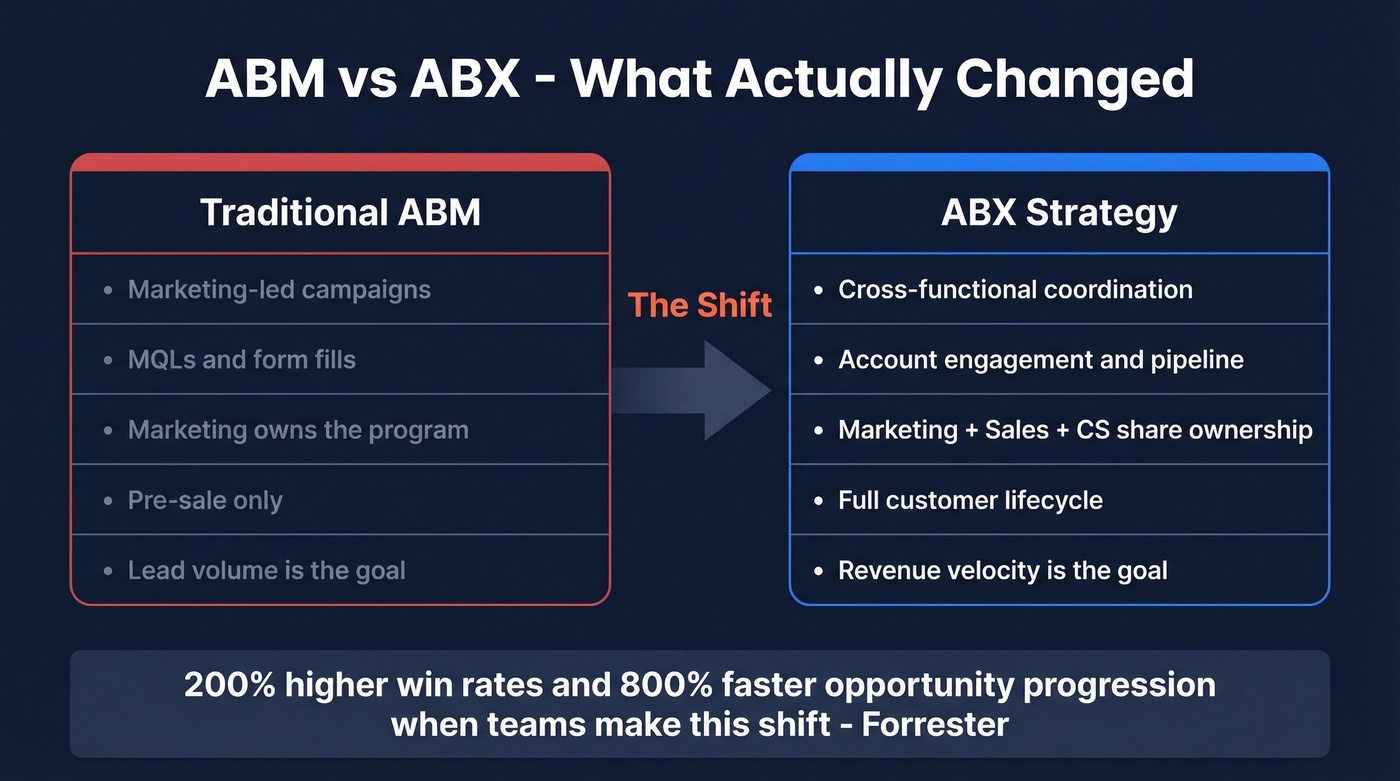
| Dimension | ABM | ABX |
|---|---|---|
| Focus | Marketing-led campaigns | Cross-functional coordination |
| Core metric | MQLs, form fills | Account engagement, pipeline |
| Team ownership | Marketing owns | Marketing + Sales + CS share |
| Lifecycle scope | Pre-sale only | Full customer lifecycle |
| Success signal | Lead volume | Revenue velocity |
Forrester research puts hard numbers on this: teams that moved from MQL-based measurement to buying-group engagement saw a 200% increase in win rates and 800% improvement in opportunity progression. Those aren't marginal gains. That's a fundamentally different operating model producing fundamentally different outcomes.
Why Most ABX Programs Fail
Nearly 80% of organizations say they have an ABM program, but only 29% measure it with ABM-aligned metrics. That disconnect is where programs die. Five failure modes show up again and again.
1. Sales ignores accounts. The most common and most expensive failure. We've seen teams where sales only worked 50% of the target account list - meaning marketing wasted half its budget on accounts no one followed up on. The consensus in RevOps circles (and on r/sales, frankly) is that the number-one ABM killer isn't strategy. It's follow-through. Conversion rates double when the ADR team sits within marketing and shares accountability.
2. MQL measurement. If your dashboard still reports on lead volume, you're running ABM with a new label. Account engagement velocity, buying-group coverage, and pipeline influence are the metrics that matter. MQLs actively mislead.
3. Too many tactics. Teams get excited and deploy ads, direct mail, events, gifting, and personalized content simultaneously across 500 accounts. The result is noise, not coordination. Start with one play, prove it works, then layer.
4. Bad contact data. You can't run coordinated multi-threading plays if half your emails bounce and your phone numbers connect to switchboards. Account-based experience programs require verified contact data for 3-5 people per account across your entire target list. Prospeo's 98% email accuracy and 7-day refresh cycle keep your plays from collapsing on bounced emails or stale buying-committee coverage.

5. No executive sponsor. ABX requires sales and marketing to share KPIs, budgets, and accountability. Without a VP or CRO enforcing that alignment, teams revert to siloed behavior within weeks.

ABX programs need 3-5 verified contacts per account across your entire target list. That's 450-750 contacts for a 150-account program - all accurate, all current. Prospeo's 300M+ profiles with 98% email accuracy and 7-day refresh cycle give you the buying committee coverage that makes multi-threading plays actually work.
Stop losing deals because your contact data expired six weeks ago.
How to Develop Your ABX Strategy
Select and Tier Your Accounts
Not all accounts deserve the same investment. The FIRE methodology (Fit, Intent, Relationship, Engagement) is a solid starting framework, but the real leverage comes from tiering ruthlessly:
| Tier | % of Accounts | Conversion Likelihood | Investment Level |
|---|---|---|---|
| Tier 1 | 5% | 20x base rate | 1:1 personalized plays |
| Tier 2 | 20% | 5x base rate | 1:few cluster plays |
| Tier 3 | 75% | <1% | Programmatic only |
Tier 2 accounts advance at roughly 6% per week. Tier 1 accounts convert at 20x the base rate within three months - but only if you maintain above 90% retention in that stage. Drop below that threshold and the math collapses. For benchmarks, SaaS teams typically target 15-25% account-to-opportunity conversion; manufacturing runs 8-12%.
Map the Buying Committee
Most ABM programs have one contact per account. ABX requires a minimum of a primary contact plus three influencers to reach critical mass. Map these roles for every Tier 1 and Tier 2 account:
- Economic buyer - controls budget, signs the contract
- Champion - internal advocate who sells for you when you're not in the room
- Technical evaluator - validates integration, security, compliance
- End user - the person who'll actually use the product daily
Enterprise committees run 12-24 people deep. You don't need all of them, but you need enough coverage that your deal doesn't die when one contact goes on vacation or changes jobs. For a 150-account program, that's 450-750 contacts that need to be accurate and current. This is where most programs quietly fall apart - not on strategy, but on data hygiene.

Score Account Readiness
Gut feel doesn't scale. Use a Signal-Heat Score (0-100) to operationalize account readiness:
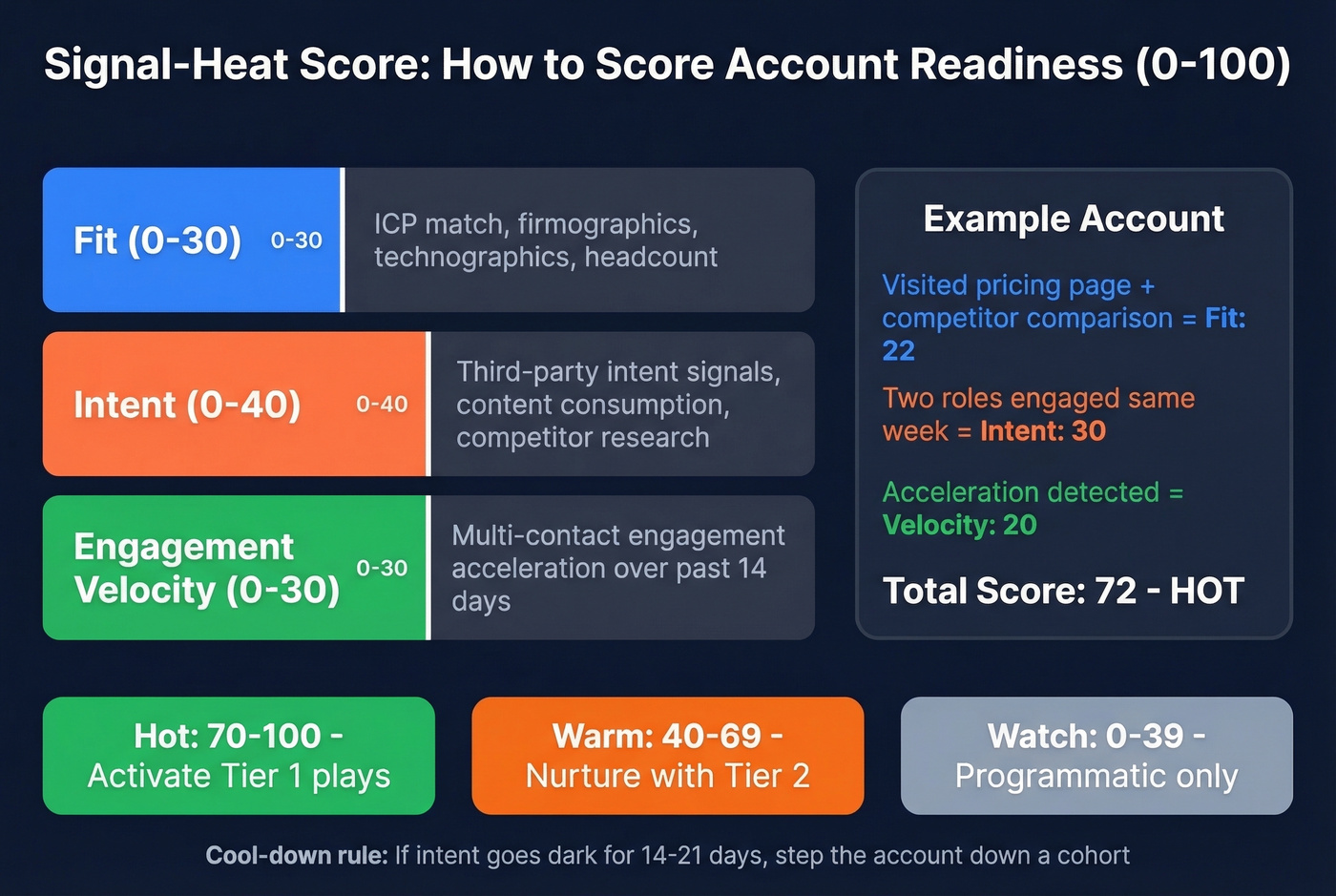
Fit (0-30): ICP match - firmographics, technographics, headcount. Intent (0-40): Third-party intent signals, content consumption, competitor research. Engagement Velocity (0-30): Multi-contact engagement acceleration over the past 14 days.
Thresholds: 70-100 is Hot (activate Tier 1 plays), 40-69 is Warm (nurture with Tier 2), 0-39 is Watch (programmatic only). Refresh scores weekly.
A practical example: an account visits your pricing page, reads a competitor comparison, and two different roles engage with your content in the same week. That's a Fit of 22, Intent of 30, Engagement Velocity of 20 - Score 72, Hot, routed to an AE immediately.
The cool-down rule matters just as much. If intent signals go dark for 14-21 days, step the account down a cohort and pause outbound. Chasing cold accounts burns credibility.
Design Orchestrated Plays
ABX campaigns follow a three-phase structure: Preparation (2-4 weeks), Activation (4-8 weeks), and Follow-Up (2-4 weeks). The key difference from traditional ABM is that plays are signal-triggered, not calendar-triggered.
The best ABX play we've encountered was dead simple. An intent signal fired showing a "ghost account" researching a competitor. The team launched targeted ads within 24 hours, sent a personalized direct mail piece on day 3, and the AE called on day 5. That account closed at $1.2M in three weeks. No elaborate nurture sequence - just coordinated speed against a real buying signal. AI-driven scoring and personalization tools are making this kind of real-time response increasingly scalable, with predictive models flagging accounts entering buying windows before traditional intent signals even fire.
Lock In Cross-Functional SLAs
Without written SLAs, ABX alignment lasts about two weeks. Then teams revert to their silos. Lock in these five components before you launch:
- MQA definition - what qualifies an account as marketing-qualified (score threshold + engagement criteria)
- Response-time commitments - AE follows up on Hot accounts within 4 hours, not 4 days
- Routing rules (RACI) - who owns what at each stage, documented and visible
- Shared KPIs - both teams measured on pipeline and revenue, not just their own funnel stage
- Weekly ABX standup - 30-minute review of account movement, signal changes, and play performance
Post-sale SLAs matter just as much. CS should own expansion pipeline tracking, onboarding experience scores, and NRR as a shared KPI. Programs that stop at closed-won leave the most valuable revenue - expansion and advocacy - on the table.
ABX Metrics That Matter
The pipeline velocity formula is your north star:
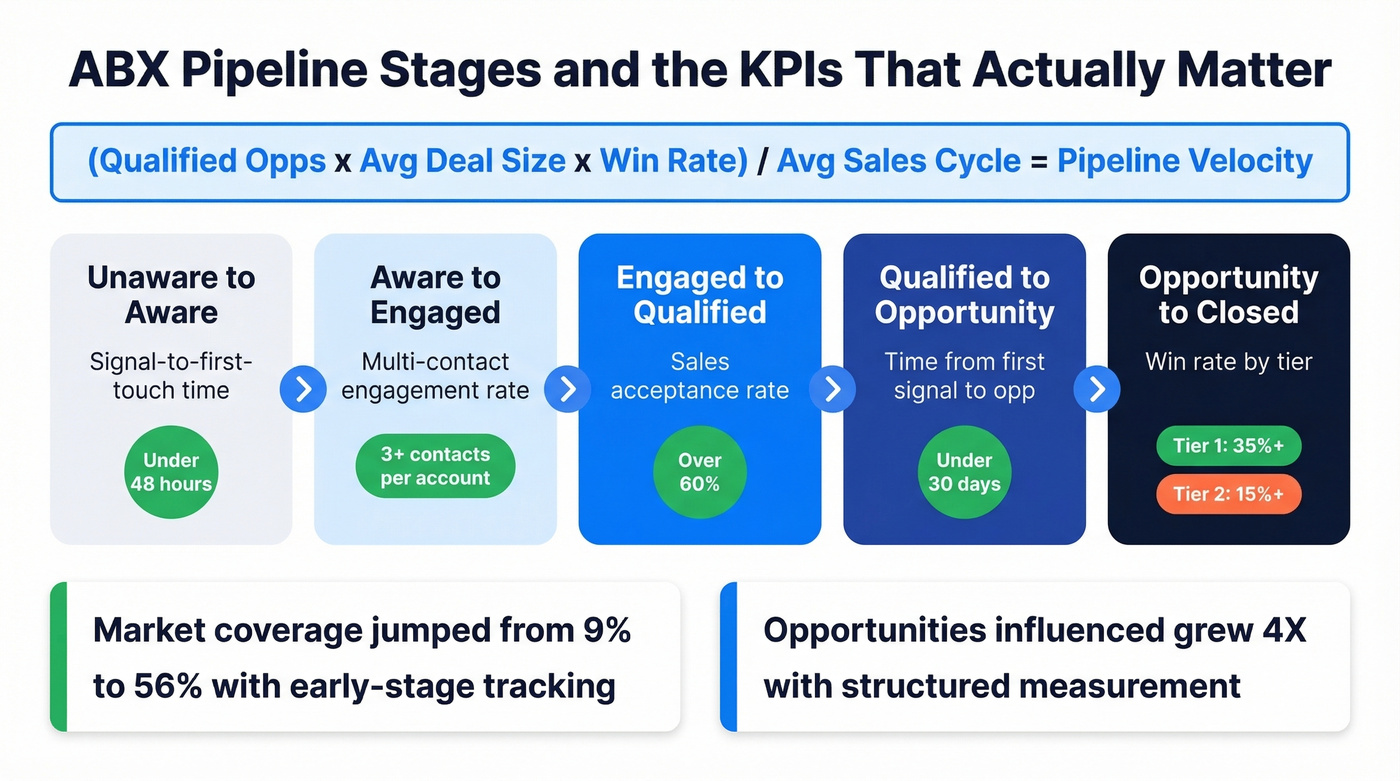
(Qualified Opps x Avg Deal Size x Win Rate) / Avg Sales Cycle
Track account progression through five stages with specific KPIs at each transition:
| Stage | Transition KPI | Target |
|---|---|---|
| Unaware to Aware | Signal-to-first-touch time | < 48 hours |
| Aware to Engaged | Multi-contact engagement rate | 3+ contacts per account |
| Engaged to Qualified | Sales acceptance rate | > 60% |
| Qualified to Opportunity | Time from first signal to opp | < 30 days |
| Opportunity to Closed | Win rate by tier | Tier 1: 35%+, Tier 2: 15%+ |
Weekly reviews should cover velocity, win rate, and stage conversion rates. Monthly reviews zoom out to net revenue retention, expansion pipeline, and advocacy metrics. Accounts with an Experience Quality Score above 90 close 30% faster - measuring experience quality isn't a nice-to-have, it's a revenue lever.
Here's where the data gets interesting. One team saw market coverage jump from 9% to 56% after including early-stage accounts in their tracking, and opportunities influenced grew 4X after implementing structured measurement. They hit a 14% engagement rate across roughly 3,000 accounts with 29+ minutes average time spent per engaged account. Those numbers only emerged because they measured the right things - most teams would've missed them entirely under MQL-based reporting.
For advanced teams, Revenue Efficiency by Segment (closed revenue / total spend per cohort) tells you which tiers and plays actually produce ROI versus which ones just feel productive.
A word of caution: if your average contract value is under $25K, you probably don't need a full ABX program. The coordination overhead eats the margin. Run targeted outbound with good data and save account-based experience plays for the deals where multi-threading and cross-functional coordination actually move the needle.
Building the Go-to-Market Motion
The biggest mistake teams make when launching is treating ABX as a marketing initiative rather than a company-wide go-to-market motion. Every revenue team - marketing, sales, and CS - needs to operate from the same account intelligence, the same scoring thresholds, and the same playbooks.
This means your CRM becomes the single source of truth for account status, not separate dashboards in marketing automation and sales engagement tools. When an account's Signal-Heat Score crosses the Hot threshold, marketing pauses programmatic ads, sales activates 1:1 outreach, and CS prepares onboarding materials - all triggered by the same event. That level of coordination is what separates programs that generate pipeline from ones that generate reports.
30-Day ABX Launch Plan
| Phase | Activities |
|---|---|
| Days 1-5 | Build account dossiers, verify buying committee contacts using Prospeo's 30+ filters and buyer intent signals |
| Days 6-10 | Map buying groups per account, assign tiers, build Signal-Heat Scores |
| Days 11-15 | Create 1:1 hub templates for Tier 1 accounts, design Tier 2 cluster plays |
| Days 16-20 | Launch intent-triggered plays, activate first Tier 1 campaigns |
| Days 21-25 | Build CS onboarding preview packs for pipeline accounts, run first weekly standup |
| Days 26-30 | Review first-week data, adjust scoring thresholds, build QBR templates |
Expect qualified meetings to start appearing in 8-12 weeks. Pipeline impact typically materializes within 90 days if account selection, scoring, and SLAs are solid from day one.
Scoring account readiness means nothing if you can't reach the economic buyer, champion, and technical evaluator with verified contact data. Prospeo gives you 30+ filters - intent signals, technographics, job changes, department headcount - to build tiered account lists with real emails and direct dials for every role on the committee.
Build your FIRE-scored target lists with data that actually connects.
The ABX Tech Stack
If you're spending $100K on an ABX platform but your email bounce rate is above 5%, you're building on sand. Here's what the stack actually looks like:
| Category | Tool | Typical Cost | Implementation |
|---|---|---|---|
| ABX Platform | Demandbase | $100K+/yr | 6 wk-4 mo |
| ABX Platform | 6sense | $100K+/yr | 2-4 mo |
| ABX Platform | Terminus | $100K+/yr | 4-6 wk |
| Analytics | HockeyStack | ~$26K-28K/yr | 2-4 wk |
| Data/Enrichment | Prospeo | ~$0.01/email, free tier | Same day |
| Orchestration | Clay | ~$149/mo | 1-2 wk |
| Sales Engagement | Outreach/Salesloft | $100-150/user/mo | 2-4 wk |
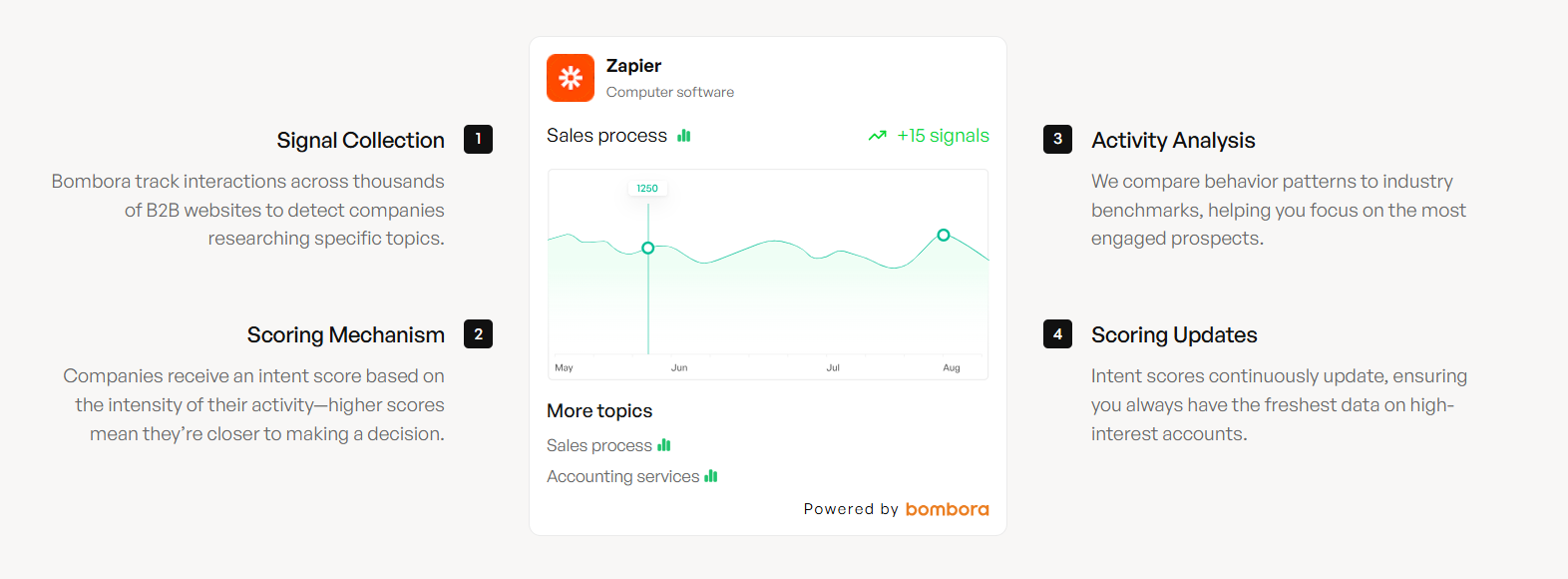
| Intent Data | Bombora | $20K-50K+/yr | 2-4 wk |
| Gifting | Sendoso | $20K-50K+/yr | 2-4 wk |
Look, you don't need a six-figure platform to start. The minimum viable ABX stack is your existing CRM, a data tool for verified buying-committee contacts, and a coordination layer. Enterprise platforms add real value at scale - predictive AI, dark funnel intelligence, cross-channel attribution - but they aren't prerequisites for running your first plays. Skip the platform if your budget is tight and invest in data quality instead.
FAQ
How is an ABX strategy different from ABM?
ABX extends ABM by coordinating the full buyer experience across marketing, sales, and customer success - not just marketing-led campaigns. The shift from MQLs to buying-group engagement has driven 200% higher win rates in Forrester research. ABX treats the account as a shared responsibility across the entire customer lifecycle.
How long does it take to see results?
Most teams see qualified meetings within 8-12 weeks of launching an ABX program. Pipeline impact typically materializes within 90 days if account selection, scoring, and cross-functional SLAs are in place from day one. Programs that skip the SLA step usually stall around week six.
Do I need an enterprise platform to start?
No. Launch with your existing CRM, a data enrichment tool for verified buying-committee contacts, and a coordination layer like Clay at $149/mo. Enterprise platforms add value at scale but aren't prerequisites - they take months to implement, while you can start running signal-triggered plays this week.
How do you build an ABX strategy from scratch?
Start with account selection and tiering using the FIRE methodology, then map buying committees with verified contact data, build a Signal-Heat Score for each account, write cross-functional SLAs between marketing, sales, and CS, and launch your first signal-triggered plays within 30 days. Teams that generate real pipeline nail all five steps before scaling.
What does a successful ABX program include?
At minimum: a tiered account list, mapped buying committees with verified contact data, a scoring model like the Signal-Heat Score, written cross-functional SLAs, and shared pipeline metrics. Skip any one of those and the program stalls.