

The Best QBR Questions to Ask - Organized by Meeting Phase
Your biggest account's QBR is Thursday. You've got a half-finished deck, stale usage data, and no agenda. You're about to wing it - and that's exactly how accounts churn quietly.
With median NRR compressing to 101% across B2B SaaS, every renewal conversation counts. Customers with regular, well-structured QBRs are twice as likely to renew, and existing customers already generate 40% of new ARR. The right QBR questions are the difference between a rubber-stamp meeting and a retention engine.
What You Need (Quick Version)
You don't need 25 random questions - you need five phases. Use the agenda template below to structure your next quarterly business review in under 60 minutes. Then pick 3-5 questions per phase and actually listen to the answers.
60-Minute QBR Agenda Template
| Phase | Time | Purpose |
|---|---|---|
| Partnership Recap | 5 min | Review last quarter's commitments |
| Performance Review | 15 min | KPIs, ROI, value delivered |
| Challenges | 10 min | Surface friction and risk |
| Goals Next Quarter | 10 min | Align on what's ahead |
| Action Plan & Close | 10 min | Document next steps with owners |
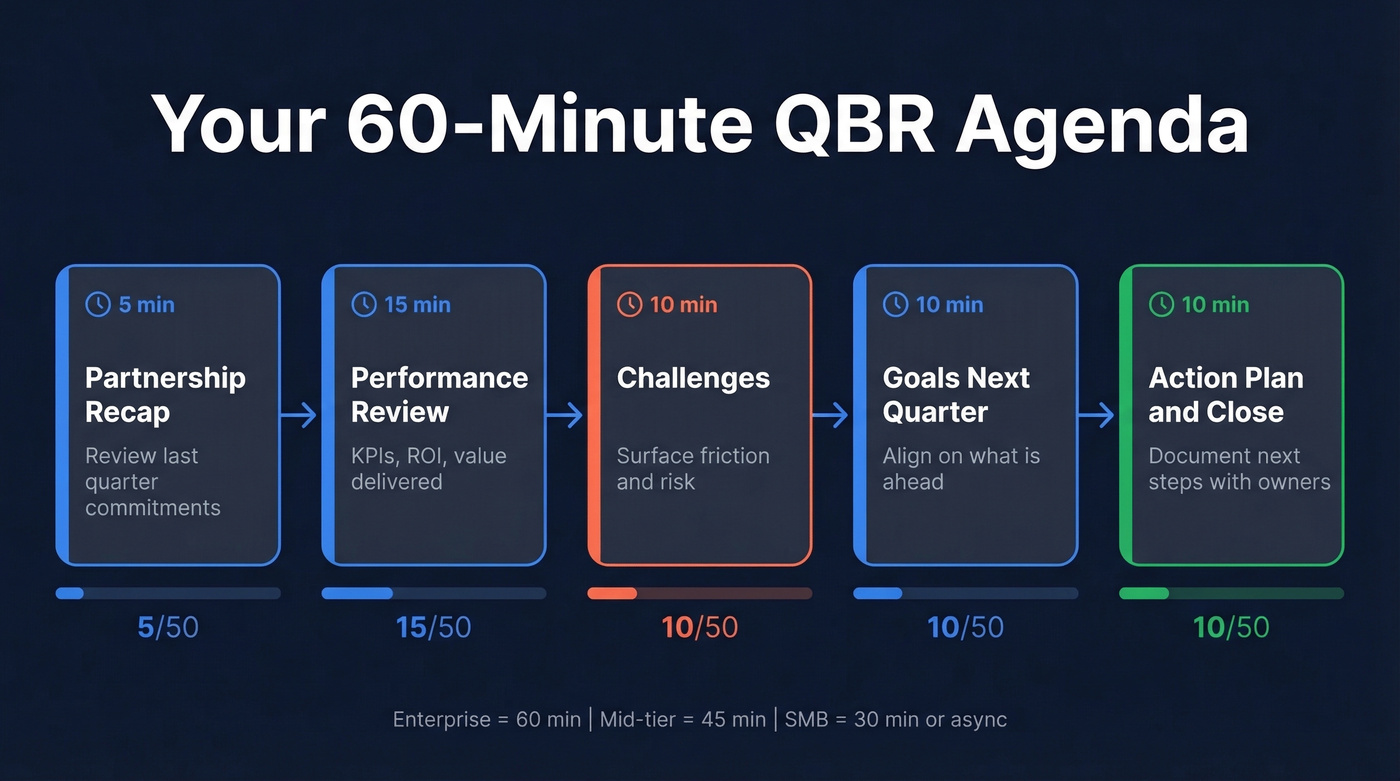
Not every account gets 60 minutes. Enterprise accounts warrant the full hour - bring a senior stakeholder and aim for the customer's VP or economic buyer. Mid-tier accounts can run 45 minutes focused on outcome-specific value. For SMB or low-touch accounts, 30 minutes works, and sometimes an async QBR doc is the better move. Match the investment to the account's strategic weight.
Questions by Phase
Pick 3-5 per phase and go deep. Depth on fewer questions beats surface-level coverage of many. We've seen teams try to cram 20 questions into a single meeting and walk away with zero actionable insights.
Phase 1 - Partnership Recap (5 min)
- "What did we commit to last quarter, and did we deliver?" This is the non-negotiable opener. It sets the tone that you take accountability seriously.
- "Were there any commitments that fell short of your expectations?" Listen for hesitation - that's where the real answer lives.
Phase 2 - Performance Review (15 min)
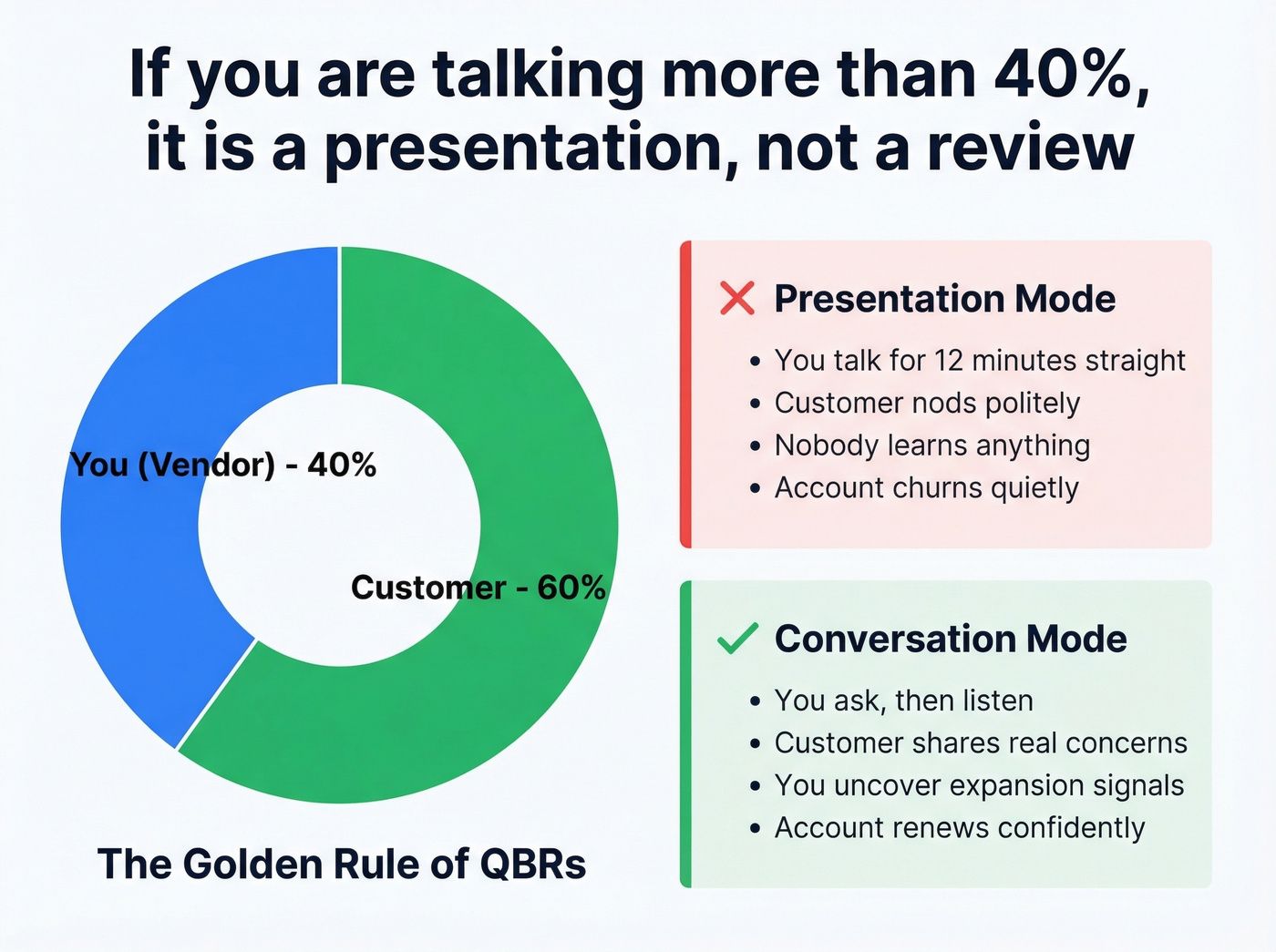
This is the phase where most QBRs go wrong. Teams default to a 15-slide data dump when what the customer actually wants is a conversation about outcomes. Lead with one or two metrics that matter to their business, let them react, and build from there. In our experience, the accounts that churn quietly are the ones where this phase became a monologue instead of a dialogue - the rep talked for twelve minutes straight, the customer nodded politely, and nobody learned anything.
- "How do you measure success with our partnership?" Their answer tells you whether your KPIs and theirs are even aligned.
- "How has our partnership impacted your business this quarter?" Let them quantify value in their own words - it's more powerful than your ROI slide.
- "Is there any part of our service that doesn't add value?" Better to hear it now than in a cancellation email.
- "What metrics would you want to see in next quarter's review?" This shapes your next QBR before you've even left this one.
- "Are you using other suppliers whose offerings overlap with ours?" Competitive intel, delivered voluntarily.
Phase 3 - Challenges (10 min)
- "Have you faced any challenges we may not be aware of?" The phrasing matters - "may not be aware of" gives them permission to surface things they've been sitting on.
- "Is there anything we promised during the sale that you feel we haven't delivered?" Uncomfortable, but it surfaces trust gaps before they become churn risks.
- "What's the biggest obstacle to getting more value from our product?" Listen for adoption gaps, internal politics, or training needs.
- "Has anything changed in your team structure that affects how you use us?" Reorgs kill adoption. Ask directly.
Phase 4 - Goals Next Quarter (10 min)
- "What does success look like for you at the end of next quarter, specifically?" The word "specifically" forces a concrete answer instead of vague aspirations.
- "Are you planning any changes to your business strategy we should align with?" Budget shifts, new markets, leadership changes - all of these affect your account.
- "If we could solve one problem for you in the next 90 days, what would it be?" Direct, actionable, and it gives you a clear deliverable.
Phase 5 - Action Plan & Close (10 min)
Skip this phase and the QBR didn't happen. Every good meeting dies in the follow-through, and this is where you prevent that.
Ask "What's the one thing we should change about how we work together?" - simple, powerful, and it signals you're open to feedback. Then ask "Who else on your team should be involved in these conversations going forward?" Stakeholder mapping happens here, not in a CRM. Close with "Can we agree on three specific action items, each with an owner and a deadline?" and document them before anyone leaves the room.
Here's the thing: if you're talking more than 40% of the meeting, it's a presentation, not a review. The best QBRs feel like a conversation where the customer does most of the talking.

Your QBR is only as good as the people in the room. If your CRM shows last quarter's org chart, you're prepping for a meeting with ghosts. Prospeo enriches your stakeholder list with 50+ data points per contact - job changes, direct dials, verified emails - at 98% accuracy.
Stop prepping QBRs with stale contact data. Enrich your account list in seconds.
Questions If You're the Buyer
Most QBR guides assume you're the vendor. If you're the customer evaluating your vendor's performance, flip the script:
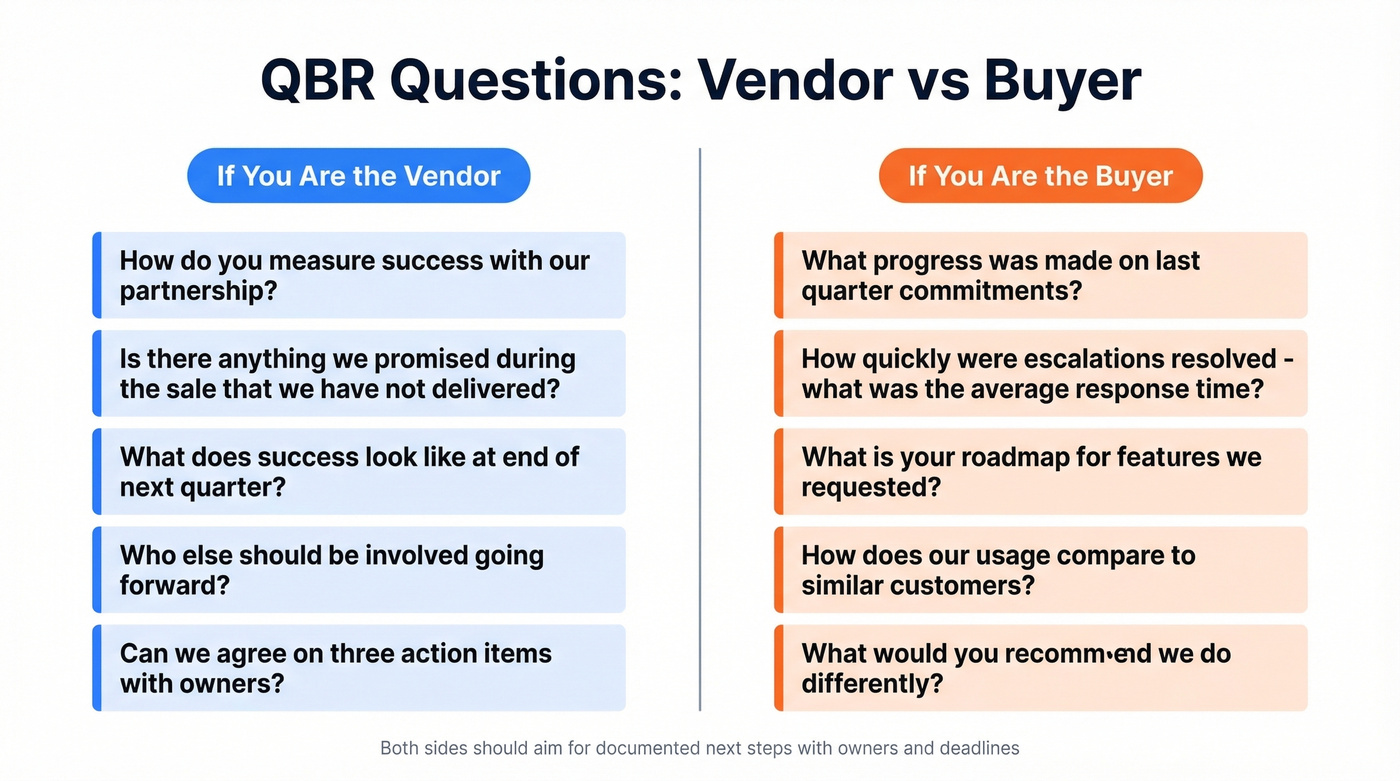
- "What progress was made on last quarter's commitments?" Start with accountability. Every time.
- "How quickly were escalations resolved, and what was the average response time?" Don't accept vague answers - ask for data.
- "Are there any weeks in the next 90 days we should watch for risk?" Maintenance windows, staffing changes, capacity constraints.
- "What's your roadmap for the features we've requested?" Vendors love to say "it's on the roadmap." Pin them to a timeline.
- "How does our usage compare to similar customers?" Benchmarking against peers reveals whether you're getting full value.
- "What would you recommend we do differently to get more from the partnership?" Good vendors have opinions. Make them share.
Pre-QBR Prep Checklist
Start by pulling up the documented next steps from your previous QBR. If you didn't document them, that's your first problem to fix - and the reason this prep checklist exists.
Gather your usage and KPI data before the meeting: adoption metrics, support tickets, ROI calculations. Don't waste meeting time pulling reports. Confirm who's attending and why. If the economic buyer isn't in the room, consider whether this QBR can actually move anything forward. Send the agenda at least a week ahead with room for the customer to add topics. Most teams skip this basic step.
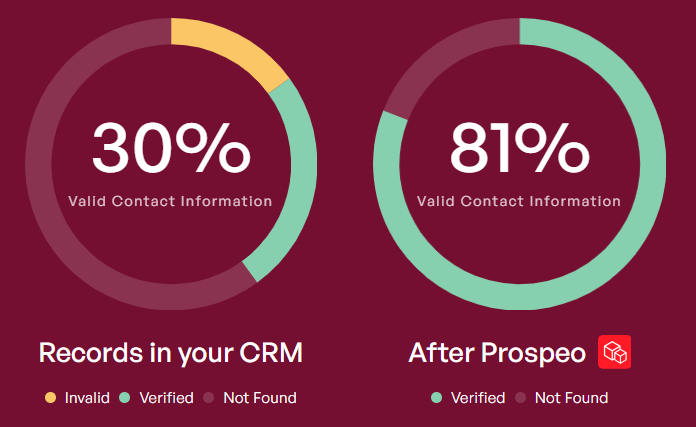
Finally, verify contact info for every attendee. Run your stakeholder list through an enrichment tool like Prospeo to catch job changes and fill in missing direct dials - it returns 50+ data points per contact with a 98% email accuracy rate, and the free tier covers 75 email lookups a month. People change roles constantly, and stale CRM data means you're prepping a QBR for people who've already left the company.
5 Mistakes That Sink QBRs
Not reviewing last quarter's action items first. Open every QBR with a 5-minute recap of what was promised and what was delivered. No exceptions.
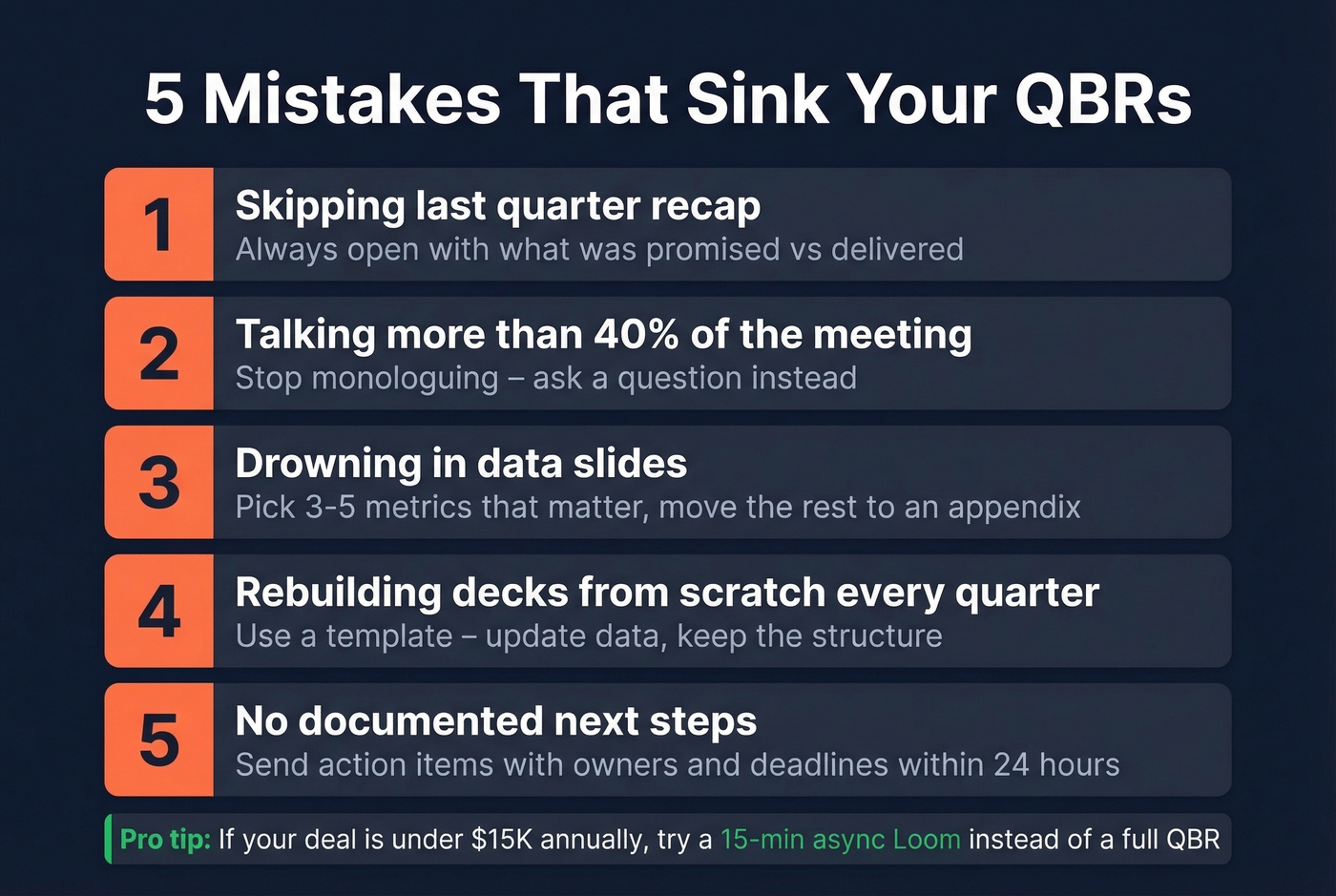
Talking for most of the meeting. Aim for a 40/60 talk ratio - you talk 40%, the customer talks 60%. If you catch yourself monologuing, stop and ask a question.
Drowning in data instead of telling a story. Reddit's r/CustomerSuccess flags this constantly: too many ad hoc reports kill the narrative. Pick 3-5 metrics that matter and move everything else to an appendix.
Rebuilding decks from scratch every quarter. Use a template. Update the data, keep the structure. We've seen teams cut QBR prep time in half just by using a consistent framework instead of starting from a blank slide.
No documented next steps with owners and deadlines. Send a summary with action items, owners, and deadlines within 24 hours. If it doesn't get written down, it doesn't get done.
Let's be honest: if your deal size is under $15K annually, you probably don't need a full QBR at all. A 15-minute async Loom video with a shared action doc will get you 80% of the value at 20% of the time cost. Save the full production for accounts that justify it.
You just asked 'Who else should be involved in these conversations?' - now you need their verified contact info. Prospeo's Chrome extension lets you find emails and direct dials for new stakeholders in one click, with 98% email accuracy and 125M+ verified mobile numbers.
Map every QBR stakeholder with verified emails and direct dials for $0.01 each.
FAQ
How long should a QBR be?
Forty-five to 60 minutes for enterprise accounts, 30 minutes for SMB or low-touch. If it runs over an hour, move supporting content to an appendix or an async document. The meeting itself should be a focused conversation, not a data dump.
What's the difference between a QBR and an EBR?
QBRs are quarterly meetings with day-to-day stakeholders focused on tactical progress, KPIs, and near-term action items. EBRs (executive business reviews) are semiannual or annual, involve senior leadership, and focus on long-term strategic alignment. Most companies need both - QBRs for operational cadence, EBRs for strategic direction.
How do I make sure the right stakeholders attend?
Review your account's org chart before every QBR - not just the names in your CRM. People change roles constantly, and your CRM won't catch it automatically. An enrichment tool can verify current job titles and contact info so you're not sending calendar invites to people who left six months ago.
What QBR questions should I ask if the account is at risk?
Lead with "What would need to change for you to feel confident renewing?" - it cuts through pleasantries and surfaces the real blockers. Follow up with "If you were to leave, what would be the primary reason?" These questions feel uncomfortable, but at-risk accounts need directness, not more slide decks. Document every concern and assign an owner before the meeting ends.