

Account Based Marketing for B2B: The Practitioner's Operating Manual
Your VP told the board you're "doing ABM" this quarter. Now you've got a Slack thread full of conflicting opinions, a sales team that thinks ABM means "marketing finally sends us leads," and a budget that won't cover the enterprise platforms everyone keeps recommending. Sound familiar?
71% of B2B practitioners now run some form of account-based marketing. But adoption doesn't equal execution. Most programs stall because teams treat ABM as a campaign type or a software category instead of what it actually is: an operating system for how marketing and sales go to market together.
What You Need (Quick Version)
- ABM is an operating system with three components - shared definitions between sales and marketing, signal-based engagement instead of gut-feel targeting, and closed feedback loops where both teams review what's working quarterly.
- Don't start without sales buy-in on the target account list. If sales won't commit to working the accounts, you'll waste 50% of your budget before you learn anything.
- You don't need a $50K platform. A CRM, clean contact data, and disciplined outreach will outperform an enterprise ABM tool with no alignment behind it.
- Measure account engagement and pipeline, not MQLs. The moment you anchor your ABM dashboard on lead volume, you've already lost the plot.
- If your average deal is under $15K, run demand gen instead. ABM's overhead - personalized content, multi-stakeholder engagement, longer cycles - only pays off when deal sizes justify the investment.
What ABM Actually Is (and Isn't)
ABM isn't a campaign. It's not a software category. And it's definitely not "sending personalized emails to a list of 500 companies."
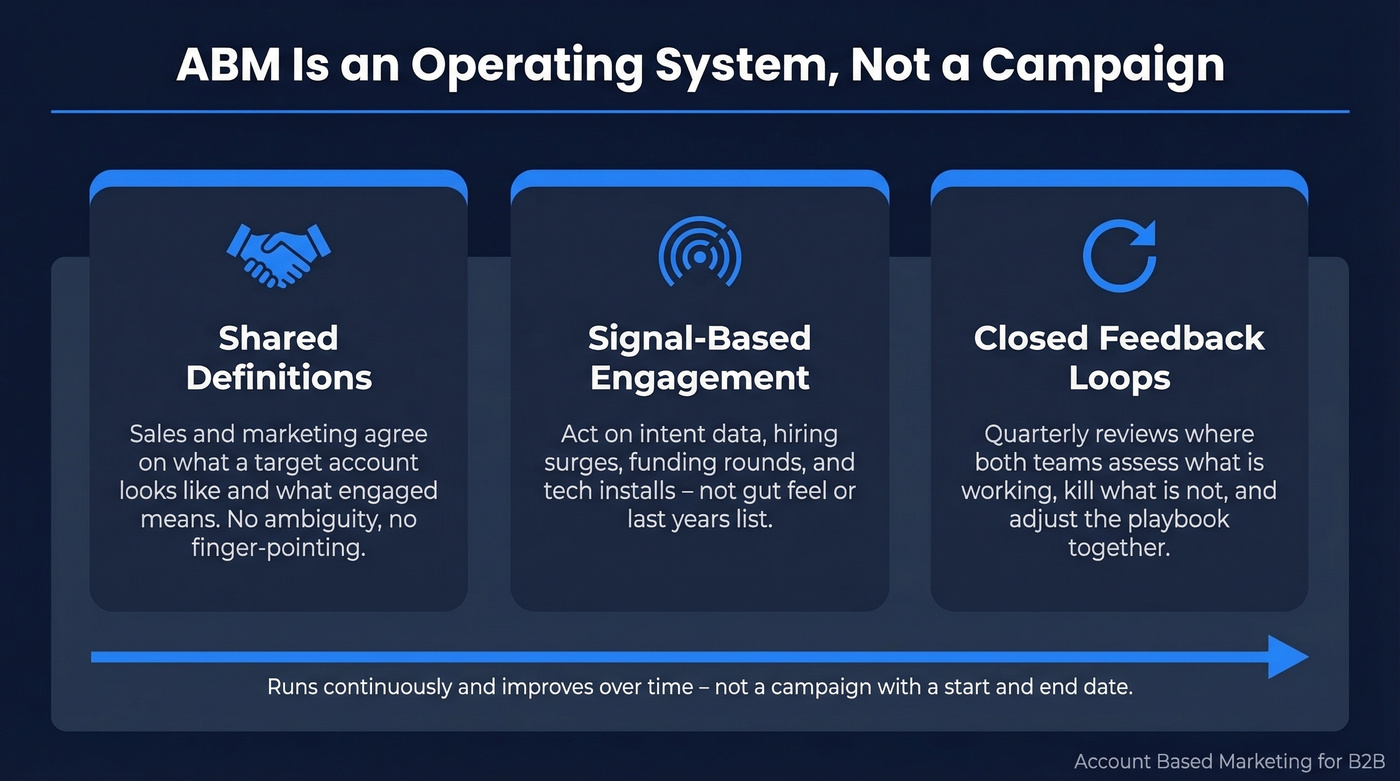
Account-based marketing in B2B is an operating system that aligns marketing and sales around named accounts. It rests on three pillars: shared definitions where both teams agree on what a target account looks like and what "engaged" means, signal-based engagement where you act on intent and behavior data rather than gut feel, and closed feedback loops with quarterly reviews where both teams assess what's working. A practitioner on r/b2bmarketing put it well - ABM failed when they ran it as "loosely connected one-off campaigns" with constant new industries and plays. It worked when they built a repeatable system.
The concept isn't new. ITSMA popularized "account based marketing" in the mid-2000s, and ABM's origins trace back to early-1990s one-to-one marketing and key-account motions. What changed is the infrastructure - CRM platforms, intent data, and enrichment tools made it possible to run coordinated account programs at scale without an army of field marketers. The distinction between ABM-as-campaign and ABM-as-operating-system matters because it changes how you staff, budget, and measure. A campaign has a start and end date. An operating system runs continuously and improves over time.
B2B ABM Benchmarks for 2026
Let's ground this in data before we get tactical.
| Benchmark | Stat | Source |
|---|---|---|
| ABM adoption | 71% of practitioners | Demand Gen Report |
| Budget allocation | 21% of marketing budget | Gartner |
| Deal size impact | 91% report larger deals | SiriusDecisions |
| Deals grew 50%+ | 25% of ABM practitioners | SiriusDecisions |
| Top channel: email | 92% effectiveness | Demand Gen Report |
| Top channel: events | 72% effectiveness | Demand Gen Report |
| Retention to profit | 5% retention lift = 25-95% profit increase | Bain |
| Intent data usage | 91% of B2B tech marketers use intent to prioritize | Guideflow |
The deal-size stat should anchor your business case. 91% of companies running ABM report larger deal sizes, and a quarter of them saw deals grow by 50% or more. That's not incremental. That's a structural shift in how revenue gets built.
The budget number is equally telling. Technology marketers with $100M+ revenue allocate 21% of their total marketing budget to ABM programs. If you're far below that benchmark, you're under-investing relative to peers.
ABM vs. Demand Gen: They're Not Competing
This is the false dichotomy that wastes the most internal meeting time. Some teams argue ABM is just one ingredient within demand generation. That framing is incomplete. ABM isn't a subset of demand gen any more than demand gen is a subset of ABM. They're complementary motions that serve different parts of your pipeline.
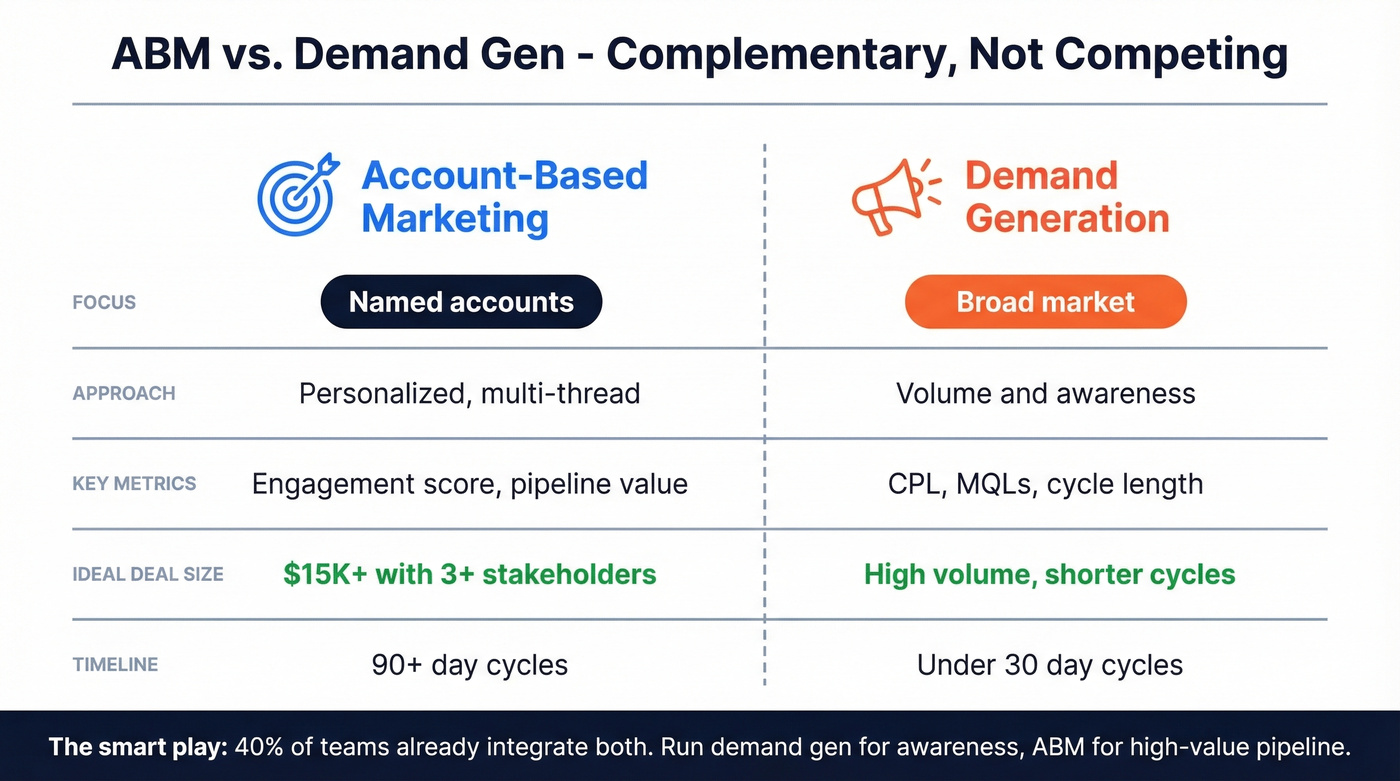
| Dimension | ABM | Demand Gen |
|---|---|---|
| Focus | Named accounts | Broad market |
| Approach | Personalized, multi-thread | Volume, awareness |
| Goal | Pipeline from target accounts | Lead volume + awareness |
| Key metrics | Engagement score, pipeline | CPL, MQLs, cycle length |
| Ideal for | Deals $15K+ with 3+ stakeholders | High-volume, shorter cycles |
40% of teams already integrate ABM with demand generation. The smart play is running demand gen to build awareness across your broader market while using ABM to concentrate resources on the accounts most likely to close at high contract values.
Here's the thing: if your average deal is in the four-figure range and your sales cycle is under 30 days, ABM's overhead will eat your margin. Run demand gen. Use account-based strategies when you're selling six-figure contracts to buying committees with 5+ stakeholders and 90-day-plus cycles. That's where the precision pays off.
Why Most B2B ABM Programs Fail
We've seen ABM programs fail more often than they succeed. The failure modes are predictable, and most of them have nothing to do with technology.
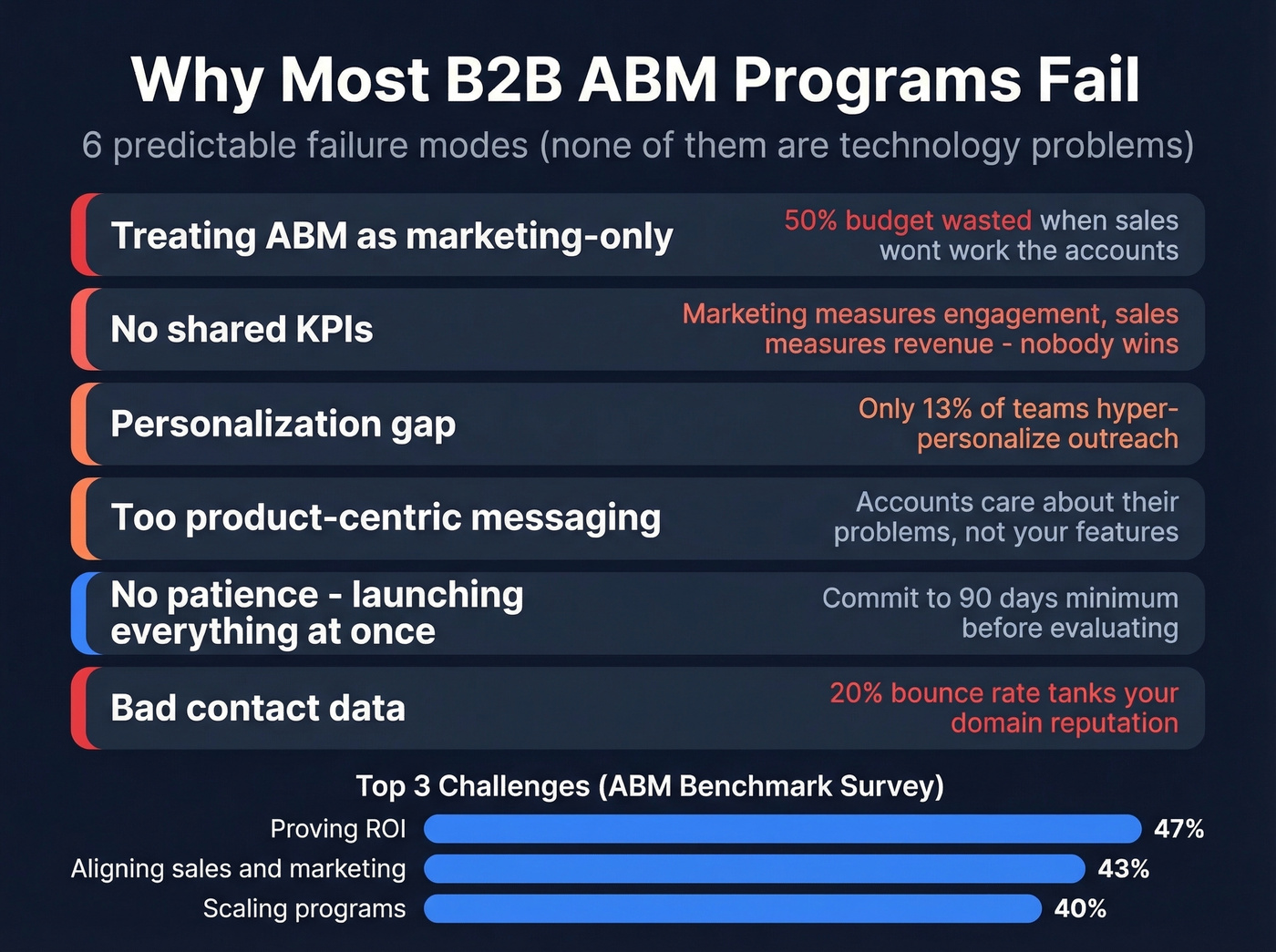
Treating ABM as marketing-only is the single most expensive mistake. ABM without sales alignment is just marketing with a fancier name. In one documented case, sales only worked half the target accounts - meaning marketing wasted 50% of the ABM budget on accounts nobody was going to follow up on. UserGems found that coordinated execution, including placing the ADR team within marketing, can double conversion rates. The fix is simple but politically hard: sales co-owns the target account list and commits to working it before a single dollar gets spent.
No shared KPIs is the quieter version of the same problem. Marketing measures engagement. Sales measures revenue. Neither team has visibility into the other's numbers. Define 3-5 shared metrics - account engagement score, pipeline progression, coverage ratio - that both teams report on weekly. If you can't get agreement on shared metrics, you don't have an ABM program. You have two teams running parallel plays.
The personalization gap is real but misunderstood. Only 13% of teams hyper-personalize their ABM outreach, and most overcorrect by either doing zero personalization or trying to build bespoke microsites for every account. The answer is tiering: Tier 1 gets custom treatment, Tier 2 gets industry clusters, Tier 3 gets programmatic targeting. You don't need a content army. You need a content framework.
Too product-centric messaging kills engagement before it starts. Your target accounts don't care about your product. They care about their problems. Lead with the account's context - their industry challenges, their competitive pressures, their recent moves - not your feature list.
Then there's the patience problem. Teams deploy every tactic at once - direct mail, podcast outreach, programmatic ads, personalized landing pages, event sponsorships - all launched simultaneously. They can't measure what's working, the team burns out, and when pipeline doesn't materialize after three weeks, leadership pulls the budget. ABM isn't performance marketing. Commit to 2-3 channels and a 90-day minimum before evaluating channel effectiveness. We've watched teams launch paid media against target accounts, see no pipeline after 14 days, and declare ABM "doesn't work." That's not a data point. That's impatience.
Bad data is the silent killer. If 20% of your contact emails bounce, you're not just wasting outreach - you're tanking your domain reputation, which poisons every future campaign. Verify every email before it hits a sequence. Catch-all handling, spam-trap removal, and honeypot filtering aren't optional. They're the minimum bar for protecting your sending infrastructure.
The top three challenges in recent ABM benchmark surveys confirm this pattern: proving ROI (47%), aligning sales and marketing (43%), and scaling programs (40%). None of these are technology problems. They're people and process problems.

Your ABM program is only as good as the contact data behind it. Prospeo gives you 98% verified emails and 125M+ direct dials so you can multi-thread every target account - not just the one contact who downloaded a whitepaper. With 30+ filters including buyer intent, technographics, and headcount growth, you build Tier 1 account lists that sales actually wants to work.
Stop wasting ABM budget on accounts you can't reach.
Building Your ABM Operating System
Define Your ICP and Select Accounts
Start with your existing customer base. Expansion ABM closes faster than net-new because you already have relationships, usage data, and internal champions. Use renewal timing, adoption milestones, and usage drop-offs as triggers for expansion plays. Then build lookalike segments from your best 20-50 accounts - matching on firmographic and technographic attributes - to keep messaging tight while scaling into net-new territory.
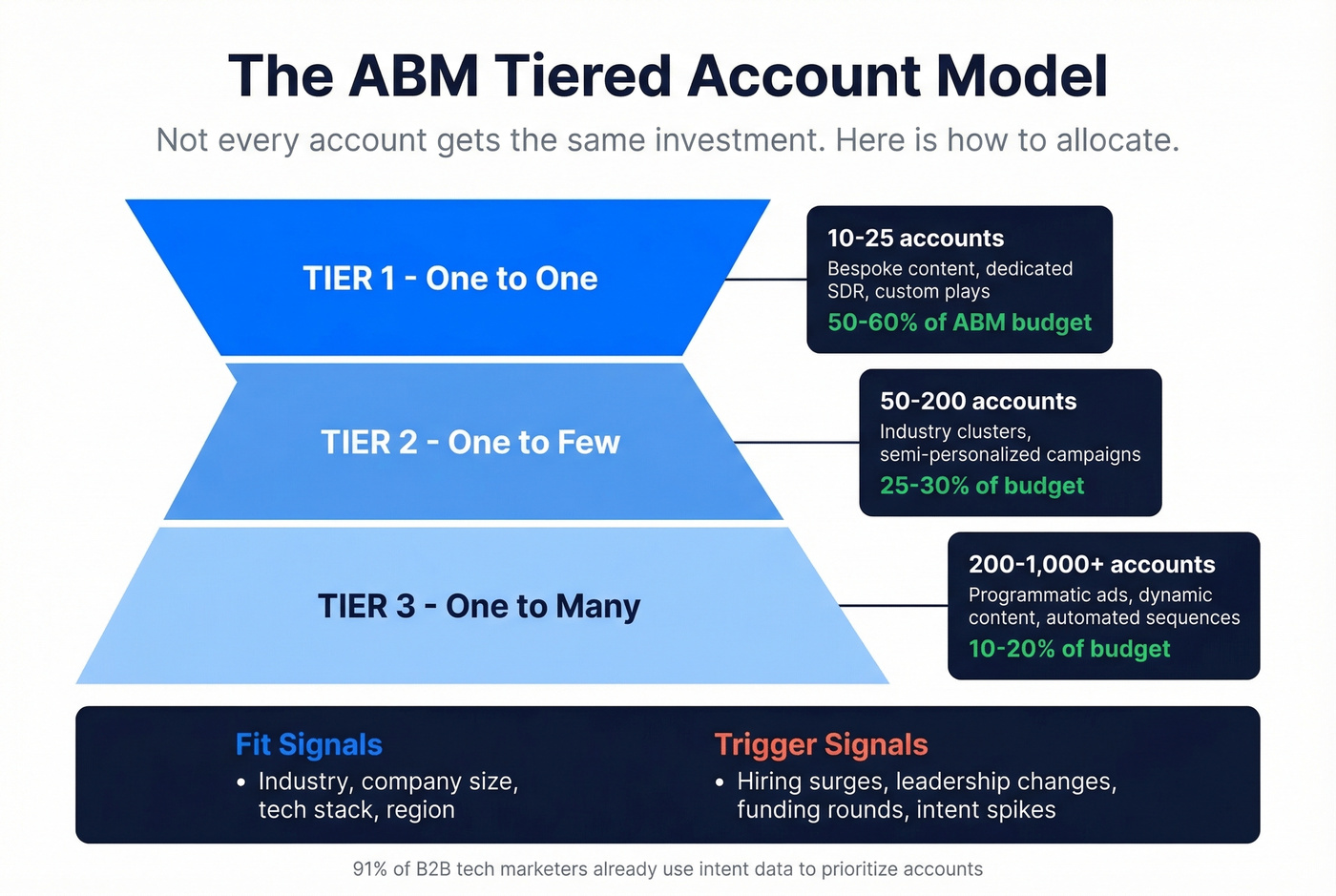
From there, build a tiered account list. Not every account gets the same investment.
Tier 1 (1:1): Your top 10-25 accounts. These get bespoke content, dedicated SDR attention, and custom plays. Allocate 50-60% of your ABM budget here.
Tier 2 (1:few): 50-200 accounts clustered by industry, use case, or persona. They get semi-personalized campaigns. Allocate 25-30% of budget.
Tier 3 (1:many): 200-1,000+ accounts. Programmatic ads, dynamic content, automated sequences. Allocate 10-20% of budget.
To select accounts, stack signals rather than relying on a single criterion. Combine fit signals like industry, company size, tech stack, and region with trigger signals like hiring surges, leadership changes, funding rounds, and intent spikes on relevant topics. 91% of B2B technology marketers already use intent data to prioritize accounts - if you're still picking targets based on gut feel and company size alone, you're leaving precision on the table. Cognism's ABM team calls this "signal stacking," and it's the difference between guessing and targeting.
Map the Buying Committee
The average B2B deal involves 3-8 core stakeholders you need to actively engage. Your job is to identify the champion, the decision-maker, the influencer, and the blocker at each target account. 42% of ABM marketers can't identify the right buyers - which means most teams are running plays against incomplete org charts.
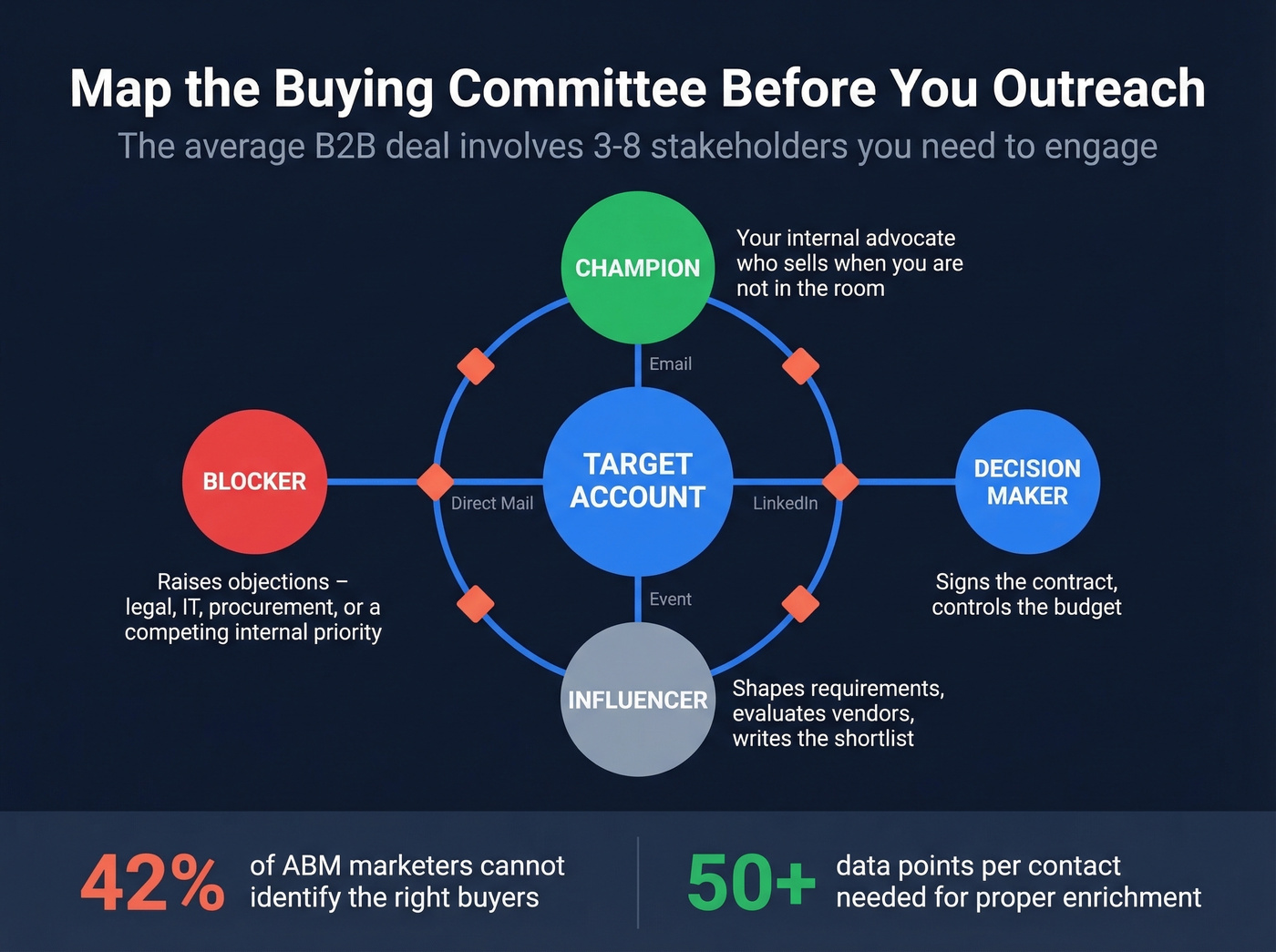
Enrich each account with verified contact data before your SDRs start outreach. Tools like Prospeo pull 50+ data points per contact and verify emails in real time, so reps aren't burning cycles on bounced emails or outdated titles. The enrichment step takes minutes and saves weeks of wasted effort downstream.

Personalize by Tier
Tier 1 accounts get bespoke treatment - custom microsites, personalized video messages, tailored case studies that reference their specific competitive situation. This is expensive and time-intensive, which is why you only do it for your highest-value targets.
Tier 2 accounts get industry-and-role clusters. A CFO at a fintech company sees different messaging than a CTO at a healthcare company, but you're not building individual assets for each account. 31% of marketers say they lack resources to personalize at scale - clustering solves that without hiring a content army.
Tier 3 accounts get programmatic ads and dynamic content. Personalization happens through targeting parameters, not custom creative.
Sequence Your Channels
Email remains the dominant ABM channel at 92% effectiveness, followed by in-person events at 72%. But sequencing matters more than channel selection.
Start with signal-based engagement on LinkedIn - 7-10 days of liking, commenting, and sharing relevant perspectives before any pitch. This warms the relationship and gives you intelligence to personalize your outreach. Then layer in email sequences tailored to the stakeholder's role and the account's tier.
For Tier 1 accounts, consider direct mail triggered by engagement score thresholds. When an account hits a certain engagement level, a physical package cuts through digital noise in a way that another email simply can't. Track response via QR codes or personalized URLs so you're not flying blind on offline channels.
Podcast ABM is an underrated play. Storemaven and Signify both used podcasts to invite VP and C-level targets as guests - building relationships while extracting buyer language that informed their sales strategy. High-effort, but remarkably effective for Tier 1 accounts where a single deal justifies the investment.
Set Up Measurement Before Launch
Define your KPIs before the first email goes out. Not after.
The three non-negotiable metrics: account engagement score, which tells you whether target accounts are interacting with your content; pipeline progression rate, which reveals if engaged accounts are moving through buying stages; and account coverage ratio, which flags accounts where you're single-threaded against a multi-stakeholder deal.
Don't anchor on MQLs. The moment you report MQLs to leadership, you've incentivized volume over quality - the exact opposite of what an account-based strategy is supposed to do.
The ABM Tech Stack (By Budget)
You don't need a $50K platform to run ABM. You need the right tools for your maturity level.
| Category | Starter ($0-$500/mo) | Growth ($500-$5K/mo) | Enterprise ($20K-$120K+/yr) |
|---|---|---|---|
| CRM | HubSpot CRM (free) | HubSpot / Salesforce | Salesforce enterprise |
| Enrichment | Prospeo (free tier) | Prospeo ($39+/mo) | Cognism ($1K-$3K/mo) |
| ABM Platform | Manual targeting | RollWorks | 6sense / Demandbase |
| Ads | LinkedIn Ads (self-serve) | RollWorks / Metadata | Demandbase |
| Engagement | Email + manual | Apollo ($49+/mo) | Outreach / Salesloft |
| Marketing Auto | HubSpot Free Tools | HubSpot ($800+/mo) | Marketo / Pardot |
Your ABM program is only as good as your contact data. Prospeo covers the enrichment layer at every budget tier - 300M+ professional profiles with 98% email accuracy and a 7-day data refresh cycle versus the 6-week industry average. The free tier gives you 75 verified emails per month, enough to pilot a Tier 1 program against 10-15 accounts. Paid plans start at roughly $39/month with no contracts. Layer in intent data across 15,000 Bombora topics to identify which accounts are actively researching your category, and you've got a signal-based targeting engine without the enterprise price tag.
A word on enterprise platforms: 6sense and Demandbase are powerful, but they come with real tradeoffs. 6sense users consistently flag inflexible setup processes and an attribution model that assigns credit to itself for account movements. At $20K-$120K+/year depending on modules and spend, you need to be confident your team will actually use the platform's full capabilities. We've seen too many companies buy enterprise ABM tools and use them as glorified ad platforms.
Our hot take: The biggest waste of ABM budget in 2026 isn't bad targeting or weak content - it's enterprise software that nobody fully adopts. A $500/month stack with genuine sales-marketing alignment will outperform a $100K platform where sales ignores the dashboards and marketing runs it like a display ad campaign. Buy the platform after you've proven the motion, not before.
Intent data without accurate contact data is a signal you can't act on. Prospeo tracks 15,000 intent topics via Bombora and pairs them with verified emails and mobiles - refreshed every 7 days, not every 6 weeks. That means your ABM engagement hits the right stakeholders while they're actively researching, at $0.01 per email instead of $1.
Turn intent signals into booked meetings for a fraction of the cost.
Measuring ABM Without Lying to Yourself
Most ABM dashboards lie. Not intentionally - but platform-native reporting has structural problems that distort your view of what's working.
The core issues: single-touch attribution that credits the last click, which is useless for multi-stakeholder journeys; siloed data across platforms that never gets unified at the account level; blind spots on offline activities like events and direct mail; and vanity metrics like impressions and clicks that tell you nothing about pipeline.
Here's what your ABM dashboard should actually track:
| Metric | Definition | Why It Matters |
|---|---|---|
| Engagement Score | Composite of visits, downloads, email responses, event attendance, ad clicks | Shows which accounts are warming |
| Pipeline Progression | Speed through buying stages | Reveals if engagement converts to movement |
| Coverage Ratio | % of buying committee engaged | Flags single-threaded accounts |
| Account Health Score | Composite of engagement + progression + deal value | Prioritizes SDR time |
| Pipeline Velocity | Time from first engagement to closed-won | Measures ABM's impact on cycle length |
| Influenced Revenue | Revenue from accounts touched by ABM | The number your CFO actually cares about |
| CAC per Account | Total ABM spend / accounts converted | Keeps unit economics honest |
For context on what good looks like: Cognism's ABM team generated $300K in pipeline within 8 weeks during their 2025 program and scaled to $700K+ in the first half of that year. Those numbers came from a coordinated program with shared metrics - not from a platform dashboard running on autopilot.
Let's be honest: multi-touch attribution is hard. No tool does it perfectly. The pragmatic approach is to track influenced revenue - any closed deal where the account was in your ABM program - alongside directly sourced pipeline where ABM was the first touch. Report both numbers. Let leadership decide how to weight them.
AI and ABM: Promise vs. Reality
Every ABM vendor is pitching AI as the answer to personalization at scale. The reality is more nuanced.
45% of practitioners see AI's promise for personalization, but nearly 70% find current AI effectiveness limited. That gap tells you everything.
Where AI genuinely helps today: account scoring that processes hundreds of signals to prioritize accounts, content personalization triggers that match assets to account context automatically, and intent signal processing that turns raw Bombora or G2 data into actionable account lists. These are real productivity gains that free up your team to focus on the creative and strategic work that still requires a human brain.
Where AI is still hype: fully automated 1:1 campaigns that write, sequence, and optimize themselves without human oversight. We're not there. The teams getting the best results use AI to accelerate human decision-making, not replace it.
One data point from the buyer side: 72% of buyers encountered AI Overviews during research, and 90% clicked at least one cited source. Your ABM content strategy needs to account for AI-mediated discovery - your thought leadership and case studies need to be the sources that AI surfaces, not just the ads that interrupt.
The Shift to Contact-Level ABM
The next evolution is already underway: moving from account-level targeting to contact-level targeting. Instead of treating "Acme Corp" as a monolithic entity, you're targeting the specific VP of Engineering, the CFO, and the procurement lead with distinct messages tailored to their role and concerns.
The numbers are compelling. Contact-level ABM drives up to 74% higher meeting conversion rates and 118% higher pipeline conversion compared to account-level approaches. 24% of teams plan to implement contact-level targeting in the next 12 months, and 72% see it as a core differentiator.
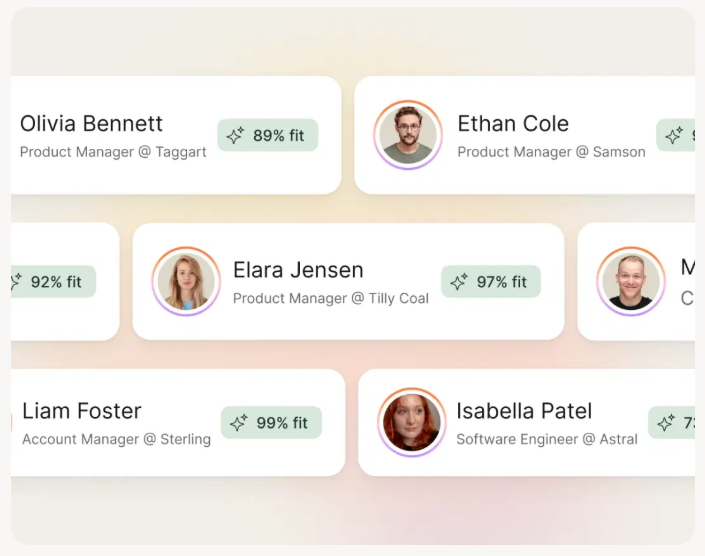
This shift puts even more pressure on data quality. You can't run contact-level ABM with stale org charts and unverified emails. You need verified contacts for specific stakeholders with accurate job titles, direct emails, and mobile numbers - not just firmographic data about the company. The teams building this enrichment infrastructure now will have a structural advantage as contact-level targeting becomes the standard.
Putting It All Together
ABM is an operating system, not a campaign you launch and forget. The teams that win with account-based marketing share three traits: sales and marketing co-own the target account list, measurement focuses on pipeline and engagement rather than lead volume, and the program runs for at least two quarters before anyone judges the results.
Start this week. Get sales to co-sign your target account list. Verify your contact data. Pick two channels and commit to 90 days. That's the foundation everything else builds on.
FAQ
Is ABM worth it for deals under $20K?
Probably not. ABM's overhead - personalized content, multi-stakeholder engagement, longer measurement cycles - only pays off when deal sizes justify the investment. Below roughly $15K in average contract value, demand gen is more efficient. Save ABM for situations where a single win covers months of program cost.
How long before ABM shows pipeline results?
Expect 3-6 months for early pipeline signals like increased engagement and booked meetings. Statistically meaningful revenue impact takes 6-12 months. The most common failure pattern is teams giving up after one quarter. Commit to 90 days minimum before evaluating.
Do I need a dedicated ABM platform?
Not to start. A CRM, clean contact data, and disciplined outreach will get you further than a $50K platform with no sales buy-in. Add a dedicated platform when you've proven the motion works and need to scale beyond 50-100 accounts.
What's the minimum budget for a B2B ABM program?
You can run a starter program for under $500/month - HubSpot CRM for free, a data tool's free tier for verified emails, and manual personalization for your top 10-15 accounts. Enterprise platforms start at $20K+/year and make sense once you're scaling beyond what manual processes can handle.
How is ABM different from outbound sales?
Outbound is one-to-one sales activity - an SDR reaching out to individual prospects. ABM orchestrates marketing and sales together against named accounts across multiple channels and stakeholders simultaneously. That coordinated, multi-threaded approach is what makes it fundamentally different from simply scaling outbound volume.