

How to Build Account Based Marketing Programs That Generate Pipeline
A RevOps lead we know ran a "crawl phase" ABM pilot with 30 accounts, a shared spreadsheet, and one sales champion. A few months later, that pilot was already influencing real pipeline - before they'd bought a single ABM platform. The lesson? Account based marketing programs generate pipeline. ABM platforms don't. Not by themselves.
[71% of B2B practitioners](https://www.demandgenreport.com/resources/2025-account-based-marketing-benchmark-survey/50610/) now run some form of ABM strategy. But 47% can't prove ROI, and 43% still struggle to align sales and marketing around it. The gap isn't strategic - most teams understand the concept of targeting high-value accounts. The gap is operational. They skip program design and jump straight to buying software.
Companies that shift from lead-based to buying-group-based ABM see 200% higher win rates and 800% faster opportunity progression. ABM isn't a campaign you run. It's an operating model you build.
What You Need (Quick Version)
An ABM program has four layers: a target account list, a buying committee map, a multi-channel engagement plan, and a shared measurement framework. Most programs fail because they skip straight to buying a platform.
Start with 25-50 accounts, clean contact data, and one sales champion who'll actually work the accounts with you. Everything else - the intent signals, the personalized microsites, the orchestration platform - comes after you've proven the model works.
What Defines an ABM Program?
An ABM program is the combination of strategy, process, people, and tools that lets you target and win specific accounts. It's not a piece of software. It's not a single campaign. And it's definitely not "just running ads to a named account list."
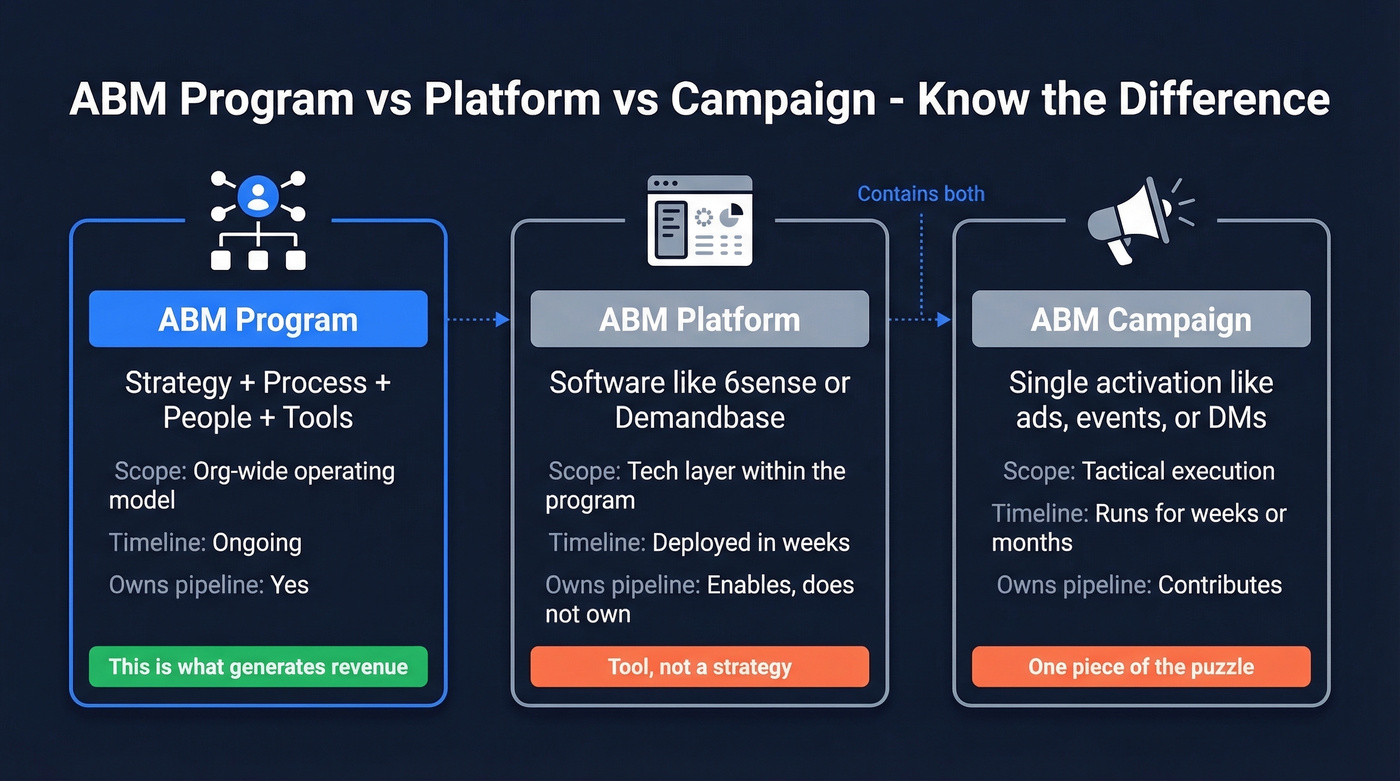
The confusion matters because it's the root cause of that 47% ROI problem. Teams buy Demandbase or 6sense, run some display ads against a target list, and wonder why pipeline didn't materialize. That's not a strategy failure - it's a program design failure. They bought a platform without building the program around it.
Buying scenarios with only 1-2 buyers now represent just 18% of B2B purchases. The rest involve complex buying committees, multiple stakeholders, and months-long evaluation cycles. ABM programs are how you orchestrate engagement across all of them.
| ABM Program | ABM Platform | ABM Campaign | |
|---|---|---|---|
| What it is | Strategy + process + people + tools | Software (6sense, Demandbase) | Single activation (ads, event, DM) |
| Scope | Org-wide operating model | Tech layer within the program | Tactical execution |
| Timeline | Ongoing | Deployed in weeks | Runs for weeks/months |
| Owns pipeline? | Yes | Enables, doesn't own | Contributes |
Three Tiers of ABM Programs
Not every account deserves a personalized microsite and a $500 gift box. The program you run should match your deal size, account volume, and team capacity.
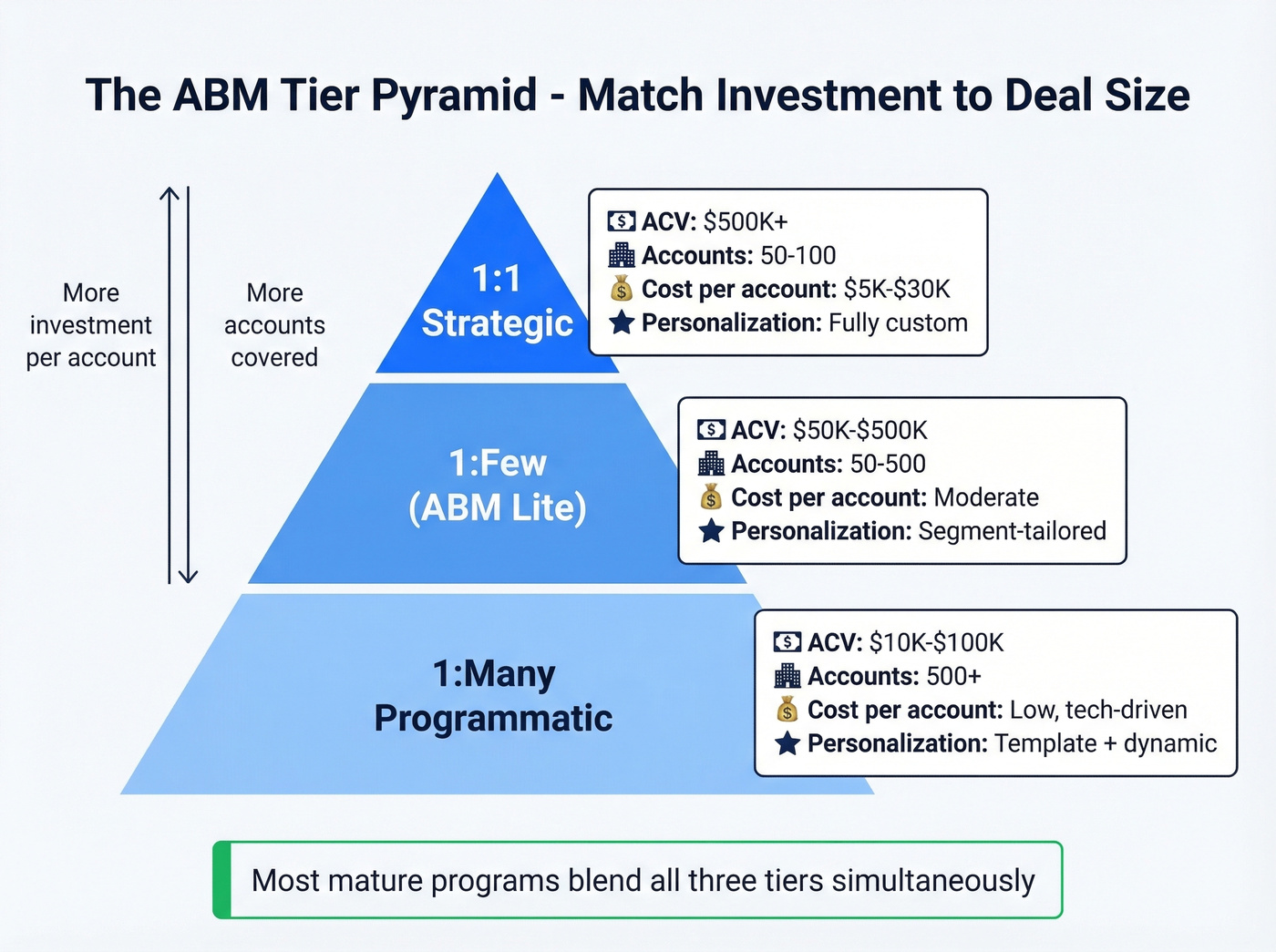
| Type | ACV Threshold | Account Volume | Resource Model | Personalization |
|---|---|---|---|---|
| 1:1 Strategic | $500K+ | 50-100 | Dedicated per account | Fully custom |
| 1:Few ABM Lite | $50K-$500K | 50-500 | Cluster-based | Segment-tailored |
| 1:Many Programmatic | $10K-$100K | 500+ | Tech-driven | Template + dynamic |
1:1 Strategic is the white-glove approach. You're investing $5,000-$30,000 per account in custom content, executive dinners, personalized microsites, and dedicated account teams. This only makes sense when a single deal can move the revenue needle significantly - think enterprise contracts where one close pays for the entire program twice over.
1:Few (ABM Lite) clusters 5-20 similar accounts - same industry, same pain point, same buying stage - and runs semi-personalized plays against the group. It's the sweet spot for most mid-market teams. You get meaningful personalization without the per-account cost of 1:1. 31% of marketers lack the resources to personalize at scale, which is exactly why this tier exists.
1:Many (Programmatic ABM) scales plays across 500+ accounts using technology - display ads, dynamic email sequences, intent-triggered workflows. The personalization is lighter, but the coverage is broad. BlueBotics ran this model across 400 global accounts with a team of one.
Most mature programs blend all three tiers. Your top slice gets 1:1 treatment. The next segment gets ABM Lite. Everything else runs programmatic.
Build Your Target Account List
Your target account list (TAL) is the foundation. Get it wrong and nothing downstream matters - you'll be running personalized campaigns against accounts that were never going to buy.
Define Your ICP
Start with your best existing customers. What do they have in common? Fast sales cycles, high lifetime value, low churn, strong product fit. Those patterns form your positive ICP criteria - firmographics, technographics, headcount, funding stage, growth trajectory.
Just as important: define your negative ICP. Which customers churn fast, require excessive support, or have poor unit economics? Exclude them. We've seen teams waste entire quarters running ABM against accounts that looked great on paper but were a terrible fit once the deal got real.
Tier Accounts by Fit, Intent, and Timing
A flat account list doesn't work. You need tiers that determine how much investment each account gets. The best tiering model scores on three dimensions.
Fit covers firmographic and technographic alignment with your ICP. Intent measures real-time buying signals - are they researching your category, visiting competitor pages, hiring for relevant roles? Timing weights recency. An intent surge in the last 14 days matters far more than steady interest over 6 months.
| Tier | Profile | Treatment |
|---|---|---|
| Tier 1 | Enterprise, strong ICP fit + recent intent surge (last 14 days) | 1:1 plays |
| Tier 2 | Mid-market, solid fit + steady intent signals | ABM Lite |
| Tier 3 | Lookalike accounts with baseline interest | Programmatic |
Track two operational KPIs: ICP Match Rate (what percentage of your TAL actually meets your ICP criteria) and Intent Hit Rate (what percentage shows above-threshold intent in the last 30 days). If either drops, your list needs work.
Map the Buying Committee
The average B2B deal now involves 11 stakeholders, each consuming 5-7 content assets before they'll engage with sales. If you're only reaching the champion and hoping they'll sell internally, you're leaving pipeline on the table.
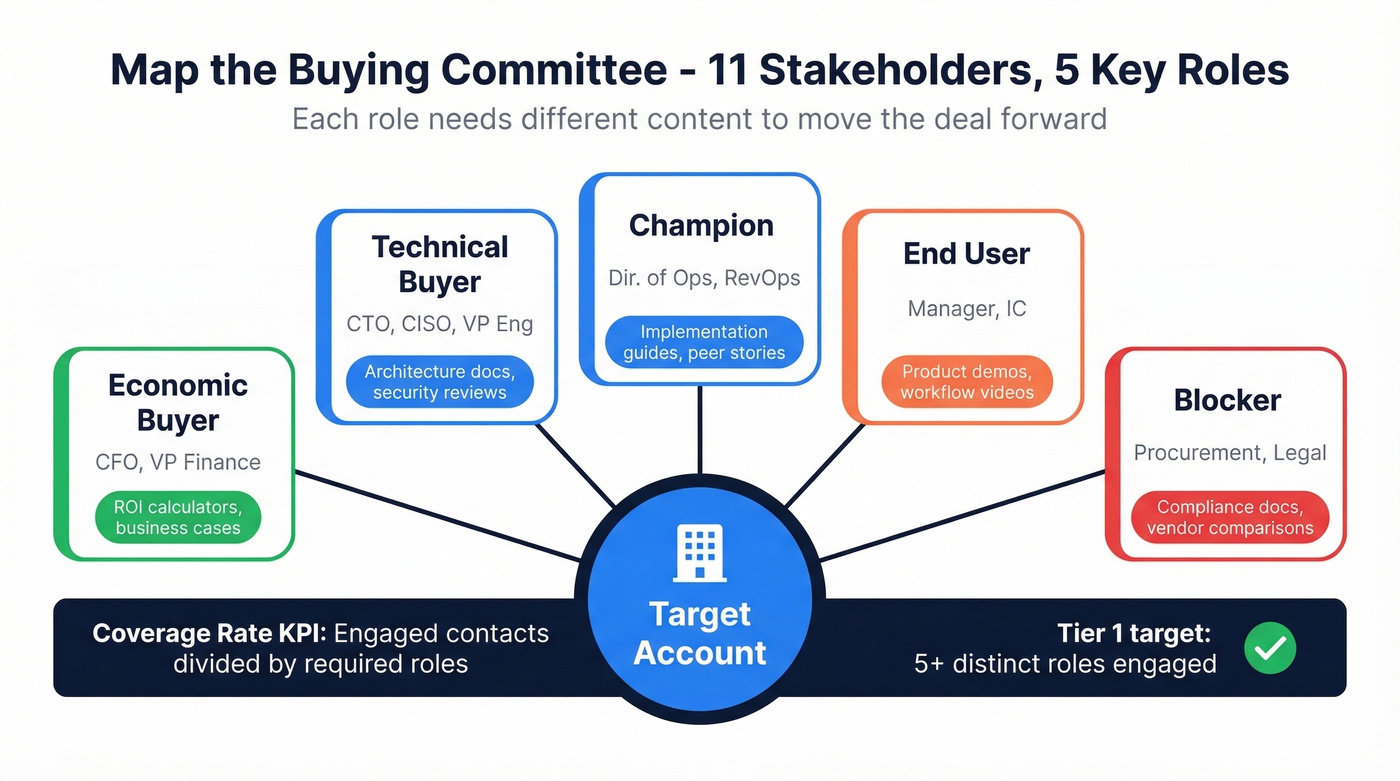
Map every target account's buying committee by role, then match content to each:
| Role | Example Title | Content That Resonates |
|---|---|---|
| Economic Buyer | CFO, VP Finance | ROI calculators, business cases |
| Technical Buyer | CTO, CISO, VP Eng | Architecture docs, security reviews |
| Champion | Dir. of Ops, RevOps | Implementation guides, peer stories |
| End User | Manager, IC | Product demos, workflow videos |
| Blocker | Procurement, Legal | Compliance docs, vendor comparisons |
The KPI that matters here is Coverage Rate: engaged contacts divided by required roles. For Tier 1 accounts, you should be engaging at least 5 distinct roles. Anything less and you're single-threaded - one internal reorg away from a dead deal.
Multi-Channel Engagement Playbook
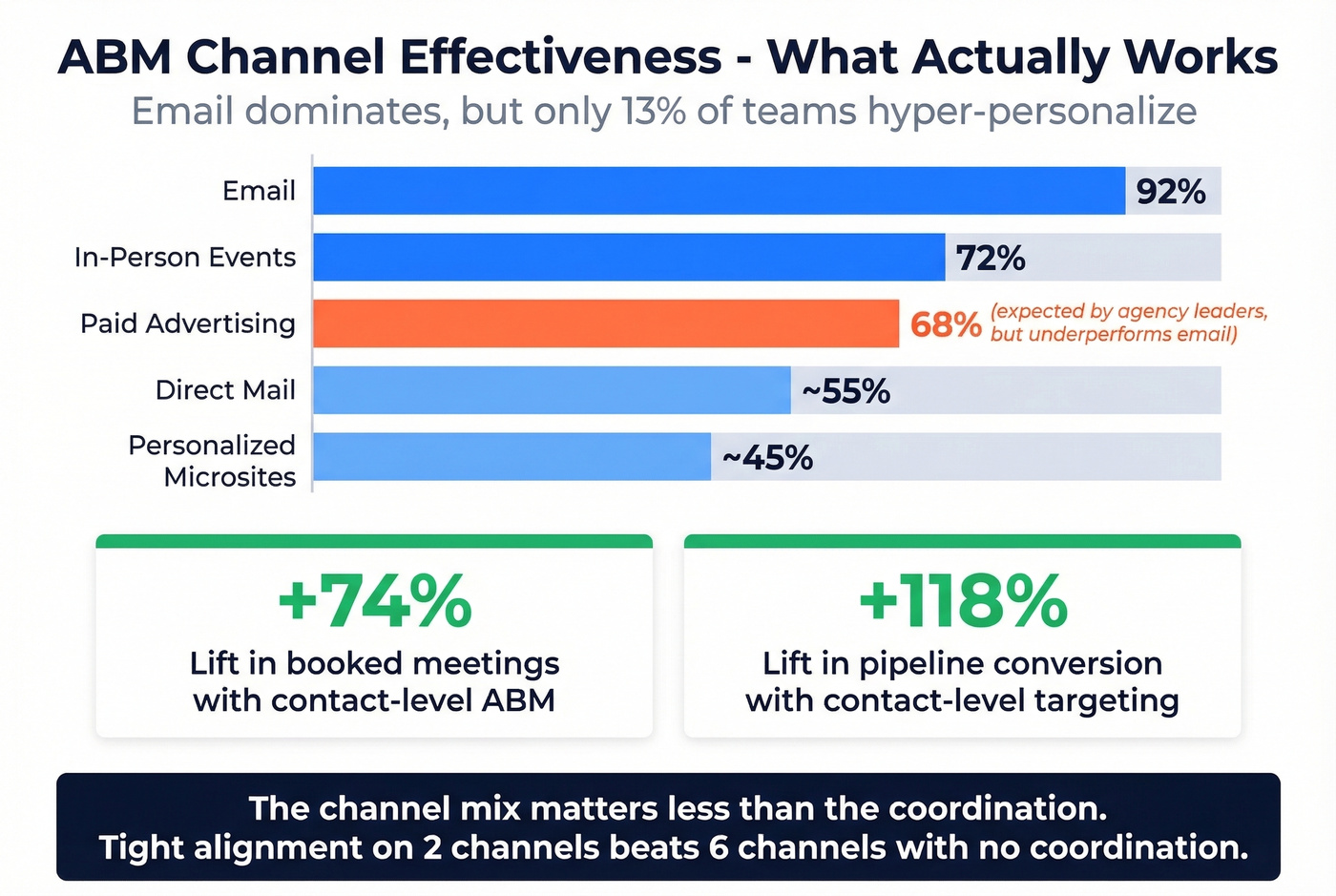
Email dominates ABM channel effectiveness at 92%, followed by in-person events at 72%. That's worth paying attention to because 68% of agency leaders expect paid advertising to deliver the strongest results - yet email consistently outperforms. Don't let ad spend crowd out your highest-converting channel.
Tier 1 accounts warrant high-touch, high-cost channels: direct mail, executive dinners, personalized microsites, 1:1 video messages. Tier 3 accounts get programmatic display ads, automated email sequences, and retargeting. The middle tier blends both - targeted webinars, industry-specific content hubs, and semi-personalized outreach.
Contact-level ABM - targeting specific individuals rather than just accounts - lifts booked meeting conversion by up to 74% and pipeline conversion by up to 118%. Yet only 13% of teams hyper-personalize their marketing. That's a massive competitive advantage sitting right there for teams willing to do the work.
Here's the thing: the channel mix matters less than the coordination. If marketing is running display ads to the CFO while sales is cold-calling the VP of Engineering with a completely different message, you don't have ABM. You have two teams doing their own thing with a shared account list. I'd take a two-channel program with tight sales-marketing alignment over a six-channel program where nobody's talking to each other.

Mapping 11 stakeholders per account means nothing if your contact data bounces. Prospeo gives you 98% verified emails and 125M+ direct dials across every buying committee role - refreshed every 7 days, not 6 weeks.
Stop running ABM plays against stale data. Start with contacts that connect.
Why ABM Fails Without Clean Data
This is where most programs silently die. You've built the TAL, mapped the buying committee, designed the multi-channel plays - and then your personalized outreach hits dead inboxes because a big chunk of your contact data decayed since you bought it.
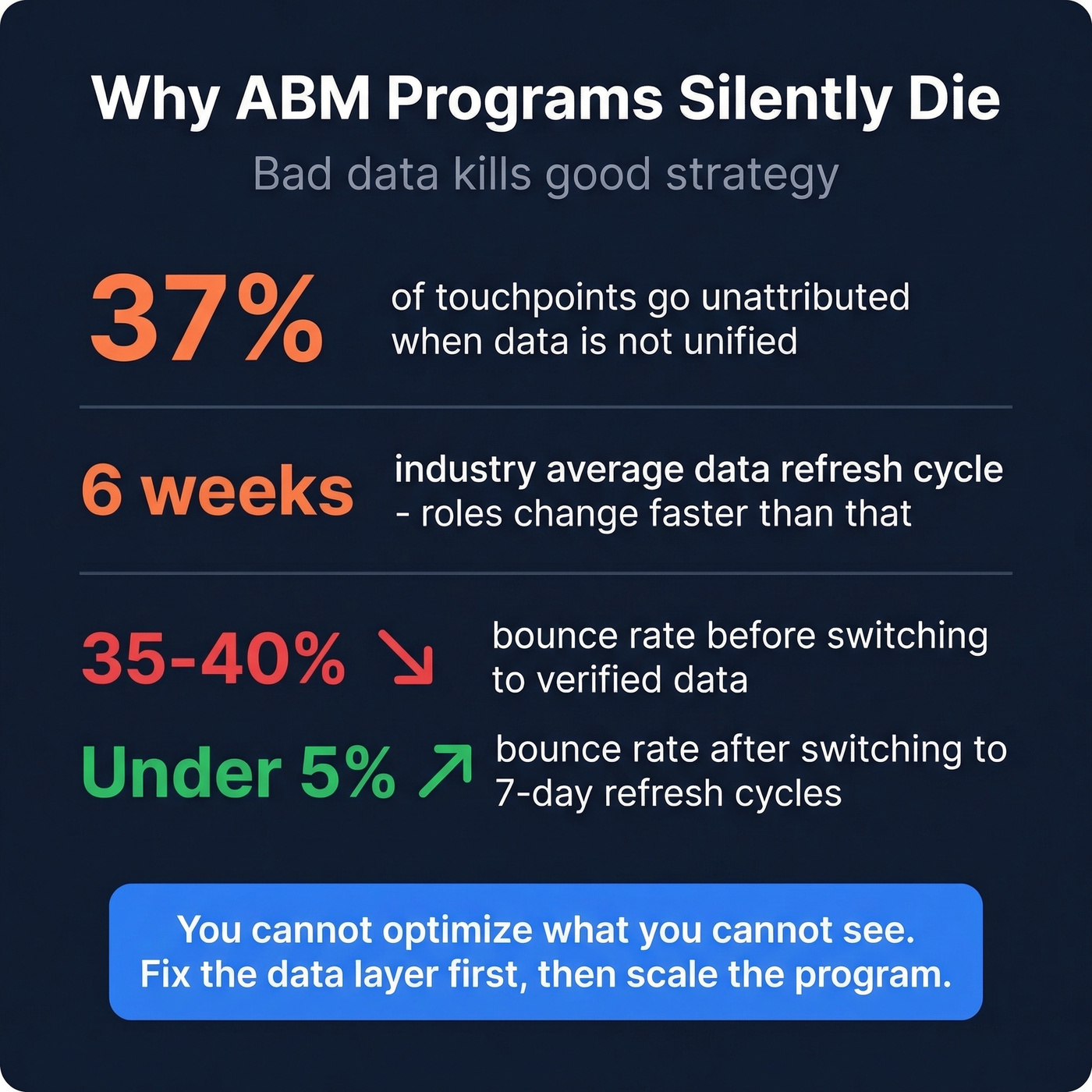
When data isn't unified, 37% of touchpoints go unattributed. More than a third of your ABM engagement becomes invisible to your measurement framework. You can't optimize what you can't see.
The industry average data refresh cycle is 6 weeks. That's an eternity when roles and org charts change constantly. Identity resolution - matching contacts across channels, devices, and data sources - is a prerequisite for multi-channel orchestration. Without it, your "personalized" email goes to someone who left the company two months ago.
Prospeo addresses this with a 7-day data refresh cycle, roughly 6x faster than the industry average. Intent data tracks 15,000 topics via Bombora, so you're not just verifying contacts but identifying which accounts are actively researching your category. Snyk's 50-person AE team dropped their bounce rate from 35-40% to under 5% and generated 200+ new AE-sourced opportunities per month after switching. At ~$0.01 per email versus $1+ at enterprise data providers, the cost difference is staggering when you're enriching thousands of contacts across hundreds of target accounts.

Tiering accounts by fit, intent, and timing requires real signals - not guesswork. Prospeo's 30+ filters including buyer intent across 15,000 topics, technographics, headcount growth, and funding let you build ABM tiers that actually reflect buying readiness.
Build your target account list with intent-enriched data at $0.01 per email.
ABM Program Budgets and Costs
Benchmark data puts ABM program budgets (excluding headcount) at roughly these ranges:
| Program Stage | Annual Budget | Per-Account (1:1) |
|---|---|---|
| Pilot | ~$200K | $5K-$10K |
| Average | ~$350K | $10K-$20K |
| Mature | ~$600K+ | $15K-$30K |
Companies allocate around 29% of marketing budgets to ABM on average. If your revenue targets are ambitious, 30-50% is more realistic.
| Budget Category | Typical Allocation |
|---|---|
| Paid media & advertising | 35-50% |
| Content & creative production | 20-30% |
| Data & tools | 10-20% |
| Direct mail & events | 10-20% |
The ratio shifts by tier - 1:1 programs spend more on events and direct mail, while programmatic efforts skew heavily toward paid media.
Platform costs add up fast. Demandbase typically runs $50K-$200K+/year. 6sense is similar at $60K-$250K+/year. HubSpot Marketing Hub starts around ~$900/month. When evaluating platforms, prioritize three criteria: data quality and match rates, implementation timeline, and whether the platform actually integrates with your existing CRM and outbound stack. A $150K platform that stalls in implementation can burn 6-12 months of momentum.
The biggest hidden cost? People. Once you factor in fully loaded salaries for ABM managers, content creators, and campaign ops, headcount often exceeds software spend.
Six Reasons ABM Programs Fail
Based on Foundry's research and patterns we've seen repeatedly:
1. Wrong executive expectations. Leadership expects pipeline in 30 days. ABM is a 6-12 month build. Set 90-day milestones for engagement metrics, not revenue. Get the CEO to sign off on the timeline before you start.
2. Target audience too narrow. Over-filtering your TAL to 15 "perfect" accounts means one lost deal tanks your entire program. Maintain enough volume per tier that no single account is make-or-break - fifty accounts minimum for a pilot.
3. TAL too broad. The opposite problem: 5,000 accounts with three SDRs. Nobody gets meaningful attention. 40% of teams can't scale ABM beyond their initial pilot, and this is usually why. Two SDRs can meaningfully work 50-100 accounts, not 500.
4. Content doesn't address real pain points. Generic whitepapers won't move a buying committee. Interview customers, listen to sales calls, mine support tickets. Build content around the objections that actually come up in deals.
5. Sales and marketing misalignment. Marketing sends MQLs, sales ignores them. Different KPIs, different definitions of success. Fix this with shared account plans, shared KPIs, and weekly pipeline reviews. Start with one sales champion, not the whole team.
6. Misreading intent signals. Treating a top-of-funnel content download as a buying signal and rushing to a demo request. A blog visit isn't the same as a pricing page visit. Calibrate your response accordingly.
How to Measure ABM Success
Stop measuring ABM like demand gen. Lead volume is irrelevant. Open rates are vanity metrics. Track account progression and pipeline velocity instead.
Leading indicators (weekly):
- Account engagement rate across target accounts
- Intent spikes and increased research activity
- ICP match rate across your TAL
- Coverage rate - buying committee roles engaged per account
Lagging indicators (monthly/quarterly):
- Opportunities created from target accounts
- Pipeline value attributed to ABM-touched accounts
- Win rate on ABM accounts vs. non-ABM
- Average contract value and deal velocity
- Expansion revenue and retention within ABM accounts
The north-star goal for a mature program: influence 50%+ of total revenue, new business plus expansion. That's when ABM stops being a "program" and becomes how your company goes to market.
A shared KPI framework across marketing, sales, and customer success is non-negotiable. If marketing is measured on engagement and sales is measured on closed-won, you'll optimize for different things and blame each other when pipeline stalls. The consensus on r/sales is pretty clear on this - misaligned incentives kill ABM programs faster than bad data does.
ABM Case Studies That Work
AVEVA and GSK (1:1 Strategic): Built a personalized microsite that drove 2,000 visits and created 46 new relationships with GSK decision-makers. Result: £7M active pipeline. Won Forrester's B2B Program of the Year.
Acxiom (Blended ABM): Entering a new vertical with zero existing relationships. Combined 1:1 and 1:few approaches to build connections at AA, McLaren, Nissan, and PSA Groupe. Generated £1.5M in pipeline within 120 days.
BlueBotics (1:Many to 1:Few, Team of One): Started with programmatic ABM across 400 global accounts, then promoted best-fit accounts into 1:few treatment. Generated £4M+ in opportunities and 160 new relationships - with a single marketer running the entire program. Proof that headcount isn't the bottleneck. Program design is.
GoodShape (1:Many): Targeted 337 accounts with programmatic ABM. Engaged 80% of them, generated 500,000 impressions and £1M+ in pipeline.
How AI Is Reshaping ABM
AI is changing how teams build and run ABM at every stage. Intent scoring models that once required manual threshold-setting now self-calibrate based on closed-won patterns. Dynamic content engines personalize landing pages and email sequences per buying role without a human touching each variation. Predictive models surface accounts showing early buying signals weeks before traditional intent tools would flag them.
The practical impact: teams can scale across larger account lists without proportionally scaling headcount. AI handles the pattern recognition and personalization at the programmatic tier, freeing human effort for the high-touch 1:1 accounts where relationships still win deals.
Skip this if you're still in pilot mode, though. AI-powered orchestration adds complexity that's only worth it once your core program mechanics are proven and you're ready to scale past 200+ accounts.
Start Building, Stop Buying
The pattern across every successful account based marketing program is the same: they built the operating model first and bought the platform second. Start with 25-50 accounts, clean data, one sales champion, and a shared definition of success. Prove the model. Then scale it.
FAQ
How long until an ABM program shows results?
Early engagement signals appear within 60-90 days. Pipeline impact typically shows at 3-6 months, with full program maturity at 9-12 months. Set 90-day milestones for engagement metrics so leadership sees progress before revenue materializes.
Can small teams run ABM effectively?
Yes. BlueBotics generated £4M+ in opportunities with a single marketer running the entire program. Start with 25-50 accounts, a 1:few approach, and your existing CRM. Scale headcount after proving the model works.
What's the difference between ABM and demand gen?
Demand gen casts a wide net to generate leads at volume. ABM targets specific accounts with personalized, multi-threaded engagement across the buying committee. 40% of practitioners already integrate both - ABM for named accounts, demand gen for everything else.
Do I need a platform to launch an ABM pilot?
No. Start with your CRM, a data tool like Prospeo for verified contacts and intent signals, and a focused account list. Evaluate orchestration platforms like Demandbase or 6sense once you need automation at scale - not before.
What's a realistic minimum budget for a pilot?
Pilot programs average around $200K excluding headcount. Scrappy teams can start smaller - a focused 1:few program with 50 accounts, existing tools, and a $5K-$10K per-account investment can launch for well under that benchmark.