

Account Planning in Sales: How to Build Plans That Actually Get Used
A RevOps lead we know ran a post-mortem on their Q1 account planning effort last year. Of 47 plans created in January, three had been opened since February. Three. The rest sat in a shared drive, perfectly formatted and completely useless.
That's not a planning problem - it's a design problem. And it's fixable.
Why Most Sales Account Plans Die by March
Here's the uncomfortable truth: fewer than 20% of companies have fully embedded account planning into their operations. The other 80% treat it as a January ritual - reps fill out a template, managers nod approvingly, and the document never gets touched again.
The failure isn't laziness. It's structural. Most account plans are designed for management review, not for the rep who actually needs to work the deal. The process often turns into a "scavenger hunt for minute details that could be found in our CRM" rather than strategic thinking. Too many accounts get plans, the plans are too long, nobody reviews them, the contact data goes stale, and by Q2 reps are back to winging it.
Let's fix each of those problems.
What You Need (Quick Version)
Account planning works when you nail five things:
- Limit plans to 5 accounts per rep. Fifteen plans means fifteen bad plans.
- Use a weighted ICP scoring model to decide which accounts deserve a plan.
- Keep the plan to one page. If it takes longer than 10 minutes to update, it won't get updated.
- Review quarterly. Not annually. Not "when we get around to it."
- Start with verified contact data. Your stakeholder map is fiction if half the emails bounce and two of the five contacts have changed jobs.
The rest of this guide walks through each piece with a filled-in template, a scoring model you can copy, and the mistakes that kill pipeline.
The Business Case
If you need to sell account planning internally, the numbers do the work. Companies with mature account-based programs attribute up to 77% of revenue growth to account-based strategies, per Momentum ITSMA research. Structured planning is associated with 28% faster sales cycles and 35% higher close rates.
The sales planning software market hit $15B in 2025 and is projected to reach ~$45B by 2033 at a 12% CAGR. Mature account-based programs report 72% higher ROI than any other marketing investment.
But here's the stat that should shape your entire strategy: only 5% of B2B accounts are actively looking to buy at any given time. Account planning isn't about covering every account. It's about identifying the 5% that matter right now and going deep on those.
Which Accounts Deserve a Plan?
Not every account earns a plan. If your average deal size is under $30K, individual plans often aren't worth the time. For everyone else, use a weighted ICP scoring model to decide where to focus.
| Criteria | Weight | What You're Measuring |
|---|---|---|
| Revenue / Size | 20% | Can they afford your solution? |
| Industry Fit | 15% | Do you win in their vertical? |
| Tech Stack | 15% | Compatible infrastructure? |
| Buying Signals | 20% | Active intent or trigger events? |
| Relationship Depth | 15% | Existing contacts / champions? |
| Competitive Position | 15% | Winnable or locked up? |
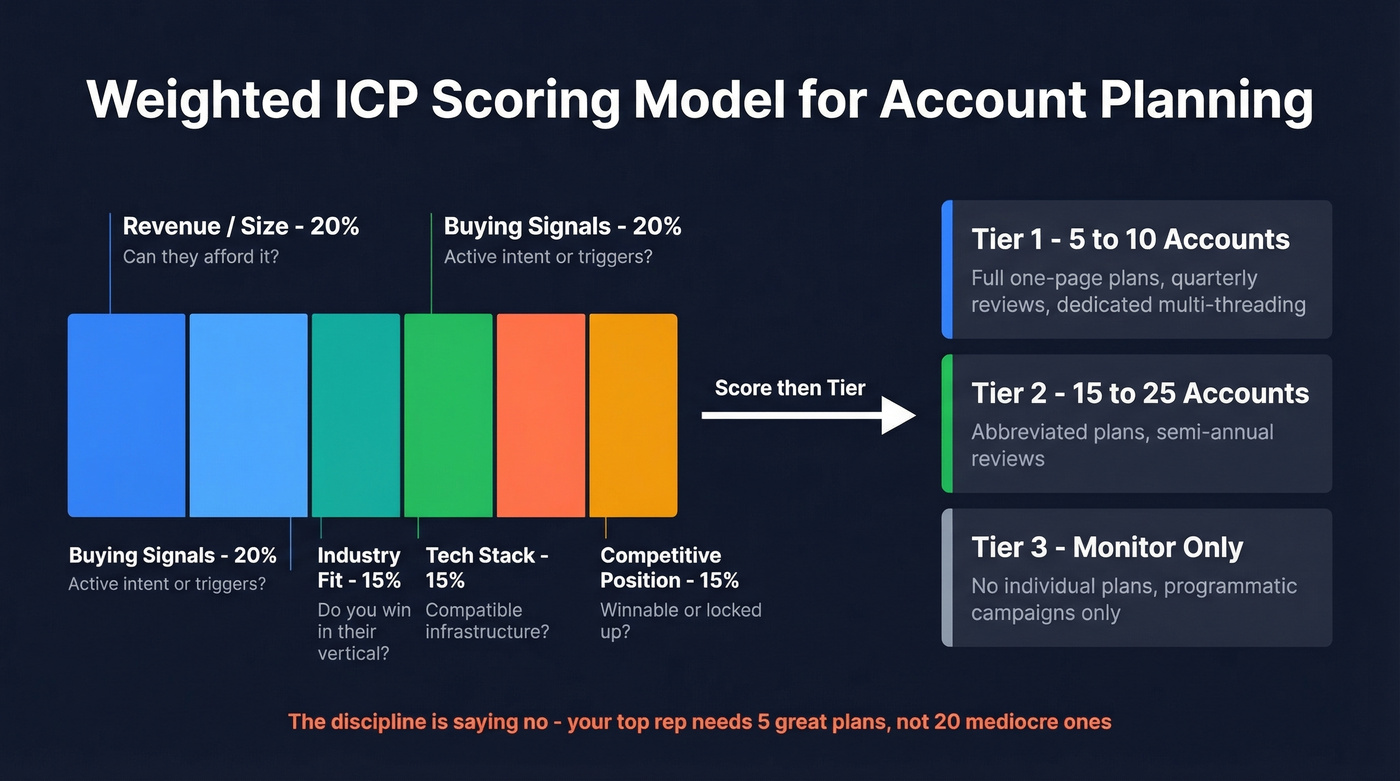
Once you've scored, tier your accounts:
- Tier 1 (5-10 accounts): Full one-page plans, quarterly reviews, dedicated multi-threading strategy.
- Tier 2 (15-25 accounts): Abbreviated plans, semi-annual reviews.
- Tier 3: Monitor only. No individual plans. Programmatic campaigns.
The discipline here is saying no. Your top rep doesn't need 20 account plans. They need five great ones.
The One-Page Account Plan Template
We've reviewed hundreds of account plans, and the ones that die fastest are always the longest. The best plan fits on one page - not because brevity is trendy, but because anything longer won't get updated. Six sections matter.
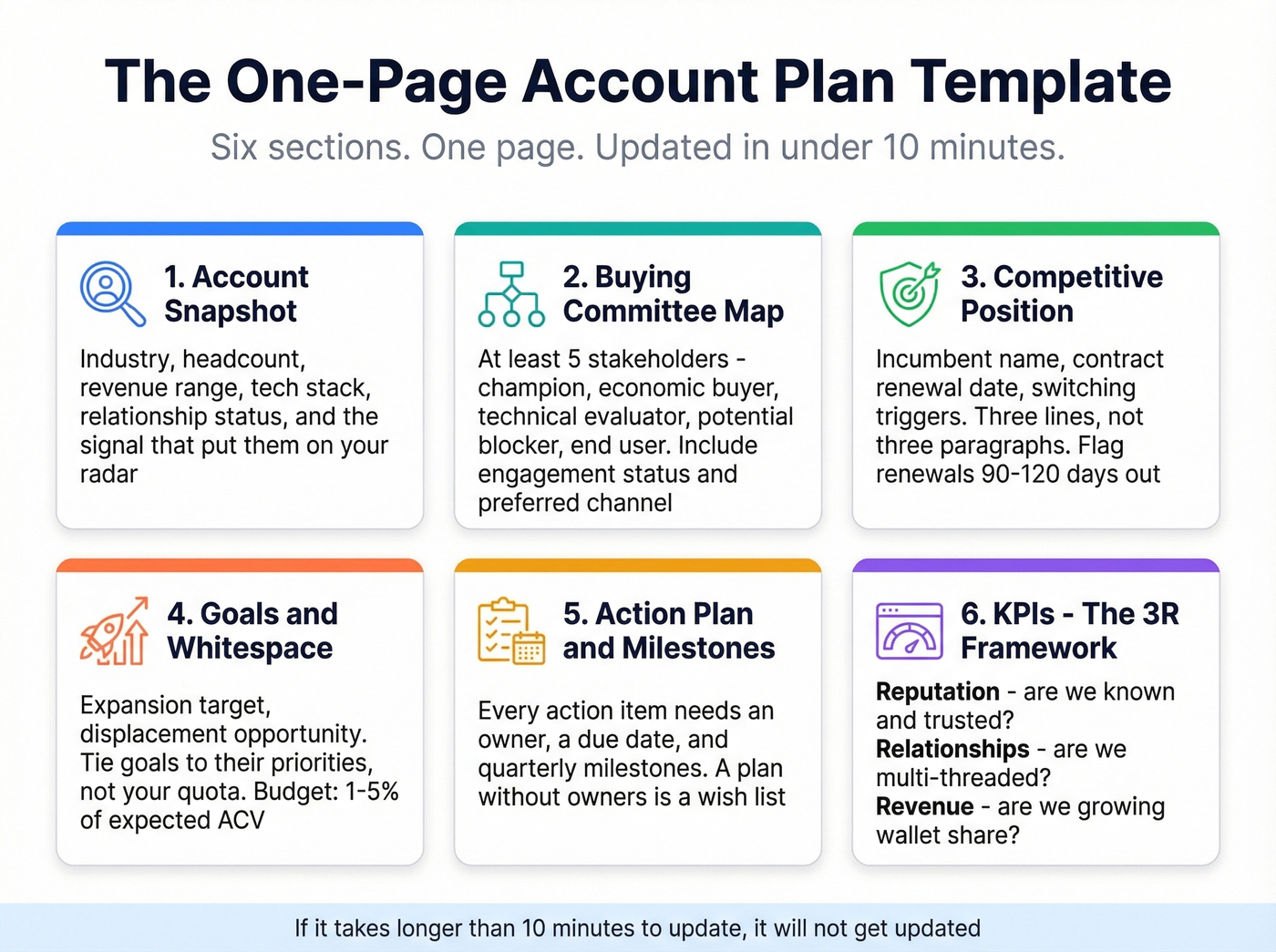
Account Snapshot
Firmographics, tech stack, relationship status, and the signal that put this account on your radar. Industry, headcount, revenue range, current tools, and how you're connected today. This isn't a Wikipedia entry - it's the context a rep needs before every call.
Buying Committee Map
Map at least five stakeholders with their roles, engagement status, and preferred channel. The average B2B deal involves 11 stakeholders - you don't need all 11 on day one, but you need to know who the champion is, who controls budget, who evaluates technically, who might block you, and who'll actually use the product. Understanding the account hierarchy within each target organization - parent companies, subsidiaries, business units - also helps you avoid duplicated effort and spot expansion paths early.
Competitive Position
Who's the incumbent? When does their contract renew? What would trigger a switch? Three lines, not three paragraphs. Flag renewal dates 90-120 days out, not 30.
Goals & Whitespace
What's your expansion target? Where's the displacement opportunity? Tie your goals to their priorities, not your quota. Budget tip: allocate 1% of expected ACV for deals $50K-$150K, 3% for $150K-$300K, and 5% for $300K+.
Action Plan & Milestones
Every action item needs an owner, a due date, and quarterly milestones. A plan without owners is a wish list. Review the action plan every few weeks - not just at the quarterly review.
KPIs (The 3R Framework)
Use the ITSMA 3R framework: Reputation - are we known and trusted? Relationships - are we multi-threaded at the right levels? Revenue - are we growing wallet share? These three dimensions keep you from optimizing for revenue alone while ignoring the relationship health that drives long-term growth.
Filled-in example:
Account: Acme Analytics (Series C, 400 employees, $85M ARR) Target ACV: $220K | Incumbent: Tableau (contract renews Q3) Buying Committee: Sarah Chen (VP Data, Champion), Marcus Webb (CFO, Economic Buyer), Priya Patel (Sr. Analyst, Technical Evaluator), James Liu (CTO, Potential Blocker), Dana Ross (Data Engineer, End User) Switching trigger: Tableau price increase at renewal + team complaints about dashboard load times Q2 milestone: Technical proof-of-concept with Priya's team Budget: 3% of $220K ACV = $6,600 allocated to 1:1 ABM plays

Your buying committee map is fiction if half the contacts have changed jobs. Prospeo refreshes 300M+ profiles every 7 days - not every 6 weeks - so your stakeholder data stays current between quarterly reviews. 98% email accuracy, 125M+ verified mobiles, and job change tracking mean your five-person committee map actually connects you to real people.
Stop planning around stale data. Start with contacts you can actually reach.
MEDDIC Makes Plans Stick
A template without a qualification framework is just a form. MEDDIC gives your account plan teeth.
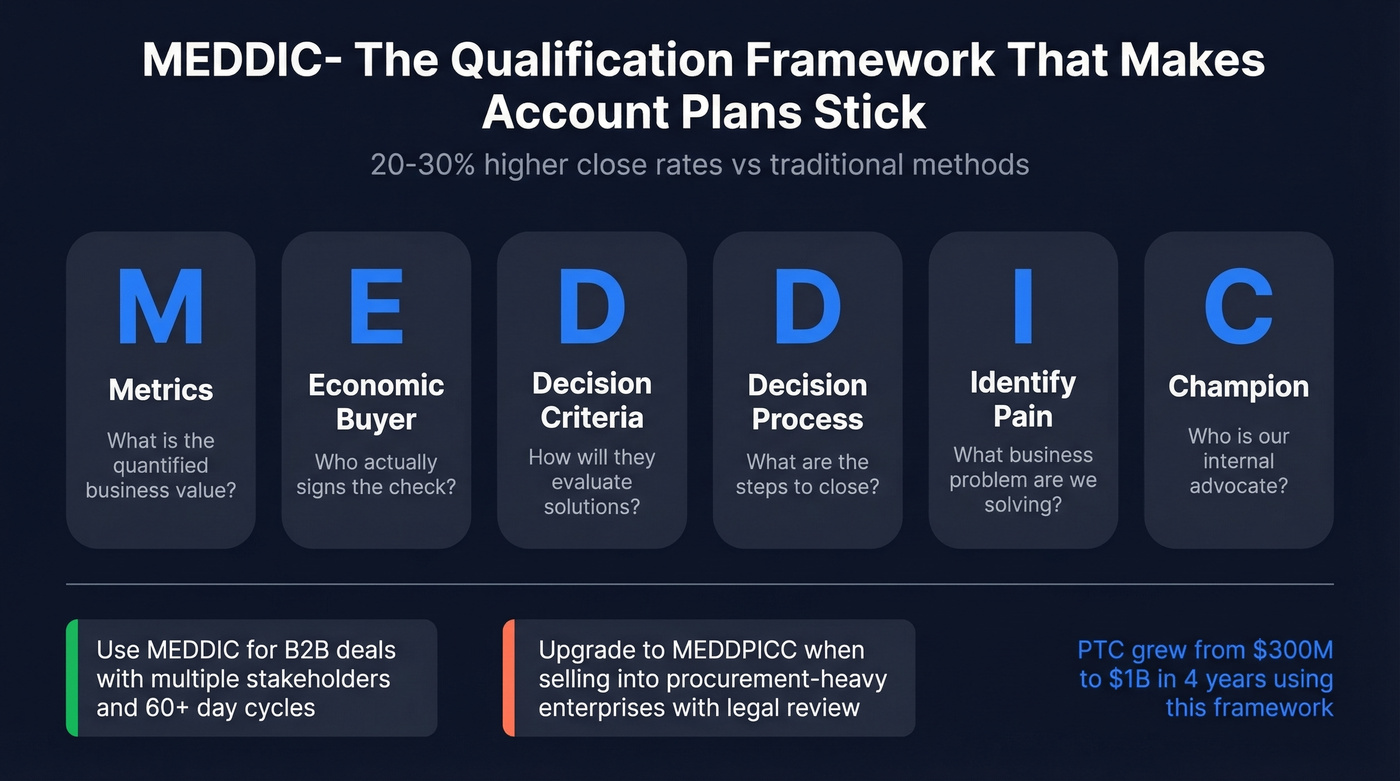
Developed in the 1990s at PTC, it breaks complex deals into six components: Metrics - quantified value. Economic Buyer - the person who signs the check. Decision Criteria - how they'll evaluate. Decision Process - steps to close. Identify Pain - the business problem. Champion - your internal advocate.
Companies adopting MEDDIC report 20-30% higher close rates versus traditional methods. PTC itself grew from $300M to $1B in four years using the framework.
Use MEDDIC if you're selling B2B deals with multiple stakeholders and 60+ day cycles. Upgrade to MEDDPICC if you sell into procurement-heavy enterprises where legal review and competitive displacement are standard. Start simple. Layer complexity only when the deal demands it.
Five Mistakes That Kill Pipeline
1. Too many plans per rep. Five is the ceiling. We've seen orgs assign 15-20 accounts per rep and wonder why every plan reads like a copy-paste job. Quality requires constraint.
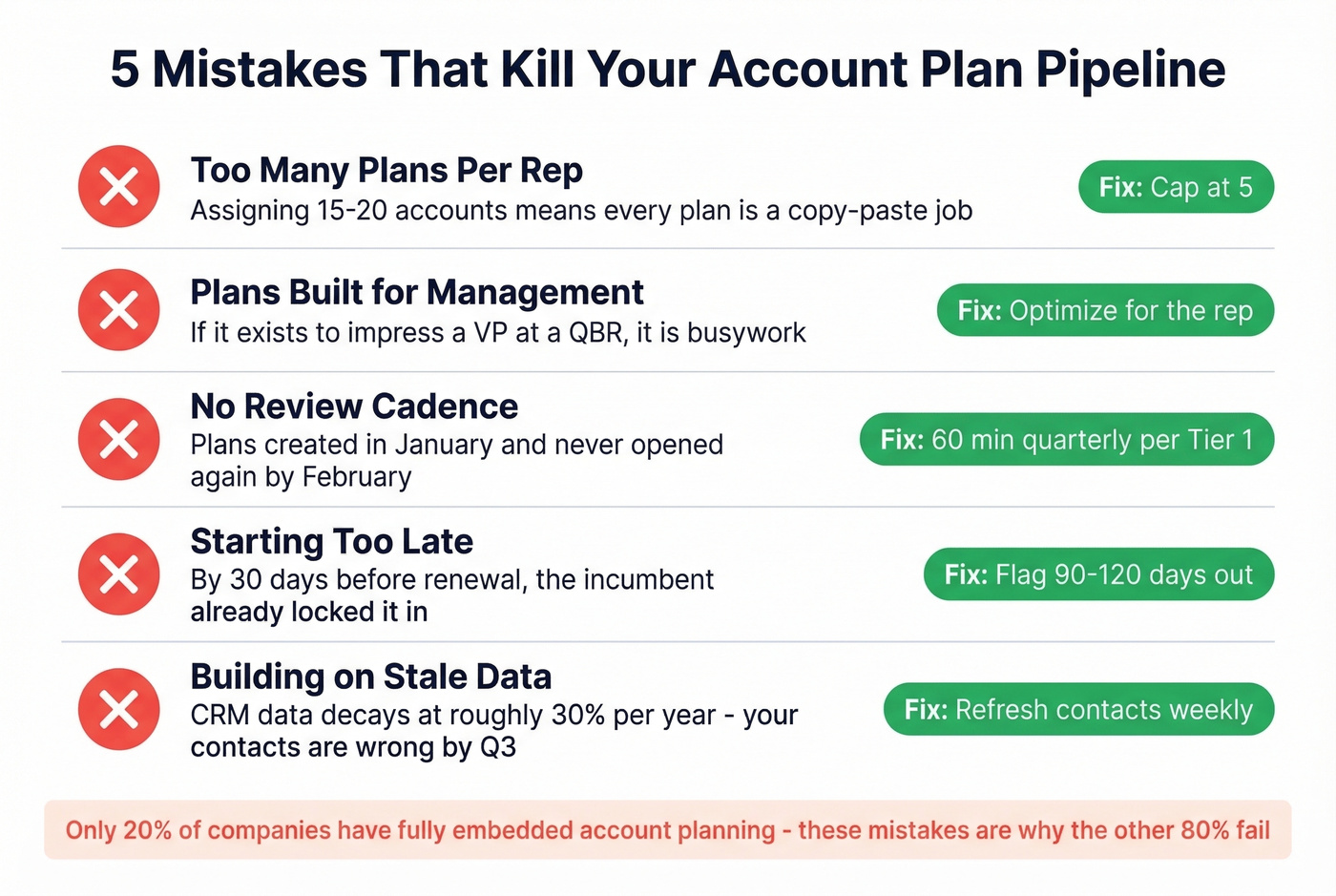
2. Plans designed for management, not the rep. If the plan exists to impress a VP in a QBR, it's busywork. The plan should help the rep decide what to do next Tuesday. That's it.
3. No review cadence. Block 60 minutes quarterly for each Tier 1 account. Structure it: 15 minutes on stakeholder changes, 15 on competitive movement, 15 on action item status, 15 on next-quarter priorities.
4. Starting too late. Flag accounts 90-120 days before renewal, not 30. By the time you're 30 days out, the incumbent has already locked in their renewal conversation.
5. Building on stale data. CRM data decays at roughly 30% per year. By Q3, your buying committee map is missing people who've left and ignoring people who've arrived. This is the mistake that compounds - and it's the one most teams ignore because fixing it feels like plumbing, not strategy.
The Data Problem Nobody Talks About
You can't multi-thread into an account if you're working off a two-year-old org chart with dead email addresses. With 11 stakeholders per average B2B deal, that's 11 contacts that need to be accurate - not "probably still there."
This is where most account plans quietly fail. The strategy is sound, the template is clean, and the rep can't reach three of the five people on the buying committee because the data is wrong.

You just scored and tiered your accounts. Now you need verified emails and direct dials for every champion, economic buyer, and blocker on the committee. Prospeo's 30+ search filters - including buyer intent, technographics, and headcount growth - map directly to the ICP scoring model above. At $0.01 per email, building contact maps for your Tier 1 accounts costs less than a team lunch.
Turn your account plan from a wish list into a contact list in minutes.
Tools Worth Considering
No single tool does everything. Here's what's worth evaluating based on what you actually need:
| Tool | Best For | Starting Price | Notes |
|---|---|---|---|
| Salesforce Sales Cloud | CRM-native planning | $25-$500/user/mo | Gartner 4.4 rating; strongest if you're already on Salesforce |
| DemandFarm | Visual org charts | ~$40-$100/user/mo | Salesforce-native; strong for mapping |
| Pipedrive | Lightweight CRM planning | From $14/mo | Good for SMBs; limited at scale |
| Apollo | Prospecting + account intel | Free tier; $49/user/mo | Broad database; lower email accuracy than Prospeo |
| Gong | Revenue intelligence layer | ~$100-$200/user/mo | Call analytics that feed planning, not planning itself |
For most teams building account plans, start with Prospeo for contact data and your existing CRM for the plan itself. Skip this if you're running deals under $30K ACV - the ROI on dedicated tooling won't be there. Add DemandFarm only if you need visual org charts at enterprise scale.
A one-page plan in Google Docs with accurate contact data beats a $50K platform nobody logs into.
AI-Powered Planning in 2026
AI isn't replacing the strategic thinking in account planning - it's replacing the 40 hours of research per account that teams burn on plan maintenance. Benchmarks show GenAI can lift sales productivity 3-5% and that personalization drives 5-8% revenue lifts.
The real shift is signal unification. Intent data, propensity scoring, and next-best-action recommendations are converging into a single layer that tells reps which accounts are heating up and which stakeholders to engage. Instead of quarterly plan reviews catching stale data, AI flags changes in real time - a champion leaves, a competitor enters, a budget cycle shifts.
The retention angle matters too. HBR found that a 5% increase in retention can raise profits 25-95%, which makes the case for strategic account planning as a retention tool, not just a new-business play. The teams winning in 2026 aren't just planning accounts - they're monitoring them continuously.
Here's our hot take: if your average deal hovers around $8K-$10K, you probably don't need account planning at all. Run a good outbound sequence, nail your follow-up cadence, and save the strategic planning for deals where the payoff justifies the investment. Account planning in sales is powerful - but only when the math supports the time spent.
FAQ
What's the difference between account planning and key account management?
Account planning is the strategic document and process - the artifact. Key account management is the ongoing relationship discipline that surrounds it. Planning is one tool within KAM, not a synonym for it.
How often should you update an account plan?
Quarterly minimum for Tier 1 accounts, semi-annually for Tier 2. If something material changes - a champion leaves, a competitor enters, a reorg happens - update immediately regardless of cadence.
How many account plans should one AE manage?
No more than five full plans. This is a hard ceiling, not a suggestion. Reps who constrain the number and invest deeply outperform those spreading effort across a dozen targets every time.
What's the best qualification framework for account planning?
MEDDIC for most B2B sales teams selling deals with multiple stakeholders and 60+ day cycles. Upgrade to MEDDPICC for procurement-heavy enterprises where legal review and competitive displacement are standard.
How do you keep stakeholder contact data accurate?
Use a data platform with automated refresh cycles rather than manual research. Prospeo refreshes every 7 days at 98% email accuracy, so your buying committee map stays current instead of decaying quarter over quarter.