Adapt.io vs EmailVerify.io: Different Tools, Different Jobs
Comparing Adapt.io to EmailVerify.io is like comparing a fishing rod to a kitchen scale. Adapt.io is a B2B contact database - you use it to find prospects. EmailVerify.io is an email verification service - you use it to clean a list you already have. They don't compete the way most people assume.
We've tested both, and the real question isn't which is better. It's which one you actually need right now.
30-Second Verdict
Pick Adapt.io if you need to build prospect lists from scratch. Pick EmailVerify.io if you've already got a list and need to scrub it before sending.
Skip this combo entirely if you need to find and verify contacts in one workflow. You'll end up stitching tools together and babysitting CSV exports in between.
Side-by-Side Comparison
| Dimension | Adapt.io | EmailVerify.io |
|---|---|---|
| Category | B2B prospecting | Email verification |
| Core function | Find contacts | Verify existing lists |
| Database | 150M+ contacts, 30M companies | N/A - verify only |
| Starting price | Free (25 credits/mo) | $20/mo (30K credits) |
| Cost per unit | ~$0.10/email credit | ~$0.00067/verify |
| G2 rating | 4.6/5 (2,789 reviews) | 4.5/5 (20 reviews) |
| Integrations | Salesforce, Outlook, Slack | Zapier, Integrately, API |
| Best for | Building prospect lists | Cleaning existing lists |
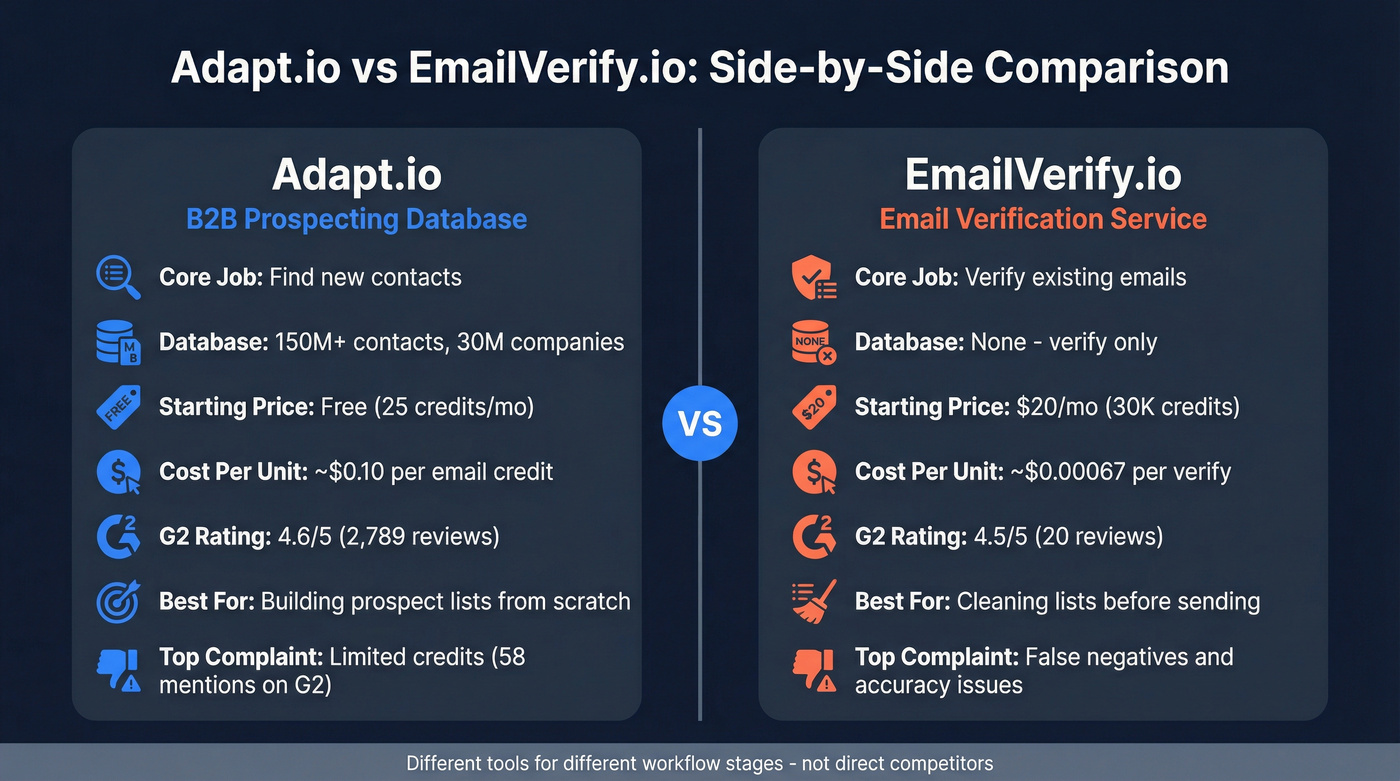
These tools serve different workflow stages, so this table compares them on their own terms rather than head-to-head.
What Adapt.io Does Well

Use this if you're an SMB sales team that needs a straightforward way to find B2B contacts by role, industry, and company size. Adapt's filtering is genuinely good - job title, department, employee count, revenue, location all work as expected. The free plan gives you 25 credits/month to test, and paid tiers run $49/mo (500 credits) and $99/mo (1,000 credits).
User reviews consistently praise ease of use (71 mentions) and lead generation workflow (34 mentions). Implementation takes about 4 months according to G2 review data, so plan accordingly if you're rolling this out to a team.
Skip this if you burn through credits fast. The #1 complaint - by a wide margin - is limited credits. "Limited Credits" and "Credit Limitations" together account for 58 tagged complaints on G2. There are also 14 mentions of incorrect email addresses, which means you'll still want a verification step downstream. That's an important detail: a prospecting tool that gives you unverified emails is only half the job done.

Adapt.io users report 14 G2 complaints about incorrect emails - which means you still need a verifier downstream. Prospeo finds and verifies in one step with 98% email accuracy, 5-step verification, and catch-all handling built in. No CSV handoffs. No second subscription.
Stop paying twice to do one job.
What EmailVerify.io Does Well
Use this if you've got a CSV of emails from a trade show, a scraped list, or an export from another tool and you need to clean it cheaply. At $20/mo for 30,000 credits, EmailVerify.io is one of the more affordable verifiers out there. The UI is clean, setup is fast, and the API works for real-time validation.
Skip this if accuracy is non-negotiable. The review sample is thin - 20 on G2 and just 4 on AppSumo, where it sits at 3.5/5. Users flag false negatives (valid emails marked invalid). Catch-all detection gets criticized too, including Yahoo/AOL domains being mislabeled. There's no spamtrap detection, a 5,000-email file limit on bulk uploads, and a daily credit cap that doesn't always match the advertised monthly allowance - one user found their 60K/month plan capped at 2K/day.
For a verification tool, accuracy is the product. These gaps matter.
Let's be honest: the consensus on Reddit threads about verification pricing is that $25-$75 to clean a 10K list is already overpriced. EmailVerify.io's rates are lower, sure. But if the results aren't accurate, cheap verification is just expensive bounces with extra steps.
What to Use If You Need Both
Here's the thing: most outbound teams need to find contacts and verify them. Running Adapt for prospecting plus EmailVerify.io for cleaning means two subscriptions, two workflows, and a CSV sitting in between. In our experience, that handoff is exactly where data quality breaks down - someone forgets to re-verify after deduplication, or the export format doesn't match, and suddenly you're sending to a stale list.
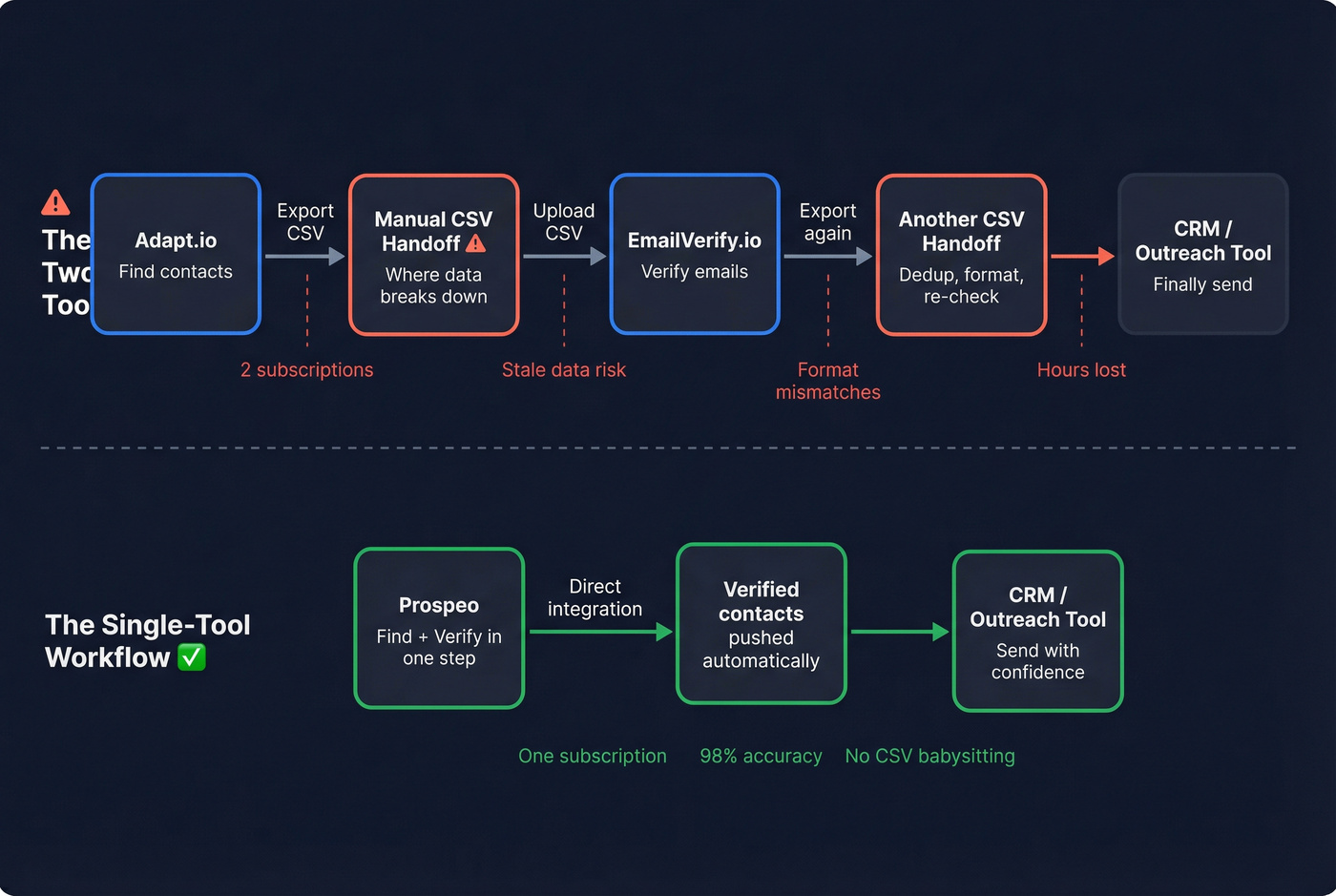
Pricing starts free (75 emails/month), paid plans run about $0.01/email with no annual contracts, and native integrations push verified contacts straight into Salesforce, HubSpot, Instantly, or Lemlist. GDPR compliant with opt-out enforcement.
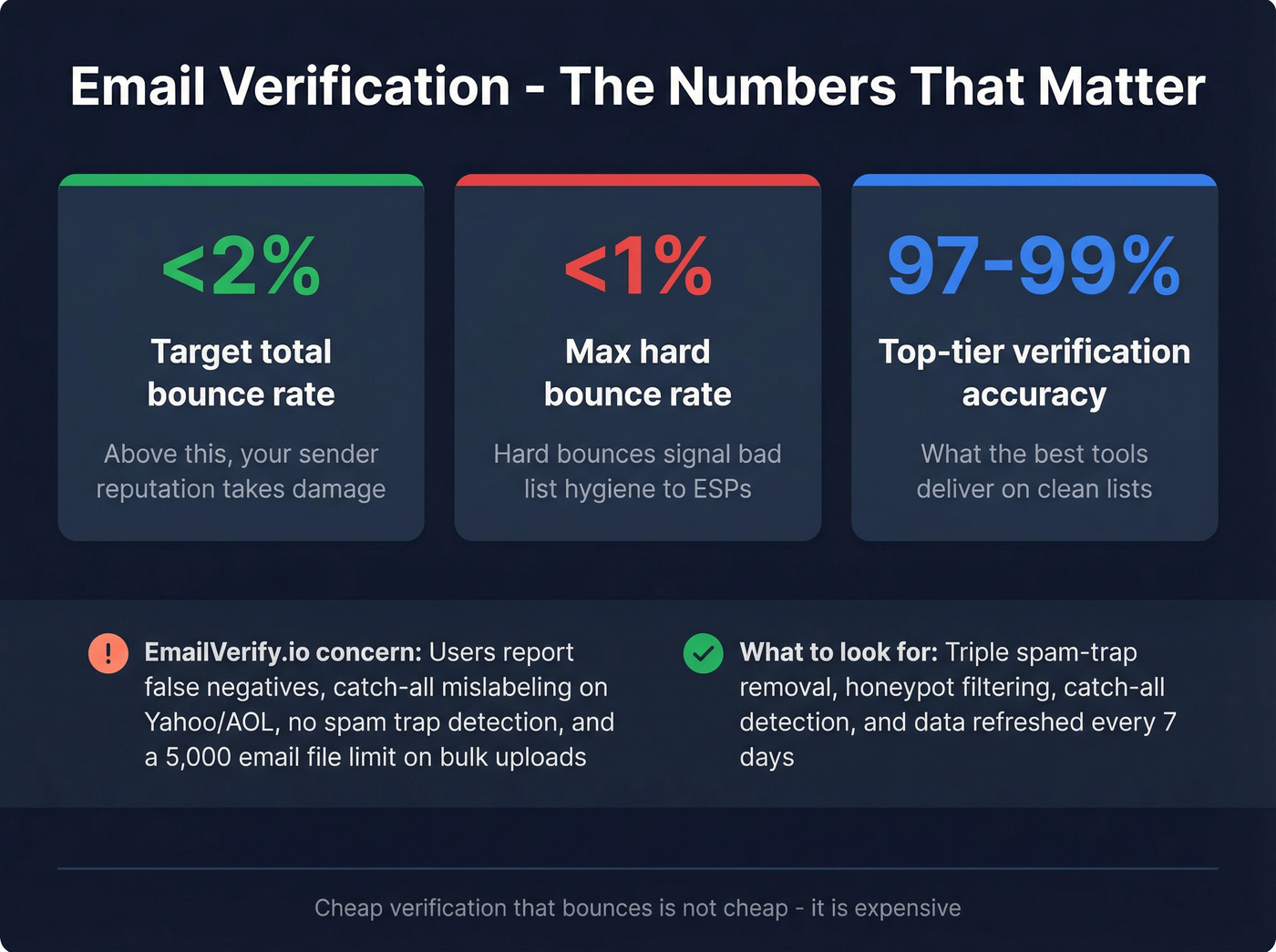
EmailVerify.io users flag false negatives, missed spam traps, and daily credit caps that don't match the plan. Prospeo's proprietary verification runs triple spam-trap removal, honeypot filtering, and catch-all detection - refreshed every 7 days, not 6 weeks. At ~$0.01/email, it costs less than a bad bounce.
Cheap verification that bounces isn't cheap - it's expensive.
The Bottom Line
Pick Adapt.io if you only need to build prospect lists and you'll verify elsewhere. Pick EmailVerify.io if you've already got lists and just need a cheap cleaning pass - but audit its accuracy on a small batch first before trusting it with your sender reputation.
If you need both - and most outbound teams do - stop stitching tools together. A single platform that finds and verifies in one step saves more than money. It saves the hours lost to broken workflows and the domain reputation damage that comes from sending to bad data.
FAQ
Are Adapt.io and EmailVerify.io competitors?
No. Adapt.io is a B2B contact database for finding leads. EmailVerify.io is a verification service for cleaning existing lists. They serve different stages of the outbound workflow - prospecting vs. list hygiene.
Can I use them together?
Yes - export contacts from Adapt, then verify through EmailVerify.io. But running two tools adds cost and friction. Prospeo handles both prospecting and verification in one platform, starting free at 75 emails/month.
What's a good bounce rate after verification?
Keep total bounces below 2% and hard bounces under 1%. Top-tier verification tools deliver 97-99% accuracy on clean lists. If you're bouncing above 2%, your verification tool isn't doing its job.