

Adapt.io vs Webbula: Different Tools, Different Jobs
Adapt.io vs Webbula is a misleading comparison. One finds contacts. The other cleans them. If you're weighing these two against each other, you're probably asking the wrong question - they don't compete.
30-Second Verdict
Adapt.io is a B2B prospecting platform. You use it to find new leads by name, title, company, or industry. Webbula is a data hygiene service. You use it to scrub, verify, and append data to contacts you already have.
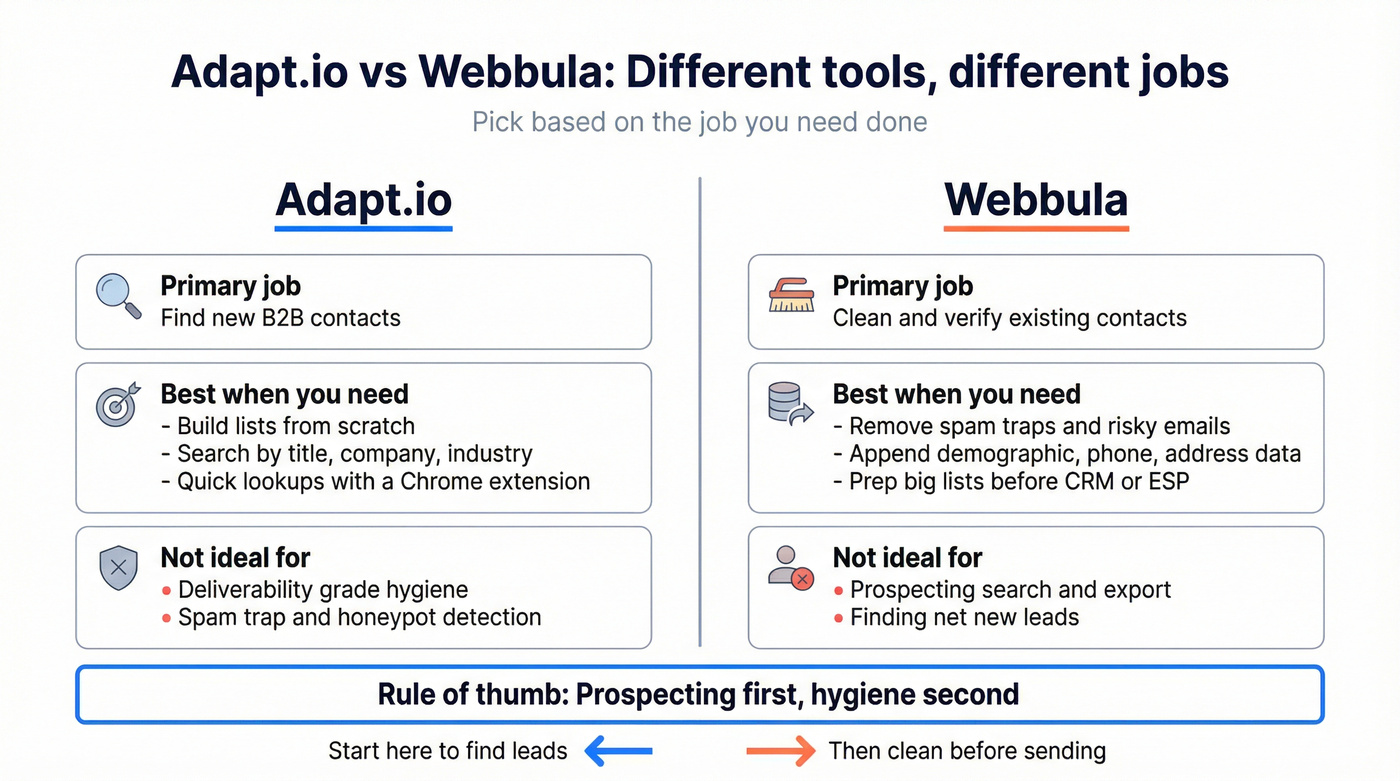
Need to build a prospect list? Adapt.io. Need to clean 50,000 trade show leads before loading them into your ESP? Webbula.
Side-by-Side Comparison
| Adapt.io | Webbula | Prospeo | |
|---|---|---|---|
| Category | B2B sales intelligence | Data hygiene & verification | B2B data + built-in verification |
| Database | 250M+ contacts | 390M+ individuals | 300M+ profiles |
| Pricing | Free / $49 / $99 / Custom | Custom only (100 free credits) | ~$0.01/email, free tier |
| Integrations | 6 native | API / FTP | Salesforce, HubSpot, Smartlead, Instantly, Lemlist, Clay, Zapier, Make |
| G2 Rating | 4.6/5 (2,789 reviews) | 4.5/5 (4 reviews) | 4.6/5 |
| Best For | Finding new B2B contacts | Cleaning existing lists | Prospecting + verified data |
The review count gap tells you everything about market presence. Adapt.io has nearly 2,800 G2 reviews. Webbula has four. Neither tool shows up in Reddit discussions - Adapt.io's generic name makes it nearly invisible in community threads, and Webbula simply doesn't come up.

Adapt.io finds contacts but doesn't deeply verify them. Webbula verifies but can't find new leads. Prospeo does both - 300M+ profiles with 5-step verification, spam-trap removal, and honeypot filtering built in. 98% email accuracy at ~$0.01/email, refreshed every 7 days.
Stop stitching two tools together when one does both better.
What Is Adapt.io?
Adapt.io is a B2B lead intelligence platform with 250M+ contacts and 50+ enrichment attributes, founded in 2017 and used by 500,000+ customers. The Chrome extension is the standout feature - we've found it's the strongest part of the product. It lets reps pull contact data while browsing company websites, and G2 reviewers agree: ease of use gets 71 mentions, contact quality gets 59.

Pricing is credit-based and transparent: Free (25 credits), Starter ($49/mo, 500 credits), Basic ($99/mo, 1,000 email credits + 100 phone credits + 1,000 enrichment credits), and Custom tiers with API access. Most G2 reviewers are in Asia and North America.
Use Adapt.io if you need to build prospect lists from scratch, want a lightweight Chrome extension for one-off lookups, or your team operates on a sub-$100/mo budget per rep.
Skip Adapt.io if you need deliverability-grade list hygiene - spam traps, honeypots, deep validation. G2 reviewers flag email accuracy issues (14 mentions) and limited credits (34 mentions). The 6-integration ecosystem is also thin compared to tools like Apollo.io.
What Is Webbula?
Webbula isn't a prospecting tool at all. Founded in 2009, it's a data hygiene and data enhancement company with three product lines: emailHygiene (threat detection, email verification, lead validation), Data Enhancement (demographic, phone, and address appends), and Programmatic Data (audience targeting taxonomy).
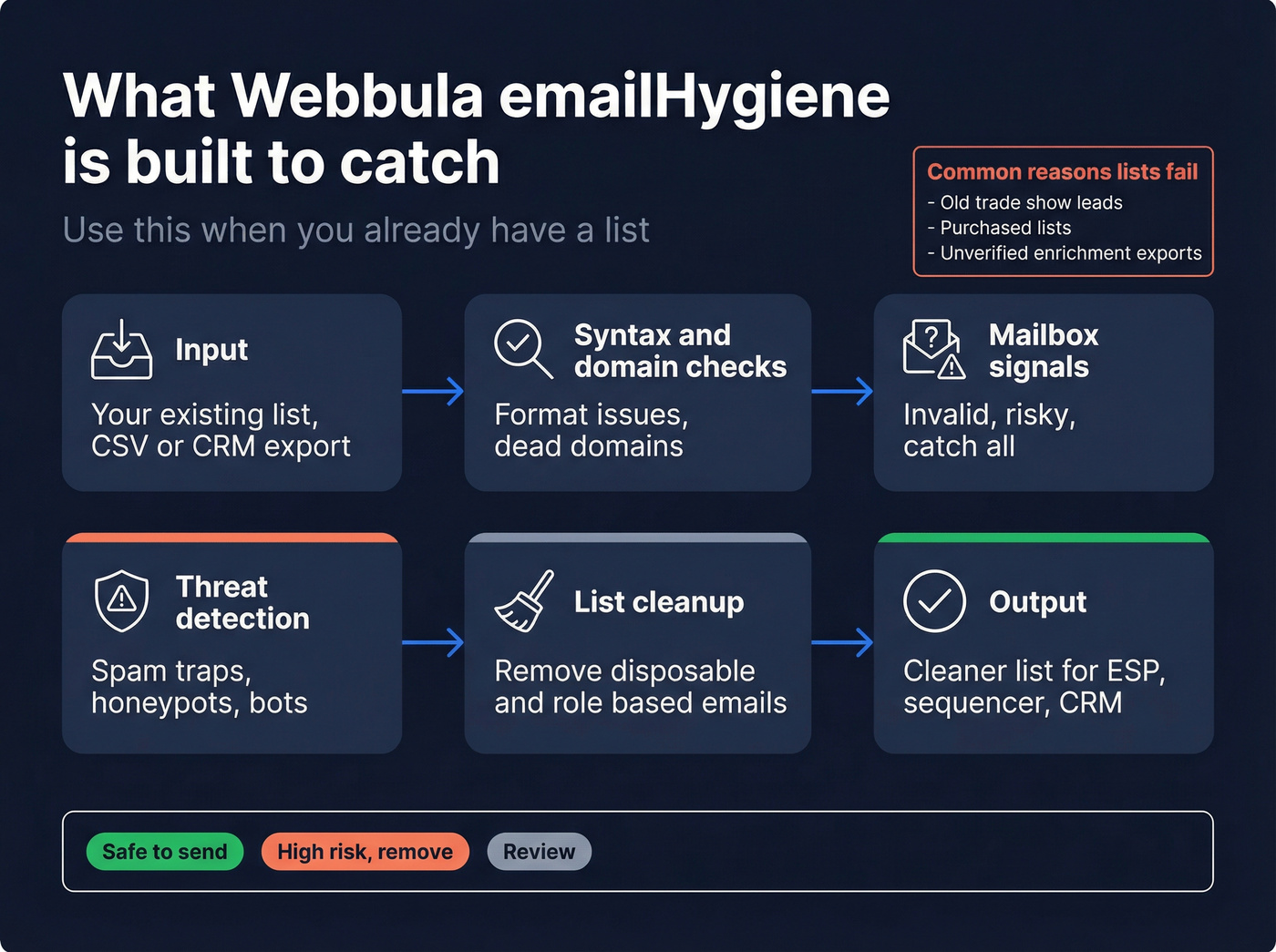
It's SOC 2 certified and accredited by IAB and Neutronian, and Truthset has ranked it a top performer in data accuracy. Its data is 100% self-reported and individually-linked from 100+ trusted sources, updated daily.
Here's the thing: the 390M+ records in Webbula's database are audience and targeting data - syndicated segments for ABM, programmatic advertising, and demographic appends. You can't type in "VP of Marketing at SaaS companies in Texas" and get a list. That's not what Webbula does. Webbula estimates that 3% of customer data becomes obsolete every month, which is exactly the problem their hygiene tools solve.
Where Webbula genuinely excels is spam trap detection. One G2 reviewer called it "head and shoulders better" than seven competing services.
Use Webbula if you have existing contact lists that need deep cleaning - spam traps, honeypots, bots, disposable domains - or you need demographic appends for audience targeting.
Skip Webbula if you need to find new contacts, want self-serve pricing (it's custom-only, with typical contracts running $500-$5,000+/month depending on volume), or you want a tool with meaningful community validation.
Which Tool Fits Your Workflow?
Most teams need both jobs done - finding contacts and making sure those contacts are clean. Let's sort this out.
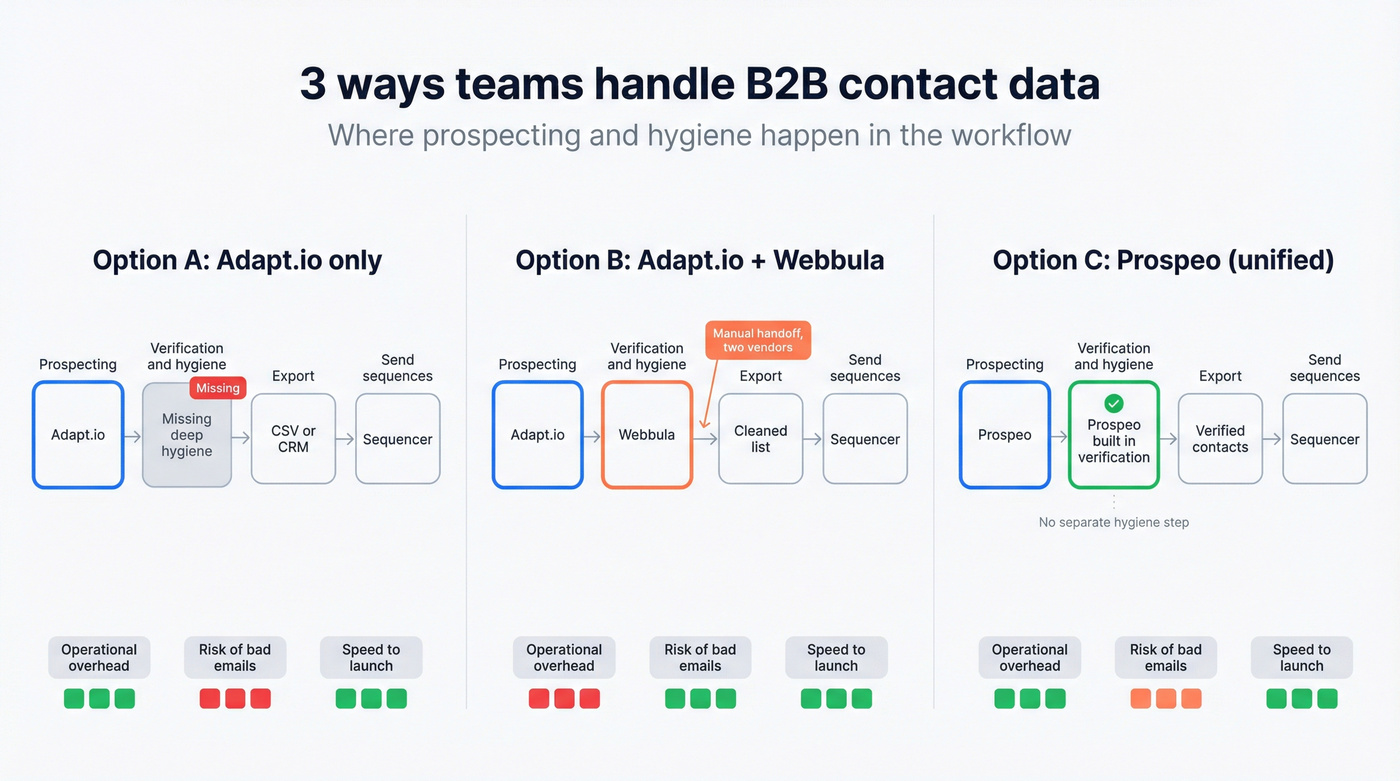
Building prospect lists from scratch? Adapt.io. It's purpose-built for search-and-export prospecting. Pair it with a verification tool like ZeroBounce before loading contacts into your sequencer.
Cleaning a massive existing database? Webbula. If you've got 50,000 trade show contacts and half the emails bounce, Webbula's spam trap detection and data appends are the right tool.
Need both without stitching tools together? That's where a unified platform makes more sense. Prospeo combines prospecting with built-in hygiene before you export a single contact - 30+ search filters handle prospecting, while catch-all handling, spam-trap removal, and honeypot filtering handle hygiene. Data refreshes every 7 days. Self-serve pricing starts free with 75 emails/month, and paid plans run about $0.01/email with no contracts.
We've seen this play out with our own outbound campaigns: managing separate prospecting and hygiene vendors creates a manual handoff that eats hours every week and introduces errors at the seams. One of our agency clients, Stack Optimize, built from $0 to $1M ARR while maintaining 94%+ deliverability and sub-3% bounce rates - largely because they didn't have to juggle multiple data tools.
If your average deal size is under $15k and your team is under 10 reps, you almost certainly don't need separate prospecting and hygiene vendors. A single platform that does both will save you more in operational overhead than any marginal data quality difference between specialized tools.
Stack Optimize built a $1M agency on Prospeo data alone - 94%+ deliverability, sub-3% bounce rates, zero domain flags. No separate hygiene vendor. No manual handoffs. Just verified contacts ready to sequence from a single platform.
Get prospecting and verification in one workflow - free tier, no contracts.
FAQ
Is Webbula an alternative to Adapt.io?
No. Adapt.io is a B2B prospecting tool for finding new contacts by role, company, and industry. Webbula is a data hygiene platform for cleaning and verifying contacts you already have. They serve different jobs in your sales and marketing stack and aren't interchangeable.
Does Adapt.io verify emails?
Adapt.io focuses on contact discovery and enrichment, not deliverability-grade list hygiene. If you need spam trap detection and deeper validation, pair your list with a dedicated verification service - or use a platform that runs multi-step verification (including catch-all and honeypot filtering) before you ever export a record.
Why isn't Webbula's pricing public?
Webbula targets agencies and enterprise teams with custom contracts based on volume, attributes, and use case. The only public offer is 100 free email hygiene credits. Expect a sales call for paid pricing - typical contracts run $500-$5,000+/month depending on scale.
Can I use Adapt.io and Webbula together?
Yes, and that's actually the intended workflow if you choose both. Use Adapt.io to build your prospect list, then run it through Webbula's emailHygiene to strip out spam traps and invalid addresses before importing into your CRM or sequencer. The downside is managing two vendors, two billing cycles, and a manual handoff between them.