

Agentic AI for Sales: What's Real, What's Hype, and How to Deploy It
It's Thursday afternoon. Your CEO just forwarded a Gartner press release and wants an agentic AI for sales strategy by Friday. You've sat through three vendor demos this quarter where "agentic AI" turned out to be a chatbot with a new label. Now you need to figure out what's actually worth buying.
On r/AI_Agents, practitioners describe the market as "a complete mess - flooded with hype and bits of real case studies." They're right. 40% of enterprise apps will feature task-specific AI agents by end of 2026, up from less than 5% in 2025. Gartner projects agentic AI could drive a $450 billion revenue opportunity by 2035. The market is moving fast. But the gap between what vendors promise and what actually works in production is enormous - and closing that gap starts with knowing what "agentic" actually means, what it costs, and where it breaks.
Before You Read Another Word
- Most "agentic AI" tools in 2026 are rebranded automation. Use the five-trait checklist below to spot real ones.
- No agent outperforms bad data. Verify your contacts before deploying anything - an agent sending emails to dead addresses automates embarrassment.
- Start with one workflow (lead qualification), one governance framework, and a 90-day pilot. Not a $50K platform. Jump to the rollout framework if you need a deployment plan now.
What Is Agentic AI in Sales?
Salesforce defines agentic AI around three pillars: autonomy, adaptability, and goal orientation. That sounds abstract, so here's a concrete comparison.
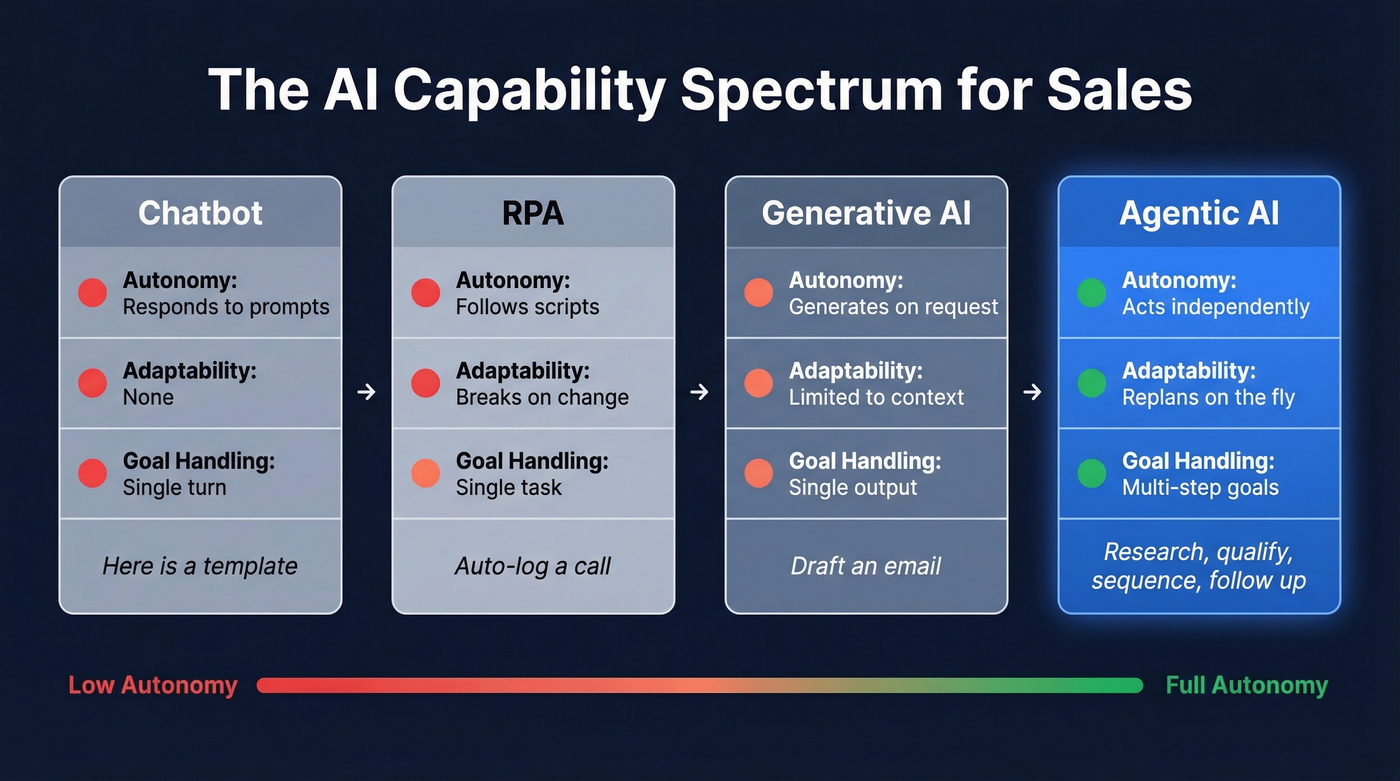
| Capability | Chatbot | RPA | Generative AI | Agentic AI |
|---|---|---|---|---|
| Autonomy | Responds to prompts | Follows scripts | Generates on request | Acts independently |
| Adaptability | None | Breaks on change | Limited to context | Replans on the fly |
| Goal handling | Single turn | Single task | Single output | Multi-step goals |
| Sales example | "Here's a template" | Auto-log a call | Draft an email | Research, qualify, sequence, follow up |
RPA breaks when the process changes. A chatbot waits for you to ask. Generative AI produces content but doesn't act on it. An agentic system takes a goal - "book a meeting with the VP of Engineering at Acme" - and orchestrates multiple steps to get there, adapting when something fails.
Gartner has already flagged "agentwashing" as a growing problem. Vendors slap "agentic" on anything with an LLM behind it. If a tool can't autonomously replan when a step fails, it's automation with better marketing copy.
Sales Problems AI Agents Actually Solve
The cold outreach baseline is brutal. Average response rates sit at 5.1%, with most campaigns landing between 1% and 5%. Nearly 20% of cold emails get flagged as spam. Advanced personalization can double response rates, but doing that manually doesn't scale.

Consider the math at a real company: Snyk had 50 AEs each spending 4-6 hours per week on prospecting - that's 200-300 hours of AE time burned weekly on research, list building, and manual outreach. IBM frames the distinction well: assistants wait for you to tell them what to do; agents understand your goals and orchestrate your tools. The promise is turning those 300 hours into pipeline instead of busywork.
How Agentic Sales Workflows Work
IBM's Sun Corp vignette is the clearest illustration of multi-agent orchestration. A sales rep requests "Generate enablement content for Sun Corp on Product X." Behind the scenes, one agent pulls CRM data - customer journey, product adoption history. A second agent assembles relevant case studies, usage patterns, and onboarding milestones. A third drafts the enablement materials and an email sequence calibrated to the prospect's stage and communication style.
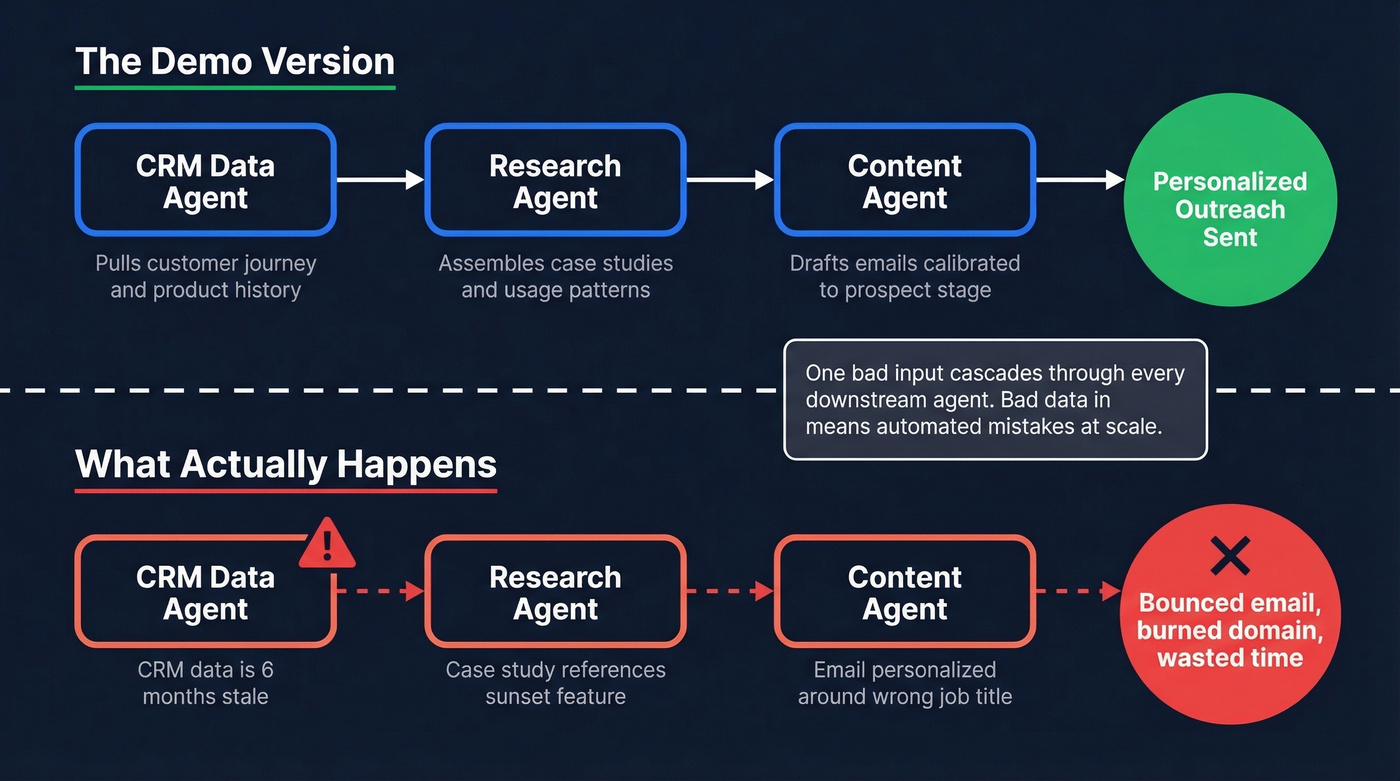
That's the demo. Here's what IBM omits: what happens when the CRM data is six months stale, the emails bounce because the prospect changed jobs, or the case study references a product feature that was sunset in Q1? Every agent in that chain is only as good as the data feeding it.
Multi-agent orchestration amplifies data quality problems - it doesn't solve them. One bad input cascades through every downstream agent. An enrichment agent pulls a stale title, a personalization agent writes copy around it, and a sequencing agent sends it to someone who left the company two months ago. You haven't saved time. You've automated a mistake at scale.

Agentic AI amplifies whatever you feed it - including bad data. Prospeo's 7-day refresh cycle and 98% email accuracy ensure your agents aren't automating bounces and burning your domain. 15,000+ companies already trust this data layer.
Fix the data before you deploy the agent.
Data Quality: The Prerequisite Nobody Wants to Talk About
AI agents don't just fail on bad data - they automate reputation damage. An agent that sends 500 personalized emails to invalid addresses tanks your domain reputation and burns sender credibility that takes months to rebuild.
This is where the data layer matters more than the agent layer. A common benchmark for data updates in this category is about six weeks. Prospeo runs a 7-day refresh cycle, which means the contact data feeding your agents is current, not stale. With 98% email accuracy across 143M+ verified emails and 125M+ verified mobile numbers, it's the verification layer that keeps agentic workflows from becoming expensive liabilities.
Snyk's results tell the story: bounce rates dropped from 35-40% to under 5%, and AE-sourced pipeline jumped 180% once the data foundation was solid. We've seen this pattern repeatedly - teams invest in the flashy agent platform first, then scramble to fix data quality when results disappoint.
Snyk cut bounce rates from 35-40% to under 5% and grew AE-sourced pipeline 180% - not by buying a fancier agent, but by fixing the data underneath. Prospeo delivers 143M+ verified emails at $0.01 each with no contract required.
Your agents deserve data that actually connects to real buyers.
Spotting Real vs. Fake Agents
Here's a five-trait test adapted from monday.com's framework that cuts through the noise:
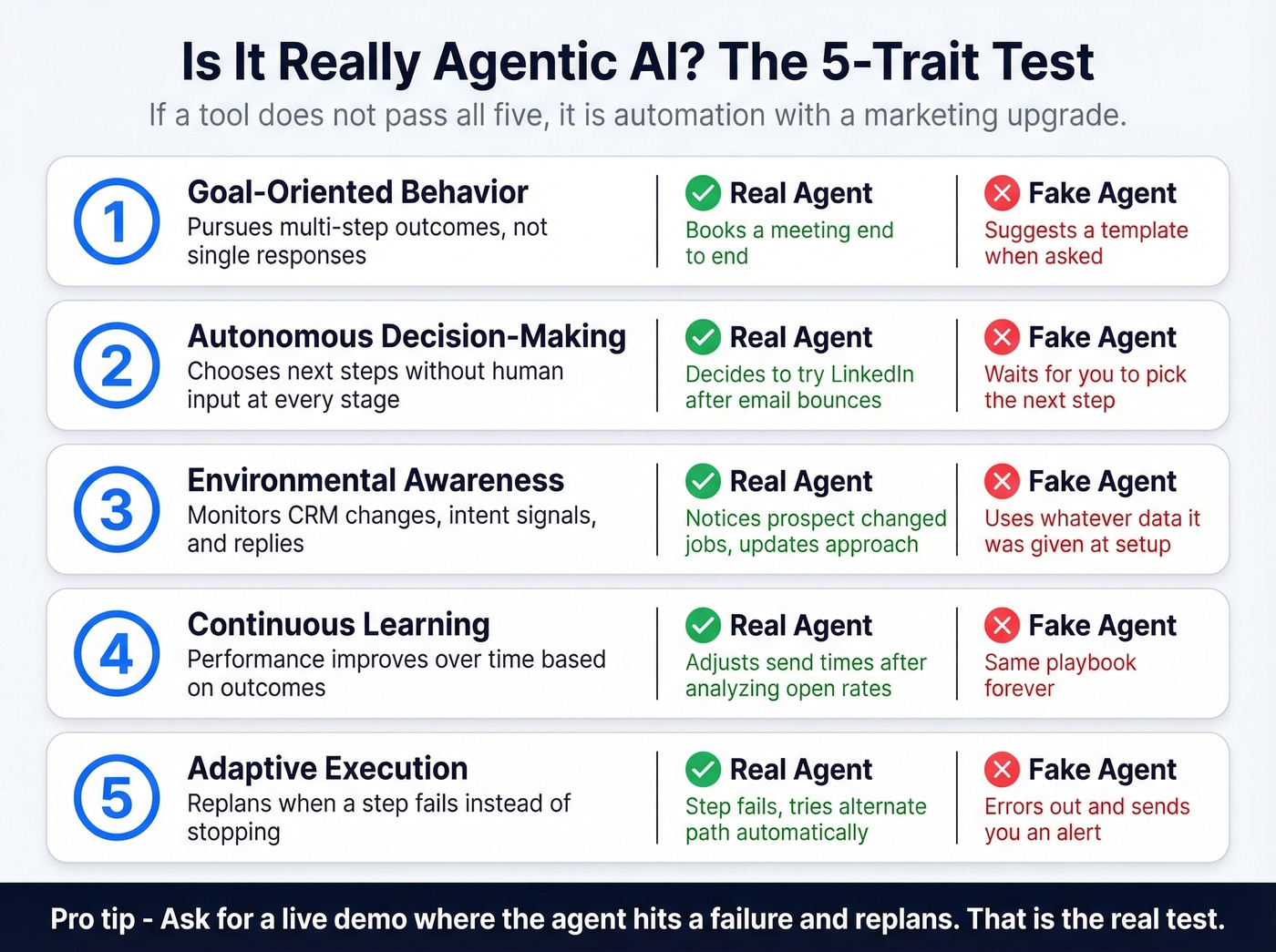
- Goal-oriented behavior - can it pursue a multi-step outcome, not just respond to a prompt?
- Autonomous decision-making - does it choose next steps without human input at every stage?
- Environmental awareness - does it monitor signals (CRM changes, intent data, email replies) and react?
- Continuous learning - does performance improve over time based on outcomes?
- Adaptive execution - when a step fails, does it replan or just stop?
If a tool doesn't exhibit all five, it's automation with a marketing upgrade. On Reddit, practitioners note that clients compare vendor demos to YouTube tutorials - the "agentic" label is how vendors justify premium pricing on what's becoming commodity workflow wiring. So demand the receipts: ask for a live demo where the agent hits a failure and replans. That's the real test.
Amplemarket's evaluation framework adds practical categories worth testing: signal detection, prospect research, sequence generation, multichannel execution, and deliverability management. A tool that handles three of those five is useful. A tool that handles all five and passes the agentic checklist above is worth paying for.
What AI Sales Agents Cost
Pricing ranges from free to eye-watering, and the models are all over the map.
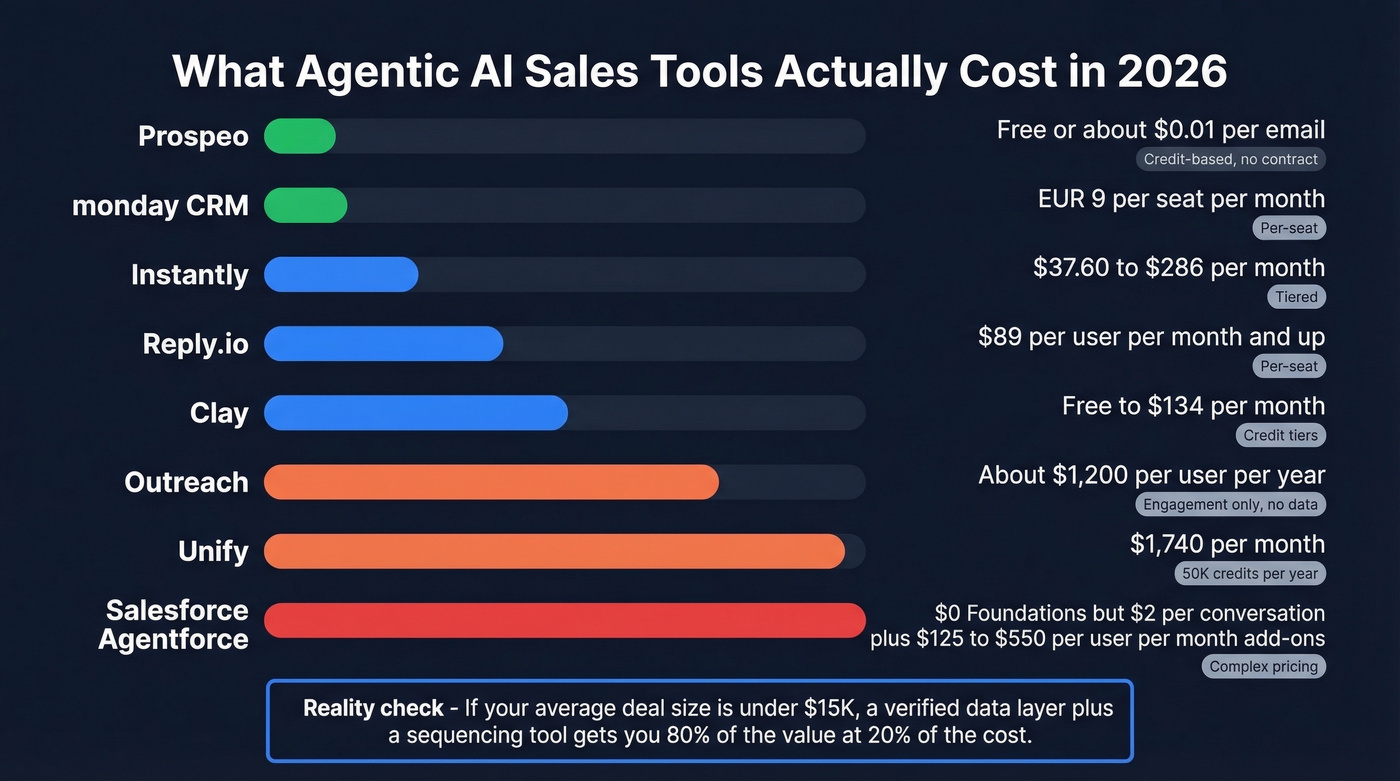
| Tool | Starting Price | Model | What's Included |
|---|---|---|---|
| Salesforce Agentforce | $0 Foundations; add-ons $125-$550/user/mo; plus usage | Per-conversation + credits + seat | CRM-native agents, Flex Credits, add-ons |
| Clay | Free / $134/mo | Credit tiers | Enrichment, waterfall search, workflows |
| Prospeo | Free / ~$0.01/email | Credit-based | Verified emails, mobiles, 7-day refresh |
| monday CRM | EUR 9/seat/mo | Per-seat | CRM + growing AI features |
| Instantly | $37.60-$286/mo | Tiered | Email outreach, warmup, leads |
| Reply.io | $89/user/mo+ | Per-seat | Multichannel sequences, AI SDR |
| Outreach | ~$1,200/user/yr | Per-seat | Engagement only - no data |
| Unify | $1,740/mo | Credits + seat | 50K credits/yr, AI outreach, intent |
Let's be honest: if your average deal size is under $15K, you probably don't need Salesforce Agentforce or Unify-level spend. A verified data layer plus a sequencing tool gets you 80% of the value at 20% of the cost. For most teams deploying AI agents in their sales process, that combination is the pragmatic starting point.
A few things jump out. Salesforce's pricing is deceptively complex: the $0 Foundations tier gets you in the door, but $2 per AI conversation adds up fast for high-volume teams. Flex Credits run $500 per 100K credits, and the Agentforce User License adds $5/user/month before you even hit the $125-$550/user tier add-ons. A 50-rep org running 100 agent conversations per rep per month is looking at $10K/month just in conversation fees.
Clay's credit-based model confuses buyers. G2 reviews consistently flag the pricing as opaque, and data quality varies depending on which enrichment providers Clay pulls from. Outreach at $1,200/user/year covers engagement only - no data, no deliverability. You're paying for a sequencer, not a platform.
Unify packs intent signals and AI outreach into one platform, but G2 reviewers flag occasional glitches, support response times, and outdated profiles as recurring pain points. At $1,740/month, those are expensive rough edges.
If you're comparing options, start with the best AI sales tools and then work backward into what you actually need: data, enrichment, sequencing, or governance.
Governance: The Make-or-Break Factor
The #1 objection from enterprise buyers isn't "does it work?" It's "where does our data go and who controls it?" Every enterprise buyer in 2026 has been burned by a vendor that promised production-ready and delivered a demo. They're not buying capability anymore - they're buying evidence.
Teams that skip governance don't just risk inefficiency. They risk brand damage at machine speed.
Three Pillars of Agent Governance
Dextral Labs' framework breaks governance into three layers that make sense for sales teams.
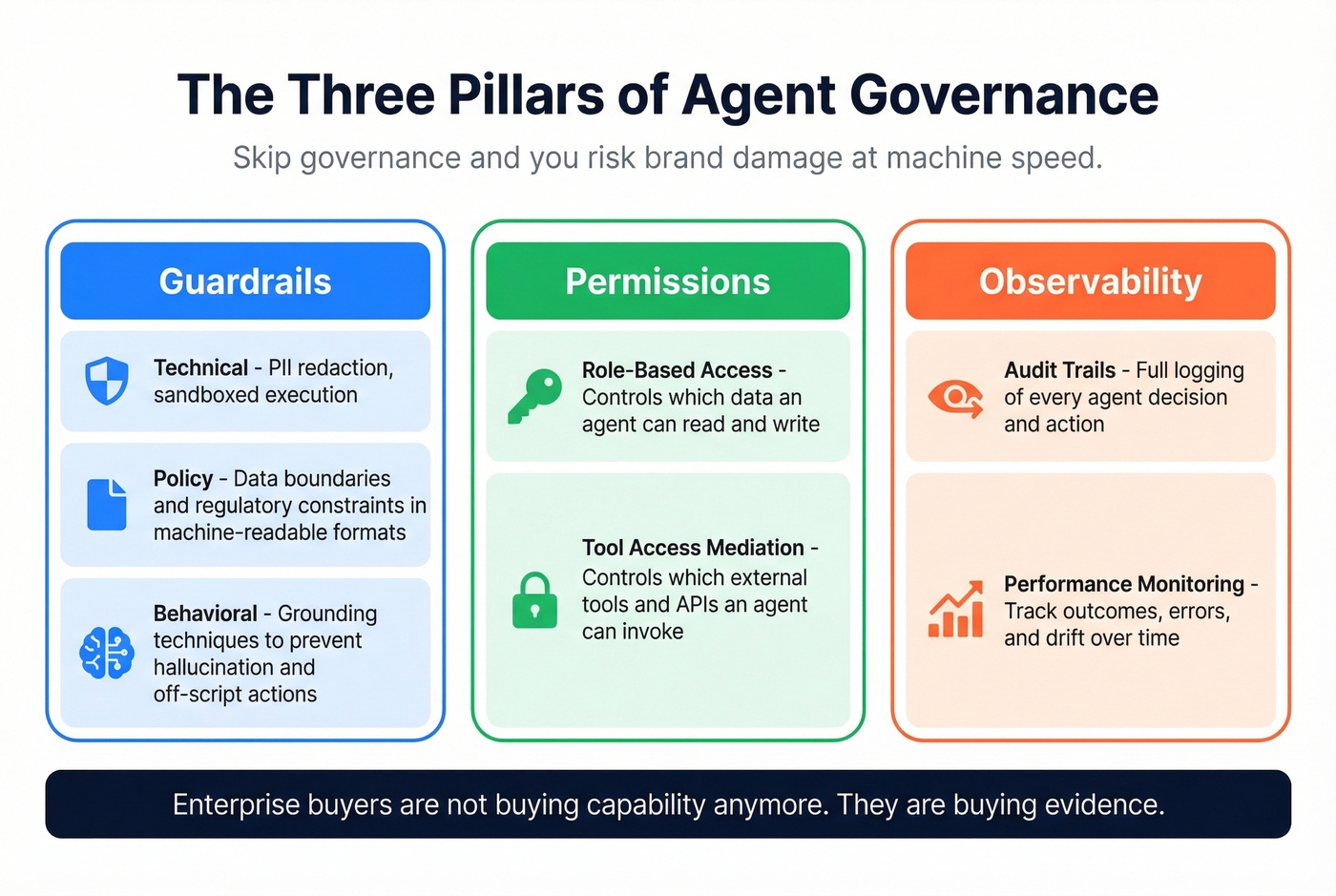
Guardrails operate at three levels. Technical guardrails handle PII redaction and sandboxed execution. Policy guardrails encode data boundaries and regulatory constraints in machine-readable formats. Behavioral guardrails use grounding techniques and instruction-level constraints to keep agents from hallucinating or going off-script.
Permissions control who and what agents can access. Role-based access determines which data an agent can read, while tool access mediation controls which systems it can write to. Your lead-qualification agent shouldn't have write access to your billing system.
Auditability means you can reconstruct every decision an agent made. If a prospect complains about a weird email in six months, you need to trace exactly what data the agent used, what logic it followed, and why it chose that specific message.
Three Questions Before You Deploy
Kore.ai's governance framework distills this into three operational tests:
- Can you prevent violations before they happen - not just detect them after?
- Can you reconstruct why an agent made a specific decision six months later?
- Can you intervene meaningfully when agents operate at machine speed?
If you can't answer yes to all three, you're not ready to deploy.
What Goes Wrong Without Governance
The failure modes aren't theoretical. Taco Bell's voice AI got trolled into processing an 18,000-cup water order - no rate limiting, no human override. A man was hospitalized after following ChatGPT's diet advice that included sodium bromide. The AI Incident Database logged 108 new incidents in just the November 2025 through January 2026 window.
In sales, the failure mode is an agent that sends 500 personalized emails with hallucinated company details - congratulating a prospect on a funding round that never happened, or referencing a product they don't sell. That's not a bug report. That's a brand crisis.
In our experience, the teams that skip the governance audit end up spending 3x more fixing agent mistakes than they saved on automation.
90-Day Rollout Framework
You don't need a $50K platform to start. You need clean data and one well-scoped agent.
Weeks 1-2: Audit
Run a sample of your contact database through an email verifier tool to benchmark your current bounce rate. If it's above 5%, fix the data before you touch an agent. Identify one high-ROI workflow to automate - lead qualification is the safest starting point. Answer the three governance questions above.
Weeks 3-4: Pilot
Deploy one agent on one workflow with human-in-the-loop approval at every step. Set hard guardrails: daily send limits, approval gates for any message over a certain personalization threshold, PII boundaries. Measure baseline metrics - response rate, bounce rate, meetings booked, rep time saved.
Weeks 5-8: Expand
If pilot metrics hold, add a second workflow. Begin reducing human oversight incrementally - move from approving every message to approving exceptions only. Document decision logs for auditability. This is where most teams discover their governance gaps, and where their agentic strategy starts to show measurable ROI or reveal hidden weaknesses.
Weeks 9-12: Measure and Scale
Compare pre/post metrics across every dimension that matters: response rates, pipeline generated, rep hours reclaimed, cost per meeting booked. Build the business case with real numbers, not vendor projections. Then decide: scale the agent to more reps, iterate on the workflow, or kill it and try a different approach.
Real talk: killing a failed pilot is a better outcome than scaling a mediocre one. Skip this if you're the type of leader who can't stomach pulling the plug - agentic AI rewards decisiveness, not sunk-cost thinking.
FAQ
Will agentic AI replace salespeople?
No. Agents handle research, data entry, and initial outreach - the work reps hate. The human stays in the loop for relationship-building, negotiation, and complex deals. Reps who thrive will learn to direct agents, not compete with them.
What does agentic AI for sales actually cost?
Anywhere from free tiers to $550/user/month for Salesforce Agentforce's full edition. Most mid-market teams spend $100-$500/month starting with a single workflow. A verified data layer at ~$0.01/email plus a sequencing tool covers 80% of use cases at a fraction of platform pricing.
How do I spot "agentwashing"?
Apply the five-trait test: goal-oriented behavior, autonomous decision-making, environmental awareness, continuous learning, and adaptive execution. If a vendor's tool fails any of those - especially adaptive replanning on failure - it's standard automation with a premium label.
Where should I start if I've never used AI agents?
Pick one workflow. Lead qualification is the highest-ROI starting point. Audit your contact data first - a bounce rate above 5% means your data needs fixing before any agent touches it. Run a 30-day pilot with human oversight before scaling.
Is my data safe with AI sales agents?
Safety depends entirely on governance. Confirm where your data is stored, who has access, whether you can reconstruct agent decisions, and whether you can intervene in real time. If a vendor can't answer those four questions clearly, walk away.