

The 9 Best AI Lead Generation Tools in 2026
You built a list of 2,000 prospects last quarter, loaded them into your sequencer, and watched 400 emails bounce. Your domain reputation tanked, reply rates cratered, and the VP of Sales started asking why outbound isn't working. The problem wasn't your messaging or your ICP - it was your data.
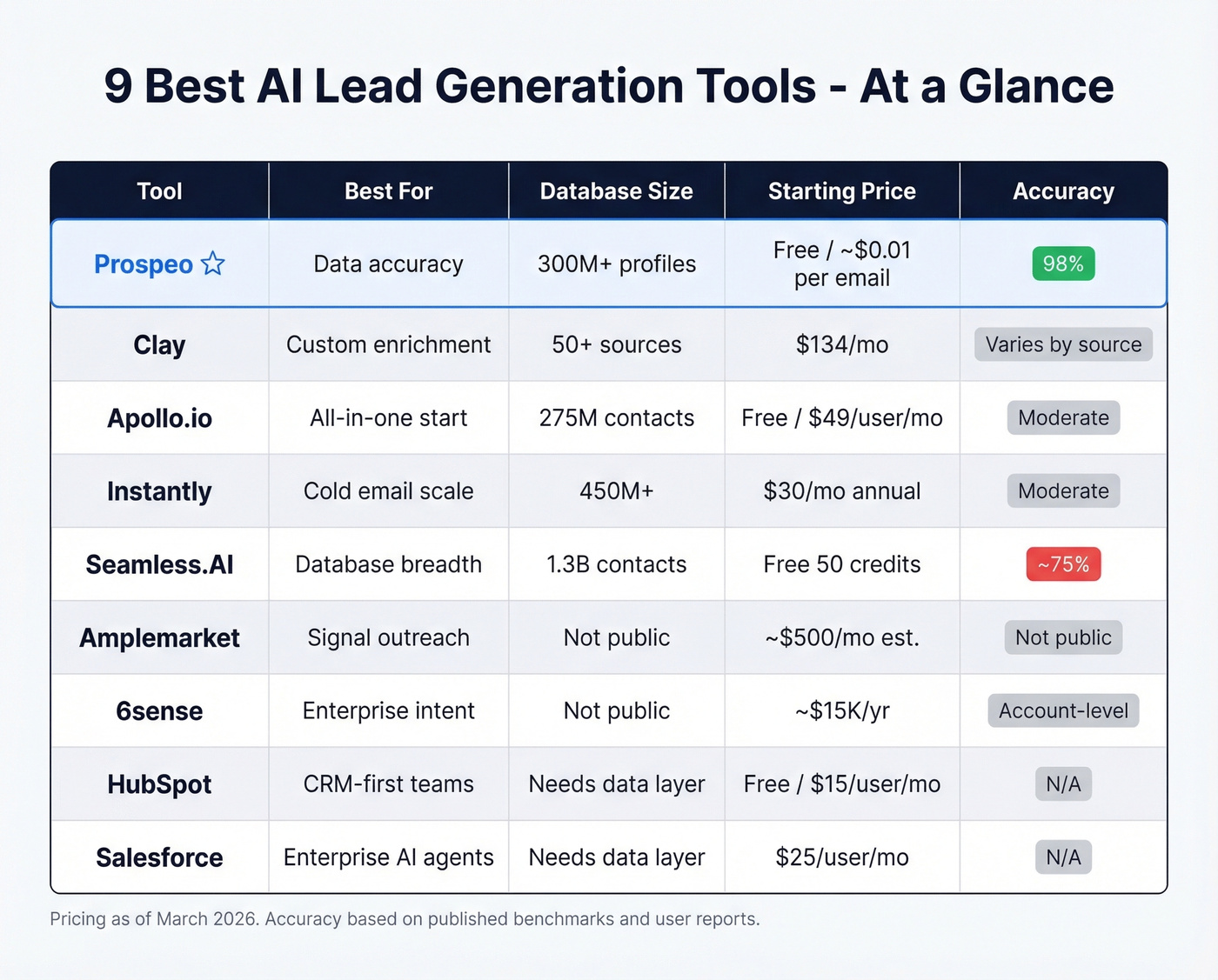
Speed compounds the damage. Harvard Business Review found that leads contacted within one hour are nearly 7x more likely to qualify than those contacted even one additional hour later. Bad data slows everything down, and slow follow-up on bad data is a double kill shot. Here's how to fix that with the right AI lead generation tool for your stack, ranked by what actually matters: data accuracy, workflow fit, and real pricing.
Our Top 3 Picks
Short on time? Start here:
- Prospeo - Best for data accuracy and verification. 98% email accuracy, 300M+ profiles, 7-day data refresh. Starts free (75 emails/month + 100 Chrome extension credits/month), paid plans run ~$0.01/email. If your bounce rate is killing your domain, this is the fix.
- Clay - Best for custom enrichment workflows. Pulls from 50+ data sources and lets you chain enrichment steps like building blocks. Starts at $134/month with 2,000 credits.
- Apollo.io - Best all-in-one starting point. 275M contacts, free plan, paid from $49/user/month. The fastest path from zero to a working prospect list.
How to Evaluate AI Lead Gen Tools
Let's be honest: most "AI lead generation tools" are databases with a ChatGPT wrapper bolted on top. The label "AI" gets slapped on everything from a basic email finder to a full autonomous SDR agent, which makes comparison shopping a nightmare unless you know what role each tool plays in your workflow.
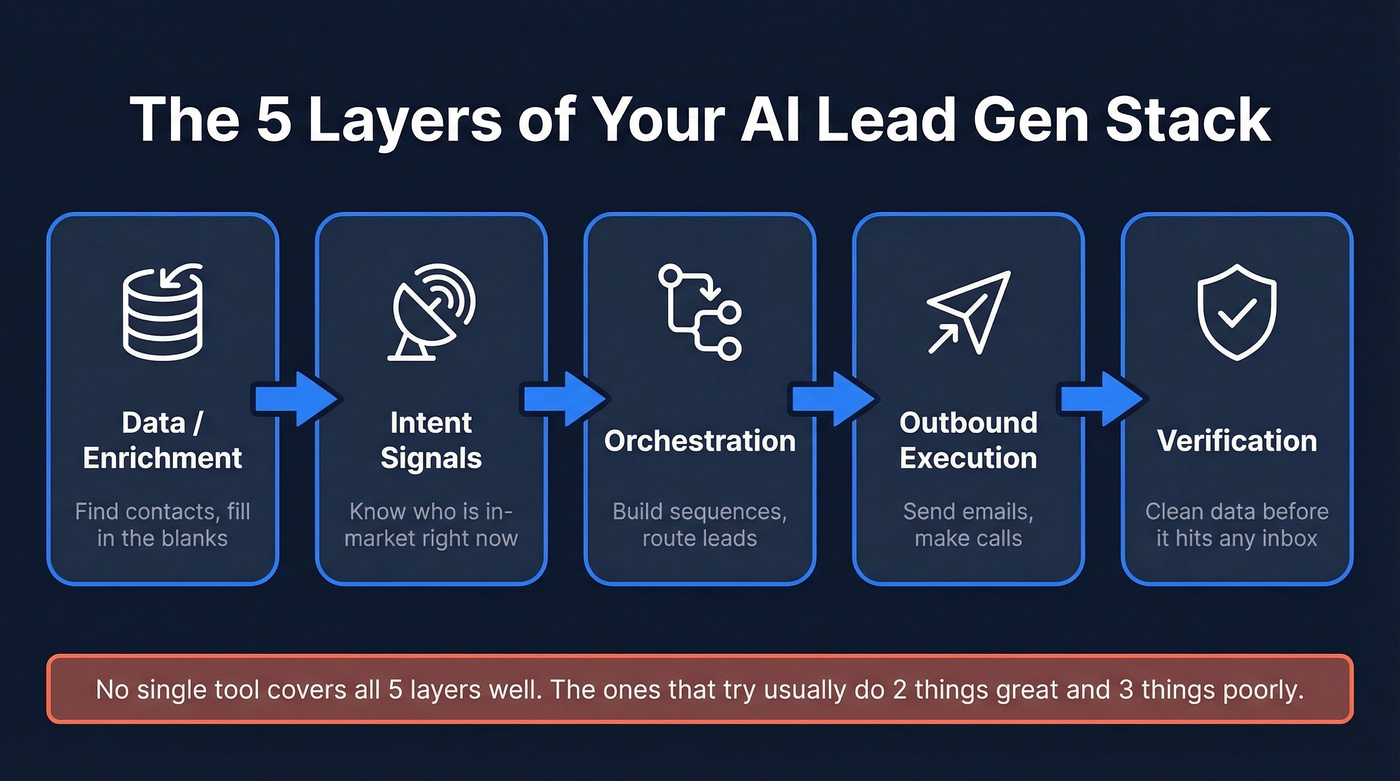
Think of your lead gen stack in five layers: Data/Enrichment (finding contacts and filling in the blanks), Intent Signals (knowing who's in-market right now), Orchestration (building sequences and routing leads), Outbound Execution (sending emails, making calls), and Verification (making sure the data is clean before it hits anyone's inbox). No single tool covers all five layers well. The ones that try usually do two things great and three things poorly.
The numbers back this up. AI-powered lead scoring alone improves conversion rates by around 25%, and B2B buyers now use an average of 10 channels during their purchase journey - up from 5 in 2016. Omnichannel engagement rates hit 18.96% compared to 5.4% for single-channel outreach. The AI-driven lead generation market is projected to grow from $7.4B to $16.2B by 2034, which means a flood of new tools and a lot of noise. In our testing, the tools that claim the largest databases rarely have the cleanest data. Evaluate every prospecting platform by which workflow layer it actually serves, not by how many times it says "AI" on the homepage.
The 9 Best AI Lead Generation Tools
Prospeo - Best for Data Accuracy
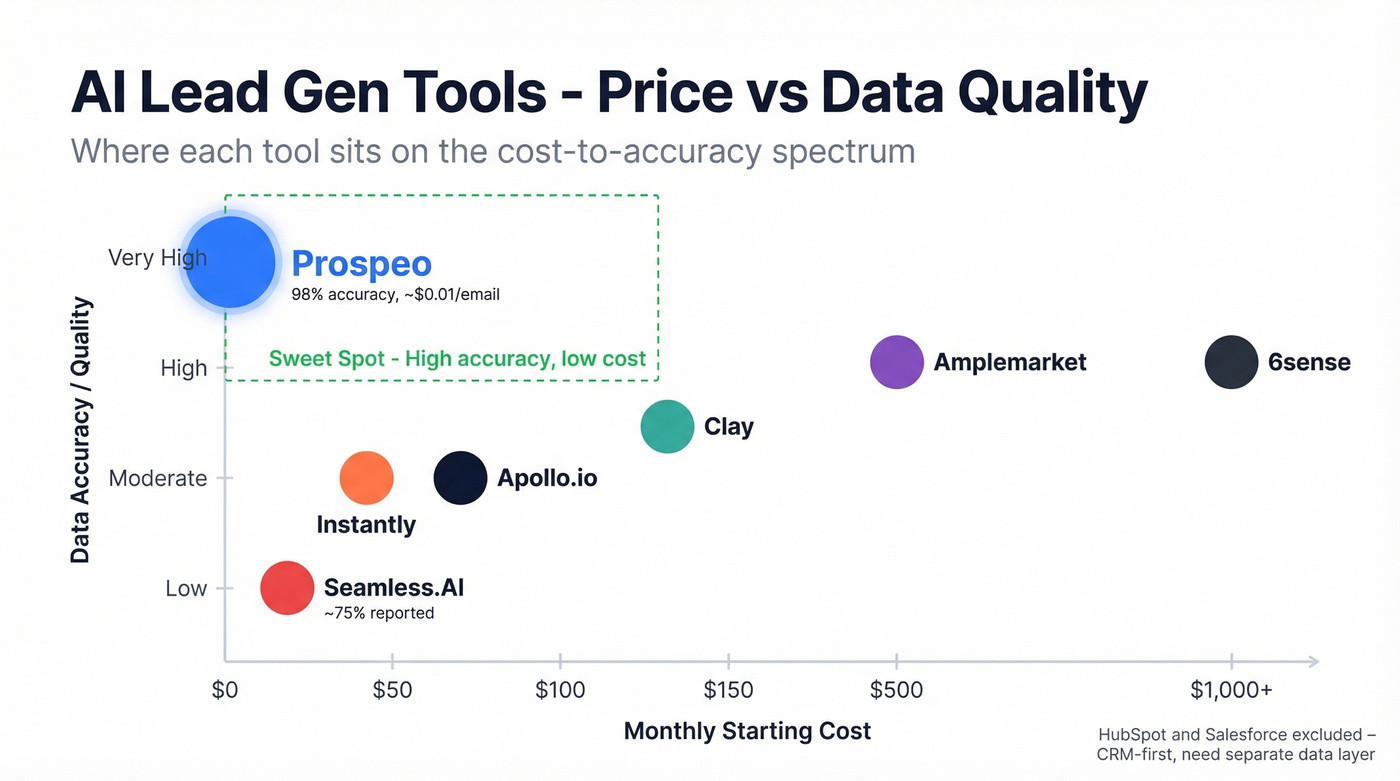
Prospeo's database covers 300M+ professional profiles, 143M+ verified emails, and 125M+ verified mobile numbers - all refreshed on a 7-day cycle while the industry average sits at six weeks. The 5-step verification process, including catch-all handling and spam-trap removal, delivers 98% email accuracy. Those verified mobiles hit a 30% pickup rate across all regions.
The proof is in production results. Snyk's 50-person AE team went from a 35-40% bounce rate to under 5% after switching, and AE-sourced pipeline jumped 180%. That's not a marginal improvement - that's the difference between outbound working and outbound being a cost center. Stack Optimize built from $0 to $1M ARR using Prospeo as their data backbone, maintaining 94%+ client deliverability with bounce rates under 3% and zero domain flags across all clients.
Pricing is self-serve and transparent: free tier gives you 75 emails/month, paid plans run roughly $0.01 per email, and 10 credits per mobile number. No annual contracts, no sales calls required. Integrations cover Salesforce, HubSpot, Smartlead, Instantly, Lemlist, Clay, Zapier, and Make.
Use this if: Your bounce rate is above 5%, you need verified mobiles that people actually answer, or you're an agency scaling campaigns across multiple clients without burning domains.

Clay - Best for Custom Enrichment
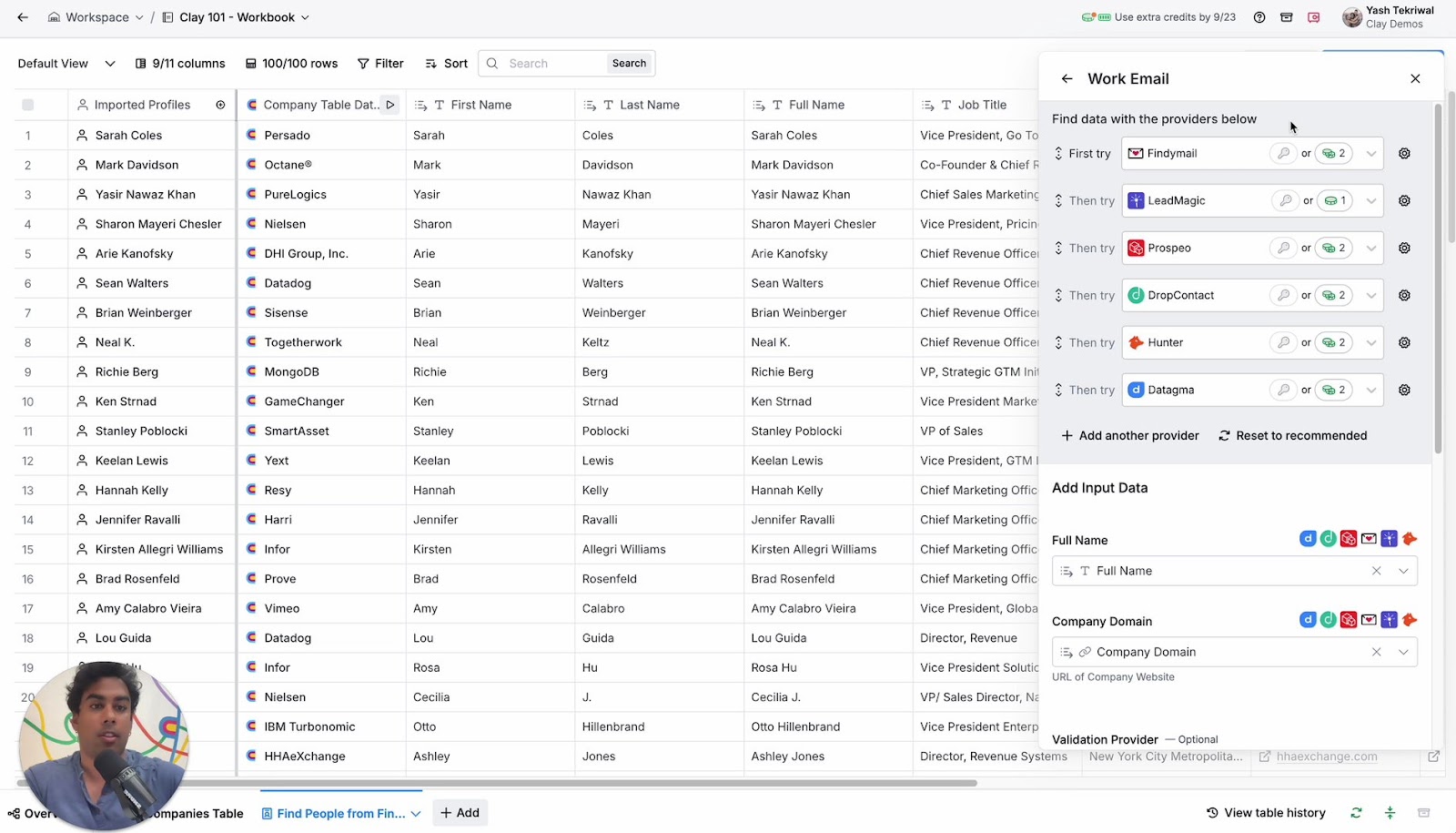
Clay connects to 50+ data sources and lets you build enrichment workflows by chaining steps together - one practitioner on r/salestechniques described it as "LEGO pieces for data." You can build weirdly specific prospect lists that no single database could produce on its own, combining firmographic filters from one source with technographic data from another and intent signals from a third.
Pricing starts at $134/month with 2,000 enrichment credits. Power users burn through credits fast, so budget accordingly - heavy teams spend $300-500/month easily.
Use this if: You need to combine multiple data sources into a single enriched list and you have someone on the team who enjoys building workflows. Skip this if you want plug-and-play simplicity. Clay has a real learning curve, and it rewards tinkering. If nobody on your team wants to be the "Clay person," you'll underuse it.
Apollo.io - Best All-in-One Starting Point
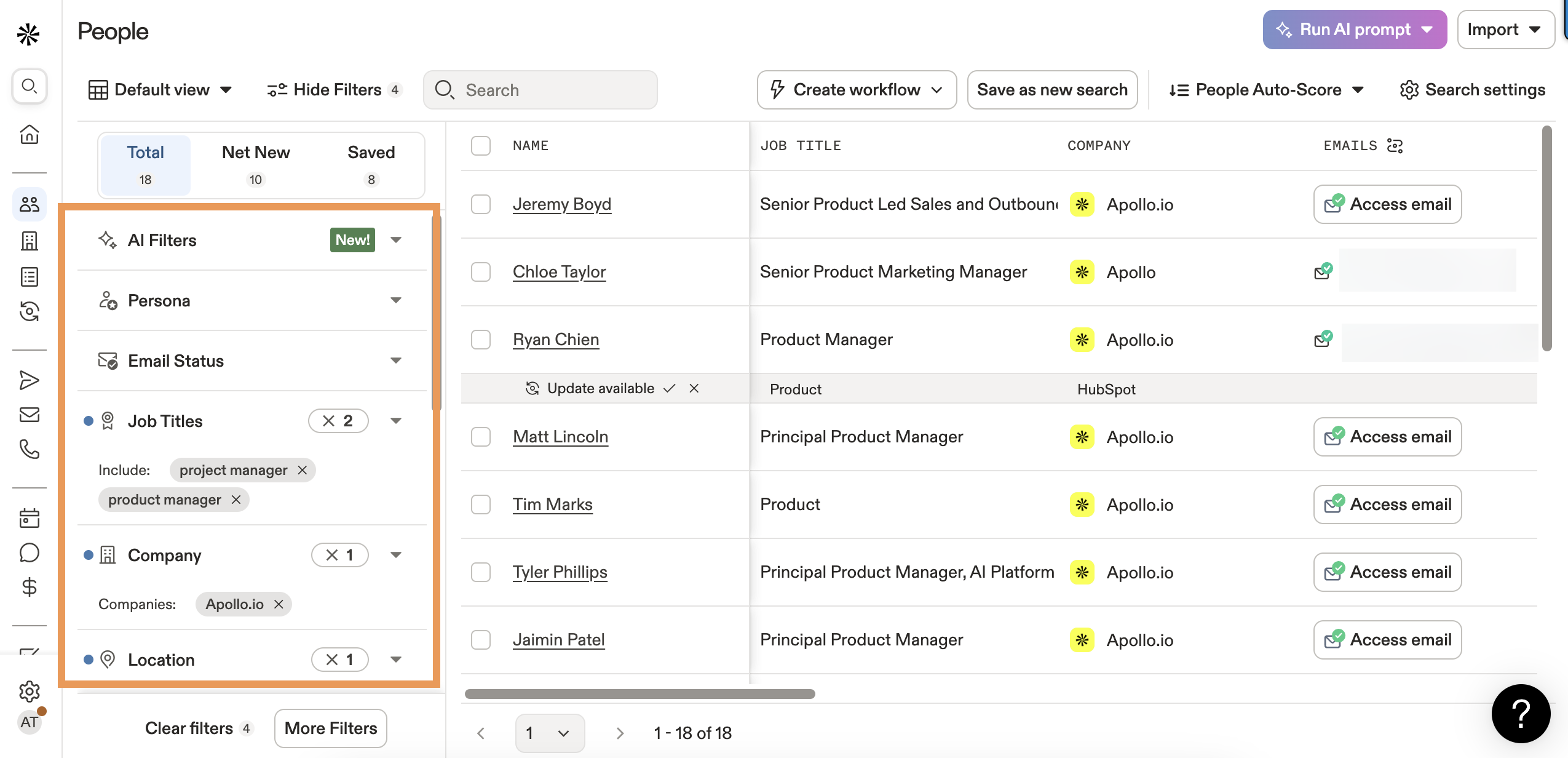
Apollo is the default choice when you need a prospect list fast. The database covers 275M contacts across 60M companies, and the free plan is genuinely usable - not a teaser that forces an upgrade after two searches. Paid plans start at $49/user/month (Basic), scaling to $79 (Professional) and $119 (Organization, minimum 3 seats).
The built-in sequencer means you can find contacts and email them from the same platform. For a startup with no existing stack, that's a real advantage.
Use this if: You're building outbound from scratch and want one tool that handles prospecting, list-building, and basic sequencing without stitching together three products. Skip this if you're selling into niche industries or smaller markets. Reddit threads on r/sales consistently flag Apollo's data quality as weaker outside mainstream B2B verticals - pair it with a verification layer before you hit send.
Instantly - Best for Cold Email at Scale
Here's what confuses everyone about Instantly: it's actually three products wearing a trenchcoat.
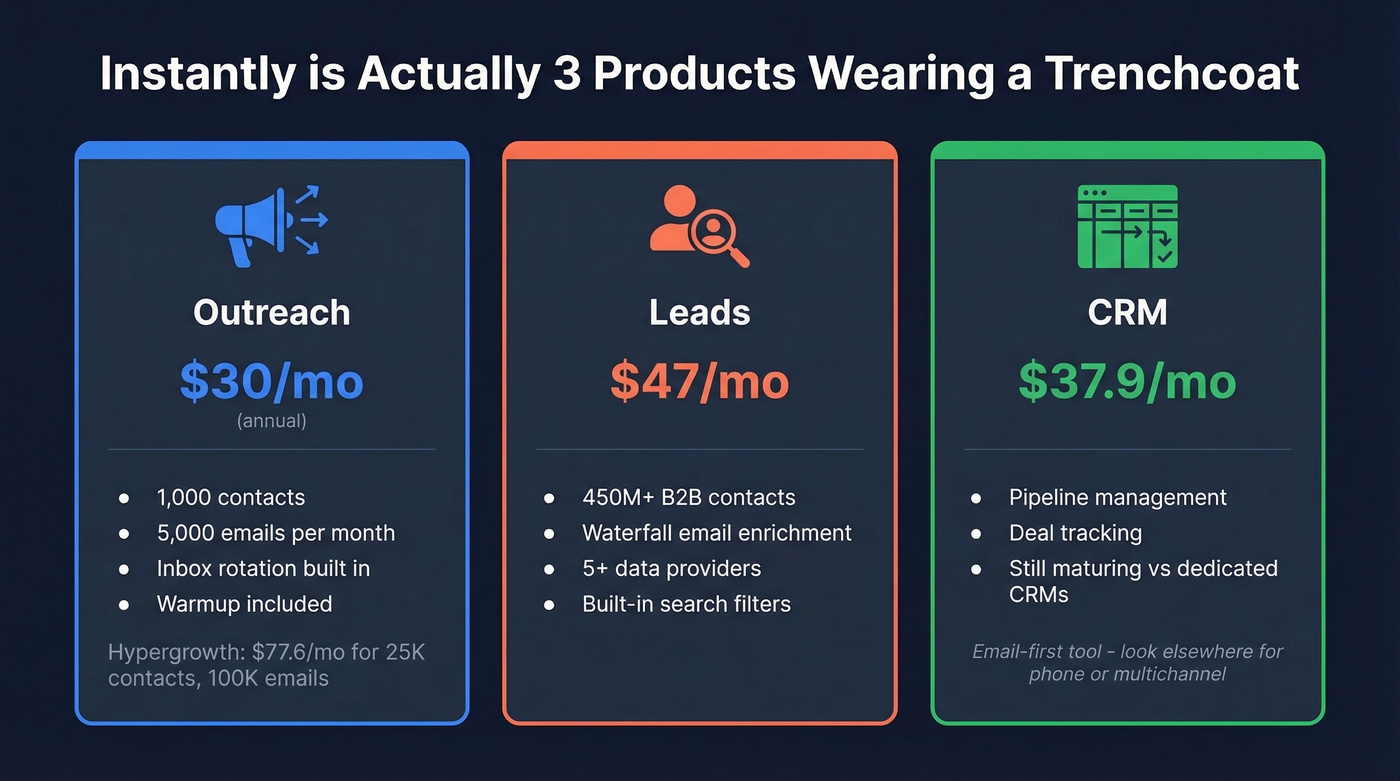
| Product | Starting Price | What You Get |
|---|---|---|
| Outreach | $30/mo (annual) | 1,000 contacts, 5,000 emails/mo. Hypergrowth: $77.6/mo for 25K contacts, 100K emails |
| Leads | $47/mo | 450M+ B2B contacts, waterfall email enrichment across 5+ providers |
| CRM | $37.9/mo | Still maturing vs. dedicated CRMs |
The volume pricing is hard to beat for high-volume cold email. Inbox rotation and warmup come built in, which saves you from cobbling together separate tools. But Instantly is an email-first tool - if you need phone numbers or multichannel outreach, look elsewhere.
Seamless.AI - Largest Database (with Caveats)
The pitch: 1.3B business contacts and 121M companies - the largest claimed database on this list. The reality: almost every useful feature is an add-on. The AI assistant, enrichment, autopilot sequences, job change alerts, and intent data are all gated behind separate purchases.
Look, if a tool won't show you pricing upfront, that's a feature of their sales process, not their product.
The free plan gives you 50 credits to test. After that, Pro and Enterprise tiers require talking to sales. One user reported a 25% bounce rate from a Seamless list - that kind of bounce rate doesn't just waste sends, it damages your sender reputation for months. Use Seamless for sheer database breadth, but verify every contact through a separate tool before sequencing.
Amplemarket - Best for Signal-Based Outreach
Amplemarket's Duo copilot monitors buying signals and builds curated prospect lists based on real-time triggers - job changes, funding rounds, tech stack shifts. It's the closest thing to a "tell me who to call right now" tool on this list.
The learning curve is steeper than Apollo or Instantly, but the signal quality justifies the ramp time. Pricing is custom - expect $500-1,500/month for small teams based on community reports. Best for mid-market teams that have outgrown basic list-building and want intent-driven outreach.
6sense - Enterprise Intent Data
6sense is the heavyweight for account-level buying signals. The budget math is real: Team tier runs ~$15K-$20K/year, Growth sits at ~$25K-$60K/year, and Enterprise climbs to $60K-$100K+.
A realistic budget for a 5-person team is around $58K/year once you factor in seats, credit overage, and partial RevOps allocation. Implementation takes 4-8 weeks and typically requires dedicated RevOps support. There's a free tier (50 credits/month) if you want to kick the tires. Best for enterprise teams with the budget and operational maturity to act on account-level intent data at scale.
HubSpot - CRM-First Teams
HubSpot's strength isn't prospecting - it's the native connection between CRM, marketing automation, and sales sequences. The free CRM is a legitimate starting point. Starter runs from $15/user/month, Professional jumps to $90/user/month with workflow automation and reporting.
You'll still need a data layer feeding contacts into it. But if your team already lives in HubSpot, adding a separate CRM creates more friction than it solves.
Salesforce (Agentforce) - Enterprise AI Agents
Salesforce's Agentforce ($550/user/month) brings autonomous AI agents into the CRM for lead routing, qualification, and follow-up. Starter plans begin at $25/user/month. Only worth evaluating if your team already runs on Salesforce - the value is in the ecosystem integration, not the standalone AI capabilities.

Every AI lead generation tool in this list depends on one thing: data quality. Prospeo's 5-step verification delivers 98% email accuracy on 300M+ profiles - refreshed every 7 days, not every 6 weeks. Snyk cut their bounce rate from 40% to under 5% and grew AE-sourced pipeline 180%.
Stop feeding bad data into good workflows. Start with 75 free verified emails.
Comparison Table
| Tool | Best For | Database | Starting Price | Key Strength |
|---|---|---|---|---|
| Clay | Custom enrichment | 50+ sources | $134/mo | Flexible workflow chains |
| Apollo.io | All-in-one start | 275M contacts | Free / $49/user | Speed to first list |
| Instantly | Cold email scale | 450M+ | $30/mo (annual) | Volume + inbox warmup |
| Seamless.AI | Database breadth | 1.3B contacts | Free (50 credits) | Raw coverage |
| Amplemarket | Signal outreach | Not public | ~$500/mo (est.) | Intent + copilot |
| 6sense | Enterprise intent | Not public | ~$15K/yr | Account buying signals |
| HubSpot | CRM-first teams | N/A (CRM) | Free / from $15/user | CRM + marketing hub |
| Salesforce | Enterprise AI | N/A (CRM) | $25/user/mo | Agentforce agents |
How to Build Your Stack
You don't need nine tools. You need three or four that cover your workflow layers without overlap. Pilot any new tool with a small team for 2-4 weeks before rolling it out company-wide - the fastest way to waste budget is deploying a tool nobody adopts.
Mid-Market: Prospeo (data + verification) -> Clay (enrichment) -> Instantly or Lemlist (outreach) -> HubSpot or Salesforce (CRM). Total: $300-700/month. Clay handles complex enrichment, verified data ensures every email lands, and your sequencer handles execution.
Enterprise: 6sense (intent) -> Salesforce (CRM) -> Amplemarket or a dedicated sequencer (outreach), with a data enrichment layer feeding verified contacts into the pipeline. Total: $3K-8K/month depending on seats and 6sense tier.
Here's the thing: if your average deal size is under $10K, you probably don't need 6sense-level intent data. A solid data platform plus a good sequencer will outperform an expensive intent tool that your team doesn't have the bandwidth to act on. We've seen teams waste entire quarters because they bought the enterprise stack before they had the operational maturity to use it.
You don't need another AI wrapper - you need contacts that don't bounce. Prospeo gives you 143M+ verified emails and 125M+ verified mobiles with a 30% pickup rate, all at ~$0.01/email. No contracts, no sales calls, no domain damage.
Stack Optimize built $1M ARR on Prospeo data with zero domain flags. Your turn.
Mistakes That Kill Your ROI
Skipping email verification. Every bounced email chips away at your sender reputation. Once your domain gets flagged, even good emails land in spam. Verify every contact before it enters a sequence - not after your first campaign tanks.
Over-automating without human review. AI can draft 500 personalized emails in an hour. But "personalized" doesn't mean "good." Keep a human in the loop on at least the first 50 sends of any new sequence to catch wrong company references, outdated news, and robotic tone.
Ignoring deliverability infrastructure. Domain warming, inbox rotation, and SPF/DKIM/DMARC configuration aren't optional. One r/salesdevelopment thread put it well: you're "one policy shift away from a bad month" if you're not diversifying your sending infrastructure.
"Set it and forget it" mentality. If you're not marking which leads converted and which sequences underperformed, your tools can't learn. Treat your AI lead gen stack like a garden, not a vending machine.
No CRM integration. Leads that don't sync to your CRM fall through cracks. Reps work the same account without knowing it. Pipeline reporting becomes fiction. The 15 minutes of setup saves hours of duplicate work every week.
Ignoring GDPR and CCPA compliance. Scraping contacts without consent or proper data handling isn't just risky - it's expensive. Fines under GDPR can reach 4% of annual revenue. Use tools that are GDPR-compliant and enforce opt-out globally, and make sure your outreach includes a clear unsubscribe mechanism.
FAQ
What is an AI lead generation tool?
Software that uses artificial intelligence to identify, score, enrich, or engage potential B2B buyers. The category spans data platforms, intent signal tools, enrichment engines, and outbound sequencers. Most combine machine learning for lead scoring with automation for outreach execution.
How much do these tools cost?
Free tiers exist at several platforms including Prospeo (75 emails/month) and Apollo. Most mid-market teams spend $50-$500/month per tool. Enterprise intent platforms like 6sense can exceed $60K/year. Budget based on which workflow layers you need to cover.
Which AI tool is best for lead generation?
It depends on your weakest workflow layer. For data accuracy and verification, Prospeo leads with 98% email accuracy and a 7-day refresh cycle. For custom enrichment across dozens of sources, Clay is hard to beat. Apollo.io is the best all-in-one starting point to go from zero to a working pipeline fast.
Can AI fully replace human SDRs?
Not yet. AI handles volume and speed - 500-2,500+ emails/day, sub-60-second response times - but meeting conversion rates sit around 15-20% versus 25% for humans. The best results come from a hybrid model: AI handles prospecting at scale, humans step in for complex deals and relationship-building.