

AI Lead Nurturing: Build a Stack That Actually Converts
If you've ever watched a beautifully crafted nurture sequence bounce off 30% of your list, you know the problem isn't your copy - it's your data. The biggest lie in AI lead nurturing is that you need an "AI-native" platform. Data quality and workflow design matter more than which vendor's LLM writes your subject lines. Here's the playbook that actually works in 2026.
What AI Lead Nurturing Actually Is
Most people confuse this with drip campaigns. A drip campaign sends the same five emails on a fixed timer, regardless of whether the lead opened anything, visited your pricing page, or quietly evaluated your competitor. Lead nurturing with AI is fundamentally different: it uses behavioral signals, predictive scoring, and real-time personalization to adapt sequences dynamically based on what each lead actually does.
The stakes are real. 79% of leads never convert into sales, and the primary reason isn't bad messaging. It's that most nurturing systems treat every lead identically - blasting the same content at the same cadence to a VP of Engineering and a marketing intern who downloaded the same whitepaper. AI fixes this by scoring, segmenting, and sequencing based on intent signals rather than arbitrary timers.
The Stack You Actually Need
AI-driven lead nurturing works when you nail three layers: clean data, predictive scoring, and signal-triggered sequences. Most teams fail at layer one.
Here's the minimum viable stack:
- Automation layer: HubSpot (SMB) or Salesforce (enterprise) for scoring and CRM workflows
- Sequencing layer: Outreach, Instantly, or Smartlead for multi-channel execution
Start by verifying your contact database. Companies using lead scoring see 138% ROI versus 78% without. Then build branching workflows triggered by intent signals - not timers. Signal-personalized outreach hits 15-25% reply rates versus the 3-5% cold email average. That's the difference between a sequence that books meetings and one that burns your domain.
Why It Matters - The Numbers
The adoption curve has already tipped. 81% of sales teams have implemented or are experimenting with AI, and the results aren't subtle. Teams using AI-driven sales nurturing are 1.3x more likely to see revenue growth - 83% of AI-using teams reported growth versus 66% without.
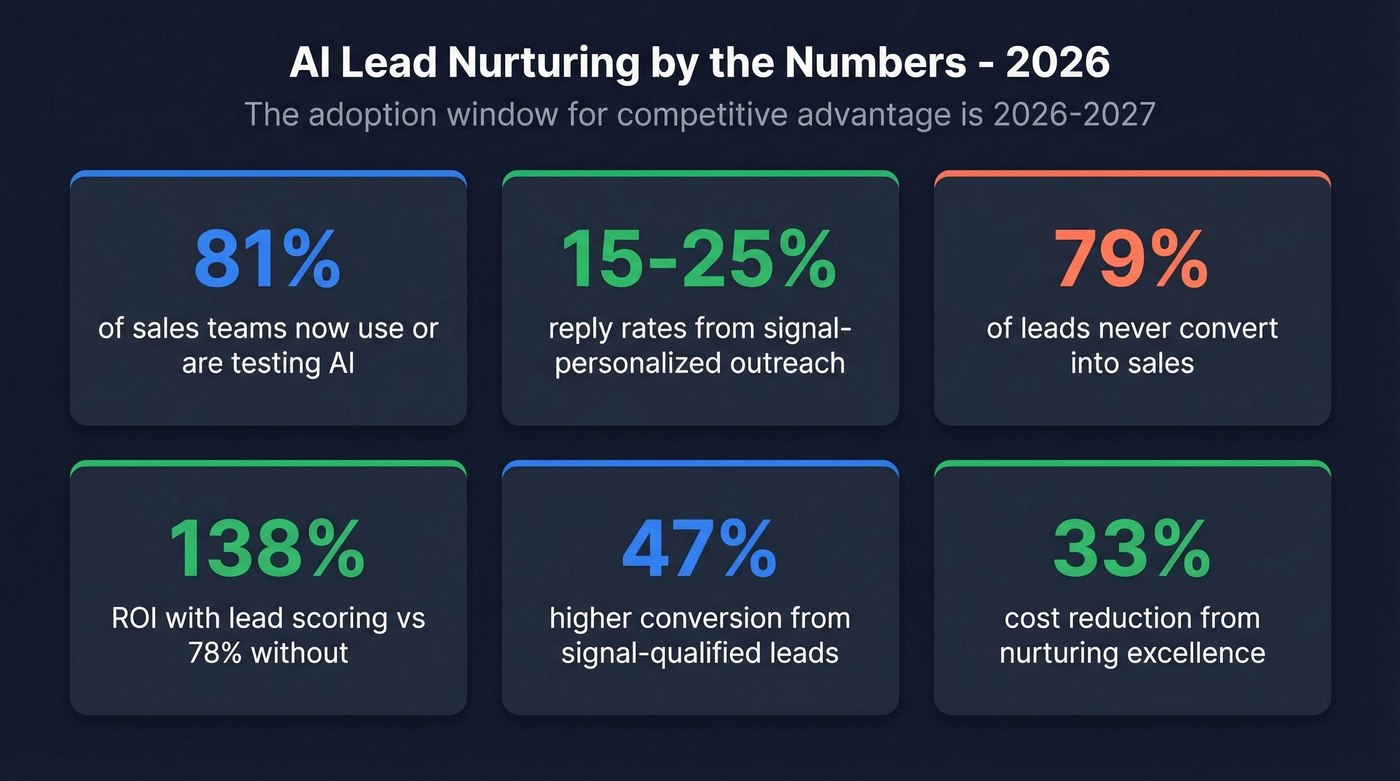
The AI SDR market is projected to hit $15 billion by 2030 at a 29.5% CAGR. With average B2B cost per lead ranging from $31 for SEO to $72 for webinars, the 33% cost reduction from nurturing excellence compounds fast at scale.
Here's our take: the window to gain a structural advantage with intelligent nurturing is 2026-2027. After that, every team will have these capabilities and the edge disappears. Signal-qualified leads already convert at 47% higher rates with 43% larger deal sizes. If your competitors are running AI-scored, signal-triggered sequences and you're still on a five-email drip timer, you're already behind.
The Data Quality Problem Nobody Talks About
A team invests $30,000+/year in a shiny automation platform, builds gorgeous nurture sequences with AI-personalized subject lines, and launches to their 50,000-contact database. Within two weeks, 20-30% of emails bounce. Their domain sender reputation craters. Deliverability drops below 80%. Sound familiar?
The root cause is always the same: the data layer was rotten before a single workflow fired. No amount of sophistication in your nurturing setup can compensate for contacts that don't exist.
We've seen this play out firsthand. A global logistics company was running bounce rates at 50%. After rebuilding their data foundation, bounces dropped to under 4%, data accuracy hit 96%, and they saw a 22% increase in booked meetings within six months. Snyk's 50 AEs cut bounce rates from 35-40% to under 5% and grew AE-sourced pipeline by 180%. The pattern is unmistakable: AI is only as smart as the data you feed it.
Before you spend a dollar on sequencing tools, fix your data layer. Everything downstream depends on it.

Every AI nurturing workflow starts at Layer 1: clean data. Prospeo's 5-step verification delivers 98% email accuracy on a 7-day refresh cycle - not the 6-week industry average. Snyk's 50 AEs cut bounce rates from 35-40% to under 5% and grew pipeline 180% after fixing their data foundation.
Stop feeding bad data to smart workflows. Fix Layer 1 first.
The 5-Layer Nurturing Stack
Most teams think about AI nurturing as a single tool. It's actually a stack with five distinct layers, and skipping any one creates a bottleneck that no amount of automation can fix.
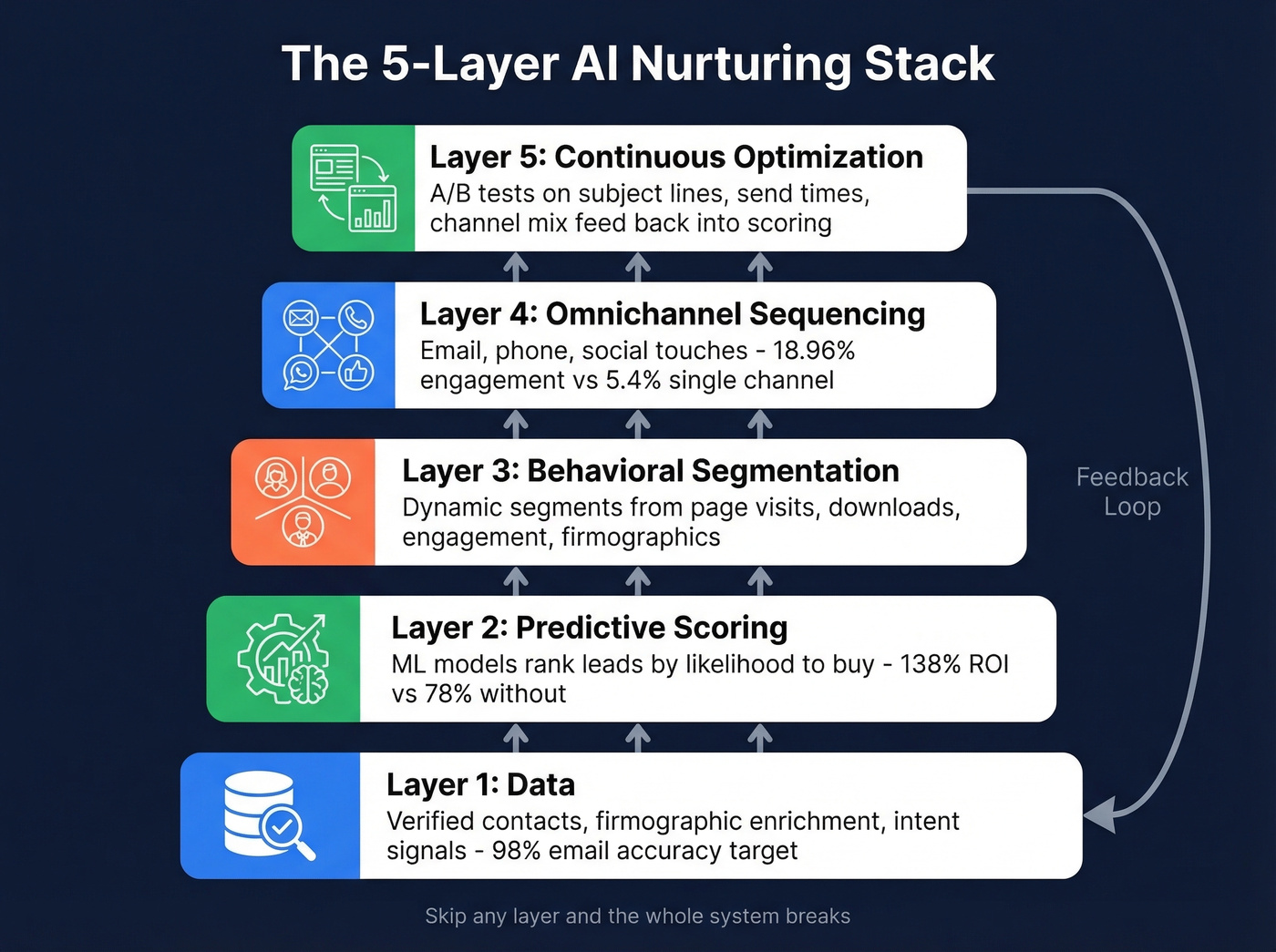
Layer 1: Data
Your foundation. You need verified contact data, firmographic enrichment, and intent signals that tell you who's actively researching your category. Prospeo's 5-step verification process with catch-all handling and spam-trap removal ensures 98% email accuracy on a 7-day refresh cycle - compared to the 6-week industry average. For teams needing to chain multiple data sources, Clay handles waterfall enrichment workflows well alongside your core verified contact provider.
Layer 2: Predictive Scoring
Machine learning models analyze historical conversion patterns to rank leads by likelihood to buy. Only 44% of organizations use lead scoring - that adoption gap is your competitive advantage.
Layer 3: Behavioral Segmentation
Combine scoring output with behavioral signals - page visits, content downloads, email engagement - and firmographic data like company size, industry, and tech stack. Static lists are dead. Dynamic segments that update in real time are what make intelligent nurturing work.
Layer 4: Omnichannel Sequencing
Email alone isn't enough. Omnichannel engagement hits 18.96% versus 5.4% for single-channel approaches. Your sequences should span email, phone, and social touches, triggered by scoring changes and behavioral signals. This is where adaptive engagement really shines - adjusting channel mix and timing to each prospect's behavior.
Layer 5: Continuous Optimization
Every sequence generates data. The optimization layer runs continuous A/B tests on subject lines, send times, channel mix, and content variants, then feeds results back into scoring and segmentation. Each cycle makes the next one smarter.
AI Lead Scoring - Highest-ROI Layer
Your team is working 200 leads a month, but 60% of them were never going to buy. Without scoring, your reps are chasing ghosts - burning hours on contacts who downloaded a whitepaper for a college project.
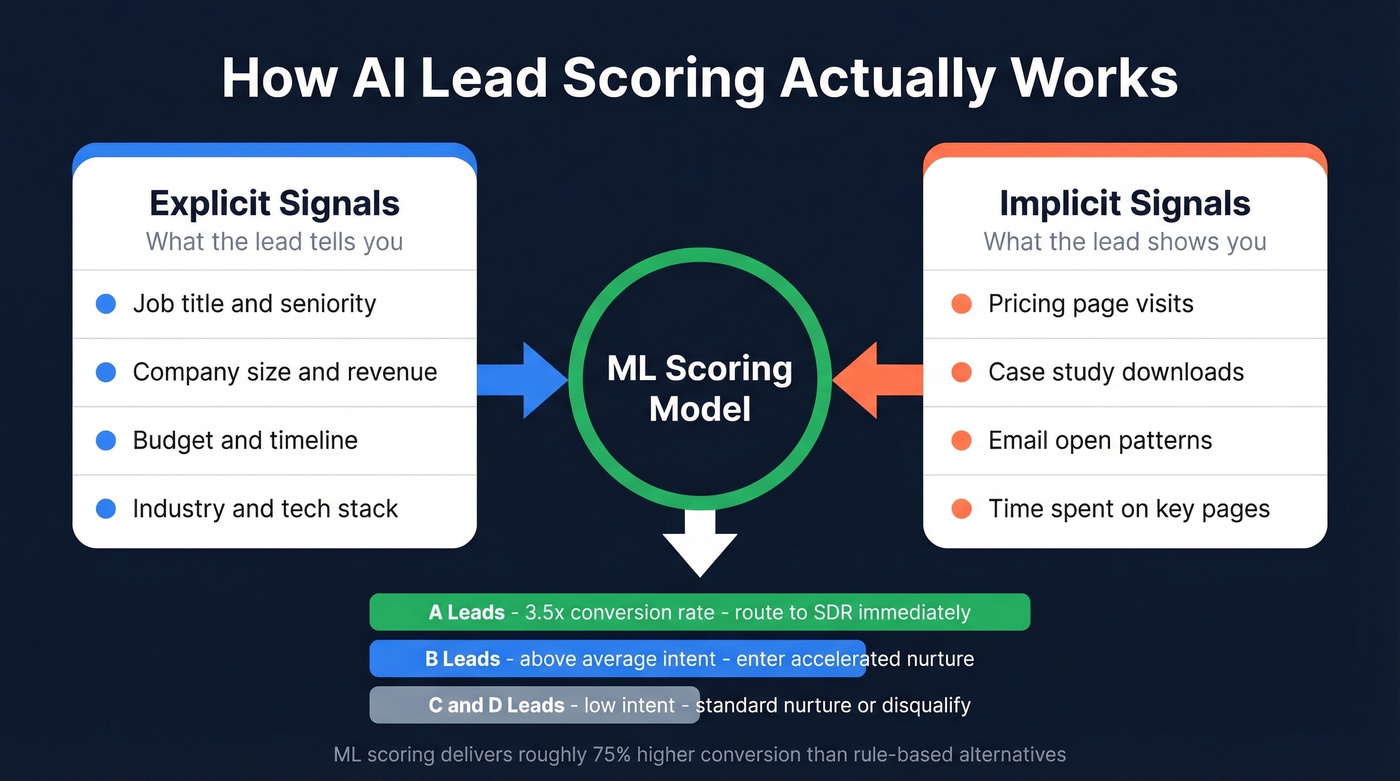
Let's be honest: if you're only going to implement one AI capability, make it lead scoring. Organizations using it see 138% ROI versus 78% without, and ML-powered scoring delivers roughly 75% higher conversion rates than rule-based alternatives. Early ML deployments in sales consistently show 300-400% first-year ROI.
The distinction between explicit and implicit signals matters. Explicit signals are things the lead tells you - job title, company size, budget. Implicit signals are things the lead shows you - pricing page visits, case study downloads, email open patterns. ML models combine both to produce a score that's dramatically more predictive than either alone. One thing worth flagging: make sure your scoring model is explainable. If reps can't understand why a lead scored high, they won't trust the system.
A mid-market fintech lender provides a concrete example. Their lead-to-SQL conversion sat at 8%. After implementing ML scoring, top-scoring leads converted at 3.5x the previous rate, and the team reduced time spent on unqualified leads by 80%.
Building Your First Workflow
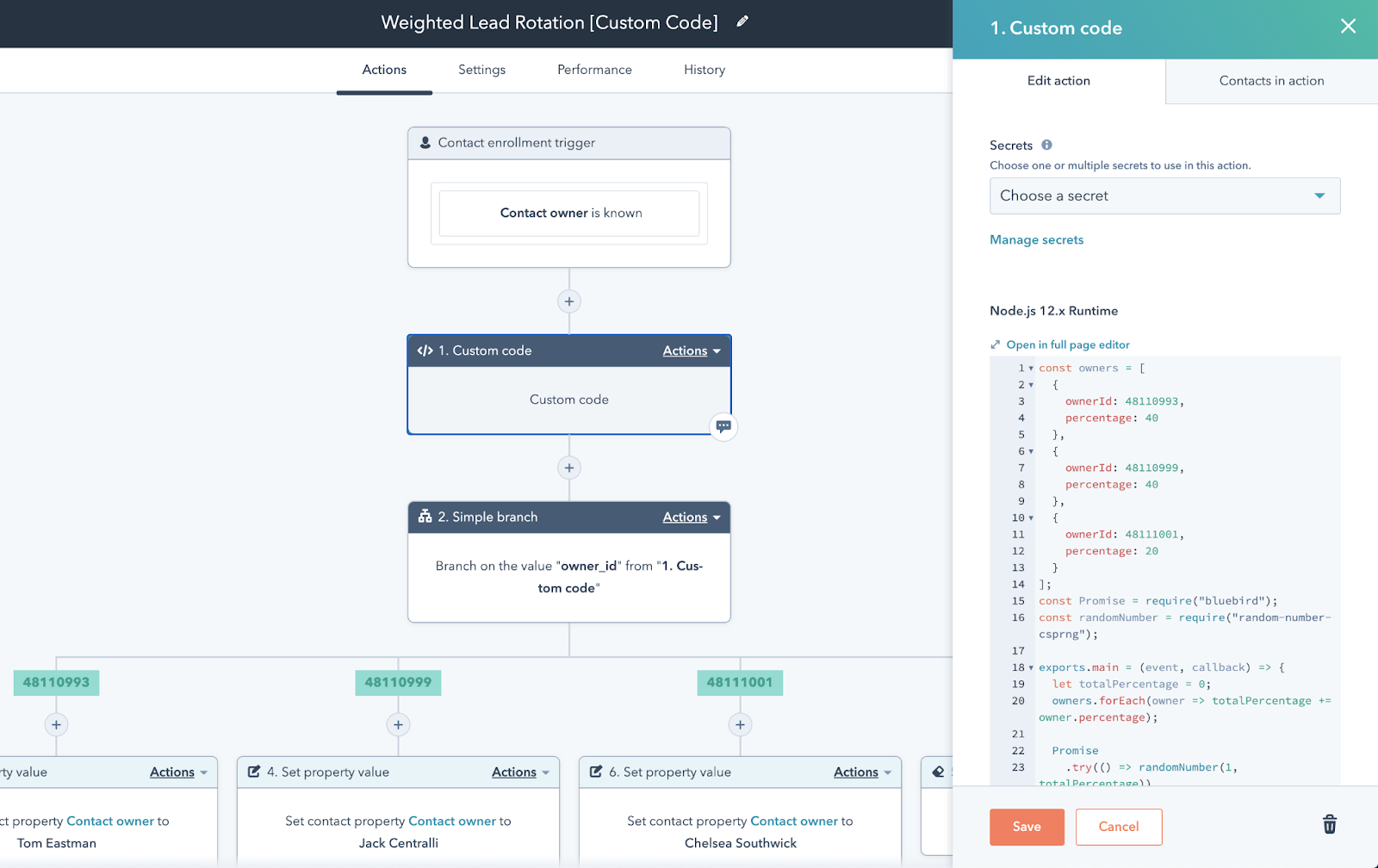
Here's a trigger-condition-action sequence you can implement this week:
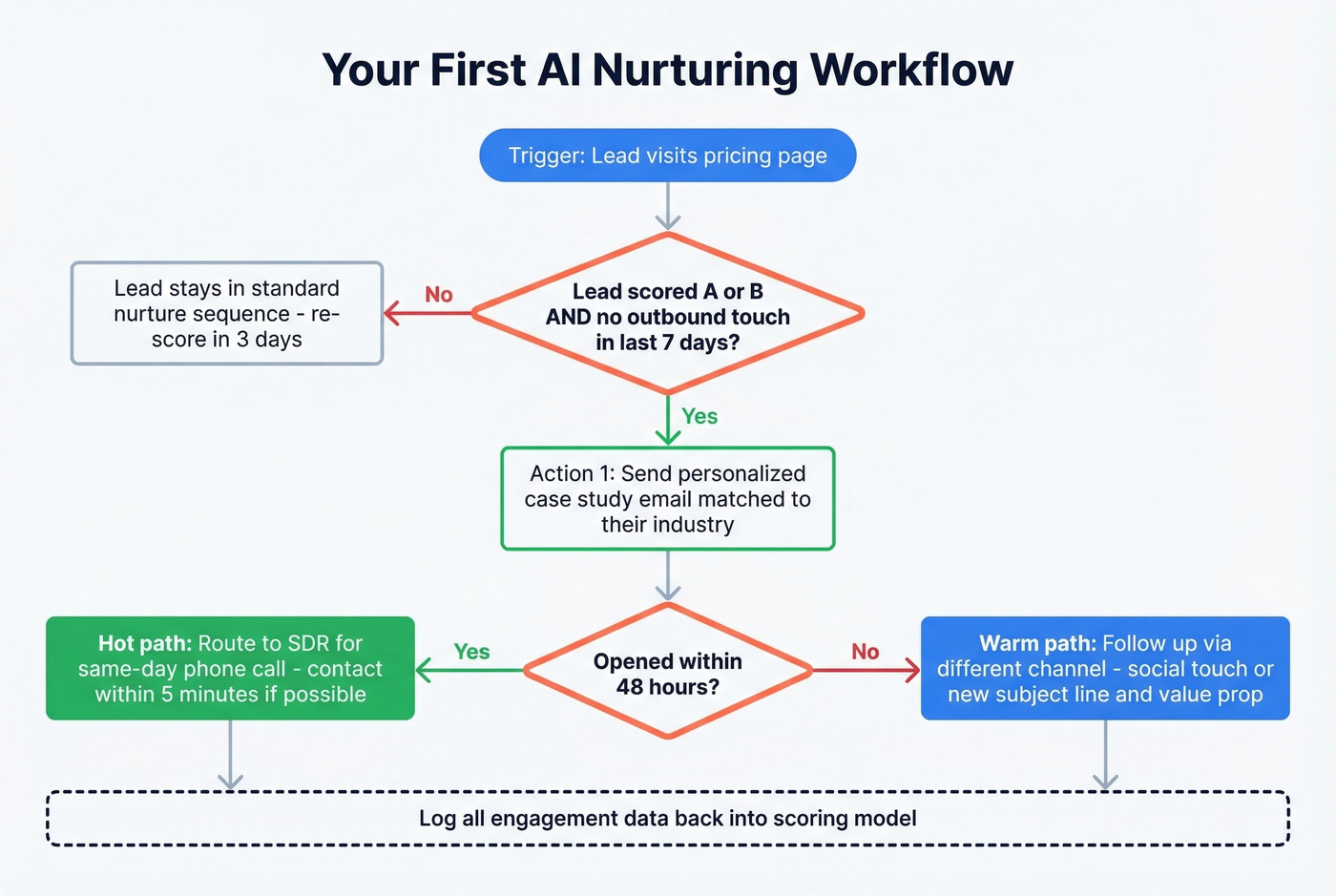
Trigger: Lead visits your pricing page.
Condition check: Lead is scored A or B AND no outbound touch in the last 7 days.
Action 1: Send a personalized email featuring a case study relevant to their industry, pulled from firmographic data.
Branch - if opened within 48 hours: Assign to an SDR for a phone call within the same business day.
Branch - if not opened in 48 hours: Follow up via a different channel - social touch or a second email with a different subject line and value prop.
Speed matters enormously. Contacting a lead within 5 minutes of a high-intent action dramatically increases qualification odds. Your workflow should route hot signals to humans fast, not queue them for a Tuesday batch review.
Real talk: most teams overcomplicate their first workflow. Start with one trigger, two branches, and three actions. Get the data and scoring layers right first. You can add complexity once you've proven the basic loop converts.
Scaling AI Sales Nurturing
Once your foundational workflow is converting, it's time to layer in more sophisticated tactics. Here's what separates top-performing teams from everyone else - and what the tools actually cost.
| Tool | Free Tier | Entry Paid | Mid Tier | Enterprise |
|---|---|---|---|---|
| Prospeo | 75 emails/mo | ~$0.01/email | Credit-based | Custom |
| HubSpot | Yes | $15/user/mo | $90/user/mo | $150/user/mo |
| Salesforce | No | $25/user/mo | $175/user/mo | $550/user/mo |
| Clay | Up to 100 searches/yr | $149/mo | $349/mo | $800/mo+ |
| ActiveCampaign | No | ~$29/mo | ~$79/mo | Custom |
| Outreach | No | ~$100/user/mo | Custom | Custom |
| Apollo | Yes | ~$49/user/mo | ~$99/user/mo | Custom |
HubSpot is the obvious choice for SMB teams that want scoring, automation, and CRM in one platform. The free tier is genuinely useful for getting started. Professional at $90/user/month is where it becomes a serious workflow engine for branching sequences.
Salesforce is the enterprise play. The depth of customization and 7,000+ AppExchange integrations make it unmatched for complex orgs, but Agentforce at $550/user/month is serious money.
Clay handles enrichment workflows beautifully at $149/month - a power tool for RevOps teams, not a casual purchase. ActiveCampaign at ~$29/month is solid for email-first automation on a budget. Outreach at ~$100/user/month is the gold standard for sales sequencing. Apollo offers a free tier with prospecting and basic sequencing - good for scrappy teams, though data accuracy doesn't match dedicated verification tools.
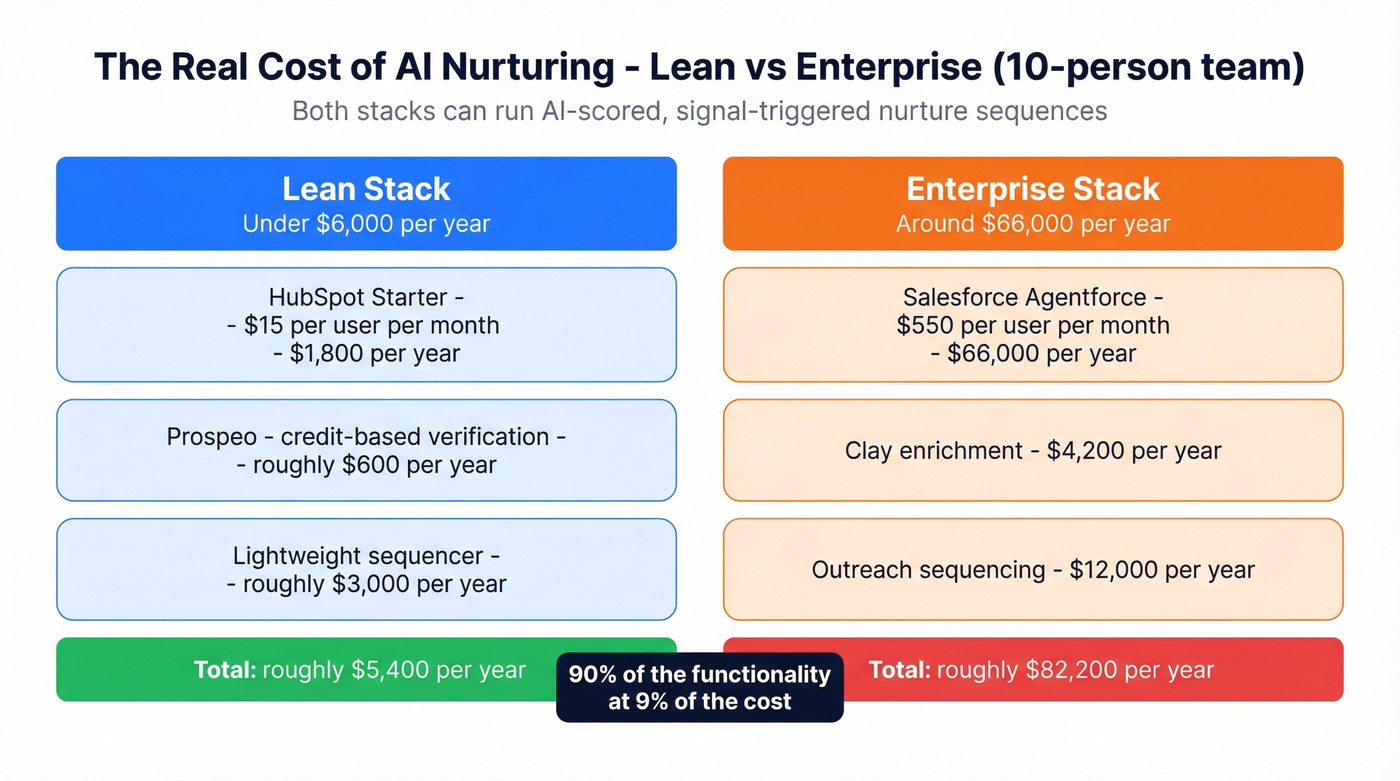
The price gap is worth highlighting: a 10-person team on Salesforce Agentforce pays roughly $66,000/year. The same team on HubSpot Starter + Prospeo + a lightweight sequencer often comes in under ~$6,000/year. Both can run AI-scored, signal-triggered nurture sequences. The enterprise stack gives you more customization; the lean stack gives you 90% of the functionality at 9% of the cost.
Skip Salesforce if you're under 50 reps and don't need deep customization - you'll spend more time configuring than selling.
Before committing to any tool, run a 100-lead audit: verify a sample against your CRM and measure actual deliverability. Then model your true cost per booked meeting, not just per seat. That single exercise will tell you more than any demo.
Signal-triggered sequences only work when emails actually land. At $0.01 per verified email, Prospeo gives your AI nurturing stack the 98% accuracy foundation it needs - with intent data across 15,000 topics to fuel your scoring models.
Layer intent signals on verified contacts for 47% higher conversions.
Why AI Nurturing Fails
Bad data destroying deliverability. If 20-30% of your emails bounce, your domain reputation tanks within weeks. No amount of AI personalization recovers from a blacklisted sending domain.
No strategy before tools. Teams buy HubSpot Professional, turn on workflows, and wonder why nothing converts. You need a scoring model, segment definitions, and a content map before you configure a single automation. 91% of marketers say automation is critical - critical doesn't mean plug-and-play.
Over-automation without human oversight. We call this the "Zapier spaghetti" problem - 47 connected automations with no one monitoring them. When a workflow sends "Hi Unknown!" because a field is blank, you've lost that lead forever.
Poor CRM integration. Automation tools that don't sync cleanly with your CRM create duplicates, data silos, and conflicting records. We've run bake-offs where the "best" nurturing tool created 4,000 duplicate contacts in Salesforce in the first week.
Ignoring compliance. GDPR and CCPA aren't optional. Build consent checks into your workflows from day one. (If you need a framework, start with B2B compliance basics.)
FAQ
How is AI lead nurturing different from drip campaigns?
AI lead nurturing adapts sequences dynamically using behavioral signals and predictive scoring, while drip campaigns send fixed emails on a timer. Signal-triggered sequences hit 15-25% reply rates versus 3-5% for static drips - a 3-5x improvement in engagement.
What's the minimum tech stack needed?
Three tools that integrate cleanly: a verified contact provider for the data layer, a CRM with scoring capabilities like HubSpot or Salesforce, and a sequencing tool like Outreach or Instantly. Total cost can start under $600/month for a small team.
How long until you see results?
Most teams see measurable reply-rate improvements within 30-60 days. Scoring models need 3-6 months to reach peak accuracy as they learn your conversion patterns, so expect compounding gains over time.
Does this work for small teams?
It's arguably more impactful for small teams because it multiplies limited capacity. A 5-person team can nurture thousands of leads simultaneously with AI handling sequencing, scoring, and channel selection automatically.
What's the biggest risk?
Automating on top of bad data. If your emails bounce at 20-30%, AI nurturing will destroy your domain reputation faster than manual outreach would. Verify your database first - bulk verification catches invalid addresses before they damage your sender score.