

8 Drip Campaign Templates You Can Steal Today
Most drip campaign template roundups are 2,000-word strategy essays with zero actual copy you can paste. This one's different. Below are 8 sequences with subject lines, body copy, timing, and cadence - ready to drop into whatever tool you're running. Automated drip flows pull a 5.58% click rate vs. 1.69% for one-off campaigns across 183,000+ brands. That gap alone justifies the next hour of your time.
What You Need First
Start with three sequences before adding complexity: a welcome series, an abandoned cart or trial-to-paid flow, and a re-engagement drip. Those three cover the biggest revenue moments in any funnel - and automated flows already deliver 3.3x higher click rates than one-off sends.
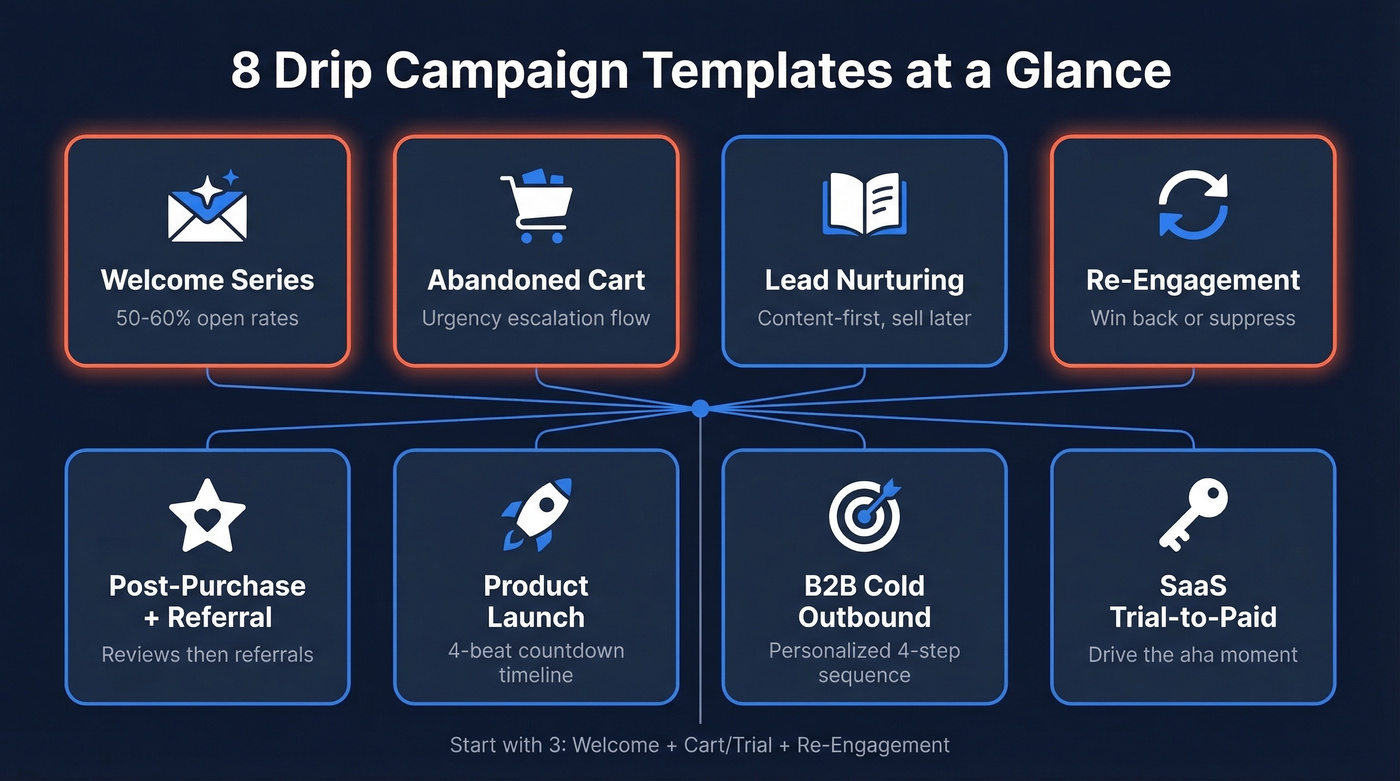
Here are all eight email drip templates:
- Welcome Series
- Abandoned Cart
- [Lead Nurturing / Educational](#lead-nurturing - educational)
- [Re-Engagement / Win-Back](#re-engagement - win-back)
- [Post-Purchase + Referral](#post-purchase - referral)
- Product Launch
- B2B Cold Outbound
- SaaS Trial-to-Paid
Copy-Paste Email Drip Templates
Welcome Series
Welcome emails pull 50-60% open rates - often double regular marketing emails, which commonly sit around 20-30%. Don't waste that window. A/B test your Email 1 subject line first; small tweaks move results fast.
Email 1 - Immediately after signup:
Subject: Welcome to [Brand] - Let's Get Started!
Body: "Hey [First Name], thanks for joining. Here's [lead magnet/resource]. One thing to know about us: [single-sentence value prop]. Hit reply if you have questions - we actually read these."
Email 2 - Day 2-3:
Subject: So, what's our story?
Body: Quick brand story. Why you exist, who you help. Under 150 words.
Email 3 - Day 4-5:
Subject: Our most popular [content/product/resource]
Body: Link to your best-performing asset. Social proof: "[X] people downloaded this last month."
Email 4 - Day 7-10:
Subject: Don't just take our word for it
Body: Customer testimonial or case study snippet.
Email 5 - Day 10-14:
Subject: Ready for this? [Benefit-focused CTA]
Body: Clear next step - book a demo, start a trial, browse the catalog. One CTA only.
Dollar Shave Club nails this structure: their welcome email leads with the value prop and a single CTA, then follows up with social proof and product education before making the hard ask. Simple, personality-driven, and high-converting.
Abandoned Cart
Urgency escalation is the pattern. Start soft, end with scarcity. Add an SMS nudge 6-12 hours after Email 1 - conditioned on whether they opened the email - to catch mobile-first shoppers without double-tapping.
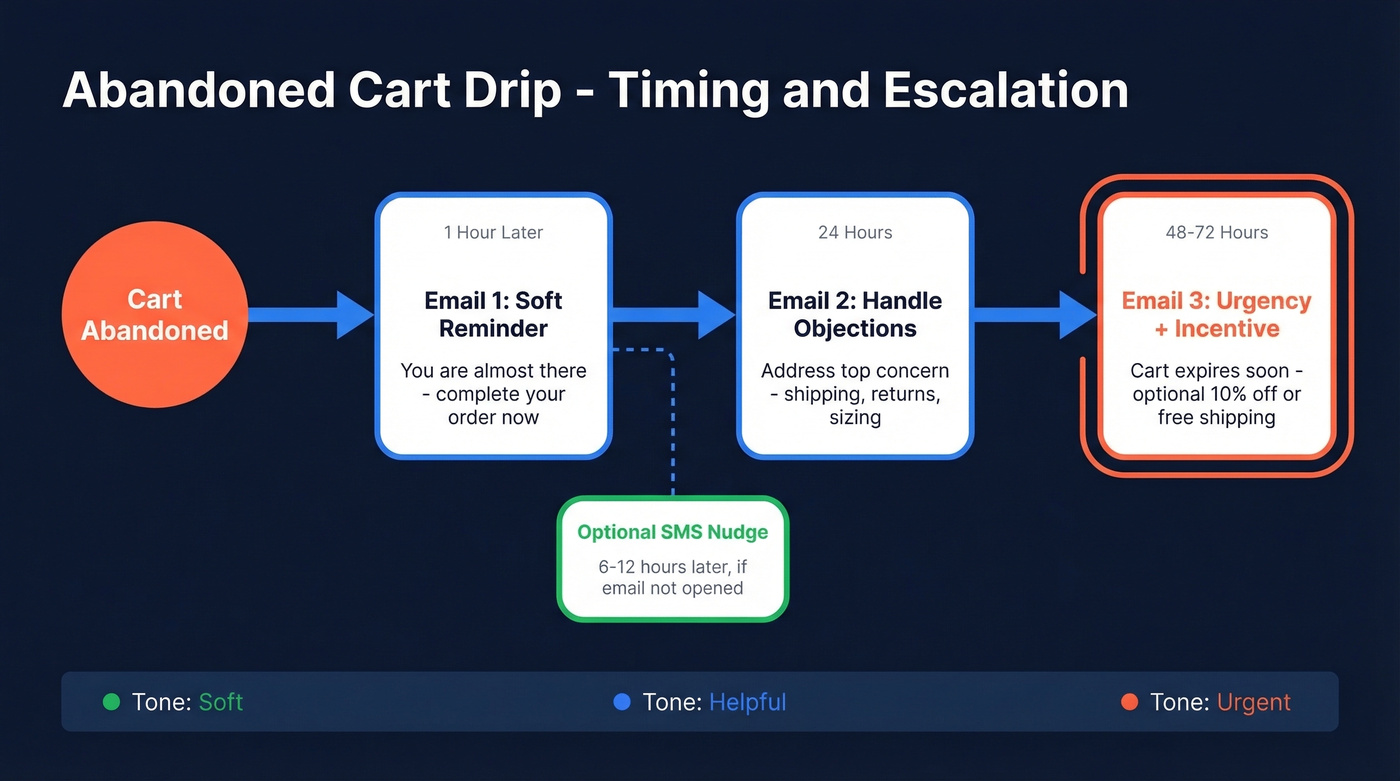
Email 1 - 1 hour after abandonment:
Subject: You're almost there - complete your order now
Body: "Hey [First Name], you left [Product] in your cart. Here's a quick link to pick up where you left off: [CTA button]. Need help? Reply to this email."
Email 2 - 24 hours:
Subject: Still thinking it over?
Body: Address the top objection (shipping cost, return policy, sizing). Include a product image and one-click checkout link. A/B test this subject line against something objection-specific like "Free returns, no risk."
Email 3 - 48-72 hours:
Subject: Last chance - your cart expires soon
Body: Add urgency. "We can only hold your items for [X] more hours." Optional: small incentive like free shipping or 10% off.
Lead Nurturing / Educational
Content-first, sell-later. This email drip campaign template builds trust before asking for anything.
Email 1 - Day 0 (trigger: content download or webinar signup):
Subject: The [Topic] guide I wish I'd had earlier
Body: Deliver the promised resource. Add one insight they didn't expect. Tease what's coming next.
Email 2 - Day 3:
Subject: The #1 mistake in [Topic]
Body: Educational content. Link to a blog post or guide. No product pitch.
Email 3 - Day 6:
Subject: How [Customer] solved [Problem]
Body: Case study or success story. Light product mention, heavy on results.
Email 4 - Day 10:
Subject: A quick framework for [Outcome]
Body: Actionable framework or checklist. Position your product as the tool that makes it easier.
Email 5 - Day 14:
Subject: Ready to try it yourself?
Body: Direct CTA - trial, demo, or consultation. You've earned the ask.
Re-Engagement / Win-Back
Here's the thing: if they don't respond to 2-3 emails, they're gone. Suppress them and protect your sender reputation. Long winback sequences just annoy people. Here's the decision tree:
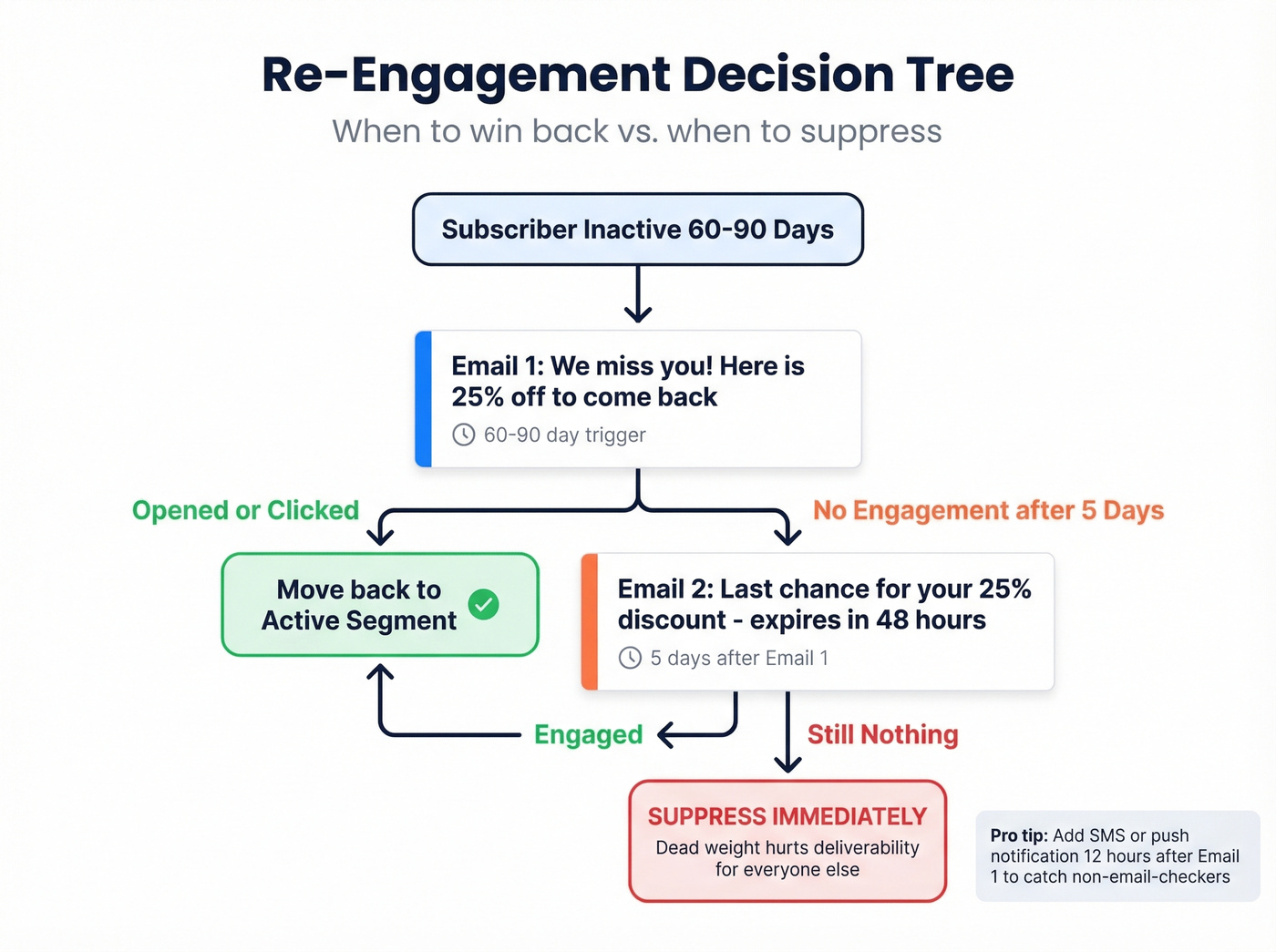
Inactive 60-90 days -> Send Email 1 (Subject: We miss you! Here's 25% off to come back). Offer a reason to return: "We've added [new feature/product] since you last visited. Use code WELCOME25 for 25% off."
-> Opened or clicked? Move back to active segment. -> No engagement after 5 days? Send Email 2 (Subject: Last chance for your 25% discount). "Your code expires in 48 hours." -> Still nothing? Suppress immediately. Dead weight on your list hurts deliverability for everyone else.
Duolingo's re-engagement emails are the gold standard - their guilt-trip owl ("These reminders don't seem to be working...") is memorable because it has genuine personality. You don't need a cartoon mascot, but you do need a voice that stands out in a crowded inbox. A push notification or SMS 12 hours after Email 1 can also catch people who've stopped checking email from that brand entirely.
Post-Purchase + Referral
This one works as a simple if/then flow rather than a rigid sequence:
If the product has been delivered (3-5 days post-ship) -> send a feedback request. Subject: How did we do? Body: "Your [Product] should have arrived. We'd love your feedback - takes 30 seconds: [Review link]. Need help? Just reply."
If they leave a positive review (4+ stars) -> trigger the referral ask immediately. Subject: Know someone who'd love [Brand]? Body: "Share your referral link and you both get [incentive]. Here's your unique link: [Referral URL]."
If they leave a negative review -> trigger a support follow-up instead. Never ask an unhappy customer for referrals.
Product Launch
Think of this as a four-beat timeline, not a numbered list:
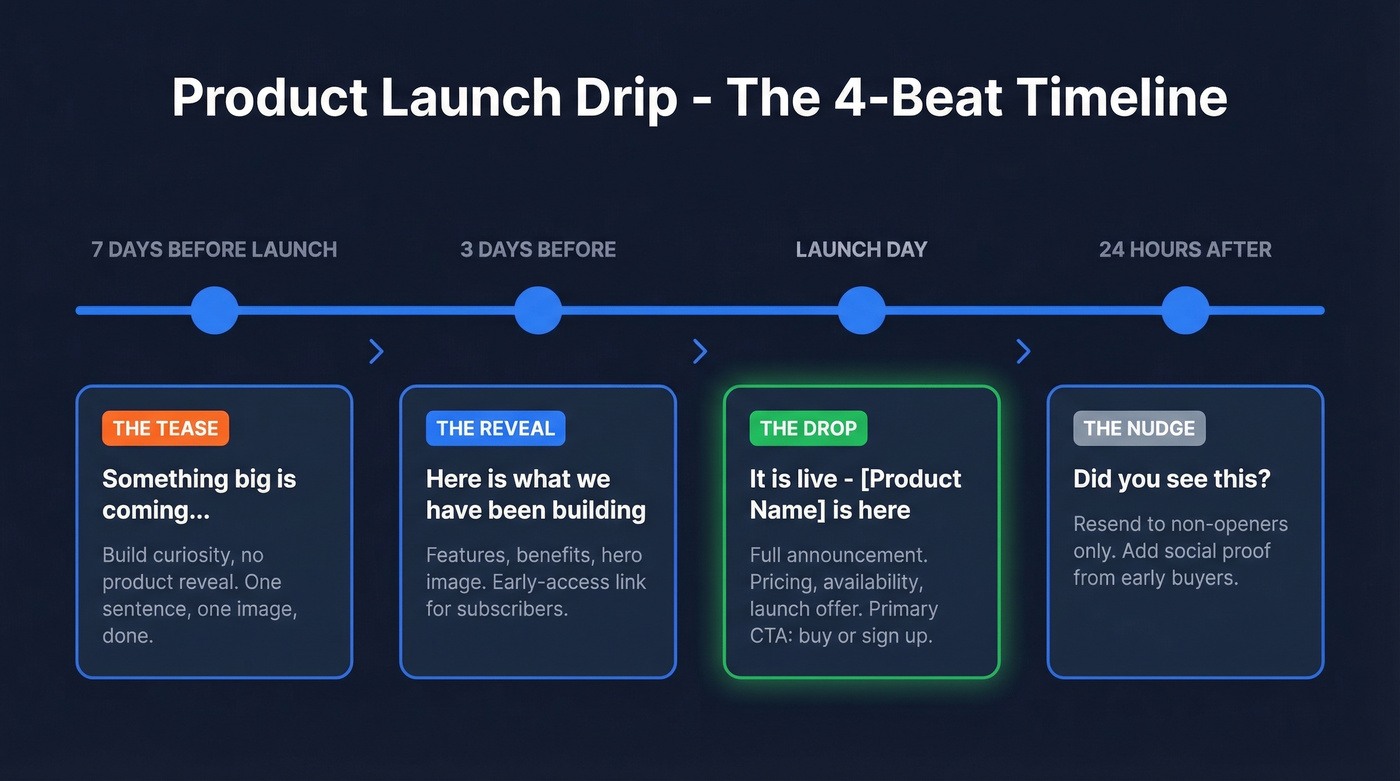
7 days out - The Tease. Subject: Something big is coming... Build curiosity without revealing the product. "Mark your calendar for [Date]." One sentence, one image, done.
3 days out - The Reveal. Subject: Here's what we've been building. Features, benefits, one hero image. Early-access link for subscribers.
Launch day - The Drop. Subject: It's live - [Product Name] is here. Full announcement. Pricing, availability, launch offer. Primary CTA: buy or sign up.
24 hours later - The Nudge. Subject: Did you see this? Resend to non-openers only. Add social proof from early buyers.
B2B Cold Outbound
This is where most automated sequences fail - not because the copy is bad, but because the data is.
Email 1 - Day 0 (personalized intro):
Subject: Congrats on [trigger - promotion, funding, new role]
Body: "Hey [First Name], saw [specific trigger]. At [Your Company], we help [role] at [company type] solve [pain point]. Worth a 15-minute call this week?"
Email 2 - Day 3 (social proof):
Subject: How [Similar Company] increased pipeline by [X]%
Body: One-paragraph case study. Specific numbers.
Email 3 - Day 7 (value offer):
Subject: Free [resource/audit/sample] for [Company]
Body: Offer something tangible. Lower the commitment bar.
Email 4 - Day 12 (breakup):
Subject: Should I close your file?
Body: "If [pain point] isn't a priority right now, no worries - I'll stop reaching out. But if timing changes, here's my calendar link."
This structure uses PAS and value-first frameworks and avoids the "generic pitch" trap. Personalization in Email 1 isn't optional - a Reddit benchmark put a 3-step personalized sequence at a 5.7% reply rate, compared to sub-2% on templated blasts.
The sequence fails if your emails bounce. High bounce rates waste sends, hurt sender reputation, and drag future deliverability down with it. We've watched teams build beautiful 4-email outbound sequences only to torch their domain because 15% of the list was invalid. Verify every address before loading contacts into your sequencer. Tools like Prospeo check emails in real time with 98% accuracy and catch spam traps and catch-all domains at roughly $0.01 per email - cheaper than the domain reputation damage from a single bad campaign.
If you want a longer version of this flow, start with a proven B2B cold email sequence and adapt the offer.
SaaS Trial-to-Paid
Every email should push the user toward the "aha moment." For high-intent signups like demo requests or hand-raisers, compress to daily sends for the first 5 days.
Email 1 - Immediately after trial start:
Subject: Your [Product] trial is live - start here
Body: One quick-win action. "Do this in the next 5 minutes and you'll see [benefit]."
Email 2 - Day 2:
Subject: 3 things power users do in their first week
Body: Tips that drive feature adoption. Link to help docs or a short video.
Email 3 - Day 4:
Subject: [First Name], you're invited
Body: Invite to a live onboarding session or community.
Email 4 - Day 7:
Subject: How [Customer] got [Result] with [Product]
Body: Success story from a similar user.
Email 5 - Day 10:
Subject: Your trial ends in [X] days
Body: Reminder with upgrade CTA. Highlight what they'll lose.
Email 6 - Day 13:
Subject: Last day to keep your [Product] account
Body: Final push. Optional: limited-time discount for engaged users.
Industry-Specific Adjustments
The templates above work across verticals, but small adjustments make a real difference.
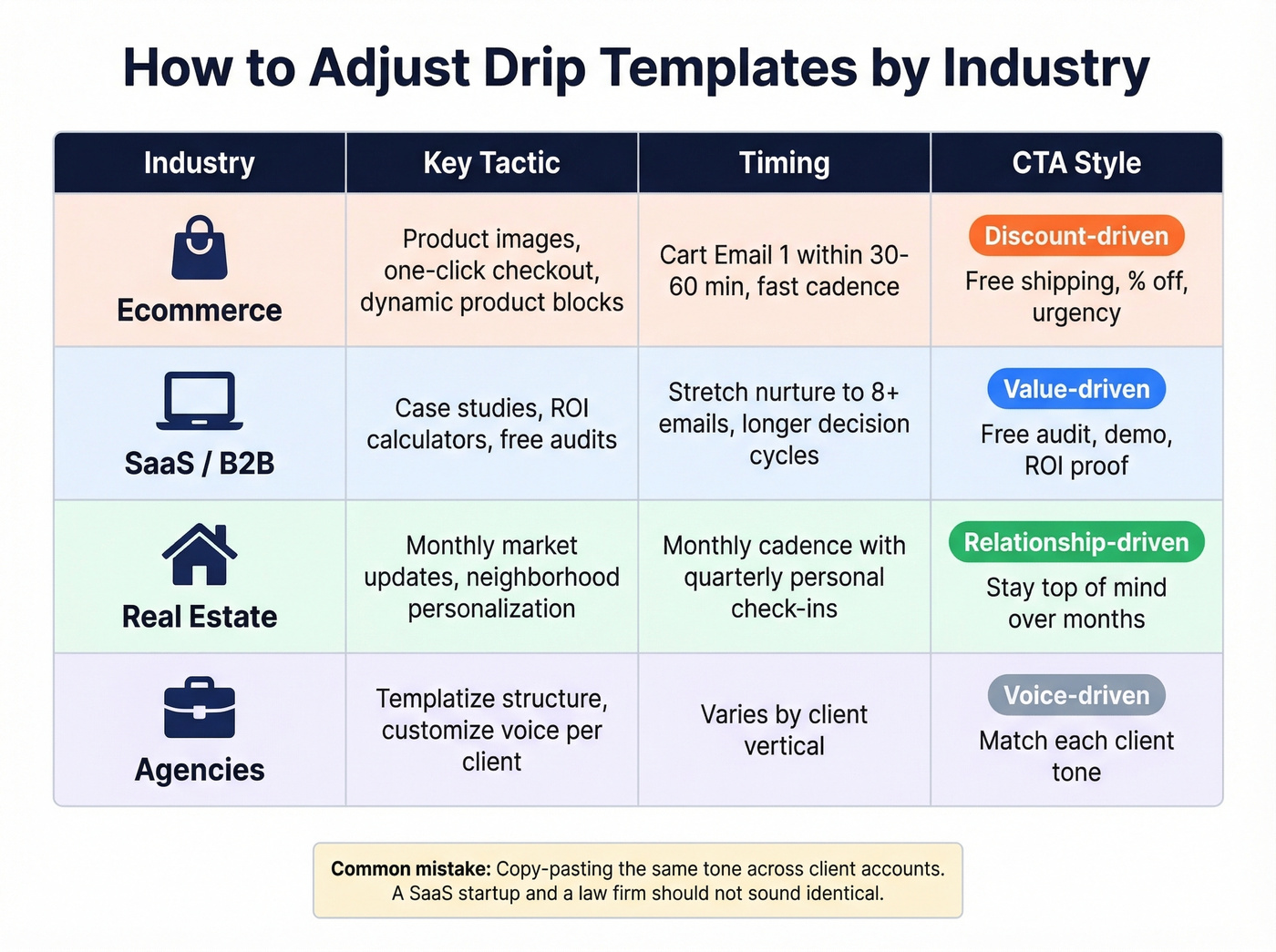
Ecommerce: Lean hard on product images and one-click checkout links. Your abandoned cart Email 1 should fire within 30-60 minutes - not an hour later. Include dynamic product blocks showing the exact items left behind, and keep copy short because these buyers aren't reading essays.
SaaS / B2B: Replace discount-based CTAs with value-based ones like free audits, ROI calculators, and case studies. Your nurture sequence can stretch to 8 emails since B2B buyers have longer decision cycles and need more touches before they're ready to talk to sales.
Real estate: Drip campaigns here are about staying top-of-mind over months, not days. A monthly market update paired with a quarterly personal check-in is a strong default. Personalize by neighborhood or price range.
Agencies: If you're running drips for clients, templatize the structure but customize the voice. One common mistake we see is copy-pasting the same tone across multiple client accounts - a SaaS startup and a law firm shouldn't sound identical, even if the sequence architecture is the same.

That cold outbound template above? It only works if the email actually reaches someone. 35% bounce rates kill drip campaigns before they start. Prospeo delivers 98% email accuracy with 5-step verification - so your sequences land in real inboxes, not spam traps.
Stop writing perfect drip copy for addresses that bounce.
Planning Your Sequence Architecture
Templates are the easy part. The sequence architecture is what separates drip campaigns that convert from ones that annoy.
Before you touch your email tool, map these elements. Start with your entry trigger - the action that starts the sequence. Form submit, cart abandon, trial signup, manual list upload. Then define your exit conditions: when does someone leave the drip? After purchase? After booking a demo? After opening zero emails across the full sequence?
Next, build your branching logic. If they open Email 2 but don't click, do they get a different Email 3? If they visit the pricing page mid-sequence, do they skip ahead to the conversion ask? These conditional paths are where the real lift comes from, and they're the piece most teams skip because they feel complicated - but even one branch point per sequence can double your conversion rate compared to a linear drip.
Set suppression rules. Never drip someone who already converted. Never drip someone in an active sales conversation. Sounds obvious - gets missed constantly. For cadence, 6-8 emails per drip is typical. B2B sends default to Tue/Wed/Thu at 10am local time, then test from there. Define your success metric before launch: demo bookings, purchases, reply rate.
If deliverability is a priority, use an email deliverability guide and monitor your email bounce rate as a leading indicator.

2026 Benchmarks for Drip Campaigns
Stop obsessing over open rates. Apple Mail Privacy Protection inflates them, and they're less reliable than they used to be. Click rate and conversion rate are the two metrics worth tracking.
| Metric | One-Off Campaigns | Automated Flows |
|---|---|---|
| Click rate | 1.69% | 5.58% (3.3x higher) |
| Order rate | 0.16% | 2.11% (13x higher) |
Data from Klaviyo across 183K+ brands. Open rates excluded due to Apple MPP inflation.
Automated flows generate 13x higher order rates than one-off campaigns. That's the entire case for drip sequences in one number.
If you want to calculate and diagnose performance, use a clear click rate formula and track it per segment.
MailerLite's benchmarks across 3.6M campaigns show overall averages of 43.46% open rate and 2.09% click rate, with significant industry variation: ecommerce averages 32.67% open and 1.07% click, nonprofits hit 52.38% open and 2.90% click, and software sits at 39.31% open and 1.15% click.
One trend worth watching: unsubscribe rates jumped from 0.08% to 0.22% year-over-year. That's not because emails got worse - Gmail UI changes made opting out frictionless. Healthy list hygiene, not a red flag.
Let's be honest about something: if your average deal size is under $10K, you probably don't need a 12-email nurture sequence. Three to five well-timed emails with strong CTAs will outperform a bloated drip that loses people by Email 7. Complexity isn't a strategy.
Best Tools for Drip Campaigns
| Tool | Free Tier | Paid From | Best For |
|---|---|---|---|
| Brevo | 300 emails/day | $9/mo | Startups, tightest budget |
| MailerLite | 500 contacts | $10/mo | Clean UI, simple flows |
| Mailchimp | 500 contacts | $13/mo | First-time email marketers |
| ActiveCampaign | - | $15/mo | Advanced automation logic |
| Omnisend | Yes | $16/mo | Ecommerce under $20/mo |
| Freshmarketer | Yes | $18/mo | CRM-native workflows |
| Klaviyo | Yes | $20/mo | Ecommerce, Shopify-first |
| Kit | 10,000 contacts | $39/mo | Creators, newsletters |
| Mailmodo | Yes | $49/mo | Interactive AMP emails |
Pricing via Zapier's roundup
Our opinionated picks: Startup on a budget? Brevo. The free tier is genuinely useful, and deliverability is solid. Ecommerce? Klaviyo if you can afford it - the Shopify integration is unmatched. Omnisend if you can't. Need serious automation logic? ActiveCampaign, but brace for the learning curve. The consensus on r/MarketingAutomation is that ActiveCampaign's pricing ramps fast with contact count, and Klaviyo feels overpriced outside pure ecommerce. Brevo keeps getting recommended as the cost-effective all-rounder.
If you're sending outbound drips, consider dedicated follow up email software instead of forcing it into a newsletter ESP.
Skip Mailchimp if you're past the "I've never sent an email campaign" stage. Its automation builder hasn't kept pace with the competition, and you'll outgrow it fast.
Mistakes That Kill Your Sequences
Missing the welcome window. Peak engagement happens in the first 15 minutes after signup. If your welcome email fires an hour later, you've already lost momentum. Set it to immediate.
Email + SMS overlap. Don't hit both channels simultaneously. Delay SMS by 6-12 hours and condition it on whether they opened the email. Double-tapping feels aggressive.
Too many emails too fast. Three emails in two days is a fast track to the spam folder. Space marketing drips 2-3 days apart minimum.
Launch and disappear. We've seen teams build a 6-email nurture sequence, launch it, and never look at it again. Run weekly metric checks and a quarterly workflow audit. Refresh content every 6 months at minimum - stale copy and outdated links erode trust quietly.
Poor segmentation. Sending the same drip to a trial user and a paying customer wastes both their time and yours. Segment by lifecycle stage at minimum. If you need a starting point, build an ideal customer profile and segment from there.
Ignoring metrics. If your click rate is below 1% after 1,000 sends, something's broken. A/B test subject lines and CTAs - run tests for 24-48 hours before reading results.
Bad contact data. This one's silent and deadly. Invalid emails bounce, bounces hurt sender reputation, and damaged reputation means your good emails land in spam too. Verify your list before launching any sequence.
If you're scaling outbound, use a dedicated email reputation tool and keep your email velocity under control.
Every drip template on this page needs one thing: verified contact data behind it. Prospeo gives you 300M+ profiles with 30+ filters - buyer intent, job changes, technographics - so your sequences reach the right person at the right moment. At $0.01 per email, bad data is no longer an excuse.
Build the list that makes these templates actually convert.
FAQ
How many emails should a drip campaign include?
Most drip campaigns run 3-8 emails depending on the use case. Welcome series work best at 3-5 emails, cold outbound at 4-5, and nurture sequences can stretch to 6-8. More than 8 rarely improves conversion - it just increases unsubscribes.
How far apart should drip emails be spaced?
Space marketing drips 2-3 days apart as a default. For high-intent signups like trial activations or demo requests, compress to daily sends. Cart abandonment emails can fire hourly, while educational nurtures need breathing room.
What's a good click rate for automated flows?
Automated flows average a 5.58% click rate across 183,000+ brands on Klaviyo. Anything above 3% is solid for most industries. Below 1.5% means your content or segmentation needs work - click rate matters more than open rate in 2026 since opens are inflated by Apple MPP.
Do drip campaigns still work in 2026?
Automated flows generate 13x higher order rates than one-off campaigns and 3.3x higher click rates. The ROI case is stronger than ever - the tools are cheaper, the automation is smarter, and the benchmarks keep improving year over year.
How do I keep cold outbound drips from bouncing?
Verify every email before it enters your sequence - aim for under 3% bounce rate. Anything higher risks your sender domain getting flagged by inbox providers. Real-time verification catches invalid addresses, catch-all domains, and spam traps before they damage deliverability.